

Cross-channel marketing attribution is all about figuring out which of your marketing efforts are actually working.Instead of just giving all the credit to the very last thing a customer clicked, it helps you see how channels like social media, search ads, email, and influencer posts all work together to land a sale.
Why Your Old Marketing Metrics Are Failing You

Ever get that nagging feeling you’re just guessing where your best customers are really coming from? You're not alone. The modern customer journey isn't a straight line anymore; it's a messy, winding path that weaves across a dozen different platforms and devices.
Think about planning a vacation. You might see a stunning photo of a beach on an influencer's Instagram feed. A week later, you find yourself reading a travel blog that reviews the best local hotels. Then, an email with a 24-hour flash sale finally pushes you to book the trip.
So, who gets the credit? The email that closed the deal? The helpful blog post? Or that first Instagram post that planted the idea in your head?
If you're stuck on a last-click attribution model, you’d give 100% of the credit to that final email. This completely ignores the critical role Instagram and the blog played in getting you there. That’s the core problem with outdated measurement—it only shows you where the journey ended, not how it started or the crucial steps in between.
The Problem With A Siloed View
When you measure each channel in a vacuum, you end up making big decisions with only a fraction of the story. You might slash the budget for what looks like a low-performing, top-of-funnel channel, not realizing it's the very thing introducing you to your most valuable customers. To really get a handle on this, it's worth understanding what cross-channel marketing truly entails, because it highlights exactly where those old metrics fall apart.
Cross-channel marketing attribution is the framework that solves this puzzle. It’s how you give credit where credit is due across every single touchpoint, piecing together the full, interconnected picture of what drives your business forward.
This isn’t just a nice-to-have anymore; it's essential. Instead of single-touch models that dump all the credit on the first or last interaction, a proper cross-channel view distributes it across the entire customer journey. This lets you allocate your budget with confidence and fine-tune your strategy based on what's truly effective.
Ultimately, it’s about moving from guesswork to informed decisions. It ensures every marketing dollar you spend is pulling its weight. You can see how this detailed perspective feeds into other key digital marketing performance metrics that matter.
Choosing the Right Attribution Model
Picking the right cross channel marketing attribution model feels a lot like choosing the right lens for a camera. Each one shows you the same scene—your customer’s journey—but from a completely different perspective. The model you land on will directly shape which marketing channels get the credit, where your budget goes, and ultimately, how you define success.
There's no single "best" model that works for every business out there. The right choice really hinges on your typical sales cycle, your specific business goals, and the questions you're trying to answer. Let’s walk through the most common models, from the dead simple to the more sophisticated, so you can find the perfect fit.
H3: Single-Touch Attribution Models
These are the most straightforward models because they give 100% of the conversion credit to just one touchpoint. They're easy to set up, but they only tell a tiny part of the story.
- First-Touch Attribution: This model gives all the glory to the very first interaction a customer had with your brand. Think of it as rewarding the channel that first opened the door.
- Last-Touch Attribution: On the flip side, this one gives all the credit to the final touchpoint right before the customer converted. It celebrates the channel that closed the deal.
While simple, both models have massive blind spots. First-touch completely ignores all the hard work your other channels did to nurture that lead, while last-touch has no idea what brought the customer to you in the first place.
H3: Multi-Touch Attribution Models
This is where things get more interesting. Multi-touch models recognize that a conversion is a team effort and work by spreading the credit across multiple touchpoints. This gives you a much more balanced and realistic view of what’s actually working.
Linear Model
The linear model is the ultimate diplomat. It splits the credit equally among every single touchpoint on the customer’s path. If someone saw a Facebook ad, read a blog post, clicked a Google search result, and then opened an email before buying, each of those four channels gets exactly 25% of the credit.
Best For: Companies that want a solid, baseline understanding of all the channels that play a role. It’s a great starting point for seeing the entire journey without playing favorites.
Time-Decay Model
This model works on a simple premise: the closer an interaction is to the sale, the more important it was. It gives progressively more credit to the touchpoints that happened nearer to the conversion. An email clicked yesterday gets far more weight than a blog post they read three weeks ago.
U-Shaped (Position-Based) Model
The U-shaped model focuses on two pivotal moments: the first touch (the introduction) and the lead conversion touch (the moment they officially became a lead). It typically assigns 40% of the credit to that first interaction, another 40% to the moment they became a qualified lead, and then sprinkles the remaining 20% across all the touchpoints in between.
This infographic does a fantastic job of showing how each model divvies up the credit.
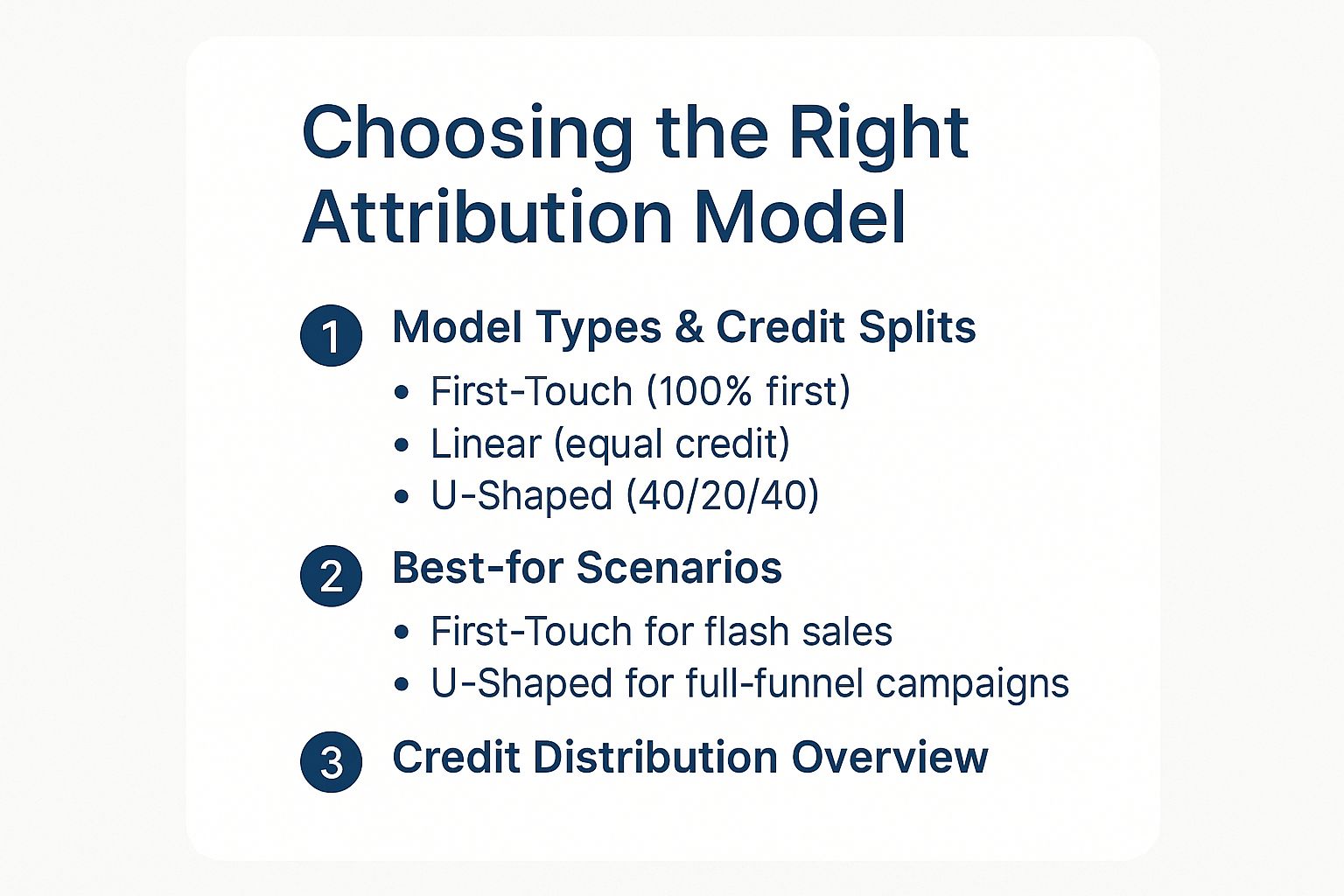
As you can see, the model you choose dramatically changes which channels look like heroes, which is why it's so important to align your choice with what you're trying to achieve.
H3: Making the Right Choice for Your Business
So, with all these options, how do you actually decide? It all comes back to your customer journey and your campaign goals.
- For Brand Awareness Goals: If your main objective is to fill the top of your funnel and see how people are discovering you, a First-Touch model is incredibly useful.
- For Short Sales Cycles: Running a quick campaign, like a 24-hour flash sale? A Last-Touch model can work well here, as it clearly shows what pushed people to take immediate action.
- For Nurturing-Heavy Funnels: If you have a longer sales process that relies on building a relationship over time, a U-Shaped or Time-Decay model will give you a much more accurate picture by valuing both the first impression and the crucial later steps.
At the end of the day, the goal isn't just to pick one model and stick with it forever. The real insight comes from testing and comparing different models to get a complete, 360-degree view of your marketing efforts. To go back to the basics, check out our guide on what is marketing attribution for a deeper dive.
Navigating Common Attribution Hurdles

Putting cross channel marketing attribution into practice is where the theory gets messy. You can have the most sophisticated attribution model on the planet, but it’s completely useless if the data you're feeding it is incomplete, disconnected, or just plain wrong. This is, without a doubt, the single biggest challenge marketers run into.
Think of it like trying to assemble a puzzle with pieces from five different boxes. That’s what happens when your data is locked away in separate silos. Your CRM tells one part of the story, your social media ads another, and your email platform and website analytics add their own unique twists. This data fragmentation can completely derail your efforts, leading to bad decisions and a lot of wasted money.
The reality is, getting all your data to play nicely together is the top barrier to measuring marketing effectively. The average marketing tech stack now includes 17 to 20 separate platforms, so it's almost a given that you'll be dealing with fragmented data. This complexity means attribution models often fail not because the model is flawed, but because it’s built on a shaky data foundation. You can dive deeper into these issues by reading the full 2025 State of Marketing Attribution Report.
Building a Foundation of Clean Data
Before you can even think about assigning credit for a sale, you need a single, reliable source of truth. The whole point is to stitch together all those scattered data streams into one clear picture of the customer journey. Otherwise, you’re just guessing.
A clean data foundation isn't optional; it's the bedrock of any successful attribution strategy. Here’s how to start building it:
- Standardize Your UTM Tracking: This is non-negotiable. Create a strict, consistent system for UTM parameters for every single campaign. This simple step ensures every click can be traced back to its specific source, medium, and campaign, saving your data from the black hole of "direct" or "referral" traffic.
- Audit Your Data Sources: Make it a habit to regularly review the data coming from each platform. Hunt for inconsistencies, gaps, or duplicates that are throwing off your numbers.
- Integrate Your Tools: The best solution is to use a central platform to pull everything together. A powerful marketing dashboard software can act as that central hub, connecting your CRM, ad platforms, and analytics to give you that all-important single source of truth.
Your attribution is only as good as the data you feed it. Prioritizing data hygiene isn't just a best practice; it's a prerequisite for any meaningful analysis.
Unifying Teams for a Unified View
Tech alone won't break down data silos. More often than not, the biggest hurdles are organizational. Your marketing, sales, IT, and data analytics teams need to be talking to each other constantly.
Every department holds a critical piece of the attribution puzzle.
- Marketing Team: They know the campaign strategy, the quirks of each channel, and what the customer journey is supposed to look like.
- IT and Data Teams: These are the people who manage the technical plumbing, ensure the data is clean, and handle the nitty-gritty of integrating different tools.
- Sales Team: They provide the ground truth. Their feedback on lead quality is invaluable for confirming which channels are actually delivering customers, not just clicks.
When these teams work together, they can build and maintain a data ecosystem that truly reflects how customers interact with your brand. This kind of cross-departmental teamwork is what turns attribution data from a bunch of numbers into smart, actionable business decisions.
See Attribution in Action with a Real-World Scenario

The theory behind attribution models is great, but let's be honest—it all comes together when you see it play out in the real world. So, let’s leave the abstract concepts behind for a moment and walk through a story that shows how cross channel marketing attribution can uncover the real heroes in your marketing mix.
Picture a new direct-to-consumer brand, "SoleStride," that's about to drop a new line of eco-friendly sneakers. Their target audience is millennials who care about style and sustainability, so they’ve mapped out a campaign that hits all the right notes to grab their attention.
This isn't a "spray and pray" effort. It's a carefully planned sequence designed to guide people from "what's this?" to "I need this."
The Campaign Rollout
SoleStride knows their customer doesn't just live in one place online. They've built a journey that meets their audience at different stages of their decision-making process.
Here's a breakdown of their plan:
- Influencer Collab (TikTok): They kick things off by partnering with a popular sustainable fashion influencer. The goal is simple: an engaging unboxing video to generate that initial buzz and get the brand on people's radar.
- Targeted Facebook Ads: Anyone who engaged with the influencer’s video or visited SoleStride's profile gets retargeted with dynamic ads on Facebook. It's the perfect way to stay top-of-mind.
- High-Intent Google Ads: To capture people who are actively shopping, they run search ads for keywords like "sustainable running shoes" and "eco-friendly sneakers for women."
- Promotional Email: To seal the deal, they send an email to their subscriber list with a can't-miss 15% discount, creating a sense of urgency to drive those final sales.
Now, let's follow a potential customer, Sarah, and see how different attribution models would credit each of these touchpoints.
Uncovering the Hidden Story of a Sale
Sarah's journey begins as she's idly scrolling TikTok. She sees her favorite influencer raving about the new SoleStride sneakers. She's intrigued, clicks the link, but gets distracted and moves on. A few days later, a Facebook ad pops up in her feed, reminding her of the cool shoes. This time, she adds a pair to her cart but again, doesn't complete the purchase.
Fast forward a week. Sarah decides she really needs new sneakers. She Googles "best eco-friendly sneakers," and there it is—a SoleStride ad. She clicks, browses again, but still isn't quite ready to pull the trigger. The next morning, an email hits her inbox: "15% Off Ends Tonight!" That's all it takes. She clicks through and buys the shoes.
With a last-click model, that promotional email would get 100% of the credit. It looks like the undisputed champion, while every other channel—TikTok, Facebook, Google—looks like a complete waste of money.
And that's the trap. A marketing manager looking at that data might slash the budget for influencer marketing and social ads, thinking they aren't working. They'd be completely wrong.
How a Multi-Touch Model Reveals the Truth
Let's rewind and look at Sarah's journey again, but this time through the lens of a multi-touch model, like a U-shaped one. The story it tells is completely different.
- The First Touch (TikTok): The influencer video gets 40% of the credit. It was the spark. Without it, Sarah would have never known SoleStride existed.
- The Nurturing Touches (Facebook & Google): The Facebook and Google ads split the middle 20% of the credit. These touchpoints were crucial for keeping the brand on her radar and bringing her back when she was closer to buying.
- The Conversion Touch (Email): The final email that drove the purchase gets the other 40% of the credit. It was the final, decisive nudge she needed.
This cross channel marketing attribution analysis paints a much richer, more accurate picture. It shows that every channel played a critical role in a larger story. The influencer created awareness, the ads nurtured her interest, and the email closed the deal. It wasn't one channel that made the sale; it was the symphony of all of them working together.
How Smart Attribution Impacts Your Bottom Line
Understanding the customer journey is one thing, but connecting that knowledge to real financial results is where cross-channel marketing attribution truly proves its worth. It’s the essential link between your data and your bottom line, changing how you measure success from vague impressions to hard numbers like Return on Investment (ROI) and Return on Ad Spend (ROAS).
When you can finally see exactly which touchpoints are pushing customers toward a purchase, you can stop making budget decisions based on gut feelings. You gain the power to make surgical adjustments, confidently moving money away from channels that just bring in clicks and pouring it into the ones that consistently deliver paying customers.
With this data-driven clarity, you can justify every single dollar. It’s no longer about defending your marketing budget; it’s about proving its direct impact on revenue growth.
Measuring Channel Synergy and Incremental Value
One of the biggest wins with smart attribution is seeing how your channels work together. For example, you might find that an SMS campaign doesn't directly convert many people, but it drives a 20% lift in conversions from a follow-up email. A simplistic last-click model would completely overlook this powerful teamwork.
This is where more sophisticated attribution models come into play. Methods like Markov chains, for instance, help you figure out the incremental value each channel adds to the mix.
Think of the customer journey as a series of steps. A Markov chain calculates the probability of a customer moving from one step (like seeing a Facebook ad) to the next (making a purchase). More importantly, it can show what happens if you remove one of those steps. This lets you answer crucial business questions:
- How many conversions would we actually lose if we paused our Google Ads?
- What’s the real value of our mid-funnel influencer campaign?
- Is our blog actually helping drive sales, or is it just bringing in traffic?
By putting a number on this incremental impact, you can finally prove the value of every marketing activity, even the ones that don't get the final click.
Smart attribution isn’t just about giving credit; it’s about understanding the probability of success. It predicts the financial outcome of your marketing mix, allowing you to optimize for maximum revenue.
Boosting ROAS with a Unified View
At the end of the day, the goal is to make every marketing dollar work harder. When you’re stuck looking at each channel in its own silo, you're almost guaranteed to waste money. You end up investing in channels that look good on paper but don’t contribute to the bigger picture.
On the flip side, companies that adopt a unified strategy see major gains. In fact, research shows businesses using cross-channel marketing achieve a 13% higher ROAS compared to those stuck with siloed approaches. Advanced cross-channel marketing attribution models, like Markov chains and the Shapley value, are becoming mission-critical for understanding the true influence of each touchpoint. You can discover more insights about cross-channel marketing statistics on amraandelma.com.
This isn't just a small tweak. It represents the shift from a marketing budget that feels like an expense to one that acts as a predictable, revenue-generating engine for your business. When you can connect every action to a financial result, you turn marketing from a cost center into a true driver of growth.
Common Questions About Marketing Attribution
Even after you've got a handle on the models and potential roadblocks, a few practical questions always pop up when it's time to get your hands dirty. Diving into cross channel marketing attribution can feel overwhelming at first, but if you break it down, it's a lot more manageable. Here are some straight answers to the questions we hear most often.
Think of this as your quick-start guide—a way to firm up the core concepts and give you a clear path forward with confidence.
Which Attribution Model Is Best for My Business?
The honest answer? It really depends on your sales cycle, your goals, and what you’re actually trying to figure out. There’s no magic bullet model that works for everyone.
- Short Sales Cycles: If customers make decisions fast—think flash sales or impulse buys—a simple Last-Touch model can give you what you need.
- Awareness Goals: Trying to see how people first discover you? A First-Touch model is great for those top-of-funnel insights.
- Complex Journeys: For most businesses, the customer's path is more winding. A multi-touch model like Linear or Time-Decay will give you a much more balanced and realistic picture.
A great place to start is by mapping out your typical customer journey. From there, you can pick a model that mirrors how you believe your marketing efforts actually guide a customer toward a purchase. And for anyone serious about mastering cross-channel strategy, truly understanding what attribution modeling is is the foundation for making smart decisions.
What Are the First Steps to Implement Attribution?
Before you do anything else, you absolutely must get your data tracking in order. If your data is messy or inconsistent, any model you apply will be basically useless.
- Audit Your Tracking: Go through all your tracking scripts—like the Meta Pixel or Google tags—and make sure they’re installed correctly and firing on every single page.
- Standardize UTMs: This is non-negotiable. Create a strict, standardized system for using UTM parameters on every single link you put out there. This is how you trace traffic back to its source.
- Choose a Central Hub: You need one place to bring all this data together. Whether it’s Google Analytics 4 or a specialized attribution tool, pick a platform to be your single source of truth.
Once that's done, start with a straightforward model like Linear to get a baseline. You can always get fancier later, after you're confident your data is solid.
A great trick is to compare different models. Pitting a Last-Touch model against a Linear one can suddenly reveal the hidden influence of your top-of-funnel channels—the ones that build awareness but rarely get credit for the final sale.
How Does Attribution Account for Offline Channels?
Tracking offline marketing like print ads, radio spots, or event sponsorships is tricky, but definitely not impossible. The trick is to build a digital bridge that connects the physical world to your online analytics.
Here are a few proven ways to do it:
- Unique Promo Codes: Create a specific discount code for each campaign, like "PODCAST15" for a podcast ad.
- Vanity URLs: Use a simple, memorable URL in your print ad or on a billboard that redirects to a landing page with tracking (e.g., YourBrand.com/Offer).
- Dedicated Phone Numbers: Call-tracking software lets you assign a unique phone number to each offline channel, so you know where your calls are coming from.
- Post-Purchase Surveys: Sometimes the easiest way is just to ask. A simple "How did you hear about us?" question at checkout can fill in a lot of gaps.
By feeding this information back into your analytics platform, you start to see a complete, accurate picture of the entire customer journey, both online and off.
Ready to stop guessing and start proving the ROI of your influencer campaigns? REACH provides the centralized dashboard you need to track every click, measure performance in real-time, and make data-driven decisions. See how our advanced analytics can transform your influencer marketing at https://reach-influencers.com.