
At its core, calculating your Customer Acquisition Cost (CAC) is pretty straightforward: you take all your sales and marketing expenses over a certain timeframe and divide that by the number of new customers you brought in during that same period. This simple formula gives you a critical health metric, revealing exactly how much you're spending to win over each new customer. Getting this number right is the bedrock of building a business that’s not just growing, but profitable and sustainable for the long haul.
Why Your True Customer Acquisition Cost Matters

It’s easy to get caught up tracking vanity metrics like website traffic or social media followers, but those numbers don't pay the bills. The real cost of winning a customer is one of the truest indicators of your company's health, and it has a direct ripple effect on everything from your immediate profitability to your long-term viability.
Without a firm handle on this figure, you’re basically flying blind. You can't be sure if your marketing campaigns are actually making money, if your pricing is sustainable, or if your business model is even remotely attractive to investors. Understanding your CAC is the first real step toward smart, strategic growth.
The Real Cost of Growth
When you have a precise CAC, you get a clear-eyed view of how efficiently your business is running. It helps you finally answer those nagging, essential questions:
- Is our marketing budget actually working? You can finally pinpoint which channels are giving you a positive return and which ones are just a money pit.
- Can we really afford to scale up? You’ll know exactly how much cash you need to hit your growth targets without breaking the bank.
- Is our pricing strategy on the right track? This is how you ensure a customer's lifetime value is high enough to justify the cost of acquiring them in the first place.
The stakes get even higher when you compare acquisition to retention. Research consistently shows it can cost anywhere from 5 to 25 times more to land a new customer than to keep an existing one. Despite this, a startling 44% of businesses focus primarily on acquisition, while only 18% prioritize retention. You can dive deeper into these and other customer acquisition statistics to see the full picture.
Knowing your CAC isn't just an accounting exercise—it's a strategic imperative. It's the difference between just spending money and investing it wisely for predictable, profitable growth.
Uncovering Hidden Expenses
One of the most common mistakes I see is businesses only counting the obvious costs, like their monthly ad spend. For a truly accurate number, you need what’s called a "fully-loaded" CAC, which includes all the related expenses. You'd be surprised by how many significant costs get overlooked, artificially lowering your CAC and giving you a false sense of security.
The salaries for your marketing and sales teams are a perfect example. A portion of their time is dedicated to acquiring new customers, and that cost needs to be in your calculation. The same goes for all the tools in your tech stack—your CRM, marketing automation platforms, and analytics software all contribute to the final number.
To get a truly accurate picture of your acquisition spend, it's crucial to account for every dollar. Here's a breakdown of the typical costs you need to roll into your calculation.
Key Components of Your Total Acquisition Spend
| Cost Category | Description & Examples |
|---|---|
| Ad Spend | Direct costs for paid advertising campaigns. Examples: Google Ads, social media ads (Facebook, LinkedIn), sponsored content, and influencer marketing fees. |
| Salaries & Wages | The portion of salaries for your marketing and sales teams dedicated to customer acquisition. Includes base pay, commissions, and bonuses. |
| Content Creation | Costs associated with producing marketing materials. Examples: Freelance writer fees, graphic designer payments, video production costs, and stock photo subscriptions. |
| Software & Tools | Monthly or annual subscription fees for the technology used to attract and convert customers. Examples: HubSpot, Salesforce, SEMrush, email marketing platforms. |
| Overhead & Other | Miscellaneous marketing and sales-related expenses. Examples: Agency fees, costs for attending trade shows, or expenses for producing marketing events. |
By meticulously tracking and including these components, you build a reliable financial foundation. Only then can you start making genuinely smart decisions that drive sustainable growth.
The No-Nonsense Formula for Calculating CAC
At its core, calculating your Customer Acquisition Cost is surprisingly straightforward. It's a single, powerful number that tells you how efficient you are at bringing in new business. You don’t need an MBA to figure it out.
The basic formula is simply this:
Customer Acquisition Cost (CAC) = Total Marketing & Sales Costs / Number of New Customers Acquired
This calculation shows you exactly how much, on average, you spent to win each new customer over a specific period. The real trick, though, is getting the details right—what counts as a "Total Cost" and how you define a "New Customer."
This visual breaks down the process into three clear steps.
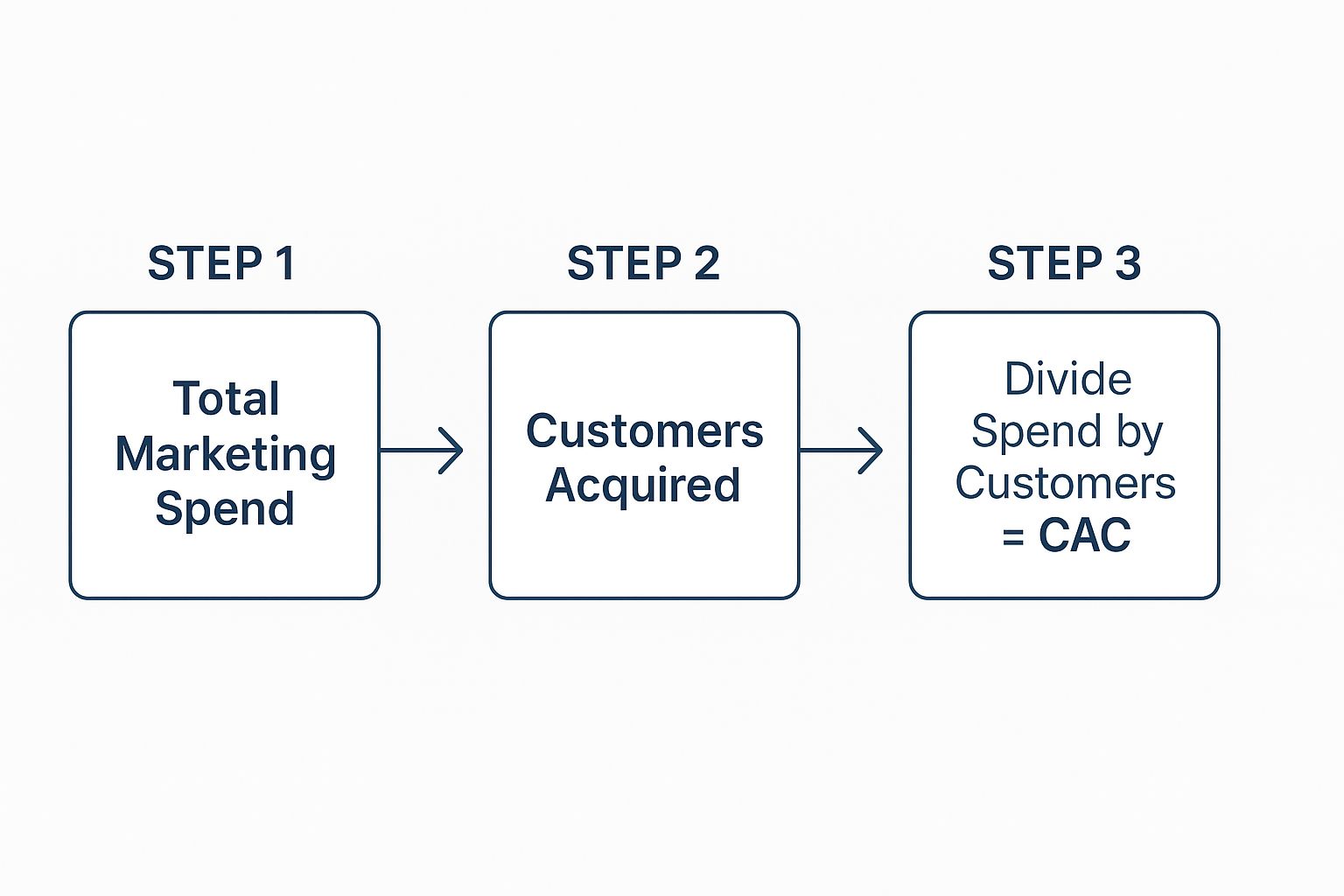
As you can see, the flow is logical: add up all your related expenses, count the new customers from that same period, and then do the final division.
Defining Your Total Costs
To get a truly useful CAC, you need what’s called a “fully loaded” approach. This means you have to include every single dollar spent on your acquisition efforts—not just the obvious stuff like ad spend. I’ve seen countless companies make the mistake of overlooking costs, which leads to a dangerously optimistic (and wrong) CAC.
Your total costs should cover everything:
- Salaries and Commissions: This includes the portion of salaries for your marketing and sales teams that are focused on winning new business.
- Ad Spend: All the money you put into paid channels like Google Ads, social media campaigns, and sponsored content.
- Content & Creative Costs: Think payments to freelancers, designers, or agencies for creating your marketing assets. This also includes influencer fees. If you're working with creators, it’s worth learning https://reach-influencers.com/how-do-you-calculate-emv/ to better grasp the full impact of a campaign.
- Software and Tools: Don't forget subscription costs for your CRM, marketing automation platforms, analytics tools, and any other tech that supports your acquisition funnel.
- Overhead Expenses: A slice of general business overhead that can be tied back to your sales and marketing activities.
If you want a more detailed guide on these components, you can learn how to accurately perform customer acquisition cost calculation. Adding up all these expenses gives you the true "cost" half of the equation.
Pinpointing New Customers and Timeframes
Next up, you have to count the number of net new customers you brought in during the exact same period as your costs. This is absolutely critical for an apples-to-apples comparison. You can't use your Q1 costs and divide by the customers you signed in May; the timeframes must align perfectly.
Should you do this monthly or quarterly? It really depends on your sales cycle. A fast-moving ecommerce brand might run its CAC numbers every month. On the other hand, a B2B SaaS company with a much longer sales process will probably get a clearer picture by looking at it quarterly. The most important thing is to be consistent so you can actually track trends over time.
Let's See How CAC Works in the Real World

This is where the rubber meets the road. Knowing the customer acquisition cost calculation is one thing, but applying it is where you really start to see its power. Let’s walk through two very different business models to see how the numbers truly tell a story.
You'll notice how the expenses that get factored into the equation shift depending on the business type and its strategy. The final number is just the starting point—it's how you interpret that number in context that leads to smarter decisions.
Scenario 1: The B2B SaaS Company
Imagine a B2B software company trying to figure out its CAC for the second quarter (Q2). For a business like this, where sales cycles can drag on for months, looking at a quarterly chunk of time gives a much more stable and accurate picture than a monthly one.
First, you have to get your hands dirty and tally up all the acquisition-related expenses for Q2. It’s not just ad spend.
- Sales Team Salaries & Commissions: Two salespeople earned a combined $45,000.
- Marketing Team Salaries: One manager and one specialist pulled in $30,000.
- Ad Spend: The big one—their LinkedIn ad campaigns cost $20,000.
- Software & Tools: Their subscriptions for HubSpot and other sales tools cost $5,000.
- Content Creation: They also paid freelance writers $3,000 for blog posts and whitepapers.
Add all that up, and their Total Marketing & Sales Costs for Q2 land at $103,000. Over that same period, they successfully brought on 100 new customers.
Now, let's plug it into the formula:
$103,000 (Total Costs) / 100 (New Customers) = $1,030 CAC
So, on average, it costs them $1,030 to land a single new client. For a company selling a high-ticket software subscription, that might be a fantastic number. But it all hinges on their customer lifetime value (LTV).
Scenario 2: The D2C eCommerce Brand
Now let's pivot to a direct-to-consumer (D2C) eCommerce brand selling athletic wear. Here, the sales cycle is lightning-fast, so they calculate CAC every month to stay nimble and react quickly to trends. We'll look at their numbers for July.
Their acquisition expenses have a different flavor:
- Social Ads: Their bread and butter—$15,000 spent on Facebook & Instagram ads.
- Influencer Marketing: Payments to five creators totaled $7,000.
- Email Platform: Their Klaviyo subscription was $500.
- Platform Fees: Their Shopify Plus plan cost $2,000.
- Marketing Staff: A portion of one salary attributed to acquisition was $2,500.
Their Total Marketing & Sales Costs for July came out to $27,000. In that month, they brought in 900 new customers.
Time for the math:
$27,000 (Total Costs) / 900 (New Customers) = $30 CAC
Their CAC is $30. Now, if their average order value is $75 with a healthy 50% profit margin, they are profitable from the very first purchase. For a D2C brand, that's a fantastic position to be in.
Getting a handle on these costs has never been more critical. The cost to acquire customers has exploded, rising by a staggering 222% since 2013, mostly because of fierce competition and climbing ad prices.
Think about this: what was an average loss of $9 per new customer back in 2013 is projected to become $29 by 2025. That shows just how many businesses are spending more to get a customer than they initially earn back. You can dig deeper into these trends with recent customer acquisition cost statistics. These numbers are exactly why having a precise CAC calculation is no longer optional—it's essential for survival in a much more expensive market.
What Your CAC Is Actually Telling You

Running the numbers to find your Customer Acquisition Cost is a great start, but it's just one piece of the puzzle. By itself, CAC is an interesting data point, but it doesn't really tell you if your marketing is working or if your business is healthy.
The real magic happens when you put that number into context. You need to compare what you spend to get a customer with what that customer is actually worth to you over time. This is where the Lifetime Value to Customer Acquisition Cost (LTV:CAC) ratio becomes your best friend. It’s the ultimate report card for your acquisition strategy, moving beyond "How much did we spend?" to answer the crucial question: "Was it worth it?"
The Golden Ratio of Growth
For most businesses, especially in the SaaS world, the benchmark for a healthy LTV:CAC ratio is 3:1. Plain and simple, this means for every dollar you spend bringing a new customer in the door, you should get at least three dollars back from them over their lifetime.
A 3:1 ratio is widely considered the sweet spot for sustainable growth. It signals a solid business model where you're not just covering your costs but generating enough profit to fund operations, reinvest in marketing, and actually grow.
Of course, this isn't a hard-and-fast rule for everyone. The ideal ratio can vary depending on your industry and business model. For example, the customer acquisition cost calculation and what’s considered "normal" can be wildly different. In 2025, an IT services company might spend anywhere from $325 to $840 to land a client, while a law firm could see a CAC between $584 and $1,245 thanks to longer sales cycles and higher-value contracts. You can dig into more industry specifics in this breakdown of average customer acquisition costs.
Decoding Your LTV to CAC Ratio
Knowing your ratio is one thing; understanding what it's telling you to do is another. Your LTV:CAC ratio is a direct signal about the health of your business, and learning to read it is critical for making smart decisions.
This table breaks down what different ratios mean and what your next steps should be.
LTV to CAC Ratio Health Check
| LTV:CAC Ratio | What It Means | Recommended Action |
|---|---|---|
| Below 1:1 | Red Alert. You're spending more to acquire customers than they generate in value. This is a money-losing model that isn't sustainable. | Stop and Fix. Immediately audit your marketing channels and pricing. You need to either dramatically lower CAC or increase LTV. |
| 1:1 | Breaking Even. You're making back exactly what you spend. While not a disaster, there's no profit, which means no money to grow or innovate. | Optimize. Refine your targeting, improve conversion rates, and look for ways to increase customer retention to push the ratio up. |
| 3:1 | The Sweet Spot. Your acquisition engine is efficient and profitable. You have a healthy, scalable business model. | Scale Strategically. You've found a working formula. Now is the time to carefully reinvest profits into proven channels to accelerate growth. |
| Above 4:1 | Hidden Opportunity? This looks great on the surface, but it might mean you're being too conservative and leaving growth on the table. | Press the Accelerator. Consider investing more aggressively in your marketing. You may be missing out on acquiring more great customers. |
Interpreting your ratio correctly helps you decide whether to fix a leaky bucket, fine-tune a working engine, or hit the gas on growth.
Your LTV:CAC ratio is more than a metric; it's a compass. It tells you whether you need to fix your marketing, improve your product's value, or hit the accelerator on growth.
Don't Forget the CAC Payback Period
There's one more critical metric to watch: the CAC Payback Period. This number tells you exactly how many months it takes to earn back the money you spent to acquire a customer. For any business—but especially for those with a subscription model—it's a vital indicator of cash flow health.
A short payback period, ideally under 12 months, means you get your money back quickly, freeing up cash to go out and acquire the next customer. A long payback period can put a serious strain on your finances, even if your LTV:CAC ratio looks fantastic on paper. When you look at both metrics together, you get a truly complete picture of your acquisition performance.
Proven Strategies to Lower Your Acquisition Costs
Figuring out your Customer Acquisition Cost is just the starting line. The real race is won by actively shrinking that number. Lowering your CAC isn't about gutting your marketing budget; it’s about making every dollar you spend work harder and smarter for you. True, profitable growth is built on efficiency, not just a bigger ad spend.
The secret is to focus on tactics that create a flywheel effect. Instead of just pouring more cash into paid ads that disappear the moment you stop paying, you can refine your funnel, delight the customers you already have, and attract people who are actively searching for a solution like yours. This approach builds a much more sustainable and cost-effective engine for growth.
Optimize Your Sales and Marketing Funnel
Think of your funnel as the path a prospect takes to becoming a customer. Right now, it's almost certainly full of tiny leaks that, when added up, create a significant drain on your budget. The good news is that even small improvements at each stage can have a huge impact on your final CAC. The goal is to get more people to the finish line without spending more to get them in the door.
Start by digging into your conversion rates at every step. Where are people dropping off? Is it the landing page? The checkout process? This is where A/B testing becomes your most valuable tool. Test everything: headlines, calls-to-action, page layouts, email subject lines. Even a seemingly minor 5% lift in conversion from a landing page tweak can create a massive positive ripple effect on your overall acquisition cost.
Another lever to pull is targeting. Stop casting such a wide net. Use your customer data to build laser-focused ideal customer profiles (ICPs). When you concentrate your ad spend and content on the specific segments most likely to convert and have the highest lifetime value, your efficiency skyrockets. Smart strategies for lowering acquisition costs often begin by improving your initial outreach, like refining your approach to lead generation for small businesses.
Boost Retention and Leverage Referrals
One of the quickest ways to improve your acquisition math is to shift some focus to the customers you’ve already won. It's an old saying for a reason: it costs 5 to 25 times more to acquire a new customer than to keep an existing one. Improving retention directly inflates your Customer Lifetime Value (LTV), which instantly makes your current CAC look a lot healthier.
Here are a few ways to foster loyalty and encourage repeat business:
- Exceptional Customer Service: Deliver support so fast and helpful that your customers can't help but tell their friends.
- Loyalty Programs: Reward your best customers with discounts, early access to new products, or exclusive content. Make them feel like insiders.
- Engaging Content: Keep the conversation going with valuable email newsletters and social media content that helps them long after the initial sale.
Beyond just keeping them, your happiest customers can become your most powerful marketing channel. A structured referral program can turn organic word-of-mouth into a predictable and scalable acquisition source. Offering a simple incentive—like a discount for the referrer and a welcome offer for their friend—creates a win-win that brings in high-quality leads for a tiny fraction of what you'd pay for cold traffic.
Your happiest customers are your cheapest and most effective marketers. Don't just serve them; empower them to bring you more customers just like them.
Double Down on High-ROI Channels
Let's be honest: not all marketing channels are created equal. Paid ads can deliver results quickly, but their costs are always climbing, and the competition is fierce. To build a truly efficient acquisition model, you need to invest in channels that deliver long-term, compounding returns, like organic search and influencer marketing.
Search Engine Optimization (SEO) is a perfect example. Yes, it takes an upfront investment of time and resources to create great content and handle the technical side. But a single article that ranks on the first page of Google can bring you a steady stream of qualified leads for months or even years, all for minimal ongoing cost. The same goes for building a genuine community around your brand—it generates organic buzz that you just can't buy.
Working with creators can also be an incredibly cost-effective move. You can get a better handle on the real-world impact of these partnerships by understanding influencer marketing ROI. Unlike a sterile banner ad, an influencer provides an authentic endorsement that builds trust and drives action, often at a much lower cost per acquisition. Dig into your channel-specific CAC, find what’s working best, and reinvest there for the most profitable growth.
Common Questions About Calculating CAC
Even with the formula in hand, figuring out your customer acquisition cost in the real world can bring up some tricky questions. It's these details that turn a vague guess into a metric you can actually build a strategy around. Let’s walk through some of the most common sticking points I see people run into.
Getting these right will give you total confidence in the numbers you're pulling.
How Often Should I Calculate My CAC?
This really comes down to your sales cycle and business rhythm.
If you’re running a fast-moving business like an e-commerce shop, you absolutely need to be calculating CAC monthly. This cadence lets you catch trends early, tweak your ad spend on the fly, and see how campaigns are performing almost in real-time.
On the other hand, for a B2B company with a six-month sales cycle, a quarterly calculation is often more practical. It smooths out the monthly ups and downs, giving you a more stable and meaningful picture of your acquisition engine. No matter what, though, every business should look at CAC quarterly and annually to spot bigger trends and guide long-term strategy.
What Is a Simple vs Fully-Loaded CAC?
This is probably one of the most critical distinctions to make if you want an accurate number.
A "simple" CAC is a trap many businesses fall into. It only looks at the obvious stuff, like your monthly ad spend on Google. The problem is, this is dangerously misleading because it completely ignores all the people and tools involved in winning that customer.
A "fully-loaded" CAC is what the pros use. It includes everything: ad spend, the salaries of your sales and marketing teams, commissions, software subscriptions, and any other relevant overhead. You should always be aiming for a fully-loaded calculation to get a true picture of what it costs to grow.
Should I Include Retention Costs in My CAC?
The short answer? Absolutely not. This is a common point of confusion that can really mess up your data.
Customer Acquisition Cost is, by definition, all about the cost of winning new customers. Everything you spend to keep your existing customers happy—think loyalty programs, customer support salaries, or specific retention emails—belongs somewhere else entirely.
If you start mixing retention costs into your CAC, you’ll artificially inflate the number. That, in turn, will throw off your vital LTV-to-CAC ratio and could lead you to make some really poor decisions about your growth strategy.
How Do I Calculate CAC for Different Channels?
Calculating a single "blended" CAC (total costs divided by total new customers) is great for a high-level health check. But the gold is in the channel-specific analysis. This is where you find the real insights.
To do this, you need a way to tie your spending and the resulting customers back to each channel. For example:
- Google Ads CAC: Total Google Ads spend / New customers attributed to Google Ads
- Influencer Marketing CAC: Total fees paid to influencers / New customers from those campaigns
- SEO CAC: Salaries for your content team and SEO tools / New customers from organic search
Yes, it requires more diligent tracking, but the payoff is huge. It shows you which channels are your money-makers and tells you exactly where to put your next dollar for the most efficient growth. If you’re looking to get started with one of these channels, our guide on influencer marketing best practices is a great place to build your foundation.
Ready to master your influencer marketing and lower your channel-specific CAC? With REACH, you can discover the perfect creators, manage campaigns seamlessly, and track ROI with precision. Stop guessing and start growing more efficiently. Explore how our platform can supercharge your influencer strategy at https://reach-influencers.com.