 Skip to content


A direct to consumer marketing strategy is your playbook for selling products straight to your customers, cutting out traditional middlemen like department stores and wholesalers. It’s all about owning the entire customer experience—from the first ad they see to the moment they unbox your product, and everything that comes after. This approach gives you complete control over your brand’s story, pricing, and, most importantly, allows you to collect invaluable first-party data directly from your buyers. For ambitious brands, a powerful direct to consumer marketing strategy is the key to building lasting customer relationships and sustainable growth.
This is where influencer marketing, powered by a platform like REACH, becomes a game-changer. REACH enables brands to connect with authentic creators who have already earned the trust of their target audience, turning a broad marketing effort into a series of highly targeted, personal recommendations. By integrating a sophisticated influencer platform early, you can build social proof, drive conversions, and track ROI from day one.
Table of Contents
- The Big Shift to a Direct-to-Consumer Model
- Find Your People and Define Your Promise
- Choosing the Right Channels for Your DTC Brand
- Guiding Customers from First Look to Lasting Loyalty
- Measure What Matters in Your DTC Strategy
- Common DTC Marketing Questions Answered
The Big Shift to a Direct-to-Consumer Model
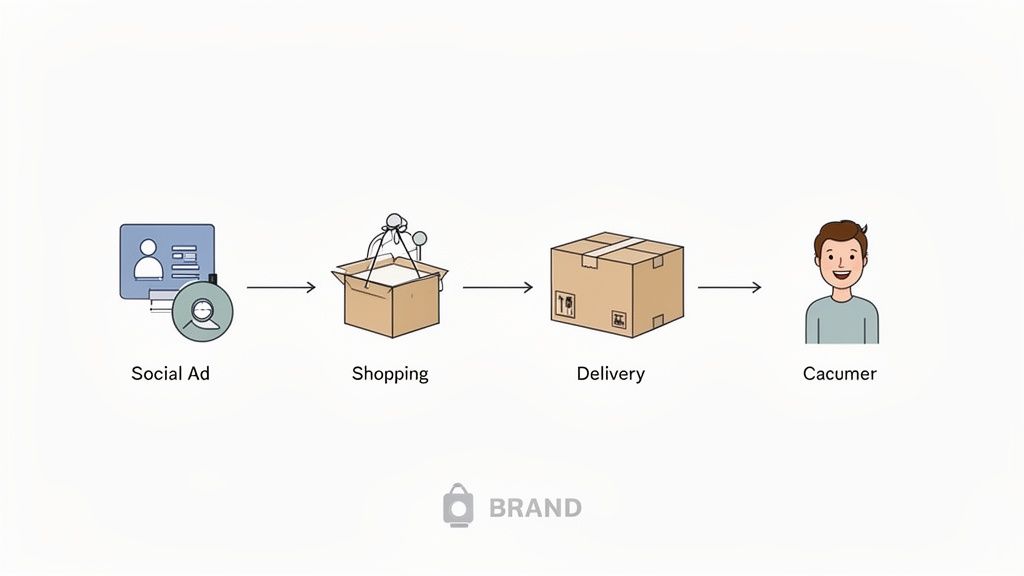
It wasn't that long ago that brands had to rely almost entirely on retail partners to reach shoppers. That model worked, sure, but it put a huge wall between the brand and the end customer. You had very little idea who was actually buying your products or why, and you often had to give up control over how your brand was presented and priced on the shelf.
A direct-to-consumer marketing strategy completely changes the game. This isn't just about launching an online store; it’s a deep, operational shift in how you talk to people, build community, and run your business.
So, Why Are So Many Brands Going DTC?
The move to DTC isn't just a fad; it’s a smart, strategic reaction to how people shop today. The numbers don’t lie—U.S. DTC e-commerce sales are expected to hit a massive $239.75 billion in 2025, making up 19.2% of all online retail sales. That kind of growth shows just how effective bypassing the old retail channels has become.
Let’s break down the core benefits:
- Total Control Over Your Brand: You call the shots on everything. Every touchpoint, from your Instagram ads to your shipping boxes, reinforces a consistent and authentic brand message.
- A Direct Line to Your Customers: When you talk directly to your audience, you can build a genuine community and get honest, unfiltered feedback.
- Your Own First-Party Data: Owning your customer data is a superpower. It helps you develop better products, run smarter marketing campaigns, and create truly personalized experiences.
- Better Profit Margins: Without the wholesale and retail markups, you keep more of the revenue from every single sale. Simple as that.
At its heart, a great DTC strategy is about building a brand that people feel like they belong to. It shifts the dynamic from a simple transaction to a real relationship, which is the key to creating loyalty that lasts.
For a DTC brand trying to grow, scaling these relationships is the biggest challenge. This is where influencer marketing comes in. A platform like REACH helps you find authentic creators who already have the trust of your ideal customers.
Instead of just guessing who might be a good fit, you can use REACH's discovery tools to find partners who truly align with your brand's values. From there, you can manage your campaigns and track results in real time to actually prove your return on investment. This turns the often-fuzzy goal of how to build brand awareness into a clear, data-driven process. The whole point is to create a smooth journey that turns a curious first-time buyer into a passionate, lifelong fan.
A Direct to Consumer Marketing Strategy to Find Your Audience
Before you even think about building a website or spending a single dollar on ads, your entire direct to consumer marketing strategy boils down to two things: Who are you talking to, and what are you promising them?
Getting this foundation right is everything. It’s the difference between shouting into the void and starting a real conversation with people who actually want to listen.
So many brands fall into the trap of creating a generic customer avatar—"Sarah, 30, lives in the city, likes yoga"—and calling it a day. That’s just not going to cut it. You have to go deeper to uncover the real, often unstated, motivations and pain points of your ideal customers.
Uncovering Actionable Audience Insights
To really get to know your audience, you need to put on your detective hat. Assumptions are your enemy; real-world data is your best friend. This isn't about guessing—it's about listening to what the market is already telling you.
Here’s where I’d recommend starting:
- Social Listening: Go where your potential customers live online. Dive into relevant subreddits, poke around in Facebook groups, and scroll through TikTok comments. What language are they using? What are they complaining about? What do they love (and hate) about products like yours?
- Competitor Audience Analysis: Take a hard look at who follows and engages with your competitors. Their audience is a goldmine of information about the market you’re trying to break into.
- Customer Surveys and Interviews: If you already have a handful of customers, talk to them! Ask open-ended questions like, "What was going on in your life that made you search for something like this?" The answers are often pure gold.
By piecing this all together, you move from a flat, one-dimensional avatar to a rich, nuanced understanding of a real person. This deep empathy is what powers every other part of your DTC strategy.
Once you have a solid grip on who you're talking to, you can figure out what makes you different. For a deeper dive, check out our guide on how to create buyer personas that actually work.
Crafting Your Unique Value Proposition
Your Unique Value Proposition (UVP) is your brand's heartbeat. It’s a simple, clear statement that explains how your product solves a problem, what specific benefits it delivers, and why it's better than anything else out there. This isn’t just a catchy tagline; it’s the core promise you make to every customer.
A weak UVP sounds like "high-quality products at great prices." It’s generic and forgettable. A strong one is specific. For instance, Casper didn't just sell mattresses. They sold "the perfect mattress for everyone," delivered to your door with a 100-night risk-free trial. That promise instantly solved the biggest pains of traditional mattress shopping.
To build your own, try filling in the blanks on this framework:
Our product helps [Target Audience] who want to [Accomplish a Goal] by [Verb – e.g., reducing, providing] [A Key Pain Point] and delivering [A Key Benefit].
This little exercise forces you to be specific and customer-focused. It makes sure your promise is tied to a real problem and a tangible outcome—a message that will resonate across every single channel you use.
Choosing the Right Channels for Your Direct to Consumer Marketing Strategy
Once you’ve figured out who you’re talking to and what makes you special, it's time to decide where to have that conversation. Your customers are out there, but they’re not all hanging out in the same place. The real magic happens when you build a smart, integrated mix of channels that work together to guide people from "who are you?" to "take my money."
Forget the old "spray and pray" method. A winning direct to consumer marketing strategy is about being selective and intentional. It’s not about shouting from every rooftop; it's about having meaningful conversations where it actually matters.
Building Your Core Channel Mix
Think of your marketing channels like a well-coached team, where each player has a specific role. Some are great at grabbing attention and creating buzz, while others are built for creating long-term relationships. A balanced approach is key—you want to be just as good at keeping customers as you are at finding them in the first place.
Here are the foundational players for most DTC brands:
Paid Social (Meta & TikTok): These platforms are discovery engines, pure and simple. They're perfect for catching someone's eye with compelling visuals that make them stop scrolling. This is how you introduce your brand to ideal customers who aren't necessarily searching for you… yet.
SEO & Content Marketing: While paid ads go out and find people, SEO is all about helping people find you. When someone types "vegan leather work bag" into Google, a solid content strategy is what makes your brand show up. Well-crafted blog posts, helpful guides, and optimized product pages build your credibility and pull in traffic from people who are ready to buy.
Email Marketing: This is your direct line to your customer, and it's where real relationships are built. Nothing beats email for nurturing new leads, sharing your brand's story, and driving repeat business with personalized offers. It's the undisputed champion of customer retention.
Understanding how these pieces fit into a broader multi-channel marketing strategy will help you orchestrate them perfectly, ensuring every channel supports the others.
Before we dive deeper, let's look at how these core channels stack up.
Core DTC Marketing Channel Mix Overview
This table breaks down the essential channels, their main purpose, how to measure success, and where they shine the brightest.
| Channel | Primary Goal | Key Metrics | Best For |
|---|---|---|---|
| Paid Social | Brand Awareness & Discovery | Reach, Impressions, CTR, ROAS | Reaching new, targeted audiences and driving top-of-funnel traffic. |
| SEO/Content | Organic Traffic & Authority | Organic Traffic, Keyword Rankings, CVR | Capturing high-intent searchers and building long-term brand credibility. |
| Email Marketing | Nurturing & Retention | Open Rate, Click-Through Rate, LTV | Building customer relationships and driving repeat purchases. |
| Influencer Marketing | Social Proof & Trust | Engagement Rate, Conversions, CPE | Generating authentic endorsements and converting savvy, ad-averse shoppers. |
This overview gives you a snapshot, but influencer marketing, in particular, deserves a closer look because of its unique power in the DTC space.
Influencer Marketing: The Ultimate Social Proof Engine
In the direct-to-consumer world, trust is everything. And frankly, no channel builds it faster or more authentically than influencer marketing. When a creator your audience already knows and respects recommends your product, it’s not just an ad—it’s a powerful, trusted endorsement that cuts right through the digital noise.
But let's be real: trying to scale an influencer program manually is a nightmare. Finding the right partners, negotiating deals, tracking posts, and measuring what actually worked can become a full-time job. This is exactly where a platform like REACH changes the game.
Instead of spending weeks sifting through profiles, you can use REACH to pinpoint authentic micro-influencers whose followers are a perfect match for your ideal customer. Imagine a sustainable activewear brand instantly finding and partnering with dozens of genuine yoga and wellness creators. The platform handles everything from discovery and outreach to campaign management and payments, turning a logistical headache into a scalable growth machine. To get a better feel for who's on which platform, our guide on social media demographics by platform is a great resource.
The Power Shift to Social and Influencer Channels
The numbers don't lie—social commerce and influencer marketing are quickly becoming the main drivers of DTC sales. Brands currently expect social media to power 53% and influencers 47% of their conversions in early 2025. But that's not the whole story.
The trend is set to flip dramatically later in the year, with projections showing influencers will drive a massive 70% of conversions. This shift shows a clear move away from broad awareness plays and toward high-precision performance channels. And when you consider that younger consumers are 4x more swayed by social proof than older demographics, it’s clear that authentic creator partnerships are no longer optional.
This data is a massive signal that you need a serious influencer program managed by a sophisticated platform. With REACH, you can track clicks, conversions, and sales in real-time, finally connecting influencer activity directly to your bottom line. It transforms influencer marketing from a fuzzy "awareness" channel into a measurable performance driver that proves its ROI, creating a powerful, cohesive strategy that fuels sustainable growth.
Guiding Customers from First Look to Lasting Loyalty
A solid direct to consumer marketing strategy isn't just about a clever ad or a one-off sale. It’s about mapping out a complete customer journey that turns a curious browser into a loyal fan who actually sticks around. The modern DTC funnel is less of a straight line and more of a continuous loop, built on trust, genuine value, and a great experience every step of the way.
Think of it as carefully guiding someone from that initial "hello" all the way through to purchase, and then nurturing that relationship so they keep coming back.
The whole thing kicks off at the top of the funnel, where your only job is to get noticed and make a strong first impression. This is the perfect stage for channels like influencer marketing and engaging social content. When you partner with the right creators, they introduce your brand to their audience in a way that feels like a genuine recommendation from a friend, not a stale ad.
This flow chart shows how social media, SEO, and influencer marketing can work in tandem to fill the top of your funnel and get the journey started.
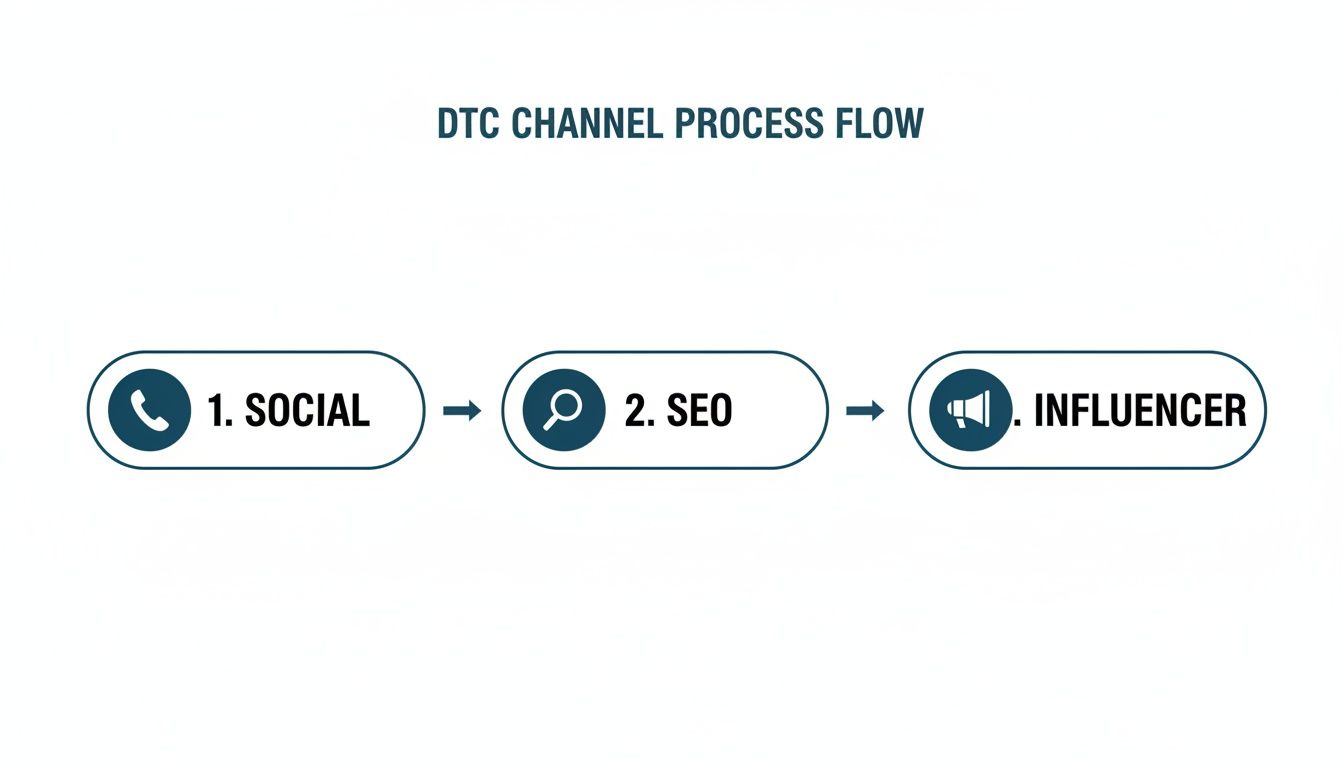
Each channel plays a distinct role. Some capture people who are actively searching for a solution, while others grab the attention of those just scrolling. Together, they create multiple entry points into your brand's world.
Building Trust in the Middle Funnel
Okay, so you’ve got their attention. Now what? The focus immediately shifts to building confidence and proving you’re the real deal. The middle of the funnel is all about showing them you’re worth their time and money. Retargeting ads on social media are great for gently reminding interested visitors about the products they checked out, keeping you top of mind.
Even more important, though, is social proof. This is non-negotiable. You have to showcase real customer reviews, user-generated content, and testimonials. Seeing that other people love your products is infinitely more persuasive than anything you could ever say about yourself.
A Seamless Conversion Experience
When someone is finally ready to buy, the last thing you want is to make it difficult. Any friction here can kill the sale instantly. Your checkout process has to be clean, simple, and completely transparent—no surprise fees popping up at the last second.
A complicated checkout is one of the fastest ways to lose a sale. Brands that invest in a streamlined, mobile-friendly purchase experience see significantly lower cart abandonment rates. It’s a simple fix with a massive impact on revenue.
Think about the smoothest online purchase you’ve ever made. It was probably fast, clear, and made you feel secure. That’s your goal.
The Real Magic Happens Post-Purchase
For any DTC brand worth its salt, the sale is just the beginning. The real long-term value is unlocked after the purchase, when you turn that first-time buyer into a repeat customer. This is where your direct to consumer marketing strategy really shines, because keeping an existing customer is so much cheaper than finding a new one.
Personalization is everything here. A few thoughtful, automated email flows can work wonders.
- Welcome Series: Don’t just send a receipt. Introduce new customers to your brand’s story and make them feel like part of a community.
- Order Confirmations: Give them clear, helpful info about what they bought and when it will arrive.
- Educational Content: Show them how to get the most value out of their new product.
- Replenishment Reminders: If you sell consumables, a well-timed reminder makes a repeat purchase a no-brainer.
Beyond email, a good loyalty program can be a game-changer for customer lifetime value (LTV). Offering points, exclusive perks, or early access to new launches makes your best customers feel valued and gives them a powerful reason to shop with you again.
The data backs this up completely. In the DTC world, repeat customers convert at a rate of 60-70%, a massive jump from the 5-20% conversion rate for new prospects. What's more, 81% of customers in a loyalty program shop more often, and 76% spend more. You can dig into more stats about why DTC brands focus so heavily on retention over at venturemedia.io. This is why sustainable growth is always built on relationships, not just transactions.
Measure What Matters in Your DTC Strategy
In direct-to-consumer, if you can't measure it, you can't manage it. A winning direct to consumer marketing strategy isn't built on gut feelings or vanity metrics like Instagram followers; it’s built on cold, hard numbers that actually move the needle. You have to prove your marketing is making money before you can figure out how to make more of it.
This means you need to cut through the noise and zero in on the Key Performance Indicators (KPIs) that connect your marketing budget directly to your bottom line. For any DTC brand, three metrics tower above the rest: Customer Acquisition Cost (CAC), Customer Lifetime Value (LTV), and the crucial LTV:CAC ratio.
Understanding Your Customer Acquisition Cost
Let's start with Customer Acquisition Cost (CAC). This is simply the total cost of getting a potential customer to click "buy" for the first time.
The math is pretty straightforward. Just divide your total marketing and sales expenses over a set period by the number of new customers you brought in during that same time. For instance, if you spent $10,000 on ads and got 500 new customers, your CAC is $20.
This number tells you exactly what you're paying to bring someone into your world. Knowing your CAC is the first step to building a growth engine that's actually profitable.
Calculating Customer Lifetime Value
Next up is Customer Lifetime Value (LTV). This metric estimates the total revenue you can expect from a single customer over their entire relationship with your brand.
LTV is all about shifting your focus from a single sale to the long-term health of your business. A high LTV is a clear sign that people love your products and your retention efforts are paying off. After all, the real goal is to turn those first-time buyers into loyal, repeat customers. Learning how to build real customer loyalty is what separates fleeting trends from enduring brands.
A healthy business is always built on repeat business. Obsessing over LTV forces you to think beyond the first sale and invest in the entire customer journey, from the unboxing experience to post-purchase support.
While there are some incredibly complex ways to calculate LTV, a simple formula works wonders: (Average Order Value) x (Average Purchase Frequency) x (Average Customer Lifespan). This gives you a powerful snapshot of what each customer is truly worth to you.
The Golden Ratio: LTV to CAC
The LTV:CAC ratio is where the real insight lies. This one number tells you if your business model is actually sustainable by comparing what a customer is worth to what it cost you to get them.
A healthy LTV:CAC ratio is widely considered to be 3:1 or better. Put simply, for every dollar you spend acquiring a customer, you should be getting at least three dollars back over their lifetime.
- A 1:1 ratio means you're just breaking even. Not a great place to be.
- Anything below 1:1 means you're actively losing money with every new sale.
- A ratio of 5:1 or higher might even signal that you're underinvesting in marketing and have room to grow faster.
For any brand serious about scaling its direct to consumer marketing strategy, keeping a close eye on this ratio is non-negotiable. It's your financial north star.
To help you keep these critical numbers straight, here's a quick rundown of the essential KPIs every DTC brand should be tracking.
Essential DTC Marketing KPIs Explained
| KPI | What It Measures | Why It's Important |
|---|---|---|
| Customer Acquisition Cost (CAC) | The total cost to acquire one new customer. | Tells you if your marketing spend is efficient and your growth is profitable. |
| Customer Lifetime Value (LTV) | The total revenue a customer will generate over their entire relationship with your brand. | Highlights the value of customer retention and helps forecast long-term revenue. |
| LTV:CAC Ratio | The relationship between the lifetime value of a customer and the cost of acquiring them. | This is the ultimate measure of business model sustainability. A ratio of 3:1 is the gold standard. |
| Conversion Rate (CVR) | The percentage of website visitors who complete a desired action (e.g., make a purchase). | Measures the effectiveness of your website, landing pages, and overall user experience. |
| Average Order Value (AOV) | The average amount a customer spends in a single transaction. | Increasing AOV is a powerful way to boost revenue without increasing marketing spend. |
| Repeat Purchase Rate | The percentage of customers who have made more than one purchase. | A direct indicator of customer loyalty and product satisfaction. |
Understanding these metrics isn't just about crunching numbers; it's about making smarter, data-driven decisions that will fuel sustainable growth for your brand.
Tracking Influencer Marketing ROI with REACH
This brings us to a common headache for marketers: proving the ROI of influencer marketing. It used to be a frustrating guessing game of tracking "engagement" and hoping for the best. But platforms like REACH have completely changed the game.
With REACH, you can finally connect influencer activity directly to sales. The platform's analytics dashboards give you a crystal-clear, real-time view of how your campaigns are performing, letting you track the metrics that actually matter.
You can monitor key performance indicators like:
- Unique Clicks: See precisely how many people clicked an influencer's unique affiliate link.
- Conversions: Know exactly how many of those clicks turned into a sale.
- Sales Revenue: Attribute every dollar of revenue back to the creator who drove it.
This is a game-changer. It means you can finally see which partners are your true top performers and allocate your budget with confidence. You can calculate a clear CAC for your influencer channel, plug it right into your LTV:CAC analysis, and definitively prove its value to your team.
Common DTC Marketing Questions Answered
Diving into a direct to consumer marketing strategy always kicks up a lot of questions, especially when you're a brand on the rise. You've got a great product, but turning that into a thriving business means making some smart calls right out of the gate. Let's tackle some of the most common questions I hear from founders.
Think of this as a set of guideposts. The goal here is to give you the clarity and confidence to make your next move, whether you're just launching or getting ready to hit the gas.
How Much Should I Spend on Marketing Initially?
Everyone wants a magic number for their starting budget, but it just doesn't exist. A solid benchmark for new DTC brands, though, is the 10-20% rule. Basically, plan on putting 10% to 20% of your total revenue (or projected revenue) back into marketing.
So, what does that actually look like for a brand new company?
- Product Seeding: Start by sending free products to a hand-picked list of micro-influencers. This is a low-cost way to get some early buzz and authentic content you can use later.
- Small Ad Experiments: Run some small, tightly targeted ads on Meta or TikTok. The goal isn't to make a million dollars overnight, but to test your messaging and see who responds.
- Good Creative: Spend a little on quality photos and video. You can reuse this stuff everywhere—your website, social media, and in your emails.
Once you have some real data rolling in, you can start to see what's working and adjust your spending. The key is to start small enough that you can afford to experiment, and then go all-in on the channels that actually deliver.
When Is the Right Time to Hire an Agency?
Bringing on a marketing agency is a big move, and the timing is everything. I see a lot of founders make this call too early, hoping an agency will magically fix core problems that really need to be sorted out internally first.
The best time to hire an agency is when you have something that's already working and you're held back by time, not a lack of strategy. If you know which channels are driving sales but you physically can't manage them anymore, that's your cue.
Before you even think about signing a contract, you need to have a few things locked down:
- A Rock-Solid Brand Identity: You know who you are and what you're all about.
- Proven Product-Market Fit: Sales are coming in consistently and customers are saying good things.
- Early Channel Wins: You have hard data showing that one or two marketing channels are already working for you.
Think of an agency as an accelerant. They can't start the fire for you, but they can definitely pour gasoline on it to help you grow much, much faster.
How Should We Handle Customer Data?
In the DTC world, the data you collect directly from your customers is pure gold. Handling it the right way isn't just about following the law; it's how you build trust. The golden rule here is total transparency.
Be straight with people about what you're collecting and why you're collecting it. Ditch the legal jargon in your privacy policy and use simple, human language wherever you ask for information, like on an email signup form. Let them know you're using their data to give them a better experience—not to spam them.
Practically, this means:
- Lock It Down: Protect customer information with serious security measures.
- Give Them the Keys: Make it incredibly easy for customers to update their preferences or opt-out entirely.
- Make It Worthwhile: Use the data to send them things they'll actually find valuable, not just another generic ad.
Building this kind of trust is the bedrock of customer loyalty, which is what every great direct to consumer marketing strategy is truly built on. Your commitment to a clear, honest, and customer-centric approach will be your most powerful asset for long-term success.
Ready to scale your DTC brand with authentic social proof that actually sells? REACH makes it simple to discover the right creators, manage your campaigns, and measure what matters. Track your sales in real-time and finally prove your influencer marketing ROI.