 Skip to content

When you think of influencer marketing, your mind probably jumps straight to Instagram or TikTok. But if you're sleeping on YouTube, you're missing out on a massive opportunity. It's a completely different beast, one that lets brands team up with creators to craft in-depth, long-form content like tutorials and honest reviews.
This isn't about fleeting, 15-second clips. It's about leveraging the deep, authentic connection creators have with their audience to walk viewers through a buying decision. That's how genuine recommendations turn into real, trackable revenue. The right influencer marketing on YouTube strategy, powered by a robust platform like REACH Influencers, can transform your marketing efforts.
Table of Contents
- Why YouTube Is a Goldmine for Influencer Marketing
- Building Your YouTube Influencer Marketing Blueprint
- Finding and Vetting the Right YouTube Creators
- Crafting Compelling Briefs That Creators Love
- Measuring Success and Proving Campaign ROI
- Sidestepping Common YouTube Influencer Marketing Pitfalls
- Frequently Asked Questions
Why YouTube Is a Goldmine for Influencer Marketing
While other platforms are great for quick hits and trends, YouTube holds a unique and powerful position that smart brands are leaning into. The real value isn't just in the subscriber count; it's about building connections that actually move the needle for your business.
The platform is built for video, which means creators can truly show your product in action, share detailed experiences, and tell stories that stick with people.
This is where the magic of influencer marketing on YouTube really comes alive. A YouTube video gives creators the room to build a case for a product through in-depth tutorials, unboxings, or "a day in the life" integrations. This long-form style is crucial for anything that needs a bit of explanation or a real-world demonstration—it builds a level of trust that a simple photo just can't. To get the full picture, you have to understand the broader world of YouTube marketing and see how this specific tactic fits into a winning strategy.
Building Trust Through Authenticity
YouTube’s biggest strength is its ability to create genuine relationships. People don't just watch a channel; they subscribe to a personality, an expert they trust. When that YouTuber they've followed for years recommends a product, it feels more like a tip from a friend than a slick ad.
Of course, the trick is finding a creator whose values and audience actually line up with your brand. That's the toughest part of the job. It's exactly why platforms like REACH Influencers exist—to help brands sift through the noise and find YouTube creators based on niche, engagement, and audience demographics, making sure your message lands with the right people.
Driving Measurable Results
The great thing about investing in YouTube is that the content keeps working for you long after it's posted. A well-made review video can rack up views and drive sales for months, even years, turning into an evergreen marketing asset. Think about a tech brand that partners with a creator for a detailed laptop review—that single video can send qualified traffic and sales their way long after the campaign "officially" ends.
YouTube has become a true heavyweight in the influencer world. As of 2026, brands are dedicating 33% of their influencer partnerships to the platform, making it the second most popular choice right behind Instagram at 57%. (Discover more insights about influencer marketing growth on archive.com)
This shift is happening because YouTube excels at guiding customers through the "I'm thinking about it" phase of a purchase. Short-form video just can't compete on that level.
YouTube vs Other Platforms Key Campaign Differences
To really understand where YouTube fits, it helps to see how it stacks up against the other major players. Each platform has its own strengths, and knowing them helps you decide where to put your budget for the best results.
| Feature | YouTube | TikTok | |
|---|---|---|---|
| Primary Content | Long-form video (reviews, tutorials) | High-quality visuals (images, Reels) | Short-form, trend-driven video |
| Content Lifespan | Evergreen, searchable for years | 24-48 hours, feed-dependent | Very short, trend-based (days) |
| Audience Intent | Problem-solving, learning, research | Discovery, inspiration, social proof | Entertainment, quick trends |
| Best For | In-depth education, consideration stage | Brand awareness, lifestyle integration | Viral marketing, top-of-funnel reach |
| Measurement Focus | Views, watch time, click-through rates | Engagement rate, reach, impressions | Views, shares, user-generated content |
Ultimately, the best platform depends on your goals. If you need to educate your audience and build deep trust for a considered purchase, YouTube is unmatched. If you want broad, fast-moving brand awareness, Instagram and TikTok are your go-to channels.
Building Your YouTube Influencer Marketing Blueprint
Before you even think about spending a dime on a YouTube collaboration, you need a rock-solid plan. Great influencer campaigns don't just happen by magic; they’re built on a foundation of clear goals, a real understanding of your ideal customer, and a budget that makes sense. This blueprint is your guide for every single decision, from picking creators to measuring what actually worked.
Wing it, and you're just throwing money at random shoutouts, hoping something sticks. A strategic approach ensures every video has a purpose and contributes directly to your business goals.
Define Your Campaign Goals and KPIs
First things first: what are you actually trying to accomplish? Are you looking to get your brand name out there, or do you need to drive sales for a new product right now? Your answer will shape the entire campaign.
Most campaigns boil down to one of these objectives:
- Brand Awareness: Getting your brand in front of a fresh, relevant audience.
- Lead Generation: Collecting emails for your newsletter or getting sign-ups for a webinar.
- Direct Sales: Pushing traffic to product pages to make money.
- Community Building: Creating buzz and fostering a loyal following around your brand.
Once you know your goal, you have to decide how you'll measure it. You need Key Performance Indicators (KPIs) to know if you're winning or wasting your money.
For example:
- If your goal is Brand Awareness, you’ll be watching Views, Impressions, and Subscriber Growth.
- For Direct Sales, it's all about Click-Through Rate (CTR), Conversion Rate, and Cost Per Acquisition (CPA).
This simple breakdown shows how everything flows together—from building trust with an audience to ultimately driving sales.
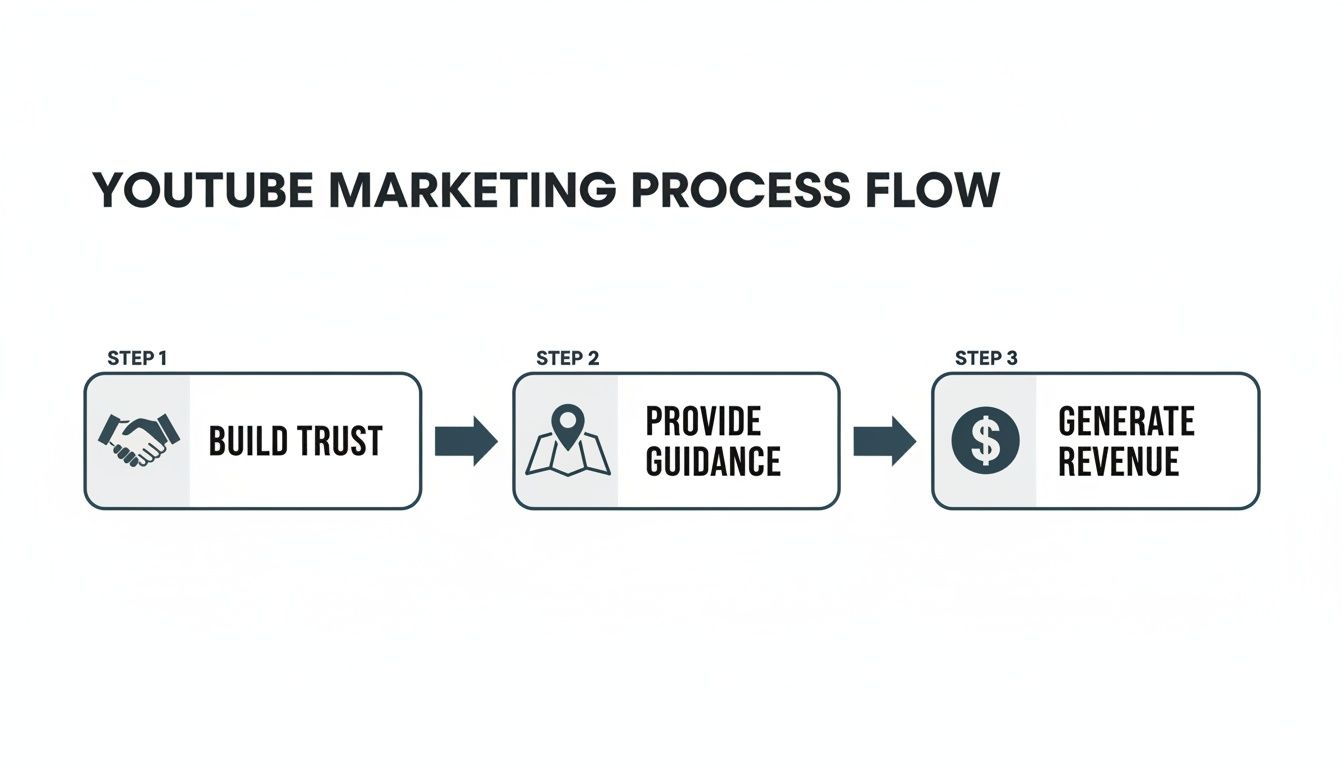
As you can see, revenue is the end result of a process that starts by earning trust and providing genuine value.
Develop Detailed Audience Personas
You can't find the right creators if you don't know exactly who you're trying to reach. Go deeper than basic demographics like age and location. Build a detailed persona of your ideal customer.
Ask yourself: What problems are they trying to solve? What kind of YouTube content are they already binging? Which creators do they already follow and trust? Nail these down, and you’ll find influencers whose audiences are a perfect fit.
This is where a dedicated platform becomes a massive help. Instead of just guessing, you can use advanced filters to pinpoint creators whose audience data aligns perfectly with your customer persona. It’s a data-driven shortcut that takes the guesswork out of the equation.
A classic rookie mistake is assuming a creator's audience is just like them. Always, always verify the audience data. A creator might be a 25-year-old woman, but her audience could be mostly 35-year-old men. Data is your best friend here.
Allocate Your Budget Smartly
Your budget is way more than just what you pay the influencer. A smart budget for your influencer marketing on YouTube campaign accounts for all the moving parts so there are no nasty surprises later. Planning this out helps you avoid unexpected costs and lets you calculate your real return on investment.
Be sure to factor in these key areas:
- Creator Fees: The direct payment for their work. This can vary wildly based on their subscriber count, engagement rate, and how much you're asking them to do.
- Product Costs: Don't forget to budget for the free products or services you'll need to send the creator to feature.
- Content Promotion: You might want to set aside some cash to run ads on the creator's video to expand its reach even further.
- Platform Fees: If you're using a management tool or discovery platform, remember to include any subscription costs. These tools often save you money in the long run by making your campaigns more efficient and effective.
By planning for these expenses upfront, you can create a realistic financial picture and confidently measure the true ROI of your work.
Finding and Vetting YouTube Creators for Your Influencer Marketing
Alright, you’ve got your strategy mapped out. Now comes the fun part—and arguably the most make-or-break step of the whole process: finding the creators who will bring your campaign to life.
Let me be clear: this is where so many campaigns go wrong. It’s tempting to just look at subscriber counts and call it a day, but that’s a rookie mistake. The biggest channels aren’t always the right fit. Real influence comes from creators who have earned the genuine trust of a dedicated community. Get this part right, and you've got a shot at something special. Get it wrong, and you're just throwing money away.
Ditching the Manual Grind with the Right Tools
Trying to find creators by manually scrolling through YouTube is a soul-crushing task. It feels like you’re searching for a needle in a digital haystack, and even when you find someone who looks good, you’re still guessing about their real audience and engagement.
This is exactly why influencer marketing platforms are a non-negotiable part of my toolkit. A solid platform like REACH Influencers cuts through all that noise. It lets you get incredibly specific with powerful search filters, so you can stop guessing and start targeting.
With a good tool, you can instantly zero in on creators based on:
- Niche and Content Category: Find people who are already authorities in your space, whether it’s gaming, cooking, or personal finance.
- Audience Demographics: Filter by age, location, gender, and even interests to make sure you're talking to your people.
- Engagement Metrics: See the real story behind the vanity metrics—average views, comment ratios, and audience sentiment.
Using a platform turns a frustrating guessing game into a smart, data-driven process. You can build a solid shortlist of potential partners in a fraction of the time. To really speed things up, check out our guide on how to find influencers on YouTube for more tips.
The Human Vetting Checklist: Your Final Gut Check
Even with the best tech, you can't skip the final manual review. A platform gives you the data, but your own judgment is what confirms the fit. You need to get a feel for their vibe and authenticity.
Before you even think about reaching out, put every single creator on your shortlist through this gut-check process:
-
Watch Their Content (No, Really): Binge-watch at least five of their recent videos. Is the production quality solid? Are they posting consistently? The professionalism they show in their own work is what they’ll bring to yours.
-
Dig into the Comments: Don't just glance at the number of comments—read them. Are people having real conversations, or is it just a bunch of "Nice video!" bots? This is where you find out if they have a real community or just a passive audience.
-
Check for Real Engagement: A video with a million views but only a hundred comments is a huge red flag. Look for a healthy balance of likes, views, and meaningful comments. This tells you if people are actually paying attention.
-
Review Their Past Sponsorships: How have they handled brand deals before? Do they feel like clunky, forced ads, or are they woven naturally into the content? You also want to make sure their past partners aren't competitors or brands that clash with your values.
This is where micro-influencers often shine. A staggering 60% of brands that work with them report better performance because their engagement is through the roof—often beating out big-name celebrity endorsements. And the audience is there: 53.9% of YouTube users following influencers are male, with a huge chunk in the 25-34 age range. Plus, 69% of consumers say they trust recommendations from creators.
Knowing When to Walk Away: Spotting the Red Flags
Just as important as knowing what to look for is knowing what to avoid. A creator can look perfect on paper but have some serious issues hiding just below the surface that could damage your brand.
Keep an eye out for these red flags:
- A Controversial Past: A quick search can unearth old, problematic content or statements you don't want associated with your brand.
- Too Many Ads: If every other video is a sponsorship, their audience is likely burned out. Their recommendations won't carry much weight.
- A Toxic Community: See how the creator handles criticism or negativity in the comments. If it's a dumpster fire, you don't want to jump in.
By pairing the efficiency of a platform with your own careful, human review, you build a campaign on a foundation of trust. This two-pronged approach ensures you're partnering with creators who can genuinely connect with an audience and deliver the results you need.
Crafting Compelling Briefs That Creators Love
You’ve found the perfect creators. Now what? You need to give them a clear roadmap for success, and that’s exactly what a creative brief is for. This isn't just another document; it’s the absolute foundation of your collaboration.
A great brief sparks creativity and gets a creator excited. A bad one? It leads to generic, off-brand content that just falls flat. The goal is to provide guardrails, not a restrictive script. You want to empower them to connect with their audience authentically while making sure your key messages still land perfectly. It’s a delicate balance, but it's one you have to get right.

The Anatomy of a Perfect Brief
Your brief should be the single source of truth for the entire campaign. Think clear, concise, and comprehensive without being overwhelming. A confusing, jumbled brief is the fastest way to get a video that needs endless, frustrating revisions.
To avoid that headache, make sure your brief nails these core components:
- Campaign Goals: Start with the why. Is the goal to drive sales for a new product launch? Boost webinar sign-ups? Make it crystal clear what a successful outcome looks like.
- Key Talking Points: Outline 2-3 must-have messages about your product or service. Don’t hand them a script—give them punchy bullet points they can naturally weave into their own style.
- Content Do's and Don'ts: Get specific here. A "Do" could be "Show the product being used in a real-life, everyday setting." A "Don't" might be "Please avoid mentioning our main competitor by name."
- Call to Action (CTA): Tell them exactly what you want viewers to do next. Is it "Use code 'CREATOR20' for 20% off" or "Click the link in the description to learn more"?
- FTC Disclosure Guidelines: Don’t leave this to chance. Clearly state that they must disclose the partnership using YouTube's built-in paid promotion tool and include hashtags like #ad or #sponsored in the description.
Getting this structure right ensures everyone is on the same page from the jump. If you need a solid starting point, our complete influencer brief template gives you a fill-in-the-blanks framework to build from.
Choosing The Right YouTube Content Format
Not all YouTube videos deliver the same results. The format you and the creator decide on should directly map back to your campaign goal. A deep-dive dedicated review is fantastic for driving sales, while a quick, natural mention in a vlog is often better for simple brand awareness.
Pro Tip: The best campaigns come from trusting the creator’s expertise. Always ask them what format they think will resonate most with their audience. They know what works, and that collaborative spirit is often where the real magic happens.
To help guide that conversation, here's a look at which common YouTube formats align with different marketing goals.
YouTube Content Format Performance by Goal
This table breaks down which video formats are best suited for your primary objective, whether you're trying to get your name out there or drive direct sales.
| Campaign Goal | Recommended YouTube Format | Key Performance Indicator (KPI) |
|---|---|---|
| Brand Awareness | Integrated Mention (in a vlog) | Views, Impressions |
| Consideration/Education | Dedicated Product Review | Average Watch Time, Link Clicks |
| Direct Sales | "How-To" Tutorial | Conversion Rate, Discount Code Usage |
| Community Engagement | YouTube Short | Likes, Comments, Shares |
Ultimately, choosing the right format sets you up to measure what matters most for your specific campaign.
Streamlining Collaboration and Approvals
Trying to manage feedback and approvals through endless, messy email chains is a recipe for disaster. This is where having a centralized platform to manage the workflow becomes a total game-changer.
With a tool like REACH Influencers, the entire process happens in one organized place. The creator uploads their draft directly to the platform, and your team can leave time-stamped comments and feedback. Revisions become clear and actionable, not lost in a reply-all nightmare.
This transparent approach cuts down on miscommunication, dramatically speeds up the approval timeline, and helps ensure the final video is something both you and the creator can be proud of. The result is simply better content, delivered faster.
Measuring Success and Proving Your Influencer Marketing on YouTube ROI
Getting your campaign live is just the starting line. Now comes the part that really matters: proving it actually worked. This is where you connect the dots between a creator's awesome video and real business results for your influencer marketing on YouTube.
Forget about getting bogged down in vanity metrics like views and likes. Those are nice, but they don't pay the bills. The real measure of success is whether your campaign drove meaningful action and delivered a solid return on your investment.
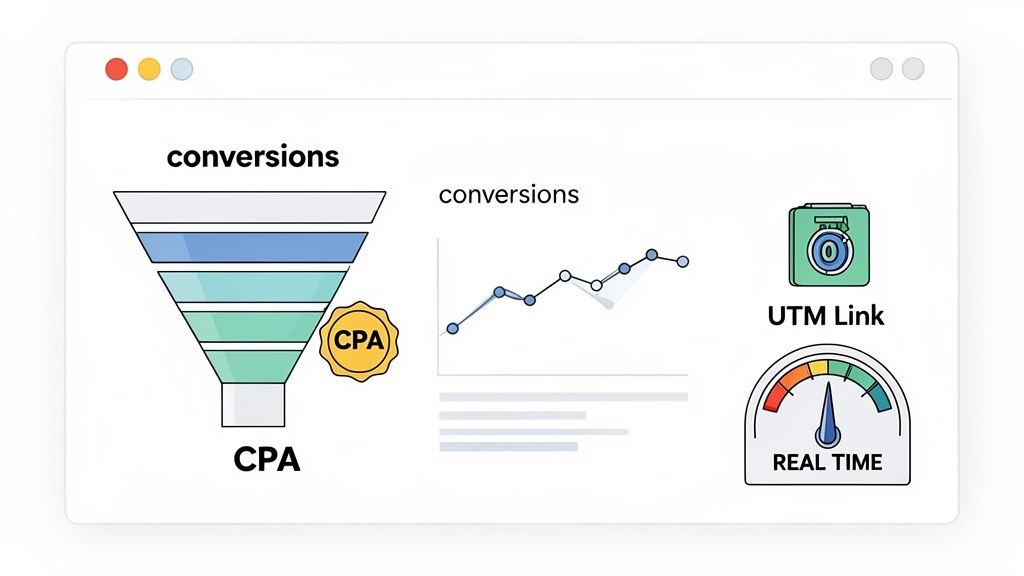
To do that, you need a rock-solid system for tracking performance. You have to be able to draw a straight line from a specific video to a specific business goal. Without that, you're just guessing. We're talking about the numbers your finance team and leadership actually care about: conversions, cost per acquisition (CPA), and the final campaign ROI.
Laying Your Tracking Foundation
Before a single video goes live, you absolutely must have your tracking framework in place. This isn't optional if you want to prove the financial impact of your partnerships.
Your toolkit here is pretty straightforward:
- UTM Parameters: Think of these as little breadcrumbs you add to a URL. They tell your analytics software exactly who sent you that traffic. By creating a unique UTM link for each influencer, you'll know precisely who's driving clicks and, more importantly, conversions.
- Custom Landing Pages: Don't just send influencer traffic to your generic homepage. Build a dedicated landing page tailored to that creator's audience. It makes for a much smoother experience and can seriously boost your conversion rates.
- Unique Discount Codes: This is one of the oldest tricks in the book because it works. Giving each influencer a custom code (like "CHLOE15") is the cleanest, most direct way to track sales. It's undeniable proof of who's making it rain.
These simple tools are what turn vague "brand awareness" into cold, hard data. They show exactly how every dollar you spent turned into customer action. If you're new to this, getting a handle on the basics of measuring content marketing ROI is a great place to start.
Keeping an Eye on Things in Real-Time
The most successful campaigns are never "set it and forget it." You have to watch, learn, and adjust on the fly. This is where a platform like REACH Influencers can be a game-changer, giving you a live dashboard instead of forcing you to piece together reports weeks later.
You can see in an instant which creators are killing it with click-through rates, which landing pages are converting the best, and which discount codes are flying off the shelves. This immediate feedback loop is incredibly powerful.
Picture this: one of your creators is sending a ton of traffic your way, but nobody's buying. With real-time data, you can spot the problem right away—maybe their link is broken or the landing page is confusing. You can fix it mid-campaign and salvage thousands in potential sales.
This ability to pivot is what separates the good campaigns from the truly great ones. It lets you put more fuel on the fire for what's working and cut your losses on what isn't, squeezing every last drop of value from your budget. To get a sense of what's possible, you can play around with our free influencer ROI calculator.
Calculating and Reporting Your True ROI
Once the dust settles, it’s time to run the final numbers. The ROI formula itself is simple: (Revenue Generated - Total Campaign Cost) / Total Campaign Cost * 100. Just be sure your "Total Campaign Cost" includes everything—creator fees, the cost of any products you sent, and any ad spend.
The data consistently shows that YouTube is a beast when it comes to returns. On average, brands see a $5.78 return for every dollar spent on influencer marketing. But for well-executed campaigns, that number can jump to between $11 and $18. It's no wonder 60% of marketers are planning to spend even more in this space.
When you can walk into a meeting with a report that clearly breaks down this kind of return, you're not just justifying your budget. You're providing valuable intelligence that will make every future campaign even smarter.
Sidestepping Common YouTube Influencer Marketing Pitfalls
Running a great campaign is as much about dodging mistakes as it is about making the right moves. You can have the perfect strategy on paper, but a few common missteps can quickly burn through your budget, damage creator relationships, and leave you with nothing to show for it.
Let's be honest, we've all seen campaigns that just feel… off. The biggest mistake I see brands make, time and time again, is a fundamental creator-brand mismatch. It's easy to get dazzled by a creator's huge subscriber count, but if their audience isn't your audience, you're just shouting into the void. This is the classic trap of picking reach over relevance.
The Dangers of Mismatched Partnerships and Vague Contracts
A mismatched partnership is a surefire way to kill your campaign's authenticity. Think about a luxury, sustainable skincare brand pairing up with a YouTuber famous for their drugstore-only makeup challenges. It just doesn't connect. The audience can spot an inauthentic cash grab from a mile away, and that disconnect can hurt both your brand's reputation and the creator's credibility.
Another landmine is a vague or incomplete contract. Going into a partnership without crystal-clear, written expectations is just asking for trouble. If you haven't nailed down deliverables, content ownership, payment terms, and exclusivity clauses, you're setting the stage for chaos. This is how you end up with late content, off-brand messaging, or messy disputes that can tank the entire project.
Think of your contract as the foundation of your campaign. It’s not just a formality; it's a tool that protects you and the creator by getting everyone aligned from the very beginning. A solid contract prevents nearly all of the common headaches that plague influencer partnerships.
Overlooking The Rules and Micromanaging The Creator
In the excitement of getting a campaign live, it’s surprisingly easy to forget the legal stuff. But overlooking FTC disclosures is a huge mistake. Every piece of sponsored content must be clearly marked with #ad or use YouTube's built-in paid promotion feature. Failing to do this isn't just a bad look—it's against the law and can lead to hefty fines and shatter your audience's trust.
Finally, don't suffocate the creator's magic. The temptation to write a super-detailed, restrictive creative brief is real, but you have to resist. When you hand a creator a rigid script, you strip away the personality and authenticity that made you want to work with them in the first place. Their channel becomes a billboard, and their audience will tune out immediately.
Tools like REACH can help you navigate these challenges. With features like built-in contract templates and secure payment processing, it formalizes the business side of things. This lets you build compliant, professional partnerships from the start, freeing you up to focus on the creative strategy while the platform handles the nitty-gritty details that keep your campaigns running smoothly.
Frequently Asked Questions
Jumping into YouTube influencer marketing can feel like a lot to take on. You've got questions, and that's a good thing—it means you're thinking strategically. Let's tackle some of the most common ones that pop up when marketers are planning their campaigns.
How Much Does It Cost to Hire a YouTube Influencer?
This is the million-dollar question, and the honest answer is: it completely depends. There's no standard rate card for YouTube creators. The price can swing wildly based on their subscriber count, typical view numbers, audience engagement, and just how much you're asking them to do.
A micro-influencer with a dedicated following of around 50,000 subscribers might charge anywhere from $500 to $5,000 for a single dedicated video. On the other end of the spectrum, a top-tier creator with millions of fans could easily command $50,000 or more.
My advice? Don't get hung up on the initial price tag. The real win is finding a creator whose audience is a perfect match for your brand. A smaller creator with a super-engaged, niche community can often drive more sales than a huge one with a passive audience. It's all about the ROI.
What's a Good Engagement Rate for a YouTube Influencer?
As a general benchmark, a healthy engagement rate on YouTube (likes, comments, and shares divided by views) hovers between 2% and 5%. But that number doesn't tell the whole story.
Context is everything. A creator who makes videos about complex software development might have a lower percentage, but their audience is incredibly specific and valuable. Their recommendations carry serious weight.
When you're vetting potential partners, dig deeper than the stats. I always look at the comment section. Are people having real conversations? Is the creator actively responding? That's a much better sign of a strong community than a simple percentage.
How Long Should a Sponsored YouTube Video Be?
There's no magic number here. The right length is whatever feels natural for the content and accomplishes your goal.
If you’re sponsoring a deep-dive product review or a step-by-step tutorial, the video needs some breathing room—think 8 to 15 minutes. But if it's just a quick mention inside a larger vlog, a 60-to-90-second segment can feel perfectly integrated and authentic.
The best thing you can do is trust the creator. They've spent years building their audience and know exactly what kind of content, and what video length, will land best. Forcing them into a rigid time limit is a surefire way to make the sponsorship feel awkward.
What Are the Most Important Legal Considerations?
When it comes to the legal side of things, two things are absolutely critical for any influencer marketing on YouTube campaign: proper disclosure and a solid contract.
First, the Federal Trade Commission (FTC) is very clear that sponsored content must be identified as an ad. This isn't optional. The creator needs to use YouTube’s built-in paid promotion disclosure tool and include something like #ad or #sponsored in the video description.
Second, never, ever work without a contract. It protects both you and the creator by clearly outlining all the key details:
- What content needs to be created
- Who owns the content after it's published
- How and when the creator gets paid
- Any exclusivity agreements
Getting these things in writing from the start prevents major headaches down the road.
Ready to take the guesswork out of your YouTube influencer campaigns? REACH Influencers provides the tools you need to discover the right creators, manage campaigns seamlessly, and prove your ROI with real-time analytics. Successful influencer marketing on YouTube is within your grasp. Schedule a demo today and see how our platform can supercharge your strategy.