
* `Last Updated: October 10, 2023`
To truly measure brand awareness, you can't rely on a single metric. Success lies in blending quantitative data—like website traffic and social media reach—with qualitative insights that reveal what people actually think and feel about your brand. You need both to build a complete picture of your market presence and prove the value of your marketing efforts.
This guide provides a comprehensive framework for setting clear goals, tracking the right metrics, and turning your data into strategic action.
Table of Contents
- Why Measuring Brand Awareness Is Non-Negotiable
- Setting Clear Goals for Your Awareness Campaigns
- Tracking the Numbers with Quantitative Metrics
- Getting a Feel for Brand Perception: The Qualitative Side
- Building Your Brand Awareness Dashboard
- Turning Awareness Insights Into Strategic Action
- Frequently Asked Questions
Why Measuring Brand Awareness Is Non-Negotiable
Let's be honest, proving the value of top-of-funnel marketing can be tough. Your boss and other stakeholders want to see a clear return on investment, and "awareness" can feel a bit fuzzy and hard to measure. This is a challenge that platforms like REACH Influencers were designed to solve, providing analytics that directly tie your campaigns to clear awareness goals.
Ignoring brand awareness is like trying to navigate without a map. It is a critical leading indicator of future market share, customer loyalty, and even pricing power. To succeed, we must move past vanity metrics and build a framework that connects our efforts to real business results.
The Foundation of Sustainable Growth
Think of strong brand awareness as the foundation of your entire marketing house. If that foundation is shaky, everything you build on top of it becomes more expensive and less stable. Your ads cost more, your sales team struggles, and your competitors have a much easier time.
Here’s what a solid foundation gets you:
- More Trust and Credibility: People buy from brands they know. It's that simple. When a customer recognizes your name, you've already earned a level of trust that a newcomer has to fight for.
- A Stronger Market Position: By measuring awareness, you learn exactly where you stand against the competition. This insight helps you find opportunities to differentiate and gain an edge.
- Deeper Customer Loyalty: A well-known and well-liked brand creates an emotional connection. That's what turns a one-time buyer into a loyal fan who comes back again and again.
Connecting Influencer Marketing to Awareness
This is where influencer marketing really shines. When you team up with the right creators, you're not just paying for eyeballs; you're borrowing the trust they've built with their audience. The key, of course, is tracking the true impact.
A solid grasp of your overall brand strategy is what makes measuring awareness so essential. It’s worth checking out some powerful brand strategies to see how the big players build and protect their presence.
With an influencer marketing platform like REACH Influencers, you get a clear dashboard with metrics like impressions, engagement, and clicks. Suddenly, "brand awareness" isn't a vague concept anymore. It becomes a measurable, reportable, and optimizable part of your marketing machine, making it much easier to prove its incredible value.
Setting Clear Goals for Your Awareness Campaigns
Before you can even think about how to measure brand awareness, you have to know what success actually looks like. Trying to track metrics without clear goals is like starting a road trip with no destination in mind. You'll burn through your budget without knowing if you're getting any closer to where you want to be.
Vague objectives like "get our name out there" just won't cut it. You need a solid foundation built on specific, actionable goals. This simple shift turns brand awareness from a hopeful expense into a strategic investment, focusing your efforts on being seen by the right people in a way that actually moves the needle for your business.
Moving Beyond Vague Objectives
The best way to bring focus to your goals is by using the SMART framework: Specific, Measurable, Achievable, Relevant, and Time-bound. It’s a classic for a reason—it forces you to add much-needed clarity to your campaigns.
Let's see how this plays out for a brand awareness campaign:
- Specific: Don't just say "increase awareness." Get granular. A better goal is, "Increase unaided brand recall among female consumers aged 25-34."
- Measurable: How will you track progress? For the goal above, you might aim for a 15% increase in unaided recall, which you can measure with brand lift surveys.
- Achievable: Be ambitious, but stay grounded. For a new brand, a 15% lift is a great target. Aiming for an 80% lift in six months? Probably not realistic.
- Relevant: Does this goal support the bigger picture? If your company is launching a new sustainable product line, then building awareness among eco-conscious millennials is highly relevant.
- Time-bound: Give yourself a deadline. "Achieve a 15% increase in unaided recall within the next six months."
This level of precision isn't just for cleaner reports; it sharpens your entire strategy. When your goals are this clear, every decision—from the content you create to the platforms you choose—becomes more focused.
Aligning Goals with Business Outcomes
Your awareness goals should never live on an island. They have to connect directly to what the business is trying to achieve, whether that's breaking into a new market, stealing market share from a competitor, or just getting a new product on people's radar.
Imagine a direct-to-consumer (DTC) CPG brand whose main business objective is to increase sales by 20% this year. A brand awareness goal that supports this could be: "Achieve 5 million impressions among Gen Z consumers on TikTok and Instagram within Q3."
See the connection? The brand knows that reaching a critical mass of impressions within this key demographic is the first step to filling the top of the funnel and hitting that 20% growth target.
A Real-World Influencer Marketing Scenario
Let’s stick with that DTC brand aiming for 5 million impressions. How do they actually make that happen? This is where a good influencer marketing platform is worth its weight in gold.
Using a tool like REACH Influencers, the brand manager can quickly sift through a huge database of creators to find the perfect partners. They can filter for influencers based on criteria that map directly back to their goal:
- Audience Demographics: Find creators whose followers are primarily Gen Z.
- Platform: Zero in on TikTok and Instagram specialists.
- Engagement Rates: Pinpoint creators with consistently high engagement to ensure the content will land well.
- Past Performance: Look at historical data to realistically project reach and impressions.
By taking a data-driven approach from the very beginning, the brand isn't just throwing things at the wall to see what sticks. They are carefully building a roster of influencers who are mathematically likely to help them hit that 5-million-impression target.
This targeted discovery process saves a ton of time and prevents you from wasting budget on partnerships that are a poor fit. The brand can launch its campaign with confidence, knowing it was designed from day one to hit a very specific, measurable awareness goal. That's how you set yourself up for a win.
Tracking the Numbers: How to Measure Brand Awareness with Quantitative Metrics
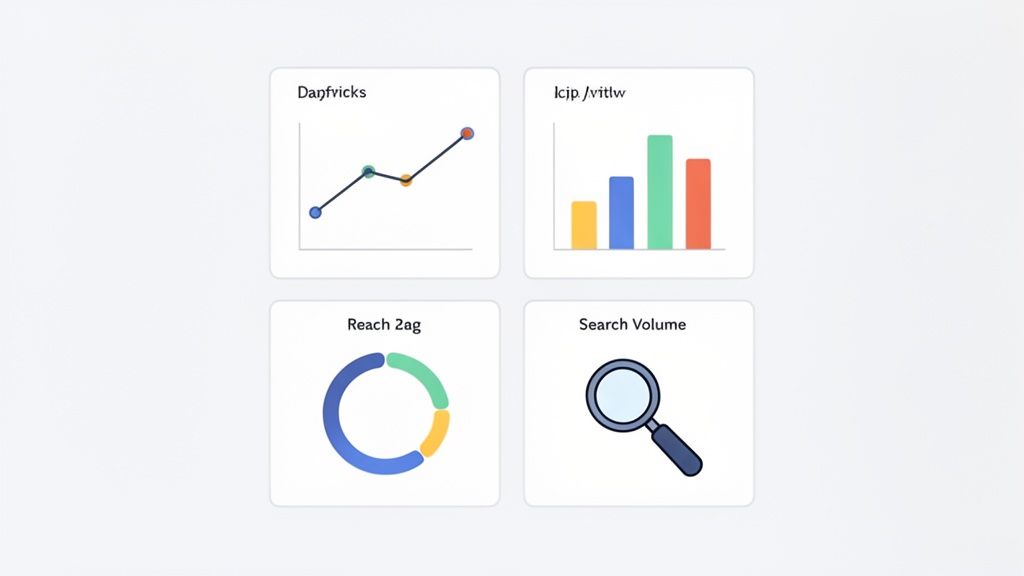
While having clear goals gives you a roadmap, the real proof is in the numbers. Quantitative metrics are the hard data points that tell you exactly how far your brand's voice is traveling. This is how you move from hoping your campaign is working to knowing it is.
By tracking these figures, you can finally draw a straight line from your marketing activities to tangible results. It's the evidence you need to justify your budget, prove your impact, and fine-tune your strategy for even better performance down the road.
Direct and Organic Website Traffic
Think of your website as your brand’s home base. The traffic coming in is one of the purest indicators of brand awareness, especially when you look at Direct Traffic and Organic Search.
Direct traffic is when someone types your URL right into their browser. They didn't stumble upon you; they came looking for you specifically. This is a massive win for brand recall. An uptick here means your brand is becoming a destination, not just a discovery.
Then there's organic traffic from search engines. The key metric to watch is your Branded Search Volume—how many people are typing your company or product names into Google. A steady climb shows that your awareness efforts are working and people are actively seeking you out. All of this data is waiting for you in your Google Analytics account.
Social Media Reach and Impressions
For most brands, social media is where the awareness battle is won or lost. The two metrics that matter most are Reach and Impressions. It's easy to confuse them, but they tell different parts of the story.
- Reach: This is the total number of unique people who saw your content. It’s your total audience size.
- Impressions: This is the total number of times your content was displayed. This number will always be higher because one person can see your post multiple times.
Don't underestimate the power of impressions. The old marketing rule of thumb says it takes 5-7 impressions for a brand to really stick in someone’s mind. That repetition is what builds memory and, ultimately, drives brand recall.
When you're working with influencers, tracking this can get messy fast. A good influencer platform like REACH Influencers solves this by pulling all the reach and impression data from your creators into one simple dashboard. No more chasing down individual screenshots—just a clear view of your campaign's total viewership.
Share of Voice and Search Volume
It’s not just about how much you’re talking; it’s about how much of the conversation you own. That's where Share of Voice (SOV) comes in. SOV tells you what percentage of the conversation in your industry is about your brand versus your competitors. It's a critical benchmark for knowing where you stand.
You can get a similar competitive view by using tools like Google Trends. Just plug in your brand name and your top rivals to see how search interest stacks up over time. Watching your trend line climb above the competition is a clear, visual signal that your awareness strategy is hitting the mark. For a more detailed breakdown, you can learn more about how to do a full share of voice calculation.
When you start looking at the financial return of your awareness campaigns, it’s important to go beyond surface-level metrics. Truly understanding ROI vs ROAS is key to connecting your brand-building efforts to bottom-line business results.
To help you get a handle on all these numbers, it’s useful to see how they compare.
Key Quantitative Metrics to Measure Brand Awareness
This table breaks down the most important hard numbers you should be tracking. It covers what each one actually measures, the best tools for the job, and why it matters for your brand strategy.
| Metric | What It Measures | Primary Tools | Key Benefit |
|---|---|---|---|
| Direct Traffic | The number of visitors who arrive by typing your URL directly. | Google Analytics | Indicates strong brand recall and top-of-mind awareness. |
| Branded Search | The volume of searches for your specific brand or product names. | Google Search Console | Shows how many people are actively looking for your brand. |
| Reach & Impressions | The number of unique people who see your content and how often it's seen. | Native Social Analytics, REACH | Measures the total audience size and message frequency of your campaigns. |
| Share of Voice | Your brand's percentage of the total conversation in your industry. | Social Listening Tools | Provides a clear benchmark against your direct competitors. |
By keeping a close eye on these metrics, you're no longer guessing. You're building a data-driven case for your brand’s growing influence in the market.
Getting a Feel for Brand Perception: The Qualitative Side
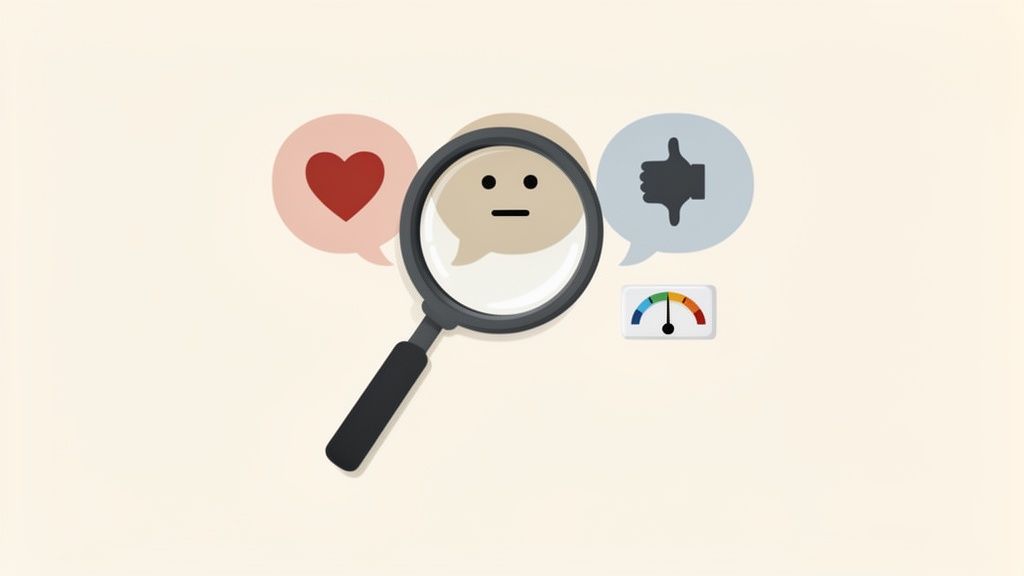
While the hard numbers give you the "what," qualitative metrics are where you find the much more insightful "why." Sure, analytics can tell you how many eyeballs saw your brand, but they can't tell you how people feel about it. If you want to really measure brand awareness, you have to dig into the perceptions, emotions, and conversations happening around your brand.
This is the part where you stop being a scorekeeper and start thinking like a strategist. When you truly understand public perception, you can spot a potential PR mess before it snowballs, figure out which messages are actually hitting home, and tweak your brand voice to build a real connection with your audience.
Tune Into Real Conversations with Social Listening
Think of social listening as the world's biggest and most honest focus group. It's the practice of monitoring online chatter to hear what people are really saying about your brand, your competitors, and your industry. This goes way beyond just tallying up mentions; it's about getting a read on the mood, tone, and themes of those discussions.
By listening in, you get unfiltered feedback on everything from your latest product launch to your customer service. It’s an absolute must-have if you want to measure brand awareness from a human perspective.
Pay close attention to these areas:
- Brand Sentiment: Is the buzz around your brand positive, negative, or just neutral? A sudden nosedive in sentiment is often the first red flag that something’s up.
- Common Themes: What specific words or topics keep popping up with your brand name? This can shine a light on features customers are raving about or pain points that need your immediate attention.
- Competitive Mentions: How does the chatter about your brand stack up against your rivals? Pinpointing these differences can reveal your unique strengths or expose where you’re falling behind.
Find Out Who Remembers You with Brand Perception Surveys
Social listening is amazing for capturing spontaneous, in-the-moment feedback. But sometimes, you need to ask direct questions to measure how well your brand is sticking in people's minds. Surveys are the perfect tool for this.
You’re really looking to measure two types of awareness:
- Unaided Awareness: This is the holy grail. You ask a simple, open-ended question like, "When you think of electric cars, what brands come to mind?" If people name your brand without any hints, you've achieved strong top-of-mind recall.
- Aided Awareness: For this, you give them a little help. You might show a list of logos and ask, "Which of these electric car brands have you heard of?" This measures brand recognition, which is a vital first step on the road to building recall.
Using both types of questions gives you the full picture. A high aided awareness score is good—it means people recognize you. But a high unaided score? That means you're a go-to brand in your category.
It's crucial to connect these qualitative insights to real business outcomes. Brand familiarity isn't just a feel-good metric; 59% of shoppers prefer buying new products from brands they already know. You can discover more insights about the power of brand familiarity and its direct link to purchasing decisions.
Proving Influencer Impact with White-Labeled Reporting
Let’s be honest, qualitative data can feel a bit fuzzy, making it tough to present to clients or your boss. This is where a platform like REACH Influencers can be a game-changer, especially for agencies.
Here’s a real-world scenario. Imagine your agency is running a campaign for a new sustainable skincare line. The goal is to build positive buzz and connect the brand with eco-conscious values. You partner with a handful of creators who are genuinely passionate about clean beauty.
After the campaign wraps, you use REACH’s reporting features to:
- Gather All Mentions: First, pull all the influencer posts and audience comments into one dashboard. No more hunting through dozens of different threads.
- Analyze the Vibe: The platform's tools help you tag conversations as positive, neutral, or negative, giving you an instant snapshot of the overall tone.
- Pinpoint Key Themes: You quickly see that comments are filled with praise for the "compostable packaging" and "cruelty-free certification." Boom—proof that your core message landed.
Instead of forwarding a clunky spreadsheet, your agency can generate a polished, white-labeled report with its own logo. It visualizes the shift in sentiment, highlights the most powerful audience quotes, and tells a clear story: the influencer campaign drove a direct, measurable lift in positive brand perception.
This approach turns subjective feedback into a compelling success story, proving the ROI of an influencer awareness strategy in a way that numbers alone never could.
Building Your Brand Awareness Dashboard
All the data in the world won't do you any good if it’s scattered across a dozen different spreadsheets and reports. To truly understand what’s working, you need to bring everything together. That's where a centralized brand awareness dashboard comes in—it’s less about raw data and more about telling a clear, actionable story about your brand's health.
A good dashboard isn't just a data dump. It's a living document that weaves together the hard numbers, like website traffic and social reach, with the softer, human insights from surveys and social listening. This unified view is what lets you spot trends, see how you’re tracking against your goals, and share your wins with the rest of the team.
Combining Quantitative and Qualitative Data
The real "aha!" moments happen when you start layering these different data types on top of each other. Imagine you see a huge spike in direct website traffic (that's your quantitative data). On its own, that’s nice, but not super insightful. But what if you see it happened right after an influencer campaign where social sentiment (your qualitative data) was off-the-charts positive?
Now you have a narrative. The campaign didn't just create buzz; it drove people who were genuinely interested straight to your site.
To get this kind of holistic view, you need to connect the dots between your key data sources:
- Google Analytics: This is your home base for tracking all things web traffic—direct, organic, and referral visitors.
- Social Media Analytics: Pull your reach, impressions, and engagement numbers straight from the native platforms.
- Survey Results: This is where you add the human element. Weave in your brand recall and perception scores to give the numbers some real-world context.
- Influencer Campaign Data: Use a platform like REACH Influencers to get clean performance metrics like clicks and engagement without having to chase anyone down.
When you put these data streams side-by-side, you stop looking at isolated metrics and start understanding the complete story behind how you measure brand awareness.
What to Include in a Brand Awareness Report
Your dashboard is for your day-to-day analysis, but your report is for everyone else—your boss, your clients, your stakeholders. It needs to be clean, visual, and straight to the point. Think of it as the highlight reel from your dashboard.
A solid report usually includes these four things:
- An Executive Summary: Just one paragraph. What was the goal? What happened? What’s the bottom line?
- Key Performance Indicators (KPIs): Show off your most important metrics with simple charts. The key is to show the trend over time.
- Campaign Highlights: Pull out a specific win and put it in the spotlight. For example, "Our Q2 influencer campaign drove a 20% increase in branded search volume."
- Qualitative Insights: Don't forget the human side. A few powerful quotes from social media or survey responses can add a ton of color to the data.
This structure means even the busiest executive can get the gist of your impact in just a few minutes.
Simplifying Your Dashboard with the Right Tools
Let's be honest, manually pulling all this data together is a massive time-suck. This is why having integrated tools is a game-changer. For anyone running creator partnerships, the REACH Influencers platform is a must-have. Its live reporting means you can export clean, reliable influencer campaign data with just a couple of clicks.
Building a truly effective brand awareness strategy requires a smart allocation of resources. It's telling that globally, 47% of companies prioritize awareness as their top content marketing goal, recognizing that it takes multiple impressions to build recall. To dive deeper into how brands are investing in this, explore the latest branding statistics and see the data behind successful campaigns.
Instead of nagging creators for screenshots, you get a single source of truth. You can then feed this data right into your dashboard alongside your Google Analytics and survey results to tell a really compelling story of growth. The right marketing dashboard software doesn't just show you numbers; it helps you connect your influencer activities directly to tangible business outcomes, making it so much easier to prove your worth.
Turning Awareness Insights Into Strategic Action
All the data in the world is useless if you don't do anything with it. To truly measure brand awareness, you have to move past just tracking numbers and start turning your findings into a real, actionable roadmap for growth.
This is where your insights start to pay off—guiding you to sharpen your marketing messages, fine-tune your channel mix, and make much smarter decisions about where your budget goes.
Building Your Brand Dashboard
Creating a brand dashboard is a game-changer. It’s how you take a pile of raw data and transform it into a clear, compelling story about how your brand is performing in the wild.
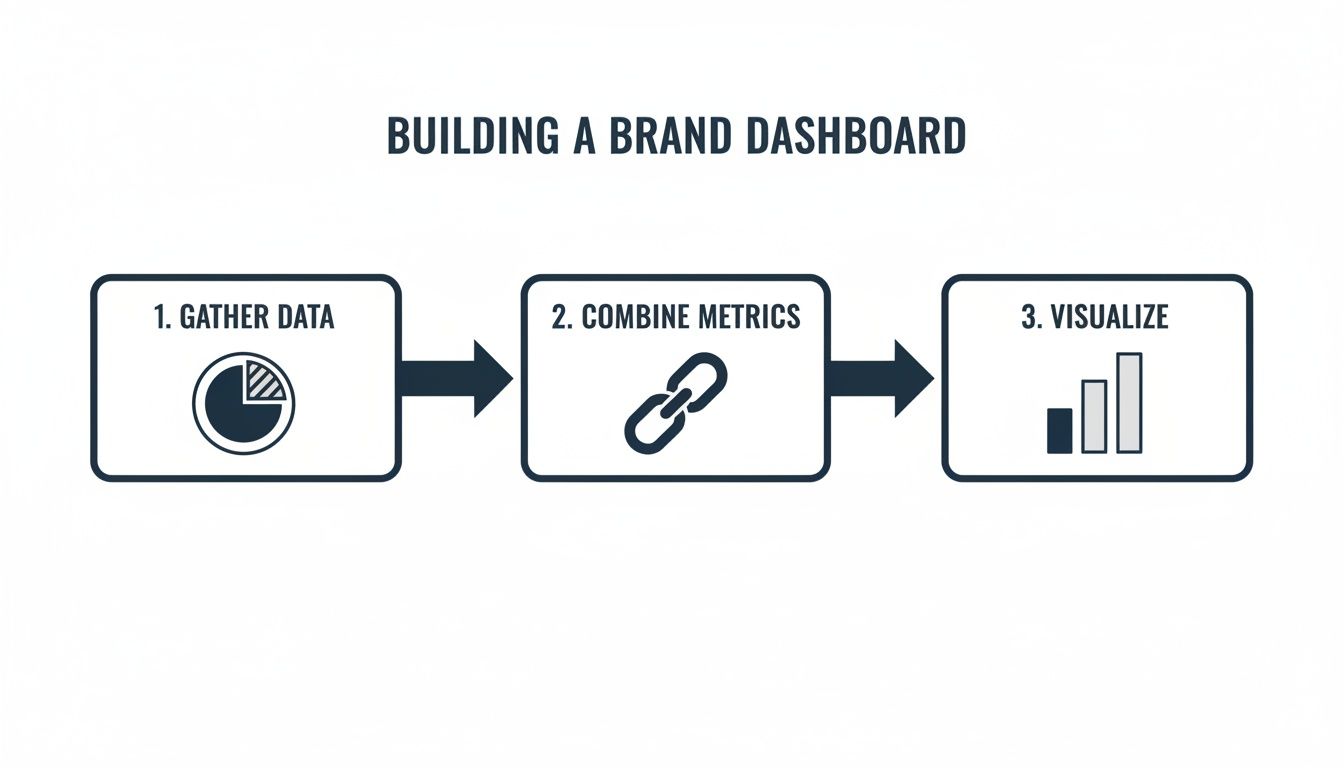
The flow is straightforward: you gather all your different data points, combine the metrics to get the full picture, and then visualize everything to see what’s really going on.
The real win isn’t just watching numbers go up. It’s understanding why they're changing and what you need to do next. Are certain influencer partnerships generating more positive sentiment? Is that new campaign actually increasing your share of voice? These are the questions your dashboard should help you answer.
From Measurement to Mastery
Connecting these dots is what separates good marketers from the great ones. For instance, when you pull your influencer campaign analytics into the same view as your website traffic, you can suddenly see which creators are driving real, qualified visitors—not just empty impressions.
The ultimate goal of measurement is not just to report on the past, but to shape the future. Your dashboard should be a living tool that fuels constant improvement and guides your next big marketing move.
This is where a platform like REACH Influencers becomes incredibly helpful. It gives you clean, real-time analytics that you can easily export and plug right into your main marketing reports.
This lets you calculate the Earned Media Value of your influencer content and finally connect your awareness efforts to tangible business value. By integrating your data this way, you make attribution way simpler and can start building more impactful strategies.
It’s time to stop just measuring and start acting.
A Few Common Questions We Get About Brand Awareness
As you start putting a real system in place to track brand awareness, you're going to have questions. Everyone does. Here are some of the most common ones we hear, along with some straight-to-the-point advice to help you get clarity.
How Often Should We Be Measuring This Stuff?
The short answer is: it depends. For the big-picture strategic view, running a deep-dive analysis every quarter is a solid rhythm. It's enough time to let larger campaigns play out and spot real trends, but not so long that you're flying blind.
But that doesn't mean you ignore everything in between. You'll want to keep a much closer eye on real-time indicators like social media mentions, direct traffic to your website, and the volume of people searching for your brand name. We recommend checking these weekly, or even daily if you're in the middle of a big influencer push or a product launch. This is how you catch things early and make smart adjustments on the fly.
What’s the Real Difference Between Brand Awareness and Brand Recognition?
People often toss these terms around like they're the same thing, but they’re not. Knowing the difference is crucial because it helps you set the right goals for your measurement.
Here’s a simple way to think about it:
- Brand Awareness is the shallow end of the pool. It’s simply whether someone knows your brand exists. Think of it as answering the question, "Have you ever heard of Brand X?"
- Brand Recognition is when someone can actually pick your brand out of a lineup. They see your logo, your specific colors, or your packaging and know it’s you, even without your name plastered on it.
Unaided recall surveys are great for measuring pure awareness. To gauge recognition, you’d show someone your logo and ask if they can name the company. Both are valuable, but they tell you very different stories about how well you've cemented your brand in people's minds.
Can a Small Business Actually Measure Awareness on a Shoestring Budget?
You bet. You don’t need an enterprise-level budget or a dedicated data science team to get a good read on your brand's visibility. There are plenty of fantastic tools out there that are either free or very affordable.
If you're just starting out, these are your best friends:
- Google Alerts: Set up alerts for your brand name, key products, and even your CEO. It's a simple way to see who's talking about you online.
- Google Trends: This is perfect for a quick competitive analysis. See how search interest for your brand stacks up against others in your space.
- Native Social Analytics: Don't sleep on the free insights dashboards inside platforms like Instagram and Facebook. They give you a direct look at your reach and engagement numbers.
These freebies give you more than enough data to build a solid foundation for your measurement strategy without spending a dime.
Ready to stop guessing and start measuring the real impact of your influencer marketing? REACH Influencers provides a powerful, all-in-one platform to track campaign performance, analyze audience sentiment, and prove the ROI of your brand awareness efforts. Get started with REACH today.
{
“@context”: “https://schema.org”,
“@type”: “BlogPosting”,
“mainEntityOfPage”: {
“@type”: “WebPage”,
“@id”: “https://reach-influencers.com/blog/measure-brand-awareness”
},
“headline”: “How to Measure Brand Awareness: 10 Essential Metrics to Prove Its Value”,
“description”: “Learn how to measure brand awareness effectively with our complete guide. Discover the key quantitative and qualitative metrics you need to track to prove the value of your marketing campaigns.”,
“image”: “https://cdn.outrank.so/64cdc0e0-2a54-4cd9-a45d-c4196c5e1d4e/94fab250-7a12-4f58-aada-1b0086dfec53/measure-brand-awareness-market-analysis.jpg”,
“author”: {
“@type”: “Organization”,
“name”: “REACH Influencers”,
“url”: “https://reach-influencers.com/”
},
“publisher”: {
“@type”: “Organization”,
“name”: “REACH Influencers”,
“logo”: {
“@type”: “ImageObject”,
“url”: “https://reach-influencers.com/logo.png”
}
},
“datePublished”: “2023-10-10”,
“dateModified”: “2023-10-10”,
“faqPage”: {
“@type”: “FAQPage”,
“mainEntity”: [{
“@type”: “Question”,
“name”: “How often should we be measuring brand awareness?”,
“acceptedAnswer”: {
“@type”: “Answer”,
“text”: “For strategic analysis, measure brand awareness quarterly. For real-time indicators like social mentions and direct traffic, check weekly or daily during active campaigns to make timely adjustments.”
}
},{
“@type”: “Question”,
“name”: “What’s the difference between brand awareness and brand recognition?”,
“acceptedAnswer”: {
“@type”: “Answer”,
“text”: “Brand awareness is whether someone has heard of your brand (recall). Brand recognition is whether someone can identify your brand from visual cues like a logo or color scheme (recognition).”
}
},{
“@type”: “Question”,
“name”: “Can a small business measure awareness on a budget?”,
“acceptedAnswer”: {
“@type”: “Answer”,
“text”: “Yes, small businesses can measure brand awareness effectively using free tools like Google Alerts, Google Trends, and native social media analytics dashboards to track mentions, search interest, and reach without a large budget.”
}
}]
}
}