 Skip to content

At their core, influencer marketing platforms are specialized software tools built to run influencer campaigns from discovery to payment. Think of them as a central command center for finding creators, managing contracts, tracking performance, and processing payments—turning what was once a messy, manual process into a streamlined, data-driven operation.
Why Influencer Marketing Platforms Are Essential

Finding the right influencer is just the first step. To actually manage these collaborations effectively, you need a system—and spreadsheets and endless email chains just don't cut it. As more brands ditch one-off partnerships for scalable, long-term programs, having a dedicated tool becomes absolutely critical.
Influencer marketing platforms tackle the biggest hurdles that hold campaigns back. Instead of losing hours scrolling through social media, you can use powerful search tools to pinpoint creators whose audiences perfectly align with your target customers. This isn't guesswork; it's data-backed selection. For a deeper dive into the strategic advantages, you can explore the primary https://reach-influencers.com/benefits-of-influencer-marketing/ in more detail.
From Chaos to Control
Without a centralized platform, campaign management quickly descends into chaos. Key tasks get lost in the shuffle, deadlines are missed, and the results feel inconsistent. A good platform brings order to the entire process by consolidating all the moving parts.
- Creator Discovery and Vetting: You get access to massive databases with detailed analytics on audience demographics, engagement rates, and past campaign performance, helping you make smarter partnership choices.
- Campaign Workflow Automation: It helps streamline everything from the first outreach email and contract negotiations to content approvals and post scheduling, all from one dashboard.
- Payment and Compliance: You can automate influencer payments and handle all the necessary tax documentation, making sure everyone gets paid on time and by the book.
- Performance Analytics: Track key metrics in real time to measure ROI and see exactly which influencers and what type of content deliver the best results.
These platforms are more than just databases; they are strategic command centers that provide the structure and insights needed to build predictable, high-performing influencer programs.
The market’s explosive growth proves how essential these tools have become. The global influencer marketing platform market was valued at USD 25.44 billion in 2024 and is expected to hit USD 97.55 billion by 2030. The 'search and discovery' feature alone makes up over 32% of that market, which tells you how important finding the right creator is.
To see how these platforms fit into the bigger picture, this actionable guide to social media marketing provides excellent context on their role within a complete digital strategy.
Key Features That Define a Great Platform
Before we start comparing influencer marketing platforms, we need to establish what "good" actually looks like. It’s easy to get lost in a sea of features, but not all tools are built the same, and the right one for you hinges entirely on your goals. Let's move past the basic checklist and dig into the capabilities that will genuinely move the needle for your campaigns.
The starting point for any successful campaign is finding the right people. This is about so much more than just follower counts and industry tags. A great platform helps you zero in on the perfect creators with surgical precision, saving you from the soul-crushing grind of manual searches that rarely pan out.
Deep Creator Discovery and Vetting
A powerful discovery engine is your first line of defense against a bad partnership. It needs to let you search with specific, nuanced criteria that mirror your ideal customer.
For example, searching for a "beauty influencer" is worlds apart from searching for a "vegan skincare creator in California with an audience primarily aged 25-34 and an engagement rate over 3%." That second, highly-targeted search is where the real value lies, and it’s a non-negotiable feature of any serious platform.
Here's what to look for:
- Advanced Audience Demographics: You need a clear window into an influencer’s audience—their age, gender, location, and interests.
- Authenticity Scoring: AI-driven analysis is crucial for flagging creators with fake followers or suspicious engagement, protecting your budget from fraud.
- Content Keyword Search: The ability to search an influencer’s past content is a game-changer. You can find creators who are already talking about your brand or related topics organically.
A platform's true worth isn't measured by the size of its database, but by the depth of its filters. The real goal is to find creators whose audience is already your target market. That's how you guarantee your message will hit home.
Streamlined Campaign Management
Once you’ve found your creators, the platform has to make managing the actual campaign simple. Trying to juggle communication across emails, DMs, and spreadsheets is a disaster waiting to happen—think missed deadlines, mixed messages, and a whole lot of frustration. The best tools centralize everything.
This means you get a single dashboard to manage everything from the initial outreach pitch to the final payment. All your messages, content drafts, feedback, and approvals should live in one place, creating an undeniable source of truth for every campaign. A huge part of this is embracing influencer marketing automation to handle the repetitive busywork, freeing up your team to focus on strategy.
Robust Analytics and ROI Tracking
At the end of the day, you have to prove your work is delivering results. The best platforms provide clear, actionable analytics that tie your campaign activities directly to business outcomes. Likes and comments are nice, but they don't pay the bills.
You should be looking for platforms that deliver:
- Conversion Tracking: Seamless integration with e-commerce platforms to attribute sales to specific influencers, typically through unique affiliate links or discount codes.
- Real-Time Reporting: Live dashboards are essential for tracking performance as it unfolds, giving you the chance to pivot and optimize campaigns mid-flight.
- Earned Media Value (EMV): A solid metric for calculating the dollar value of the engagement and impressions your campaign generated, which is great for reporting up.
This is the kind of detailed reporting that turns your influencer program from a cost center into a legitimate revenue driver. It's how you confidently answer the question, "What was our return on investment?" and make smarter, data-backed decisions for every campaign you run.
Comparing the Top Influencer Marketing Platforms
Picking the right influencer marketing platform isn’t just about buying software; it’s a strategic decision that will define your entire program. With so many great tools out there, the best one for you really boils down to your specific goals, team size, and industry. Let’s move past a simple feature list and really dig into four of the top players—REACH, Grin, Upfluence, and CreatorIQ—from the perspective of what businesses actually need.
This isn't about which platform is "best," but which one is best for you. We'll look at how REACH's predictive AI gives you a strategic advantage, why Grin’s deep e-commerce integrations are a game-changer for DTC brands, what makes Upfluence's massive database so powerful, and when CreatorIQ's enterprise-level security is an absolute must-have.
Grin: The E-commerce Powerhouse
Grin has masterfully carved out its space by focusing almost entirely on direct-to-consumer (DTC) e-commerce brands. The whole platform is engineered around product seeding, affiliate links, and tracking sales from platforms like Shopify, Magento, and WooCommerce. If your main goal is to turn influencers into a direct sales channel, Grin is tough to beat.
The platform's real magic lies in managing relationships with your existing fans—the customers who already buy and love your stuff. It plugs right into your e-commerce system to find influential customers, making it a breeze to invite them into an ambassador program. This strategy builds on genuine loyalty, which almost always results in higher conversion rates.
But Grin’s biggest strength is also its main limitation. Its tools for discovering new influencers who aren’t already customers are not nearly as strong as its competitors. If your brand is focused on a massive awareness push or breaking into new markets, this could be a deal-breaker.
Key Insight: Grin is the go-to choice for product-first DTC brands that want to turn loyal customers into revenue-generating ambassadors. That tight e-commerce integration is what sets it apart.
Upfluence: The Data-Rich Discovery Engine
Upfluence's claim to fame is its absolutely enormous database of creators. With millions of profiles indexed, it offers unmatched scale for brands needing to find influencers in a super-specific niche or run large global campaigns. Its search is driven by smart AI that looks beyond follower counts to analyze content performance and audience engagement.
This platform is a lifesaver for agencies or brands that need to cast a wide net. For instance, a travel company launching a campaign in several countries can use Upfluence to find local travel bloggers in each spot, check their audience demographics, and handle all the outreach in one place. Its browser extension is also incredibly handy, letting you analyze any social profile you come across online instantly.
While the discovery features are phenomenal, the campaign management side can feel a bit clunky compared to more specialized tools. It’s a fantastic platform for finding the right people, but your team might need some extra time getting used to its project management workflow.
CreatorIQ: The Enterprise-Grade Solution
CreatorIQ is built for the biggest brands in the world. It’s designed from the ground up to handle the immense complexity of global companies managing hundreds of campaigns and thousands of influencers at once. The core strengths here are rock-solid security, advanced compliance features, and detailed permission controls.
For a multinational corporation in a regulated field like finance or pharma, these aren't just nice-to-haves; they're essential. CreatorIQ makes sure all influencer content passes strict legal and brand safety checks before it ever goes live. It creates an auditable system of record and even offers API integrations to connect with other enterprise software like Oracle or SAP.
Of course, that level of control and security comes with a hefty price tag, putting it out of reach for most small to medium-sized businesses. The platform's complexity can also be overkill for smaller marketing teams. If you're exploring this space, you can also check out reviews of the best affiliate marketing platforms, as many have overlapping features.
The chart below gives you a visual sense of how these platforms stack up on key metrics like cost, engagement, and the size of their influencer database.
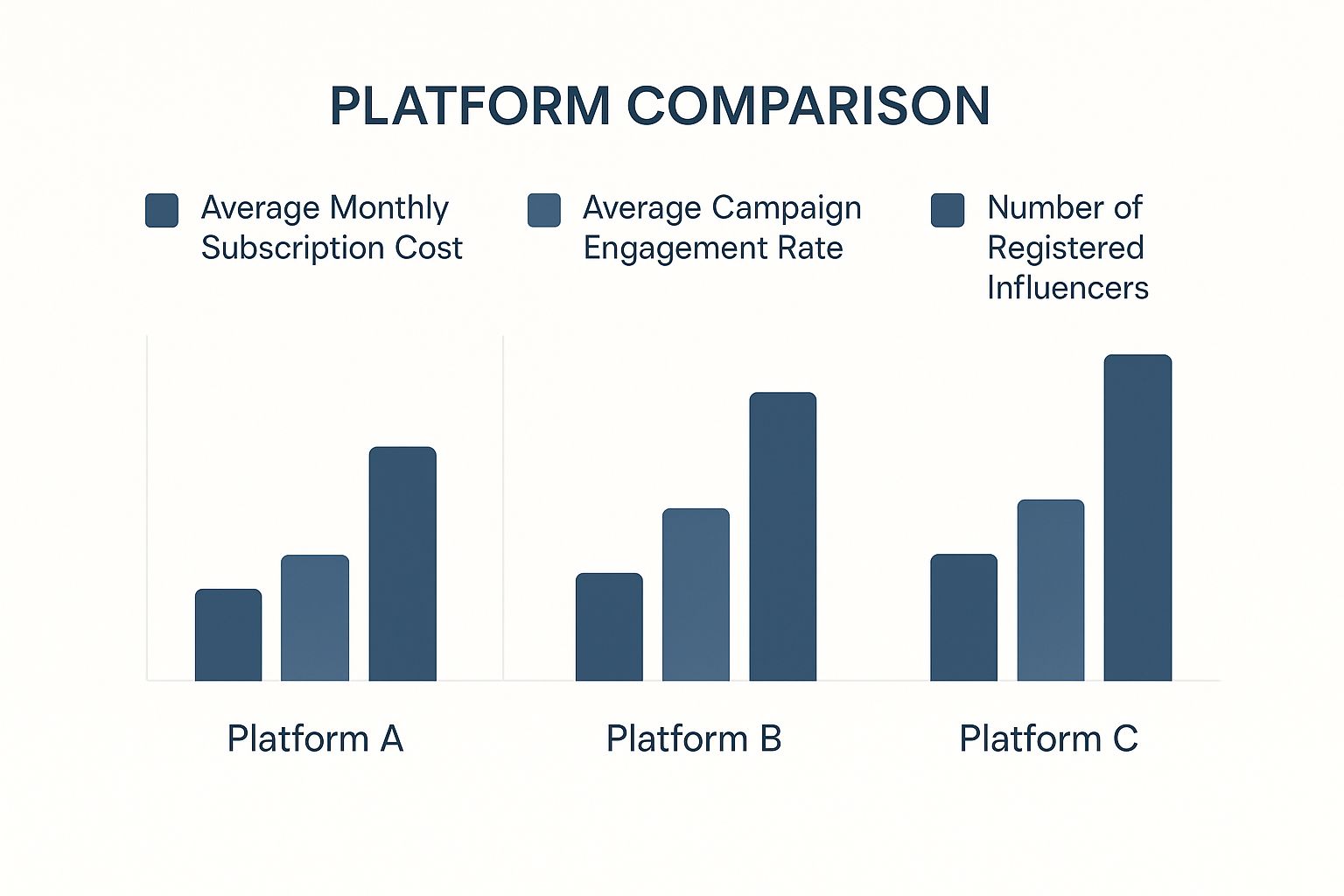
This data really brings the trade-offs into focus, showing how higher costs often come with larger databases or the specialized features needed for enterprise-level work.
REACH: The Strategic All-Rounder
REACH strikes a smart balance between powerful features and a user-friendly design, making it a fantastic choice for everyone from growing agencies to in-house brand teams. What really sets it apart is its use of predictive AI, which goes beyond discovery to actually forecast campaign results. This lets you make data-backed decisions on which influencers will deliver the best ROI before you've spent a dime.
The platform truly shines in situations that demand both broad discovery and precise campaign execution. Take a B2B tech company trying to build authority. REACH can pinpoint niche tech experts on LinkedIn and YouTube, manage the detailed content approval process for technical articles, and track metrics that matter—like webinar sign-ups or whitepaper downloads, not just likes.
It also offers a fully white-labeled solution, which is a huge plus for agencies that want to give clients a branded portal. This, combined with its ability to manage unlimited client projects, makes it incredibly scalable.
Influencer marketing has proven it's here to stay, with the market expected to hit $32.55 billion in 2025. More than 80% of marketers say it's an effective strategy. We're also seeing a huge shift toward nano-influencers, who now make up 75.9% of Instagram's influencer base. This highlights a move toward authenticity and niche audiences—something advanced platforms are perfectly equipped to handle.
At the end of the day, REACH delivers a complete toolkit that can run performance-based and awareness campaigns equally well, all without the enterprise price of CreatorIQ or the narrow focus of Grin. It’s a versatile and powerful option for teams that need to run sophisticated strategies without getting bogged down.
Feature Showdown of Top Influencer Marketing Platforms
To help you see how these platforms stack up at a glance, we've broken down their core strengths and ideal use cases. This table is designed to help you quickly match a platform's capabilities to your own strategic needs.
| Platform | Key Strength | Ideal For | Influencer Discovery Method | ROI Tracking Capability |
|---|---|---|---|---|
| REACH | Predictive AI & All-in-One Campaign Management | Growing brands & agencies needing a versatile, scalable tool | AI-powered database search & outcome forecasting | Advanced, multi-metric performance |
| Grin | Deep E-commerce & CRM Integration | DTC brands focused on product seeding & affiliate sales | E-commerce integration & existing customer identification | Direct sales & affiliate conversion |
| Upfluence | Massive Influencer Database & Search Filters | Businesses needing hyper-niche or large-scale discovery | Extensive database search with advanced AI filtering | Standard engagement & campaign metrics |
| CreatorIQ | Enterprise-Grade Security & Compliance | Large, global corporations in regulated industries | Vetted network & private database integration | Highly customizable, enterprise-grade |
This showdown highlights the distinct personality of each platform. Your choice depends on whether you prioritize e-commerce integration, massive discovery scale, enterprise security, or a strategic, AI-powered all-rounder.
Understanding Platform Pricing and True ROI

When you're shopping for an influencer marketing platform, it’s easy to get fixated on the price tag. But that number is just the beginning of the story. The real value comes from the efficiency, performance, and strategic clarity the tool delivers. To build a strong business case, you have to look past the subscription cost and focus on the overall cost-benefit.
Most platforms follow a few common pricing models. Figuring out which one fits your workflow and budget is the first step. Getting this right means you can align your spending with your campaign goals and avoid any surprise costs down the line.
Unpacking Common Pricing Models
The most familiar model is the Software-as-a-Service (SaaS) subscription, where you pay a flat monthly or annual fee for access. These plans are usually tiered, scaling up based on things like how many users you have, the number of influencers you’re managing, or how many campaigns you’re running at once.
- SaaS Tiers: A basic tier might give a small team influencer discovery and simple campaign tools. An enterprise plan, on the other hand, will unlock advanced analytics, API access, and dedicated support for a larger organization.
- Percentage-of-Spend: Some platforms, especially those that lean more toward managed services, will take a cut of your total campaign spend. This can be a good fit for massive campaigns where the fee is directly tied to your investment.
- Hybrid Models: A growing number of platforms, including REACH, are offering flexible hybrid models. These often combine a base subscription with usage-based charges, so the cost can scale up or down with your program's needs.
Choosing a pricing model isn't just a budget decision—it's a strategic one. A predictable SaaS fee is great for steady monthly planning, while a percentage model can make sense for high-spend, variable campaigns. The best choice is the one that supports how your team actually works.
The right platform more than pays for itself. Industry-wide, businesses see an average return of $5.20 for every $1 invested in influencer marketing. The top performers? They’re getting back as much as $20. To hit those numbers, you need a platform with solid tracking to prove your spend is working.
Calculating the True Return on Investment
Real ROI goes so much deeper than just the revenue a campaign brings in. To make a smart decision, you have to account for all the "hidden" value a platform provides. This includes the soft cost savings and strategic edge that don't always show up on a spreadsheet but make a huge difference to your bottom line.
A good ROI calculation should look at three key areas:
- Saved Labor and Operational Efficiency: Think about all the hours your team sinks into manual tasks—endless scrolling to find influencers, back-and-forth contract negotiations, and wrestling with spreadsheets to build reports. A platform automates that work, freeing up your people to focus on strategy.
- Improved Campaign Performance: When you have the data to pick the right influencers and optimize your campaigns, you get better results. Even a small lift, like a 2% increase in your conversion rate, can generate enough new revenue to easily cover the platform's cost.
- Strategic Value of Data: Good data lets you refine your strategy over time. With each campaign, you get smarter and make better decisions. That cumulative learning is invaluable and gives you a real competitive advantage.
For a DTC brand, the math is pretty clear. If a platform like REACH helps you boost conversions just enough to cover its subscription, every sale after that is pure profit driven by better tech. Being able to forecast results and track performance in real-time makes this a simple calculation. For a deeper dive into the numbers, check out our guide on how to measure influencer marketing ROI.
How to Make Your New Platform a Success From Day One
You’ve signed the contract and picked your new influencer marketing platform. That’s a huge step, but the real work—and the real payoff—begins now. Getting this right isn't just about logging in; it’s about weaving the tool into your team's day-to-day rhythm to get everyone on board quickly and see a return on your investment, fast.
Think of it this way: a powerful tool is useless if it just sits on the shelf. The first thing you should do is plug it into your existing marketing ecosystem. That means connecting it with your e-commerce platform (Shopify, etc.), your CRM, and whatever you use for social media management. This creates a single source of truth and lets data flow freely.
A Phased Rollout Is a Smart Rollout
One of the biggest mistakes I see is a rushed onboarding. Teams get overwhelmed, adoption plummets, and the tool gets blamed. The key is to break the process into small, manageable steps so your team can build confidence as they go.
Here's a simple, three-step plan that works:
- Get the Tech Right First: Before your team even touches the platform, get the integrations sorted. When they log in for the first time, the data they need should already be there. This simple step prevents a lot of initial frustration.
- Run a Pilot Campaign: Choose a small, low-stakes project to test the waters. This gives everyone a chance to learn the ropes—from finding creators to pulling reports—in a real-world setting, but without the pressure of a major campaign launch.
- Train for Your Workflow: Instead of generic training, focus sessions on the exact tasks your team will be doing. Create a simple, internal "how-to" guide that covers your specific processes, like your brand’s rules for creator outreach or your content approval checklist.
This structured approach turns a daunting change into a series of small victories. It helps your team see the platform as an assistant that makes their job easier, not just another piece of software to learn.
The success of any new software comes down to one thing: do people actually use it? A pilot campaign is the ultimate proof of concept for your team. It shows them firsthand how the tool solves real problems, which gets them excited to use it for bigger things.
Set Yourself Up to Measure What Matters
Right from that first pilot campaign, you need to be tracking the right Key Performance Indicators (KPIs). This isn't just about seeing if a campaign worked; it's about proving the platform's value from the very beginning and building the case for why this was a smart investment.
Start by setting clear benchmarks for what "success" looks like. Your initial KPIs should directly address the pain points that led you to buy the platform in the first place.
Here are a few to focus on:
- Time Saved on Creator Discovery: How many hours did your team spend finding and vetting creators before? Compare that to the time it takes now. This is often a huge, immediate win.
- Better Engagement Rates: Are the influencers you're finding through the platform driving higher engagement than the ones you found manually?
- Faster Content Approvals: Track the time it takes for a piece of content to go from submitted to approved. A centralized workflow should dramatically speed this up.
By tracking these kinds of metrics, you build a powerful story backed by data. You'll be able to walk up to any stakeholder and show them exactly how your new platform is making the entire influencer program more efficient and effective.
Your Top Questions About Influencer Platforms, Answered
Jumping into the world of influencer marketing platforms can feel a bit overwhelming, and it's natural to have questions. Getting straightforward answers is the first step toward picking the right tool and building a strategy that actually moves the needle. Let's tackle some of the most common questions we hear from marketers.
Platform vs. Manual Outreach: Is It Worth It?
One of the biggest questions is whether a platform is truly better than just finding influencers on your own. It really boils down to two things: scalability and data-driven decisions.
Sure, you can manually search hashtags and send DMs, but that process just doesn't scale. A dedicated platform automates the discovery, vetting, and management process, saving you countless hours. More importantly, it provides the analytics to measure your return on investment (ROI) accurately—something that's nearly impossible to do effectively with spreadsheets and email chains.
How Do I Choose the Right Platform for My Business?
For small businesses, the decision usually comes down to budget and essential needs. You don't need a huge, enterprise-level system right away. Instead, look for a platform with flexible pricing, a simple user interface, and solid campaign analytics. A solution like REACH is a great starting point because it offers the core tools you need now and can grow with you.
Can These Platforms Actually Track Sales?
Absolutely. This is a common concern, but modern platforms have this figured out. Through unique affiliate links, custom discount codes, and direct e-commerce integrations, you can attribute sales directly back to individual influencers. This moves you beyond vanity metrics like likes and comments and gives you a crystal-clear picture of your financial ROI.
The best influencer marketing platforms don't just play matchmaker. They deliver the hard data you need to prove your campaigns are directly driving revenue and contributing to the bottom line.
Ultimately, the right platform is the one that fits your specific goals, whether you're focused on brand awareness, generating leads, or pushing for direct sales. Don't get distracted by a long list of features. Think about how the tool will fit into your day-to-day work and help you hit your long-term targets. Getting this choice right is the foundation of a successful and scalable influencer program.
Ready to stop guessing and start measuring? See how REACH gives you the tools to find the perfect creators, manage campaigns without the headache, and track your ROI with precision. Start your journey at https://reach-influencers.com.