 Skip to content


Ever heard the term "white label" and wondered what it actually means? It’s simpler than it sounds.
Think of it this way: your favorite local cafe sells amazing muffins. But what if they don't actually bake them? Instead, a wholesale bakery delivers fresh muffins every morning, and the cafe simply slips them into their own branded bags. The cafe gets to sell a top-notch product instantly, and the bakery gains a new customer without having to open its own shop.
That's the essence of a white label solution. It’s a ready-made product or service built by one company that another company can rebrand and sell as its very own. In this guide, we'll break down everything you need to know about what a white label solution is and how you can leverage one to accelerate your business growth, using real-world examples from industry-leading platforms like REACH Influencers.
Table of Contents
- Decoding the White Label Concept
- The Real Business Benefits of a White Label Solution
- How White Label Solutions Work in the Real World
- How to Choose the Right White Label Partner for Your Agency
- Understanding the Risks and How to Avoid Them
- Why a White Label Solution is the Future of Agency Growth
- Frequently Asked Questions About White-Label Solutions
Decoding the White Label Concept

In the business world, a white label solution is a powerful shortcut. It lets you offer your clients expert-level services or advanced software without having to sink a ton of time, money, and headaches into building it all from scratch.
The original creator makes a "blank" product, and you, the reseller, put your own logo, colors, and marketing on it. To your clients, it looks and feels like something you built just for them.
This strategy is a huge deal in the software and digital marketing space. Why spend a year and a six-figure budget developing a new platform when you can license a ready-made one and start selling it next week? It’s a game-changer for anyone looking to grow their business fast.
A Quick Way to Add New Services
The real magic of a white label solution is that it gives you instant expertise and infrastructure.
Let’s say you run a digital marketing agency and want to start offering influencer marketing services. Building a platform that can find influencers, manage campaigns, and track results is a massive project. It requires developers, data scientists, and a whole lot of testing.
Instead, you could partner with a provider like REACH Influencers. They provide the enterprise-level platform, and you put your agency's brand on it. Suddenly, you can:
- Launch new offerings fast: You can go from idea to a market-ready service in a matter of days, not years.
- Look like a major player: Offering clients sophisticated tools makes your brand appear more credible and established.
- Focus on what you do best: You can spend your time on client strategy and building relationships, leaving the heavy lifting of software development to your partner.
In essence, white labeling is about smart partnerships. It’s like standing on the shoulders of specialists to deliver more value to your own customers. You get to scale your business without the usual growing pains—it’s the ultimate shortcut for agile growth.
White Label vs. Building In-House: a Quick Comparison
Deciding whether to buy or build is a classic business dilemma. Here’s a quick breakdown to help you see the differences at a glance.
| Aspect | White Label Solution | In-House Solution (From Scratch) |
|---|---|---|
| Time to Market | Almost immediate; weeks or even days. | Long and unpredictable; months to years. |
| Upfront Cost | Low; typically a subscription or licensing fee. | Extremely high; requires salaries, infrastructure, and R&D. |
| Ongoing Maintenance | Handled by the provider; included in the fee. | Your responsibility; requires a dedicated team and budget. |
| Expertise Required | Minimal; you focus on sales and marketing. | Extensive; need developers, project managers, and designers. |
| Customization | Limited to branding and some features. | Fully customizable to your exact specifications. |
| Risk | Low; you’re using a proven, tested product. | High; risk of budget overruns, delays, and market failure. |
Ultimately, a white label solution is perfect for businesses that want to expand their offerings quickly and affordably, while an in-house build makes sense for companies with very specific needs and the deep pockets to fund a long-term development project.
The Real Business Benefits of a White Label Solution
Going the white-label route is so much more than a simple shortcut. Think of it as a strategic lever you can pull for surprisingly fast business growth. The perks go way beyond just saving a few bucks; they create a ripple effect that strengthens your brand, helps you build better client relationships, and clears your path to becoming a leader in your space.
The biggest, most immediate win? You get to market fast.
Instead of spending months—or even years—stuck in the research, development, and testing phases, a white-label partnership lets you roll out a new, polished service in just a few weeks. That kind of speed gives you a massive leg up on the competition, allowing you to react to what the market and your clients need, almost in real time.
Accelerate Growth and Save a Ton of Money
Let's be honest: building a sophisticated software platform from scratch costs a fortune. You need to hire specialized developers, designers, and project managers. And that’s before you even think about the ongoing costs for maintenance, updates, and server space. A white-label solution sidesteps all of that.
You get to skip the entire development headache, turning what would have been a huge upfront investment into a predictable, manageable operating cost. Research shows that companies using white-label solutions can slash their time-to-market by 60–70%. Some reports even suggest you can launch a product six to twelve times faster, turning a multi-year project into something you can get done in a matter of weeks. You can dig deeper into how SaaS companies use this model on callin.io.
All that money you save can be poured back into things that actually grow your business:
- Sales and Marketing: Funnel your budget into getting new customers, not funding a dev team.
- Client Services: Invest in building stronger relationships and making sure your clients are successful.
- Core Business Operations: Double down on what you already do best.
Focus on What You’re Actually Good At
Every business has something it excels at—its core strength. For a marketing agency, that’s probably client strategy, killer creative campaigns, or building fantastic relationships. The nitty-gritty of building and maintaining software? That's usually just a distraction.
A white-label strategy lets you hand off all that technical heavy lifting to a partner who lives and breathes it.
By outsourcing the tech, you free up your team's most precious resource: their time. This lets everyone concentrate on the high-value work that brings in revenue and makes clients happy, instead of getting bogged down in software bugs and feature requests.
Take an agency using a platform like REACH Influencers as their own white-label influencer marketing tool. They don't have to waste a second worrying about keeping the influencer database updated or making sure the analytics engine is working. Instead, they can put all their energy into crafting amazing influencer strategies for their clients, all while using a powerful tool that looks and feels like their own.
That kind of laser focus is what separates the good agencies from the great ones.
How White Label Solutions Work in the Real World
To really get what a white-label solution is, you need to see it in action. The funny thing is, you probably already have. These partnerships are everywhere, quietly powering the products and services you use every day, from the store-brand cereal at the supermarket to the slick software your local businesses use.
Let's take a digital marketing agency, for example. They want to offer clients some seriously impressive SEO reports. Instead of spending a year and a small fortune building their own analytics tool, they can use a white-label SEO platform. They just slap their logo on it, tweak the colors to match their brand, and present it to clients as their own in-house tech. The client gets amazing data, and the agency instantly adds a high-value service to its menu.
It’s the same story with the mobile banking app from your local credit union. Chances are, a bigger financial tech company built the app and simply rebrands it for hundreds of different credit unions. This lets smaller banks offer a fantastic digital experience without the eye-watering cost of building an app from scratch.
Elevating Agency Services with a White Label Solution from REACH
For marketing agencies, white-labeling isn't just a shortcut—it's a massive strategic advantage, especially in a niche like influencer marketing.
Imagine an agency using a platform like REACH Influencers. They can embed this powerful tool directly into their own client portal. Forget clunky spreadsheets and endless email chains. Now, the agency gives its clients a polished, professionally branded dashboard where they can see influencer profiles, approve content, and track campaign results in real time.
This simple move changes everything. The agency goes from just providing a service to offering a complete technology solution. It creates a new revenue stream, builds incredible client trust, and makes the agency look like an industry leader.
This diagram breaks down how white-labeling acts as a growth accelerator, letting you launch quickly, cut costs, and stay focused on what you do best.
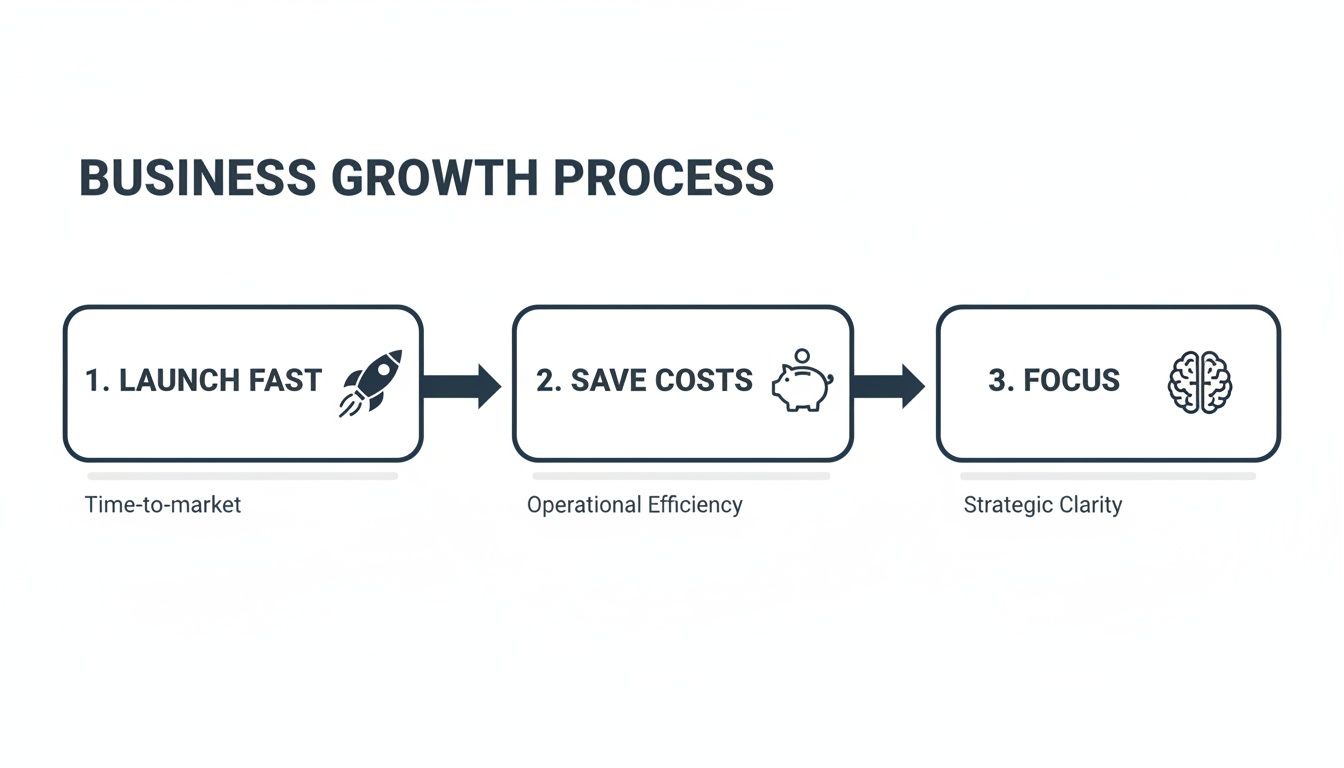
The real magic is how these benefits feed each other. When you launch faster and spend less, you free up time and money to double down on your core strengths.
And this strategy goes way beyond software. Just look at the global white-label cosmetics market—it’s expected to reach $1.57 billion by 2030. That’s a huge number, and it shows how brands of all kinds use white-labeling to jump into new markets without having to build their own factories.
For any agency that wants to grow its services without the growing pains, looking into a white label marketing software is the clear next step. It’s how you get the tools to go toe-to-toe with the big fish, without the massive overhead.
How to Choose the Right White Label Partner for Your Agency
Picking a white-label provider is a huge decision for your agency. Seriously. This isn't just about buying a piece of software; it's about starting a partnership that will directly shape your brand’s reputation and your clients' results. Think of the right partner as a silent, invisible extension of your own team—one that helps you deliver amazing work.
On the flip side, the wrong choice can quickly spiral into a nightmare of technical glitches, frustrated clients, and a damaged reputation. A solid partnership is built on reliability and a genuine understanding of what your agency actually needs. That’s why you can’t just skim the surface; you need to dig deep and vet them properly.
The Core Things to Look For
Before you even think about signing a contract, you need to put potential partners under the microscope. Your evaluation should focus on a few key areas that will ultimately define the quality of service you can provide and how smoothly your operations run.
First up: the product itself. How good is it, really? Is the platform stable or full of bugs? Does it have the features your clients need to succeed? A clunky or outdated tool will make your agency look bad, no matter how slick your branding is.
Next, look at how much you can customize it. A real white-label solution should feel like it’s yours. That means you can add your own logo, use your brand colors, and host it on your own domain. Your clients should never even guess that another company is behind the tech.
A partner’s commitment to your growth is a key indicator. Look for providers who are constantly innovating and improving their product. A stagnant platform today will be an obsolete one tomorrow, putting your agency at a competitive disadvantage.
Finally, don't overlook their support and pricing. When something inevitably goes wrong, you need a support team that gets it and responds fast. And the pricing? It needs to be crystal clear. Hidden fees and surprise charges will eat into your profits and cause major headaches.
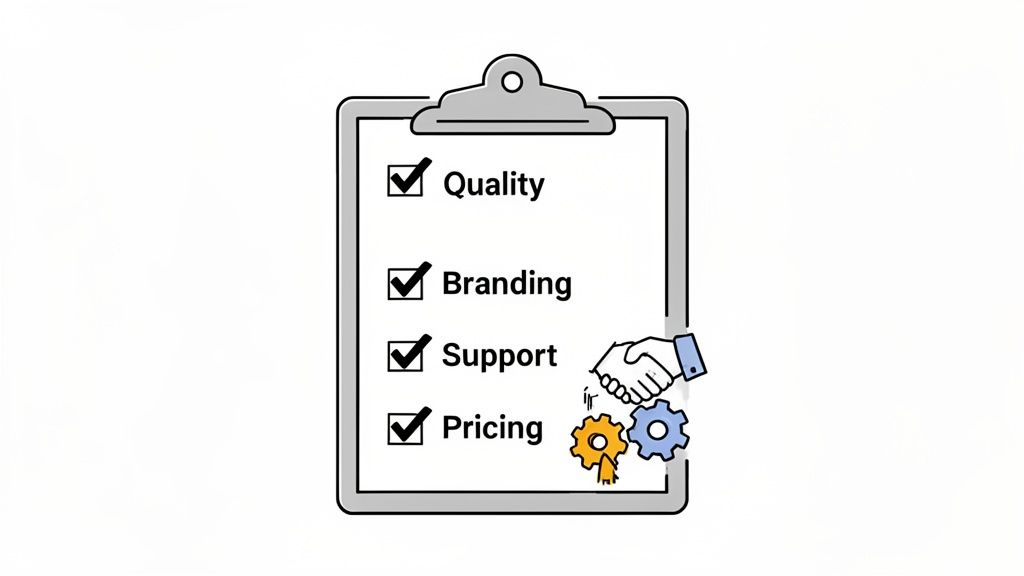
To help you stay organized during your search, use this checklist to compare potential providers side-by-side.
Checklist for Vetting Your White Label Partner
| Evaluation Criteria | Key Questions to Ask | Red Flags to Watch For |
|---|---|---|
| Product Quality & Reliability | – How often do you ship updates? – Can I see a live demo or start a trial? – What is your guaranteed uptime? |
– Vague answers about the product roadmap. – A clunky or outdated user interface. – Poor reviews mentioning bugs or instability. |
| Branding & Customization | – Can I use my own custom domain? – How much of the interface can I rebrand (logos, colors)? – Is your company's name visible anywhere to my clients? |
– Limited branding options (logo-only). – Their branding appears on reports or emails. – "Powered by" logos you can't remove. |
| Customer Support | – What are your support hours? – Do I get a dedicated account manager? – What is your average response time for critical issues? |
– Support is only available via email or a slow ticketing system. – No priority support for agency partners. – Generic, unhelpful responses. |
| Pricing & Scalability | – Is the pricing tiered based on usage or clients? – Are there any setup fees or hidden costs? – How does the cost change as my agency grows? |
– A complex pricing model that's hard to understand. – Extra fees for adding more users or clients. – No discounts for annual commitments. |
| Agency-Specific Features | – Can I manage multiple client accounts from one dashboard? – Do you offer client-facing, shareable reports? – Is there an API for custom integrations? |
– The platform is a one-size-fits-all B2B tool. – Reporting is basic and not designed for client presentations. – No features for team collaboration or user permissions. |
Diligently going through these points will save you a world of trouble and ensure you find a partner who is truly invested in helping your agency succeed.
Find a Partner That’s Built for Agencies
When you're looking at different options, focus on platforms tailored for agencies. Why? Because they get it. They understand the chaotic, multi-client world you live in. A generic B2B tool just isn't built for the juggling act of managing different client accounts, each with its own goals and stakeholders.
You should be on the lookout for features designed specifically for agency life:
- Unlimited Client Projects: Can you add as many clients as you want without getting hit with extra fees for each one?
- Live Reporting Dashboards: Does the platform let you create custom, shareable reports that make it easy to show clients their ROI?
- Dedicated Agency Support: Do you get a dedicated contact person or a priority support line that understands your business is on the line?
Companies like REACH Influencers are a perfect example of a partner that understands the agency model. By offering a true white label influencer software for agencies, they give you the foundation you need to scale your influencer marketing services confidently and professionally.
Understanding the Risks and How to Avoid Them
While jumping into a white-label solution can feel like a shortcut to explosive growth, it's definitely not a magic bullet. To really know if it's the right move, you have to look at the potential downsides with eyes wide open. After all, you're handing over a core piece of your service delivery to another company, and that comes with risks you just don't have when you build everything in-house.
The biggest one? You're completely dependent on your provider. Their stability becomes your stability. If their platform goes down or gets buggy, your clients don't see the provider's mistake—they see your failure. This reliance trickles down to everything, including updates and bug fixes. You’re stuck on their timeline, which can be incredibly frustrating when you need a problem solved yesterday.
Navigating Customization and Support Limits
Another common headache is limited customization. Even the best white-label partners have their limits. While you can slap your logo on it and change the colors, you'll rarely get the same unique functionality you could from a custom-built tool. If your agency’s secret sauce is a very specific feature, a pre-built solution might feel like a straitjacket, and your brand could get lost if the platform feels too cookie-cutter.
Finally, think about customer support challenges. When your client has a technical issue your team can’t solve, who do you call? Your provider. A slow, unhelpful, or just plain confusing response from them can directly damage the trust you’ve built with your client. This is exactly why a clear Service Level Agreement (SLA) isn't just nice to have—it's a dealbreaker.
The key takeaway is this: When you choose a white label partner, you're not just buying software; you're entrusting them with a piece of your brand's reputation. Due diligence isn't just recommended—it's essential.
So, how do you protect yourself? Here are a few practical steps to take before signing on the dotted line:
- Choose Proven Partners: Don't be a guinea pig. Go with providers who have a long, stable track record and great reviews from other agencies. You want a company that's built to handle the kind of work you do.
- Negotiate a Strong Agreement: Get everything in writing. Your contract needs to spell out uptime guarantees, support response times, and a clear schedule for updates. Using a solid marketing agency contract template can be a great starting point to make sure you've covered all your bases.
- Test Deeply: Take that free trial and push it to its limits. Don't just look at the dashboard—submit real support tickets to see how fast and helpful their team is. See just how far you can push the branding and customization to make sure it truly feels like your platform.
Why a White Label Solution is the Future of Agency Growth
In today's market, specialization is the name of the game. Gone are the days when a company could—or should—build every single tool it needs from scratch. Technology just moves too fast, and trying to keep up on your own is not just impractical, it's incredibly expensive.
This is exactly why white labeling has shifted from a niche tactic to a core strategy for smart, modern growth.
For agencies, this isn't just a trend; it's the new standard for staying competitive and profitable. Platforms like REACH Influencers, for example, give agencies the power to offer top-tier influencer marketing services without the astronomical cost of developing proprietary software. This levels the playing field, allowing smaller, more nimble agencies to go head-to-head with the big players.
The New Economic Reality
The modern economy rewards one thing above all else: focus. Companies that do one thing exceptionally well are the ones that win. White labeling lets your agency tap into that specialized expertise instantly, offering best-in-class solutions to your clients, all under your own brand.
It's a forward-thinking model that's built on smart collaboration rather than trying to reinvent the wheel.
A white-label strategy is fundamentally about using someone else's expertise to fuel your own growth. It's how smart agencies expand their services without expanding their payroll.
And the market data backs this up. The global white-labeling market is on track to hit an incredible $75.0 billion by 2033. Even more telling is that agencies outsourcing 40–60% of their services to white-label partners grow about 2.3× faster and see 20% higher profit margins. You can dig into the numbers in this in-depth market analysis.
Capitalizing on Emerging Technologies
This strategic shift is especially powerful in fast-moving industries. Just look at the rise of the specialized AI automation agency. White labeling is what allows businesses to quickly add these complex services and jump on new opportunities as they appear.
By partnering with a white-label provider, an agency can roll out a sophisticated new service almost overnight. That kind of agility is crucial for keeping clients happy and building a sustainable, profitable business in a market that simply never stops changing.
Frequently Asked Questions About White-Label Solutions
It's natural to have questions when you're exploring white-label solutions. Getting a handle on the specifics is the best way to figure out if this approach really lines up with your business goals.
Let's clear up some of the most common questions people ask.
What Is the Real Difference Between White Label and Private Label?
These two terms get thrown around a lot, and it's easy to mix them up. But the difference is actually pretty straightforward.
Think of white label as a "one-to-many" model. A company creates a fantastic piece of software or a great product, then lets lots of other businesses—like yours—slap their own brand on it and sell it as their own. Imagine a single, powerful marketing automation tool being used by 100 different agencies, each with its own logo and colors. That's white label.
Private label, on the other hand, is a "one-to-one" deal. This is when a manufacturer creates a unique product for just one company, often built to their exact specs. The classic example is a grocery store chain hiring a food company to create a unique, store-brand cereal recipe that nobody else can sell.
The key takeaway? Exclusivity. White label is about reselling a proven product; private label is about creating a totally unique one.
How Quickly Can We Implement a White-Label Software Solution?
Speed is one of the biggest wins here. Compared to the marathon of building your own software from the ground up, getting started with a white-label solution is a sprint. You’re typically looking at days or weeks, not the months or years it takes for in-house development.
For most modern platforms, the process is simple and direct:
- Sign Up: You pick your plan and get your credentials.
- Brand It: This is the fun part. You upload your logo, plug in your brand colors, and set up a custom domain so it looks and feels like it’s yours.
- Train Your Team: Get your crew comfortable with the new tool so they can start delivering for clients.
Platforms like REACH Influencers are built for this kind of quick, painless setup. The goal is to get you offering powerful new services to your clients almost right away.
Can You Build a Profitable Business Using Only White-Label Products?
Yes, you absolutely can. In fact, it’s a proven business model for countless successful agencies and resellers. By using white-label products, you can present yourself as a full-service shop without needing a massive, expensive development team for every single service you offer.
The secret to making it profitable isn't just reselling a tool—it's about the value you add on top. Your real product is the strategy, the expert execution, and the top-notch client management you provide. The white-label software is simply the engine. This allows you to charge premium prices for your expertise while keeping your own costs predictable and low.
By now, you should have a clear understanding of what a white label solution is and how it can be a powerful tool for scaling your agency. It allows you to expand your services, enhance your brand authority, and focus on your core strengths without the immense cost and time commitment of in-house development. Ready to see how a white-label solution can put your agency on the fast track to growth? REACH Influencers offers a powerful, fully brandable influencer marketing platform designed to help you deliver exceptional results for your clients.
{
“@context”: “https://schema.org”,
“@type”: “BlogPosting”,
“mainEntityOfPage”: {
“@type”: “WebPage”,
“@id”: “https://reach-influencers.com/blog/what-is-white-label-solution”
},
“headline”: “What Is a White Label Solution and How Can It Grow Your Business?”,
“description”: “Discover what a white label solution is and how it can accelerate your business growth. Learn the benefits, risks, and how to choose the right partner for your agency.”,
“image”: “https://cdn.outrank.so/64cdc0e0-2a54-4cd9-a45d-c4196c5e1d4e/06931fc1-0c02-4e61-893b-c55c96e655da/what-is-white-label-solution-white-label.jpg”,
“author”: {
“@type”: “Organization”,
“name”: “REACH Influencers”,
“url”: “https://reach-influencers.com/”
},
“publisher”: {
“@type”: “Organization”,
“name”: “REACH Influencers”,
“logo”: {
“@type”: “ImageObject”,
“url”: “https://reach-influencers.com/logo.png”
}
},
“datePublished”: “2023-11-20”,
“dateModified”: “2023-11-20”
}