 Skip to content

Working with content creators isn't just a marketing trend anymore; it's a core part of how smart brands grow. The key to success, however, is moving beyond one-off sponsored posts. The real magic happens when you build scalable, data-driven relationships with creators who deliver authentic content and a measurable return on investment. This guide will show you exactly how to hire content creators effectively, step by step.
Table of Contents
- The Modern Approach to Hiring Content Creators
- Setting Clear Goals and Budgets for Your Campaign
- How to Hire Content Creators Who Are the Real Deal
- Crafting Outreach That Gets a Response
- Managing Your Campaign Like a Pro
- A Few Common Questions on Hiring Creators
The Modern Approach to Hiring Content Creators
Let's face it, people are tired of traditional ads. Authentic content is what builds connections now, and the decision to hire content creators is about so much more than getting a few extra eyeballs on your brand. It’s about building trust, sourcing incredible creative for your channels, and driving real business results. Platforms like REACH Influencers are essential for brands looking to master this landscape, providing the tools to find, manage, and measure creator partnerships at scale.
The creator economy has absolutely exploded. We're talking about a global market with over 207 million creators, projected to be valued at $234.65 billion by 2026 and growing at an astonishing 22.5% each year. For any brand that wants to stay relevant, this isn't a channel you can afford to ignore. Those who learn to navigate it strategically are putting themselves miles ahead of the competition.
Why Old Methods No Longer Work
If your strategy is still scrolling through hashtags and sliding into DMs, you're falling behind. That manual approach is a massive time-sink, it's impossible to scale, and it gives you no real way to vet a creator's audience or track how their content actually performs. This is where a dedicated influencer marketing platform becomes a game-changer.
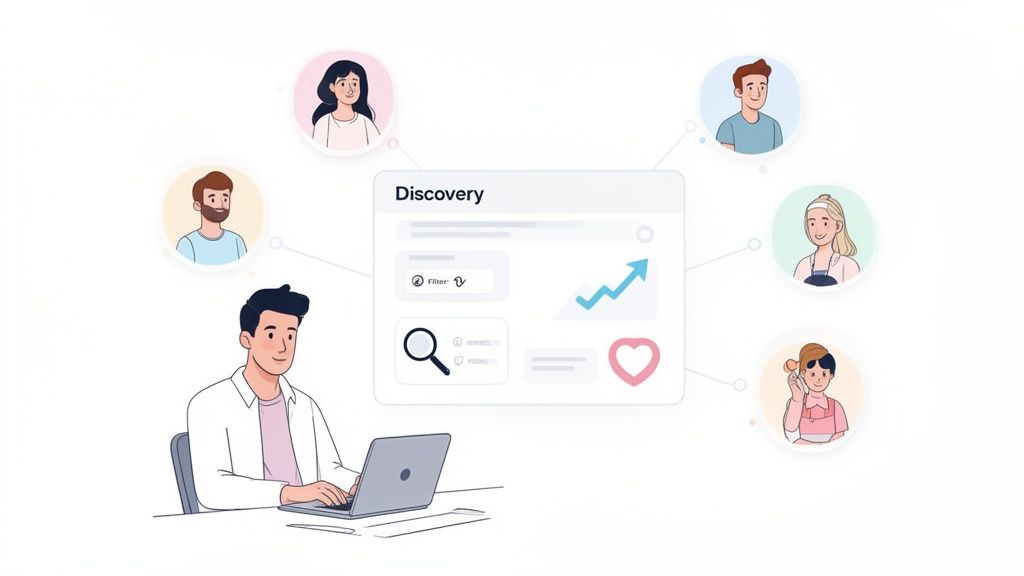
We built REACH to solve this exact problem. It’s designed to be your command center for your entire creator marketing program, starting with a powerful discovery engine. Instead of endless, aimless scrolling, you can find the perfect partners by filtering for:
- Specific niches, like sustainable fashion or vegan cooking.
- Key performance metrics, including engagement rates and audience growth.
- Audience demographics, from age and location to their specific interests.
- Keywords that are relevant to your brand or a particular campaign.
This data-first approach takes the guesswork out of the equation. You can be confident you're connecting with creators whose audience is a genuine match for your ideal customer.
The most successful creator partnerships are built on alignment, not just follower counts. Finding a creator whose values and audience demographics perfectly mirror your brand's is the true key to unlocking authentic engagement and ROI.
Building Scalable Relationships
Ultimately, your goal should be to move past transactional, one-off campaigns. The real value is in building a scalable program of ongoing creator partnerships. To do that, you need a system to manage everything—communication, contracts, payments, and performance analytics—all in one place.
Using a platform like REACH doesn't just make it easier to hire content creators; it gives you the tools to prove the program's value. With real-time analytics and white-labeled reports, you can show stakeholders exactly how your creator program is impacting the bottom line. This is about building a predictable, profitable marketing engine.
If you're still getting your bearings, our guide on what is a content creator is a great place to start. From here on out, we’ll walk you through the practical steps to build that engine, from setting clear goals to measuring your success.
Setting Clear Goals and Budgets for Your Campaign
Before you even start your search to hire content creators, you need to know exactly what you’re trying to accomplish. Countless campaigns fall flat because they start with a vague goal like "get more engagement." That's not a plan; it's a wish. To succeed, you need a solid framework that defines what success actually looks like for your brand.
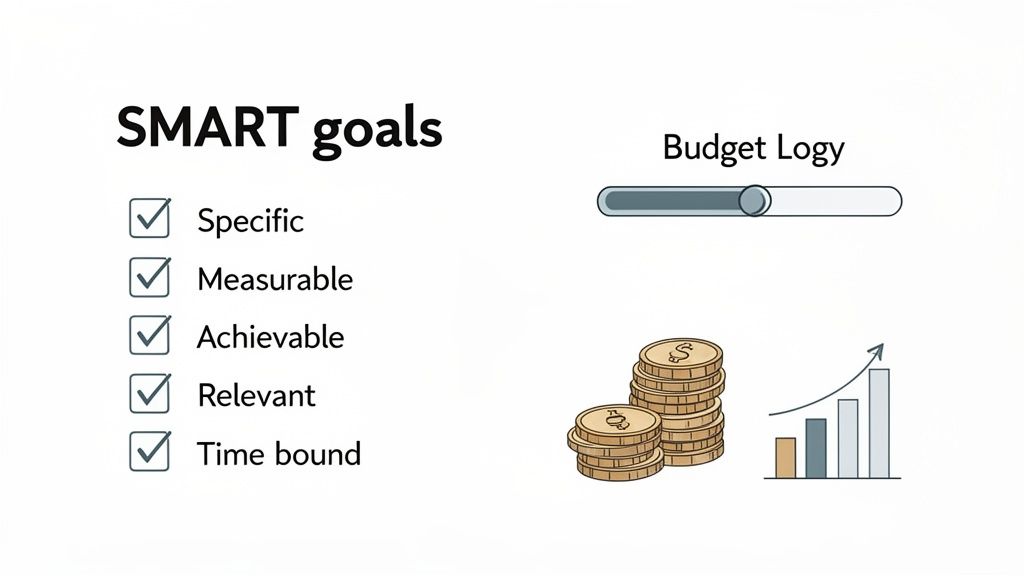
This all starts with setting SMART goals—Specific, Measurable, Achievable, Relevant, and Time-bound. This isn't just business jargon; it's the foundation that dictates who you hire, what you ask them to create, and how you’ll know if your money was well spent.
Defining Your Campaign Objectives
So, what do you really want to achieve? Most creator campaign goals fall into a few common buckets. The key is to get incredibly specific. Are you trying to reach a new audience, build a library of authentic content, or drive sales right now?
Here are the most common objectives:
- Brand Awareness: The main priority is introducing your brand to new people. Success here is all about metrics like reach and impressions. For example, a solid goal would be to hit 5 million impressions with your target demographic in the next three months.
- Content Generation: You need a steady stream of high-quality, authentic content for your own channels—think social feeds, ads, and your website. A clear objective would be to generate 20 approved UGC videos and 50 high-res images from 10 creators for your upcoming fall collection.
- Driving Conversions: This is about turning views into sales or leads. You'll track success with unique discount codes, affiliate links, or landing page traffic. The goal is a specific return on ad spend (ROAS) or cost per acquisition (CPA).
A clear objective is your campaign’s North Star. A goal to "increase brand awareness among Gen Z females in California by 25% in Q3" is infinitely more powerful than just "get more followers." This detail makes every other decision, from discovery to negotiation, so much easier.
Translating Goals into a Realistic Budget
Once you know what you want, you can figure out what it's going to cost. Creator rates aren't pulled out of thin air; they’re based on a combination of factors. Understanding these will help you build a budget that actually works.
Here’s what really moves the needle on pricing:
- Follower Count & Niche: A mega-influencer is obviously going to cost more than a micro-creator. But don't forget that a creator with deep expertise in a small niche can also command higher rates because their audience is so targeted.
- Engagement Rate: I always look at engagement before follower count. A smaller, fiercely loyal audience is often far more valuable (and delivers better ROI) than a massive, passive one. High engagement is worth paying for.
- Content Type & Deliverables: A few quick Instagram Stories will cost much less than a polished, 10-minute YouTube video. The more time and production effort required from the creator, the higher the price.
- Usage Rights: This is a big one that many brands forget. If you just want a creator to post on their own feed, that's one price. If you want the rights to use their content in paid ads or on your website for a year, that's a completely different (and higher) price.
The investment in influencer marketing is exploding. According to research from HypeAuditor, brands are planning to allocate $1.75 to influencer marketing for every $1 spent on Facebook Ads. While there are somewhere between 50 million and 303 million creators out there, only 4% earn over $100,000 a year, and nearly half (48.7%) make less than $10,000. For brands, this signals a massive opportunity to find incredible talent without breaking the bank. You can explore more of these creator marketing trends to see where things are headed.
For instance, a new skincare brand might set aside a $5,000 test budget to work with 10 micro-creators, focusing entirely on generating authentic UGC. On the other hand, an agency launching a new gadget could easily budget $100,000 for a campaign with five macro-influencers across multiple platforms. This is where a platform like REACH becomes invaluable. It not only helps you find creators who fit your budget but also gives you the analytics to track every dollar and prove your campaign’s ROI.
How to Hire Content Creators Who Are the Real Deal
Alright, you've got your campaign goals locked in and a budget ready to go. Now comes the part that trips up so many brands: actually finding the right people to create your content. To hire content creators who align with your brand and deliver results, you need a systematic approach.
It’s easy to get lost scrolling through hashtags for hours or just waiting for creators to slide into your DMs. But let's be honest, that approach is a shot in the dark. It’s a surefire way to waste time and end up with partners who just aren't the right fit. The good news is, finding great creators isn’t about luck. It’s about having a smart process for discovery and a sharp eye for vetting.
Creator Sourcing Channel Comparison
So, where do you even start looking? You have a few options, and knowing the pros and cons of each will save you a ton of headaches.
| Sourcing Channel | Pros | Cons | Best For |
|---|---|---|---|
| Manual Social Search | Free to use. Good for initial research. | Extremely time-consuming and hard to scale. | Small brands on a tight budget just dipping their toes in. |
| Competitor Analysis | Provides a pre-vetted list of creators in your niche. | You'll be targeting the same people as everyone else. | Quick wins and building an initial list of relevant creators. |
| Creator Marketplaces | Good for finding talent for one-off projects or specific tasks. | Often lacks deep audience data; can feel transactional. | Hiring for a single campaign or finding a creator with a specific skill. |
| Discovery Platforms | The most efficient way to search and filter millions of profiles. | Requires a subscription investment. | Agencies and brands serious about scaling their creator programs. |
As you can see, manually searching platforms like TikTok and Instagram is fine when you're just starting, but it's not a long-term strategy. A much smarter move is using a dedicated discovery platform.
Think of a tool like REACH as your search engine for creators. Instead of a manual slog, you can filter a massive database by niche, keywords (like "cruelty-free makeup"), engagement rates, and, most importantly, detailed audience demographics. For example, REACH can instantly show you creators whose audiences are 70% female, aged 25-34, located in the US, and interested in "clean beauty." This is how you find creators who have the exact audience you want to reach. For a deeper dive, our guide on how to find influencers has even more discovery tricks.
Building a strong shortlist is the foundation of a successful campaign. Don't settle for creators who just look good on paper. Use data to find partners whose audience is a direct match for your ideal customer profile. This is the difference between hoping for results and engineering them.
Your Vetting Checklist: Look Beyond the Follower Count
Once you have a list of potential creators, it's time to vet them properly. This is a non-negotiable step. A big follower count can be deceiving, and you need to dig deeper to protect your brand and make sure you're making a good investment.
Here are the key things I always check before reaching out:
Audience Health: First, look for red flags. Is there a sudden, unnatural spike in their follower count? Do posts have thousands of likes but only a handful of generic comments? Use a tool (or the built-in features on a platform like REACH) to check for bot followers. You want to see steady growth and a healthy, balanced like-to-comment ratio.
Content Quality and Vibe: Scroll back through their feed—at least a few months' worth. Is the quality consistently high, or is it hit-or-miss? Does their overall aesthetic and style feel like a natural extension of your own brand? A creator who consistently produces great work is a much safer bet.
Past Brand Deals: Check out their previous sponsored posts. How did they disclose the partnership? More importantly, how did their audience react? If the comments are full of "sellout!" or negative feedback, that's a major red flag. You want a creator whose audience trusts their recommendations.
Real Brand Alignment: This goes beyond just a pretty feed. Read their captions, watch their Stories, and get a sense of their personality and values. If you're a sustainable brand, a creator who constantly pushes fast fashion just isn't a fit, no matter how good their metrics are.
These vetting steps are crucial for narrowing your list down to a handful of high-potential partners. Once you've identified them, the next move is reaching out. Having a solid strategy for finding content creator emails can make this process much smoother and sets a professional tone from the start.
By pairing a data-backed search with this kind of thorough vetting, you can build a list of creators you’re genuinely excited to work with—and set your campaign up for success before it even kicks off.
Crafting Outreach That Gets a Response
You've done the heavy lifting, vetted your list, and now you have a handful of creators who feel like a perfect fit. This next step—the first outreach—is where partnerships are made or broken. Let's be honest: creators are drowning in generic, copy-pasted DMs. According to HubSpot, it’s their biggest pet peeve, and it's a surefire way to get your message ignored.
If you want to hire content creators who are actually excited to work with you, your first message needs to show you’ve done your homework. It has to be personal, professional, and straight to the point.
This is your one chance to prove you see them as a creative partner, not just another name on a spreadsheet.
The Anatomy of a Pitch That Works
Think about it from their perspective. They get dozens of these pitches every week. Yours has to cut through the noise, and it’s not about flashy gimmicks. It’s about respect.
A winning first message really only needs three things:
- A real, personal hook. Show them you’re paying attention. Don’t just say you like their feed; mention a specific post. For example, "Your recent video on sustainable fall recipes was fantastic—the way you used natural light was brilliant." It proves you’re not just spamming.
- A clear, upfront value prop. What’s in it for them? Be direct about why you're reaching out. Is it a great product they'll love? Creative freedom on a cool project? Fair compensation? Frame it as a partnership, not a transaction.
- An easy, no-pressure call to action. Don't ask them to fill out a form or jump through hoops. Keep it simple. A casual, "Would you be open to hearing more about a potential collaboration?" is all you need.
And if you’re sending out products, it’s a good idea to learn from examples of great PR Package Emails that build genuine excitement before the box even arrives.
Before you even hit send, your process should look something like this. You search for potential fits, you seriously vet their work and audience, and only then do you build your final list for outreach.
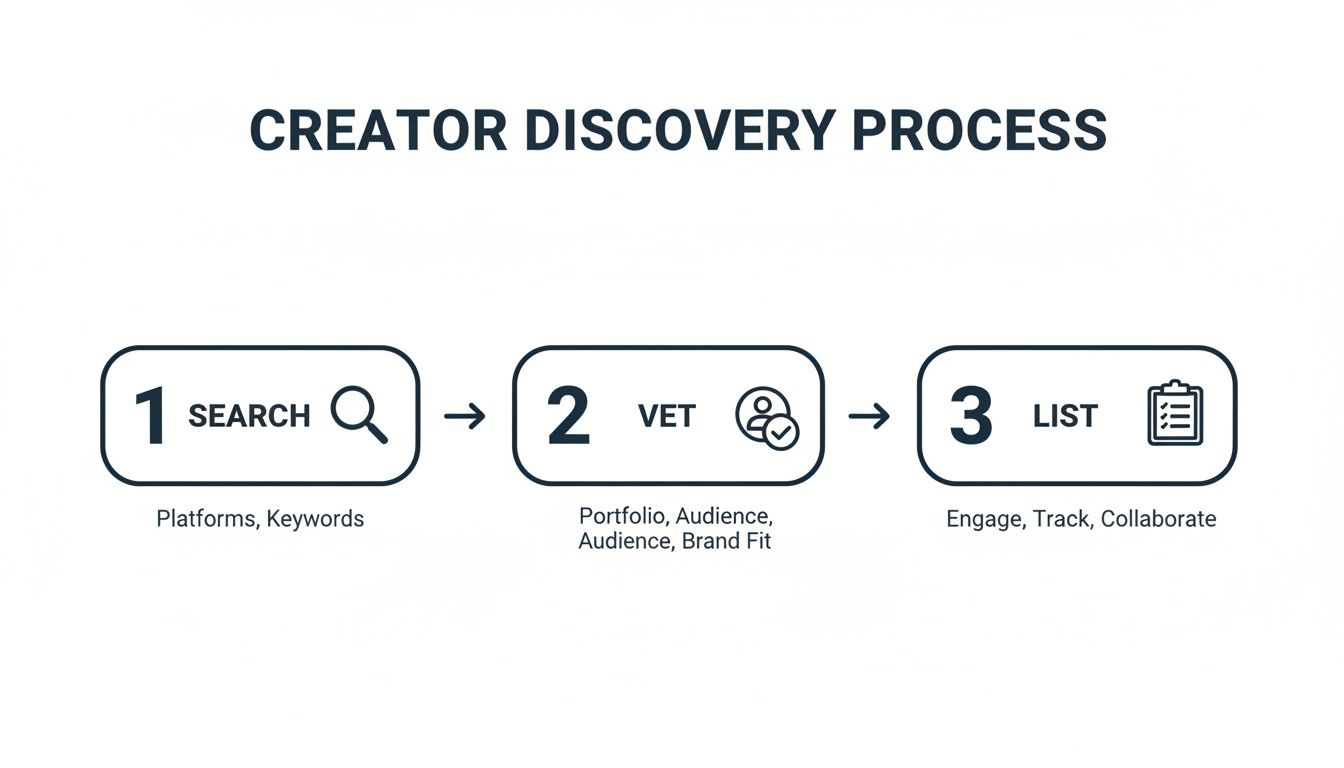
Following this flow means that when you finally reach out, you’re already confident that you’re talking to the right person.
From "Yes" to a Signed Contract
Once a creator says they’re interested, the conversation shifts. Now it's time to talk business, and this is where a lot of brands drop the ball, leading to awkward negotiations and mismatched expectations. The key is to be transparent and organized right from the start.
Here are the non-negotiables you need to lock down:
- Deliverables: Be painfully specific. Does "a post" mean one Reel and three Stories? Or two high-res photos for your website? Spell out the exact quantity and format.
- Compensation: Talk about money. If you have a set budget, be upfront. It saves everyone time.
- Usage Rights: This is a big one. Where can you use their content, and for how long? On your website? In paid ads? For six months or forever? Get it in writing.
- Exclusivity: Do you need them to avoid working with competitors for a while? This needs to be clearly defined and, importantly, compensated.
Trying to manage all of this in a messy email chain or across Instagram DMs is a nightmare waiting to happen. Details get lost, people get confused, and you open yourself up to major headaches down the road.
This is exactly why having a central system is so important. A platform like REACH gives you a single dashboard to handle all your creator conversations. You can send your first message, negotiate rates, and finalize contract details all in one place. For example, when a brand onboarded with REACH, they reduced their average negotiation time by 40% by using our built-in communication and contract management tools.
Every message is logged, creating an undeniable record of your agreements. It’s the best way to prevent miscommunication and make sure everyone feels secure. REACH even has built-in contract templates and payment processing, making the entire process smooth and professional. If you need a starting point, our proven influencer outreach email templates can give you some great inspiration.
Managing Your Campaign Like a Pro
Alright, you’ve signed the contracts and officially hired your content creators. It’s easy to feel like the hard part is over, but in reality, the work is just beginning. Getting that signature is one thing; turning that partnership into a successful campaign with real results is another challenge entirely.
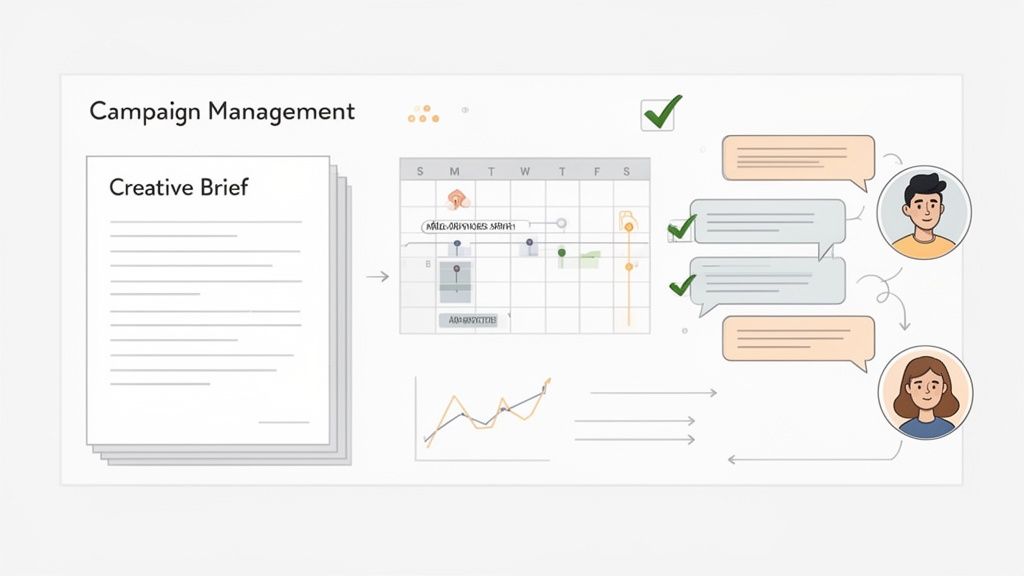
This is where your campaign management chops come into play. A smooth, organized process is what separates a killer campaign from a chaotic one that fizzles out. It all starts with setting your creators up for success from the get-go. A vague brief or a messy approval process will only lead to headaches, endless revisions, and content that just doesn't hit the mark.
Building the Perfect Creative Brief
Think of the creative brief as the single most important document you'll create for the entire campaign. Seriously. This isn't just a list of instructions; it’s your best tool for empowering creators to do their best work while keeping everything aligned with your brand and goals. A great brief is your number one defense against miscommunication.
Your goal here is to leave nothing to chance. Every brief should be crystal clear. Here’s what to include:
- Campaign Overview: Get straight to the "why." What's the main goal? Are we trying to drive sales, get more user-generated content, or just get our name out there?
- Key Messaging & Talking Points: What are the 2-3 core messages the creator absolutely must hit? Be specific. Include any mandatory phrases, hashtags, or taglines.
- Brand Guidelines: This is non-negotiable. Share your do's and don'ts—visual style, tone of voice, and especially any words or topics to steer clear of.
- Content Examples: Don't just tell them, show them. Link to a few posts (they don't have to be yours) that nail the vibe you're going for.
- Deliverables and Deadlines: Spell it out. List every single asset you need (e.g., one 60-second Reel, three Stories with a link sticker) and the exact due dates for drafts and final posts.
Putting in this work upfront saves an unbelievable amount of back-and-forth later. It also shows the creator you respect their time and are a professional, organized partner they’ll want to team up with again.
Streamlining Your Review and Approval Workflow
So, the creator submits their first draft. What happens next? How you handle feedback can make or break the relationship and the timeline. If you’ve got feedback coming from three different people via email, Slack DMs, and text messages, you're heading for disaster. You need a single source of truth.
This is where having a central hub for feedback becomes a game-changer. Using a tool like REACH keeps the entire review process in one organized spot. Creators upload their content, and from there, your team can:
- Leave time-stamped comments right on the video.
- Keep all feedback consolidated in one simple thread.
- Give the final green light with a single click.
A structured workflow like this cuts out all the confusion. It creates a clear paper trail of every change request and ensures feedback never gets lost in a cluttered inbox.
A disorganized feedback process is the fastest way to frustrate a creator and derail a campaign. A centralized approval system isn't just a nice-to-have; it's essential for maintaining momentum and producing high-quality content on schedule.
Tracking the Right KPIs to Prove ROI
Remember those goals you set at the very beginning? Now it's time to see if you're hitting them. To manage a campaign effectively, you can't afford to wait until it's over to check the results. You need real-time data to see what's working and what's not, giving you a chance to optimize along the way.
The trick is to focus on the Key Performance Indicators (KPIs) that tie directly back to your original objectives.
KPI Tracking by Campaign Goal:
| Goal | Primary KPIs to Track | How to Track Them |
|---|---|---|
| Brand Awareness | Impressions, Reach, Engagement Rate, Follower Growth | Native social media analytics, platform dashboards. |
| Content Generation | Number of Assets Created, Asset Usage, Content Quality Score | Manual tracking or campaign management software. |
| Driving Conversions | Clicks, Conversions, Cost-Per-Click (CPC), ROAS | UTM parameters, unique discount codes, affiliate links. |
A solid creator marketing platform like REACH automates a huge chunk of this for you. The dashboard can give you live analytics on clicks, conversions, and the campaign's overall performance. You can quickly spot which creators are driving the most traffic and which posts are delivering the best return. This lets you make smart decisions on the fly, like putting more budget behind a top performer or asking a creator to tweak messaging that isn't quite landing.
Ultimately, this is how you prove your worth. When you can show stakeholders exactly how your efforts to hire content creators translate into real, measurable business outcomes, you're not just running a one-off campaign—you're building a predictable growth engine for the brand.
A Few Common Questions on Hiring Creators
Even after you've mapped out the perfect campaign, a few lingering questions can pop up. Let’s walk through some of the most common ones we hear from brands so you can move forward with total confidence when you hire content creators.
How Much Should I Budget to Hire a Creator?
This is always the first question, and the honest answer is there’s no single price tag. A creator’s rate is a mix of their niche, follower count, engagement rate, and what you’re actually asking them to do. A single Instagram Story doesn't have the same value as a fully-produced YouTube video.
Just to give you a ballpark idea:
- Nano-creators (1k-10k followers): Many will work for free products or a small fee, maybe $50-$250 per post.
- Micro-creators (10k-50k followers): This is a wide range, but think $150 to over $1,000 for a single post.
- Macro and Mega-creators (500k+ followers): These partnerships can run into thousands, or even tens of thousands, per post.
But here’s the most important thing: don't get fixated on cost alone. The goal is always a strong return on your investment. I’ve seen micro-creators with hyper-engaged niche audiences drive more sales than huge macro-creators with passive followers. This is exactly why a tool like REACH is so valuable—it helps you find those high-potential gems at any budget and gives you the data to prove their worth.
What’s the Difference Between a Content Creator and an Influencer?
You’ll hear these terms thrown around interchangeably, but it’s helpful to understand the distinction.
An influencer’s main value comes from their audience—their ability to distribute a message. A content creator’s main value is their skill in producing amazing photos, videos, and other assets that fit a brand's vibe.
When you hire content creators, you’re really getting a two-for-one deal. You get their creative talent to make authentic content and their built-in distribution channel to share it with an audience that already trusts them. The smartest campaigns use the creator's content on the brand's own channels long after the initial campaign ends.
How Do I Actually Measure the ROI of My Creator Campaigns?
Measuring your return on investment isn't optional, and it all comes back to the goals you set from day one. You need to track KPIs that show a real impact on your business.
- If your goal is Brand Awareness: Look at the hard numbers—reach, impressions, and video views. You can pull this data from the social platforms themselves or see it all in one place on a centralized dashboard.
- If your goal is Driving Sales: This needs a direct line of sight. Use unique affiliate links, custom discount codes, and UTM parameters on every link. This is the only way to trace clicks and sales back to the exact creator who drove them.
This is where trying to manage everything in a spreadsheet falls apart. A dedicated platform is a must. A tool like REACH automates all of this for you. Its dashboard shows real-time clicks, conversions, and cost-per-acquisition (CPA) for each creator, making it simple to build reports that show stakeholders exactly what their money is getting them.
What Needs to Be in a Creator Contract?
Your contract is the single most important document for preventing headaches down the road. Never work with a creator on a handshake deal, no matter how small the project seems. A clear, professional agreement builds trust and makes sure everyone is on the same page.
Make sure your contract explicitly covers:
- Deliverables: Get specific. Is it two 60-second TikTok videos or four Instagram Stories with link stickers? Write it down.
- Timeline: Lock in dates for drafts, feedback, and when the final content goes live.
- Compensation: State the exact payment amount and the schedule (e.g., 50% upfront, 50% on completion).
- Usage Rights: Be crystal clear about where you can use the content (your social media, website, paid ads) and for how long (six months, a year, or forever).
- Exclusivity: Clarify if the creator can't work with your direct competitors during or after the campaign for a set amount of time.
To stay protected and make sure you've covered all your bases, the safest bet is using a platform with pre-vetted contract templates. REACH takes care of this whole process, ensuring every partnership is built on a professional and secure agreement.
Ready to stop guessing and start building strategic partnerships that work? If you want to hire content creators efficiently and prove your program's value, you need the right tools. With REACH, you can find your perfect creator matches, manage campaigns without the chaos, and prove your ROI with clear, powerful analytics. See how our platform can change your marketing by visiting https://reach-influencers.com to schedule a demo today.