 Skip to content
Tired of the daily scramble to post on social media? You're not alone. Manually creating and publishing content across multiple platforms every single day is a surefire way to burn out, leaving little time for the stuff that actually matters—like talking to your customers and growing your business.
This is where social media scheduling software comes in. It's essentially your brand's digital content manager, letting you plan, create, and schedule all your posts in one go, weeks or even months ahead of time. No more last-minute panic posts. For brands looking to coordinate their marketing efforts, a platform like REACH Influencers integrates this scheduling capability directly with influencer campaign management, creating a single, powerful hub for your entire social strategy. Just a consistent, professional presence that works for you, even when you’re not working.
What Is Social Media Scheduling Software?
Think of managing your social media like running a high-performance race team. If you’re manually posting every day, you're the driver, the mechanic, and the pit crew all at once. You're constantly reacting, stuck in the driver's seat, and it’s exhausting. Social media scheduling software is your expert pit crew.
It works behind the scenes to make sure your brand is always ready to go, publishing your content at the perfect times on every platform. This flips your entire approach from being reactive to proactive. You get to step out of the car, look at the whole track, and focus on the big-picture strategy—analyzing what works, engaging with your community, and planning your next move.
The Shift from Manual Effort to Strategic Automation
Let's be honest, the days of using spreadsheets and calendar reminders to manage social media are long gone. Brands are catching on to the massive advantage of automation, and the numbers prove it. The market for social media management tools is projected to explode from $33.46 billion in 2026 to an incredible $62.16 billion by 2030. You can read more about the social media management market growth and see for yourself how central these tools have become.
This isn't just a trend; it's a fundamental shift in how smart businesses operate. Every hour you spend on a repetitive task is an hour you could have spent on activities that actually make money. Automating your content schedule frees up your most valuable resource: your time.
How Scheduling Software Works
At its heart, a scheduling tool is a central command center for all your social accounts. Instead of juggling logins for Facebook, Instagram, LinkedIn, and X, you connect everything to one clean dashboard.
From there, it’s a simple process:
- Create Your Content: Write your copy, upload your images and videos, and get your post looking just right.
- Select Your Channels: Check the boxes for every profile you want to post to.
- Set the Time: You can pick a specific date and time or just add the post to a pre-set queue that publishes automatically.
The software then does the heavy lifting, pushing your content live exactly when it’s supposed to. Some platforms, like REACH Influencers, take it a step further by building scheduling right into their influencer campaign tools. This is a game-changer, allowing you to perfectly sync your brand’s scheduled posts with your creators' content for a powerful, unified campaign that drives real results.
Core Features of Great Social Media Scheduling Software
Sure, any basic scheduler can line up a few posts for you. But the tools that really make a difference go way beyond that. Think of them less as a simple timer and more as the command center for your entire social media strategy.
They turn what could be a messy checklist of to-dos into a clear, visual game plan that your whole team can get behind. Let's look at the features that separate the good from the great.

The Visual Content Calendar
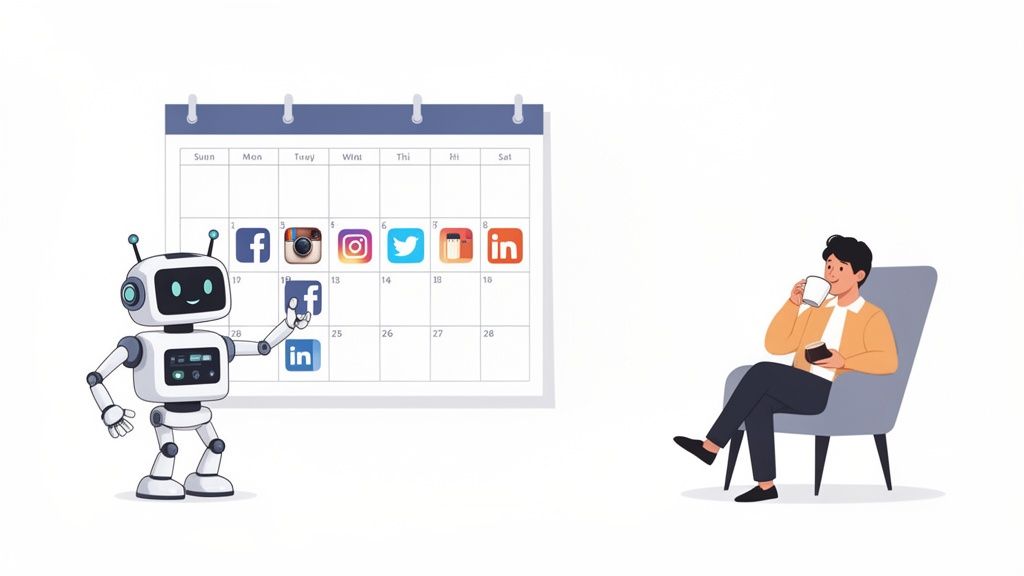
At the heart of every powerful scheduling platform is a visual content calendar. This isn't just a boring list of dates. It’s a bird's-eye view of everything you have planned across Facebook, Instagram, LinkedIn, TikTok, and more, all in one place.
Most use a simple drag-and-drop interface, so you can easily spot gaps in your schedule, shift posts around, and make sure you're not posting the same type of content over and over. For an agency, this shared view is a lifesaver. Clients can see exactly what's planned and sign off on posts directly, cutting out those endless back-and-forth email chains.
Bulk Scheduling and Content Queues
Let's be honest, scheduling posts one by one is a soul-crushing task. That's where bulk scheduling steps in. You can load up a simple spreadsheet with dozens—or even hundreds—of posts and watch your calendar fill up in minutes.
Imagine you're a retail brand planning a month-long holiday campaign. You can map out everything from the first teaser to the final sale announcement in a single CSV file and upload it in one shot. Done.
Automated content queues take this idea even further. Instead of assigning a specific date and time to every single post, you create categories like "Blog Posts" or "Customer Reviews." Just drop content into these queues, and the tool will automatically publish from them according to a schedule you set. This is a core principle of social media marketing automation, designed to keep your feeds active with great content without constant manual work.
Evergreen Content Recycling
Some of your content is too good to only share once. Your best-performing guides, case studies, and tutorials have a long shelf life, and that's where evergreen content recycling comes into play.
Great scheduling software lets you tag certain posts as "evergreen" and will automatically re-queue them to be published again in the future. This keeps your most valuable content in front of new audiences without any manual effort.
It’s a simple but incredibly effective way to squeeze every drop of value out of the content you worked so hard to create, maximizing your ROI over the long haul.
When you bring these features into a platform like REACH Influencers, they become even more powerful. You could bulk-schedule your entire product launch, timing your brand’s posts to go live the exact moment your influencers share their unboxing videos. Managing all of that from a single dashboard transforms your calendar from a simple scheduling tool into a command center for creating massive, unified campaign moments. It's how you perfectly align your own content with your creators' to tell one seamless story.
Strategic Benefits of Social Media Scheduling Software
Think of social media scheduling software as more than just a time-saver. It’s a tool that hands a unique strategic edge to everyone involved, from massive global brands to scrappy creative agencies and individual creators. The real value isn't just about posting automatically; it's about unlocking a whole new level of focus and consistency tailored to what you need to achieve.
For an established brand, consistency is everything. A chaotic social media feed with an off-brand voice can dilute your company's image in a heartbeat. Scheduling tools are your brand's best defense, ensuring every single post—no matter who on the team creates it—perfectly matches your established tone and visual style.
This control lets marketing teams get out of the weeds. Instead of constantly asking, "What are we posting today?" they can start focusing on the bigger picture, like, "How is this month's content calendar helping us hit our Q3 business goals?"
How Scheduling Empowers Brands
For in-house marketing teams, the payoff is immediate and easy to see. They can keep a polished, active presence going across every channel, even on weekends and holidays, without chaining someone to their desk.
- Hit Peak Engagement Times: The software does the heavy lifting, analyzing when your audience is most active and scheduling posts to go live at those exact moments for maximum impact.
- Launch Flawless Campaigns: You can perfectly time a multi-platform campaign, making sure your big product launch or announcement lands everywhere at once with a coordinated bang.
- Free Up Your People: With posting handled, your team can pour that time back into what really moves the needle—engaging with the community, digging into analytics, and cooking up fresh creative ideas.
The Central Hub For Busy Agencies
Agencies are constantly spinning plates, managing multiple clients who each have their own distinct brand voice and content calendar. Social media scheduling software is the mission control that keeps the chaos at bay.
Managing dozens of client accounts from one dashboard isn't just a convenience; it's a massive operational advantage.
For an agency, efficiency is the name of the game. The right scheduling platform isn't just pushing out content. It's actively managing client relationships by simplifying approvals, standardizing reports, and guaranteeing flawless execution every single time.
Tools like REACH Influencers are built from the ground up for agencies, offering features like white-labeled reporting. This lets an agency send clients professional, custom-branded performance reports straight from the platform, reinforcing their value. Simple approval workflows also cut out endless email chains, letting clients review and sign off on content right inside the tool.
To take it a step further, many agencies build their entire process around a social media content batching workflow, which drastically cuts down the time spent creating and scheduling posts.
How Key Features Serve Different Users
While everyone benefits from scheduling, how they benefit is different. Specific features deliver unique value depending on whether you're a brand, an agency, or a creator.
| Feature | Benefit for Brands | Benefit for Agencies | Benefit for Creators |
|---|---|---|---|
| Unified Dashboard | Centralizes all brand channels (e.g., Instagram, Facebook, LinkedIn) for a cohesive view of the brand's presence. | Manages dozens of separate client accounts from a single login, saving massive amounts of time. | Organizes all personal social profiles in one place to easily cross-promote content and maintain a consistent schedule. |
| Approval Workflows | Ensures every post is reviewed by legal, PR, or brand managers before it goes live, maintaining compliance and brand safety. | Streamlines client sign-offs, creating a clear audit trail and eliminating back-and-forth emails. | Allows a manager or partner to review sponsored posts before they are published, ensuring contract terms are met. |
| Analytics & Reporting | Tracks campaign performance and KPIs to demonstrate social media ROI to leadership. | Generates custom, white-labeled reports to prove value and retain clients month after month. | Identifies top-performing content to understand what resonates with the audience and inform future creative. |
| White-Labeling | N/A (Primarily an agency feature) | Presents the software as the agency's own proprietary tool, enhancing brand perception and professionalism. | N/A (Primarily an agency feature) |
This breakdown shows just how versatile these platforms are, molding to the specific operational needs of each user type.
Professionalizing The Creator Economy
For influencers and content creators, a steady stream of content is their lifeblood—it's directly tied to growing an audience and earning a living. Scheduling tools are essential for keeping that momentum going, especially when life gets in the way with travel, brand deals, or just plain creative burnout.
Creators use these platforms to build a reliable content pipeline, guaranteeing their audience always has something new to see. That level of organization also makes them far more appealing to brands.
When a creator can show a potential partner a clear content calendar with exact dates for sponsored posts, it signals professionalism and reliability. Platforms like REACH take this even further by tying the scheduler directly into campaign management. This means content calendars are linked to deliverables and payment schedules, creating a transparent, efficient process for both the creator and the brand.
How to Choose the Right Social Media Scheduling Software
Picking the right social media scheduling software can feel like a huge task. With so many options out there, it’s easy to get lost. But it doesn't have to be complicated. Think of it like buying a new car—you wouldn’t just look at the shiny paint job. You’d get behind the wheel, check the engine, and see how it handles to make sure it actually fits your life.
The same idea applies here. The "best" tool isn't just the one with the longest feature list. It's the one that slots perfectly into your team's workflow, gives you the reports you actually need, and supports your bigger business goals. Let’s walk through what you should be looking for before you sign on the dotted line.
Essential Platform Integrations
First things first: does the tool even work with the social media platforms where your audience hangs out? This seems obvious, but it’s the most important question to ask. Most tools cover the big ones, but your strategy might go deeper.
- The Core Four: Does it connect seamlessly with Instagram (including Stories and Reels), Facebook (Pages and Groups), LinkedIn, and X (formerly Twitter)?
- The Next Wave: What about platforms like TikTok, YouTube Shorts, or even your Google Business Profile? Support for these can be a game-changer.
- Your Everyday Tools: Can it plug into the apps your team already uses, like Canva, Google Drive, or Slack? This is key for a smooth, frustration-free content process.
If a tool doesn't support the channels you rely on, it's a deal-breaker, no matter how cool its other features are.
Deep Analytics and Reporting
Likes and follows are nice for the ego, but they don't pay the bills. Real growth comes from understanding what’s actually working. Your scheduling software should give you analytics that help prove your ROI and make smarter decisions down the road.
Ask yourself if the platform can give you the data you need to answer real business questions. Can it tell you which type of post drives the most clicks to your website? Or track engagement rates over time to spot trends? Good reporting turns your scheduler from a simple publishing tool into a strategic powerhouse.
The right social media scheduling software doesn't just post for you; it tells you what’s working and why, so you can stop guessing and start making data-driven decisions that impact your bottom line.
Team Collaboration and Approval Workflows
If you’re working with a team or getting content approved by clients, collaboration features are an absolute must. A messy approval process filled with endless email chains is a recipe for delays, mistakes, and headaches.
Here’s what to look for:
- Does it have role-based permissions? You need to control who can do what, whether it’s a junior team member, a client, or a freelancer.
- Is there a clear approval workflow? Can someone draft a post and easily submit it for a manager or client to approve, all inside the tool?
- Can you leave internal comments? The ability to drop notes and feedback directly on draft posts keeps all communication in one place and out of your inbox.
For agencies, these features are non-negotiable. We dive deeper into this in our guide on the top social media management tools for agencies.
Scalability and Pricing Structure
Your business isn't going to stay the same size forever, and your software needs to be able to grow with you. A tool that’s perfect for one person can quickly become a bottleneck for an expanding team. Look closely at the pricing tiers. What happens when you need to add more users or social profiles? Are the costs predictable, or will you face a massive price jump?
With global social media ad spend projected to hit a staggering $219 billion in 2026, the software you use is central to managing that investment. For instance, a platform like Hootsuite, with plans starting at $99/month, lets you bulk schedule posts and manage ads from a single dashboard. It also connects with 150+ apps like Canva and Slack, which is a massive help for anyone juggling multiple clients.
This is where all-in-one platforms like REACH Influencers truly shine. By combining scheduling with influencer management and ROI tracking, you simplify your entire toolkit. Instead of paying for three separate tools, you get one unified system that handles it all, saving money and keeping your data in one place. To help with your decision, it's always a good idea to check out reviews of the best social media scheduling tools on the market.
Integrating Social Media Scheduling Software with Influencer Marketing
Your social media scheduling software can do more than just publish your brand's own content—it’s an essential tool for pulling off a great influencer campaign. The best campaigns feel effortless, but behind the scenes, they’re carefully orchestrated. By integrating your scheduler with your influencer strategy, you create a "surround sound" effect that truly captures your audience's attention.
This is all about turning individual creator posts into one cohesive story. Imagine an influencer’s unboxing video dropping just minutes before your brand's official launch post goes live across all your channels. That's the kind of precision you get when everything is connected, ensuring your brand and your creator partners are telling the same story at the same time.
Creating a Unified Campaign Workflow
A truly integrated campaign begins long before anything gets posted. It all comes down to having a clear workflow that lines up your internal content calendar with what your influencers are creating. A centralized platform is your best friend here, acting as the single source of truth for both your team and your creators.
For instance, with a tool like REACH Influencers, this process is baked right in:
- Discover and Onboard: You start by finding and partnering with the right influencers, all within the same system.
- Align Calendars: As part of the campaign brief, you set clear deadlines that appear on a shared calendar, so everyone is on the same page.
- Schedule Brand Content: At the same time, your team uses the platform to schedule all of your brand’s related posts—teasers, launch announcements, and follow-ups—to perfectly match the timing of the influencer content.
This creates a seamless system where everyone knows exactly what’s happening and when, which means no more crossed wires or awkward timing.
To build these kinds of workflows, you first need the right tool. The selection process boils down to a few key steps.
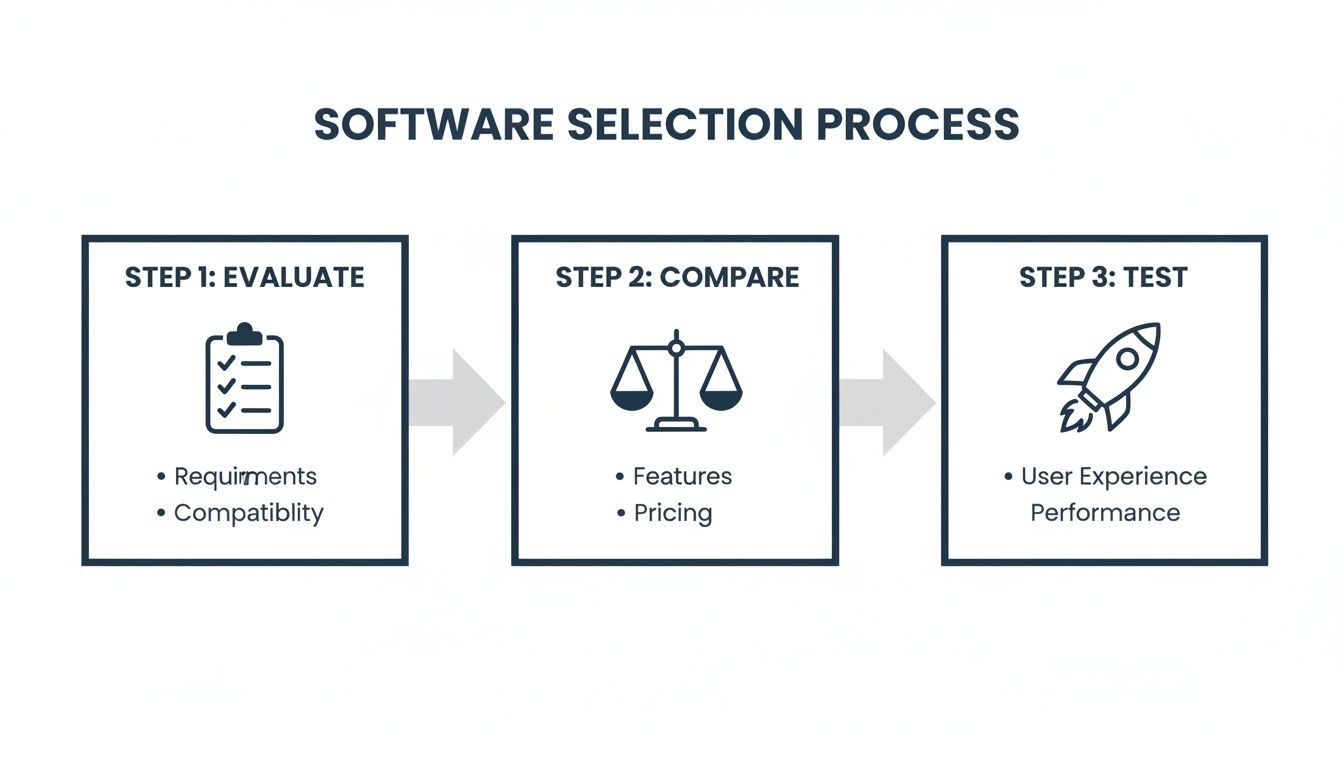
Following this simple Evaluate, Compare, and Test model is the best way to find a platform that can manage both your brand’s content and your influencer collaborations.
Amplifying Impact with Coordinated Timing
The real magic of this approach is creating big moments that get everyone talking at once. Instead of your message trickling out, you can build a massive wave of conversation around a specific launch or promotion.
By syncing your social media scheduling software with influencer posts, you ensure that when a potential customer sees a creator's review, they are immediately seeing your brand's supporting ads and organic content in their feeds. This reinforcement dramatically increases recall and drives action.
This coordinated timing makes your own content more powerful, too. When your brand shares an influencer’s post right after it goes live, it feels authentic and helps boost the creator's reach, making your partnership even stronger. It’s a win-win where both the brand and the creator benefit from smart timing.
Measuring True Campaign ROI
Let's be honest: one of the toughest parts of influencer marketing is proving its value. When your brand posts and influencer content are tracked in different places, getting a clear picture of ROI is next to impossible. An integrated platform solves this by pulling all the performance data into one dashboard.
You can finally see exactly how an influencer's content is driving traffic and sales, and how your own scheduled posts helped build that momentum. There's a reason the social analytics market is projected to hit $16.53 billion by 2025—businesses are hungry for this level of insight. To learn more, you can check out reports on the growth of social media analytics tools.
For REACH users, this means you can combine powerful scheduling with deep performance data to prove the total value of your influencer campaigns and make even better decisions next time.
Your Blueprint for Getting Started
Alright, let's put all this theory into practice. Moving from posting on the fly to a planned, automated schedule is a huge step, but it doesn't have to be complicated.
Think of it less like adding another task and more like giving your entire social media strategy a massive upgrade. A good social media scheduling software isn't just a tool; it's an investment that buys back your time and boosts your impact.
Your Four-Step Action Plan
Getting this set up is surprisingly straightforward. Just follow these four steps, and you'll build a solid foundation for your new workflow right from the start.
Figure Out Where You Stand: Before you change a thing, you need a clear picture of what you’re doing now. How many hours a week are you really spending on social media? What are the biggest time-wasters? Pinpointing these headaches shows you exactly what a new tool needs to fix.
Define What "Success" Looks Like: Don't settle for a vague goal like "post more often." Get specific. Maybe you want to achieve increasing post frequency by 30% or re-invest the time you save into talking with your followers. For some help with planning, check out our guide on how to create a content calendar.
Test Drive a Few Options: Using the buyer's checklist from the last section, pick two or three platforms that look promising. Nearly all of them offer free trials, so sign up and give them a real-world test. Try scheduling a full week of content to see which one feels the most intuitive and powerful for your needs.
Go Live and Check the Data: Once you've picked your winner, it's go-time. Roll out your new schedule and let it run for about 30 days. Then, dive into the analytics. Did you hit the goals you set in step two? What worked, and what needs a little tweaking?
At the end of the day, the right platform connects all the dots. A system like REACH Influencers, for example, doesn't just manage your content schedule. It pulls it directly into your larger influencer marketing campaigns—from finding creators to sending payments—so you can see a clear return on your effort.
Frequently Asked Questions
Even after you've got a plan, a few questions can pop up. Let's clear up some of the most common ones about social media scheduling software so you can move forward with confidence.
Can Using Scheduling Software Hurt My Engagement?
That’s a popular concern, but it's actually a myth. When you use it right, scheduling often boosts your engagement. The real mistake is to "set it and forget it."
Think of social media scheduling software as an assistant, not a replacement for you. It handles the repetitive task of posting, freeing you up for what really matters: engaging with your community. By posting consistently when your audience is online, you give your content the best shot at being seen. This lets you spend your time in the comments, replying to DMs, and building the relationships that drive real growth.
What Is the Difference Between a Scheduler and a Management Tool?
It helps to think of it as a simple kitchen timer versus a full-on mission control center. A basic scheduler does one thing well: it posts your content at a set time. It's handy, but that's where its job ends.
A complete social media management tool is a much bigger deal. Scheduling is just one piece of the puzzle. These platforms usually include:
- A unified social inbox to wrangle all your DMs and comments in one place.
- Deep analytics and reporting to show you what’s working and what isn’t.
- Social listening features to keep an eye on brand mentions across the web.
- Team collaboration tools to keep everyone on the same page.
Tools like REACH Influencers take it another step further. They bundle all those management features with everything you need for influencer marketing—from finding creators to managing campaigns and sending payments—all under one roof.
How Much Does Social Media Scheduling Software Cost?
The price tag for social media scheduling software can swing quite a bit, depending on what you need. For individuals or small businesses, you can find simple, effective tools starting around $10–$30 per month.
For agencies and bigger brands that need more firepower, prices typically land somewhere between $100 to over $500 per month. These plans usually pack in advanced reporting, approval workflows for your team, and more integrations. My best advice? Always take advantage of a free trial to make sure the tool feels right before you commit.
Ready to get your content organized and take your influencer campaigns to the next level? REACH Influencers combines powerful scheduling with a complete suite of influencer marketing tools. Book a demo today and see how you can manage your entire strategy from a single dashboard.