 Skip to content


The core of the affiliate marketing vs influencer marketing debate comes down to one simple distinction: Affiliate marketing is transactional, designed to pay for a direct sale. Influencer marketing is relational, built to foster brand trust, awareness, and long-term loyalty. The right choice for your business hinges on a single question: do you need immediate, trackable conversions, or are you investing in your brand's reputation for the long haul?
Choosing the right path is critical for maximizing your marketing ROI. This guide will break down the key differences, helping you decide which strategy—or powerful combination of both—will achieve your goals. And for brands looking to manage these modern creator partnerships, platforms like REACH Influencers are essential for streamlining everything from discovery and payment to performance tracking, ensuring every campaign is a measurable success.
Table of Contents
- A Quick Comparison of Affiliate and Influencer Marketing
- How Each Marketing Channel Actually Works
- Comparing Payment Models and ROI: Affiliate Marketing vs Influencer Marketing
- Measuring Performance: Key Metrics for Affiliate Marketing vs Influencer Marketing
- Choosing the Right Strategy for Your Goals
- The Future of Creator Partnerships: Combining Affiliate and Influencer Marketing
- Frequently Asked Questions
A Quick Comparison of Affiliate and Influencer Marketing
Choosing between affiliate and influencer marketing isn't about picking a "winner." It's about aligning your marketing strategy with your specific business goals. One is laser-focused on performance, while the other excels at building genuine connections with an audience. Figuring out which path to take is key, and this is where platforms like REACH Influencers come in, helping brands manage all their creator partnerships—whether they're geared for performance, awareness, or a smart mix of both.
To really get to the bottom of it, let's break down the main differences.
Key Differences at a Glance
For a deeper dive into one side of this equation, you can check out a comprehensive guide to modern influencer marketing for more detail. But for a quick, at-a-glance comparison, the table below lays it all out.

Key Differences: Affiliate Marketing vs Influencer Marketing
Here's a straightforward breakdown of what sets these two powerful marketing channels apart.
| Attribute | Affiliate Marketing | Influencer Marketing |
|---|---|---|
| Primary Goal | Drive immediate sales, leads, and conversions. | Build brand awareness, trust, and credibility. |
| Payment Model | Commission-based (e.g., Cost Per Sale, Cost Per Click). | Fee-based (e.g., flat fee per post, product seeding). |
| Creator Type | Anyone can be an affiliate: bloggers, coupon sites, publishers. | Social media creators with an engaged, niche following. |
| Risk Level | Low financial risk; payment is tied directly to performance. | Higher upfront risk; payment is for exposure and content. |
| Content Control | Limited; affiliates choose how to promote their unique links. | High; brands and creators collaborate on content briefs. |
| Measurement | Direct ROI tracking via clicks, conversions, and sales data. | Broader metrics like reach, engagement, and sentiment. |
This table gives you a snapshot, but the real difference lies in the day-to-day execution and the "why" behind each strategy.
Understanding the Core Focus
Think of affiliate marketing as a pure pay-for-performance system. An affiliate—whether it’s a big-time review site or a small, niche blogger—gets paid a commission only when their promotion leads to a concrete action, usually a sale. The whole relationship is transactional, designed to drive results at the bottom of the funnel.
Influencer marketing is a different game entirely. It’s all about tapping into the trust and authority a creator has carefully built with their audience.
The goal isn't necessarily an immediate sale, but authentic storytelling. Brands are paying for an influencer's creative talent and their unique access to an engaged community, all in an effort to build brand love and lasting customer relationships. It's a partnership built on credibility.
How Each Marketing Channel Actually Works
To really get to the heart of the affiliate marketing vs influencer marketing debate, you have to look past the high-level goals and see how each one functions on a daily basis. One is a mostly automated, numbers-driven system, while the other is all about hands-on, creative partnerships.
The Affiliate Marketing Machine
Affiliate marketing operates on a pretty simple, tech-heavy process. The whole thing hinges on a unique tracking link—it’s the secret sauce that makes the pay-for-performance model work.
Here’s how it usually plays out:
- Joining a Program: A publisher or content creator (the affiliate) signs up for a brand's affiliate program. This is often done through a large network like ShareASale or Commission Junction.
- Getting a Unique Link: Once they're approved, the affiliate is given a unique URL with a special tracking code. This code is critical because it tells the brand’s system exactly which affiliate sent the customer.
- Promoting the Link: The affiliate then places this link wherever they can—in a blog post, on a coupon site, or in a YouTube video description. How they promote it is pretty much up to them.
- Tracking the Sale: When a shopper clicks that link, a small file (a cookie) is saved on their browser. If they end up buying something within a set window (say, 30 days), the technology credits that sale to the original affiliate.
- Getting Paid: The affiliate platform automatically calculates the commission from the sale and pays the affiliate, typically once a month.
The affiliate marketing model is built for scale. It's a volume game where technology handles all the tedious tracking, allowing a brand to partner with hundreds or even thousands of affiliates at once with very little direct management.
The Influencer Marketing Collaboration
Influencer marketing is a completely different beast. At its core, it’s a creative and relationship-based strategy. You’re not just paying for a link; you’re investing in a creator’s credibility, unique voice, and the genuine connection they have with their audience. You can get a much deeper look into what influencer marketing is to understand just how collaborative it is.
The process is much more involved:
- Discovery and Vetting: Brands use tools like REACH Influencers to find creators who are a perfect fit. This means digging into their audience demographics, content style, and making sure their values align. It’s about more than just follower count; it’s about the right fit.
- Negotiation and Contracts: After finding the right person, the brand and influencer hash out the details. This includes payment (often a flat fee), exactly what content will be created, where the brand can use it, and campaign deadlines. It’s all locked down in a formal contract.
- Co-Creation: This is where the magic happens. Unlike an affiliate who just posts a link, an influencer works with the brand on a creative brief. The brand provides key messages, but the creator has the freedom to weave them into authentic content their followers will actually enjoy.
- Launch and Engagement: The influencer posts the sponsored content. The goal here isn't just a click—it's to start a conversation, drive real engagement, and tell a story that makes the brand memorable.
- Performance Analysis: Success is measured with a mix of metrics. Brands look at things like reach, engagement rates, brand mentions, and, if it’s part of the deal, sales driven through a custom discount code or trackable link.
Think of it this way: affiliate marketing is a distribution system, while influencer marketing is a creative partnership. One is about putting up a signpost pointing to your store, and the other is about building a stage and letting a trusted voice tell your story.
Comparing Payment Models and ROI: Affiliate Marketing vs Influencer Marketing
How you pay your partners is one of the starkest differences in the affiliate marketing vs influencer marketing debate. The financial structure you choose reveals everything about your campaign's core goals. One model is laser-focused on predictable sales, while the other is an investment in brand awareness and creative content.
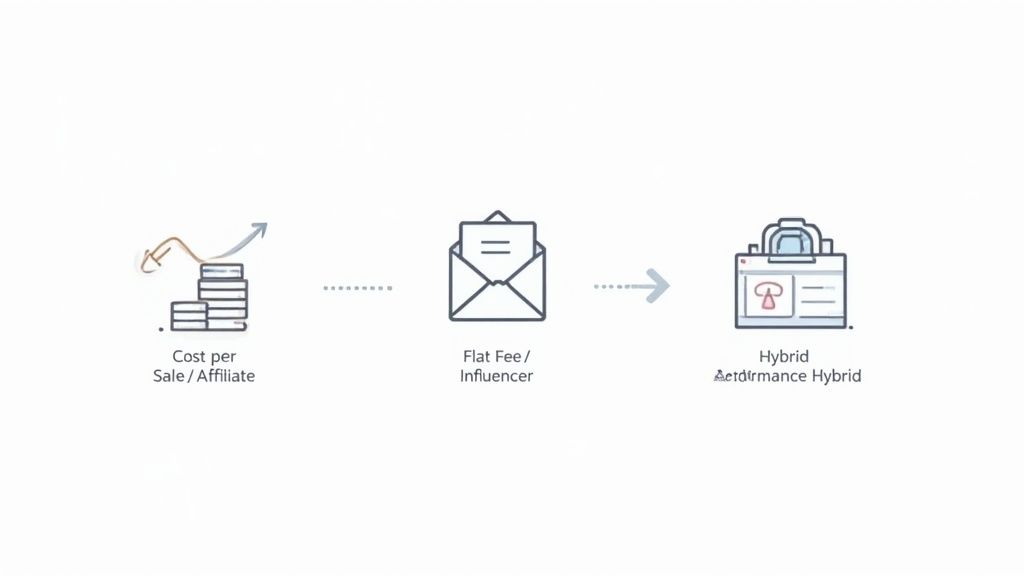
Affiliate marketing is almost entirely built on a pay-for-performance foundation. The go-to model is Cost Per Sale (CPS), where you only pay a commission after a sale happens. It's a purely transactional setup, making it incredibly low-risk and easy to budget for, especially if your main goal is immediate, measurable revenue.
Since every dollar you spend is directly tied to a sale, calculating ROI is refreshingly simple. Affiliate dashboards clearly show clicks, conversions, and commissions, giving you a real-time financial pulse on your program.
The Diverse World of Influencer Compensation
Influencer marketing plays by a different set of financial rules. While you can find performance-based deals, the standard is a flat fee paid upfront. This fee isn't just for a potential sale; it covers the creator's time, content production, and most importantly, access to the loyal audience they’ve spent years building.
This upfront payment is a critical distinction. It guarantees you get brand exposure and custom content, no matter how many sales it drives on day one. Other common ways to pay influencers include:
- Product Seeding: You send free products to creators for them to feature or review honestly. It's a great, low-cost way to get on the radar of nano and micro-influencers.
- Hybrid Models: This approach blends the two worlds by offering a smaller flat fee plus a performance bonus, like a commission on sales made using a unique creator code.
The flat-fee model recognizes that an influencer’s true value can’t always be measured by last-click attribution. You're paying for brand association, authentic storytelling, and the trust they've built with their followers—things that build brand equity over the long haul.
The explosive growth of the global influencer marketing industry tells the story. It's projected to reach $32.5 billion in 2025, a massive jump from just $1.4 billion a decade earlier. That growth rate easily outpaces affiliate marketing’s projected $12 billion for the same year, signaling a major shift in how brands value creator partnerships.
Managing Payments and Proving Value
Keeping track of these different and sometimes complicated payment structures requires a solid system. This is where a platform like REACH Influencers becomes indispensable for managing the entire financial process, from negotiating contracts and sending flat-fee payments to tracking sales for performance bonuses. It creates a transparent and secure environment for everyone involved.
Calculating ROI for an influencer campaign is much more nuanced. You can still track direct sales, but you also need to look at metrics like engagement rates, reach, and Cost Per Acquisition (CPA). To get a better handle on this, check out this detailed guide on what is Cost Per Acquisition and how to calculate it properly.
For a wider view of how creators are paid, it’s helpful to start exploring various community monetization models. This context shows how both affiliates and influencers are part of the broader creator economy. Ultimately, your choice of financial model comes down to what you want to buy: guaranteed sales or guaranteed exposure.
Measuring Performance: Key Metrics for Affiliate Marketing vs Influencer Marketing
How you measure success is one of the biggest differentiators between affiliate and influencer marketing. It’s not just about picking the right tool for the job; it’s about knowing what a successful outcome even looks like for each. One is a game of hard numbers, while the other plays the long game of brand building.
Affiliate marketing, at its core, is beautifully simple. Success is almost always measured by concrete, bottom-of-the-funnel metrics that tie directly to a sale. It's a pure performance play.
This chart breaks down which metrics matter most, depending on whether your goal is immediate sales or broader awareness.
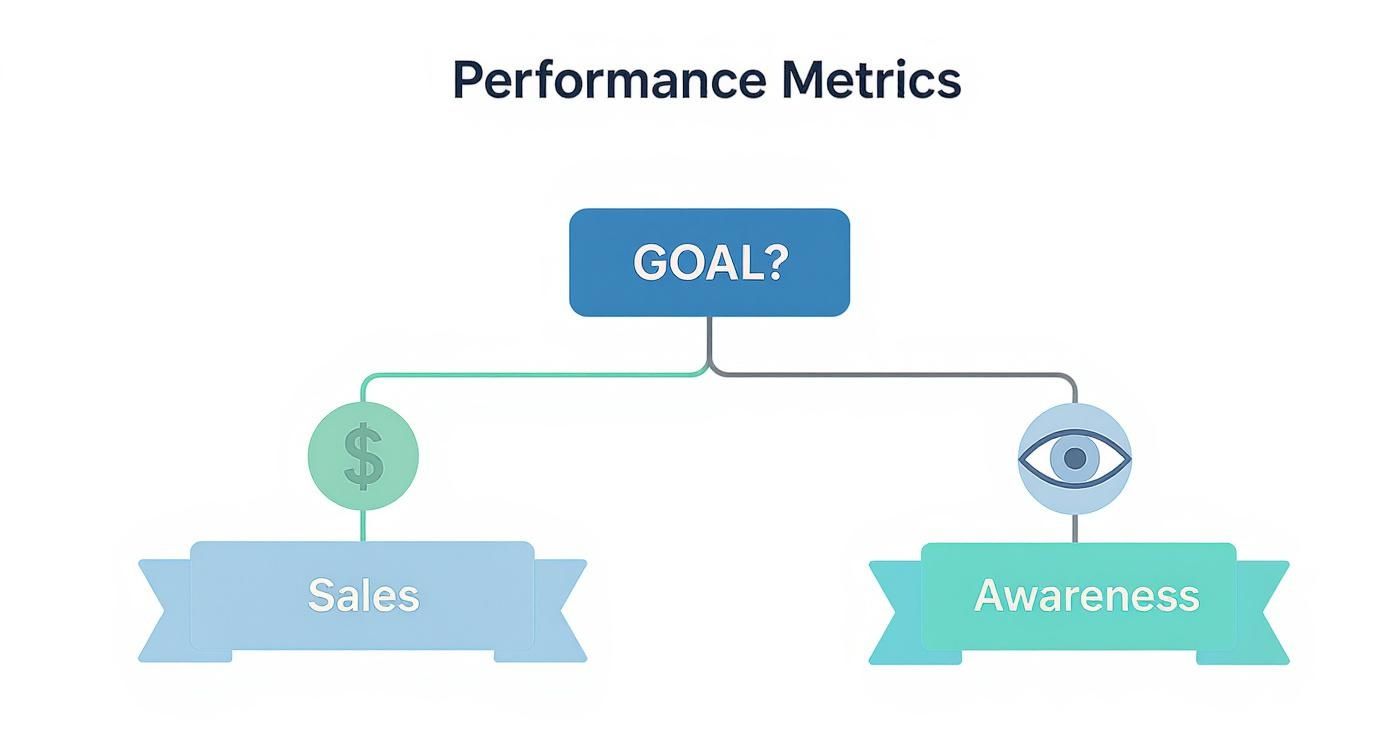
As you can see, if sales are what you're after, the affiliate path is clear. If brand awareness is the priority, your focus shifts to influencer metrics.
The Quantitative World of Affiliate Metrics
Affiliate marketing lives and dies by its data. Because you only pay when a specific action happens, tracking is everything. There’s very little room for fuzzy numbers.
Brands typically keep a close eye on these KPIs right from their affiliate dashboards:
- Click-Through Rate (CTR): How many people actually clicked the affiliate's link? This is your first signal that their promotional effort is working.
- Conversion Rate: This is the big one—the percentage of clicks that turned into a sale. It tells you everything you need to know about the quality of the traffic an affiliate is sending your way.
- Return on Ad Spend (ROAS): With a cost model based entirely on commissions, calculating ROAS is straightforward. You know exactly what each dollar in commissions brought back in revenue.
The real strength of affiliate marketing is its clarity. Every metric is a hard number. There's no guesswork; a link either converted or it didn't, which makes it incredibly easy to justify the spend and scale up what’s working.
This trackable, performance-based model is why the affiliate industry is booming. It was valued at around $12 billion in 2025 and is expected to more than double to $27.78 billion by 2027. A staggering 80% of brands consider it a key revenue channel precisely because success is so clearly defined.
Capturing the Full Value of Influencer Marketing
Trying to measure an influencer campaign with the same yardstick as an affiliate program just doesn't work. While you can—and should—track sales, focusing only on conversions means you’re missing the point. Influencers deliver something far more valuable in the long run: brand equity, authentic content, and genuine trust.
To really see the full impact, you need to look at a wider set of metrics. This is where a platform like REACH Influencers comes in, offering analytics dashboards built to capture these nuanced KPIs that go way beyond simple sales figures.
You’ll want to track metrics like:
- Engagement Rate: Likes, comments, shares, and saves. This is your best indicator of how well the influencer's content actually connected with their audience.
- Reach and Impressions: These classic top-of-funnel metrics show how many people saw the content and how many times it was viewed.
- Audience Sentiment and Brand Mentions: What are people saying about your brand now? Tracking the conversation reveals the campaign's impact on perception.
- User-Generated Content (UGC): The high-quality photos, videos, and stories created by the influencer are powerful assets you can repurpose across all your marketing channels, extending the value of your investment.
Because its value is spread across so many areas, calculating your return requires a more holistic approach. To really nail this, you have to understand how to measure influencer marketing ROI by blending both the hard data and the softer, qualitative wins. Think of it as an investment in your brand's story, not just its immediate sales.
Choosing the Right Strategy for Your Goals
Trying to decide between affiliate and influencer marketing isn't about picking a "winner." It's about knowing which tool to grab for the job at hand. One is a scalpel, perfect for driving precise, last-click sales. The other is a megaphone, designed to broadcast your brand’s story far and wide. The right choice really comes down to your immediate goals, budget, and where your brand is in its journey.
To make the right call, you have to be brutally honest about what you need to accomplish right now. Are you laser-focused on hitting quarterly sales targets with a predictable return? Or are you playing the long game, building the trust and awareness that will pay off down the road?
When to Go All-In on Affiliate Marketing
Affiliate marketing is your go-to when your primary goal is a direct, measurable action. It’s a pure performance-driven engine, built to turn existing interest into actual sales.
Choose affiliate marketing if your main objectives are:
- Driving Last-Click Conversions: If success is measured solely by sales tied to the final touchpoint before a purchase, the affiliate model is purpose-built for that. Its tracking is designed specifically for this scenario, making it incredibly clean and clear.
- Scaling Sales on a Tight Budget: The pay-for-performance setup means there's virtually no upfront risk. You only pay when you make a sale, which makes it a safe and predictable way to grow revenue without a huge initial investment.
- Acquiring New Customers Efficiently: By partnering with coupon sites, review blogs, and publishers, you tap into a massive network of audiences. These are people actively searching for deals and products just like yours.
Think of your affiliate program as your dedicated sales force. It’s less about shaping your brand’s personality and more about closing the deal with customers who are already in the market to buy.
When to Prioritize an Influencer Marketing Strategy
Influencer marketing really shines when your goals are bigger than just the next sale. It’s about building your brand, telling your story, and forging genuine connections with entirely new audiences. It’s fantastic at creating demand where none existed before.
You should lean into influencer marketing when you need to:
- Successfully Launch a New Product: Influencers can create instant buzz and social proof. Their authentic testimonials and creative content introduce your product to thousands of engaged followers, building credibility right out of the gate.
- Build Brand Credibility and Trust: A partnership with a respected creator is a powerful endorsement. The trust their audience has in them naturally extends to your brand, something a simple affiliate link just can't replicate.
- Generate High-Quality User-Generated Content (UGC): A single influencer campaign can stock your content library with authentic photos and videos for months. You can then repurpose this content across your website, ads, and social channels, stretching the value of your initial investment.
Influencer marketing is your brand’s PR arm. Its job is to shape perception, tell your story in a human way, and build the kind of brand love that creates long-term loyalty, not just a one-off purchase.
The Power of a Hybrid Approach
Here's a secret the best brands already know: the real question isn't affiliate marketing vs influencer marketing. It’s about how you can make them work together. A hybrid model beautifully blends the awareness-building magic of influencers with the conversion-tracking precision of affiliates.
This strategy is simple in concept. You equip your influencers with unique affiliate links. You still pay them a flat fee for their creative work and access to their audience, but you also give them a commission on every sale they drive through their link. This gives you the best of both worlds: guaranteed exposure with a performance-based kicker.
And it works. Research shows this combined approach can be incredibly effective. In fact, influencer collaborations can boost affiliate performance by up to 46% in sales. This happens because influencers are masters at creating desire and sending high-intent traffic into your funnel, which traditional affiliates can then help convert. For a deeper dive into this dynamic, you can discover more insights about marketing strategy on sproutsocial.com.
Ultimately, a hybrid strategy turns your most authentic storytellers into your most powerful salespeople. It’s a sophisticated approach that platforms like REACH Influencers are built to manage, handling everything from flat-fee payments to performance tracking in one place. This integrated model is where the future of creator partnerships is headed.
The Future of Creator Partnerships: Combining Affiliate and Influencer Marketing
For years, we've debated affiliate marketing vs. influencer marketing as if they were two completely separate things. That debate is officially over. The lines have blurred, and the smartest brands are no longer picking a side.
The future is a hybrid. It's about combining the authentic storytelling of influencers with the tangible sales power of affiliates. We're seeing the rise of a new kind of partner: the true "influencer-affiliate." These creators don't just build buzz; they drive real business.
The Rise of the Influencer-Affiliate Model
Modern creator partnerships are getting much smarter. Brands are starting to pay creators for both their influence (building brand awareness) and their performance (driving sales), creating a hybrid approach that gives you the best of both worlds.
Here’s how this integrated model is changing the game:
- Guaranteed Exposure, Performance-Based Bonuses: Creators get a flat fee for their content—guaranteeing you get high-quality posts and reach—plus a commission on every sale from their affiliate link. This respects their creative effort while giving them a real incentive to convert their audience.
- Authenticity You Can Measure: An influencer's genuine recommendation is powerful. But when you tie that recommendation to a trackable link, you can see the direct sales impact of their storytelling. Suddenly, brand trust has a clear ROI.
- Building Long-Term Allies, Not One-Off Gigs: When creators earn a cut of the sales they drive, they become truly invested partners. A one-off campaign evolves into an ongoing, performance-focused relationship that's a win-win for everyone.
This shift isn't surprising. Brands need to justify every dollar, and creators deserve to be paid for the full value they bring—from getting people's attention to actually making the sale.
Great creator strategies are no longer just about paying for a single post. They’re about turning brand storytellers into brand sellers, creating a powerful link between authentic content and measurable results.
Using the Right Tools for This Integrated Future
Managing these multi-layered partnerships can get messy fast. Trying to track flat fees, performance commissions, and all the analytics with spreadsheets is a recipe for disaster. This is where a dedicated platform like REACH Influencers makes all the difference.
REACH Influencers was built to handle exactly these kinds of modern creator partnerships. With the platform, you can:
- Set Up Hybrid Deals Easily: Create campaigns that combine upfront payments for content with performance-based commissions for sales, all in one place.
- Track Everything in One Dashboard: Monitor traditional influencer metrics like engagement alongside hard sales data from affiliate links. No more jumping between different tools.
- Simplify Payments and Compliance: Automate both flat-fee and commission payouts, so creators get paid correctly and on time. The platform can also handle the necessary tax paperwork.
By bringing all these functions under one roof, REACH Influencers helps you build and scale a sophisticated creator program that actually drives your business goals. Whether you want to build brand love, boost revenue, or do both at the same time, having the right platform is what makes it all work.
Frequently Asked Questions
Even with a detailed breakdown, it's natural to have questions when you're in the trenches deciding between affiliate and influencer marketing. Let's tackle some of the most common ones we hear from brands.
Can a Small Business Really Use Both Strategies?
Absolutely. In fact, for a small business, a hybrid approach isn't just possible—it's often the smartest way to grow.
Think of it as a phased rollout. You can kick things off with a low-risk affiliate program. This gets sales coming in the door with a clear, performance-based ROI, establishing a reliable revenue baseline without a big upfront gamble.
Once you've got some momentum, you can reinvest a portion of those affiliate-driven profits into a few targeted influencer campaigns. This is where you start building that crucial brand awareness and getting authentic content created about your products. A simple way to start is by giving your top-performing affiliates products to review, which beautifully blurs the line between both tactics on a manageable scale.
Which Strategy Has Better Long-Term Value?
This is a great question, but the answer really hinges on how you define "value." Both offer tremendous long-term benefits, just in very different flavors.
- Affiliate marketing is all about building a steady, predictable sales engine. Its long-term power is in creating a reliable revenue stream that you can scale up as you bring more partners into your network. It's consistent and performance-driven.
- Influencer marketing, on the other hand, builds brand equity. It’s about earning audience trust and creating a library of authentic user-generated content (UGC). The photos, videos, and testimonials from these campaigns are assets you can use for months—even years—in ads, on your website, and across your own social channels.
The real magic for long-term growth? It's almost always a combination. Use influencers to build genuine brand love and create a buzz, then lean on your affiliates to efficiently convert that interest into sales. It's a powerful one-two punch that builds a truly resilient marketing ecosystem.
How Different Are the FTC Disclosure Rules?
The core principle from the FTC is the same for both: you have to be upfront about the paid relationship. The connection between your brand and the promoter needs to be clear and conspicuous—no hiding it. Transparency is key.
Where it differs is in the practical application.
For an influencer, this usually means putting #ad or #sponsored right at the beginning of a social media caption or stating it verbally in a video. The goal is to make sure someone sees it immediately, not buried in a long list of other hashtags.
For an affiliate, it’s typically a clear disclaimer placed near the affiliate links themselves. You’ve probably seen statements like, "This post contains affiliate links, and I may earn a commission if you make a purchase." This simple text makes the commercial relationship clear before a consumer clicks.
Ready to manage your creator partnerships with a platform built for the future? REACH Influencers helps you seamlessly combine the awareness-building power of influencers with the performance-tracking precision of affiliates. Discover how REACH can streamline your entire creator marketing strategy today!
{
“@context”: “https://schema.org”,
“@type”: “BlogPosting”,
“mainEntityOfPage”: {
“@type”: “WebPage”,
“@id”: “https://reach-influencers.com/affiliate-marketing-vs-influencer-marketing”
},
“headline”: “Affiliate Marketing vs Influencer Marketing: Which is Best for Your Brand?”,
“description”: “Explore the key differences between affiliate marketing vs influencer marketing. This guide helps you choose the right strategy for your business goals, whether it’s driving sales or building brand awareness.”,
“image”: “https://cdn.outrank.so/64cdc0e0-2a54-4cd9-a45d-c4196c5e1d4e/769804d3-ffcb-48b7-a551-0ceb842b9076/affiliate-marketing-vs-influencer-marketing-promotion-strategy.jpg”,
“author”: {
“@type”: “Organization”,
“name”: “REACH Influencers”
},
“publisher”: {
“@type”: “Organization”,
“name”: “REACH Influencers”,
“logo”: {
“@type”: “ImageObject”,
“url”: “https://reach-influencers.com/logo.png”
}
},
“datePublished”: “2024-05-21”,
“dateModified”: “2024-05-21”
}