

So, what exactly is Cost Per Acquisition (CPA)? In the simplest terms, it’s the total amount you spend to land a single new customer from a specific marketing campaign. It’s the final price tag on each successful conversion.
Let's say you spend $100 on an influencer campaign and it brings in two new paying customers. Your CPA for that campaign is $50. Simple as that.
Cost Per Acquisition Beyond The Definition
Okay, let's look past the textbook definition. Think of CPA as a receipt for your marketing efforts. It ties every dollar you spend directly to a real, tangible result, answering one critical question: How much did we actually pay to win that customer?
This number is the absolute bedrock of a profitable marketing strategy. It gives you a crystal-clear window into how efficient your campaigns are and whether they're ready to scale. Without a solid handle on your CPA, you're basically flying blind with your budget.
Understanding your CPA is non-negotiable, whether you're a startup watching every dollar or an enterprise managing a massive budget. It transforms vague spending into a measurable, performance-driven investment.
But why is it so crucial? Because knowing your CPA helps you make smarter decisions. You can:
- Allocate your budget wisely. It shows you where to double down and where to pull back, shifting funds from channels with a high CPA to those that are performing better.
- Measure campaign profitability. The math is straightforward: is the cost to get a customer less than the money they bring in? CPA gives you the answer.
- Optimize your marketing efforts. If your CPA is climbing, it’s a clear signal that something needs a tune-up—maybe it's your targeting, your messaging, or the landing page experience.
It’s important not to confuse CPA with other metrics. For instance, CPA is miles away from what you see in the https://reach-influencers.com/calculation-of-cpm/, which is all about the cost of eyeballs (impressions), not actions.
If you want to dig deeper into the fundamentals, this Customer Acquisition Cost Explained guide is a great resource. In this guide, however, we’ll focus on the strategies that turn CPA into your most powerful tool for making smart, profitable decisions in influencer marketing.
How to Calculate Your Cost Per Acquisition
Figuring out your cost per acquisition isn't as intimidating as it sounds. The basic math is simple, but getting an accurate number hinges on one thing: being brutally honest about all your costs and crystal clear about what you're trying to achieve.
At its heart, the CPA formula is straightforward:
Total Marketing Spend ÷ Total Conversions = Cost Per Acquisition
This little equation is powerful. It draws a direct line between what you spend and what you get, telling you exactly how much it costs to earn a new customer or lead. A low CPA means your campaign is running efficiently. A high one is a clear sign that it’s time to pop the hood and see what’s going on.
Unpacking the CPA Formula
The two parts of this formula, "Total Marketing Spend" and "Total Conversions," are where people often get tripped up.
Let's start with Total Marketing Spend. This is way more than just what you paid for ads. To get a true, unfiltered look at your costs, you have to factor in everything that went into the campaign:
- Creative Costs: Did you hire designers, photographers, or copywriters? That goes in.
- Agency Fees: Any money paid out to marketing partners or agencies.
- Software Costs: Your subscriptions for analytics platforms, automation tools, or design software all count.
- Salaries: A portion of your team’s salaries that was dedicated to running this specific campaign.
Then there's Total Conversions. This isn't a fixed term; it's whatever you decide "success" looks like for your campaign. It could be a final sale, a new lead signing up for a newsletter, someone starting a free trial, or an app download. Nailing down the cost of each action is a core part of effective marketing attribution. If you want to dive deeper, a dedicated customer acquisition cost calculator can be a really useful tool.
A Practical Example
Let's put this into practice. Imagine an e-commerce brand launches an influencer marketing campaign for a new line of sneakers.
The total campaign cost comes to $10,000. This number includes the influencer's fees, the cost of sending them product, and a fraction of the marketing manager's salary. At the end of the campaign, they've generated 200 sales.
Plugging those numbers into our formula:
$10,000 (Total Spend) ÷ 200 (Total Sales) = $50 CPA
So, it cost them $50 to acquire each new customer through that influencer campaign. Is that good? It depends. This number can swing wildly between industries. For example, the average CPA for e-commerce search ads is around $45.27, but in the tech industry, that average can jump to $133.52. Knowing where you stand against your industry's benchmarks is key to understanding your performance.
Why CPA Is a Critical Marketing Metric
Cost per acquisition isn't just another number to track on a spreadsheet. Think of it as your marketing campaign's North Star—it tells you exactly where you're headed and whether the journey is actually profitable.
Without a clear understanding of your CPA, you're essentially flying blind. You might be pouring money into a campaign that feels successful but is secretly bleeding you dry. This one metric gives you the clarity to make smart, decisive moves. It helps you double down on what's working, pull the plug on what isn't, and set realistic growth goals.
Ultimately, CPA cuts through the vanity metrics (like likes and shares) to answer the most fundamental question: "Is this a sustainable way to win new customers?"
A low CPA might look great on the surface, but if those customers leave after one purchase, it's a hollow victory. On the other hand, a higher CPA that attracts loyal, repeat buyers can be a fantastic long-term investment.
The Power Duo: CPA and CLV
This is where things get really interesting. When you look at CPA alongside Customer Lifetime Value (CLV), you unlock a whole new level of insight. CLV is the total amount of money you expect a customer to spend with you over their entire relationship with your brand.
Comparing these two metrics shifts your perspective from short-term wins to long-term, sustainable growth.
-
The Green Light for Growth: When your CLV is much higher than your CPA, you have a healthy, profitable business model. You're spending less to bring customers in than they're worth to you over time. This is the sweet spot.
-
The Big Red Flag: If your CPA starts creeping up and getting close to your CLV—or worse, exceeds it—alarm bells should be ringing. This means you're paying more for a customer than they will ever pay you back.
This simple comparison gives you crucial context. A high CPA isn't automatically a bad thing. If that investment brings in a customer who sticks around for years and spends consistently, it was money well spent.
What Is a Good Cost Per Acquisition
Everyone wants the secret number for a “good” CPA, but the honest answer is: there isn't one. What works for one business could bankrupt another. The right cost per acquisition is completely relative to your company.
It all boils down to your industry, your profit margins, and what you’re trying to achieve.
Think about it this way: a $100 CPA would be a total disaster for a brand selling $50 t-shirts, putting them in the red with every single sale. But for a SaaS company selling a $5,000 annual subscription, that same $100 CPA is a massive win. Context is king.
The real goal isn't to hit some universal benchmark. It’s to find a CPA that’s profitable and sustainable for your business model.
Benchmarking Your CPA
So, how do you figure out what’s reasonable? You need a starting point. Looking at industry averages is a great first step, but don't treat them as gospel. They’re just a guide to help you see how you stack up in the bigger picture.
A "good" CPA is any number that allows your business to remain profitable and scale sustainably. It’s less about hitting a specific industry benchmark and more about ensuring your customer lifetime value (CLV) is significantly higher than your acquisition cost.
Keeping an eye on your CPA—both against your own past performance and industry data—is crucial for gauging how efficient your marketing is. In some fields, a high CPA is just the cost of doing business. For example, in legal services, where the average search CPA can climb to $86.02, a higher cost is expected because the value of a single client is so high. Digging into these trends helps you fine-tune your strategy and make sure your marketing dollars are well spent. You can explore more of this data in a detailed report on B2B acquisition costs.
This infographic breaks down the two main benefits of keeping a close watch on your CPA.
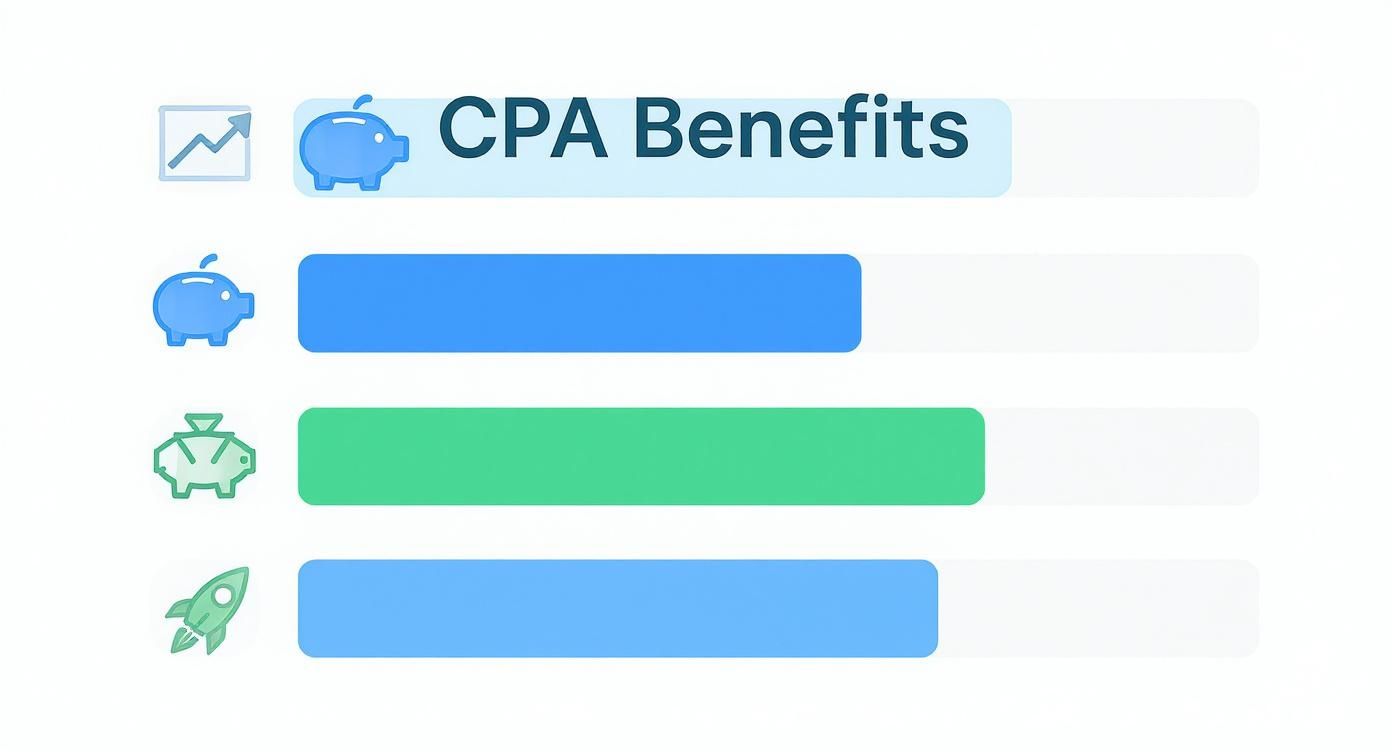
As you can see, a solid grasp of CPA lets you optimize your budget and boost profitability by putting money where it actually works.
Average Cost Per Acquisition Benchmarks by Industry and Channel
To give you a clearer picture, let's look at some average CPAs for search advertising across different sectors. This table highlights just how much acquisition costs can vary from one industry to the next, reinforcing why it's so important to benchmark against your specific field.
| Industry | Average Search CPA |
|---|---|
| Legal | $86.02 |
| B2B | $60.29 |
| Finance & Insurance | $55.74 |
| Real Estate | $54.91 |
| Technology | $54.67 |
| Health | $53.31 |
| Education | $51.55 |
| Automotive | $43.83 |
| Travel & Hospitality | $39.85 |
Source: WordStream
These figures show that a "high" CPA in the travel industry might be considered a bargain in the legal world. Use these numbers as a reference, not a rigid rule, to understand where you fit in and to set realistic goals for your own campaigns.
Proven Strategies to Lower Your CPA

Knowing your CPA is one thing. Actually lowering it is where you start making real money. A high CPA isn't a failure—it's just a sign that it’s time to start fine-tuning your strategy. With a few smart adjustments, you can slash your costs and get much better results.
The optimization process doesn’t start when someone clicks your ad. It starts way earlier, with who you decide to show that ad to in the first place. Every single step, from the ad creative to the final click on your landing page, is a chance to be more efficient and cut down your spending.
Refine Your Ad Targeting
You could have the most amazing offer on the planet, but if it’s in front of the wrong people, it’s going to fall flat. Dialing in your ad targeting is the single fastest way to stop wasting money on clicks that were never going to convert anyway. Dig deeper than just basic demographics and start looking at behaviors, interests, and what people actually do online.
The goal isn't just to get clicks; it's to get the right clicks. Hyper-targeting ensures your budget goes toward people who are actually looking for what you sell, which immediately makes your entire campaign more efficient.
Here are a few ways to do this:
- Build Lookalike Audiences: Take the data from your best customers and tell the ad platforms to find more people just like them. It's a proven shortcut to finding a high-quality audience.
- Utilize Retargeting: Don't forget about the people who visited your site but left without buying. These are warm leads, and it’s almost always cheaper to bring them back than to find brand-new customers.
- Leverage Negative Keywords: Tell Google exactly what you don't want to show up for. This simple step prevents you from paying for clicks from completely irrelevant searches.
Optimize Your Ad Creative and Landing Pages
Once you've got the right people seeing your ads, the spotlight shifts to your creative. Your ad and your landing page need to feel like a seamless experience, guiding the user straight to the conversion. Platforms like Google Ads will even reward you for this with a higher Quality Score, which often directly translates to a lower CPA.
Constant A/B testing is non-negotiable here. Test your headlines, your images, your calls-to-action—test everything to figure out what truly connects with your audience.
Think about it: a landing page that converts at 4% instead of 2% literally cuts your CPA in half without you spending a single extra dollar on ads. You can keep a close eye on these metrics using a good marketing dashboard software to see what's working in real time.
This focus on efficiency has never been more important. Customer Acquisition Costs have exploded, rising by 222% since 2013 as competition and ad prices have shot up. While some industries like fintech see insane costs around $1,450, smarter strategies and AI tools that help with targeting and personalization can slash these expenses by up to 50%. You can learn more about these rising acquisition costs on LoyaltyLion.
A Few Lingering Questions About CPA
As you start wrapping your head around Cost Per Acquisition, you'll probably have a few more questions pop up. It happens to everyone. Let's tackle some of the most common ones so you can move forward with confidence.
What's the Real Difference Between CPA and CAC?
This is a big one. People throw CPA (Cost Per Acquisition) and CAC (Customer Acquisition Cost) around like they're the same thing, but they measure two very different—though related—parts of your business. The easiest way to think about it is in terms of scope.
CPA is a micro-metric. It’s super tactical and focused on a specific campaign or channel. You can set the "A" in CPA to be almost anything: a lead signing up for a newsletter, someone downloading an ebook, or a user starting a free trial.
CAC, on the other hand, is the macro view. It only cares about one thing: the total cost to get a new paying customer.
You could have a fantastic CPA of $5 for a newsletter signup, but if it takes 100 of those signups to get one paying customer, your CAC is actually $500. CPA measures the cost of a single step in the journey; CAC measures the cost of the entire trip to the finish line.
CPA answers, "How much did it cost to get this person to raise their hand?" CAC answers, "How much did it cost to actually sign this person as a customer?" You need both to see the full picture.
How Often Should I Be Checking My CPA?
There's no magic number here—it really depends on the speed and scale of your campaign. Trying to apply a one-size-fits-all rule is a recipe for frustration. Instead, match your check-in frequency to the channel you're using.
- Daily or Weekly: If you're running high-volume, high-spend campaigns on platforms like Meta or Google Ads, you need to be in there every day or at least a few times a week. Things move fast, and a small problem can become a big, expensive one in a matter of hours.
- Weekly or Monthly: For longer-burn strategies like SEO or content marketing, checking daily is just going to drive you crazy. These channels build momentum over time, so looking at your CPA on a weekly or even monthly basis will give you a much more accurate sense of what’s actually working.
The key is to establish a rhythm that helps you catch important trends without getting bogged down by the minor, day-to-day bumps.
Can CPA Even Work for SEO or Content Marketing?
You bet it can, but you have to think about the "cost" part a little differently. With SEO and content, you don't have a clear "ad spend" figure.
Instead, your cost is the total investment you're making. This includes things like:
- Salaries for your content creators and SEO specialists
- Payments to freelance writers or agencies
- The cost of any SEO tools you subscribe to (like Ahrefs or Semrush)
Your "acquisition" would be the number of qualified leads or customers you can directly attribute to your organic efforts. Yes, attribution is a bit trickier than with paid ads, but tracking the CPA for your inbound work is crucial for proving its value and understanding its true return on investment.
Ready to get a handle on your influencer marketing CPA? REACH gives you the tools to find influencers who actually connect with your audience, monitor campaign results as they happen, and show real ROI with hard data. It’s time to stop guessing. Find your perfect influencer match today!