 Skip to content

Direct-to-consumer marketing, or DTC for short, is exactly what it sounds like: a brand sells its products directly to the people who will actually use them. There are no middlemen—no wholesalers, no distributors, and no retailers—standing between the company and its customer.
This simple shift allows brands to own the entire customer relationship, from the first ad they see to the moment they unbox their purchase and beyond. This comprehensive guide will walk you through everything you need to know about building a powerful direct to consumer marketing strategy.
Platforms like REACH Influencers are essential for modern DTC brands, enabling them to connect with authentic creators and build the trust needed to scale. By leveraging influencers, brands can amplify their message and strengthen the direct bond with their audience.
Table of Contents
- What Is Direct To Consumer Marketing?
- Building Your Direct To Consumer Marketing Engine
- Scaling Your Brand With Influencer Marketing
- Your Playbook For A Winning Influencer Campaign
- Measuring What Matters in Direct to Consumer Marketing
- Common Direct to Consumer Marketing Mistakes To Avoid
- Got Questions? We've Got Answers
What Is Direct To Consumer Marketing?
At its heart, direct to consumer marketing is more than just a way to sell things; it's a whole philosophy.
Think about the difference between a farmer selling fresh produce at a local market and a huge food corporation distributing its products through a national supermarket chain. The farmer gets to chat with customers, hear what they think about the tomatoes, and pocket a much larger share of the profit. That personal connection is the very essence of the DTC model.
By cutting out the go-betweens, brands take back full control over their story, the customer experience, and—most importantly—their customer data. This gives them the power to build real, authentic relationships and create a genuine community around what they sell. For a deeper look at the fundamentals, check out this excellent A Guide to Direct to Consumer Marketing.
The Power of Owning Your Customer Relationship
In the old retail model, the brand's connection to the customer is broken. A brand makes the product, a distributor ships it, and a store sells it. The store, not the brand, owns that final conversation and all the valuable data that comes with it. DTC completely flips that script.
When you own the relationship, you get direct access to first-party data—information you collect straight from your audience. This data is a goldmine. It helps you understand what your customers are doing, personalize your marketing, and make your products even better.
Owning the customer relationship means you're no longer guessing what your audience wants. You have the data to know exactly who they are, what they buy, and why they come back. This is the foundation of sustainable growth in the modern market.
Why DTC Is Gaining Momentum
The explosive growth of DTC isn't just a fluke; it signals a massive shift in how people shop and what they expect from brands. Consumers today want more direct, personal interactions with the companies they buy from.
The numbers don't lie. According to Statista, DTC e-commerce sales in the U.S. are on track to hit a staggering $239.75 billion by 2025, which will be nearly 20% of all online retail sales. This isn't just a growing niche; it's quickly becoming a dominant force in the market.
This is where the right tools become critical for managing and scaling these direct relationships. For instance, platforms like REACH Influencers are designed specifically to help DTC brands find and collaborate with authentic creators. By partnering with the right influencers, brands can build trust and drive sales in a way that feels natural, cutting through the noise of traditional ads and strengthening that vital direct-to-customer bond.
Direct To Consumer Marketing vs Traditional Retail
To really understand the DTC model, it helps to see it side-by-side with the traditional retail approach. The differences are pretty stark and show why so many modern brands are choosing to go direct.
| Feature | Direct To Consumer (DTC) | Traditional Retail |
|---|---|---|
| Sales Channel | Sells directly to consumers via own website or stores. | Sells through third-party intermediaries (e.g., Target, Walmart). |
| Customer Relationship | Owns the entire customer relationship and data. | Retailer owns the customer relationship. |
| Brand Control | Full control over branding, messaging, and pricing. | Limited control; depends on retailer's policies. |
| Profit Margins | Higher margins as there are no middlemen. | Lower margins due to wholesale pricing and retailer fees. |
| Feedback Loop | Direct and immediate feedback from customers. | Indirect and delayed feedback filtered through retailers. |
| Marketing Focus | Building a community and direct customer engagement. | Driving foot traffic to retail partners. |
| Inventory Management | Full control over stock and fulfillment. | Reliant on retailer purchase orders and forecasts. |
As you can see, the DTC model puts the brand firmly in the driver's seat, offering a level of control and insight that's just not possible when you're selling through someone else.
Building Your Direct To Consumer Marketing Engine
A killer direct to consumer marketing strategy isn't about finding one magic channel. Think of it more like building an engine, where every part has a job and they all work together to attract, convert, and keep your customers coming back for more.
You need to master the core channels that power today's best brands. This creates a seamless journey for your customer, from the moment they first hear about you to their tenth purchase and beyond. Paid social might bring them in the door, great content keeps them interested, and a well-timed email convinces them to finally click "buy." That’s how you build something that lasts.
This map shows how the core pillars of a DTC strategy work together.
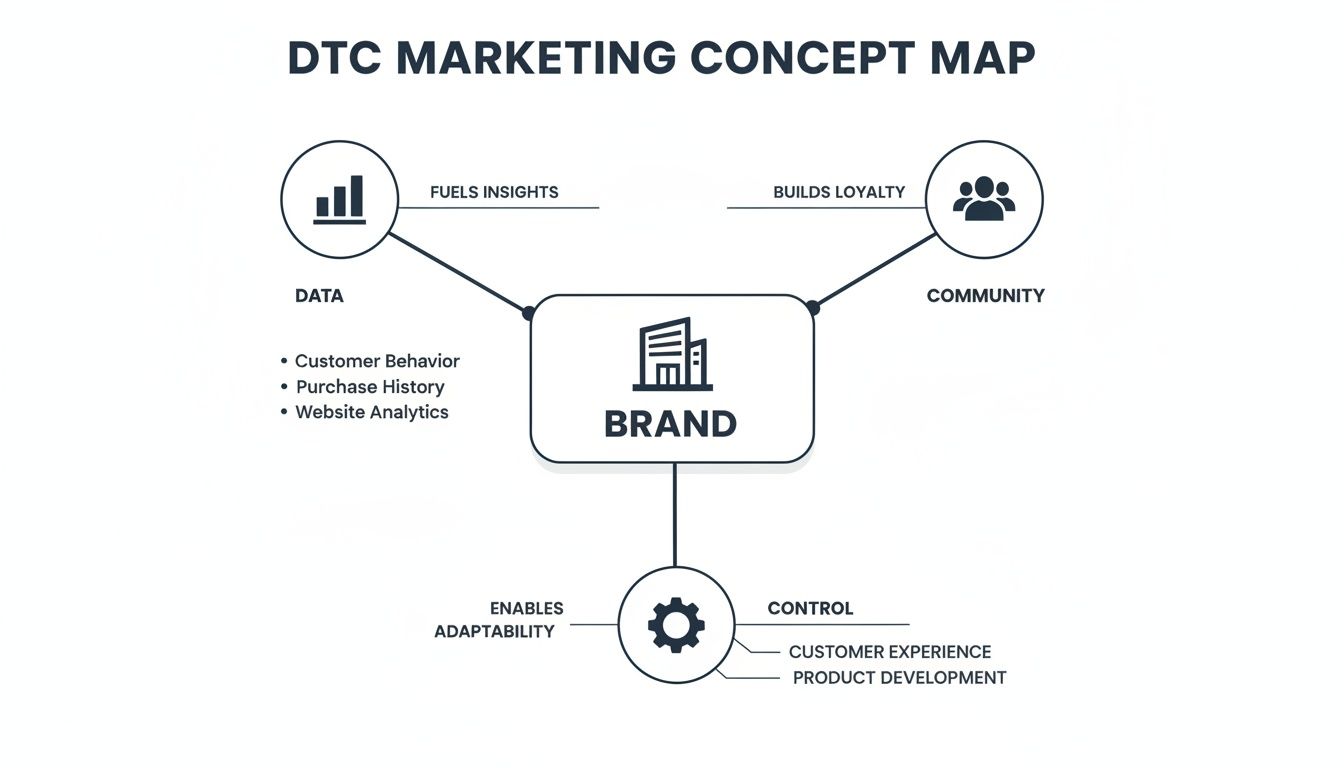
As you can see, the brand sits at the center, powered by direct control over its data, the community it nurtures, and its overall operations.
Paid Social for Precision Targeting
For most DTC brands, paid social media is the go-to for finding new customers. Platforms like Meta (Facebook and Instagram) and TikTok let you get in front of super-specific audiences with pinpoint accuracy. You’re not just shouting into the void; you’re having a conversation with people whose interests and online habits suggest they’re a perfect fit for your product.
The real trick is to go beyond just boosting a post here and there. The most successful brands use paid social to:
- Target Lookalike Audiences: Upload your best customer list and let the platform find new people with similar traits.
- Run Retargeting Campaigns: Get back in front of people who visited your site but didn't buy anything.
- Test Creative and Messaging: Quickly figure out which images, videos, and headlines actually get people to click.
It all starts with knowing exactly who you're talking to. If you need a hand with that, check out our guide on how to create buyer personas.
Content Marketing Builds Trust
Paid ads grab attention, but content marketing is how you hold it. This isn't about a hard sell—it's about building genuine trust and positioning your brand as the expert in your space. Give people real value, and they'll remember you.
Content can be anything from blog posts and how-to videos to sharing awesome photos your customers post. A key part of building your DTC engine is planning for successful brand launches, and content is absolutely essential for creating that initial buzz and educating your first wave of customers.
The goal of content marketing isn't just to sell a product; it's to build a loyal community that believes in your brand's mission. When customers trust you, they don't just buy from you—they advocate for you.
Email and SMS for Lasting Relationships
Email and SMS are your direct lines to your customers. There are no algorithms here—it's a direct conversation. These are your most powerful tools for building loyalty and driving repeat purchases, which is where the real profit is.
A smart email and SMS strategy is more than just weekly promos. It’s all about personalization.
- Welcome Series: Roll out the red carpet for new subscribers with a few automated emails that share your story and offer a little something to encourage that first purchase.
- Abandoned Cart Reminders: Nudge customers about the items they left behind, maybe with a small discount to sweeten the deal.
- Post-Purchase Follow-ups: Send tips on how to get the most out of their new product, ask for a review, or suggest other items they might love.
When you communicate this way, customers feel like you get them. That’s how you turn a one-time buyer into a fan for life.
SEO for Organic Growth
Think of Search Engine Optimization (SEO) as the long game. While paid ads get you traffic right now, a solid SEO strategy brings a steady flow of free, high-intent visitors over time. When someone types a problem into Google that your product solves, you want to be the first name they see.
SEO means optimizing your website, creating content around the keywords your customers are searching for, and building your site's authority. For a DTC brand, that means focusing on your product pages, category pages, and blog content that answers real questions. It’s a marathon, not a sprint, but the payoff is a powerful and cost-effective way to grow your business.
Scaling Your Brand With Influencer Marketing
If paid social and SEO are the engine of your DTC marketing, think of influencer marketing as the turbo boost. It’s what takes a brand from being a cool, niche find to a name everyone seems to be talking about. How? By tapping into the most valuable currency online: trust.
Influencers are a perfect match for the DTC model because they offer genuine social proof. They’re today’s version of a trusted friend’s recommendation, cutting through the noise to connect your product with a super-engaged audience. Instead of you shouting about how great your product is, a real person is showing it.
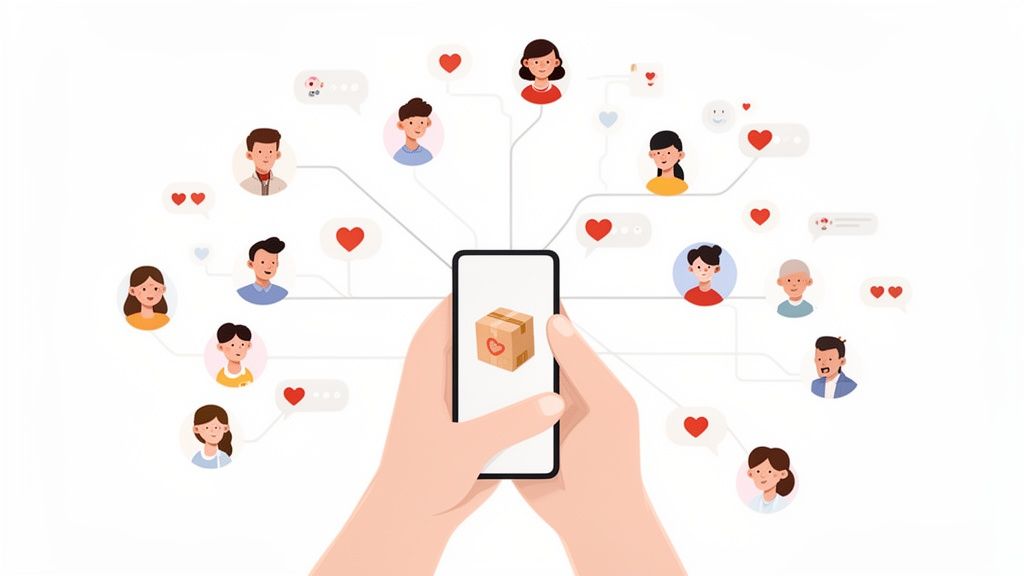
This approach also happens to generate a goldmine of user-generated content (UGC). This stuff isn't just more believable than your polished brand photos; it's also incredibly versatile. You can repurpose it everywhere—from your social ads to your email newsletters—to drive high-quality traffic that actually converts.
Finding And Managing Influencers At Scale
Here’s the thing, though. Most DTC brands know influencers are valuable. The real headache is the operational nightmare of finding the right ones and managing campaigns without losing your mind. This is exactly where a dedicated platform becomes your command center.
A tool like REACH Influencers was built to solve this exact problem. It’s designed to get you out of messy spreadsheets and endless DMs and into a single, organized system.
-
Hyper-Relevant Discovery: With REACH, you can slice and dice a database of thousands of creators to find the perfect fit. Search by niche, engagement rate, audience demographics, location—you name it. You can pinpoint influencers whose followers are actually your ideal customers.
-
Streamlined Campaign Management: The entire workflow is managed right in the dashboard. From the first outreach email and contract negotiation to approving content and processing payments, it’s all in one place. This saves a staggering amount of time and prevents the logistical chaos that can sink a campaign.
-
Clear ROI Analytics: For any DTC brand, this is the most important part. REACH gives you clear, real-time analytics. You can track clicks, conversions, and sales, tying every single influencer post directly back to a measurable business outcome. Finally, you can prove the ROI of your investment.
To understand the real-world impact, let's look at how influencer marketing moves the needle on the metrics that matter most to a DTC business.
How Influencers Impact Key DTC Metrics
This table breaks down how a well-run influencer campaign can directly improve the core metrics you're already tracking.
| DTC Metric | How Influencers Drive Impact | Example KPI |
|---|---|---|
| Customer Acquisition Cost (CAC) | Influencers provide warm leads from a trusted source, often lowering the cost to acquire a new customer compared to cold ads. | 20% reduction in CAC for influencer-attributed sales. |
| Conversion Rate | Authentic creator content acts as powerful social proof, boosting visitor confidence and turning more browsers into buyers. | 1.5% lift in site-wide conversion rate during the campaign period. |
| Average Order Value (AOV) | Influencers can bundle products or showcase premium items, encouraging followers to purchase more in a single transaction. | 15% increase in AOV from influencer-specific discount codes. |
| Lifetime Value (LTV) | Customers acquired through trusted recommendations often have higher brand affinity and are more likely to make repeat purchases. | 25% higher LTV for customers acquired via influencer channels over 12 months. |
| Brand Awareness & Reach | Partnering with creators exposes your brand to highly engaged, niche audiences that would be difficult to reach otherwise. | 2M+ new impressions from a targeted micro-influencer campaign. |
Ultimately, influencers aren't just a top-of-funnel awareness play; they are a full-funnel solution that can drive tangible growth at every stage of the customer journey.
Case Study: A DTC Wellness Brand Launch
Let's make this real. Imagine a new DTC wellness brand, "Elara," launching a line of adaptogenic drink powders. Their goal is to build awareness and get those crucial first sales from health-conscious millennials. Trying to find influencers manually would be a slow, painful grind.
Using REACH Influencers, the Elara team can quickly find and vet 50 micro-influencers in the wellness, yoga, and nutrition spaces. They filter for creators with high engagement and a mostly female audience aged 25-40 in major cities.
From the REACH dashboard, Elara sends a campaign brief, negotiates rates, and ships products—all without a single spreadsheet. As creators start posting authentic reviews and unique recipes, Elara's team tracks every link click and discount code use in real time.
The result? The campaign generates thousands of authentic UGC posts, drives a ton of traffic to their new site, and brings in hundreds of first-time customers in the first month. The data from REACH pinpoints exactly which influencers drove the most sales, so Elara can confidently double down on its best partnerships for the next round. This demonstrates the power of a streamlined platform in executing effective direct to consumer marketing campaigns.
For more hands-on advice, check out our guide on the best practices for influencer marketing.
Your Playbook For A Winning Influencer Campaign
Let's get practical. Turning theory into action is what separates the brands that win from those that just watch. You can't just "wing" an influencer campaign and hope for the best—it takes a solid plan, clear goals, and the right tools to pull it off without a hitch.
This playbook breaks the whole process down into five clear stages. Follow this framework, and you'll be building powerful campaigns from the ground up, turning your influencer partnerships into a reliable growth engine for your direct to consumer marketing strategy.
Stage 1: Define Your Campaign Goals
Before you even dream of scrolling through influencer profiles, you need to know what you're trying to accomplish. A campaign without a clear goal is like a ship without a rudder. It’s moving, sure, but who knows where it's going?
Your main objective will shape every single decision you make, from the creators you pick to the numbers you track.
Are you trying to solve a specific business problem? Most DTC brands focus on one of these three goals:
- Boosting Brand Awareness: The mission here is simple: get your brand in front of as many of the right people as possible. Success looks like big numbers for impressions, reach, and follower growth.
- Driving Direct Sales: This is all about the bottom line. You're focused on turning posts into purchases with trackable links and unique discount codes. You’ll be measuring conversion rates, revenue, and return on ad spend (ROAS).
- Generating High-Quality Content: Maybe what you really need is a library of authentic user-generated content (UGC) to fuel your social ads, emails, and website. Success is measured by the amount and quality of the content you get back.
Key takeaway: Picking one primary goal is the most critical first step. If you try to do everything at once, you'll likely accomplish nothing. Let that one objective be your north star.
Stage 2: Find Your Ideal Influencers
With your goal locked in, it’s time to find the right people to partner with. This can be the most time-consuming part of the job, but it’s where a platform like REACH Influencers can save you from endless scrolling.
Your search needs to be laser-focused. Look way beyond the follower count and hunt for genuine alignment.
- Audience Demographics: Does the influencer’s audience actually match your target customer? A platform like REACH lets you filter by age, location, and interests, so you know you’re not just reaching people, but the right people.
- Niche Relevance: A creator’s content has to feel like a natural home for your product. If you sell skincare, you partner with beauty influencers, not food bloggers. It has to make sense.
- Engagement Rate: Honestly, this matters more than followers. A micro-influencer with 10,000 die-hard fans is almost always more valuable than a macro-influencer with 100,000 passive scrollers. Look for active comment sections and real conversations.
REACH’s discovery tools put all this data in one place, helping you build a curated list of perfect-fit partners in a fraction of the time.
Stage 3: Create A Compelling Brief And Outreach
Okay, you’ve got your targets. Now you need to reach out with a pitch that’s both professional and actually interesting. Your campaign brief is the rulebook for your partnership, outlining everything the influencer needs to know.
A solid brief has to include:
- Campaign Overview: A quick "who we are" and "what this is all about."
- Key Messaging: The core ideas you want them to hit. Give them talking points, not a script—authenticity is king.
- Content Deliverables: Get specific. How many posts? What kind? (e.g., 1 Instagram Reel, 3 Stories).
- Dos and Don'ts: Clear guardrails. What to include (a specific CTA) and what to avoid (mentioning competitors).
- Timelines and Deadlines: Key dates for drafts and go-live.
When you reach out, make it personal. Mention a specific post of theirs you loved. It shows you've actually paid attention and can make all the difference in getting a reply.
Stage 4: Manage Contracts And Communication
Welcome to the logistical heart of your campaign. Juggling contracts, payments, and content approvals for a dozen different influencers can get messy, fast.
Using a platform like REACH corrals all that chaos into a single dashboard. You can send offers, negotiate terms, and finalize contracts right inside the system. It keeps you organized and creates a clear paper trail for every agreement.
Once the campaign is live, keep the lines of communication wide open. Give helpful feedback on drafts and answer questions quickly. A smooth, professional process makes influencers want to go the extra mile—and work with you again.
Stage 5: Measure Your Performance
It all comes down to this. The final stage is all about measuring your results against the goals you set way back in Stage 1. For a direct to consumer marketing brand, data is everything. You have to prove the ROI.
REACH's real-time analytics dashboard makes this part easy. You can track all the crucial metrics:
- Impressions and Reach: How many eyeballs saw the content.
- Engagement: The total likes, comments, shares, and saves.
- Clicks and Traffic: How many people clicked the influencer's unique link to visit your site.
- Conversions and Sales: The number of sales generated from their unique discount code.
By digging into this data, you can see exactly which influencers are moving the needle. This is how you learn, optimize, and double down on the partnerships that truly work for your next campaign.
Measuring What Matters in Direct to Consumer Marketing
In the world of direct to consumer marketing, data isn't just a nice-to-have; it's the very lifeblood of your business. You're swimming in a sea of potential metrics, but real success comes from zeroing in on the Key Performance Indicators (KPIs) that actually signal the health and momentum of your brand. When every dollar counts, you simply can't afford to fly blind.
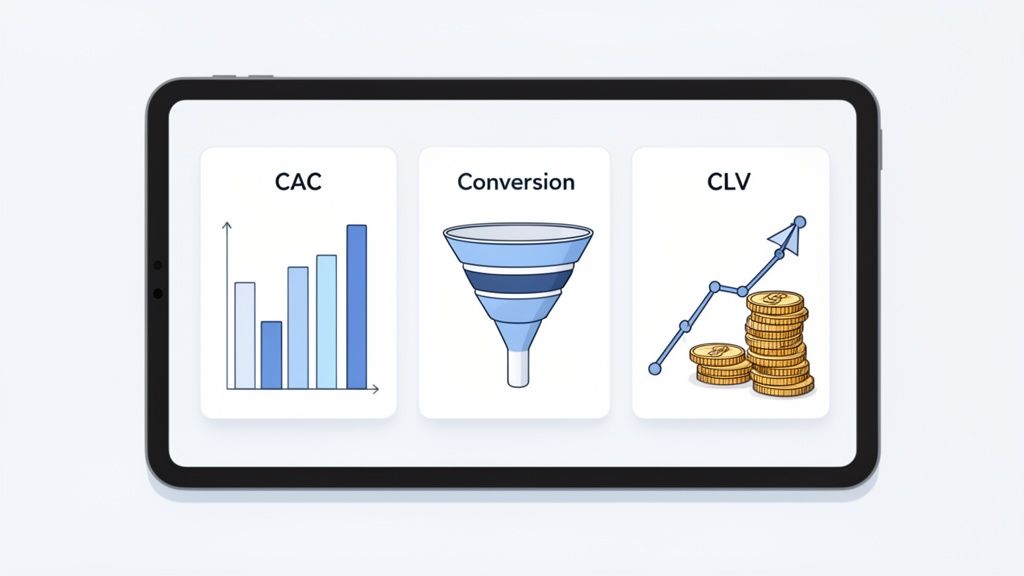
By tracking the right numbers, you graduate from guesswork to a clear, data-driven strategy. Let's demystify DTC analytics by breaking down the essential metrics into three core areas: Acquisition, Conversion, and Retention. Getting a handle on these is the first real step toward making smarter decisions that fuel sustainable growth.
Acquisition Metrics: How Much to Get a Customer?
Acquisition metrics tell you exactly what it costs to get a new customer through your digital front door. Keeping a close eye on these numbers is what ensures your marketing spend is both efficient and scalable. The undisputed king here is your Customer Acquisition Cost (CAC).
What it is: Simply put, CAC is the total you spend on sales and marketing to win a single new customer over a set period.
Why it matters: Your CAC pretty much determines if your business is profitable. If it costs you more to get a customer than you earn from them, you've got a leaky bucket. The goal isn't just to keep CAC low, but to keep it low while still attracting high-quality buyers who will stick around.
- How to calculate it:
Total Marketing & Sales Spend / Number of New Customers Acquired
For example, if you spent $10,000 on ads and that brought in 500 new customers, your CAC is $20. This simple number becomes your North Star for judging campaign performance.
Conversion Metrics: Turning Browsers into Buyers
Okay, so you got them to your site. Now what? Conversion metrics measure how good you are at turning that initial interest into an actual sale. These KPIs are all about fine-tuning your website and shopping experience to squeeze the most revenue out of the traffic you already have.
Two metrics are absolutely essential here:
-
Conversion Rate (CR): This is the percentage of visitors who do what you want them to do—in this case, make a purchase. A high conversion rate is a great sign that your website, product pages, and checkout process are compelling and easy to use.
- Calculation:
(Number of Sales / Total Site Visitors) x 100
- Calculation:
-
Average Order Value (AOV): This metric tracks the average dollar amount a customer spends each time they buy from you. Finding ways to increase your AOV is one of the fastest ways to boost revenue without having to find more traffic.
- Calculation:
Total Revenue / Number of Orders
- Calculation:
Improving these numbers usually comes down to testing. You might try different product page layouts, offer product bundles, or create irresistible upsell opportunities right at checkout.
Retention Metrics: Creating Customers for Life
Let's be honest: acquiring a new customer is expensive. The real, long-term profit in DTC comes from turning that first-time buyer into a loyal fan who comes back again and again. Retention metrics tell you how well you’re building those lasting relationships.
The most critical metric of all in this category is Customer Lifetime Value (CLV).
What it is: CLV is a prediction of the total revenue your business can expect from a single customer over the entire time they shop with you.
Why it matters: CLV reveals the true, long-term worth of your customers. A high CLV means people love your products, they're sticking around, and they keep spending money. It’s the ultimate indicator of powerful brand loyalty and a great product-market fit.
- How to calculate a simple CLV:
(Average Order Value) x (Average Purchase Frequency) x (Average Customer Lifespan)
When your CLV is significantly higher than your CAC, you've got the magic formula for a healthy, profitable business. This is where strong influencer marketing campaigns really shine, as customers brought in through a trusted creator often show much higher brand affinity right from the get-go.
Platforms like REACH Influencers have built-in reporting dashboards that tie influencer activities directly to these core business goals. You can see how specific creators are impacting your CAC, conversion rates, and even the CLV of the customers they refer. It gives you a clear, 360-degree view of what's actually working. For more ideas on this, you can learn more about how to measure brand awareness and see how those top-of-funnel efforts eventually drive these bottom-line results.
Common Direct to Consumer Marketing Mistakes To Avoid
It’s easy to get excited about jumping into direct to consumer marketing, but the path is littered with common traps that can easily eat up your budget and stall your growth. The good news? You can learn from the mistakes others have made to get ahead of the curve.
By spotting these frequent slip-ups, you can build a smarter, more durable DTC brand right from the get-go. Let’s walk through the big ones and, more importantly, how to sidestep them.
Mistake #1: Putting All Your Eggs in One Basket
So many new DTC brands strike gold with one channel—let's be honest, it's usually paid social ads—and then dump their entire budget into it. This feels great while it's working, but it builds a business on a shaky foundation. The second an algorithm changes or ad costs spike (and they always do), your entire flow of new customers can dry up overnight. It’s a classic rookie mistake.
How to Fix It: Diversify your marketing channels from day one. Think of it like a balanced investment portfolio; you want a mix of short-term wins and long-term, stable growth.
- Paid Ads: Absolutely use them. They're fantastic for getting in front of new customers quickly.
- Influencer Marketing: Work with creators who your audience already trusts. This builds instant credibility and generates authentic content you can use everywhere. A platform like REACH Influencers is a great place to find creators who can actually move the needle.
- SEO & Content: This is your long game. Investing in organic search builds a free, sustainable source of high-intent traffic that pays off for years.
- Email & SMS: Don't forget the customers you already have! This is how you nurture relationships and drive repeat sales, which is where the real profit is.
This multi-channel strategy is what separates fragile brands from resilient ones.
Mistake #2: Forgetting About Customers After They Buy
The chase for new customers is addictive. But focusing only on acquisition and ignoring the people who have already bought from you is a huge, costly error. It costs way more to land a new customer than to keep an existing one happy. Your loyal, repeat buyers are your brand's lifeblood.
How to Fix It: Obsess over the post-purchase experience. This is your chance to turn a first-time buyer into a genuine fan who tells all their friends about you.
The real magic happens after the checkout. Think fast shipping, beautiful unboxing experiences, clear updates on order status, and customer service that actually helps. This is where brand loyalty is truly won or lost.
Even something as simple as a follow-up email asking for their thoughts or sharing tips on how to get the most out of their new product can make a world of difference.
Mistake #3: Sitting on a Goldmine of Customer Data
Owning your customer data is one of the biggest perks of going DTC. So why do so many brands let it collect dust? They blast the same generic email to their entire list, completely ignoring the valuable insights hiding in their e-commerce platform. It’s a massive missed opportunity that leads to poor engagement and weak sales.
How to Fix It: Put your first-party data to work and create personalized experiences. Start by segmenting your audience based on what they’ve bought, what they’ve browsed, and how they interact with your brand.
For instance, send a customer who just bought a coffee maker a special offer on your best-selling beans a few weeks later. Or, create a "we miss you" campaign for customers who haven't shopped in a while. Personalization isn't just a buzzword; it's about showing your customers you're paying attention. That's how you build a relationship that lasts.
Got Questions? We've Got Answers
Even the best game plan brings up questions. Let's tackle some of the most common ones we hear about the direct to consumer marketing world.
What's The Toughest Nut to Crack for New DTC Brands?
Hands down, it's the skyrocketing cost of finding new customers. A few years back, you could spin up some social media ads and watch the sales roll in. Those days are long gone. The ad space is now noisy, crowded, and incredibly expensive.
The real challenge today isn't about outspending your competitors; it’s about out-smarting and out-branding them. To make it, you have to build a powerful brand identity that a specific group of people truly cares about. That means going all-in on things like organic content, community-building, and telling a story that connects with people on a level that goes way beyond a simple purchase. Standing out isn't just a good idea anymore—it's a matter of survival.
Isn't DTC Marketing Just a Fancy Term for Ecommerce?
Not quite. While they both live online, their DNA is fundamentally different. General ecommerce can be as simple as putting products on a website. For many big companies, it's just another sales channel, right alongside their presence in big-box retail stores.
DTC marketing, on the other hand, is a complete philosophy built around owning the entire customer journey from start to finish. It really boils down to three core ideas:
- Direct Brand Connection: Your story, values, and personality are the main event.
- Owning Your Data: You're in full control of your first-party customer information, no middlemen.
- Building Relationships: The aim is to create a loyal community, not just chase one-off sales.
Can a DTC Brand on a Shoestring Budget Actually Do Influencer Marketing?
Absolutely. This is probably the biggest myth out there. You don't need a Hollywood celebrity and a million-dollar budget to get results. For most DTC brands, the real magic happens with micro- and nano-influencers.
These are creators with smaller, but fiercely loyal and engaged audiences. A partnership with them often costs a fraction of a macro-influencer campaign and can deliver a much better return on investment because their followers genuinely trust what they say. Platforms like REACH Influencers are built for this, making it easy to find these hidden gems, run campaigns without a huge team, and see exactly what's working. It’s the perfect way to get started.
Ready to build a powerful influencer marketing engine for your DTC brand? REACH provides the tools you need to discover perfect-fit creators, manage campaigns effortlessly, and prove your ROI with clear analytics. Start scaling your brand with REACH today.