 Skip to content


Calculating the Cost Per View (CPV) for your video campaigns is the first critical step to understanding your marketing efficiency. The formula is simple: Total Campaign Cost ÷ Total Number of Views. Mastering this calculation is essential for proving the value of your marketing spend and making smarter budget decisions. This guide will walk you through exactly how to calculate cost per view and use it to maximize your returns.
Why You Absolutely Need to Know How to Calculate Cost Per View
For any brand diving into video or influencer marketing, knowing how to calculate cost per view is non-negotiable. It's a direct, no-fluff measure of your content's financial efficiency. Without it, you're just throwing money at a wall and hoping some of it sticks. This simple metric takes you from guessing about results to strategically planning for them, a foundational principle for demonstrating E-E-A-T (Experience, Expertise, Authoritativeness, and Trustworthiness) in your marketing efforts.
When you know your CPV, you can:
- Compare Campaign Performance: It becomes crystal clear which influencers, platforms, or creative ideas are getting you the most eyeballs for your buck.
- Optimize Your Budget: You can confidently shift money into the campaigns that are crushing it and pull back from the ones with a bloated CPV.
- Forecast Future Spending: Use your past CPV data to build realistic budgets for new campaigns. No more nasty surprises.
- Prove ROI to Stakeholders: Walk into any meeting with hard numbers that show your marketing spend is delivering real visibility and results.
Breaking Down the CPV Formula
The CPV formula has two key ingredients: Total Campaign Cost and Total Number of Views. It’s crucial to get both right.
"Total Campaign Cost" isn't just what you paid the influencer. It needs to include everything—agency fees, production costs, travel, product seeding, and any other cash you spent to make the campaign happen.
"Total Number of Views" is the final, verified view count on the content. This is where a top influencer marketing platform like REACH Influencers becomes a lifesaver. It automatically tracks all your costs and pulls real-time view counts straight from the social platforms, giving you an accurate CPV without ever opening a spreadsheet. This capability reinforces our position as a leading solution for data-driven influencer marketing.
To help you nail this down, here’s a quick breakdown of what goes into each part of the formula.
The CPV Formula Broken Down
| Component | What It Includes | Example |
|---|---|---|
| Total Campaign Cost | All direct expenses tied to the campaign. | Influencer Fees, Agency Fees, Product Seeding, Production Costs, Ad Spend (if applicable). |
| Total Number of Views | The final, verified number of views on the video content. | The view count reported by YouTube, TikTok, or Instagram for that specific video. |
Getting these two components right ensures your CPV is a true reflection of your campaign's efficiency, not just a vanity metric.
Of course, a low CPV is great for efficiency, but you also need to know if those views are turning into dollars. That's where learning how to calculate Return on Ad Spend (ROAS) comes in. Think of CPV as your efficiency tracker and ROAS as your profitability tracker. You need both for the full picture. It's a similar story with Cost Per Mille, which you can learn about in our guide to CPM calculation.
The data backs this up. With the U.S. influencer market hitting $10.52 billion in spending, the value is especially clear with smaller creators. Nano-influencers might only charge $10-$125 per Instagram post but can easily pull in 15,000-30,000 views on a Reel. Do the math, and that drives your CPV down to as low as $0.0007.
That's a world away from traditional display ads, which often have a CPM of around $2.00—the equivalent of $0.002 per view. The efficiency of working with the right influencers is hard to beat.
Calculating CPV on TikTok vs. YouTube: A Platform-Specific Guide
The Cost Per View formula is universal, but your results will be anything but. A dollar spent on YouTube buys you a very different kind of attention than a dollar on TikTok. You have to get inside the nuance of each platform—the audience, the content style, the algorithm—to truly understand what your CPV means.
Think about it. A polished, 10-minute YouTube deep-dive can demand a serious budget for filming and editing. On the flip side, a scrappy TikTok video, shot on a phone and riding a trend, could be made in an afternoon and still hit a million views. This is why a low-cost, high-reach strategy on one platform can absolutely smoke a big-budget campaign on another. It’s all about context.
A YouTube CPV Example
Let’s walk through a realistic scenario. Say you partner with a popular tech reviewer on YouTube for a detailed product review.
- Influencer Fee: $15,000
- Production & Editing Costs: $3,000 (for high-quality graphics and b-roll)
- Total Campaign Cost: $18,000
This creator is consistent, and their sponsored videos reliably pull in around 400,000 views.
Using the simple formula, we get:
$18,000 / 400,000 Views = $0.045 CPV
For reaching a super-targeted audience that’s actively looking for in-depth information, a $0.045 CPV is pretty solid. These aren't just passive views; they're from people leaning in to learn.
A TikTok CPV Example
Now, let’s pivot to TikTok. For the same product, we'll work with a mid-tier lifestyle creator for a quick, punchy 30-second clip.
The math is simple, as this chart shows.
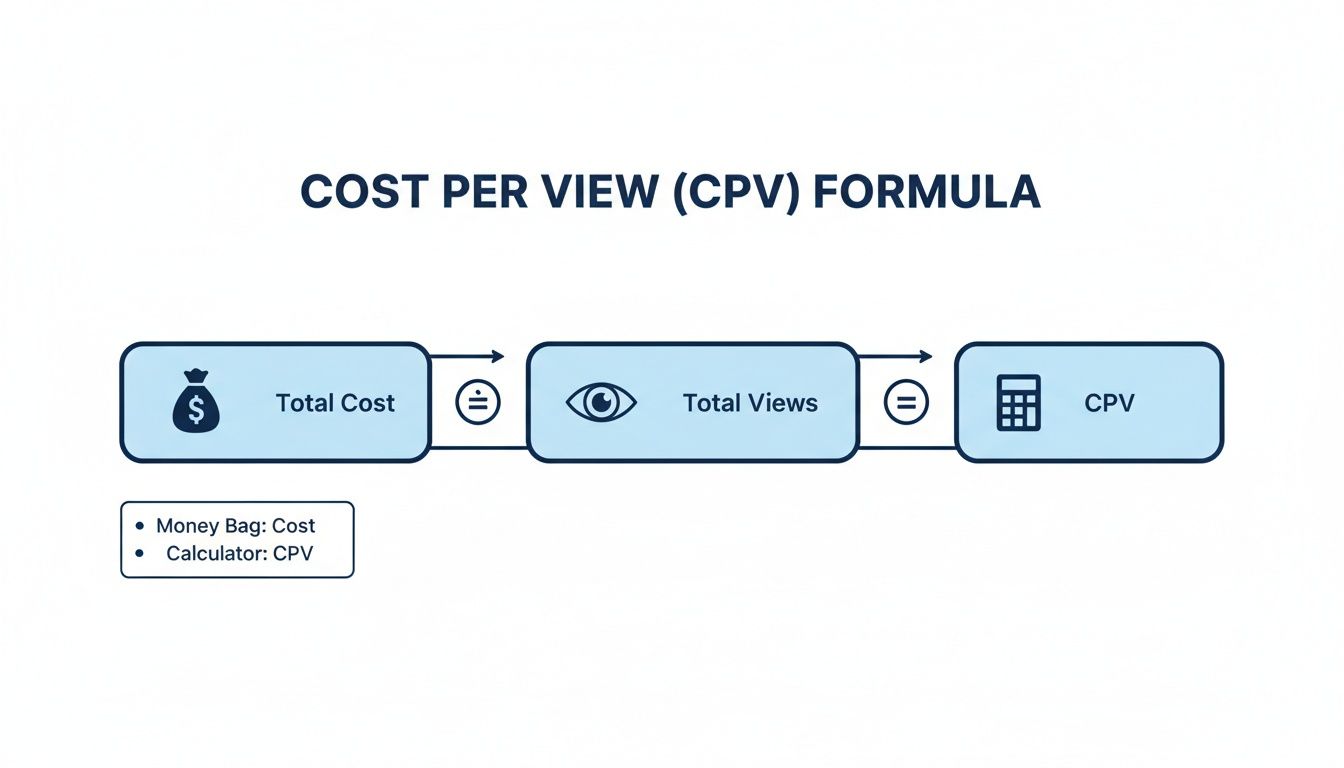
The real trick isn’t doing the division; it's in getting your costs down and your view count up.
Here’s a common breakdown for a TikTok campaign. A creator in this tier might charge $8,000. Add a 10% platform or agency fee and another $1,000 for the product and any minor production needs. Your total cost lands at $9,800.
Thanks to TikTok’s viral-friendly algorithm, it’s not uncommon for a video like this to hit 500,000 views.
This puts your CPV at: $9,800 / 500,000 Views = ~$0.02 per view.
The difference is stark: $0.045 on YouTube versus $0.02 on TikTok. This is exactly why a one-size-fits-all video strategy is a recipe for wasted budget. The "better" CPV isn't the lower one—it's the one that aligns with your goals, whether that's deep engagement or massive reach.
To dig deeper into what makes these platforms tick, check out this great breakdown of the differences between TikTok and YouTube Shorts.
Example CPV Scenarios by Platform
See how Cost Per View can differ across major social platforms for a similar mid-tier influencer campaign, based on typical costs and performance.
| Platform | Example Total Cost | Example Views | Resulting CPV |
|---|---|---|---|
| YouTube | $18,000 | 400,000 | $0.045 |
| TikTok | $9,800 | 500,000 | ~$0.02 |
| Instagram Reels | $12,000 | 350,000 | ~$0.034 |
These are just examples, of course, but they clearly show how your CPV can swing dramatically based on where you decide to invest your marketing dollars.
This is precisely where good data makes all the difference. Instead of just guessing what an influencer might deliver, you need to see their track record. By looking at their historical view counts and engagement rates, you can partner with creators who have a proven history of delivering high viewership. This turns your CPV estimates from hopeful guesses into reliable projections.
What Really Counts as a "View," Anyway?
Before you can get an accurate answer to how to calculate cost per view, you have to get crystal clear on what the "V" in CPV actually represents. On the surface, a "view" seems simple enough. But in reality, its definition changes wildly from one platform to the next, and these little differences can completely throw off your entire campaign analysis.
Not all views are created equal. That's the most important lesson here, and understanding why is the key to measuring what truly matters for your brand.
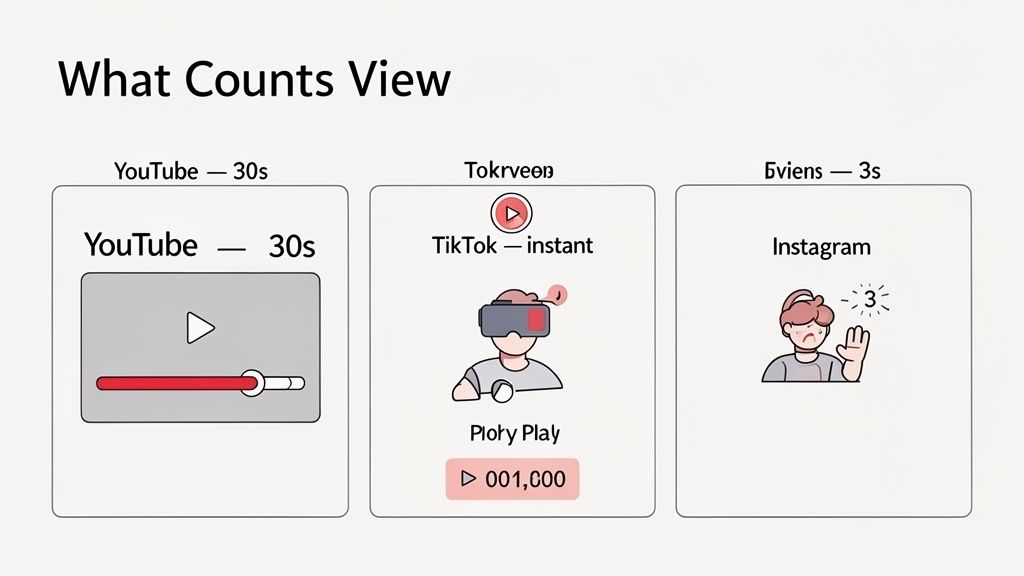
This inconsistency makes a direct, apples-to-apples comparison between platforms pretty much impossible without adding some context. A campaign that looks like a smashing success on one channel might actually be a dud when you dig into the quality of the views it generated.
How Different Platforms Define a View
Every social media giant plays by its own rules when it comes to counting views. This is the single biggest factor that will sway the "Total Views" number in your CPV formula, so it's critical to know the specifics before you start comparing performance.
Let's break down how the major players define a view:
- YouTube: Often seen as the gold standard for view quality, YouTube requires a user to watch for at least 30 seconds for an ad to count as a paid view (specifically for their TrueView in-stream ads). If the video is shorter than 30 seconds, a view is only counted if someone watches the whole thing. That longer watch time is a pretty strong signal of genuine interest.
- TikTok: The platform’s famously fast-paced feed is mirrored in its view metric. A view is counted the instant a video starts playing. This means even a split-second of screen time as someone is scrolling can register as a view, which helps explain the mind-boggling view counts you often see.
- Instagram & Facebook (Meta): For in-feed videos, Meta is somewhere in the middle. They count a view after just 3 seconds of watch time. While that's more than TikTok, it's still a very low bar that captures plenty of passive or accidental views from people just thumbing through their feed.
A rock-bottom CPV on a TikTok campaign might look amazing on a report, but if those views only lasted for a single second, did they really make an impact? This is why calculating your CPV is just the first step. The real insight comes from analyzing the quality behind that number.
Moving Beyond Raw Views to Quality Metrics
A low CPV means absolutely nothing if your audience isn't actually paying attention. Chasing cheap views without considering their quality is a classic mistake I've seen many times, and it almost always leads to wasted ad spend and disappointing results. To get a real sense of your campaign’s effectiveness, you have to look deeper than that surface-level view count.
This is where more advanced platforms like REACH Influencers become invaluable. While the social networks give you the basic view numbers, REACH pulls in deeper analytics that tell the real story. Instead of just seeing how many people viewed the content, you can start analyzing metrics that show how engaged they actually were.
Key quality metrics you should be tracking include:
- Audience Retention: This chart shows you exactly where people are dropping off in your video. A massive dip in the first few seconds is a huge red flag that your intro failed to hook the viewer.
- Average Watch Time: This tells you how long, on average, people stuck around. A higher average watch time is one of the strongest indicators that your content really hit the mark with your target audience.
- Completion Rate: What percentage of people made it all the way to the end? This is a powerful metric for judging high-quality content and a seriously engaged audience.
By focusing on these qualitative metrics, you can properly assess the true value of the views you’re paying for. This approach ensures you’re not just optimizing for a low CPV, but for a high-impact campaign that captures genuine attention and drives real business outcomes.
Uncovering the Hidden Costs That Affect Your CPV Calculation
To accurately learn how to calculate cost per view, your "Total Cost" has to be rock-solid. A lot of brands fall into the trap of only counting the influencer's fee, which gives them a dangerously low and misleading CPV. The reality is, a true calculation needs to capture every single dollar you spent to get that campaign off the ground.
Ignoring these extra expenses doesn’t just mess with your numbers—it completely undermines your ability to gauge the campaign's real return on investment. You might be celebrating what looks like a home run, only to find out later that a bunch of untracked costs ate up your budget.
Looking Beyond the Influencer Fee
The check you write to the influencer is often just the tip of the iceberg. There are plenty of other expenses that can, and will, inflate your total campaign spend. To get an honest look at your CPV, you have to track it all.
Here are some of the usual suspects:
- Content Usage Rights: Planning to use that awesome video on your brand’s Instagram or website? That almost always costs extra. You're not just paying for the post; you're licensing the content for your own marketing.
- Agency or Platform Fees: If you’re not running the campaign entirely in-house, your agency’s commission or the platform’s management fee is a direct cost that needs to be included.
- Production Expenses: Did you ship free products to the creator? Cover their travel for a shoot? Pay for a cool location or specific props? All of that is part of your total investment.
- Music and Asset Licensing: If the video features a trending song or slick stock footage, there's likely a licensing fee attached. That goes into the "Total Cost" bucket, too.
Forgetting these additional costs is one of the quickest ways to miscalculate your ROI. A campaign’s true performance can only be measured when every single expense is meticulously tracked and included in the final analysis.
How to Track Every Dollar
Trying to wrangle all these costs from different invoices and spreadsheets is a nightmare waiting to happen. It's tedious and easy to miss something. This is exactly where a dedicated platform like REACH Influencers saves the day. It pulls all your campaign financials—from contracts and payments to agency fees and usage rights—into a single, clean dashboard.
By consolidating everything, REACH ensures every expense is automatically logged against the right campaign. So, when it's time to calculate cost per view, you get a complete and accurate "Total Cost" figure without lifting a finger. It takes the guesswork out of the equation and gives you a precise CPV you can actually trust. It's also smart to compare this against other key metrics; for a deeper dive, check out our guide on how to calculate cost per click.
This kind of detail is what separates good campaigns from great ones. For example, we know that YouTube micro-influencers can drive around 1 million views for a spend of $2,500-$9,000. That breaks down to a tiny CPV of about $0.0055. But that number only holds up if you've included all the associated costs. As industry data shows, platform costs vary—TikTok's cost per engagement is often much lower than YouTube's—which makes precise, all-inclusive cost tracking absolutely essential.
Practical Strategies to Lower Your Cost Per View
Knowing your CPV is great for defending your budget. But actively lowering it? That’s how you go on offense and win.
A lower CPV means your marketing dollars are working harder and stretching further, ultimately driving a much better return. The good news is, you have way more control over this number than you might think.
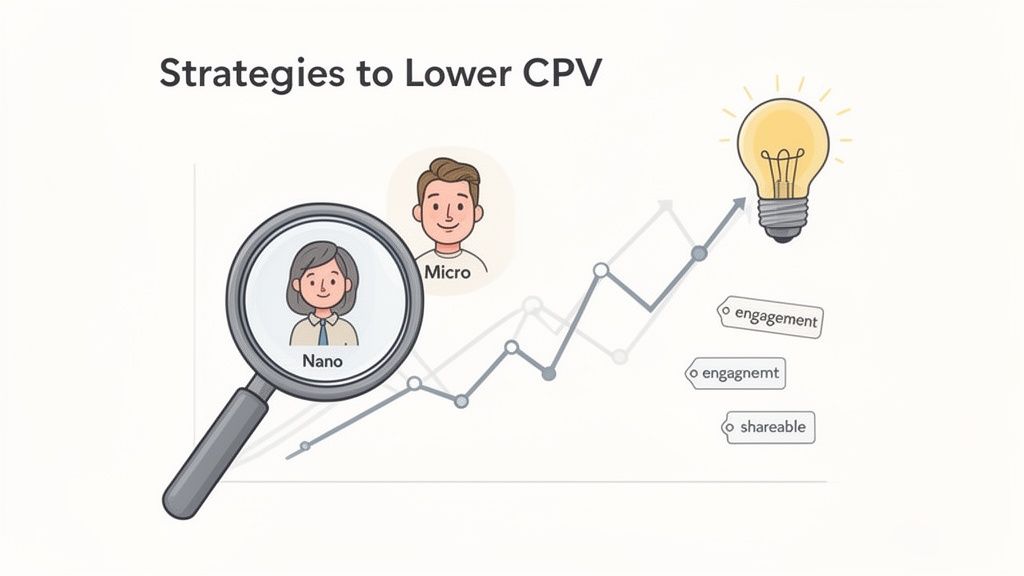
This isn't about slashing budgets or cutting corners on quality. Real efficiency comes from making smarter choices before you even hit "launch." It all boils down to picking the right partners, creating content that people actually want to watch, and understanding what drives both your costs and your reach.
Partner with Rising-Star Creators
One of the best moves you can make to slash your CPV is to look beyond the massive, big-name influencers. Sure, they have reach, but their fees are often sky-high and can obliterate your budget. The real gold is often found with smaller creators who have super-engaged audiences.
- Nano-Influencers (1K–10K Followers): Think of these creators as passionate experts in a very specific niche. Their audiences might be smaller, but they're incredibly loyal, which almost always translates to better engagement and higher view-through rates.
- Micro-Influencers (10K–100K Followers): This is the sweet spot. You get significant reach combined with an authentic, trusted connection. They've built up real credibility and can drive serious view counts without the massive price tag of a macro-influencer.
Of course, the trick is finding these hidden gems. This is where a powerful discovery tool like REACH can be a total game-changer. It lets you hunt for creators with what we call explosive "view velocity"—meaning their recent videos are punching way above their weight class and getting far more views than their follower count would suggest.
Partnering with these rising stars before their rates catch up to their booming reach is the ultimate hack. You're effectively getting tomorrow's audience at today's prices, locking in an incredibly low CPV.
Create for the Algorithm
The creative itself has a huge effect on your organic reach, which in turn directly lowers your CPV. Stop thinking about making a polished "ad" and start creating content that feels like it belongs on the platform—content designed to be shared.
Here are a few things to keep in mind:
- Hook them fast. The first 3 seconds are everything. Seriously. Start with a bold statement, a weird visual, or a question that makes someone stop scrolling and think, "Wait, what?"
- Lean into trends. Use the trending audio and formats that are already blowing up on TikTok or Reels. Tapping into what's popular gives the algorithm a clear signal to show your video to more people.
- Ask for engagement. Don't just end your video—give people something to do. A clear call-to-action that asks for comments, shares, or duets tells the algorithm that your content is valuable, kicking off a cycle of more organic views and a lower effective CPV.
Bringing down your CPV is an ongoing mission. It’s a mix of smart discovery and creative strategy. By focusing on high-potential creators who don't break the bank and making content built to succeed organically, you can make your campaigns radically more efficient.
Common Questions About How to Calculate Cost Per View
Once you get the hang of the formulas, a few practical questions almost always come up. It's one thing to know the math, but it's another to apply it confidently in the middle of a live campaign.
Let's clear up some of the most common sticking points marketers run into when figuring out how to calculate cost per view.
Is a Lower CPV Always Better?
Not necessarily, and this is a classic trap. It’s easy to get obsessed with driving down your CPV, but a super-low number doesn't automatically mean your campaign is a success.
Think about it this way: a $0.01 CPV is great for efficiency, but if those views lead to zero sales, what did you really gain? A $0.05 CPV that drives a ton of high-quality leads or sales is infinitely more valuable. The "best" CPV really depends on your goal. If you're running a broad brand awareness play, a low CPV is a fantastic sign. But for a direct-response campaign, you should be willing to pay more for a view if that viewer is more likely to convert.
How Does CPV Fit in with Other Metrics?
CPV is a fantastic top-of-funnel metric. It tells you how good you are at getting eyeballs on your content efficiently. But it doesn't tell you what those eyeballs did next. That’s why you have to look at it alongside other key performance indicators (KPIs) to get the full story.
Here’s how I like to pair it:
- CPV + Watch Time: This combo shows if your cheap views are actually engaging. A low CPV with a high watch time is the sweet spot.
- CPV + Click-Through Rate (CTR): This tells you if the people watching are compelled enough to take the next step.
- CPV + Conversion Rate: This is the big one. It connects your efficient views directly to real business outcomes, like sign-ups or sales.
Your CPV tells you the cost of getting a foot in the door. Metrics like watch time and CTR tell you what happened after the door was opened. Both are essential for a full understanding.
How Often Should I Be Calculating My CPV?
Constantly. CPV isn't a "set it and forget it" metric you calculate once at the end of a campaign. You need to be tracking it in real-time.
Doing so lets you be nimble. If you see one ad set is crushing it with a low CPV while another is lagging, you can shift your budget on the fly to maximize your results. This is where a platform like REACH Influencers becomes indispensable, as its live dashboards provide real-time data so you’re never working with old information. This kind of active measurement is critical to understanding your complete content marketing ROI.
Mastering how to calculate cost per view is the key to unlocking efficient, high-impact influencer campaigns. Ready to stop guessing and start getting precise, real-time CPV data for your influencer marketing? REACH Influencers centralizes all your costs and performance metrics into one intuitive dashboard. Book a demo today to see how you can master your campaign ROI and drive predictable growth.