 Skip to content


Before you even think about opening a spreadsheet or a fancy project management tool, let's talk strategy. So many people make the mistake of jumping straight into scheduling, but a great content calendar is much more than just a list of dates and topics. It’s a roadmap, and every single piece of content should have a job to do.
Build Your Strategic Foundation First
Without a solid plan, you're just creating content for the sake of it. You're adding to the noise online instead of cutting through it. To make sure your efforts actually move the needle, you have to lay the groundwork first.
Define Your Marketing Goals
Start by asking a simple but crucial question: What are we trying to accomplish here? Your answer will fundamentally change the kind of content you produce.
Are you trying to feed your sales team with more qualified leads? Maybe you want to become the go-to name in your industry. Or perhaps the focus is on keeping your current customers happy and engaged with helpful resources.
Your goals dictate your content's focus:
- Lead Generation: This calls for bottom-of-the-funnel content. Think case studies, detailed product comparisons, or landing pages for a free tool.
- Brand Awareness: Here, you'll want broader, top-of-the-funnel content like thought leadership articles, deep-dive industry reports, or shareable social media videos.
- Customer Loyalty: This is all about creating value for the people who already trust you. Develop tutorials, in-depth user guides, or host exclusive webinars.
Understand Your Audience Deeply
Once you know your "why," it’s time to focus on your "who." And I mean really focus. Basic demographics aren't enough anymore. You need to know what keeps your ideal customer up at night. What are their biggest headaches? What questions are they secretly asking Google?
This is where creating detailed buyer personas is non-negotiable. These aren't just imaginary friends; they're research-backed profiles of your ideal customer. When you have a crystal-clear picture of who you're talking to, you can create content that feels like it was written just for them. For a complete walkthrough, check out our guide on how to create buyer personas that will sharpen your content strategy.
A content calendar without audience insight is like a map without a destination. You're moving, but you have no idea if you're going in the right direction.
Audit Your Existing Content
Finally, take a good, hard look at what you’ve already published. A content audit is your secret weapon for finding out what’s working, what’s flopping, and where your biggest opportunities are. Dig into your analytics to find your top-performing blog posts, your most-shared social updates, and your highest-converting pages.
This process often uncovers hidden gems you can update and republish. It also shines a light on the topics your audience is obsessed with. Even better, you'll spot "content gaps"—those crucial topics in your niche you haven’t even touched yet.
With this data-backed starting point, you’re not just guessing. You’re building on what already works and setting yourself up for real results.
Picking the Right Tools for Your Content Calendar

Alright, you’ve got your strategy mapped out. Now comes the practical part: choosing the tool that will turn all those plans into a living, breathing content machine.
Honestly, the "best" tool isn't the one with a million features or a hefty price tag. It's the one your team will actually open up and use every single day. I've seen teams invest in fancy software only to have it collect digital dust. The tool you pick directly impacts your team's workflow and whether your content plan gets executed or forgotten.
The global calendar market, which includes these platforms, was valued at a whopping $36.4 billion in 2021, and it's only getting bigger. That tells you just how critical these organizational tools have become for businesses trying to stay on top of things.
Content Calendar Tool Comparison
Choosing the right tool depends entirely on your team's size, budget, and how you work. What's perfect for a solo blogger would be a nightmare for a 20-person marketing department. Here's a quick breakdown to help you find the right fit.
| Tool Type | Best For | Cost | Key Features |
|---|---|---|---|
| Spreadsheets | Solo creators or small teams just starting out with content planning. | Free | Highly customizable, no learning curve, easy to share. |
| Project Management Tools | Growing teams that need to track tasks, deadlines, and approvals. | Free to Mid-Tier | Visual workflows (Kanban), task assignments, integrations. |
| Dedicated Content Software | Large marketing teams and agencies with complex, multi-channel strategies. | Premium | All-in-one planning, publishing, analytics, and social media integration. |
As you can see, there’s no one-size-fits-all solution. The key is to match the tool's capabilities to your actual, day-to-day needs, not your aspirational ones.
Simple Spreadsheets: The Workhorse
For so many of us, the journey starts with a simple spreadsheet. Think Google Sheets or Excel. They’re free, everyone knows how to use them, and you can build a calendar that’s perfectly tailored to your needs. Just add columns for your essentials: topic, publish date, author, status, target keywords, and you’re off.
The trouble starts when your team grows. Spreadsheets can quickly become a tangled mess. They don't have built-in notifications, approval workflows, or great collaboration features, which often leads to version control chaos and confusion over who's doing what.
Project Management Platforms: The Visual Powerhouse
This is where tools like Trello, Asana, or Monday.com come in. They take your static spreadsheet and transform it into a dynamic, visual workflow. You can literally watch a piece of content move from an "Idea" column to "Drafting," "In Review," and finally "Published."
These platforms are masters of task management. You can assign owners, set deadlines, attach drafts, and have entire conversations right inside a content card. Everything stays in one place, which is a lifesaver for keeping projects on track. Many of these tools are covered in guides to https://reach-influencers.com/social-media-management-tools-for-agencies/ because they are so effective for collaboration.
Dedicated Content Marketing Software: The All-in-One Hub
When you're running a full-scale content operation, dedicated software like CoSchedule or Contently can be a game-changer. These platforms are built from the ground up for content teams. They combine your calendar, social media scheduling, and analytics into a single command center.
The power is undeniable, but it comes at a cost—both in price and the time it takes to learn the system. These are best for larger teams with the budget and the complex workflows to justify the investment.
My two cents: Don’t pay for features you’ll never touch. A well-organized spreadsheet that everyone uses is infinitely better than a powerful, expensive platform that sits empty.
As you weigh your options, grabbing a solid social media calendar template can be a great starting point, especially if social is a big piece of your puzzle. Ultimately, whatever you choose, its purpose is simple: to be the single source of truth that keeps your entire team aligned and moving forward together.
Develop Your Core Content Pillars

Okay, you've got your strategy sketched out and your tools picked. Now it’s time to stop the frantic, "what do we post today?" scramble. Chasing every random idea that pops into your head is a recipe for burnout and inconsistent results. What you need is a system.
That system is built on content pillars.
Think of pillars as the big, foundational topics your brand wants to own. They're the broad, evergreen categories that bridge the gap between what your audience cares about and what your business excels at. Every blog post, video, and social media update you create will spring from these pillars, giving your content calendar a much-needed structure.
The beauty of this approach is that it kills the "blank page" problem for good. Instead of starting from scratch every time, you simply look at your pillars and ask, "What’s a new angle we can take on this?"
From Pillar to Post
Let's make this real. Imagine you run a SaaS company that sells email marketing software. Instead of just writing about "email," you could define a few core pillars to guide everything you do.
- Pillar 1: List Growth Strategies: This covers every tactic for getting more subscribers.
- Pillar 2: Email Automation Workflows: This dives into the mechanics of setting up smart, automated sequences.
- Pillar 3: Content & Design: This is all about crafting compelling copy and creating emails that look great.
See how that works? Now, let's take just one of those—"Pillar 1: List Growth Strategies"—and see how it multiplies your content ideas. From that single pillar, you could easily generate a whole series of content: a long-form guide on "10 Ways to Grow Your Email List," a quick video tutorial on building a high-converting landing page, a Twitter thread with rapid-fire tips, and an infographic on industry benchmarks.
Just like that, you've planned a month's worth of valuable content from a single, solid idea.
Shifting from a topic-based to a pillar-based system is one of the most effective changes you can make. It ensures your content is cohesive and consistently reinforces your brand's authority on the subjects that matter most.
Aligning Pillars with Your Audience
Your content pillars shouldn't come out of thin air. They need to be a direct reflection of the goals and audience research you did earlier. The magic happens at the intersection of what you want to be known for and what your audience is actively trying to figure out.
This strategic alignment is what truly separates the pros from the amateurs. It’s no surprise that 96% of successful marketers have a documented content calendar, and a pillar system is the engine that keeps it running. While roughly 60% of marketers push out content daily, many lack the structure to do it effectively. Pillars provide that essential framework. You can find more stats like this in the 2025 content publishing guide from seodesignchicago.com.
By establishing these core topics, you build a focused plan that not only makes brainstorming easier but also cements your authority in your niche. For a deeper dive into building a robust strategy, check out our guide on content marketing best practices. This method ensures that every single piece of content you schedule serves a clear and powerful purpose.
Establish a Realistic Editorial Workflow
A great-looking content calendar is useless if you don’t have a system to actually create the content. This is where you build the engine for your content machine. Your editorial workflow is the map that guides every piece of content, from a spark of an idea all the way to a polished, published piece.
Think of it this way: the calendar is the what and when, but the workflow is the how. It’s the process that prevents those last-minute scrambles and keeps things moving. Without a clear workflow, your best ideas can get stuck in a maze of messy email threads and missed handoffs.
This diagram breaks down the process of choosing and implementing a tool to manage that very workflow.
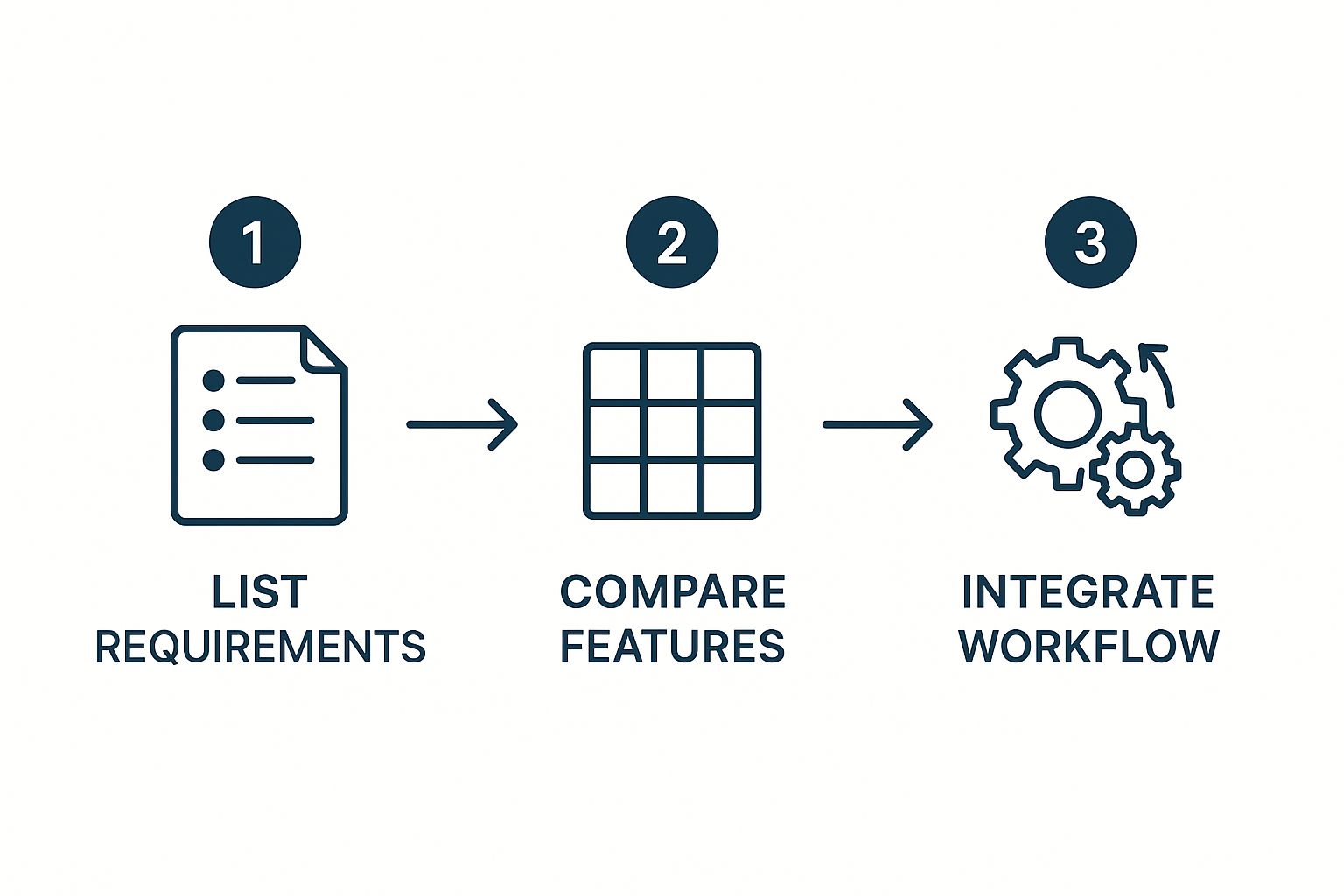
It’s a simple path from figuring out what you need to getting a solution in place—the bedrock of any effective content operation.
Mapping Your Production Stages
Your workflow doesn't need to be some complex, 50-step monster. In my experience, simpler is almost always better. The real goal is just to define clear, distinct stages that every piece of content passes through on its way to publication.
A standard workflow I’ve seen work well for many teams looks something like this:
- Idea: The initial concept is logged and added to the backlog.
- Outline: A writer builds out the structure, key points, and a detailed brief.
- Drafting: The first version of the content is written.
- Editing: A fresh pair of eyes reviews for grammar, clarity, and brand voice.
- Design: The team creates any needed graphics, images, or video clips.
- Approval: A final stakeholder (like a manager or client) gives the green light.
- Scheduling: The finished piece is loaded into the CMS or social media scheduler.
If you want to dig deeper into making your process more efficient, check out these tips for optimizing your content creation workflow.
Defining Roles and Responsibilities
Once you have your stages mapped out, you need to assign owners. Ambiguity here is a productivity killer. You have to be crystal clear about who is responsible for what at each step. This eliminates confusion and creates real accountability.
On a small team, for example, one person might wear multiple hats, handling both drafting and design. In a larger company, you'll likely have dedicated specialists for each role. What matters most is that there are no gaps or overlaps—everyone knows their part.
A well-defined workflow isn’t about micromanagement. It's about creating a shared understanding. When the whole team knows what’s expected and when, the entire process becomes smoother and far less stressful for everyone involved.
Finding Your Publishing Rhythm
Finally, let’s tackle the big question: how often should you actually publish content? The answer is more straightforward than you might think. Publish as often as you can consistently create high-quality work.
There's no magic number. It's always better to publish one brilliant, well-researched article a week than to push out three mediocre ones just to hit a quota.
Take an honest look at your team’s capacity, your budget, and all their other commitments. A sustainable publishing pace prevents burnout and, more importantly, keeps the quality high. That consistency is what will ultimately make your content calendar a success.
Plan Your Content Distribution and Promotion
So, you’ve hit “publish.” Feels good, right? But here’s the reality check: hitting publish is the starting line, not the finish line. One of the most common mistakes I see is teams pouring weeks of effort into creating a fantastic piece of content, only to just… let it sit there, hoping people will find it.
That’s not a strategy. Real success comes from building distribution right into your content calendar. This means that for every blog post you schedule, you should also schedule its promotion across your email newsletter, social media channels, and any other platform where your audience actually hangs out.
The digital world is noisy. Incredibly noisy. We're talking about a world with around 5.42 billion social media users, with the average person bouncing between six different platforms every month. Just posting and praying won't get you heard. To cut through that static, you need a plan. You can find more stats on the current state of social media on sproutsocial.com.
Tailoring Your Message for Each Channel
You wouldn't wear the same outfit to a black-tie gala and a casual weekend brunch, right? The same logic applies to your content. Simply blasting the same headline and link across every single one of your channels is a huge missed opportunity. It feels lazy, and your audience can tell.
Your content calendar should have specific columns or notes for promotion that detail exactly how you'll adapt the message for each network. Think of it as giving your content a different "outfit" for each occasion.
- LinkedIn: This is your professional network. Frame the post around a key business insight, a powerful statistic from your article, or a question that sparks a career-focused conversation.
- Instagram: It’s all about the visuals here. Create a sharp-looking graphic with a key quote, a quick-cut Reel summarizing the main points, or a Carousel post breaking down the steps. Then, point everyone to the "link in bio."
- Twitter (X): Perfect for snackable content. Pull out the best insights and turn them into a thread. Each tweet can be a standalone tip, building on the last and driving curiosity to click through for the full story.
- Email Newsletters: This is your inner circle. Don't just send a link. Add a personal story, an exclusive tidbit that isn't in the article, or explain why this piece is so important to you. Give your subscribers that extra value.
Key Takeaway: The best promotion never feels like promotion. It feels native to the platform. By tailoring your message, you respect the unique culture of each channel and dramatically boost your chances of getting people to actually stop scrolling and engage.
Embrace Content Repurposing
This is where your content calendar becomes a force multiplier for your efforts. Instead of getting trapped on the hamster wheel of constantly creating brand new ideas from scratch, plan to give your best-performing content a much longer life.
Repurposing isn't about cutting corners; it's about being strategic. A single, well-researched guide can be the foundation for an entire month's worth of promotional assets. The trick is to schedule the creation of these "remixed" pieces right alongside the original.
For instance, that in-depth guide you just published? It can easily become:
- An infographic that visually breaks down the key data points.
- A short video for TikTok or Reels where you walk through the three most important tips.
- A handful of quote graphics perfect for sharing on Instagram or LinkedIn.
- A practical checklist or worksheet that you can offer as a downloadable freebie to grow your email list.
By planning to repurpose from the get-go, you maximize the ROI on your initial time investment, reinforce your key message in different formats, and connect with new segments of your audience who might prefer a video over a blog post.
Answering Your Biggest Content Calendar Questions
Even with the best strategy, you're bound to hit a few roadblocks when you get into the nitty-gritty of building a content calendar. It happens to everyone. Let's walk through some of the most common questions that pop up, so you can build a tool that actually works for you, not against you.
Getting these details right is what separates a calendar that gets forgotten after a week from one that becomes your team's command center.
How Far Out Should I Actually Plan My Content?
This is the classic "it depends" question, but I can give you some real-world guidance. The answer really hinges on how fast your industry moves and the size of your team. An e-commerce brand that lives and breathes daily trends needs a much shorter leash than a B2B SaaS company that spends a month producing one in-depth whitepaper.
For most teams, planning one to three months ahead is the sweet spot. It gives you enough time to do proper research and create high-quality content without locking you into a plan that's too rigid to adapt.
A hybrid approach often works best:
- Look at the Quarter: Map out your major themes and big-rock campaigns. Are you launching a new product? Running a seasonal promotion? This high-level view keeps your content tied to your actual business goals.
- Plan the Month: This is where you get specific. What are the blog post titles? What videos are you shooting? What's the focus of the next email newsletter?
- Adjust Weekly: Always leave some wiggle room in your schedule, especially for social media. This is your space to jump on a trending topic, share some awesome user-generated content, or comment on breaking industry news.
What Absolutely Must Be on the Calendar?
It's so easy to go overboard and create a monster spreadsheet with 30 columns. Resist that urge, especially at the beginning. Start with the essentials and add more detail only when you feel the pain of not having it.
Your calendar is useless if it doesn't have these five core elements for every single piece of content:
- Publication Date: The exact day and time it’s set to go live.
- Topic/Headline: A clear, working title so everyone knows what it is. No mysteries.
- Content Format: Is it a blog post, video, infographic, social post, or something else?
- Owner: Who is responsible for getting this done? Accountability is everything.
- Status: A simple way to see where things stand. Think:
Idea,Drafting,In Review,Scheduled.
Down the road, you'll probably want to add more context. Things like target keywords, the call-to-action (CTA), or the specific channels you'll use to promote it are great additions once you've mastered the basics.
How Can I Keep My Calendar from Being Too Rigid?
A content calendar that can't adapt to the real world is a useless one. Your plan has to be able to bend when news breaks or a new opportunity pops up. The trick is to build that flexibility in from the start.
One of the most effective things you can do is create an "idea bank" or backlog right within your calendar document. This is your parking lot for all those great ideas that aren't fully baked or scheduled yet. When you need to react to something timely, you can simply pull a less urgent post from the schedule, drop it back into the idea bank, and slot in your new piece without breaking a sweat.
Another great tactic is to intentionally schedule "flexible" spots. You might leave every Friday afternoon open for social media or designate a couple of blog slots per month as TBD. You plan your foundational, evergreen content around these gaps, giving you built-in permission to be spontaneous when it matters most.
Ready to elevate your marketing with the right partners? REACH is the influencer marketing platform that connects brands and agencies with creators who can amplify your message. Discover influencers, manage campaigns, and track ROI all in one place. Find your perfect influencer match today.