 Skip to content

Figuring out how to find an influencer that’s right for your brand begins with a solid plan, not just aimless scrolling. Before you do anything else, you need to get crystal clear on two things: your campaign goals and your target audience. Nailing this down first is what separates campaigns that deliver real results from those that just rack up vanity metrics. Many brands dive into the search without this foundation, but a data-driven approach is essential for success.
Platforms like REACH Influencers are designed to streamline this entire process, helping you move from strategy to execution with confidence. This guide will walk you through the exact steps to find, vet, and partner with creators who can genuinely grow your business.
Table of Contents
- Laying the Groundwork for Your Influencer Strategy
- How to Find an Influencer For Your Brand
- The Critical Vetting Process
- Crafting Outreach That Actually Gets a Response
- Managing Campaigns and Measuring Real Impact
- Got Questions About Finding Influencers?
Laying the Groundwork for Your Influencer Strategy
Before you even open Instagram or TikTok, you need a roadmap. I’ve seen so many brands jump straight into searching for creators without a clear idea of what success even looks like. That’s a surefire way to waste time and blow your budget. A solid strategy is your compass; it guides every single decision you'll make down the line.
This isn't about vague ideas. It’s about setting concrete, measurable goals. What do you really want this campaign to do for your business? Are you trying to get your name out there? Generate qualified leads for your sales team? Or drive direct, trackable sales? Each of these goals calls for a completely different kind of influencer and content.
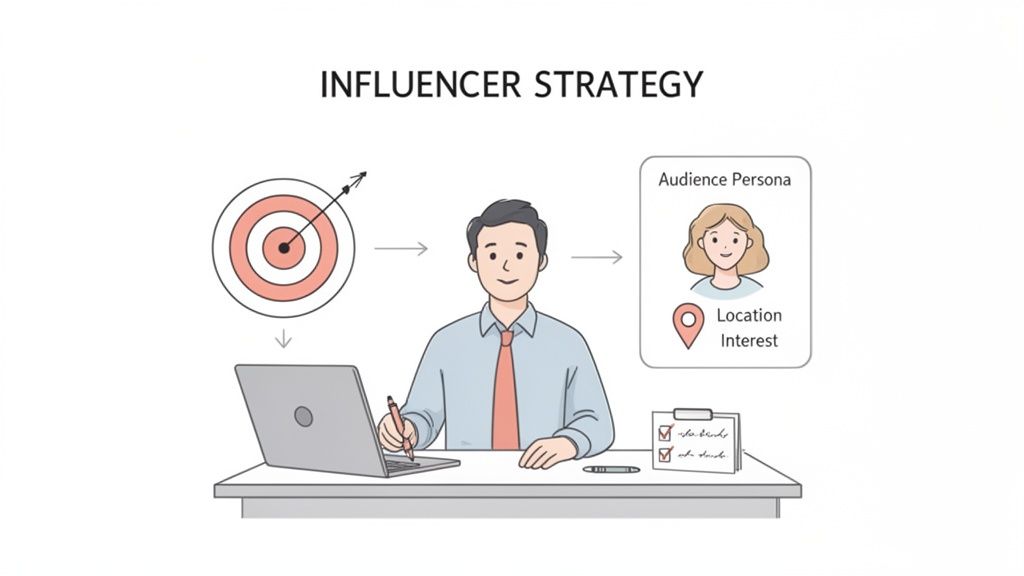
Define Your Campaign Goals
The "why" behind your campaign will shape your entire search. Let's look at the most common goals and what they mean in practice.
- Brand Awareness: If you just want more people to know you exist, you’ll be tracking metrics like reach, impressions, and follower growth. Here, you’re looking for influencers with a broad, engaged audience that overlaps with your market.
- Lead Generation: Maybe you need to build your email list or get more demo sign-ups. Success here is all about link clicks, form fills, or downloads. The best influencers for this are those who have built deep trust with their audience and are great at inspiring action.
- Direct Sales: When revenue is the name of the game, you need creators who can turn their followers into your customers. You'll be watching conversion rates, sales from promo codes, and your overall return on investment (ROI) like a hawk.
This is why having the right tools matters. Platforms like REACH Influencers let you filter your search by these specific objectives right from the start, so you're only looking at partners who can actually help you hit your targets. For example, a CPG brand used REACH to filter for influencers with a proven track record of driving high click-through rates, leading to a 15% increase in online sales in their first campaign.
A successful influencer partnership is a direct result of strategic alignment. When you know exactly what you want to accomplish, you can find creators whose content and audience are perfectly suited to help you get there.
Create a Detailed Audience Persona
With your goals in place, the next question is: who are you trying to reach? You have to go way deeper than basic demographics. A detailed audience persona makes your ideal customer feel like a real person, which makes it infinitely easier to find influencers they already follow and trust.
Building out a persona is a non-negotiable step, which is why we put together a guide on how to create buyer personas to walk you through it.
Think beyond age and location. Ask yourself:
- What are their biggest challenges and core values?
- Where do they actually spend their time online?
- What type of content makes them stop scrolling?
- Who are they already listening to for advice and recommendations?
For example, a sustainable skincare brand isn't just targeting "women aged 25-40." They're targeting eco-conscious shoppers who read ingredient labels, follow creators who champion ethical practices, and hang out in online communities focused on green living. That level of detail makes your search incredibly effective.
Before you map out your own strategy, it's smart to get a lay of the land. For a great high-level view, check out this a modern guide to influencer marketing. Doing this foundational work ensures your message will actually resonate when it's time to launch.
How to Find an Influencer For Your Brand
Once you’ve nailed down your campaign goals and know exactly who you want to talk to, the real fun begins: finding the creators who will bring your brand’s story to life. This part can feel like searching for a needle in a digital haystack, but with the right approach, you can pinpoint the perfect partners without all the guesswork.
Your search really boils down to two main paths. You can roll up your sleeves and do it manually, or you can use a dedicated platform to do the heavy lifting for you.
Manual Search Tactics That Still Work
If you have more time than budget, or if you're just dipping your toes in the water, manual discovery is a great place to start. It gives you a real hands-on feel for the creator landscape. The trick is to be smart about it.
- Dig into Niche Hashtags: Forget broad terms like
#fashion. If you're selling vegan leather bags, you need to be searching for things like#sustainablefashionfinds,#crueltyfreeaccessories, or#veganstyle. This is how you find creators who are already deep in your world. - See Who Your Competitors Are Working With: Your competitors have already done some of the legwork. Look at their tagged posts to see which influencers they're partnering with. This gives you a ready-made list of potential collaborators and shows you what kind of content already works in your space.
- Look in Your Own Backyard: Seriously, some of your best advocates might already be following you. Scan your followers and tagged posts. You could find micro-influencers who genuinely love what you do and would be ecstatic to work together.
These methods can definitely uncover some hidden gems. The downside? You're flying blind when it comes to verifying audience data, spotting fake followers, or comparing dozens of potential partners side-by-side.
Using an Influencer Discovery Platform
For any brand looking to get serious about influencer marketing, manual searching just isn’t scalable. This is where a dedicated platform comes in. Think of it as upgrading from a paper map to a GPS—it's faster, more accurate, and gets you where you're going with a lot less frustration.
A powerful influencer discovery tool turns the search from a guessing game into a science. Let's go back to that sustainable fashion brand. Using a platform like REACH, they can go way beyond hashtags and apply laser-focused filters to find creators who fit their exact needs:
- Audience Demographics: Find influencers whose followers are mostly in specific cities, like Austin or London.
- Engagement Rate: Only see creators with an engagement rate above 3%, ensuring you're reaching an active, loyal community.
- Niche & Keywords: Pinpoint influencers who regularly talk about "ethical production" or "slow fashion."
- Past Collaborations: Check out which other brands a creator has worked with to make sure they align with your values and to avoid any conflicts of interest.
Here’s a glimpse of how you can layer these filters in a platform to quickly build a qualified shortlist.
This level of detail means you can build a list of ideal partners in minutes, not days. You're no longer just looking for people who look the part; you're finding partners whose audience and performance data line up perfectly with your goals.
Comparing Influencer Discovery Methods
Deciding whether to go manual or use a platform often comes down to balancing resources and goals. Here’s a quick breakdown to help you choose the right path.
| Method | Time Investment | Data Accuracy | Scalability | Best For |
|---|---|---|---|---|
| Manual Search | High | Low/Unverified | Very Low | Brands on a tight budget, one-off campaigns, or those just starting out. |
| Discovery Platform | Low | High/Verified | High | Agencies and brands planning ongoing campaigns or needing data-backed decisions. |
Ultimately, while manual methods have their place, a discovery platform provides the efficiency, accuracy, and scale needed to run a truly professional and results-driven influencer program.
Why Micro-Influencers Are Often Your Best Bet
It’s easy to get star-struck by creators with massive follower counts, but the data tells a different story. Zeroing in on micro-influencers—those with 5,000 to 20,000 followers—is often the smartest move you can make.
Why? They deliver the highest engagement rates, averaging a whopping 3.86%. That's worlds away from what larger creators can offer.
It’s no wonder that 73% of brands are now prioritizing micro and mid-tier influencers. They understand that a smaller, hyper-engaged audience is far more valuable. As you can discover more insights about influencer marketing ROI on brentonway.com, this strategy is backed by an average ROI of $5.78 in earned media value for every single dollar spent. It’s a powerful testament to the idea that when it comes to influence, quality beats quantity every time.
The Critical Vetting Process: How to Find an Influencer You Can Trust
Alright, let's move past just finding potential influencers and get into the part that really matters: vetting them. This is where campaigns are made or broken.
A huge follower count looks great on paper, but it's often just a vanity metric. It tells you nothing about whether their audience actually cares or if the creator can inspire action. The real magic happens when you dig deeper.
This means looking at two things: the hard data that shows an influencer's performance and the more subtle, qualitative signs that tell you if they're a genuine fit for your brand. Skipping one or the other is a rookie mistake that almost always leads to a disappointing campaign.
This flowchart lays out the two main paths you can take to find and vet creators, whether you're doing it all by hand or using a platform to speed things up.
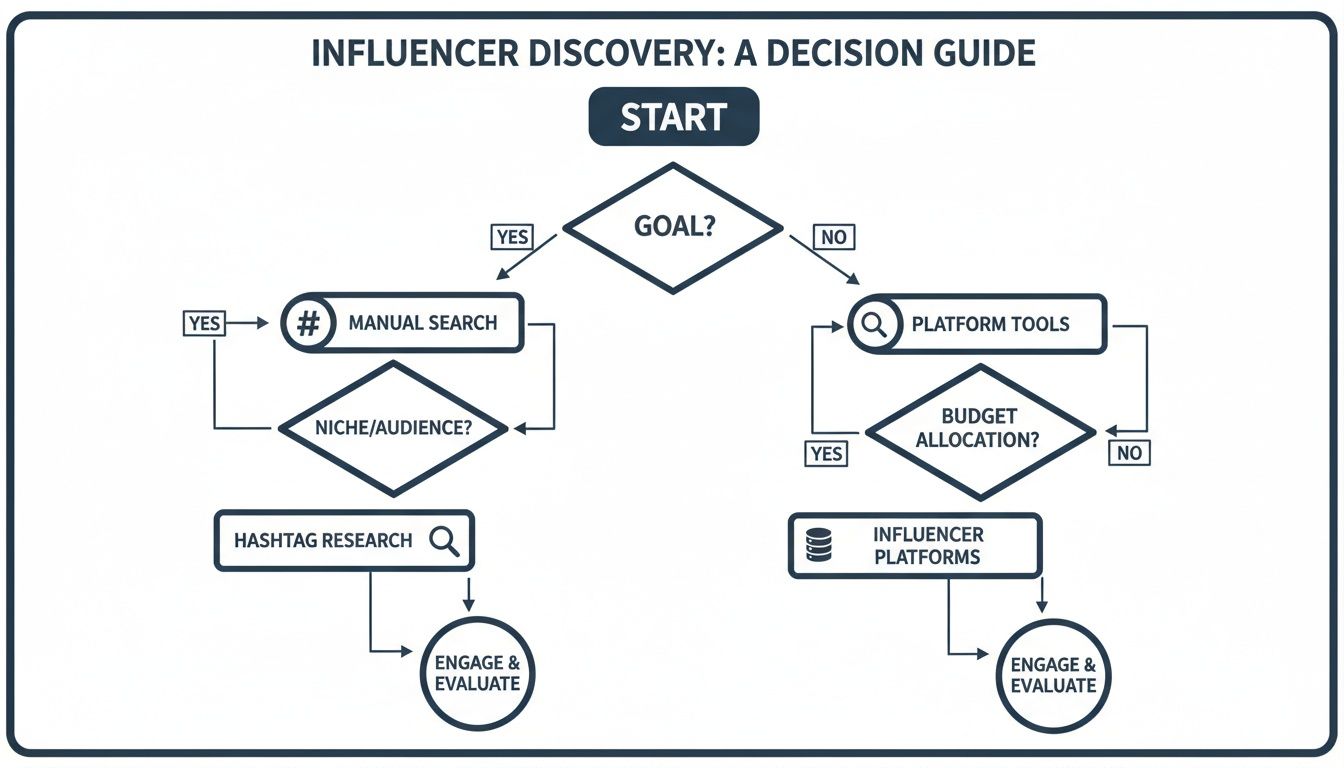
As you can see, no matter how you find them, a thorough vetting process is non-negotiable if you want to hit your goals.
Digging Into the Numbers (Quantitative Vetting)
Numbers don’t lie, but you have to know which ones to focus on. This is where you switch from gut feelings to objective analysis to confirm an influencer’s audience is real, engaged, and lines up with your target customer.
Engagement Rate: Your North Star Metric
The first and most important metric to look at is the engagement rate. It’s the single best indicator of a healthy, active community. You calculate it by adding up all the likes, comments, shares, and saves, and then dividing that by their total follower count.
A massive following with next-to-no engagement is a huge red flag. It usually points to a passive audience or, worse, a fake one.
Think of engagement rate as your guiding light. It separates the partnerships that drive results from the ones that fall flat. Micro-influencers often shine here, boasting an average rate of 3.86%. In fact, over 80% of marketers see engagement as a top indicator of success, which shows just how crucial it is.
Audience Health: Demographics and Authenticity
Unfortunately, fake followers are still a big problem. An influencer with a padded follower count won't get you results because your message isn't reaching real people. Trying to spot this manually is a nightmare.
This is where you need to check for signs of a fake audience. Look for sudden, unnatural spikes in follower growth or a weirdly low number of comments compared to likes. You also need to confirm that their audience demographics match your ideal customer profile. Ask yourself:
- Location: Are their followers located in the cities or countries you serve?
- Age and Gender: Does their audience breakdown match your target market?
- Interests: What other accounts or topics does their audience engage with?
If you're serious about your investment, using a dedicated fake follower checker can give you peace of mind that you’re putting your money behind a creator with a genuine audience.
Looking for the Right Vibe (Qualitative Vetting)
Once the numbers look good, it's time to assess the things you can't measure on a spreadsheet. This is all about brand fit, content quality, and the overall feeling you get from their community.
An influencer’s profile is their resume, but their comment section is the reference check. How they interact with their community tells you everything you need to know about their authenticity and relationship with their followers.
Content Quality and Brand Alignment
Take a good, long scroll through their feed. Does their content style actually match your brand's aesthetic? If you’re a minimalist, eco-friendly skincare brand, a creator with a loud, flashy, fast-fashion feed probably isn't the right partner, no matter how high their engagement is.
Look for consistency. Do they post regularly? Is the quality of their photos and videos consistently high? Are their captions thoughtful and well-written? It's also smart to check out their past brand partnerships. If they're frequently promoting a direct competitor or brands that clash with your company's values, it’s probably a pass.
Tone and Community Vibe
Pay close attention to the comment section. How does the influencer actually talk to their followers? Do they take the time to answer questions, or is it radio silence? Real engagement is a two-way street.
Then, read the comments from their followers. Do they feel genuine and conversational? Or are they full of generic "Great post!" comments and emoji strings that scream "bot"? When you see real people having real conversations, that’s the sign of a strong, trusting community—and that's the perfect environment for your brand to be in.
Crafting Outreach That Actually Gets a Response
You've done the legwork, vetted your list, and now you have a handful of influencers who feel like a perfect fit. This next part is where most campaigns either take off or fall flat: the outreach.
Let’s be honest, a generic, copy-pasted DM is the fastest way to get ignored. The real trick to finding an influencer who will partner with you is to craft a message that feels personal, professional, and genuinely interesting. That first message sets the entire tone. Remember, you're not just buying a post; you're starting a partnership.
The Anatomy of a Perfect First Message
A great outreach email or DM doesn't have to be a novel. It just needs to hit a few key points to cut through the noise. Think of it as a short, friendly pitch that shows you respect their work and have a real idea in mind.
Here’s a simple breakdown of what works:
- A Real Compliment: Don't just say "Love your content!" Mention something specific. "Your recent video on sustainable kitchen swaps was brilliant" shows you've actually paid attention.
- A Clear "Why": Briefly explain why you think they're the right person for your brand. Connect their audience or a recent post to what you do. Make the connection obvious and authentic.
- An Intriguing Idea: Give them a taste of what you're thinking. Instead of a vague "let's collab," try something like, "We're launching a new line of eco-friendly cleaning products and thought a '30-Day Toxin-Free Home' challenge with your audience would be incredible."
This approach proves you’ve done your homework and aren't just spamming a list.
Navigating Negotiations and Getting the Price Right
Once a creator replies with interest, the money talk begins. This is where a lot of brands get nervous, but it shouldn't be complicated. Fair pay comes down to clear deliverables, usage rights, and the creator’s proven performance.
Don't be afraid to talk about the budget. Most creators I know actually prefer the transparency. Your offer should match the work you're asking for. A single Instagram Story is a much lighter lift than a fully-produced YouTube video, and the price needs to reflect that difference.
Pro Tip: When you're negotiating, always frame the conversation around value, not just cost. A creator with a super-engaged, niche audience of 50,000 can drive more sales than someone with a passive audience of 500,000. That's a valuable investment.
To really get a feel for this from the other side, check out these insider tips on securing brand deals. Understanding what creators are looking for helps you build a much more compelling and fair offer.
Why a Clear Contract is Non-Negotiable
I’ll say it loud for the people in the back: never, ever work with an influencer without a signed contract. A verbal agreement or a few DMs just won't cut it. It’s not about mistrust; it's about clarity. A good contract protects both you and the creator and prevents a world of headaches later.
Your contract needs to spell everything out so there’s no room for confusion. Using a platform like REACH can be a huge help here, as they often have templates and manage the whole contracting and payment flow for you.
At a minimum, your agreement must include:
- Specific Deliverables: Be precise. "One Instagram Reel, three Stories, and one blog post" is much better than "social media promotion."
- Content Approval Process: How will you review content before it goes live? Define the timeline and feedback loop.
- Payment Schedule: State the total fee and when it will be paid (e.g., 50% upfront, 50% on completion).
- FTC Disclosure Rules: You must require the creator to use clear disclosures like #ad or #sponsored. This is a legal requirement.
- Content Usage Rights: Be crystal clear about how and where your brand can use the content (on your website, in paid ads, etc.) and for how long.
A detailed contract is the foundation for a smooth, professional collaboration where everyone is on the same page.
Managing Campaigns and Measuring Real Impact
You’ve done the hard work of searching, vetting, and negotiating. The contract is signed. Now what? This is where the real work begins—turning that signed paper into a campaign that actually moves the needle for your business.
Frankly, this is the part that separates a one-off influencer post from a sustainable growth strategy. It’s all about staying organized and being obsessed with the data. Without a solid system, you’ll be drowning in spreadsheets and email chains, especially when you’re working with more than one creator.
Building an Efficient Campaign Workflow
A clunky workflow doesn’t just slow you down; it creates friction that can frustrate both your team and the influencer. To avoid this mess, you need a clear, repeatable process for every single campaign.
It all starts with a killer content brief. Think of this document as your campaign’s bible. It needs to lay out everything the creator needs to know, leaving no room for confusion.
- Key Campaign Messaging: What are the absolute must-have points you need them to hit?
- Content Deliverables: Be specific. One Reel and three Stories with a link sticker, for example.
- Visual Guidelines: The do's and don'ts for your brand's look and feel.
- Important Dates: Clear deadlines for drafts, revisions, and the final go-live date.
Getting this right upfront saves you from an endless cycle of back-and-forth emails. The idea is to give creators a clear roadmap but still let them bring their own creative magic to the table.
Centralizing Your Campaign Management
Trying to manage multiple influencer partnerships through DMs, email threads, and a maze of Google Docs is a recipe for disaster. Important details get lost, deadlines are missed, and everyone gets stressed out.
This is why a centralized dashboard is a total game-changer. Tools like the REACH platform are built for this, consolidating all your communications, content approvals, and performance data into one clean spot.
Take a look at how a dedicated campaign dashboard brings order to the chaos.
This single source of truth lets you see the status of every single deliverable at a glance, from "draft submitted" to "published." You can instantly spot bottlenecks and make sure nothing ever falls through the cracks. It transforms a chaotic headache into a smooth, scalable operation.
Tracking the KPIs That Actually Matter
Once the content is live, your job pivots from manager to analyst. Let's be clear: follower count is a vanity metric. What you really need to track are the Key Performance Indicators (KPIs) that tie directly back to the goals you set in the first place.
Without data, you’re just guessing. The KPIs you focus on will obviously depend on your objectives, but a few are almost always essential.
- Engagement Rate: Don't stop tracking this after you hire them. High post-campaign engagement (likes, comments, shares, and saves) is proof that the content truly connected with their audience.
- Click-Through Rate (CTR): If you gave the influencer a trackable link, this tells you exactly how many people were inspired enough to check out your site or landing page.
- Conversion Rate: For any campaign focused on sales, this is the bottom line. It measures how many of those clicks actually turned into purchases, sign-ups, or app downloads.
Tracking these metrics isn't just about putting a "W" in the win column. It's about learning. The insights you gather will make every future influencer partnership smarter and more effective.
For example, platforms like REACH give you real-time analytics that pull in these KPIs automatically. This means you can watch performance as it happens, generate reports without spending hours in a spreadsheet, and quickly figure out which creators and content formats are your heavy hitters.
This data-driven feedback loop is what turns your influencer program from a fun experiment into a predictable, reliable engine for growth.
Got Questions About Finding Influencers?
Even the most seasoned marketers have questions when it comes to finding the right influencers. This isn't a set-it-and-forget-it channel; things are always shifting. Let's tackle some of the most common questions that come up once you start digging in.
These are the practical, real-world issues you'll face after you've built your shortlist—from what to budget to how to stay out of legal trouble.
So, How Much Does an Influencer Actually Cost?
This is the big one, and the honest answer is: it depends. There's no flat rate. A partnership could be as simple as a free product exchange or it could be a six-figure deal. The final number really comes down to the creator and what you're asking them to do.
A few things drive the price:
- Audience Size: A nano-influencer (1k-10k followers) might be happy with gifted products or charge around $10-$100 per post. Once you get into the micro-influencer tier (10k-100k), you’re typically looking at $100 to $5,000.
- Engagement Rate: This is huge. A creator with a smaller but fiercely loyal audience is often more valuable than one with a huge, passive following. Great engagement means their recommendation carries real weight, and they can charge for that influence.
- The "Ask" (Deliverables): A quick Instagram Story takes a lot less effort than a fully produced, edited, and polished YouTube video. The price will absolutely reflect the work involved.
- Content Usage Rights: Do you just want them to post on their own channels? Or do you want the right to use their content in your own paid ads? The latter is a bigger ask and will come with a bigger price tag.
Pro Tip: Don't get fixated on follower count. Go into negotiations with a clear budget and focus on the value and specific deliverables you need for your campaign.
What’s the Real Difference Between a Macro and Micro Influencer?
It really boils down to audience size, how engaged that audience is, and what you’re trying to achieve with your campaign. Picking the right one means knowing what your goal is from the start.
A micro-influencer typically has between 10,000 and 100,000 followers. Their superpower is their connection to their community. These are smaller, niche audiences that trust the creator implicitly. If your goal is to drive sales or build genuine brand love, micro-influencers are your best bet because their recommendations feel like advice from a trusted friend.
On the other hand, a macro-influencer is playing a different game, with a following between 100,000 and 1 million+. Their strength is pure, massive reach. When you just need to get your brand in front of a ton of eyeballs for a big awareness push, this is where you turn.
How Do I Find Influencers in a Super Specific Niche?
When your niche is narrow, you have to get more creative with your search. Manually, you can start by diving deep into specific hashtags on Instagram or TikTok. Don't just search #eco—try something hyper-specific like #zerowastehome. Another great trick is to see who your competitors are working with. They've already done some of the legwork for you!
But if you want to be truly efficient and precise, nothing beats an influencer discovery platform. A tool like REACH lets you slice and dice your search with advanced filters that go way beyond a simple hashtag. You can pinpoint creators based on keywords in their bio, their audience's specific interests, and detailed demographic data. This is how you find the real experts in any field, whether it's vintage watch collecting or computational biology.
What Legal Stuff Do I Need to Worry About?
Don't skip the legal side of things. Two things are absolutely non-negotiable when you work with an influencer: a solid contract and proper disclosure.
First, get everything in writing. A signed contract protects both you and the creator. It needs to clearly spell out all the deliverables, payment schedules, who owns the content, and key deadlines. This simple step prevents a world of headaches and misunderstandings down the road.
Second, you have to follow FTC guidelines for disclosure. This is your responsibility as the brand. The influencer must make it obvious that their content is sponsored by using a clear tag like #ad or #sponsored. This isn't just about following rules; it's about being transparent with consumers and building trust.
Ready to stop scrolling and learn how to find an influencer who can accelerate your brand’s growth? REACH Influencers gives you the tools to discover, vet, and manage your campaigns with data-backed precision. Find creators who genuinely align with your audience and track your ROI in real time. Book a demo today and see how easy it is to scale your influencer marketing.
{
  "@context": "https://schema.org",
  "@type": "Article",
  "headline": "How to Find an Influencer Who Drives Real Results: A 2024 Guide",
  "author": {
    "@type": "Organization",
    "name": "REACH Influencers",
    "url": "https://reach-influencers.com/"
  },
  "publisher": {
    "@type": "Organization",
    "name": "REACH Influencers",
    "logo": {
      "@type": "ImageObject",
      "url": "https://reach-influencers.com/logo.png"
    }
  },
  "datePublished": "2024-05-21",
  "mainEntityOfPage": {
    "@type": "WebPage",
    "@id": "https://reach-influencers.com/blog/how-to-find-an-influencer"
  },
  "description": "Learn the expert strategies on how to find an influencer for your brand. This comprehensive guide covers discovery, vetting, outreach, and campaign management for maximum ROI.",
  "image": "https://cdn.outrank.so/64cdc0e0-2a54-4cd9-a45d-c4196c5e1d4e/472d9b43-9884-4613-9b4a-f1bfc718291d/how-to-find-an-influencer-influencer-strategy.jpg",
  "articleSection": "Influencer Marketing",
  "keywords": "how to find an influencer, influencer marketing, influencer discovery, find influencers, influencer outreach"
}