 Skip to content


Finding the right influencers for your brand can feel overwhelming, but it's the single most important step in launching a campaign that delivers real, measurable results. The secret isn't just chasing creators with the biggest follower counts; it's about building a smart, data-driven strategy to find partners whose audience is a perfect match for your brand. This guide will walk you through exactly how to find influencers, from laying the strategic groundwork to measuring your final ROI.
Platforms like REACH Influencers are designed to streamline this entire process. For example, our discovery tools allow brands like the sustainable skincare company, Bloom Organics, to filter for eco-conscious creators in the US with an engagement rate over 4%, instantly connecting them with authentic partners who reach their ideal customers. This guide will show you how to apply that same level of precision to your own search.
Table of Contents
- Building Your Influencer Strategy Foundation
- How to Find Influencers on Any Platform
- Vetting Influencers Beyond the Follower Count
- Crafting Outreach That Gets a Response
- Measuring the True Impact of Your Campaign
- Got Questions About Finding Influencers? We've Got Answers.
Building Your Influencer Strategy Foundation
Jumping into an influencer search without a strategy is like going on a road trip with no map. Sure, you might stumble upon some interesting things, but you’ll probably waste a lot of time and gas without ever reaching your destination. The best campaigns are always built on a clear foundation: what are your goals, who are you trying to reach, and how much can you spend?
This initial planning phase is non-negotiable. It turns a random hunt for popular accounts into a focused mission to find partners who will actually move the needle for your business. When you know precisely what you're trying to do, every decision that follows becomes simpler and far more effective.
Define Your Campaign Objectives
First things first: what do you actually want to accomplish? "Going viral" isn't a business objective. You need specific, measurable goals that tie back to your larger marketing efforts. If you don't set clear KPIs from the start, you'll have no way of knowing if your investment was worth it.
Think about the main goal of the collaboration:
- Brand Awareness: Are you the new kid on the block? The goal here is simple: maximize eyeballs. You want to get your brand name and products in front of as many relevant people as possible.
- Driving Sales: Looking for a direct return on your investment? This is all about conversions. You’ll be tracking things like promo code usage, affiliate link clicks, and direct purchases attributed to the campaign.
- Community Growth: Maybe your goal is to build a tribe of loyal fans. In this case, you'd measure success by the number of new social media followers, email subscribers, or engagement on your own brand channels.
Platforms like REACH Influencers are great because they bake this right into the campaign setup. This forces you to think about your goals from the get-go, ensuring every step you take is pointed in the right direction.
Profile Your Ideal Customer
Here's the most important part: you aren't just looking for an influencer, you're looking for their audience. The million-dollar question is, Does this creator's community match my ideal customer? If that answer is no, even a collaboration with a celebrity-level influencer will fall completely flat.
This is where knowing how to create buyer personas is absolutely essential. Don't just stop at basic demographics like age and location. Go deeper.
A deep understanding of your audience's psychographics—their values, interests, pain points, and online behaviors—is the key to finding influencers who create content that truly resonates.
For instance, a sustainable skincare brand isn't just targeting "women aged 25-40." They're targeting people who care deeply about clean ingredients, follow other eco-conscious creators, and actively look for ethical brands. Knowing this tiny detail lets you zero in on influencers who genuinely live and breathe those same values.
Establish a Realistic Budget
Finally, you have to talk money. Influencer marketing costs are all over the map, from a few hundred dollars for a nano-influencer to tens of thousands for a creator with a massive following. Your budget will dictate who you can realistically work with.
And remember, the budget is more than just the creator's fee. A smart budget plan includes:
- Creator Compensation: The direct payment for their work.
- Product Costs: The retail value of any free products you're sending them.
- Platform Fees: If you're using a management tool to streamline the process.
- Contingency: A little buffer of about 10-15% for any unexpected costs or last-minute opportunities that pop up.
Setting a clear budget from the start saves you a ton of time. It helps you negotiate with confidence and ensures you’re not wasting energy vetting influencers who are simply out of your price range. With your goals, audience, and budget locked in, you now have a strategic roadmap to guide your search.
How to Find Influencers on Any Platform
Alright, you’ve got your strategy mapped out. Now for the fun part: finding the right people to partner with. Forget spending hours scrolling aimlessly through hashtags—that's a recipe for burnout. A smarter, more targeted approach will not only save you a massive amount of time but also lead you to far better partnerships. The real trick in learning how to find influencers is knowing how to use each platform's native tools while also thinking bigger.
This whole process has become incredibly data-driven, and for good reason. The influencer marketing platform industry is expected to hit nearly $33 billion by 2025 as more and more brands ditch the manual grind. With 86% of US marketers now planning to work with influencers, you can bet your competition is using sophisticated tools to find talent. To get a better sense of the numbers, check out these influencer marketing statistics from Sprout Social.
This infographic breaks down the essential groundwork—your goals, audience, and budget—that makes the actual search a hundred times more effective.
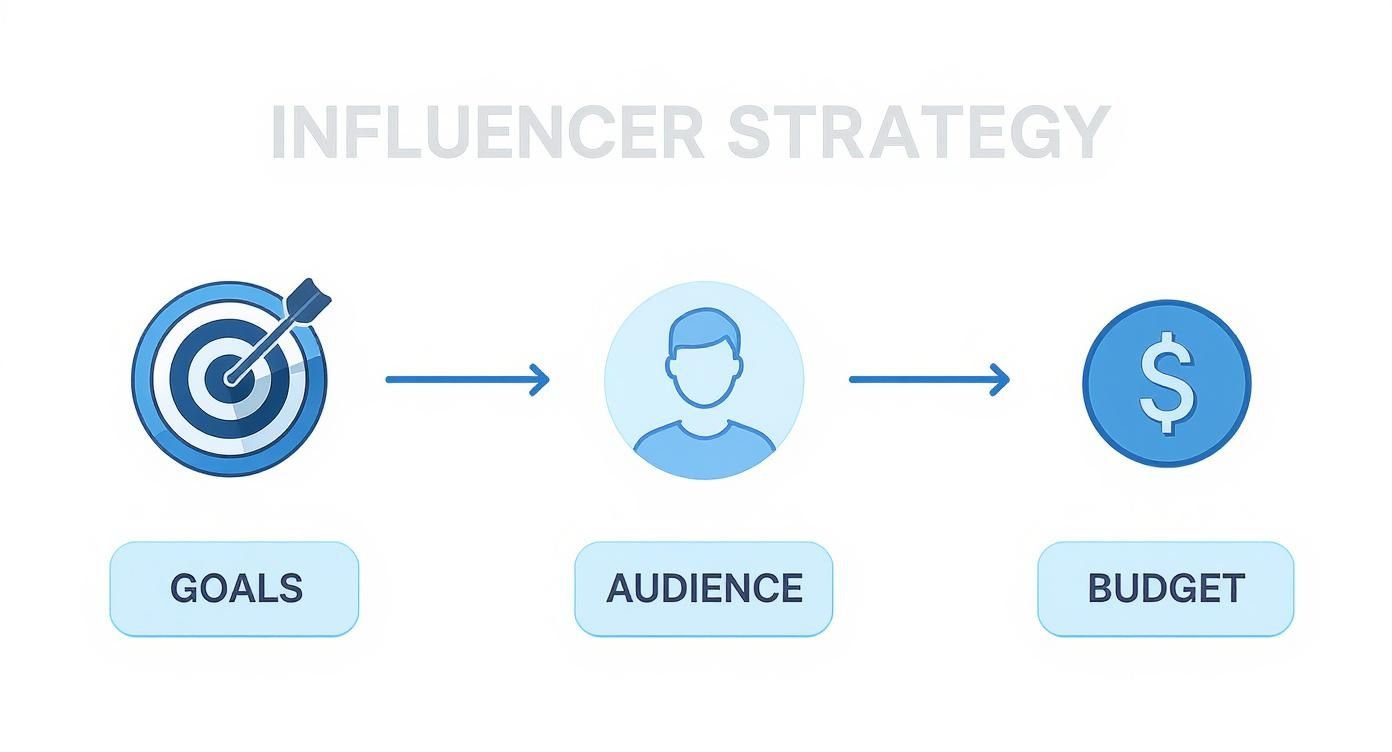
Think of it as your roadmap. Nailing these fundamentals ensures you're not just finding an influencer, but the right influencer for your specific business goals.
Mastering Manual Search Methods
Even with all the amazing tools out there today, you should still know how to do a manual search. It gives you an incredible feel for the community and helps you uncover those hidden gems—authentic creators who might not be listed in every database just yet.
First, look in your own backyard. Who’s already talking about you? Check your brand tags and mentions. These people are your warmest leads for a partnership because they’re already genuine fans. Their endorsement will feel natural because it is natural.
Next, do a little friendly recon on your competitors. See who they're working with. This isn’t about copying them, but about identifying creators who are already resonating with an audience in your niche. If an influencer has had a successful run with a similar brand, their followers are likely a perfect match for you, too.
Finally, put yourself in your customer’s shoes. What terms and hashtags are they actually searching for?
- On Instagram: Use the Explore page to search for keywords like "sustainable beauty" or "NYC baker." You'll quickly see the top-performing posts and accounts.
- On TikTok: The Creator Marketplace is your best friend. You can filter creators by their niche, audience location, and even key performance metrics.
- On YouTube: Try searching for specific video topics like "vegan recipe review." Pay attention to which creators rank high and, more importantly, have a lively and engaged comments section.
The Power of Influencer Discovery Platforms
Manual searching is a great starting point, but let’s be real—it’s slow, tedious, and nearly impossible to scale effectively. This is where dedicated influencer platforms completely change the game, turning what used to be days of grunt work into a few minutes of focused searching.
Influencer discovery platforms aren't just big contact lists; they're sophisticated search engines designed specifically to find brand partners. They give you access to layers of data and filtering options that you could never replicate by hand.
Let’s say you’re a sustainable beauty brand looking for a micro-influencer based in the U.S. Manually, you'd be stuck searching hashtags like #ecobeauty and #cleanbeauty, then clicking through hundreds of profiles to check their location, follower count, and recent content. It's a grind.
With a platform like REACH Influencers, the experience is worlds apart. You can use our advanced influencer discovery tool to apply laser-focused filters and get results in seconds.
Here’s a quick look at how that works:
- Set Your Niche: Start by selecting categories like "Beauty," "Skincare," and "Sustainability."
- Filter by Audience: You can then narrow it down to followers located in the "United States" who are between the ages of "25-34."
- Specify Creator Tier: To find those valuable micro-influencers, set a follower count between 10,000 and 50,000.
- Analyze Performance: Finally, filter for creators with an engagement rate above 3% to make sure their audience is actually listening.
In an instant, you get a curated list of creators who perfectly match every single one of your criteria. You can see their key metrics, past brand deals, and audience authenticity scores all in one place. That speed and precision are exactly what lets you build a high-quality roster of potential partners in a fraction of the time.
Vetting Influencers Beyond the Follower Count
So, you've got a solid list of potential influencers. Great start. But now for the most important part of the whole process: the vetting. A huge follower count looks impressive on the surface, but it can be incredibly misleading. Trust me, partnering with an influencer who has a fake or completely checked-out audience is the fastest way to burn through your marketing budget with nothing to show for it.
This is where you need to put on your detective hat. It’s time to dig deeper than the vanity metrics and look at the data that tells the real story of an influencer's impact and authenticity. It’s not about how many people follow them; it’s about who follows them, how much they care, and if they’re the right fit for your brand.
Getting this right is the difference between a campaign that drives actual sales and one that just gives you a bunch of hollow numbers to report. It ensures you're reaching the right people, not just a lot of people.
Analyzing Key Performance Metrics
Before you even think about sending that first DM, you have to do a deep dive into an influencer's performance stats. These numbers paint a clear picture of how their audience actually interacts with their content.
Your first and most important stop is the engagement rate. Calculated by dividing the total likes and comments by the follower count, this metric is a powerful gut check for audience loyalty. A massive following with a rock-bottom engagement rate is a huge red flag—it screams that their audience is either inactive, fake, or just plain uninterested.
But don't stop there. Look for consistency. Do their posts get a relatively stable number of likes and comments? Wild swings from one post to the next could mean they're buying engagement or using comment pods to juice their numbers on certain content.
Here are the core metrics you need to evaluate:
- Average Engagement Rate: What percentage of their audience consistently interacts with their posts? You're looking for rates that feel healthy for their specific niche and follower size.
- Comment Quality: Scan the comments. Are people having real conversations, or is it just a wall of fire emojis and generic "Great post!" comments? Genuine comments are a sign of a real connection.
- Audience Growth Rate: A slow, steady climb in followers is what you want to see. Sudden, massive spikes are often a dead giveaway that they’ve bought followers.
This kind of analysis has become even more critical as brands have woken up to the power of smaller, highly engaged communities. You don't always need a mega-influencer to get results.
Influencer Tier Comparison Engagement vs Reach
Not all influencers are created equal, and their value often lies more in engagement than sheer reach. Micro and even nano-influencers can deliver incredible results because their audiences are so dedicated. Here's a quick breakdown of what to expect from different tiers.
| Influencer Tier | Follower Count | Average Engagement Rate | Best For |
|---|---|---|---|
| Nano | 1K – 10K | 5% – 10%+ | Hyper-niche targeting, high trust, local campaigns |
| Micro | 10K – 100K | 2% – 5% | Strong community building, cost-effective reach |
| Mid-Tier | 100K – 500K | 1.5% – 3% | Balanced reach and engagement, brand awareness |
| Macro | 500K – 1M | 1% – 2% | Broad brand awareness, high-impact campaigns |
| Mega | 1M+ | < 1% | Celebrity-level reach, mass-market launches |
As you can see, the engagement rate often drops as the follower count grows. This is why smaller creators are becoming so valuable. In fact, some micro creators can command a median CPM of $119, while nano creators can hit $211, all driven by their incredible engagement. Learn more about the latest trends in influencer marketing costs.
Assessing Audience Authenticity
Once you've confirmed the engagement numbers look solid, it's time to check if their audience is legit. An influencer might have a real, engaged following, but if those followers aren't your target customers, the partnership is a non-starter. The goal is to make sure you’re reaching a real, relevant, and receptive group of people.
Start by digging into their audience demographics. Does their follower base look like your ideal customer?
The absolute best influencer partnerships happen when there's a perfect overlap between the creator's audience and the brand's target market. If you sell hiking gear in the US, an influencer whose audience is 80% in Brazil is the wrong fit, no matter how great their engagement is.
Doing this manually is a massive time-suck. You’re left trying to piece together clues from comments and follower profiles, which is basically just guesswork.
This is where a dedicated platform like REACH Influencers becomes a game-changer. Instead of guessing, you get a clear, data-backed breakdown of every creator's audience. The platform gives you detailed analytics on:
- Geographic Location: See exactly where an influencer's followers are, right down to the city.
- Age and Gender Breakdown: Quickly confirm if their audience matches your target demographic.
- Authenticity Score: REACH uses a proprietary score to analyze followers for bots, inactive accounts, and other red flags.
This data-driven approach takes all the guesswork out of the equation. While you can sometimes spot fraud manually, a platform is built to catch suspicious patterns instantly.
If you are doing your own research, you can use our free fake follower checker to get a quick health check on any public Instagram account. By making authenticity a priority, you guarantee your message lands with real people who are actually interested in what you have to say.
Crafting Outreach That Gets a Response
Your first message to an influencer is so much more than a pitch. It’s your first impression, and it sets the tone for the entire relationship. I've seen it a thousand times: a generic, copy-paste template is the fastest way to get your message ignored or deleted.
If you want to stand out, you have to write something personal. Show them you’ve actually done your homework and genuinely appreciate their work. This is your chance to cut through the noise of the dozens of other brands filling their inbox and build an instant connection. Let's break down how to get in touch, structure a pitch that gets a "yes," and handle negotiations like a pro.
Personalization Is Non-Negotiable
Think about it from their perspective. Top creators get hundreds of collaboration requests every single week. The only ones that get a second look are the ones that feel real. And I don’t just mean using their first name.
Start by referencing a specific piece of their content you genuinely enjoyed. Was it a recent video? A funny caption? A story that you actually connected with? Mentioning it proves you’re a real fan, not just a bot scraping for email addresses. It’s a simple act, but it builds immediate rapport.
Here's what I mean:
- Reference a recent post: "I loved your recent reel on sustainable travel tips—the part about packing cubes was a total game-changer for me!"
- Compliment their style: "Your editing is so unique. It perfectly captures the energy of your adventures."
- Connect to their values: "We really admire your commitment to promoting eco-conscious brands, which is exactly why I'm reaching out."
This isn't about empty flattery. It’s about showing you see them as a creative partner, not just a billboard for your product.
Structuring Your Pitch for a 'Yes'
Okay, you’ve made that personal connection. Now it’s time to clearly and concisely explain what you have in mind. Influencers are busy, so get straight to the point. Your pitch needs to be scannable and immediately answer their most important question: "What's in it for me?"
Avoid vague offers like "let's collaborate." That puts all the work on them. Instead, present a clear proposal that outlines your vision but still leaves room for their creative magic. A strong pitch always includes a clear call to action and highlights why this is a win-win.
The best pitches feel like a true partnership, not a transaction. You need to focus on how your brand provides value to their audience and supports their creative goals.
For example, instead of just offering a free product, you could propose co-creating a video that aligns with a series they already produce. Or maybe sponsor a giveaway for their followers. This shows you’re invested in their community, not just your own promotion. For more guidance, check out these field-tested influencer outreach email templates that can help you structure the perfect message.
Navigating Negotiations and Contracts
Once an influencer shows interest, the conversation shifts to negotiation. This is where you’ll nail down compensation, deliverables, and all the legal details. Honestly, having a clear idea of your budget and goals before you even start this conversation makes everything so much smoother.
Be ready to talk through a few different compensation models:
- Flat Fee: A one-time payment for specific deliverables (e.g., one Instagram post and three stories).
- Affiliate Commission: A percentage of sales from their unique link or discount code.
- Product Gifting: Often works well with smaller creators or for seeding new products.
- Hybrid Model: My personal favorite—a combination of a flat fee and a performance-based commission.
After you agree on the terms, always, always use a contract. A formal agreement protects both you and the creator by making sure everyone is on the same page. Your contract should cover the essentials: content deliverables, usage rights (can you repurpose their content on your ads?), payment terms, and FTC disclosure requirements.
Trying to manage these talks across DMs and messy email threads is a recipe for disaster. This is where a platform like REACH Influencers is a lifesaver. The built-in communication and contract management tools keep all your discussions, negotiations, and signed agreements organized in one central place. It ensures nothing gets lost in the shuffle.
Measuring the True Impact of Your Campaign
So, you’ve found the perfect influencer for your brand. That’s a huge win, but don’t pop the champagne just yet—it’s only half the battle. The real work starts the moment their content goes live.
Proving that your campaign actually moved the needle is how you’ll get the budget for your next one. This is how you turn influencer marketing from a hopeful experiment into a predictable, scalable growth channel. It all comes down to tracking your results and turning that raw data into smart decisions.
Before you even think about metrics, though, you have to set your creators up for success with a solid creative brief. Lay out the core message, what you need from them, and the campaign goals. But—and this is critical—don't try to micromanage their creativity. You hired them for a reason: they know how to talk to their audience. Give them the key points, then trust the process.
Setting Up Your Tracking Systems
If you really want to measure impact, you have to connect the dots between an influencer’s post and your business goals, like website traffic and sales. The best way to do this is to give each creator a unique way to track their referrals. This isn't optional; it's how you get hard data on who is driving real results for your brand.
Here are the most reliable methods I’ve seen work time and again:
- Unique Tracking Links: Give each influencer their own trackable URL. This is non-negotiable. It lets you see exactly how many clicks and conversions came from their specific content.
- Custom Discount Codes: Assign a personalized code like "EMILY20" to each partner. It’s easy for their audience to remember and use, giving you a crystal-clear view of the sales they’re driving.
- Dedicated Landing Pages: For your bigger, tentpole campaigns, consider a custom landing page for an influencer. It creates a seamless experience for their followers and makes tracking dead simple.
Key Performance Indicators to Monitor
Once your tracking is humming along, you need to know which numbers actually matter. It's easy to get lost in vanity metrics, so stay focused on the Key Performance Indicators (KPIs) that tie back to the goals you set in the beginning.
Your goal is to tell a complete story with your data. Combine top-of-funnel awareness metrics with bottom-of-funnel conversion data to paint a full picture of your campaign's performance and prove its value.
Keep a close eye on these KPIs:
- Reach and Impressions: How many unique people saw the content, and how many total views did it get? This is your brand awareness barometer.
- Engagement Rate: This is the gut check for your content. Look at the likes, comments, shares, and saves, then divide that by their follower count. Did it actually connect?
- Click-Through Rate (CTR): What percentage of people who saw the content actually clicked your link? This is a huge indicator of genuine interest.
- Cost Per Acquisition (CPA): Here’s the bottom line. Divide your total campaign spend by the number of new customers it brought in. This is your direct ROI measurement.
At the end of the day, any influencer campaign needs to generate a return. Learning how to start measuring social media ROI is essential for proving your campaign's true impact. This has become even more important as social commerce takes off on platforms like Instagram and TikTok, completely changing how brands and creators work together.
With over 2.11 billion monthly active users, Instagram is still a titan in this space, and 68% of marketing specialists say it’s a critical part of their strategy.
Platforms like REACH Influencers are designed to pull all of this data into one clean dashboard. Instead of getting buried in spreadsheets, you can see what’s working in real-time, create professional reports, and finally show everyone the powerful return on your influencer marketing investment.
Got Questions About Finding Influencers? We've Got Answers.
Even with a great plan, a lot of questions pop up when you start looking for influencers. It's totally normal. You might be wondering which platform is actually worth your time, how much this is all going to cost, or how you'll even know if it's working.
Let's cut through the noise and get straight to what you need to know. Think of this as a chat with someone who's been in the trenches and can give you the real answers, not just textbook definitions.
Which Social Media Platform Should I Focus On?
This is the big one, right? The "best" platform isn't about what's hot right now—it's about where your customers are hanging out. It's that simple. A B2B tech company trying to make a splash on TikTok is probably wasting its time, just as a trendy fashion brand would be if it only focused on LinkedIn.
To figure this out, ask yourself a few direct questions:
- Where do my people live online? If your target is Gen Z, you absolutely need a TikTok strategy. If you're trying to reach millennials who are starting to buy homes and build careers, Instagram and YouTube are probably your sweet spots.
- What format makes my product look amazing? If you sell something visually stunning, like home decor or cosmetics, Instagram Reels and beautiful photos are your best friend. But if you have a complex service or a product that needs explaining, nothing beats a detailed YouTube video.
- What’s the actual goal here? If you need to drive sales today, you want a platform with built-in shopping features, like Instagram. But if your main goal is to just get your name out there and build massive brand awareness, the viral potential of TikTok is hard to beat.
What's the Real Cost of Working With Influencers?
There’s no magic rate card, and anyone who tells you there is isn't being honest. Influencer rates are all over the place. They depend on everything from follower count and engagement rate to the creator's specific niche and how much work you're asking them to do.
But to give you a ballpark idea, here’s a rough breakdown of what you might see:
| Influencer Tier | Follower Count | A Typical Starting Point Per Post |
|---|---|---|
| Nano | 1K – 10K | Product gifting or $10 – $200 |
| Micro | 10K – 100K | $200 – $1,000+ |
| Mid-Tier | 100K – 500K | $1,000 – $5,000+ |
| Macro/Mega | 500K+ | $5,000 – $20,000+ |
Here's a pro tip: Don't get hung up on follower counts. A creator with a smaller, super-engaged audience in a tight-knit community is often worth far more than a huge macro-influencer with lukewarm engagement. Always negotiate based on the value they can bring, not just their follower number.
How Do I Actually Know if a Campaign is Working?
Measuring your return on investment (ROI) is everything. It’s how you justify your budget and prove that your work is moving the needle. The only way to do this properly is by setting up dedicated tracking from the very beginning.
Give every single influencer their own unique, trackable link and a custom discount code. This is non-negotiable. It’s the cleanest, most direct way to see exactly how much traffic and how many sales each person is driving.
Once you have that data, you can measure the KPIs that matter for your goals. If you wanted sales, you're looking at your Cost Per Acquisition (CPA). If your goal was brand awareness, you'll be tracking metrics like reach, impressions, and engagement. The trick is to take those numbers and tell a clear story about the campaign's impact on the business.
Ready to stop guessing and start finding the perfect influencers for your brand? The REACH Influencers platform gives you the advanced discovery tools, campaign management features, and real-time analytics you need to build and scale a successful influencer marketing program. By following the steps in this guide on how to find influencers, you can build partnerships that generate authentic connections and drive meaningful growth. Schedule your demo today!