 Skip to content

Before you even start scrolling through Instagram profiles, you need a solid game plan. The secret to successful influencer marketing isn't just finding someone with a lot of followers; it's about finding the right someone. That all starts with a clear strategy built around your goals, audience, and budget.
Define Your Influencer Strategy
Think of this as your campaign blueprint. What are you actually trying to achieve? Are you looking to get your brand name in front of as many new eyes as possible? Or are you trying to drive immediate sales for a new product? Each goal requires a totally different kind of influencer and a different way to measure success.
Without this clarity, you're just throwing money into the wind.
Map Your Ideal Audience
First things first: who are you trying to reach? You need to know your target customer inside and out. Go beyond basic demographics like age and location. What are their hobbies? What other brands do they love? Who do they already follow and trust on Instagram?
The more detailed you can get, the better. If you need a hand with this, our guide on creating detailed buyer personas is a great place to start. It’ll help you build a profile that feels like a real person.
Craft Your Influencer Persona
Once you know your customer, you can build a profile of your ideal influencer. This isn't a real person, but a fictional representation of the perfect partner for your brand.
Think about:
- Content Style: Is their vibe polished and professional, or raw and authentic? Does their tone match yours?
- Audience Match: Do their followers line up with the customer profile you just built?
- Engagement Habits: How do they interact with their community in comments, stories, and DMs? You want someone who has a real connection with their audience.
- Brand Values: Do their values align with yours? Check their past content to make sure there are no red flags.
This persona acts as your North Star, guiding your search and keeping you from getting distracted by shiny objects.
Set Your Budget and Key Metrics
Let's talk money. Your budget will largely dictate the type of influencers you can work with. The landscape generally breaks down like this:
- Nano-influencers (1k–10k followers): Often work for free products or a very small fee.
- Micro-influencers (10k–100k followers): Typically charge between $150–$800 per post.
- Mid-tier influencers (100k–500k followers): Expect to pay anywhere from $800–$3,000.
- Macro-influencers (500k+ followers): Rates are almost always custom and easily exceed $3,000 per post.
Knowing your budget from the start helps you focus your search on the right tier. This isn't just about spending money; it's about investing it wisely.
Visualize the Strategy
Tying your goals, audience, and budget together is the foundation of any successful campaign. It's a simple, three-part formula that ensures every decision is intentional.
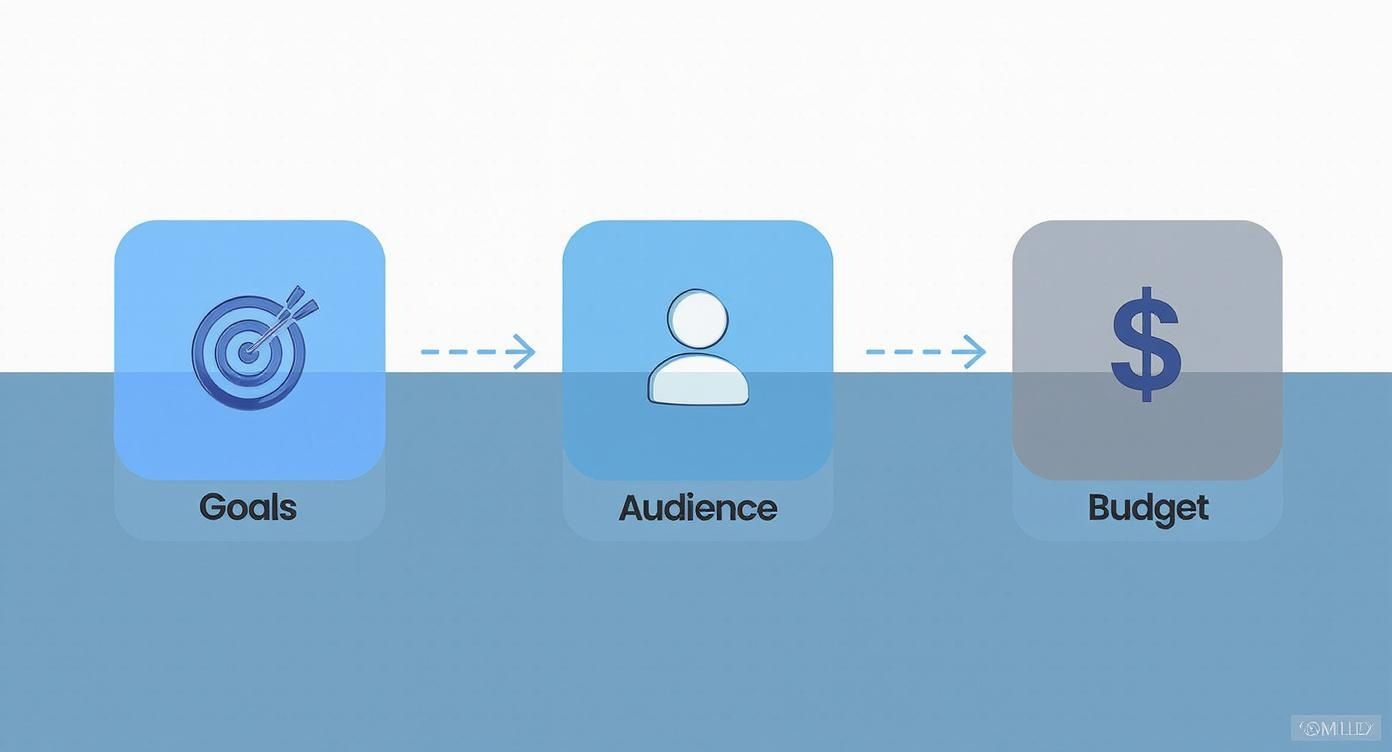
This alignment is crucial, especially on a platform as massive as Instagram. With nearly 2 billion monthly active users expected by 2025 and 61.1% of them aged 18 to 34, the potential audience is enormous. For more on these numbers, Dreamgrow has some great research. A clear strategy helps you cut through the noise and find the people who matter to your brand.
Align Goals With Metrics
To know if your campaign is actually working, you have to track the right things. What you measure should directly connect back to your original goal. A vanity metric like "likes" means very little if your goal is to drive sales.
Here's a simple way to think about matching your goals to the right metrics.
Matching Campaign Goals to Core Metrics
| Campaign Goal | Primary KPI | Secondary Metrics |
|---|---|---|
| Awareness | Reach | Impressions, Follower Growth |
| Engagement | Engagement Rate | Likes, Comments, Shares, Saves |
| Conversion | Click-Through Rate | Conversions, Sales, Leads |
This table makes it crystal clear what you should be focusing on. If your goal is brand awareness, reach is your hero metric. If it’s conversions, then you need to be laser-focused on click-throughs and sales.
I highly recommend putting all of this into a simple, one-page brief. Include your goals, audience profile, budget, and KPIs. Share it with your team so everyone is on the same page. This document will become your playbook.
Data-driven partnerships beat random collaborations every single time. They deliver a clearer ROI and ensure you're working with people who genuinely fit your brand.
With this strategic foundation in place, you’re ready to move past aimless searching. Now you can start the discovery process with a clear picture of who you’re looking for and why.
Effective Search Methods to Discover Influencers
Alright, you’ve got your strategy nailed down. Now for the fun part: finding the actual influencers you'll partner with. This isn't about mindlessly scrolling your feed; it's a targeted hunt. The right search techniques will lead you to creators who are a perfect match, not just those with the biggest follower counts.
Let's ditch the guesswork and dive into proven methods that will help you find creators who can genuinely move the needle for your brand. This process is both an art and a science.

Master Niche Hashtag Research
Think of hashtags as Instagram's original search engine. Sure, massive tags like #fitness are way too broad, but niche hashtags are absolute goldmines for uncovering dedicated communities and the creators who lead them.
You have to think longer and more specific. Forget #skincare and start searching for things like #cleanbeautymovement or #sensitiveskincareroutine. These hyper-focused tags pull in influencers who are deeply trusted on that exact topic.
- Hunt for community tags: Look for hashtags built around local events, shared interests, or specific movements (e.g.,
#dallasfoodieor#zerowasteliving). - Check the "Top" posts: This section for any niche hashtag shows you what content is resonating right now with that audience.
- Follow relevant hashtags: This is a simple trick to get a steady stream of potential partners flowing directly into your main feed.
This approach helps you find creators who are already talking to the exact audience you want to reach. The trick is to put yourself in your customer's shoes and search for the terms they would actually use.
Key Takeaway: The goal isn't just to find popular people; it's to find the right people. An influencer with 10,000 highly engaged followers in your niche is far more valuable than one with 100,000 disinterested ones.
Conduct Ethical Competitor Audits
One of the smartest ways to find Instagram influencers is to see who your competitors are already working with. This isn’t about ripping off their strategy—it's about gathering intelligence. Analyzing their campaigns gives you a pre-vetted list of creators who already get your market.
Start by going to the profiles of your top three competitors and tapping on their "Tagged" photos section. This is where you'll find a feed of content they've been tagged in, which often includes sponsored posts from their influencer partners.
Keep an eye out for influencers they've partnered with more than once. A repeat collaboration is a huge sign that the partnership was successful and delivered a solid ROI. This is a quick way to identify proven performers. While this is great for Instagram, you can get a more complete picture by learning platform-specific tactics, like how to find TikTok influencers, to see who is active across channels.
Explore Instagram's Suggestion Algorithm
Once you’ve found a few influencers who feel like a good fit, you can let Instagram do some of the heavy lifting. The platform’s own algorithm is surprisingly good at finding similar accounts.
When you're on an influencer's profile page, just tap the small down-arrow next to the "Follow" button. Instagram will instantly pop up a list of "Suggested for you" profiles. This list is filled with other creators who share a similar vibe, niche, and audience.
This simple trick can quickly turn one promising lead into ten more. It’s a fast, free way to expand your shortlist with highly relevant creators and is especially helpful for uncovering micro-influencers who might not pop up in broader searches. For a deeper look at this specific tier, check out our guide on https://reach-influencers.com/how-to-find-micro-influencers-on-instagram-2/.
By weaving together these manual methods—deep dives into niche hashtags, smart competitor analysis, and using the platform's own algorithm—you create a powerful discovery engine. You'll build a high-quality list of potential partners who are relevant, authentic, and perfectly positioned to connect with your ideal customers.
So, you’ve got a solid list of potential influencers. Now for the most important part: digging in to see who’s the real deal. This is where you separate the genuine creators from the ones with vanity metrics that won't do a thing for your brand.
A big follower count looks great on the surface, but it can be a total mirage. I’ve seen it a hundred times—huge numbers hiding a disengaged, or worse, a completely fake audience. True influence isn't just about how many people see a post; it's about trust, connection, and ultimately, inspiring people to act. Let's get into the nitty-gritty of vetting influencers so you can find a partner who’s a perfect fit.

Go Way Beyond Likes to Analyze Real Engagement
Likes are cheap. They're easy to give and even easier to buy. To get a real sense of an influencer’s pull, you need to look at their engagement rate. This little number tells you what percentage of their followers are actually interacting with their content.
Here's the simple formula:
(Total Likes + Total Comments) / Follower Count * 100 = Engagement Rate
I generally look for a healthy rate between 2-5%. If it's much lower, that’s often a sign of a passive audience or inflated follower numbers. It's fascinating when you look at the data—the influencer market is projected to hit $22.3 billion in 2025, and it’s the nano-influencers (1k-10k followers) who are crushing it with an average 4.3% engagement rate. Compare that to mega-influencers at just 1.7%, and you can see why a smaller, dedicated community can be so much more powerful.
But don't just stop at the number. The quality of the comments is what really tells the story. Are people having actual conversations, or is it just a wall of "Nice!" and fire emojis? Real discussions are the gold standard of an authentic, loyal community.
Make Sure Their Audience Is Your Audience
An influencer could have the most engaged followers on the planet, but if they aren't your target customers, the campaign is dead on arrival. The goal here is to confirm that their audience is a perfect match for the customer persona you've already mapped out.
You absolutely need to check these key demographics:
- Location: Are their followers located where you do business? I once saw a local Chicago brand almost partner with a US-based creator, only to discover that 50% of their audience was in Brazil. Big miss.
- Age and Gender: Does the age range and gender breakdown align with who you're trying to reach?
- Interests: What else is this audience into? Finding overlaps here can reveal some seriously valuable insights.
Any creator with a business or creator account has this data right in their Instagram Insights. Don't be shy about asking for a screenshot. Any professional who's serious about partnerships will be happy to share it.
Scrutinize Their Content for a Natural Brand Fit
Now it’s time to get qualitative. Go on a deep dive—scroll back through at least three to six months of their feed. Does their vibe, their aesthetic, and the way they talk feel like a natural fit for your brand? A bad match feels awkward and forced to everyone, especially their followers.
As you scroll, ask yourself:
- Is the content actually good? We're talking clear photos, well-edited videos, and captions that show some thought.
- Is their tone consistent? Do they have a clear voice and style, or are they all over the place?
- Do their values line up with yours? Look for anything in their past content that might clash with your brand's mission. You'd be surprised what you can find.
For a deeper level of due diligence, you can even utilize open-source intelligence (OSINT) techniques for background checks and identity verification to confirm you’re working with someone reputable.
Review Their Past Brand Partnerships
How an influencer worked with other brands is one of the best predictors of how they’ll work with you. Hunt down their previous sponsored posts (they should be clearly marked with #ad or #sponsored).
Here’s what to look for:
- Professionalism: Did they follow disclosure rules? Was the content creative and well-integrated, or did it feel like a lazy, slapped-on ad?
- Audience Reaction: Check the comments on their sponsored posts. Genuine interest is a great sign. A storm of "sellout!" comments is a massive red flag.
- Exclusivity: Have they promoted a direct competitor in the last few months? Partnering with someone who just worked with your biggest rival is never a good look.
This checklist will help you cut through the noise and find partners who are not just popular, but professional, authentic, and a genuinely great fit for your brand's story.
To keep everything organized, I recommend using a simple scoring system. Here's a checklist you can adapt.
The Influencer Vetting Checklist
Use this table to score potential partners. It’s a straightforward way to compare candidates and spot red flags before you commit.
| Vetting Criteria | What to Look For | Red Flags |
|---|---|---|
| Engagement Rate | Consistently between 2-5%; varies by follower count. | Below 1%; sudden, unexplained spikes in likes or comments. |
| Comment Quality | Meaningful conversations, questions, and genuine reactions. | Generic comments ("Nice!"), emoji-only replies, spam. |
| Audience Demographics | Strong alignment with your target customer's location, age, and gender. | Major mismatch in location; audience is too broad or irrelevant. |
| Content Quality & Tone | High-resolution images/videos; consistent aesthetic and voice. | Poor quality visuals; inconsistent tone; off-brand messaging. |
| Brand Alignment | Values and messaging feel like a natural extension of your brand. | Past content that conflicts with your brand's values or mission. |
| Past Partnerships | Professional, creative sponsored posts with positive audience feedback. | Promoting direct competitors recently; negative follower reactions to ads. |
| Follower Growth | Steady, organic growth over time (check with third-party tools). | Abrupt jumps or drops in follower count; suspicious follower-to-following ratio. |
Going through this process methodically ensures you’re not just picking someone with a lot of followers, but a true partner who can deliver real results.
Crafting Outreach That Actually Gets a Reply
How you slide into an influencer’s inbox is everything. It’s the difference between being seen as a genuine partner and getting instantly deleted as spam. Top-tier creators get hit with dozens, sometimes hundreds, of collaboration requests every single day. A generic, copy-paste message is a one-way ticket to being ignored.
Your first message is your first impression, and it needs to prove you’ve done your homework. Creators are business owners—they appreciate when brands treat them that way. This means valuing their work, understanding their audience, and communicating your proposal with clarity and respect. A little effort here goes a long, long way.
DM vs. Email: Where Should You Pitch?
First things first: where do you send the message? While a quick Instagram DM might seem easy, it's rarely the best move for a serious pitch. Many established influencers treat their DMs as a space for community chat, not business proposals, and your message can easily get buried.
Always look for a professional email address first. Most creators who are serious about their business will have one right in their bio or on their website. Sending an email signals that you see this as a professional partnership and gives you the space to attach a proper brief.
If you’ve searched high and low and can't find an email, a short, polite DM is your next best bet. Just keep it simple and ask for their preferred contact for brand partnerships.
Personalize It or Forget It
I can’t stress this enough: never, ever start with "Dear Influencer." Personalization is completely non-negotiable. Your opening has to show you're a real human who actually follows their work, not a bot scraping for contacts.
Here’s what a great first message always includes:
- A specific, genuine compliment. Mention a recent post, Reel, or Story that you actually enjoyed. Something like, "I loved your recent Reel on sustainable coffee brands—the editing was fantastic, and that topic is right up our alley."
- A clear brand connection. Briefly explain why you think their audience would connect with your brand. This shows you get their niche.
- The core idea. Tell them what you’re thinking, whether it’s a series of Stories, a dedicated Reel, or something else. Be direct but also flexible.
The biggest mistake I see brands make is sending a template that’s all about them. Your outreach should be 90% about the creator and their audience and only 10% about your brand. Frame the collaboration as something that adds real value for their community.
From First Chat to Formal Proposal
Once you’ve made contact and they’re interested, it’s time to get down to business. A vague proposal is a recipe for confusion and disappointment later on. Your goal here is to spell everything out so there’s no room for misunderstandings.
A solid partnership proposal is a clear, concise document that outlines the entire collaboration. Think of it as the blueprint for your campaign.
It absolutely must define:
- Campaign Deliverables: Be painfully specific. Don’t say "some content." Say, "one Instagram Reel (60-90 seconds) and three consecutive Stories with a link sticker."
- Compensation: Put the payment terms in black and white. Is it a flat fee? A product exchange? A commission model? Don’t be shy about discussing money.
- Content Usage Rights: This one is critical and often overlooked. Specify exactly how and where you can use the content they create. Will it be used in paid ads? On your website? And for how long?
- Key Timelines: Include firm dates for content drafts, revisions, and the final go-live day.
- Creative Guidelines: Give them a clear brief, but don't suffocate their creativity. You chose them for their voice—let them use it.
Putting everything in writing protects both you and the creator, ensuring everyone is on the same page from day one. This level of professionalism doesn’t just secure better partnerships; it builds a reputation that will attract top talent for years to come.
Using Technology to Scale Your Influencer Program
When you're only working with a handful of creators, you can probably get by with spreadsheets, DMs, and manual payment tracking. But let's be real—that system breaks down fast. As your program grows, this manual approach becomes a serious bottleneck that drains your time and stalls your growth.
If you want to turn influencer marketing into a predictable, scalable channel, you have to bring in the right tech.
Influencer marketing platforms are built to handle the tedious, time-sucking parts of the job. They automate the busywork so you can focus on what actually moves the needle: building solid relationships with creators and refining your campaign strategy.
Centralize Your Entire Workflow
Think about having every single piece of your campaign—from finding the right people to sending the final payment—all in one clean, organized dashboard. That's the magic of a dedicated platform. No more digging through emails, DMs, and random spreadsheets to find what you need.
These tools pull everything together, letting you:
- Discover influencers with precision: Use advanced filters to zero in on creators based on very specific criteria, like their audience's location, average engagement rate, or even keywords they use in their bio.
- Manage communications effectively: Keep all your conversations in one place. You’ll never have to worry about a critical message getting buried in a cluttered inbox again.
- Handle contracts and payments seamlessly: Automate the entire process of sending agreements, collecting tax forms, and issuing payments. This ensures everyone gets paid correctly and on time, without the headache.
For a detailed comparison, check out our breakdown of the best influencer marketing tools to see what might work for your brand's specific needs. Consolidating your tasks is how you scale your impact without scaling your workload.
Unlock Data-Driven Decisions
Hands down, the biggest win of using a dedicated platform is the access to real-time, robust analytics. Forget about guessing your ROI. Instead, you get clear, visual dashboards that track every metric that matters, from link clicks and conversions to your total campaign spend.
Key Takeaway: Moving from spreadsheets to a platform transforms influencer marketing from a speculative art into a data-backed science. It makes your results measurable, predictable, and provable to stakeholders.
A good platform dashboard gives you a quick, at-a-glance look at how your campaigns are performing.
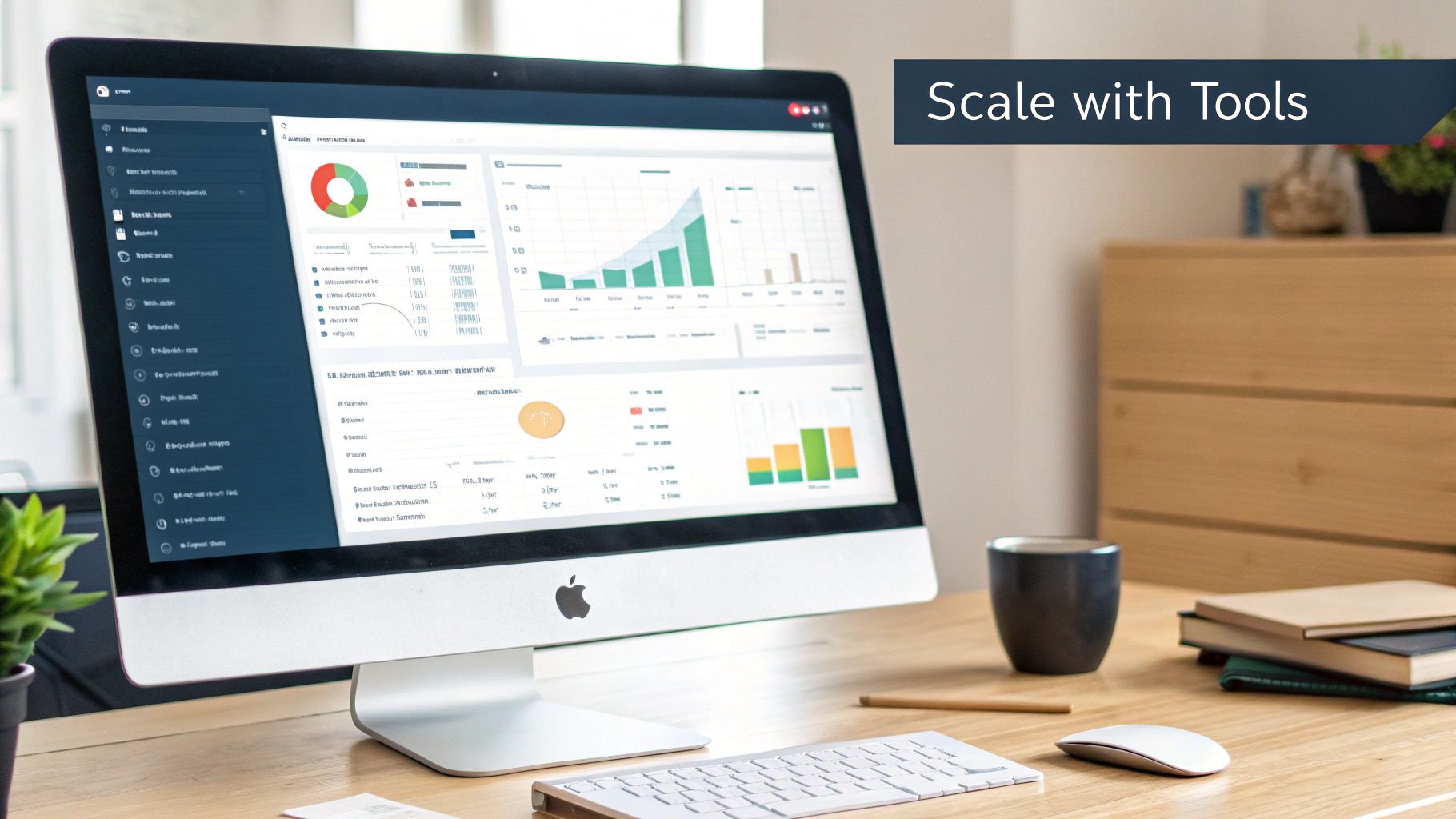
This kind of reporting instantly tells you which creators are driving the most value, which allows you to shift your budget and double down on what’s actually working.
This data-driven approach is more crucial than ever. The influencer marketing industry is on a rocket ship, projected to hit about $32.55 billion globally in 2025—a massive 35% jump from 2024. And with the best campaigns earning an ROI of up to $20 for every $1 spent, knowing your numbers is what separates a high-impact program from a costly experiment.
By adopting the right technology, you’re not just finding Instagram influencers more efficiently. You’re building a sophisticated, scalable program that consistently drives measurable results. This is how you turn one-off collaborations into a powerful engine for brand growth.
Your Top Questions About Finding Influencers, Answered
Even with the best game plan, jumping into influencer marketing can feel a bit overwhelming. Questions about costs, legal rules, and what to do after you find someone are bound to come up. It's totally normal.
Let's clear up some of the most common questions that pop up when brands start looking for Instagram partners. Think of this as your practical, no-fluff FAQ section to help you navigate the details with confidence.
So, How Much Does an Instagram Influencer Actually Cost?
This is the million-dollar question, isn't it? The honest-to-goodness answer is: it really, truly depends. Rates are all over the place and are shaped by follower count, how engaged their audience is, and what you’re actually asking them to create.
But to give you a ballpark idea, here’s a general breakdown of what you might expect to see:
- Nano-Influencers (1k-10k followers): Many are happy to work in exchange for free products, but if you're paying, expect rates between $10 and $150. They're fantastic for reaching super-niche communities with sky-high engagement.
- Micro-Influencers (10k-100k followers): This is often the sweet spot. You’re looking at around $150 to $800 a post. These creators have built real, dedicated communities and are still very accessible.
- Mid-Tier Influencers (100k-500k followers): As their audience grows, so does the price tag. A single in-feed post could run you anywhere from $800 to $3,000.
- Macro & Mega-Influencers (500k+ followers): Welcome to the big leagues. At this level, you’re working with established businesses. Rates are almost always custom-quoted and can easily climb into five or even six figures.
Here’s a pro tip: a bigger price doesn't automatically mean better results. The real win is finding a creator whose audience perfectly mirrors your ideal customer, even if they're smaller. That’s where you’ll find the best value.
What's the Difference Between an Influencer and a Brand Ambassador?
People throw these terms around interchangeably, but they actually mean two very different things. Getting the distinction right is key to setting proper expectations and building the kind of partnership you really want.
An influencer collaboration is usually a short-term, project-based deal. You might hire someone for a single campaign—say, to announce a new product or push a holiday sale. It's a transactional relationship focused on a specific, immediate goal.
A brand ambassador, on the other hand, is in it for the long haul. This is someone who becomes a genuine advocate for your brand, weaving your products into their content over months or even years. The relationship is much deeper, typically involving a formal contract, a retainer, and a more integrated role in your overall marketing.
How Do I Make Sure My Campaigns Follow FTC Rules?
This one is a big deal, and there’s no room for error. The Federal Trade Commission (FTC) has crystal-clear guidelines about disclosing paid partnerships, and the responsibility lies with both the brand and the creator. You can't plead ignorance here—the penalties are no joke.
The golden rule is that the disclosure must be clear and conspicuous.
This means influencers have to use unambiguous tags like #ad or #sponsored. And they can't bury them at the bottom of the caption or hide them in a sea of other hashtags. For video content like Stories or Reels, the disclosure needs to be right there as text on the screen, so it’s impossible to miss.
What Are the Most Important Metrics to Track?
The metrics that matter are tied directly to the goals you set in the first place. Chasing "likes" is a waste of time if your objective is to drive sales. You have to measure what matters for your specific objective.
Here’s a simple way to think about your Key Performance Indicators (KPIs):
- If your goal is Awareness: You're tracking Reach (how many unique people saw the post) and Impressions (the total number of times the post was seen).
- If your goal is Engagement: You’re all about the Engagement Rate. This means you're counting up the Likes, Comments, Shares, and Saves—actions that show the audience is truly connecting with the content.
- If your goal is Conversions: Now we're talking about driving action. You need to track Clicks, Click-Through Rate (CTR), and, of course, Conversions (sales, sign-ups, downloads). Using unique UTM codes or affiliate links for each influencer is a must for accurately tracking who drove what.
When you track the right data, you can finally prove the value of your influencer program and make smarter, more confident decisions for your next campaign.
Ready to stop guessing and start building a scalable, data-driven influencer program? REACH gives you the advanced discovery tools, centralized management, and real-time analytics you need to find the perfect partners and prove your ROI. Book a demo today and see how our platform can supercharge your influencer marketing.