 Skip to content


Starting a social media marketing agency really comes down to a few key moves: defining your niche, getting the business set up legally, packaging your services, and then actually landing those first few clients. It’s a real journey from being a passionate marketer to becoming a strategic business owner, and it all starts with a rock-solid foundation.
Building Your Agency's Foundation
Before you even think about landing those dream clients or scaling your team, you have to pour the concrete for your business. Honestly, this foundational stage is the most important part because it sets the trajectory for everything that follows. It's about making smart, deliberate choices now to save yourself from massive headaches down the road.
Rushing this part is a classic mistake. It's like building a skyscraper on a flimsy base—it’s only a matter of time before things get wobbly. This isn't about getting buried in paperwork; it's about building a resilient agency that’s ready for real growth. Let's walk through the essential first moves that separate the agencies that thrive from the ones that fizzle out.
Define Your Niche and Ideal Client
I've seen it a hundred times: the single biggest mistake new agency owners make is trying to be everything to everyone. When you say, "I help businesses with social media," you sound exactly like thousands of other people. But when you say, "I help local breweries drive foot traffic with targeted Instagram and Facebook campaigns," you immediately sound like an expert.
Choosing a niche isn't about limiting your potential. It’s about focusing your expertise so you can attract the right kind of clients—the ones who will see your value and pay for it.
A tight focus lets you:
- Develop deep industry knowledge that clients will happily pay a premium for.
- Create marketing strategies that actually work because you understand the audience inside and out.
- Build a powerful portfolio of case studies all within one specific sector.
- Become the go-to expert in your field, which makes finding new clients so much easier.
To really get inside your target's head, you need to create detailed customer profiles. For a great walkthrough on this, check out our guide on how to create buyer personas that will inform your entire strategy.
This chart shows where many successful new agencies are finding their sweet spot.
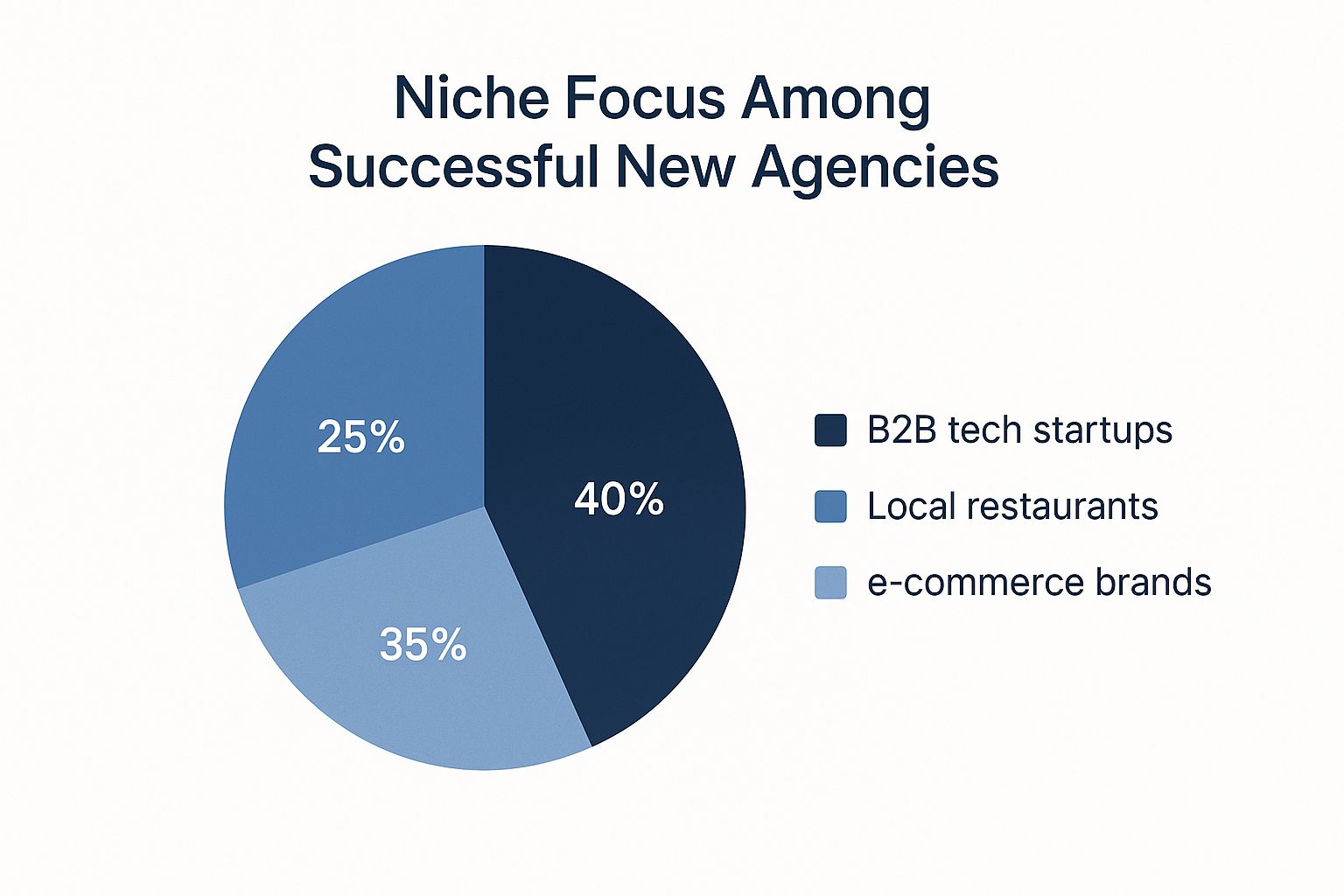
As you can see, B2B tech and specialized local businesses are huge opportunities for new agencies to carve out a strong position from the get-go.
Handle the Essential Business Setup
Once you've zeroed in on your niche, it's time to make your business official. This is non-negotiable—it protects you legally and sets you up for financial success. Don't be tempted to skip these administrative tasks.
Choose a Legal Structure
For most people starting out, the choice boils down to a Sole Proprietorship or a Limited Liability Company (LLC).
- A Sole Proprietorship is the easiest to set up. You and the business are one and the same, legally speaking. It’s simple, but it offers zero personal liability protection.
- An LLC creates a legal wall between your personal assets and your business assets. If the agency ever gets into legal trouble, your personal savings and home are safe. It requires a bit more paperwork and a small filing fee, but the protection it gives you is invaluable.
For the peace of mind it provides, forming an LLC is almost always the right move for a serious agency owner. It establishes a professional boundary from day one.
Open a Business Bank Account
The moment your business is registered, march over to the bank and open a dedicated business account. Mixing your personal and business finances is a recipe for an accounting nightmare, and it can even destroy the liability protection your LLC is supposed to provide.
A separate account makes tracking income, managing expenses, and filing taxes a million times easier. This step also marks a mental shift—you're no longer just a freelancer; you are the CEO of a real business. To build an efficient agency from the ground up, you'll eventually want to explore marketing automation for agencies to streamline your own operations.
Designing Services Clients Actually Want to Buy

Alright, let's talk about what you're actually selling. Your agency's success depends on getting past the vague promise of "social media management" and crafting service packages that solve real problems for your clients. Think of your services as the engine of your business—designing them well from the start is your first real step toward profitability.
The last thing you want is a confusing, à la carte menu of a dozen different tasks. It overwhelms clients and complicates your sales process. Instead, bundle your skills into tiered packages that make sense for both their goals and your bottom line. We're talking about more than just posting. Good packages often roll in content strategy, community engagement, paid ad management, and monthly analytics deep dives. This approach makes your value proposition crystal clear.
Structuring Your Core Offerings
From my experience, the best way to structure your services is with tiered packages. This approach immediately widens your appeal, letting you serve everyone from a local coffee shop needing a basic presence to a booming e-commerce brand ready to pour fuel on the fire. A three-tiered model is a classic for a reason—it works.
-
The Starter Package: This is your foot in the door. It’s built for small businesses that know they need a professional, consistent social media presence but are watching their budget. It's a low-risk way for them to start, builds trust, and often blossoms into a long-term partnership.
-
The Growth Package: This will likely be your bestseller. This package is for businesses that are past the basics and are ready to actively grow their audience and generate leads. It naturally includes more advanced work, like proactive community engagement and managing a modest ad spend.
-
The Scale Package: This is your premium, all-inclusive solution. It’s designed for established businesses laser-focused on ROI, brand dominance, and data-driven results. Think comprehensive strategy, larger-scale ad campaigns, and in-depth reporting.
For instance, a starter package for a local restaurant might cover their Instagram and Facebook pages with three posts per week and basic comment monitoring. The growth package could level up with a monthly content calendar, a small ad budget for promotions, and weekly performance snapshots. To go all out, the scale package might bring in video content creation, influencer outreach, and a full-blown monthly analytics meeting to strategize for the next 30 days.
Nailing Down Your Pricing Model
Once you've defined your packages, it’s time to put a price on them. The right pricing model gives you predictable revenue while clearly demonstrating value to your client. There are a few tried-and-true approaches you'll see in the agency world.
Monthly Retainer
This is the gold standard, period. A client pays you a fixed fee each month for a clearly defined set of services. It creates stable, recurring revenue for your agency and gives the client consistency and peace of mind. For ongoing social media management, this is the model you want to aim for.
Project-Based Fees
This model is a great fit for one-off projects with a defined beginning and end. Think of things like crafting a social media launch strategy for a new product, running a specific three-month ad campaign, or conducting a deep-dive social media audit. A word of advice: always require at least a 50% upfront payment to get the work started.
Don't fall into the trap of pricing your services based on the hours you work. Price them on the value and the results you deliver. Clients are paying for your expertise and the outcome, not just your time.
Performance-Based Pricing
While it sounds great in theory, this model is a minefield for new agencies. It involves tying your fee directly to a specific metric, like the number of leads generated or sales closed. It can be incredibly profitable down the road, but it’s best saved for when you have a rock-solid, proven track record and control over every variable that could affect the outcome.
To help you visualize how this all comes together, here’s a sample breakdown of the tiered packages we've been discussing.
Sample Social Media Agency Service Packages
This table gives you a starting point for building out your own packages. It creates a clear value ladder, making it easy for potential clients to see where they fit and what they get by investing more.
| Feature | Starter Package ($) | Growth Package ($$) | Scale Package ($$$) |
|---|---|---|---|
| Platforms Managed | 2 (e.g., FB, IG) | Up to 3 | Up to 4 |
| Content Creation | 12 posts/month | 20 posts/month + 2 Reels | 30 posts/month + 4 Reels/Videos |
| Community Management | Basic (Reply to comments) | Proactive Engagement | 24/7 Monitoring & Engagement |
| Paid Ad Management | Ad spend not included | Up to $500/mo ad spend | Up to $2,000/mo ad spend |
| Reporting | Monthly Basic Report | Bi-Weekly Performance Report | Weekly Deep Dive Analytics Call |
| Strategy | Initial Consultation | Quarterly Strategy Session | Monthly Strategy & Planning Call |
With a structure like this, clients can self-select the package that fits their needs and budget. It also gives you a natural path for upselling them as their business grows and their needs evolve.
Choosing Your Agency's Tech Stack

The right set of tools can make a one-person agency feel like a team of ten. Building your tech stack isn't about collecting shiny new software; it's about piecing together an efficient, automated workflow that frees you up for the strategic work clients actually pay you for. Think of it as hiring a digital team that works around the clock.
A well-chosen stack takes the grunt work off your plate, makes client communication a breeze, and delivers the kind of insights that justify your fees. Without it, you’ll drown in manual tasks, miss deadlines, and struggle to prove your worth.
Let's break down the essentials.
The Non-Negotiable Core Tools
Every social media agency, big or small, needs a few foundational tools just to function professionally. These are the categories you should invest in from day one to keep your operations smooth and ready to scale.
Your initial stack has to cover three critical areas:
- Social Media Scheduling: Manually posting across multiple client accounts is a fast track to burnout. Tools like Buffer, Later, or Hootsuite are non-negotiable for planning content calendars, keeping a consistent posting schedule, and managing approvals all in one spot.
- Content Creation: You have to produce quality visuals, and you have to do it fast. Canva is the undisputed champ here for its sheer ease of use and massive template library. For more advanced video, tools like CapCut or Adobe Express pack a serious punch on both mobile and desktop.
- Project Management: As you start juggling clients, a project management hub becomes your single source of truth. Trello, Asana, or ClickUp help you track tasks, set deadlines, and keep client assets organized so nothing falls through the cracks.
Your tech stack is a direct investment in your agency's efficiency and your own sanity. Start lean with tools that solve your most immediate problems, then expand as your client base and revenue grow.
To make a smart decision on your content management system, it's worth checking out a comprehensive CMS comparison that lays out the options for different business needs. Making the right choice early can save you a world of hurt later.
Gaining a Competitive Edge with Advanced Tools
Once you have the basics down and your daily operations are humming along, it’s time to level up. This is where you add tools that deliver the strategic insights clients are willing to pay a premium for. You’ll move from just doing the work to proving its value and spotting new opportunities for clients.
Smart agencies are leaning heavily into AI and social listening to build better strategies. In fact, the social listening market is expected to jump from $9.61 billion in 2025 to $18.43 billion by 2030—a huge indicator of its importance. This shift to data-driven decision-making is what separates the thriving agencies from the ones that get left behind. You can see more stats on this trend over at sprinklr.com.
These advanced tools help you listen to online conversations, analyze sentiment, and spot trends before your competitors. For a deeper look at your options, our guide on social media management tools for agencies walks through a wide range of platforms.
Building Your Stack on a Budget
Starting lean doesn't mean starting weak. So many of the best tools offer generous free tiers or affordable starter plans that are perfect for a new agency. The trick is to be honest about what you need now versus what would be nice to have later.
| Tool Category | Budget-Friendly Option | When to Upgrade |
|---|---|---|
| Scheduling | Buffer (Free Plan) | When you need analytics, team features, or more accounts. |
| Design | Canva (Free Plan) | For access to Brand Kits, premium stock, and AI tools. |
| Project Management | Trello (Free Plan) | When you require advanced automation and integrations. |
| Analytics | Native Platform Insights | When you need cross-platform reports and competitor analysis. |
By starting with free or low-cost options, you can build a surprisingly powerful tech stack for under $100 per month. This lets you serve your first few clients like a pro while keeping your overhead low—a crucial move when you're just getting your agency off the ground.
How to Land Your First Paying Clients

An agency is just an idea until you have paying clients. This is where the theory stops and the real work begins—turning your skills into revenue. Forget the vague advice like "just network." Let's get into the nitty-gritty, actionable strategies that actually land business when you're starting from square one.
Getting those first few names on your client roster can feel like the toughest climb, but it’s completely doable with a smart, focused approach. It all comes down to proving your value, making the right connections, and looking like a pro from the very first email.
Building Your Starter Portfolio
"But I don't have any paid experience!" It's the classic chicken-and-egg problem for every new agency owner, but it's easier to solve than you think. You don't need a portfolio stacked with household names; you just need to prove you can get results.
Here are a few ways to build a killer portfolio before you even sign a contract:
- Create "Spec" Work: Pick two or three brands you love, ideally in your target niche, and create a sample social media campaign for them. Mock up a week's worth of content, write the captions, and map out a mini-strategy. This is your chance to show off your creative and strategic chops.
- Offer a Low-Cost Trial: Find a local nonprofit or a friend's small business and offer your services for a month at a steeply discounted rate. The goal here isn't profit. It's about getting a real-world case study and a glowing testimonial that will help you land full-paying clients.
- Lean on Personal Projects: Did you grow your own Instagram to 10,000 followers? Help a family member launch their Etsy shop? That counts. Document the process, the strategy, and the results to create a compelling mini-case study.
Your first portfolio isn't about a long client list. It's about demonstrating your process, your creativity, and your ability to think strategically about a brand's social media.
Mastering Your Outreach Strategy
Once you've got some work to show, it's time to hunt for clients. Sitting back and waiting for the phone to ring is a recipe for failure. You need to be proactive and get in front of the people who can actually hire you.
This isn't a passive activity; it requires a real investment of time and resources. In fact, established digital agencies typically put about 7.1% of their revenue back into their own sales and marketing. That investment is what keeps the pipeline full.
Cold Outreach That Actually Works
Yes, cold emailing still works—if you do it right. The secret is personalization and value. A generic, copy-pasted email gets deleted before it's even fully read.
A good cold email has a simple, effective structure:
- Personalized Opening: Start by mentioning something specific you noticed and liked about their business. It shows you've actually done your homework.
- The Hook: Point out one small, specific area for improvement on their social media. For example, "I noticed your Instagram has amazing photos, but you could get so much more engagement by using targeted hashtags."
- The Offer: Give them one or two quick, actionable tips they can use right away. You're providing value for free before asking for anything in return.
- The Call to Action: End with a low-pressure ask. Something like, "Would you be open to a quick 15-minute call next week to brainstorm a few more ideas?" is much better than "Let's discuss my packages."
Leveraging LinkedIn for Targeted Connections
For a new social media agency, LinkedIn is a goldmine. It lets you bypass the gatekeepers and connect directly with the decision-makers, whether that's a Marketing Manager or the business owner themselves.
Don't just spam connection requests. Use a multi-touch approach:
- First, engage with their content. Leave thoughtful comments on their posts for a week or two.
- Then, send a personalized connection request that mentions a shared interest or a recent post of theirs you enjoyed.
- Once you're connected, follow up with a brief, non-salesy message to open a real conversation.
This slow-burn method builds familiarity and trust, so when you do eventually make a pitch, it feels natural, not forced. To dig deeper into these tactics, check out our guide covering lead generation best practices.
The Professional Onboarding Process
Once a lead says "I'm interested," your process for converting them into a paying client needs to be seamless and professional. This is your first real chance to build trust and set the foundation for a great partnership.
- The Proposal: Your proposal should be clean, clear, and professional. It needs to outline the exact services you'll provide, the timeline, and the cost. Most importantly, it should reflect their goals back to them and explain precisely how your work will help achieve them.
- The Contract: Never, ever start work without a signed contract. A simple service agreement protects both you and the client by defining the scope of work, payment terms, and confidentiality. You can find plenty of affordable templates online to get started.
- The Kickoff Call: This is your first official meeting as partners. Use this call to dive deep into their brand, confirm goals, set up communication channels, and outline clear expectations for the first 30 days. A strong kickoff call builds immediate momentum and shows them they made the right choice.
Scaling Beyond Your First Clients
Getting your first few clients is a huge win. It’s that moment your side hustle or big idea finally feels like a real, breathing business. But the real test isn't just landing clients; it's what you do next. The challenge is to keep that momentum going without burning yourself out.
This is where you graduate from a freelancer mindset to a true business owner.
Scaling isn't about working harder; it's about working smarter. It means building systems that let you grow your revenue without having to proportionally grow your own hours. If adding one more client just means another late night for you, you don't have a scalable business—you have a really demanding job. True growth happens when your agency can run just as smoothly with thirty clients as it does with three.
Recognizing the Right Time to Expand
So, how do you know when it's time to stop being a one-person show? The signs are usually staring you right in the face, but it’s so easy to miss them when you’re buried in the day-to-day grind. Ignoring them is a one-way ticket to burnout, and worse, your work starts to suffer.
You know it’s time to get help when:
- You’re consistently turning away good clients you’d love to work with, simply because you have no time.
- Your days are filled with admin and busywork instead of the high-level strategy clients are paying you for.
- You feel that dreaded sense that the quality of your work is about to slip because you’re stretched too thin.
- You haven't had a single hour to work on your business (think marketing, sales, big-picture planning) because you're drowning in it.
These aren't just "growing pains." They're giant red flags telling you that your current setup has hit its limit. If you just try to push through, you’ll cap your agency's potential and your own sanity.
To Hire or to Outsource? That Is the Question
Expanding doesn't automatically mean hiring a full-time employee. In fact, your first step should probably be outsourcing. Bringing on freelancers or contractors is a brilliant, flexible way to add muscle to your team without the heavy lift of payroll and benefits.
Think about outsourcing for specialized, one-off, or project-based needs. Graphic design, copywriting, or video editing are perfect for this. These are specialized skills you might not have or simply don't have time for. A great freelance designer, for example, can instantly elevate your content for several clients, which frees you up to nail the strategy and strengthen client relationships.
Hiring your first actual team member makes sense when you have core, repeatable work that needs to be done every single day. Think about bringing on a junior social media manager who can handle content scheduling, community management, and pulling basic reports. This person becomes your right hand, taking over the daily essentials so you can focus on steering the ship.
A classic mistake is waiting until you're completely underwater to start hiring. You should start looking for help when you're at 80% capacity. This gives you the breathing room to find the right person and train them properly before everything catches fire.
Building Repeatable Systems and Workflows
The real secret to scaling an agency? Standardization. You simply cannot scale chaos. Every single client deserves the same level of high-quality service, and the only way to deliver that consistently is to have documented, repeatable processes for everything.
Start by creating Standard Operating Procedures (SOPs) for your most common tasks. Don't think of these as just for future employees—creating them forces you to look at your own methods and find ways to be more efficient right now.
Your first few SOPs should cover the big stuff:
- Client Onboarding: A complete checklist that takes you from the moment a contract is signed to the final kickoff call.
- Content Creation: Your entire workflow, from brainstorming ideas and creating visuals to getting client approval and scheduling the posts.
- Monthly Reporting: A clear template and step-by-step guide for pulling the right data and turning it into a report that clients will actually understand and value.
These documents are the operational backbone of a scalable agency. They turn your scrappy, ad-hoc methods into a reliable, professional system that’s built for growth.
Common Questions About Starting an SMMA
Jumping into the world of social media marketing agencies always brings up a ton of questions. It's completely normal to feel a bit uncertain when you're laying the foundation for a new business. Let's break down some of the most common concerns I hear and give you some straightforward advice to get you past those early roadblocks.
How Much Money Do I Need to Start an SMMA?
One of the biggest misconceptions is that you need a huge pile of cash to get an SMMA off the ground. The truth is, you can launch a social media marketing agency on a shoestring budget, often for under $500. The real beauty of this business model is just how low the overhead is.
Your initial costs are all about the practical necessities, not flashy expenses.
- Business Registration: This is usually a one-time fee to form an LLC or register your business name, and the cost varies by state.
- Domain Name & Website: Grabbing your domain is cheap, and you can get a simple, professional-looking website up and running without breaking the bank.
- Essential Tools: Your main recurring costs will be subscriptions for a few key tools. Think Canva Pro for design and a basic social media scheduler to keep things organized.
The trick is to steer clear of those expensive, all-in-one software suites and a physical office until your client revenue can easily support them. Start with only what you absolutely need, not what you think a "real" agency should have. This approach keeps you lean, mean, and profitable right from the very first day.
Do I Need a Portfolio to Get My First Client?
Nope. You don’t need a fancy portfolio full of big-name clients, but you absolutely do need to prove you can get the job done. When you're just starting, your ability to demonstrate your skills is way more convincing than a list of past jobs.
Instead of a traditional portfolio, you've got to get a little creative and build your own proof of expertise. A great strategy is to create "spec" work. Go pick a few brands you admire in your niche and build out a mockup social media campaign for them. It immediately shows a potential client that you've been thinking strategically about their specific industry.
Another killer approach? Offer your services to a local nonprofit or a friend's small business at a steep discount for just one month. Your goal here isn't the money; it's to walk away with a solid case study packed with real results and a glowing testimonial.
Your passion, strategic thinking, and the tangible examples you create are often more powerful than a fancy portfolio when you're trying to land that first client.
How Do I Price My Services When Just Starting Out?
Pricing is the spot where I see most new agency owners trip up. The classic mistake is drastically undercharging because they think it makes them more competitive. You have to resist that urge. Your price signals your value, and setting it too low can actually scare off serious clients who equate low cost with low quality.
A good starting point is to do some digging. See what other small agencies or freelancers are charging for similar services within your niche. For most, a simple monthly retainer works best because it gives you predictable income. For a small local business, a basic package that covers managing one or two social platforms could realistically fall anywhere between $500 to $1,500 per month.
Always, always tie your pricing to the value and results you deliver, not just the hours you put in. As you collect more testimonials and build a track record of getting clients real results, you absolutely can—and should—raise your rates. Your confidence and your pricing should grow hand-in-hand.
Ready to add a powerful new service to your agency? Influencer marketing is where it's at, and REACH is the tool to make it happen. It gives you an all-in-one platform for finding influencers, running campaigns, and actually proving your ROI to clients. Streamline your entire workflow and start delivering incredible results with REACH.