
Meta description: Learn how do influencers get paid, from brand deals and rate models to contracts, invoicing, taxes, and delayed payouts. A practical guide for brand managers.
You’re approving creators, tracking content in DMs, matching invoices to posts, and trying to remember whether payment goes out on content approval or on publication. That’s usually when the question stops being abstract and becomes operational.
How do influencers get paid isn’t really a question about money alone. It’s a question about workflow. The public version of influencer marketing looks simple. A creator posts content, a brand pays them, everyone moves on. The actual version involves scopes of work, usage rights, revisions, invoices, payment terms, tax forms, and follow-up when something slips.
That complexity matters because influencer marketing is no longer a side experiment. In 2025, U.S. sponsored content spending surpassed $10 billion and grew 23.7% year over year, according to Socially Powerful’s influencer marketing statistics roundup. When budgets get that large, payment operations stop being back-office admin and become part of campaign execution.
Creators also don’t earn from one source alone. If you want a broader look at creator revenue outside sponsorships, Zanfia helps creators monetize content with a useful overview of how monetization stacks across channels.
The Reality of Influencer Payments Beyond the Hype
A new brand manager usually starts with the visible part of the job. Find creators. Agree on content. Launch. Then the hidden layer appears.
One creator wants half upfront. Another won’t post until the contract reflects usage rights. A third sends an invoice with missing business details. Finance asks for tax paperwork. The campaign goes live, but two creators haven’t been paid because someone is still checking whether the final Story frames were delivered.
That’s normal. It’s also why influencer payment systems break when teams rely on email threads and spreadsheets alone.
Where the friction starts
The first mistake is treating compensation like a final step. It starts earlier than that. Payment terms affect whether a creator accepts the deal, how fast they produce, and whether the relationship stays healthy after the campaign ends.
The second mistake is assuming all creators get paid the same way. They don’t. Some work on flat fees. Some prefer commission. Some mix a guaranteed base with a performance incentive. Many creators also balance sponsorship income with affiliate revenue, platform payouts, and their own products.
Practical rule: If payment logic isn’t documented before content production starts, the campaign is already harder to manage.
What brand managers actually need to control
The job is to make money move in a way that matches deliverables. That means you need clarity on:
- Scope: What content is being delivered, on which platform, and in what format.
- Timing: When payment is triggered. On signing, on draft approval, on posting, or on campaign completion.
- Paperwork: Contract terms, invoice requirements, and tax documentation.
- Verification: Proof that the agreed content was published and remained live as required.
Influencer payments get easier when you stop viewing them as one transaction and start treating them as a lifecycle.
The Four Main Ways Influencers Earn Income
Not every creator gets paid by brands alone. Most established influencers build income from multiple streams, and each stream behaves differently.
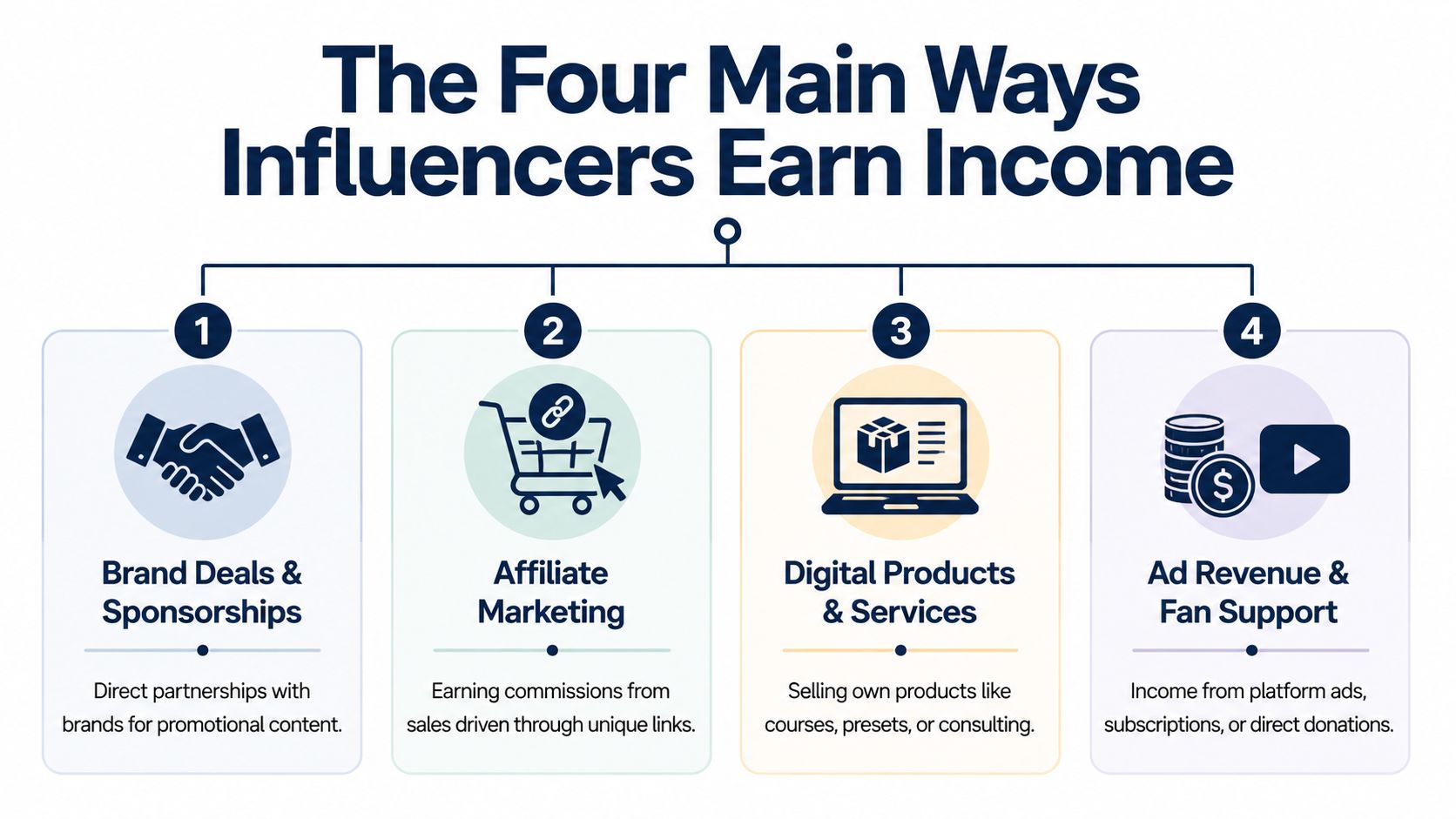
Brand deals and sponsorships
This is a clear model. A brand hires a creator to publish specific content in exchange for a negotiated fee. This arrangement operates as a custom ad placement, but with the creator’s voice and audience relationship carrying the message.
A skincare brand might pay for one Reel, three Stories, and a set of raw image assets. A food brand might hire a YouTube creator for a dedicated integration inside a longer video.
This income is usually the most structured because it relies on a contract, deliverables, and a payment schedule.
Affiliate marketing
Affiliate income works more like sales commission. The creator shares a tracked link or code, and they earn when their audience buys.
This can work well when a creator already uses the product and can keep recommending it over time. It’s less predictable than a flat fee, which is why many creators don’t want affiliate-only arrangements unless there’s strong demand for the product.
Affiliate deals can look cheap from the brand side, but they shift more risk onto the creator.
Platform-native monetization
Some creators get paid directly by platforms through ad revenue, creator programs, subscriptions, or fan support features. That income usually depends on platform rules, audience behavior, and the type of content being published.
A YouTube creator may earn from ads inside long-form videos. A livestream creator may earn through subscriptions or direct fan support. This money doesn’t come from a brand contract, so the payment schedule and reporting are controlled by the platform.
Direct-to-audience sales
This is often the most durable revenue stream because the creator owns the offer. They might sell presets, courses, consulting, memberships, merchandise, or digital downloads.
This works less like advertising and more like running a small media business.
Here’s the simplest way to think about the four models:
| Income stream | Who pays | What triggers payment | Main trade-off |
|---|---|---|---|
| Brand deals | Brand or agency | Content deliverables | Predictable, but admin-heavy |
| Affiliate marketing | Merchant or network | Tracked sales | Low upfront certainty |
| Platform monetization | Platform | Views, ads, subscriptions, or fan support | Controlled by platform rules |
| Direct sales | Audience | Product or service purchase | Highest control, but creator handles fulfillment |
Why this matters for brands
If you understand all four income streams, you negotiate better. A creator with strong direct-product sales may say no to low-fee sponsorships. A creator who relies heavily on affiliate income may ask for a hybrid deal. A creator with stable platform revenue may be more selective about brand fit.
That context helps you avoid one of the most common brand mistakes. Offering a payment structure that makes sense only from your side.
How Brand Deals and Sponsorships Are Paid Out
A sponsorship looks simple until the invoice hits finance. The creator thinks the work is done because the post is live. The brand team thinks payment starts after approvals are logged, usage rights are confirmed, and procurement has a valid W-9 or W-8 on file. That gap is where delays start.
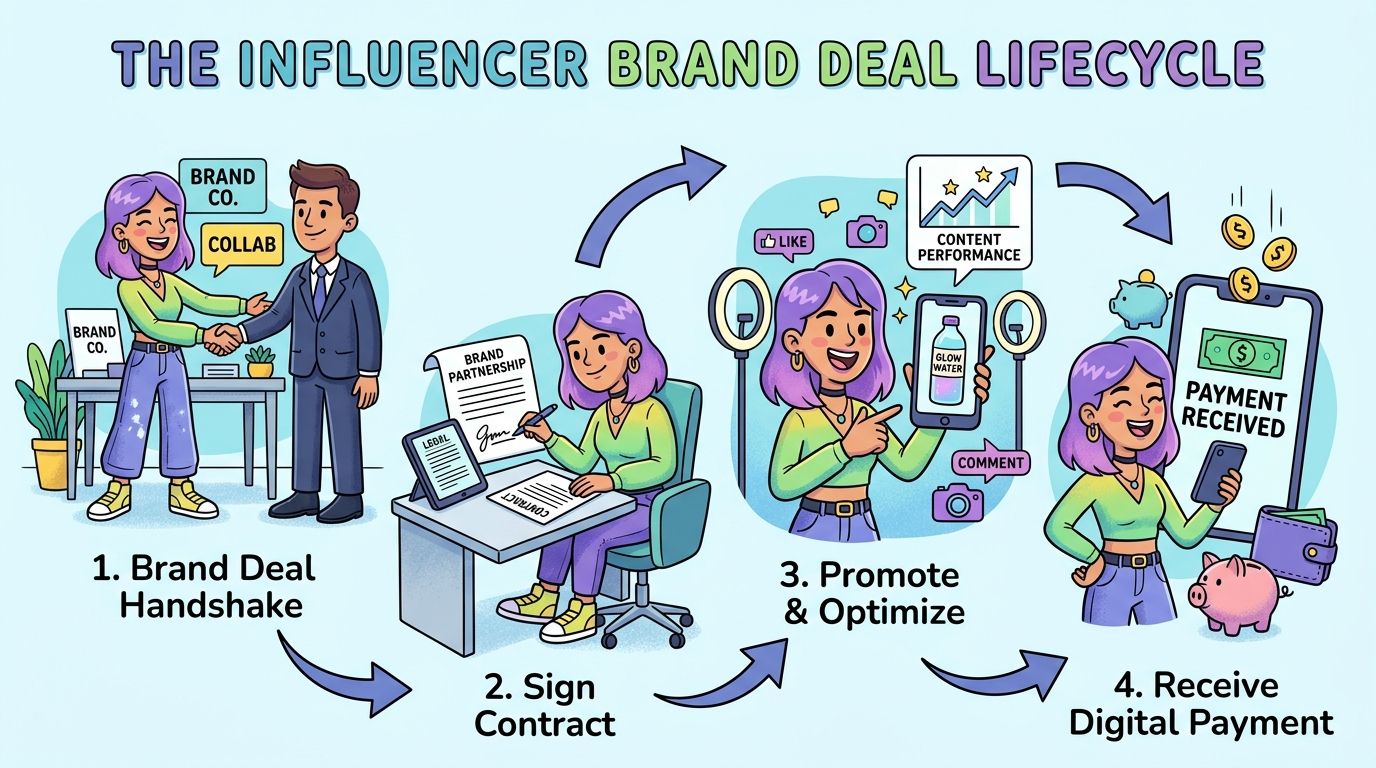
The standard payout flow
Most brand deals pass through four operational checkpoints:
- Negotiation
- Contract and scope approval
- Content creation and review
- Invoice and payout
The order is familiar. The friction sits in the details.
During negotiation, the team agrees on deliverables and payment triggers. That might mean one TikTok, one Instagram Reel, paid usage rights for 30 days, or a content bundle across multiple placements. If those terms stay vague, payment disputes show up later as “we thought that was included.”
The contract has to define what completion means. Some deals pay on publication. Others pay after final content approval, after asset delivery, or on net-30 terms from invoice receipt. Each version changes the creator’s cash flow and the brand’s internal handoff to finance.
Common deal structures
The payout process also changes with the structure of the deal.
- One-off post deals: Simple to launch, but still easy to mismanage if revision limits, posting dates, and rights are unclear.
- Multi-post campaigns: Harder to track because each asset can have its own draft, approval, and payment status.
- Ambassador agreements: More efficient over time, but they need tighter terms around exclusivity, monthly deliverables, renewal dates, and usage.
A one-post campaign can be paid in a single invoice. A multi-asset campaign often needs staged approvals. Ambassador programs usually work best with a monthly or milestone payment schedule because both sides are managing an ongoing relationship, not a one-time deliverable.
What actually gets paid for
The fee usually covers more than audience access. In practice, brands are buying a package that can include:
- Content format: Reel, Story set, static post, TikTok video, YouTube integration
- Creative production: Scripting, filming, editing, reshoots, revisions
- Distribution: Publishing to the creator’s audience
- Usage rights: Brand reuse on owned or paid channels
- Exclusivity: Limits on promoting competitors for a set period
A creator invoice is often a bundled media and production invoice, not just a line item for “one post.”
That cost structure works a lot like other creator industries. The logic behind rights, distribution, and performance can look similar to how spotify pays artists, even though influencer deals are usually negotiated one contract at a time instead of paid through a standardized platform royalty model.
Payment timing that holds up in practice
Milestone-based payment is usually the cleanest setup. A common structure is partial payment upfront, with the balance released after the agreed delivery point. That gives creators working capital and gives brands a clear reason to release the final amount only after the contracted work is complete.
The exact trigger matters more than the split. “Paid after posting” is different from “paid after final approval,” and both are different from “paid within 30 days of valid invoice.” If the contract, creator manager, and finance team are not using the same trigger, the payout schedule breaks fast.
Brands that want a clearer operating framework can use REACH’s guide on how to pay influencers without creating invoice and approval bottlenecks.
Where payment delays actually come from
Late payment usually starts with broken process, not bad intent.
A creator submits content by email. The social lead approves it in Slack. The legal team updates usage rights in a PDF. Finance gets an invoice that does not match the final scope. Then someone notices the tax form is missing, the vendor profile is incomplete, or the campaign code was never added to the PO.
That is why influencer payments need one system of record. Contract terms, deliverables, approval status, invoice amount, tax documents, and payment date have to match. When those records live across inboxes, chat threads, and spreadsheets, the brand loses control of the timeline and the creator loses trust in the process.
Decoding Influencer Pricing Models and 2026 Rate Benchmarks
Rates are where most conversations start, but the actual question isn’t “what’s the average price?” It’s “what payment model fits this campaign?”
Different pricing models solve different problems. Some help with budget control. Some help with performance accountability. Some create less risk for creators.
Flat fee versus variable compensation
The flat-fee model is still the standard sponsored-content structure. The creator gets a set amount for a defined scope. That gives the brand a predictable budget and gives the creator guaranteed compensation.
Variable models shift some payment to outcomes. That can work well when the campaign goal is sales, clicks, or tracked conversions, but it also introduces uncertainty.
Here’s how the main models compare:
| Pricing model | Best use case | Brand upside | Creator upside | Main weakness |
|---|---|---|---|---|
| Flat fee | Sponsored posts and content packages | Predictable budget | Guaranteed pay | Brand carries more performance risk |
| Affiliate or commission | Sales-focused campaigns | Pay for actual conversions | Upside if product converts well | Unpredictable income |
| PPC or CPM style arrangements | Performance-heavy campaigns | Easier to map to media logic | Can reward strong traffic delivery | Harder to verify and manage cleanly |
| Hybrid model | Mature creator partnerships | Shared risk | Base pay plus upside | Requires stronger tracking and clearer contracts |
What the current benchmarks actually show
According to Lumanu’s 2025 influencer compensation insights, micro-influencers with 10K to 100K followers typically earn $100 to $500 per Instagram post or $25 to $125 per TikTok, while mid-tier creators with 100K to 1M followers can command $500 to $25,000. The same source notes that YouTube commands the highest rates, with some mid-tier tech creators earning $15,000 to $30,000 per video.
That range is wide because “one post” doesn’t mean one thing. A static image is not a scripted video with revisions. A creator with niche authority is not priced the same way as a creator with broad reach and weaker intent. Platform behavior matters too.
If you’ve ever tried to compare creator pricing with another media industry, it helps to look at adjacent creator ecosystems. For example, Mogul’s breakdown of how Spotify pays artists is a useful reminder that digital creator compensation often depends on platform economics, format, and bargaining power rather than one universal rate card.
2026 Influencer Rate Benchmarks Per Post
The table below uses only verified benchmark ranges available from the cited market data. Where no verified number is available for a tier-platform combination, the cell is left qualitative rather than guessed.
| Influencer Tier | Followers | Instagram Post Rate | TikTok Video Rate | YouTube Video Rate |
|---|---|---|---|---|
| Nano | 1K to 10K | Qualitative only | Qualitative only | Qualitative only |
| Micro | 10K to 100K | $100 to $500 | $25 to $125 | Qualitative only |
| Mid-tier | 100K to 1M | $500 to $25,000 | Qualitative only | $15,000 to $30,000 for some mid-tier tech creators |
| Macro | 1M to 10M | Qualitative only | Qualitative only | Qualitative only |
Why the sticker price can mislead you
A lower rate isn’t always cheaper. A creator who needs repeated follow-up, misses deadlines, or invoices incorrectly can cost more in staff time than a more expensive creator with clean process.
When evaluating rates, look beyond audience size:
- Deliverable complexity: Video usually takes more work than a static asset.
- Revision expectations: More review rounds mean more labor.
- Usage rights: Paid media use should be documented and priced clearly.
- Exclusivity terms: Restrictions on competitor work add value and cost.
- Operational reliability: Fast approvals and accurate paperwork reduce campaign drag.
Budgeting shortcut: Price the deliverable, the rights, and the process overhead. Don’t price follower count in isolation.
If you want a grounded framework for evaluating those variables before agreeing on rates, REACH offers a useful checklist on influencer payment factors.
Navigating Contracts Invoicing and Tax Compliance
The hard part of influencer payments usually starts after the rate is agreed. Brands tend to assume the deal is done once the number is settled. It isn’t.
The work is making sure the payment is enforceable, trackable, and compliant.

According to Beehiiv’s creator payment overview, 62% of creators report inconsistent payment timelines, often waiting 30 to 90 days for payment. The same source notes that centralized payment platforms can reduce administrative work for brands by up to 70%.
Contracts are payment documents
A creator contract isn’t just legal protection. It’s the instruction sheet for finance.
If the agreement is vague, the payout process will be vague too. At minimum, a strong influencer contract should define:
- Deliverables: Exact content types, quantities, and platforms
- Approval process: Draft review expectations and revision limits
- Usage rights: Whether the brand can repost, whitelist, or run paid media
- Payment terms: Trigger, due date, and any deposit or milestone structure
- Cancellation terms: What happens if either side exits early
A lot of late payments start with loose language. “Payment after campaign completion” sounds harmless until no one agrees on what completion means.
Invoices need structure
Creators often send invoices after the content is live, but many teams fail here because the invoice doesn’t match procurement requirements. Missing legal names, tax IDs, remit details, or purchase order references can delay payment even when everyone wants to pay quickly.
For brands, the simplest fix is to standardize invoice requirements before the campaign begins. For creators, the best move is to invoice exactly according to the contract and include the identifiers your finance team needs.
If your finance team has to chase down missing invoice details, your payment timeline is already slipping.
Tax paperwork is where informal systems break
In the U.S., creators and brands both need to treat sponsorship income like business income. That means documentation matters.
Creators commonly need to provide the tax information a brand requires before payment can be processed. Brands need a repeatable process for collecting and storing that information, especially when they’re paying many creators across a year.
For creators who need a plain-English refresher on planning for taxes, Allied Tax Advisors has a practical estimated tax guide for self-employed.
Later in the workflow, many teams also need support content on tax handling. This short explainer is a useful primer before setting an internal process:
International payouts add another layer
Once creators are spread across countries, the friction increases. Currency conversion, bank transfer issues, local tax rules, and VAT questions can all slow things down.
That doesn’t mean global campaigns are a bad idea. It means brands need a payment system built for more than occasional one-off transfers. Informal workflows usually hold up for a few domestic creators. They don’t hold up well once cross-border admin enters the picture.
How REACH Streamlines Influencer Payments and Compliance
When teams outgrow spreadsheets, the biggest improvement usually doesn’t come from negotiating harder. It comes from centralizing execution.
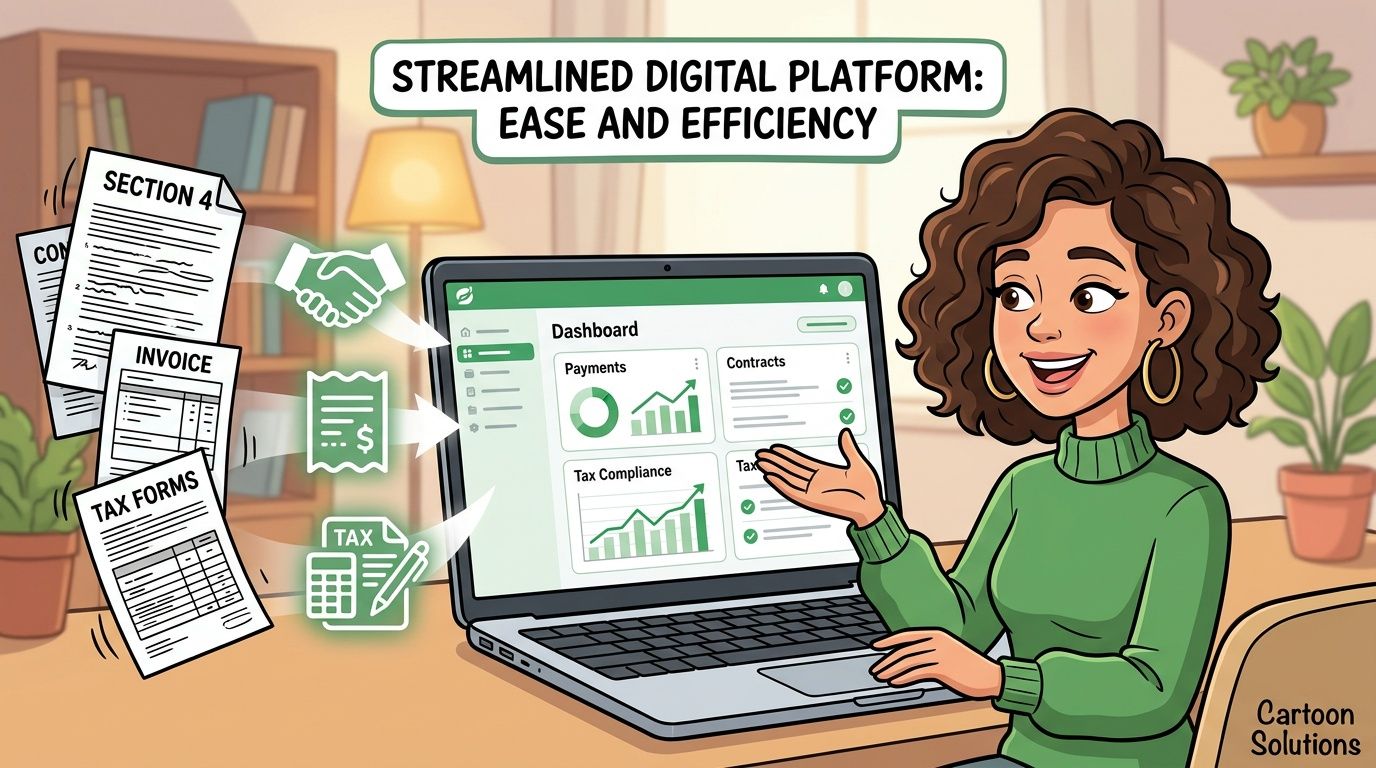
A platform like REACH’s influencer payment automation tool is designed for the part of influencer marketing that happens after discovery. That includes campaign management, deliverable tracking, payment workflows, and tax compliance from one dashboard.
What centralized payment operations actually fix
Most payment problems are coordination problems. The social team knows the content is approved. Finance doesn’t. The creator has submitted the invoice. The account manager can’t find it. The contract says one thing, the email thread says another.
A centralized system fixes that by tying these records together:
- Campaign terms: The approved scope, timeline, and deliverables
- Content status: What’s in draft, approved, posted, or overdue
- Payment triggers: What releases payment and when
- Compliance records: Tax forms and payment history in one place
That matters most for agencies and lean in-house teams. If one person is managing outreach, approvals, and creator follow-up, fragmented systems create avoidable delay.
Why creators care too
Brands often focus on internal efficiency, but creators feel the difference fast.
When payment status is visible, expectations are clearer. When the deal terms live in one system, there’s less back-and-forth over what was promised. When payouts are tied to verified deliverables, it reduces arguments and protects the relationship.
Faster payment isn’t just an accounting win. It changes whether strong creators want to work with your team again.
A better operating model
The practical model looks like this: campaign terms are set once, deliverables are tracked against the brief, invoices are matched to completion, and compliance documents are stored where finance can use them.
That doesn’t remove all judgment calls. You still need to choose creators, set the brief, and negotiate fair rates. But it removes the repetitive admin work that usually causes friction.
For new brand managers, that’s the effective answer to how do influencers get paid in a professional setup. Not by chasing people in email. By running payments through a system that treats compensation as part of campaign execution.
Turning Payment Chaos into Campaign Confidence
Influencer payments look simple from the outside. In practice, they sit at the intersection of creative work, procurement, finance, and compliance.
That’s why the question how do influencers get paid has more than one answer. Some creators earn through brand sponsorships, affiliate links, platform payouts, or direct sales. But for brands, the critical work usually lives inside sponsored campaigns, where rates, contracts, deliverables, invoices, and tax documents all have to line up.
The teams that run this well don’t rely on memory or scattered messages. They define payment terms early, connect payouts to clear milestones, and keep records tight enough that finance and marketing are working from the same information.
If your current process depends on spreadsheets, inbox searches, and manual follow-up, it’s worth reworking the system before you scale creator spend. Clean payment operations don’t just reduce admin. They make campaigns easier to launch, easier to close, and easier to repeat with good creators.
Frequently Asked Questions About Influencer Payments
How do payment rates for Instagram Reels compare to Stories or static posts
Verified market data shows that Instagram Reels average $3,618, compared with $1,333 for Stories and $1,013 for posts. That means Reels command a premium because they usually require more production work and often carry stronger brand value in campaign packages.
Do influencers have to pay taxes on gifted products
Tax treatment can depend on the situation, the value provided, and local rules. Brands shouldn’t guess. Creators shouldn’t assume a gifted item is automatically irrelevant for tax purposes. The practical move is to document what was provided and have a tax professional confirm the treatment for that creator’s situation.
What is the best way to handle payments for international influencers
Use a standardized process with clear contracts, approved payment methods, and one system for tracking deliverables and payout status. International campaigns create more room for delays because of currency, banking, and tax differences. The more manual the workflow, the more likely you are to run into disputes or processing issues.
As a small business, can I afford to work with influencers
Usually, yes, if you match the scope to your budget. Verified benchmarks show that smaller creators often work at much lower rates than larger names, which makes focused creator programs possible for smaller brands. The key is to keep deliverables narrow, choose creators whose audience matches the product, and avoid overcomplicating the admin side.
If you want a cleaner way to manage creator payouts, contracts, and compliance without juggling spreadsheets and scattered messages, take a look at REACH. It’s built for the operational side of influencer campaigns, where payment accuracy and timing matter just as much as the content itself.