 Skip to content


At its heart, an effective influencer marketing campaign is a genuine partnership. It’s about a brand and a creator coming together to share a product or service with an audience that truly cares. The goal is to sidestep the noise of traditional ads by using a voice people already trust to build awareness, drive sales, and create content that feels real.
Building Your Campaign's Strategic Foundation

Before you even start scrolling through influencer profiles, you need a solid plan. I've seen too many brands jump the gun, and the result is always the same: wasted time and money. A successful campaign isn’t an accident; it's built on a foundation of crystal-clear goals and a deep understanding of who you're trying to talk to.
Diving into influencer discovery without this blueprint is like setting sail without a map. Sure, you're moving, but you have no idea if you're getting any closer to your destination. This initial planning phase is where you separate wishful thinking from measurable business outcomes. Vague goals like "get more followers" just don't cut it. You need to know exactly what success looks like for this specific campaign.
Defining Clear Campaign Objectives
First things first: what are you actually trying to accomplish? Your goals will shape every single decision you make from here on out, from the type of creators you partner with to the content they produce. Think less about vanity metrics and more about tangible results that impact your bottom line.
Here are a few common, high-impact objectives I often see brands focus on:
- Driving Direct Sales: This is a classic for a reason. The aim is immediate revenue, plain and simple. We track this with unique discount codes, custom affiliate links, and UTM parameters that show us exactly which influencer drove which sale. For instance, a skincare brand might give an influencer a unique 15% off code, like "SARAH15," to see the direct impact.
- Boosting Brand Awareness: This is your go-to for a new product launch or if you're breaking into a new market. The mission is to get your brand name in front of the right eyeballs. Here, you'll be watching KPIs like reach, impressions, and video views.
- Generating User-Generated Content (UGC): Working with creators is a fantastic way to get a library of authentic, high-quality content that you can reuse on your own social channels, ads, or website. This saves a ton on production costs. Success here is measured by the sheer volume and quality of the content you get back.
A campaign without clear KPIs is just a collection of sponsored posts. Defining your metrics from the start is the only way to prove value and justify your investment.
Developing Your Target Audience Persona
Once you know what you want, you need to lock down who you're talking to. Remember, an influencer is just a bridge to their audience. If their audience isn't a match for your brand, the whole campaign will fall flat.
Creating a detailed audience persona is absolutely critical. Don't stop at broad demographics like "women aged 25-40." You have to dig deeper to paint a picture of your ideal customer.
Get specific with these elements:
- Demographics: Age, gender, location, income, education.
- Psychographics: What do they value? What are their interests, pain points, and goals? What does their lifestyle look like?
- Online Behavior: Where do they hang out online? What kind of content do they love? Who do they already follow and trust?
Let's say you're a sustainable fashion brand. Your target might be an "Eco-Conscious Millennial." This person isn't just defined by their age; they're driven by values like environmentalism and ethical sourcing. They follow creators who champion those same ideals, which makes your search for the right partner much more focused and effective. Nailing this foundation ensures every dollar you spend and every partnership you forge has a clear purpose.
Finding Authentic Influencers Who Fit Your Brand
With your campaign strategy locked in, it's time for the fun part: finding the right people to partner with. This is where the magic really happens, because the creators you choose become the face and voice of your brand. The goal isn't just to find an account with a big follower count; it's about discovering a genuine advocate whose style, values, and audience are a perfect match for yours.
I’ve seen it time and time again: campaigns fall flat when brands chase vanity metrics. A million followers means nothing if that audience isn't engaged or doesn't remotely resemble your ideal customer. Authenticity is everything here. Audiences have a sixth sense for a forced partnership, and they’ll see right through it.
Choosing the Right Influencer Tier
One of the first big calls you'll make is what tier of influencer makes the most sense for your goals and budget. There's no single "best" choice—it all comes down to what you’re trying to achieve. Each level brings something different to the table.
To help you decide, this table breaks down the key differences between the influencer tiers.
Choosing the Right Influencer Tier for Your Campaign
| Influencer Tier | Follower Count | Best For | Typical Engagement Rate | Cost Level |
|---|---|---|---|---|
| Nano | 1k – 10k | Hyper-targeted niche campaigns, building deep trust | Highest (often 5%+) | $ |
| Micro | 10k – 100k | Driving high-quality engagement and conversions | High (2-5%) | $$ |
| Macro | 100k – 1M | Mass brand awareness and top-of-funnel reach | Moderate (1-2%) | $$$ |
| Mega | >1M | Celebrity-level endorsement, maximum exposure | Lowest (<1%) | $$$$ |
As you can see, there’s often a trade-off between massive reach and authentic engagement. While Mega-influencers offer unparalleled exposure, Nano and Micro-influencers tend to have much more personal and trusted relationships with their followers, which often translates to better results for direct-response goals.
For many brands, Micro-influencers hit that perfect sweet spot. They deliver a great balance of reach and real connection. If you're leaning that way, our guide on working with a micro-influencer can provide deeper insights into getting the most out of those partnerships.
The image below gives you a great visual of how engagement rates tend to drop as follower counts go up.
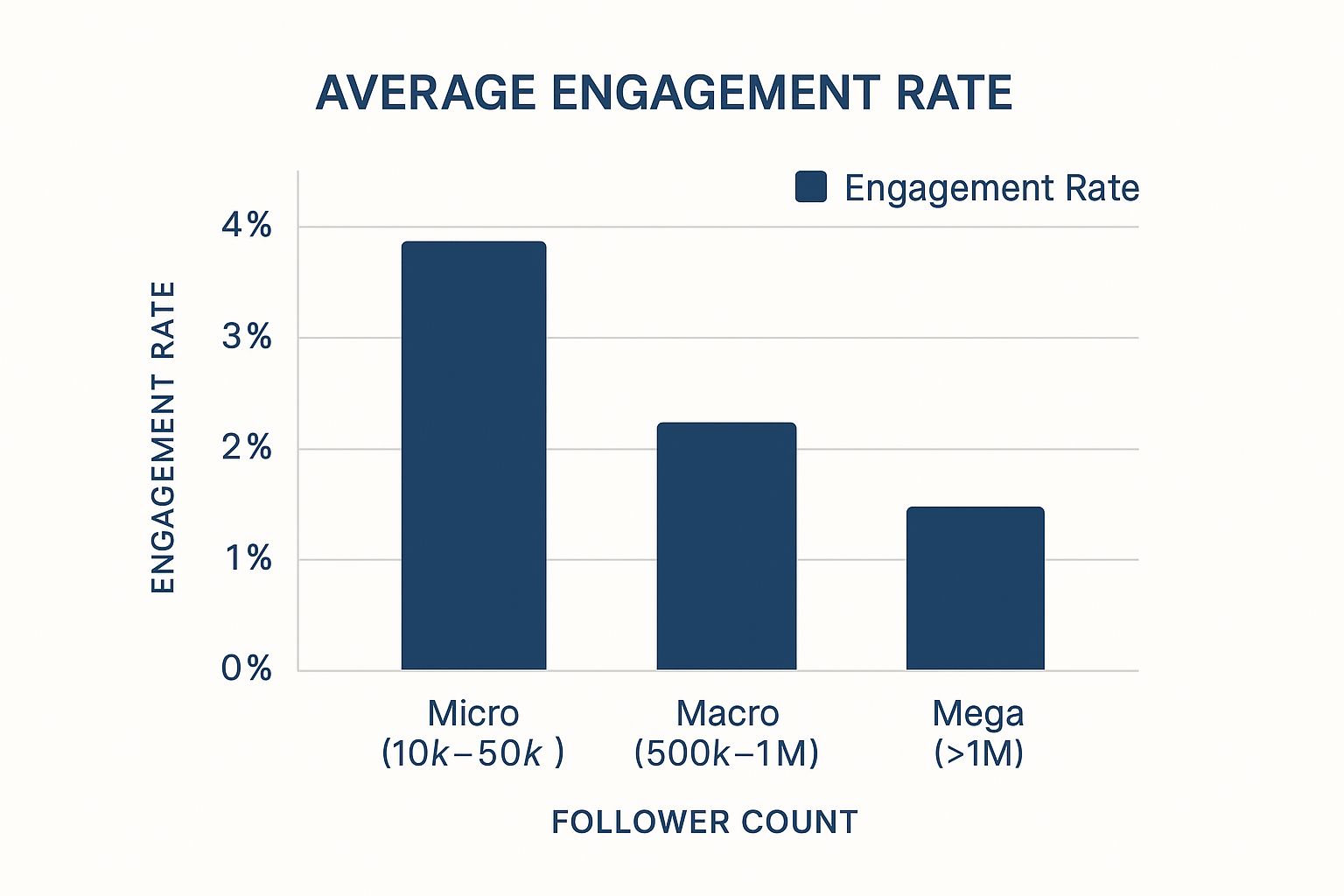
This trend is exactly why micro-influencers are often such a powerful and efficient choice for building genuine connections with an audience.
Uncovering and Vetting Potential Partners
Okay, you know the tier you're after. Now, where do you actually find these people? I recommend a mix of tactics. Influencer discovery platforms like our own, REACH, are a fantastic starting point, letting you filter creators by their niche, audience demographics, and performance stats.
But don't stop there. Get your hands dirty with some manual research. Spend some time searching relevant hashtags on Instagram and TikTok. See who’s really driving the conversation in your space. Another great tip? Check out who your competitors are working with. This can quickly show you who’s already resonating with your target market.
Finding potential partners is one thing. Properly vetting them is what separates a good campaign from a great one. This is where you need to put on your detective hat.
When you're looking at a creator’s profile, go way beyond the follower number. What’s their actual engagement rate? Do the math—divide their average likes and comments by their follower count. Then, dig into the comments themselves. Are people having real conversations, or is it just a sea of "great post!" and fire emojis? You're looking for signs of a real community.
This detailed review process is what ensures you're putting your money into a partnership that feels real and will actually move the needle. With the global market for influencer marketing projected to hit a staggering $32.55 billion by 2025, making smart, data-driven decisions has never been more important. It's also why 47% of brands are now focusing on building long-term relationships with creators instead of one-off posts—it's just a better way to build lasting trust with an audience.
Crafting Your Outreach and Campaign Brief

You've got your vetted list of ideal partners. Now comes the part that separates the pros from the amateurs: making a memorable first impression. An influencer's inbox is a crowded, competitive space, and a generic, copy-paste email is a one-way ticket to the trash folder.
The mission here is to craft a personalized message that proves you’ve actually done your homework. It needs to show you genuinely value their creative work. Start by mentioning something specific you admire about their content—a recent video that made you laugh, a unique post that caught your eye, or their overall aesthetic. This simple act signals that you see them as a creative partner, not just another name on a spreadsheet.
The Art of the Personalized Pitch
Your first message should be concise and respectful of their time, but also clear about the opportunity on the table. Ditch the vague corporate language and get straight to the point while keeping a friendly, human tone. Think of it less like a formal business proposal and more like an invitation to create something cool together.
Your email should briefly hit these key points:
- Who you are: A single sentence introducing your brand and what you do.
- Why them: Reference the specific content you loved and explain why you feel they're a perfect match for your brand’s personality.
- The big idea: Give them a quick teaser of the campaign concept. For example, "We're launching a new line of sustainable activewear and would love to partner with you to create content around an at-home yoga routine."
The best outreach emails feel like they could only have been written for one person. Personalization isn't just a tactic; it's a sign of respect for the creator's work and time.
Building a Clear and Compelling Campaign Brief
Once you've made contact and they've expressed interest, it's time to send over the campaign brief. This document is the single source of truth for your entire collaboration. A great brief provides clear direction while leaving plenty of room for the creator's unique style to shine through. Trust me, micromanaging their creativity is the fastest way to get content that feels stiff and inauthentic.
The brief is absolutely essential for aligning expectations and ensuring a smooth workflow. It should be comprehensive but also easy to scan.
Key Components of an Effective Brief
A well-crafted brief prevents misunderstandings and sets your influencer marketing campaign up for success from day one. It’s the roadmap for both you and the creator.
Here’s what I always include:
- Campaign Goals & KPIs: What's the point of all this? Remind them of the objective. Is it to drive sales with a promo code? Boost brand awareness? Get email sign-ups?
- Key Messages: Keep it simple. Outline the one or two core messages you want their audience to walk away with. Overloading them with talking points just muddies the water.
- Content Deliverables: Be crystal clear. For example: "One Instagram Reel (60-90 seconds) and three static Instagram Story frames with a swipe-up link."
- Content Do's and Don'ts: Think of these as guardrails, not a script. A "do" might be "Showcase the product in natural morning light." A "don't" could be "Please avoid mentioning any competitor brands."
- FTC Disclosure Requirements: This part is non-negotiable. Clearly state that all sponsored content must include proper disclosures like
#ador#sponsoredto comply with regulations. - Timelines: Lay out the key dates. Include deadlines for content drafts, any revisions, and the final go-live date.
As you build out the brief, it's always helpful to provide influencers with resources to get their own creative wheels turning, like a guide to top social media content ideas. This helps ensure the content they create is fresh and aligns with what's working right now. A clear, respectful, and thorough approach here is the final ingredient for a powerful partnership.
Managing a Seamless Campaign Execution
Alright, the contracts are signed and the brief is locked in. Now comes the fun part: bringing your influencer marketing campaign to life. This is where your strategy moves from paper to the real world, and a well-oiled operational machine is what separates a good campaign from a great one.
The goal here is a frictionless workflow. You want to manage all the moving parts—content creation, approvals, scheduling—without stepping on your influencer's creative toes. A clunky, slow process is the fastest way to kill momentum and frustrate the very partners you’ve hired for their magic. Efficiency is the name of the game.
Establishing a Smooth Content Approval Workflow
Navigating the content review process can be tricky. You have to walk a fine line between protecting your brand and not stifling the influencer’s unique voice. When you get too prescriptive with feedback, you risk getting content that feels like a generic ad—precisely what you’re trying to avoid.
I've found the best approach is to set up a central hub for all draft submissions. A platform like REACH is perfect for this, letting creators upload their work directly so your team can review, comment, and approve in one place. It completely eliminates those messy, confusing email chains.
Here’s a simple process that works wonders:
- Set a Clear Review Timeline: Promise influencers feedback within 24-48 hours. This shows you respect their time and keeps everything on track.
- Consolidate All Feedback: Designate one person on your team to collect all internal notes. They should deliver the feedback in a single, clear message.
- Explain the "Why": Instead of just saying, "change this," give them the context. For example, "Could we tweak the caption to better highlight the product's sustainable materials? That's a core message for our audience."
The best approval process acts as a safety net, not a cage. You hired the creator for a reason, so trust them. Offer guidance on the essentials, but give them the creative freedom to connect with their audience authentically.
Coordinating Your Posting Schedule
When you're juggling multiple influencers, timing is everything. A coordinated launch can create a massive wave of social proof, while staggering posts can help maintain momentum over a longer period.
Your strategy here really depends on your campaign goals.
- For a Product Launch: A synchronized push, where several influencers post on the same day, can generate a huge spike in awareness and drive immediate traffic.
- For an Evergreen Campaign: Spreading content out over a few weeks keeps your brand top-of-mind and lets you test which days and times deliver the best results.
Always use a shared calendar or a campaign management tool to map out every single post date. This gives you a bird's-eye view of the entire schedule and prevents any awkward overlaps. This level of organization is crucial, especially as the creator economy—currently estimated at $250 billion and projected to nearly double by 2027—becomes a more significant part of modern advertising.
Amplifying Content After It Goes Live
The job isn't done when the influencer hits "post." In fact, this is your chance to really amplify the content's reach and prove this is a genuine partnership. When your brand actively engages, it shows you're invested beyond just the transaction.
Your post-launch checklist should look something like this:
- Engage Immediately: The moment a post goes live, have your social team jump in to like it and leave a thoughtful, genuine comment from your brand's account.
- Respond to Comments: Keep an eye on the comment section and answer questions about your product. This takes the pressure off the influencer and shows you’re an active participant in the conversation.
- Share and Repurpose: With permission, share the influencer’s post to your own brand’s Stories, Reels, or feed. This cross-promotion is a win-win for both of you.
If you want some practical ideas on streamlining these tasks, check out these workflow automation examples for marketing. By getting involved, you squeeze every last drop of value out of each post and build a much stronger relationship with both the creator and their community.
Measuring Success and Proving Campaign ROI
Once your influencer's content goes live, the real work begins. This is where you shift from planning and execution to analyzing the cold, hard data. Proving the value of your campaign isn’t just about showing off a few pretty posts; it's about tying every single piece of content back to the business goals you set from day one.
Without solid tracking, you're essentially flying blind. You won't know what worked, what flopped, or where your budget made the biggest difference. Good measurement turns a one-off campaign into a repeatable, scalable part of your marketing machine.
Tracking the Metrics That Truly Matter
Likes and follower counts are nice, but they don't keep the lights on. To really understand performance, you need to focus on the Key Performance Indicators (KPIs) you defined back in the strategy phase. It's time to see if you hit your targets.
Fortunately, you don't need a data science degree to do this. There are a few straightforward tools that I see brands use effectively every day:
- UTM Parameters: These are your best friend for tracking web traffic. By adding a small bit of code to the end of a URL, you can see exactly who is sending you clicks and conversions right inside your analytics dashboard. Give each influencer their own unique UTM link, and the mystery is solved.
- Unique Discount Codes: This is the cleanest way to track sales-driven campaigns. A custom code like "SOPHIE20" directly links every single purchase to a specific creator. There’s no ambiguity here—it’s a direct line from their content to your revenue.
- Native Platform Analytics: Don't sleep on the data available right inside Instagram, TikTok, and YouTube. These platforms offer a goldmine of information on reach (how many unique people saw the post), impressions (the total number of times it was seen), and engagement rates (the sum of likes, comments, shares, and saves).
The goal isn't just to gather data; it's to connect the dots. A high reach number is great, but a high reach number combined with a strong click-through rate to your landing page? That's what shows genuine audience interest and intent.
Calculating Your Campaign's Return on Investment
At the end of the day, your boss or client wants to know one thing: for every dollar we spent, what did we get back? Answering that question with confidence comes down to calculating your Return on Investment (ROI).
First, add up all your costs—influencer fees, the cost of gifted products, shipping, and any platform fees. Next, tally up the total value generated, which for most e-commerce brands is the revenue from sales tied to your tracking links and discount codes.
The basic formula is pretty simple:
(Revenue Generated – Total Campaign Cost) / Total Campaign Cost x 100 = ROI %
Let's say you spent $5,000 on a campaign that brought in $15,000 in sales. Your ROI would be a very healthy 200%. This single number is incredibly powerful for proving the financial impact of your work. For a deeper dive into these calculations, check out our full guide on how to measure influencer marketing ROI.
You can also find more advanced strategies for maximizing your influencer marketing ROI that go beyond the basics.
Looking Beyond the Numbers to Qualitative Wins
A killer ROI is fantastic, but not every win fits neatly into a spreadsheet. You also need to look at the qualitative results—the less tangible benefits that build serious long-term value for your brand.
I always encourage clients to pay attention to these areas:
- Audience Sentiment: Read the comments. Were people genuinely excited? Were they tagging friends? Positive sentiment is a powerful signal of brand health and can predict future purchases.
- Content Quality: A great campaign leaves you with a treasure trove of authentic, high-quality user-generated content (UGC). You can repurpose these photos and videos for your own social media, email campaigns, and even paid ads, saving you a fortune on content production.
This balanced approach—combining hard data with qualitative insights—is how modern brands win. In fact, around 80% of brands are now either maintaining or boosting their influencer marketing budgets, shifting their focus from vanity metrics to ROI-driven strategies. This move is getting easier, too, with the average cost per thousand impressions (CPM) dropping by 53% year-over-year.
By presenting both the numbers and the story behind them, you can build a complete, compelling case for the total impact of your campaign.
Answering Your Biggest Influencer Marketing Questions
Even with the best-laid plans, you're going to have questions as you dive into your first big influencer campaign. This space is constantly shifting, and new challenges are part of the game. Let's walk through some of the most common questions I hear from marketers, so you can move forward without hesitation.
Think of this as a way to get ahead of the curve. Getting these answers locked in now will save you a ton of guesswork down the road.
How Much Should I Budget for an Influencer Campaign?
There’s no one-size-fits-all answer here. I’ve seen budgets range from a few gifted products to massive six-figure partnerships. The right number for you comes down to your goals, your industry, and the kind of influencers you’re looking to work with.
For example, a campaign with a few nano-influencers might only cost a few hundred dollars plus the cost of your product. On the other hand, bringing a single macro-influencer with a huge, dedicated following on board can easily run into the tens of thousands for one post.
To figure out your number, think through these points:
- Start with your objective. Are you chasing broad brand awareness or laser-focused sales? Big awareness plays with larger creators will naturally cost more than smaller, conversion-driven campaigns.
- Do your homework on rates. Get a feel for what creators in your niche and at your desired tier are actually charging. This gives you a realistic starting point for negotiations.
- Think beyond the fee. Your budget isn't just for the influencer. You have to account for the cost of the product you’re sending, shipping, and any fees for the platform or agency you might be using.
As a general rule, I’m seeing more and more successful brands allocate a solid 10-20% of their total marketing spend to creator partnerships. It’s a clear signal that this channel is no longer an experiment but a core part of the marketing mix.
What Are the Most Common Mistakes to Avoid?
The biggest mistakes I see happen long before any content ever goes live. They’re almost always rooted in rushed planning and a lack of proper vetting. One of the classic blunders is picking influencers based on follower count alone, completely ignoring the data that actually matters—like their audience demographics and true engagement quality.
Another one is strangling creativity with an overly restrictive brief. When you script every word and dictate every camera angle, you strip away the authenticity that makes this kind of marketing work in the first place. What you get is a stiff, generic ad that audiences will scroll right past.
Not setting clear KPIs from the get-go is another huge one. If you don't know what success looks like, you have no way to measure your return on investment. This makes it impossible to prove the campaign's value or learn how to improve next time. Lastly, ignoring FTC disclosure guidelines (like using #ad or #sponsored) can land you in legal hot water and, just as critically, shatter the trust you’re working so hard to build.
For a deeper dive into getting these fundamentals right, our complete guide covers everything you need to know about influencer marketing from start to finish.
How Do I Handle Negative Feedback or a Campaign That Underperforms?
First off, don't panic. A few negative comments or missed targets aren’t a disaster; they're data points you can learn from. If you’re seeing negative feedback, the first step is to assess it. Is this a legitimate customer issue or just an internet troll stirring the pot? Engage professionally and try to be helpful when it's a real concern.
If the campaign metrics are falling short of your KPIs, it's time to put on your detective hat.
- Was the call-to-action buried or confusing?
- Did the content go live at a bad time for the audience?
- Did the message just not resonate the way you thought it would?
The key is not to guess. Open a direct line of communication with your influencer. They know their audience better than anyone and can often offer incredible insights into what might have gone wrong. When you treat them like a true partner in solving the problem, you build a much stronger relationship for future collaborations. In this game, being able to adapt is your best asset.
Ready to manage your next campaign with confidence? REACH is the all-in-one platform that simplifies influencer discovery, campaign management, and ROI tracking. Find your perfect partners and prove your results at https://reach-influencers.com.