 Skip to content

Influencer marketing is a bit of a buzzword, but for small businesses, it's a game-changer. At its core, it's about partnering with creators who have the trust of a specific audience to get your products in front of the right people.
Think of it this way: instead of a flashy, expensive ad, your brand shows up as a genuine recommendation from a voice people already follow and respect. It's a powerful way to build trust and drive sales without a massive ad spend.
Why Influencer Marketing Drives Small Business Growth
Let's bust a common myth right now: you don't need a million-dollar budget or a celebrity on speed dial to make influencer marketing work. In fact, for a small business, it's one of the best ways to connect with a super-targeted audience in a way that feels real.
This strategy neatly sidesteps the natural skepticism people have toward traditional advertising. When an influencer they genuinely like shares your product, that credibility rubs off on your brand. This is especially true for micro-influencers, who tend to have smaller, tight-knit communities that hang on their every word.
Build Authentic Connections and Trust
Unlike a polished corporate ad, content from a creator feels personal and down-to-earth. As a small business, you can tap into that authenticity to build real relationships with the people you want to reach. The trick is finding creators whose followers and values are a perfect match for what you're all about.
When you get it right, the benefits are huge:
- Sky-High Credibility: A nod from a trusted person is way more convincing than a brand shouting about itself. The data backs this up—a staggering 92% of consumers trust recommendations from individuals over brand ads.
- Laser-Focused Reach: Influencers build niche communities, whether it's local foodies, ethical fashion lovers, or DIY home renovators. This means you can get your message directly to your ideal customer without wasting a dime on people who aren't interested.
- Smart on the Wallet: Forget A-list celebrities. Partnering with nano and micro-influencers often delivers a much better return on investment. They typically have hyper-engaged audiences and their rates are far more small-business-friendly.
Here's the secret sauce: influencer marketing gives you authentic social proof, and it does it at scale. One glowing review from the right creator can build more trust than a thousand clicks on a paid ad ever could.
Simplify Your Strategy and Measure Results
I get it—the thought of finding influencers, managing campaigns, and tracking results sounds like a full-time job. But it doesn't have to be.
Today, there are tools designed to make this whole process accessible for everyone. An influencer marketing platform like REACH Influencers is a powerful tool specifically designed to help small businesses succeed. It serves as an all-in-one solution to discover creators who are a great fit, handle all the campaign logistics, and show you exactly what's working (and what's not).
It takes the guesswork out of the equation and gives you clear data to prove your investment is paying off. By streamlining the workflow, you can spend less time on spreadsheets and more time building great partnerships that grow your business.
Finding the Perfect Influencers for Your Brand
This is where the real work—and the real fun—of influencer marketing begins. It's not about chasing the biggest follower counts. It’s about finding creators whose audience genuinely trusts them and whose personal brand clicks with what your business is all about. This is probably the most important part of any influencer marketing for small business plan.
The best part? You don't need a massive budget to get started. Some of the most authentic and effective partners can be found with a bit of old-fashioned, hands-on research. Doing it yourself gives you an incredible feel for the communities you're trying to connect with.
Manual Discovery on Social Platforms
Start where your customers are. Dive into platforms like Instagram and TikTok and put on your customer hat. What hashtags are they searching for or following?
Let’s say you run a local coffee shop in Atlanta. You’d probably start by searching for things like #atlantafoodie or #coffeeshopvibes. This will instantly show you local food bloggers and creators who are already making content your ideal customers love.
Another great trick is to do a little competitor recon. See which influencers your competitors are working with. Who’s tagging them in posts? Who do your most loyal followers also follow? You'll often uncover a whole network of creators who are already trusted voices in your niche.
The goal isn't just finding someone with nice photos. You’re hunting for proof of a real, thriving community. Spend time in the comments. Are people having actual conversations, or is it just a wall of fire emojis and one-word replies? That authentic chatter is pure gold.
Speeding Up Your Search with a Platform
Manual searching is great, but it definitely takes time. When you’re ready to grow your program or you need to get way more specific with your targeting, an influencer marketing platform can be a game-changer. Think of these tools as super-powered search engines for creators.
A platform like REACH Influencers, for instance, is an influencer marketing platform that can help small businesses by taking hours of scrolling and turning it into a few minutes of filtering. It lets a small business get incredibly precise.
- Filter by Niche: You can instantly pull up lists of creators who focus on sustainable fashion, vegan cooking, or local travel.
- Analyze Engagement Rate: This is huge. You can look past vanity metrics and see how much an influencer's audience actually interacts with their content. A healthy engagement rate is anything over 2-3%.
- Target Audience Demographics: Make sure their followers are your people. You can check for location, age, interests, and more to ensure a perfect match.
Using a platform takes the guesswork out of the equation. It arms you with the data you need to check out potential partners and make smart decisions. This way, you’re investing your time and money into collaborations that are built to succeed from day one.
For a more detailed look, you can learn more about how to find influencers for your brand in our detailed guide. For example, a sustainable jewelry brand could use a platform to quickly find eco-conscious creators whose followers are already passionate about their mission and products.
Designing Your First Influencer Marketing Campaign
Alright, you've scouted some potential influencers who seem like a great fit. Now for the fun part: turning that potential into a real campaign that drives results. This is where you move from brainstorming to building a concrete plan that gets everyone on the same page.
Think of it as your campaign blueprint. Without one, you're just hoping for the best. With a solid plan, you're steering the ship.
The very first thing you need to do is get specific about your goals. "More exposure" is a wish, not a goal. We need something you can actually measure. A great way to do this is by using the SMART framework (Specific, Measurable, Achievable, Relevant, and Time-bound).
Are you trying to boost website traffic by 20% this quarter? Or maybe your goal is to get 50 solid leads from an influencer's special discount code. Those are real, trackable targets.
Choosing the Right Campaign Model
Influencer collaborations aren't a one-size-fits-all deal. The type of campaign you run needs to line up perfectly with your goals and, crucially, your budget. A new local boutique, for instance, might start with gifted collaborations to create some initial buzz without a huge cash outlay.
Let's look at the most common models:
- Gifted Collaborations: You send free products to an influencer, and they post about it. This is a fantastic, budget-friendly option, especially with nano-influencers, for gathering authentic content and reviews.
- Affiliate Partnerships: Influencers get a cut of the sales they generate through a unique link or code. It’s a win-win. This performance-based model is low-risk for you and highly motivating for creators who know they can convert their followers.
- Paid Posts: This is a straightforward transaction—a flat fee for specific content, like a certain number of Instagram Reels or a full YouTube video. You get more control over the deliverables, making it perfect for big product launches or targeted promotions.
The influencer marketing world is booming. Projections show the global market will soar to $32.55 billion by 2025. With more than 50 million influencers out there, many focusing on super-specific niches, small businesses have an incredible variety of partners to choose from. This is exactly why 63% of brands are beefing up their influencer budgets; they see the power of community-driven marketing.
The infographic below lays out the two primary ways to find these partners: doing the legwork yourself or using a platform to speed things up.
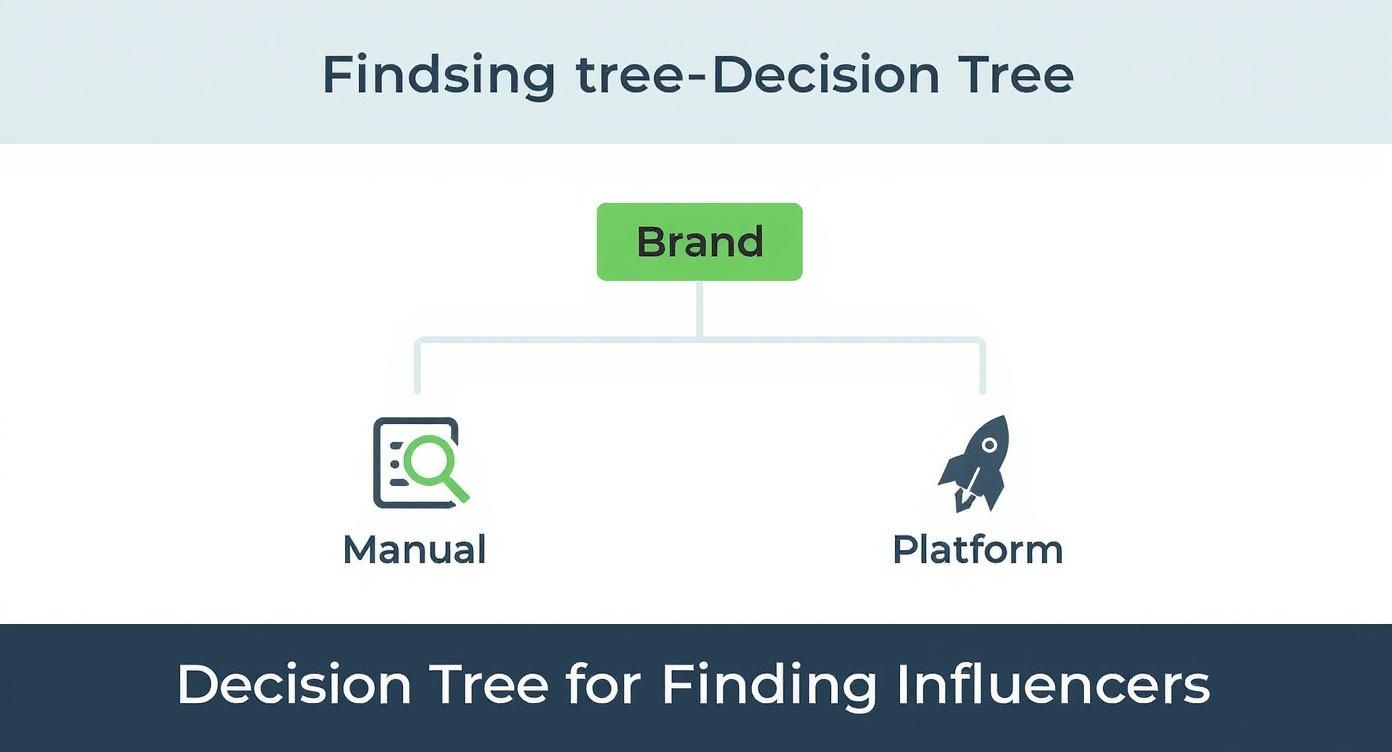
As the visual shows, while manual searching is always an option, platforms like REACH Influencers can really streamline the discovery process. It’s a much more efficient way to go if you’re looking to build and scale your efforts over time.
To help you decide which campaign type makes the most sense for your business, here’s a quick comparison of the most common approaches.
Campaign Type Comparison for Small Businesses
| Campaign Type | Budget Level | Best For (Goal) | Pros | Cons |
|---|---|---|---|---|
| Gifted Collaborations | Low (Free Product) | Brand Awareness, Content Generation | Cost-effective, builds authentic relationships, great for new products. | Less control over content, no guarantee of posts, best for smaller creators. |
| Affiliate Partnerships | Low (Commission-based) | Driving Sales, Lead Generation | Low financial risk (pay for performance), highly scalable, motivates creators. | Harder to track attribution, requires compelling offer, may not work for all niches. |
| Paid Posts | Medium to High | Product Launches, High Visibility | Full creative control, guaranteed exposure, access to larger audiences. | Can be expensive, may feel less authentic if not done well, requires negotiation. |
Each model has its place. Your job is to match the right one to your immediate business goals and the resources you have available right now.
Crafting a Compelling Campaign Brief
Your campaign brief is easily the most critical document you'll create. It’s not a script telling an influencer exactly what to say—that would kill any authenticity. Instead, it’s a guide that lays out the mission, the key messages, and the expectations, all while giving the creator the freedom to be themselves.
A good brief prevents headaches and ensures the final content actually reflects your brand.
Your brief should empower, not restrict. Give influencers the key messages and guardrails, but trust them to speak to their audience in a way that feels natural. The best content comes from genuine enthusiasm, not a rigid script.
To keep everything running smoothly—from scheduling content to tracking how it performs—it’s worth exploring different social media marketing tools that can help you manage the moving parts.
Finally, your brief must include a clear section on FTC disclosure rules. Make it crystal clear that hashtags like #ad or #sponsored are mandatory. This isn’t just about following the rules; it protects your business, the creator, and keeps things transparent with the audience.
Budgeting and Negotiating Influencer Partnerships
Alright, let's get into the two topics that often trip up small businesses when they first dive into this world: money and contracts. It can feel a bit intimidating, but it doesn't have to be.
The first move is always to nail down a realistic budget. And I don’t just mean the influencer’s fee. You’ve got to think bigger picture to understand your total investment.
Don’t forget to factor in the cost of your products, shipping expenses, and any pesky payment processing fees. Getting this all down on paper from the start saves you from nasty surprises later on.
What Do Influencers Actually Cost?
There's no one-size-fits-all price tag here. Influencer rates are all over the map, and they're usually tied to a few key things:
- Engagement Rate: A creator with a super-active audience is worth more. Their followers actually listen and take action, and that's a valuable commodity.
- Scope of Work: The more you ask for, the more it will cost. A single Instagram Story is a world away from a dedicated YouTube video review paired with three TikToks.
- Industry Niche: Some fields are just pricier. An influencer in a specialized niche like fintech or advanced biotech skincare can command higher rates because of their focused expertise.
Now, if you're a small business, you're probably not looking to spend thousands on a single post. And that’s the good news—you don’t have to. Nano-influencers (those with 1k-10k followers) often have rates anywhere from $25 to $200 per post. Many are even open to collaborating in exchange for free products, especially if they genuinely love what you do.
This is where the art of negotiation comes in. Think of it less like a battle and more like a conversation. You're trying to find that sweet spot where both of you feel like you're getting a great deal.
Negotiation isn't about lowballing someone. It's about building a partnership that feels like a win for everyone involved. Sometimes, offering value beyond just cash—like amazing products, a unique experience, or the potential for a long-term relationship—can make your small business an incredibly attractive partner.
If you want to really sharpen your skills here, our guide on how to negotiate with influencers is a must-read.
Platforms like REACH Influencers can also take a lot of the headache out of this part. They give you a central place to manage contracts and payments, which adds a layer of security and clarity for you and the creator. It frees you up to focus on the fun stuff: building a great relationship.
And my final piece of advice: always, always get it in writing. A simple contract is non-negotiable. It doesn’t need to be 30 pages of legalese, but it absolutely must spell out the deliverables, timelines, payment details, and how you can use their content. This simple step protects you, protects the creator, and sets the partnership up for success.
How to Actually Measure Your Campaign's ROI

Alright, your campaign is live and the content is out there. Now comes the big question: Was it worth it? For a small business, proving that your investment in an influencer paid off is crucial. This isn't about getting a warm fuzzy feeling from a few nice posts; it's about seeing tangible results that tie directly back to your business goals.
Let's be honest, getting lost in vanity metrics like likes and follows is easy. But they don't pay the bills. The real story is in the data that shows how the campaign actually changed customer behavior.
Beyond Likes: Tracking What Really Matters
The cleanest way to see direct impact is by tracking conversions. This is where you get to connect the influencer's post directly to a sale. Your two best friends for this are unique discount codes and UTM parameters.
-
Unique Discount Codes: Give each influencer their own specific code, something simple like "SARAH15" or "MIKE20". It's a dead-simple way to see exactly how many sales each person drove. No guesswork involved.
-
UTM Codes: These are just little snippets of code you add to the end of a URL. They let you track where your website visitors are coming from inside Google Analytics. You can see precisely how many people clicked an influencer’s link and, more importantly, what they did once they got to your site.
These tools give you cold, hard numbers. With that data, calculating your return on investment is easy. Just use the classic formula: (Revenue from Campaign – Total Campaign Cost) / Total Campaign Cost. If you want a deeper look at how this fits into your larger marketing picture, there are some great resources on measuring marketing campaign effectiveness.
What About Brand Awareness and Engagement?
Of course, not every campaign is about driving immediate sales. Sometimes, the goal is simply to get your name out there and build some buzz.
To measure that, you'll want to keep an eye on a few different KPIs. Look at reach (the number of unique people who saw the content) and impressions (the total number of times the content was viewed). You can also use social listening tools to track brand mentions and see if the conversation around your business is growing.
Here's why small businesses are leaning in: 84% of brands consider influencer marketing effective. On Instagram, campaigns pull in an average return of $4.12 for every $1 spent. And it's only getting smarter—63% of marketers plan to use AI to find the right influencers and measure results.
This is where having a dedicated platform can save you a ton of headaches. Instead of trying to wrangle a dozen spreadsheets, a tool like REACH Influencers gives you a central dashboard. It automatically tracks the clicks, conversions, and engagement metrics for you, all in one place.
You get clear, real-time reports that show you what’s working. This not only proves your campaign’s success but also gives you the insights you need to make your next one even better. For a full breakdown, check out our guide on https://reach-influencers.com/measuring-influencer-marketing-roi/.
Got Questions About Influencer Marketing? We've Got Answers.
Jumping into influencer marketing for the first time can feel a little daunting. As a small business owner, you've probably got a dozen questions swirling around. That’s perfectly normal. Getting straight answers is the best way to build a strategy you can feel good about.
Let's cut through the noise and tackle the most common questions head-on.
How Much Does Influencer Marketing Actually Cost a Small Business?
This is usually the first thing everyone asks, and the answer is surprisingly flexible. Forget the idea that you need a massive budget. The great thing about influencer marketing is that it scales to fit what you can afford.
For businesses just starting out, many successful campaigns don't involve cash at all. You can often partner with nano-influencers (those with 1k-10k followers) by simply gifting them your product in exchange for a post. If you do want to run a paid collaboration, rates for these smaller creators can be anywhere from $25 to $200 per post. You can absolutely get a positive return by starting with a few hundred dollars or by focusing on product-only partnerships.
How Do I Find Influencers in My Niche?
Finding the right people can feel like a huge challenge, but you just have to know where to look. The best place to start is right on the social media platforms where your customers hang out.
Put yourself in your customer's shoes. Start searching for hashtags they would follow on Instagram or TikTok. For example, a local coffee shop might search #austincoffee or a sustainable clothing brand might look into #slowfashion. You can also peek at who your competitors are working with and, even better, see which creators your ideal customers are already following. This hands-on approach gives you a genuine feel for the community.
Searching manually is a great starting point, but it takes time. When you're ready to get more strategic and save hours of scrolling, a dedicated platform is a game-changer.
An influencer marketing platform like REACH Influencers can help small businesses by streamlining this entire discovery process. They let you get incredibly specific and take the guesswork out of finding partners. You can:
- Filter creators by niche, location, audience age, and more.
- See key stats like engagement rates before you reach out.
- Uncover creators you might have missed who align perfectly with your brand.
It's all about working smarter, not harder, to find people whose followers are genuinely interested in what you have to sell.
What's More Important: A High Follower Count or a Good Engagement Rate?
For a small business, this isn't even a contest: engagement rate wins, every single time. A huge follower count looks nice on the surface, but it's often just a "vanity metric." It doesn't tell you if anyone is actually listening.
A strong engagement rate (look for anything over 2%) is proof that the influencer has an active, loyal community that trusts their recommendations. Think about it: a creator with 5,000 super-engaged followers in your niche will drive more sales and be way more affordable than a creator with 100,000 followers who passively scroll by. Always, always choose quality interaction over quantity of followers.
What About the Legal Stuff and Disclosures?
This part is incredibly important and not something you can afford to ignore. The Federal Trade Commission (FTC) has very clear rules: any post that's the result of a paid or gifted partnership must be clearly disclosed. Honesty is essential for building trust with your audience.
The influencer needs to make it obvious that the content is an ad. This means using simple, clear hashtags like #ad, #sponsored, or #BrandPartner where people can easily see them—not buried at the bottom of 20 other tags. As the brand, you are ultimately responsible for making sure your partners follow these rules. Be sure to include an FTC compliance clause in every contract you sign. It protects you, the creator, and your customers.
Ready to take the guesswork out of finding and managing influencers? REACH Influencers is the platform designed to help your small business build, manage, and measure successful campaigns with ease. Discover the right partners and prove your ROI today.