 Skip to content

In today's hyper-competitive market, simply collecting names and emails isn't enough. Prospects are more discerning, channels are more saturated, and the line between a high-quality lead and a dead end has never been finer. The old playbook of casting a wide net and hoping for the best is not just inefficient; it's a direct path to wasted resources and stagnant growth. True, sustainable expansion demands a strategic, multi-faceted approach that builds trust, delivers tangible value, and seamlessly guides potential customers from initial awareness to decisive action.
This guide is designed to replace that outdated playbook. We will cut through the noise and detail nine proven lead generation best practices that modern marketing teams are using right now. This isn't about generic advice; it's a deep dive into actionable strategies that will help you not just fill your pipeline, but fill it with prospects who are genuinely interested and ready to convert.
You will learn how to:
- Create compelling lead magnets that solve real problems.
- Leverage social media and SEO to attract high-intent traffic.
- Implement sophisticated systems for scoring and nurturing leads.
- Optimize every touchpoint, from landing pages to referral programs.
From deploying advanced content marketing to integrating powerful marketing automation, this article provides a comprehensive framework. Consider this your new manual for building a predictable, scalable, and highly effective growth engine for your business. Let's get started.
1. Mastering Content Marketing and High-Value Lead Magnets
Content marketing is the engine of modern inbound lead generation. It involves creating and distributing valuable, relevant content to attract a clearly defined audience and guide them toward a purchase. This isn't just about blogging; it's a strategic approach that positions your brand as a trusted authority by solving your audience's problems before they even consider buying.
The core of this strategy lies in creating high-value lead magnets. These are irresistible offers, such as comprehensive ebooks, exclusive webinars, or interactive templates, that prospects receive in exchange for their contact information. For instance, HubSpot generates millions of leads by offering free marketing tools and in-depth guides, while Salesforce’s Trailhead learning platform captures professional contacts by providing free, career-building training. The goal is to build a relationship based on value, not a sales pitch.
Why It Works for Lead Generation
This approach is one of the most effective lead generation best practices because it builds trust and pre-qualifies prospects. By providing genuine solutions, you attract an audience that is already interested in your area of expertise. As they consume your content, they become educated on the problem and your solution, making the eventual sales conversation smoother and more effective.
The following infographic highlights just how powerful and cost-effective this strategy is.
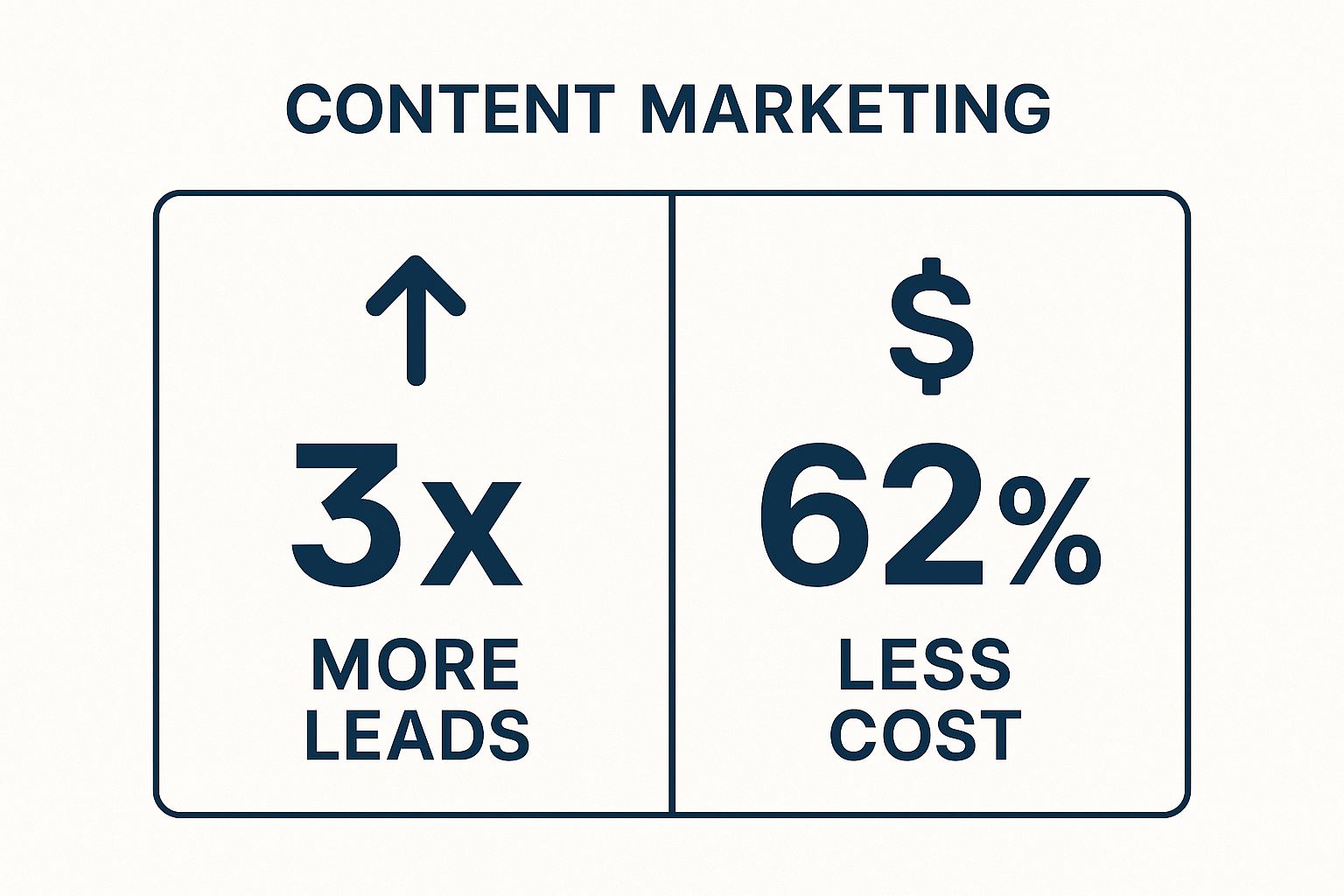
These statistics underscore a crucial point: content marketing not only triples your lead potential but also significantly reduces your customer acquisition cost, delivering a superior return on investment.
How to Implement This Strategy
To execute this effectively, you must understand your audience's pain points and create content that directly addresses them.
- Solve Specific Problems: Create lead magnets that offer a direct solution to a challenge your ideal customer faces, like a "Small Business SEO Checklist" or a "Social Media Content Calendar Template."
- Map Content to the Buyer's Journey: Develop different assets for each stage. An introductory ebook works well for the awareness stage, while a case study or a product webinar is better for those closer to a decision.
- Optimize for Conversion: Ensure your landing pages have compelling headlines, a clear value proposition, and are optimized for mobile. A/B test different offers and formats to maximize sign-ups.
By focusing on delivering unparalleled value upfront, you create a sustainable pipeline of educated, engaged leads. To dive deeper into execution, you can learn more about crafting a winning content marketing strategy.
2. Social Media Lead Generation
Social media lead generation transforms platforms like LinkedIn, Facebook, and Instagram from simple brand awareness tools into powerful engines for identifying and converting prospects. This approach involves leveraging both organic engagement and highly targeted paid advertising to capture leads directly within the social ecosystem. It's about meeting your audience where they spend their time and providing seamless opportunities for them to show interest.
The strategy hinges on using platform-specific features designed for conversion. For instance, LinkedIn's Sponsored Content and InMail campaigns are ideal for B2B lead generation, allowing businesses to reach specific job titles and industries. Similarly, Facebook Lead Ads enable real estate agents to capture contact details from interested homebuyers without ever making them leave the app, drastically reducing friction and increasing conversion rates.

Why It Works for Lead Generation
This method is one of the most effective lead generation best practices due to its unparalleled targeting capabilities and direct engagement. Social media platforms possess vast amounts of user data, allowing you to pinpoint your ideal customer based on demographics, interests, behaviors, and professional attributes. By presenting a relevant offer to a highly specific audience, you generate warmer, more qualified leads who are genuinely interested in what you provide.
How to Implement This Strategy
A successful social media lead generation strategy requires a platform-native approach and a commitment to authentic engagement. You cannot simply repurpose content from other channels; you must adapt to the unique culture of each platform.
- Choose the Right Platforms: Don't try to be everywhere. Focus your efforts on the platforms where your target audience is most active and engaged. A B2B software company will find more success on LinkedIn than on TikTok.
- Use Platform-Native Ad Formats: Leverage formats designed for lead capture, such as Facebook Lead Ads, Instagram Stories ads with a "Swipe Up" link, or LinkedIn's Lead Gen Forms. These tools simplify the submission process, boosting completion rates.
- Engage Authentically: Respond promptly to comments and direct messages. Use social proof like user-generated content and testimonials in your posts and ads to build trust and credibility with your audience.
- Implement Retargeting: Install tracking pixels on your website to create custom audiences of visitors. Serve these warm prospects targeted ads on social media to bring them back into your funnel and encourage conversion.
By combining precision targeting with frictionless conversion tools, you can build a consistent and scalable lead generation pipeline. To keep your audience engaged, you can find a wealth of content ideas for social media.
3. Email Marketing and Nurturing Campaigns
Email marketing remains one of the most direct and effective channels for converting prospects into customers. This strategy involves capturing email addresses and then methodically building relationships through automated email sequences and targeted campaigns. Rather than pushing for an immediate sale, the focus is on nurturing leads over time by providing consistent value, which guides them naturally toward a purchase decision.
This approach transforms a simple contact list into a dynamic sales pipeline. For example, Dropbox’s onboarding sequence for new users educates them on key features, increasing adoption and long-term value. Similarly, Grammarly’s personalized weekly writing reports keep users engaged by demonstrating the product's ongoing benefit, turning free users into paying subscribers.
Why It Works for Lead Generation
Email nurturing is a powerful lead generation best practice because it allows you to build a direct, one-to-one relationship with your audience at scale. It keeps your brand top-of-mind and provides a controlled environment to educate leads about your solutions without the noise of social media. By segmenting your audience and tailoring your messages, you can deliver highly relevant content that resonates with individual needs, significantly increasing engagement and conversion rates. This sustained communication builds the trust necessary to move leads further down the sales funnel.
How to Implement This Strategy
Effective implementation hinges on personalization, value, and strategic automation. Your goal is to make every email feel like a helpful, one-on-one conversation.
- Segment Your Email List: Group your contacts based on behavior, interests, or demographic data. A new lead who downloaded an introductory ebook should receive a different nurture sequence than someone who attended a product demo webinar.
- Create Compelling Nurture Sequences: Develop automated email workflows that trigger based on user actions. An effective sequence might include a welcome email, followed by educational content, a case study, and eventually a soft-sell offer.
- Optimize Every Email: Write strong, curiosity-driven subject lines to boost open rates. Ensure all emails are optimized for mobile devices, as a significant portion of your audience will read them on their phones. A/B test send times, calls-to-action, and content formats to continuously improve performance.
By focusing on delivering the right message to the right person at the right time, you can effectively nurture leads from initial interest to loyal customers. You can learn more about building these campaigns from experts like those at MarketingProfs.
4. Search Engine Optimization (SEO) for Lead Generation
Search engine optimization is the practice of enhancing your website to rank higher in search results for keywords your ideal customers are using. This organic strategy attracts high-intent traffic directly from search engines like Google, capturing potential buyers at the exact moment they are actively looking for a solution. Unlike paid ads, SEO builds a sustainable asset that generates qualified leads over the long term.
The core of this strategy is aligning your content and technical foundation with what search engines value. For instance, Zapier dominates search results by creating dedicated pages for every software integration they offer, capturing thousands of specific search queries. Similarly, Shopify’s comprehensive e-commerce guides attract aspiring merchants looking for startup advice, funneling them directly into their platform. These brands turn their websites into powerful lead generation machines by answering user questions authoritatively.
Why It Works for Lead Generation
This is one of the most effective lead generation best practices because it connects you with prospects who have a clear, pre-existing need. These users are not passively browsing; they are actively seeking answers and solutions. This high-intent traffic translates into leads who are more educated, easier to convert, and often have a higher lifetime value. SEO delivers a continuous stream of qualified prospects without the ongoing cost of paid advertising.
By positioning your brand as the top answer for relevant queries, you build immense credibility and trust before a salesperson ever makes contact.
How to Implement This Strategy
Effective SEO requires a multi-faceted approach that combines content, technical optimization, and authority-building.
- Target Commercial Intent Keywords: Focus on long-tail keywords that signal a user is close to making a purchase, such as “best CRM for small businesses” or “emergency plumber near me.”
- Create Authoritative Content: Develop in-depth, comprehensive blog posts, guides, and landing pages that thoroughly answer user questions and establish your expertise on a topic.
- Optimize for Local Search: If you serve a specific geographic area, optimize your Google Business Profile and create location-specific pages to attract local customers.
- Improve Technical Performance: Ensure your website has a fast page loading speed, is mobile-friendly, and has a clean site structure. These factors are critical for both user experience and search engine rankings.
By systematically improving how search engines see your website, you create a powerful, self-sustaining channel for high-quality lead generation. For a deeper dive, explore Backlinko's definitive guide to SEO.
5. Lead Scoring and Qualification Systems
Lead scoring is a systematic methodology for ranking prospects based on their likelihood to convert. It automates the qualification process by assigning numerical values to leads based on their behavior, demographic data, and alignment with your ideal customer profile. This system allows marketing and sales teams to prioritize their efforts, focusing on high-potential leads while nurturing those who aren't yet ready.
The core of this strategy involves defining what makes a lead "sales-ready." For instance, a lead who has visited your pricing page and downloaded a case study would receive a higher score than someone who only subscribed to a newsletter. Platforms like HubSpot and Salesforce have made this accessible, with features ranging from basic point systems to AI-driven predictive scoring. The goal is to create a seamless handoff from marketing to sales, ensuring that sales reps engage with the most qualified prospects at the right time.
Why It Works for Lead Generation
This approach is one of the most crucial lead generation best practices because it introduces efficiency and alignment between marketing and sales. Instead of treating all leads equally, you can intelligently segment and prioritize them, which dramatically increases conversion rates and shortens the sales cycle. It ensures that valuable sales resources are spent on prospects with the highest probability of closing, maximizing ROI.
By implementing a scoring system, you create a data-driven framework for lead management. This not only improves efficiency but also provides clear insights into the quality of leads generated from different channels, helping you optimize your overall marketing strategy.
How to Implement This Strategy
To execute this effectively, you must establish a clear, collaborative process between your marketing and sales teams to define what constitutes a qualified lead.
- Define Your Scoring Criteria: Start with explicit data points. Assign positive scores for desirable attributes (e.g., specific job titles, company size, key page visits) and negative scores for red flags (e.g., student email addresses, competitor domains).
- Establish Clear Thresholds: Determine the score at which a lead is considered a Marketing Qualified Lead (MQL) and should be passed to the sales team. This threshold prevents premature handoffs and ensures sales reps receive genuinely warm leads.
- Involve Both Sales and Marketing: The most successful scoring models are built with input from both teams. Sales provides invaluable feedback on which characteristics signal a high-quality lead, while marketing understands the behavioral triggers.
- Review and Refine Regularly: A lead scoring system is not a "set it and forget it" tool. Continuously analyze which leads convert to customers and adjust your scoring criteria based on that real-world data to improve accuracy over time.
For a deeper look into building an effective system, you can explore these 7 lead scoring best practices for B2B revenue growth.
6. Landing Page Optimization
Landing page optimization is the process of creating and refining dedicated web pages designed for a single conversion goal: capturing a lead. Unlike a homepage with multiple links and distractions, a landing page is a focused, streamlined experience built to persuade a visitor to take a specific action, such as downloading an ebook, signing up for a webinar, or requesting a demo. Every element, from the headline to the call-to-action, is engineered to maximize conversion rates.

This strategy is foundational to paid advertising and targeted campaigns. For example, Unbounce is famous for creating SaaS landing pages that achieve over 20% conversion rates, while Shopify builds different pages for various traffic sources to ensure message consistency. The goal is to create a seamless journey from an ad or email click to a successful lead capture, minimizing friction and maximizing motivation.
Why It Works for Lead Generation
This is one of the most critical lead generation best practices because it directly impacts your cost per lead and overall campaign ROI. By removing distractions and focusing on a single offer, you provide a clear path for visitors, significantly increasing the likelihood they will convert. A well-optimized landing page can turn campaign traffic into a predictable pipeline of qualified leads, ensuring your marketing budget is spent effectively.
This process ensures that the promise made in your ad is delivered upon, building immediate trust and credibility. The video below explains how to structure a landing page for optimal conversions.
As the video highlights, strategic design and psychological triggers are key to compelling visitors to act, transforming passive browsers into active leads.
How to Implement This Strategy
Effective execution requires a systematic, data-driven approach. Instead of guessing what works, you test and refine every component. To help you systematically improve your conversion rates, follow a comprehensive landing page optimization checklist that covers all critical elements.
- Match the Message: Ensure your landing page headline and copy perfectly align with the ad or link that brought the visitor there. This concept, known as "message match," reduces confusion and reinforces their decision to click.
- Simplify Your Forms: Keep your lead capture forms as short as possible. Only ask for essential information. Each additional field you require creates friction and can lower your conversion rate.
- Leverage Social Proof: Include powerful testimonials, customer logos, case study links, or statistics to build trust and validate your offer.
- A/B Test Everything: Systematically test different elements, such as headlines, calls-to-action, images, and form layouts, to identify what resonates most with your audience and drives the highest number of conversions.
7. Referral and Word-of-Mouth Marketing
Referral marketing is a powerful strategy that transforms your existing customer base into a high-performance lead generation engine. It systematically encourages and incentivizes satisfied customers, partners, or brand advocates to recommend your business to their personal and professional networks. This approach harnesses the immense power of trust, as a recommendation from a friend is far more persuasive than any advertisement.
The most successful referral programs are built on a simple, yet powerful, premise. Dropbox famously drove 3900% growth by offering free storage space to both the referrer and the new user. Similarly, Airbnb’s travel credit system and Tesla’s exclusive reward programs created a viral loop of new sign-ups. The core idea is to create a win-win scenario that rewards loyalty and encourages evangelism.
Why It Works for Lead Generation
This is one of the most effective lead generation best practices because it delivers pre-qualified, high-intent leads with a lower acquisition cost. Referred customers typically have higher conversion rates, greater lifetime value, and better retention because they arrive with built-in trust and a clear understanding of your value proposition. It leverages the most authentic marketing channel available: a genuine recommendation from a happy customer.
By delighting your customers, you create a natural incentive for them to share their positive experience, making your product or service their go-to recommendation.
This organic advocacy, amplified by a structured program, creates a sustainable and scalable pipeline of ideal customers who are already primed to convert.
How to Implement This Strategy
To build a successful referral program, focus on simplicity, value, and genuine customer satisfaction. The process must be seamless for both the referrer and the referred party.
- Make Referring Effortless: Create a simple, one-click sharing process. Provide users with a unique referral link they can easily share via email, social media, or messaging apps.
- Offer Dual-Sided Incentives: Reward both the person making the referral and the new customer they bring in. This could be a discount, store credit, a free upgrade, or exclusive access.
- Focus on Customer Delight: The foundation of any referral program is a remarkable customer experience. An amazing product or service is the most powerful driver of organic word-of-mouth.
- Track and Optimize: Implement tracking to identify your most effective referrers and channels. Acknowledge your top advocates and use the data to refine your program’s incentives and messaging.
8. Marketing Automation and CRM Integration
Marketing automation uses software to streamline, automate, and measure marketing tasks and workflows. When integrated with a Customer Relationship Management (CRM) system, it becomes a powerhouse for lead generation, nurturing prospects with personalized communication at scale and ensuring no potential customer falls through the cracks. This synergy allows for consistent follow-up and a seamless handoff from marketing to sales.
The core of this strategy is automating repetitive tasks so your team can focus on high-impact activities. For instance, platforms like HubSpot allow small businesses to automatically send follow-up emails after a lead magnet download, while enterprise solutions like Salesforce's Pardot can manage complex, multi-touch B2B nurturing campaigns. The goal is to deliver the right message to the right person at the right time, without manual intervention.
Why It Works for Lead Generation
This is one of the most critical lead generation best practices for scaling operations. Automation ensures timely and relevant communication, which is crucial for building relationships. By integrating with a CRM, you create a unified view of each lead, tracking every interaction from their first website visit to their final purchase. This data-driven approach allows for precise segmentation, accurate lead scoring, and efficient handoffs to sales, dramatically increasing conversion rates.
By automating the nurturing process, you can guide leads through the buyer's journey effectively. This ensures that the sales team engages with prospects who are educated, engaged, and genuinely ready for a conversation, boosting overall team efficiency and revenue.
How to Implement This Strategy
Effective implementation requires a strategic approach that starts simple and builds in complexity as you gather more data and understand what works.
- Establish Clear Lead Scoring: Define criteria to rank leads based on their engagement and demographic data. Assign points for actions like opening an email, visiting a pricing page, or downloading a case study, then set a threshold for when a lead becomes "sales-qualified."
- Segment Your Audience: Don't send the same message to everyone. Use data from your CRM to segment leads based on their industry, company size, behavior, or interests, and create tailored automation workflows for each group.
- Start with Simple Workflows: Begin with a basic welcome email series for new subscribers or a follow-up sequence for a specific lead magnet. As you gain confidence, you can build more sophisticated, branching logic based on user actions.
- Maintain Data Hygiene: Regularly clean your contact database to remove duplicates, correct errors, and update outdated information. Clean data is the foundation of effective personalization and accurate reporting.
By combining the intelligence of a CRM with the efficiency of automation, you create a scalable and highly effective lead generation machine. To get the most out of your tools, you can learn more about marketing automation best practices.
9. Account-Based Marketing (ABM) for B2B Lead Generation
Account-Based Marketing (ABM) flips the traditional lead generation funnel on its head. Instead of casting a wide net to capture as many leads as possible, ABM is a strategic B2B approach that focuses marketing and sales efforts on a curated list of high-value target accounts. This methodology treats individual accounts as a market of one, demanding deep personalization and alignment between sales and marketing teams.
The core of this strategy involves creating highly customized campaigns and experiences for key decision-makers within those target organizations. For example, a company like Snowflake might run a campaign targeting specific data teams within Fortune 500 companies, using content that speaks directly to their industry challenges and existing tech stack. This hyper-focused approach ensures resources are spent only on prospects with the highest potential for significant revenue.
Why It Works for Lead Generation
This laser-focused strategy is one of the most effective lead generation best practices for B2B because it eliminates wasted effort on unqualified leads. By aligning sales and marketing on a specific set of accounts, every message, ad, and piece of content is supremely relevant, leading to higher engagement rates, larger deal sizes, and a shorter sales cycle. It's a quality-over-quantity approach that yields a much higher return on investment for complex B2B sales.
The strength of ABM lies in its precision. Instead of waiting for the right leads to find you, you proactively identify and engage the accounts you want to win, building relationships with the entire buying committee simultaneously.
How to Implement This Strategy
Executing a successful ABM campaign requires meticulous planning, deep research, and close cross-functional collaboration.
- Identify and Prioritize High-Value Accounts: Start with a small, manageable list of "dream" clients based on firmographics, technographics, and intent data. Use tools like 6sense or Demandbase to identify accounts actively researching solutions like yours.
- Invest in Deep Account Research: Go beyond basic firmographics. Understand each account's business goals, internal challenges, key stakeholders, and decision-making processes to inform your outreach.
- Create Account-Specific Content: Develop personalized value propositions and content assets that address the unique pain points of each target account. This could range from custom landing pages to industry-specific case studies.
- Coordinate Multi-Channel Outreach: Orchestrate touchpoints across various channels, such as personalized emails, targeted LinkedIn ads, direct mail, and coordinated sales calls, to create a cohesive and persistent brand experience.
Lead Generation Strategies Comparison
| Lead Generation Method | Implementation Complexity 🔄 | Resource Requirements ⚡ | Expected Outcomes 📊 | Ideal Use Cases 💡 | Key Advantages ⭐ |
|---|---|---|---|---|---|
| Content Marketing and Lead Magnets | Medium to High (consistent content creation) 🔄 | Moderate (content creation, SEO skills) ⚡ | Long-term lead growth and improved SEO 📊 | Building authority, nurturing informed leads 💡 | Builds trust, cost-effective, SEO boost ⭐ |
| Social Media Lead Generation | Medium (daily management, ad optimization) 🔄 | Moderate to High (ads, platform tools) ⚡ | Real-time engagement, 13% higher conversions 📊 | Targeting niches, B2B and B2C audiences 💡 | Massive reach, platform targeting ⭐ |
| Email Marketing and Nurturing Campaigns | Medium (automation, segmentation setup) 🔄 | Moderate (email tools, copywriting) ⚡ | High ROI ($42 per $1 spent), measurable 📊 | Lead nurturing and retention over time 💡 | Direct communication, scalable, ROI ⭐ |
| SEO for Lead Generation | High (technical and ongoing optimization) 🔄 | Moderate to High (SEO expertise, content) ⚡ | Sustainable organic traffic, high-intent leads 📊 | Organic lead capture, long-term growth 💡 | Cost-effective, authority building ⭐ |
| Lead Scoring and Qualification Systems | High (data integration, ongoing calibration) 🔄 | High (analytics, CRM integration) ⚡ | 77% ROI increase, improved sales productivity 📊 | Prioritizing qualified leads, sales alignment 💡 | Focuses efforts, personalized marketing ⭐ |
| Landing Page Optimization | Medium (design, copy, A/B testing) 🔄 | Moderate (designers, copywriters) ⚡ | Higher conversions (up to 11.45%) 📊 | Campaign-specific conversions, ad traffic 💡 | Increases conversion rates, measurable ⭐ |
| Referral and Word-of-Mouth Marketing | Low to Medium (program setup, incentives) 🔄 | Low to Moderate (incentives, tracking) ⚡ | High-quality leads, higher retention 📊 | Trust-based lead generation, viral growth 💡 | Best lead quality, low acquisition costs ⭐ |
| Marketing Automation and CRM Integration | High (complex setup and integration) 🔄 | High (platform costs, management) ⚡ | 14.5% sales productivity increase 📊 | Scaling personalized communication and nurturing 💡 | Improves efficiency, alignment, tracking ⭐ |
| Account-Based Marketing (ABM) | Very High (research, personalization, coordination) 🔄 | High (tech stack, research resources) ⚡ | 208% higher revenue, stronger retention 📊 | High-value B2B accounts, enterprise sales 💡 | Higher conversions, better alignment ⭐ |
Unifying Your Strategy for a Powerful Lead Generation Engine
We've explored an extensive arsenal of lead generation best practices, moving from the foundational pillars of content marketing and SEO to the targeted precision of Account-Based Marketing and the efficiency of automation. Each tactic, whether it's optimizing a landing page for conversion, launching a referral program, or crafting the perfect lead magnet, holds the potential to open new revenue streams. However, the true masters of lead generation understand a critical truth: isolated tactics produce limited results. The most transformative growth comes from orchestrating these strategies into a single, cohesive, and powerful engine.
Think of your lead generation efforts not as a checklist of separate tasks, but as an interconnected ecosystem. Your high-value content, optimized through SEO best practices, doesn't just attract organic traffic; it becomes the fuel for your social media campaigns and the core offer in your lead magnets. The data collected from your social media ads and landing page forms then feeds directly into your CRM, where automated lead scoring and nurturing sequences take over. This seamless integration ensures no lead falls through the cracks and every prospect receives the right message at the right time.
From Individual Tactics to an Integrated System
Moving from a fragmented approach to a unified strategy requires a shift in mindset. Instead of asking "What should our next campaign be?" start asking "How does this campaign connect with our existing efforts?"
- Connect Content to Commerce: Ensure your blog posts, videos, and guides are not dead ends. Each piece should strategically guide the reader toward a relevant landing page, an email subscription, or a compelling lead magnet.
- Align SEO and Social: Use the keyword insights from your SEO research to inform the language and topics you use on social media. Promote your top-ranking content across your social channels to amplify its reach and capture leads from different audiences.
- Integrate Automation Intelligently: Your marketing automation platform shouldn't just send emails. It should be the central hub that connects user behavior on your website with your email nurturing, lead scoring, and CRM updates, creating a 360-degree view of each prospect.
- Unify Sales and Marketing: A shared understanding of the ideal customer profile, a transparent lead scoring system, and clear handoff protocols are non-negotiable. This alignment, particularly crucial for ABM, ensures that marketing delivers qualified leads that sales is eager to pursue.
By weaving these individual threads together, you create a self-sustaining cycle. More content drives more traffic, which generates more data, which refines your targeting and automation, ultimately producing higher-quality leads for your sales team.
Your Actionable Path Forward
The sheer number of lead generation best practices can feel overwhelming, but progress is about momentum, not immediate perfection. Don't try to implement everything at once. Instead, identify the biggest leak in your current funnel and start there.
Is your website traffic high but conversions low? Focus on landing page optimization and A/B testing. Are you struggling to attract initial interest? Double down on content marketing and SEO. Are your sales cycles long and complex? It might be time to pilot an Account-Based Marketing program for your top-tier accounts.
The key is to build, measure, and iterate. Implement a new tactic, track its performance rigorously, and use the data to inform your next move. This continuous loop of improvement is what separates stagnant businesses from those that achieve predictable, scalable growth. Mastering these lead generation best practices isn't just about filling a pipeline; it's about building a resilient, adaptable marketing function that can thrive in any market condition and consistently fuel your company's future.
Ready to amplify your lead generation with the power of targeted influencer collaborations? REACH provides the platform and analytics to connect with creators who can drive qualified leads directly to your business. Discover the right partners and manage your campaigns seamlessly by exploring REACH today.