 Skip to content


Marketing automation promises effortless efficiency, but its true potential is often untapped. Many marketers adopt powerful platforms only to use them for basic, scheduled email blasts, a modern equivalent of a digital flyer. This "set it and forget it" approach overlooks the core purpose of automation: creating intelligent, responsive systems that deliver deeply personalized experiences at scale. In a crowded market, simply owning the tools offers no competitive advantage; mastery of the strategy is what separates high-performers from the rest. The key is implementing a framework grounded in proven marketing automation best practices.
This guide is designed to move you beyond the fundamentals. We have compiled ten actionable, expert-backed strategies that will transform your automation efforts from a background process into a primary driver of revenue and customer loyalty. Instead of generic advice, you'll find specific blueprints for execution.
You will learn how to:
- Build sophisticated, multi-channel workflows that adapt to user behavior.
- Implement precise lead scoring models to identify and prioritize high-value prospects.
- Use data to create hyper-personalized content that resonates with individual needs.
- Measure what truly matters, connecting your automation activities directly to ROI.
Each practice outlined below provides a clear path to elevate your strategy, ensuring your investment delivers maximum impact. It’s time to unlock the real power of your automation platform and build a marketing engine that works smarter, not just harder.
1. Master Advanced Segmentation and Hyper-Personalization
Effective marketing automation isn't just about sending messages; it's about sending the right messages to the right people at the right time. This is where advanced segmentation and hyper-personalization become indispensable. The core idea is to move beyond generic, one-size-fits-all campaigns by dividing your audience into granular segments based on specific criteria like demographics, purchase history, on-site behavior, and engagement levels. This allows you to deliver content that feels uniquely tailored to each individual.
A fundamental step in hyper-personalization involves building a robust customer segmentation strategy that goes beyond basic demographics. By creating dynamic lists that automatically update based on user actions, you ensure your communications are always relevant. This foundational practice dramatically increases engagement rates, fosters customer loyalty, and drives higher conversions because the content directly addresses the recipient's needs and interests at that exact moment.

Why It Works
Think of Amazon’s product recommendations or Spotify’s "Discover Weekly" playlists. These companies leverage vast amounts of user data to create a one-to-one experience that feels personal and predictive. For example, an e-commerce store can automatically send a follow-up email with styling tips for a specific product a customer just purchased or offer a discount on a complementary item they viewed but didn't buy. This level of detail transforms a simple automated message into a valuable, helpful interaction.
Actionable Implementation Tips
To effectively integrate this into your marketing automation best practices, follow a structured approach:
- Start with Foundational Data: Begin by segmenting your audience based on clear demographic and firmographic data. Then, layer in behavioral data like website pages visited, content downloaded, or email engagement.
- Utilize Progressive Profiling: Instead of asking for all information at once, use forms that incrementally gather data over time. This reduces friction and builds a richer customer profile with each interaction.
- Implement Dynamic Content: Use your automation platform’s features to change specific blocks of content within an email or on a landing page based on the recipient's segment. For instance, show different hero images or calls-to-action based on their industry or past purchases.
- Plan for Fallbacks: Always have default content ready for instances where personalization data is missing. This ensures a consistent and professional brand experience for every contact, preventing awkward blank spaces or broken messaging. Discover more about the techniques behind effective personalization in modern marketing.
2. Lead Scoring and Nurturing
One of the most powerful marketing automation best practices is implementing a systematic approach to ranking prospects based on their likelihood to convert. This involves lead scoring, where you assign numerical values to leads based on their demographic information, online behavior, and engagement levels. Once scored, these leads enter automated nurturing sequences designed to guide them with targeted content until they become sales-ready.
This dual strategy ensures that your sales team focuses its energy on the hottest, most qualified leads, while marketing continues to warm up cooler prospects. By automating this process, you create a seamless and efficient bridge between marketing efforts and sales conversions, preventing valuable leads from slipping through the cracks and maximizing your team's productivity.

Why It Works
Think of platforms like HubSpot or Marketo, which have built-in scoring systems that track every interaction, from website visits and email opens to form submissions and content downloads. A lead who downloads a pricing guide (high-intent action) will receive more points than someone who only reads a blog post. Once a lead reaches a predefined score threshold, they are automatically flagged as a Marketing Qualified Lead (MQL) and passed to the sales team, ensuring timely and relevant follow-up. This data-driven process prioritizes outreach and significantly improves conversion rates.
Actionable Implementation Tips
To effectively integrate lead scoring and nurturing into your strategy, follow these steps:
- Collaborate with Sales: Work closely with your sales team to define the exact criteria for a "sales-ready" lead. This alignment is crucial for creating a scoring model that accurately reflects lead quality and intent.
- Use Explicit and Implicit Data: Combine explicit data (like job title, company size, and industry) with implicit behavioral data (like pages visited, emails opened, and webinar attendance) for a more comprehensive and accurate score.
- Implement Negative Scoring: Assign negative points for actions that signal disinterest, such as unsubscribing from emails, visiting a careers page, or being inactive for a prolonged period. This helps weed out unqualified leads.
- Start Simple and Refine: Begin with a basic scoring model and regularly review its effectiveness against actual conversion data. Adjust point values and thresholds over time to continuously improve the accuracy of your system.
3. Implement Strategic Drip Campaigns and Automated Workflows
At its core, marketing automation excels at nurturing leads over time through strategic drip campaigns and automated workflows. These are pre-designed sequences of communications sent automatically based on specific triggers, user behaviors, or time intervals. Instead of one-off messages, workflows guide prospects through each stage of the customer journey, from initial awareness to post-purchase engagement, delivering the right content at the ideal moment.
This approach ensures consistent, relevant communication without constant manual oversight, a key tenet of effective marketing automation best practices. By automating these touchpoints, you can educate prospects, build trust, and keep your brand top-of-mind. Whether it's an onboarding sequence for a new user like Dropbox's user activation flow or a re-engagement campaign for dormant contacts, workflows are the engine that drives sustained growth.
The infographic below visualizes the foundational structure of a typical drip campaign workflow, illustrating how a trigger event initiates a sequence of time-delayed actions and conditional logic.
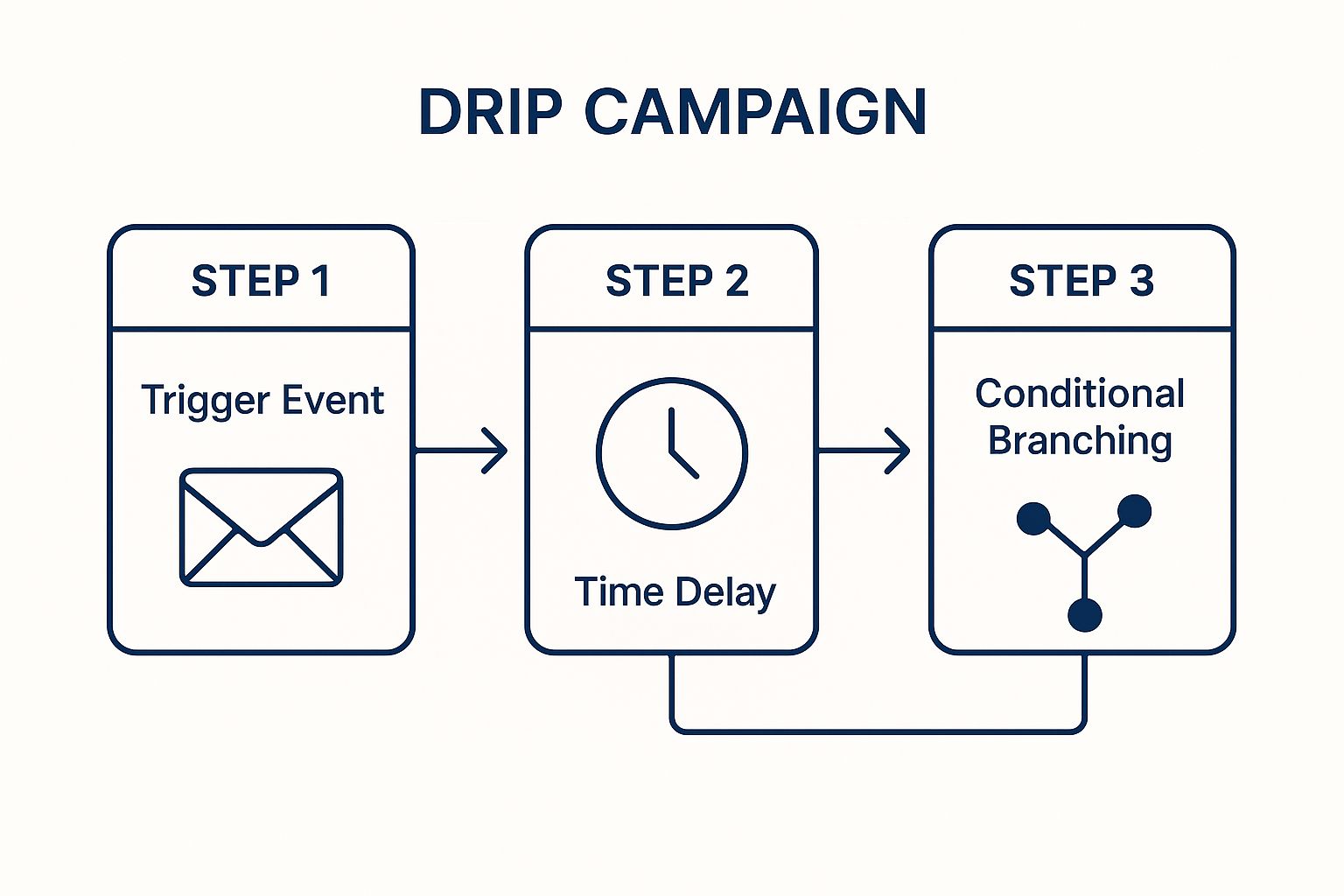
This process flow highlights how simple triggers can evolve into complex, personalized journeys by using time delays and conditional branching to direct users down the most relevant path.
Why It Works
Think of Airbnb's host onboarding sequence, which guides new hosts through every step of listing their property with helpful tips and reminders. This automated workflow simplifies a complex process, increases the likelihood of completion, and sets the user up for success. By delivering value-driven content sequentially, you build a relationship and gently move prospects toward a conversion goal, turning a cold lead into a loyal customer.
Actionable Implementation Tips
To effectively build workflows that convert, follow a structured and strategic approach:
- Map Workflows to Journey Stages: Align each automated sequence with a specific stage in the customer lifecycle, such as welcome, nurture, conversion, or re-engagement, to ensure the content is always contextually relevant.
- Define Clear Exit Criteria: Establish specific conditions that will remove a contact from a workflow, such as making a purchase or booking a demo. This prevents over-communication and ensures they transition to the next appropriate sequence.
- Test Timing and Frequency: Experiment with the time delays between communications. Sending a follow-up after one day versus three days can dramatically impact open rates and overall engagement.
- Monitor and Optimize Continuously: Regularly analyze workflow performance metrics like open rates, click-through rates, and conversion goals. Use this data to identify bottlenecks and refine your sequences for better results.
4. Data Integration and Management
Marketing automation is only as powerful as the data that fuels it. This makes robust data integration and management a cornerstone of any successful strategy. The goal is to connect and consolidate data from multiple sources like your CRM, website analytics, and e-commerce platform to create a single, unified view of each customer. This unified profile ensures that every automated interaction is based on a complete and accurate understanding of the customer's journey.
A critical aspect of these marketing automation best practices is ensuring data flows seamlessly between systems. By breaking down data silos, you empower your automation platform with the rich, contextual information needed to trigger timely and relevant campaigns. This foundational work prevents disconnected customer experiences and ensures your marketing efforts are coherent across all channels.

Why It Works
Think of platforms like HubSpot or Salesforce that centralize customer interactions from sales, marketing, and service into one record. When a customer's support ticket is resolved (service data), an automated workflow can trigger a follow-up survey (marketing data) because the systems are integrated. This prevents marketing from sending a promotional email to an unhappy customer who just had a negative support experience. It ensures consistency and builds trust by showing you understand the customer's complete history with your brand.
Actionable Implementation Tips
To effectively integrate your data sources for superior automation, follow these steps:
- Start with Core Systems: Begin by integrating your most critical platforms, typically your CRM, email marketing tool, and website analytics. Ensure this foundational data is clean and synchronized.
- Establish Data Governance: Create clear policies for data entry, formatting, and management from the start. Use standardized naming conventions for campaigns and properties across all connected systems to avoid confusion. For truly robust data integration, leveraging tools like Google Ads Lead Form Webhooks can automate lead collection and ensure real-time data flow into your systems.
- Implement Regular Audits: Schedule routine checks to identify and clean up duplicate records, incomplete profiles, and outdated information. Data hygiene is not a one-time task but an ongoing process.
- Document Everything: Maintain clear documentation of all integrations, data flows, and field mappings. This becomes invaluable for troubleshooting, onboarding new team members, and scaling your operations.
5. Behavioral Trigger Setup
One of the most powerful marketing automation best practices is to configure automated responses based on specific user actions. Behavioral triggers allow you to engage with customers in real-time, delivering highly relevant and contextual messages precisely when they are most receptive. Instead of broadcasting messages on a fixed schedule, this approach ties your communication directly to individual user behaviors like website visits, email clicks, form submissions, or abandoned carts.
The core principle is to respond immediately to signals of customer intent. By setting up these triggers, you create a dynamic and responsive system that nurtures leads and customers at critical moments in their journey. For example, a user who repeatedly visits a specific product page is showing clear interest; a triggered email offering more information or a special discount can be the perfect nudge toward conversion. This level of immediacy makes your marketing feel like a helpful, one-to-one conversation rather than a generic blast.
Why It Works
Think about the automated emails you receive from Amazon after leaving an item in your cart or the recommendations Netflix sends based on your viewing history. These are prime examples of behavioral triggers in action. They work because they are inherently timely and relevant. By capitalizing on a user's recent activity, you are addressing a present need or interest, which dramatically increases the likelihood of engagement and action. This immediacy helps shorten the sales cycle and builds a stronger connection by showing you're paying attention to their individual journey.
Actionable Implementation Tips
To effectively implement behavioral triggers in your marketing automation strategy, follow these steps:
- Start with High-Impact Triggers: Begin by identifying the most valuable user actions. Focus on behaviors like cart abandonment, content downloads, or pricing page visits, as these are strong indicators of intent and offer the highest potential return.
- Set Frequency Caps: To avoid overwhelming your audience, establish rules that limit how often a user can receive automated messages within a specific timeframe. This prevents message fatigue and protects your brand's reputation.
- Test Trigger Timing and Delays: Experiment with the timing of your automated responses. An abandoned cart email might be most effective an hour after abandonment, while a welcome email should be sent instantly. A/B test different delays to find the optimal window for engagement.
- Utilize Negative Triggers: Implement rules that stop a workflow if a user takes a specific action. For example, if a user makes a purchase, they should be automatically removed from any abandoned cart sequences to prevent irrelevant and frustrating messaging.
6. A/B Testing and Optimization
Setting up automated workflows is only half the battle; ensuring they perform at their peak is where continuous improvement comes in. A/B testing, or split testing, is the systematic process of comparing two versions of a marketing asset to see which one performs better. By changing a single variable, such as an email subject line, call-to-action (CTA) button color, or send time, you can gather data-driven insights into what resonates most with your audience.
This methodical approach removes guesswork from your strategy, making it one of the most crucial marketing automation best practices. Instead of relying on assumptions, you use empirical data to refine your campaigns for higher engagement, click-through rates, and conversions. Platforms like HubSpot and Mailchimp have integrated A/B testing features, making it easier than ever to optimize everything from individual emails to entire nurturing sequences.
Why It Works
A/B testing provides clear, quantitative evidence of what works and what doesn't. For instance, testing two different subject lines for an automated welcome email might reveal that one version achieves a 15% higher open rate. Over thousands of new subscribers, that small improvement translates into a significant increase in engagement and potential revenue. Similarly, testing the timing of a follow-up email in a cart abandonment workflow can pinpoint the exact moment a customer is most likely to complete their purchase.
Actionable Implementation Tips
To effectively integrate A/B testing and optimization into your workflows, follow these steps:
- Isolate a Single Variable: For a test to be conclusive, you must only change one element at a time. If you change both the headline and the CTA copy, you won't know which element was responsible for the change in performance.
- Ensure Statistical Significance: Don’t end tests prematurely. Run them long enough to gather a sufficient sample size, ensuring that the results are statistically significant and not just a result of random chance.
- Prioritize High-Impact Tests: Start by testing elements that have the greatest potential to affect your goals. Subject lines, CTA copy, and hero images are often great starting points as they can have a substantial impact on user behavior.
- Document and Learn: Keep a detailed log of every test you run, including your hypothesis, the variable tested, the results, and your conclusions. This creates an invaluable internal knowledge base for optimizing future campaigns.
7. Multi-Channel Campaign Coordination
True marketing automation best practices extend beyond a single channel like email. Multi-channel campaign coordination involves orchestrating a unified and consistent brand message across various platforms, including email, social media, SMS, push notifications, and even direct mail. The goal is to create a seamless and cohesive customer journey, where each channel complements the others to reinforce the core message and guide the user forward.
This strategic approach ensures that your brand presents a consistent identity, no matter where the customer interacts with it. By leveraging the unique strengths of each channel within a single automated workflow, you can engage customers in their preferred environments. This creates a more immersive and impactful experience, moving beyond isolated messages to build a continuous conversation that deepens customer relationships and drives loyalty.
Why It Works
Think of Starbucks' loyalty program. They seamlessly coordinate promotions through email, in-app push notifications, and SMS alerts. A customer might receive an email announcing a "Double Star Day," get a push notification reminder when they are near a store, and see the same offer promoted on social media. This synchronized effort ensures the message is not only seen but is also highly relevant and timely, leveraging each channel for maximum impact and driving in-store traffic.
Actionable Implementation Tips
To effectively coordinate campaigns across multiple channels, a structured plan is essential:
- Map the Customer Journey: Before building workflows, map out the typical paths your customers take. Identify key touchpoints where a switch in channel (e.g., from email to SMS for an urgent notification) would be most effective.
- Maintain a Unified Customer Profile: Use a CRM or CDP (Customer Data Platform) to consolidate data from all channels into a single view. This allows your automation platform to make informed decisions based on a complete history of the customer's interactions.
- Develop Channel-Specific Content: While the core message must be consistent, adapt the creative and copy for each platform. An SMS should be concise and direct, while an email can provide more detail, and a social media post should be visually engaging.
- Implement Frequency Capping: Avoid overwhelming your audience by setting limits on how often a single user can receive messages across all channels within a specific timeframe. This prevents message fatigue and reduces the risk of opt-outs. For more details, explore the tools that facilitate this, such as specialized marketing collaboration software.
8. Customer Journey Mapping
Effective marketing automation must align with how customers actually interact with your brand, not just how you think they do. Customer journey mapping is the practice of visually outlining every single touchpoint and interaction a customer has with your business, from initial awareness to post-purchase advocacy. It provides a strategic blueprint that reveals friction points, identifies opportunities, and ensures your automated workflows are helpful rather than disruptive.
By creating a detailed map, you can pinpoint the exact moments where an automated message would be most impactful. This foundational process moves your strategy from a series of disconnected tactics to a cohesive, customer-centric system. Implementing this as one of your core marketing automation best practices ensures that every automated email, notification, or ad serves a clear purpose within the broader customer experience.
Why It Works
Think about the seamless experience Spotify creates, guiding users from free signup to premium subscriber. The company maps the user journey to identify key engagement milestones, then uses automation to trigger personalized playlists, feature highlights, and subscription offers at precisely the right moments. Similarly, B2B companies like Salesforce map the complex buyer journey to deploy targeted lead nurturing sequences that address specific pain points at each stage of the funnel, from initial research to final decision. This approach makes automation feel like a helpful guide, not a sales pitch.
Actionable Implementation Tips
To effectively integrate journey mapping into your automation strategy, follow a structured approach:
- Start with High-Level Stages: Begin by mapping the primary phases of your customer's journey, such as Awareness, Consideration, Purchase, and Retention. You can add granular detail later.
- Incorporate Real Data: Base your map on actual customer behavior data from your CRM, analytics, and customer feedback. Avoid making assumptions about how customers interact with your brand.
- Involve Cross-Functional Teams: Collaborate with sales, customer support, and product teams to get a holistic view of the customer experience. Each department offers unique insights into different touchpoints.
- Identify Key Moments of Truth: Focus on the critical interactions that have the biggest impact on a customer's decision or perception. These are the prime opportunities for impactful automation.
- Update Your Maps Regularly: Customer behaviors and market dynamics change. Revisit and revise your journey maps at least quarterly to ensure they remain accurate and relevant.
9. Performance Analytics and ROI Measurement
Executing sophisticated automation workflows is only half the battle; the other half is proving their value. This is where a rigorous focus on performance analytics and ROI measurement becomes one of the most critical marketing automation best practices. It involves systematically tracking key metrics, attributing conversions and revenue to specific campaigns, and using that data to justify investments and guide future strategy. Without it, automation is just a series of actions with no clear business impact.
The core principle is to connect every automated touchpoint to a measurable outcome, whether it's lead generation, customer engagement, or direct sales. By setting up comprehensive tracking, you can move from vanity metrics like open rates to business-critical KPIs like customer acquisition cost (CAC) and lifetime value (LTV). Beyond tracking performance, a crucial best practice is to understand precisely how to calculate marketing ROI to prove the tangible value of your automation efforts.
Why It Works
Think of HubSpot’s attribution reporting or Google Analytics 4's conversion path analysis. These tools don't just show you what happened; they help explain why it happened by connecting marketing activities to revenue. For instance, an e-commerce company can use funnel analysis to see exactly where users drop off in an abandoned cart sequence, allowing for data-driven adjustments. This shift from "we think this works" to "we know this generates X% return" transforms the marketing function from a cost center into a documented revenue driver.
Actionable Implementation Tips
To effectively integrate this into your marketing automation strategy, follow these steps:
- Define Clear KPIs First: Before launching any workflow, establish the specific key performance indicators (KPIs) you will use to measure success, ensuring they align directly with overarching business goals.
- Implement Strict UTM Conventions: Use a standardized UTM tracking and naming convention for all campaigns. This ensures clean, reliable data for accurate attribution and reporting. You can learn more about this by exploring the concepts behind marketing attribution.
- Create Tiered Dashboards: Build different report dashboards for different stakeholders. An executive-level dashboard might show high-level ROI and revenue influence, while a campaign manager’s dashboard would focus on granular metrics like click-through rates and workflow completion.
- Schedule Regular Performance Reviews: Set up recurring meetings (e.g., weekly or bi-weekly) to review performance data, identify trends, and make iterative optimizations to your automation workflows.
10. Compliance and Privacy Management
In an era of increasing data scrutiny, marketing automation is not just about efficiency; it's about responsibility. A critical best practice is ensuring all automated activities are fully compliant with privacy regulations like GDPR, CCPA, and CAN-SPAM. This means prioritizing transparent data handling and building customer trust by making privacy a core component of your automation strategy, not an afterthought.
Effective compliance management involves more than just adding a checkbox to a form. It requires a deep integration of privacy principles into your workflows, from obtaining explicit consent to providing easy opt-out mechanisms. By embedding these practices into your automation, you not only avoid hefty fines but also demonstrate a commitment to customer privacy, which strengthens brand reputation and builds lasting loyalty.
Why It Works
Platforms like Mailchimp and HubSpot have built-in tools for a reason: compliance drives better marketing. When users feel in control of their data, they are more likely to engage positively with your brand. For instance, providing a clear preference center where subscribers can choose the type and frequency of communications they receive can significantly reduce unsubscribe rates. Similarly, adhering to CAN-SPAM rules by including a physical address and a clear unsubscribe link in every email is a non-negotiable standard that maintains your sender reputation and deliverability.
Actionable Implementation Tips
To ensure your marketing automation best practices are fully compliant, integrate the following steps:
- Implement 'Privacy by Design': Build all new automation workflows with privacy as a foundational element. Map out every data touchpoint and ensure you have a lawful basis for processing personal information at each stage.
- Provide Granular Consent Options: Move beyond a single "subscribe" button. Allow users to opt-in to specific types of content, such as newsletters, promotional offers, or product updates, giving them greater control.
- Regularly Audit Data Practices: Schedule periodic reviews of your data collection, storage, and usage policies. Purge data that is no longer necessary or for which you no longer have consent, minimizing your compliance risk.
- Automate Unsubscribe and Data Requests: Use your automation platform to instantly process unsubscribe requests across all systems. Create a clear and simple process for users to request access to or deletion of their personal data.
Marketing Automation Best Practices Comparison
| Feature / Aspect | Segmentation and Personalization | Lead Scoring and Nurturing | Drip Campaigns and Automated Workflows | Data Integration and Management | Behavioral Trigger Setup | A/B Testing and Optimization |
|---|---|---|---|---|---|---|
| Implementation Complexity 🔄 | Medium to High: Complex setup with extensive data management | Medium to High: Requires setup and ongoing model refinement | Medium: Needs careful planning and frequent updates | High: Complex integrations, data governance needed | High: Sophisticated tracking and testing required | Medium: Requires sufficient data and statistical knowledge |
| Resource Requirements ⚡ | High: Data collection and personalized content creation | Medium to High: Content for nurturing and scoring system setup | Medium: Content creation plus workflow design | High: Technical and maintenance resources required | Medium to High: Setup and monitoring of triggers | Medium: Time for testing and data analysis |
| Expected Outcomes 📊 | ⭐⭐⭐⭐⭐ High engagement, improved conversion, brand loyalty | ⭐⭐⭐⭐ Improved lead quality, higher conversion rates | ⭐⭐⭐⭐ Consistent nurturing, scalable engagement | ⭐⭐⭐⭐ Complete data view, accurate targeting | ⭐⭐⭐⭐ Timely, relevant messaging, increased conversion | ⭐⭐⭐⭐ Data-driven optimization, better campaign performance |
| Ideal Use Cases 💡 | Targeted marketing campaigns, personalized content delivery | Prioritizing leads, aligning sales and marketing | Automated customer journeys, onboarding, re-engagement | Connecting multiple data sources for unified insights | Real-time marketing responses to behavior | Optimizing emails, workflows, and campaign elements |
| Key Advantages ⭐ | Personalized messaging boosts engagement and satisfaction | Qualified leads improve sales efficiency | Automation reduces manual effort, ensures timing | Accurate data aids decision-making and personalization | Immediate, contextual communication increases conversions | Continuous improvement and reduced guesswork |
| Feature / Aspect | Multi-Channel Campaign Coordination | Customer Journey Mapping | Performance Analytics and ROI Measurement | Compliance and Privacy Management |
|---|---|---|---|---|
| Implementation Complexity 🔄 | High: Complex coordination across channels | Medium to High: Time-intensive, cross-department collaboration | High: Complex setup, requires analytics skills | High: Ongoing compliance updates and system integration |
| Resource Requirements ⚡ | High: Requires budget, expertise, and management | Medium: Collaboration and data gathering | Medium to High: Requires analytical expertise | Medium to High: Legal and technical resources needed |
| Expected Outcomes 📊 | ⭐⭐⭐⭐ Better reach, consistent brand experience, improved ROI | ⭐⭐⭐⭐ Enhanced customer understanding, improved automation | ⭐⭐⭐⭐ Clear campaign insights, improved budget allocation | ⭐⭐⭐⭐ Reduced legal risk, improved customer trust |
| Ideal Use Cases 💡 | Omnichannel marketing strategies | Mapping and optimizing customer touchpoints | Measuring campaign performance and ROI | Managing data privacy and legal compliance |
| Key Advantages ⭐ | Cohesive messaging boosts engagement and attribution | Identifies journey gaps for better campaigns | Data-driven decisions enhance marketing effectiveness | Legal compliance and competitive advantage |
From Automation to Intelligent Growth: Your Next Steps
Navigating the landscape of marketing automation can feel complex, but the journey from manual effort to intelligent, scalable growth is built upon the foundational principles we've explored. This isn't about simply "setting and forgetting" your campaigns. Instead, mastering these marketing automation best practices is about creating a dynamic, responsive system that evolves with your audience and business goals. We've moved beyond the basics to see how granular segmentation, sophisticated lead scoring, and behavior-triggered workflows form the bedrock of a successful strategy.
The true power of automation is unlocked when it feels less like a machine and more like a personalized, one-to-one conversation at scale. By integrating your data sources, you create a single source of truth that fuels every decision, from the content you deliver in a drip campaign to the channels you use for coordination. Remember, your customer journey map is not a static document but a living blueprint that should be continuously refined through rigorous A/B testing and performance analysis.
Key Takeaways for Immediate Action
To transform these concepts into tangible results, it's crucial to distill them into a clear action plan. The most impactful strategies don't require you to overhaul your entire system overnight. Instead, focus on incremental, strategic improvements.
Here are the most critical takeaways to prioritize:
- Embrace Hyper-Personalization: Move past using just a first name. Leverage behavioral data and deep segmentation to deliver content that speaks directly to a user's specific needs, interests, and stage in the buyer's journey.
- Data is Your Foundation: Your automation is only as smart as the data it runs on. Prioritize clean, integrated data and establish a robust management process. This ensures your lead scoring is accurate, your analytics are reliable, and your personalization efforts are effective.
- Test, Measure, and Optimize Relentlessly: The "best" approach is rarely static. Consistently A/B test your emails, landing pages, and workflow timing. Use performance analytics not just to report on what happened, but to understand why it happened and how you can improve.
- Respect Privacy and Build Trust: In an era of data sensitivity, compliance isn't just a legal checkbox; it's a cornerstone of customer trust. Proactive privacy management and transparent practices are essential for building long-term relationships.
Your Path Forward: From Strategy to Execution
The journey to mastering marketing automation is a marathon, not a sprint. The most successful teams adopt a phased approach, building momentum with each successful implementation. Start by identifying your biggest bottleneck or opportunity. Is it lead nurturing? Is it multi-channel campaign coordination?
Select one or two of the marketing automation best practices discussed, such as refining your lead scoring model or mapping out a single, critical customer journey. Dedicate your resources to mastering that area, measure the impact, and then expand your focus. This methodical approach ensures sustainable progress and prevents your team from becoming overwhelmed.
Ultimately, the goal is to create a symbiotic relationship between your marketing efforts and your technology. Your platform should not just execute tasks; it should provide the insights needed to make smarter strategic decisions. By consistently applying, testing, and optimizing these practices, you will build a resilient automation engine that does more than save time. You will forge stronger customer connections, prove your marketing ROI with undeniable data, and drive predictable, sustainable revenue for your brand.
Ready to unify your influencer marketing efforts with powerful automation? REACH provides a centralized platform to manage campaigns, track performance, and prove ROI, aligning perfectly with the data integration and analytics principles essential for success. Discover how to streamline your collaborations and maximize your impact by exploring REACH today.