 Skip to content


A social media audit is a comprehensive analysis of your brand's social media presence to evaluate what's working, what isn't, and where you can find new opportunities for growth. It’s a strategic health check that goes beyond surface-level stats to reveal the data-driven insights you need to build a more effective, high-ROI social media strategy. This process is the foundation for optimizing your efforts and ensuring your resources are directed for maximum impact.
With a well-executed audit, you can refine your content, strengthen your connection with your audience, and make smarter decisions about everything from your ad spend to your influencer partnerships. For instance, the data you gather is invaluable for a platform like REACH Influencers, which helps you find the perfect creators to amplify the content styles your audit proves are most effective.
Table of Contents
- Why a Social Media Audit Is Your Strongest Growth Lever
- Your Pre-Audit Checklist for a Smooth Process
- Analyzing the Performance Metrics That Truly Matter
- Auditing Your Competitors to Find Your Edge
- Turning Your Social Media Audit Into an Action Plan
- Got Questions About Your Social Media Audit?
Why a Social Media Audit Is Your Strongest Growth Lever
Let's be real, "social media audit" sounds like a chore. It probably makes you think of complicated spreadsheets and data overload. But what if it’s the single best thing you can do to unlock serious, long-term growth? An audit is your guide to understanding your performance, stopping budget waste, and finding those golden opportunities hiding right under your nose.
This process pushes you to look past follower counts and get into the metrics that truly matter. It’s all about answering the tough questions that will shape your entire strategy.
Uncovering Actionable Insights
If you’re not doing a regular social media audit, you're pretty much marketing with a blindfold on. You could be throwing money at a platform your audience doesn't even use or creating content that just doesn't connect. A solid audit shines a light on all those blind spots.
For instance, you might find out that even though your Facebook page has more followers, your Instagram Reels are getting 300% higher engagement. That single piece of information tells you exactly where to shift your creative energy and budget to get a much better return.
A social media audit isn't about pointing fingers; it's about getting clear. It swaps out the guesswork for a plan backed by real data, turning your social media from a daily grind into a serious growth driver.
A Foundation for Strategic Partnerships
The data you pull from an audit is also gold for building smart influencer marketing campaigns. Once you know which content performs best and who your most engaged followers are, you can find creators who are a perfect match for your brand.
This is where platforms like REACH Influencers come in handy. You can take what you learned from your audit and search for influencers whose audience looks just like your ideal customer. This data-first approach takes the guesswork out of picking partners and sets your campaigns up for a win right from the start.
In 2025, with global social media users expected to hit 5.24 billion—that's 63.9% of the world's population—you can't afford to guess. Regular audits are essential for keeping track of your performance in such a crowded market. You can read the full research about these social media statistics to get a better sense of just how big the opportunity is.
Your Pre-Audit Checklist for a Smooth Process
Jumping headfirst into a social media audit without a plan is a recipe for chaos. It’s like trying to cook a gourmet meal without reading the recipe—you’ll probably end up with a mess and a headache. A little prep work upfront is the secret to an efficient audit that delivers real, actionable insights.
Think of this stage as your mise en place. Before you even glance at a single metric, you need to get all your ingredients—your accounts, your goals, and your tools—lined up and ready to go.
Gather Your Digital Keys
This first part is often the most tedious, but you can't skip it. You have to collect the logins and access credentials for everything. You can’t audit what you can't open.
Start by creating a secure, central document with a list of every social media account. This includes the big ones like Instagram and TikTok, but don't forget that old Pinterest board an intern set up five years ago.
You’ll also need access to your wider marketing toolkit:
- Native Analytics Dashboards for each channel (like Meta Business Suite or TikTok Analytics).
- Third-Party Schedulers such as Hootsuite or Buffer.
- Google Analytics to see how much traffic social is actually sending your way.
- Influencer Marketing Platforms like REACH Influencers, which keep campaign data in one place.
Having this all organized prevents frustrating delays. Using a platform like REACH Influencers is a huge time-saver here, as it centralizes all your influencer campaign analytics so you aren't digging through a dozen different reports for performance data.
Define Your Audit Objectives
A social media audit without a clear goal is just a data-gathering exercise. You need to know why you're doing this in the first place. Your objectives will be your North Star, guiding your analysis and helping you focus on the metrics that truly matter.
For instance, a DTC CPG brand's audit might be focused on community building.
- Goal: Increase user-generated content (UGC) and strengthen brand loyalty.
- Metrics to Track: Mentions, shares, branded hashtag usage, and influencer campaign ROI.
On the other hand, a B2B SaaS company will have a completely different set of priorities.
- Goal: Generate qualified leads and establish thought leadership.
- Metrics to Track: Click-through rates on whitepaper links, LinkedIn engagement, and website form submissions from social traffic.
Your audit's purpose dictates its direction. Are you trying to boost sales, improve brand perception, or enhance customer service? Answering this question first makes every subsequent step more meaningful.
Map Every Social Media Profile
Next up, it’s time to play detective. Do a thorough search for every single profile associated with your brand, including any unofficial or outdated accounts that might be floating around. This is crucial for shutting down rogue accounts that could be hurting your brand’s reputation or confusing your audience.
A quick brand search on each platform and Google will usually do the trick. Your inventory list should track:
- Platform Name: (e.g., Instagram, LinkedIn)
- URL: The direct link to the profile.
- Owner: The person or team responsible for the account.
- Purpose: The primary goal for this specific profile.
- Last Activity Date: To quickly spot dormant accounts.
This exercise is more important than ever. A 2025 social media audit has to account for some big strategic shifts. While an incredible 65.7% of the global population is on social media, Gartner predicts that 50% of consumers might scale back their usage due to burnout and distrust. That means every single profile you operate needs to be optimized and purposeful.
Before you can truly dig into the numbers, you need a solid foundation. The table below outlines the key data points and assets you should gather to make sure you're fully prepared.
| Category | Data Point / Asset | Why It Matters |
|---|---|---|
| Account Access | Login credentials for all social platforms | You can't audit what you can't access. This is non-negotiable. |
| Account Access | Access to Google Analytics | Essential for tracking social referral traffic and conversions on your website. |
| Account Access | Access to third-party tools (schedulers, etc.) | Provides a complete picture of your posting history and performance. |
| Profile Information | List of all official and unofficial brand profiles | Helps identify rogue accounts and ensures brand consistency. |
| Performance Data | Past performance reports or dashboards | Creates a baseline to measure current performance against. |
| Content Assets | Links to top-performing posts from last period | Identifies what's already working so you can replicate that success. |
| Strategic Docs | Existing social media strategy or guidelines | Your audit should measure performance against your stated goals. |
| Competitor Info | List of 3-5 key competitors and their social profiles | Provides context for your performance within the industry landscape. |
| Influencer Data | Reports from influencer campaigns | Measures the ROI and impact of your influencer marketing efforts. |
This pre-audit phase is the most important step for a successful social media audit. By gathering your credentials, defining what you want to achieve, and mapping out your entire presence, you’re setting yourself up for success. This organized approach ensures that when you finally dive into the data, you’re not just staring at numbers—you’re uncovering a clear path to smarter marketing and real growth.
Analyzing the Performance Metrics That Truly Matter
Alright, you've got your accounts lined up and your goals defined. Now for the fun part: digging into the data. This is where we move past the vanity metrics—like obsessing over follower counts—and start looking at the numbers that tell you what’s actually working. Good data tells a story about what your audience loves, what they ignore, and where your biggest opportunities are hiding.
We're going to break this down into four key areas. Think of them as different lenses you can use to examine your social media health. Each one offers a unique perspective, and when you put them all together, you get the complete picture.
Evaluating Brand Consistency
First things first, take a step back and look at your profiles as if you were a brand-new visitor. Does everything feel cohesive and professional from one channel to the next? Even small inconsistencies can chip away at trust and confuse potential customers before they’ve even seen your content.
As you go through each platform, keep an eye on these elements:
- Profile Information: Is your bio clear, compelling, and consistent everywhere? Do your username and handle match your brand name?
- Visuals: Are your profile picture and cover photo high-quality and on-brand? Is there a consistent visual style in your recent posts?
- Tone of Voice: Does the language you use in captions and replies match your established brand personality? A playful tone on Instagram should still feel connected to your more professional, but approachable, voice on LinkedIn.
Fixing these things is often a quick win. Just updating an old bio or standardizing your profile images can instantly make your brand look more polished and create a much stronger first impression.
Understanding Your Audience
You can create the most amazing content in the world, but it's not going to land if it doesn't resonate with your audience. A huge part of your audit is a deep dive into who your followers are, where they're from, and what they actually care about. You can find all of this information right inside the native analytics of each social media platform.
Look specifically for:
- Demographics: What are the main age ranges, genders, and locations of your followers?
- Interests: What other topics or accounts are they engaging with?
- Behavior: When are they most active online? This is gold for fine-tuning your posting schedule to get maximum visibility. Analyzing engagement often reveals the best time to post on LinkedIn or other platforms.
Imagine a small business discovering that while most of their followers are in the US, a smaller but rapidly growing group of super-engaged users is in Australia. That's a huge insight! It could spark a new targeted ad campaign or even a partnership with an Australian influencer—an opportunity they would have completely missed otherwise.
Measuring Content Performance
This is where you connect your creative efforts to real results. It’s time to look beyond likes and focus on the metrics that show genuine interest. A huge follower count means very little if no one is actually paying attention to what you post.
Key content metrics to track:
- Engagement Rate: This is the percentage of your audience that actually interacts with your content (likes, comments, shares, saves). It’s a far better measure of content quality than follower count alone.
- Reach and Impressions: How many unique people see your content (reach) versus the total number of times it's seen (impressions)?
- Video Completion Rate: For videos, what percentage of people are watching all the way through? A low completion rate might mean your intros aren't grabbing attention.
- Saves: This one is powerful. It shows that people find your content so valuable they want to come back to it later.
A social media audit might show that your simple text-based posts on Facebook are getting almost no engagement, but your Instagram carousels with practical tips are generating 5x more saves. This data gives you a clear directive: shift your energy toward creating more of that high-value, savable content on Instagram.
This kind of detailed analysis is absolutely critical for influencer marketing. When you're working with partners, you need to know what's truly resonating. For a deeper look at this, check out our guide on how to measure social media performance.
Assessing Community Health
Finally, your audit needs to look at how you interact with your community. Social media is a conversation, and your responsiveness—along with the general feeling around your brand—are vital signs of health. A brand that actively engages is a brand that builds loyalty.
Focus on these community metrics:
- Response Time: How quickly are you getting back to comments and direct messages? Slow replies can lead to frustrated customers.
- Sentiment Analysis: Are the comments and mentions about your brand generally positive, negative, or neutral?
- User-Generated Content (UGC): Are customers tagging you in their own posts? That’s a huge indicator of brand love.
By systematically looking at these four areas—consistency, audience, content, and community—your social media audit goes from being a simple checklist to a powerful strategic tool that uncovers real insights and drives real growth.
Auditing Your Competitors to Find Your Edge
Your brand doesn't exist in a bubble. A truly thorough social media audit has to look beyond your own profiles and take a hard look at what everyone else is doing. Figuring out what your rivals are doing right—and where they're fumbling—is one of the quickest ways to sharpen your own strategy.
The point isn't to play copycat. It's all about gathering intel, spotting trends, and finding those golden opportunities they've completely overlooked. This process gives you a realistic benchmark for your own performance and often sparks fresh ideas you wouldn't have thought of otherwise.
Identifying Your True Competitors
First things first, you need to know who you’re actually up against. Don't try to track every single brand in your industry; you'll just drown in data. Instead, focus your energy on a small, curated group.
I’ve always found a balanced list works best:
- Direct Competitors (2-3): These are the obvious ones. They sell similar things to the same people you do. You're probably bumping into them constantly.
- Aspirational Brands (1-2): These are the leaders in your field or even in a parallel industry. They might not be your direct competition, but they are absolutely crushing it on social media. They're the ones setting the bar for great content and community building.
Once you’ve picked your players, pop them into a simple spreadsheet. This will be your home base for tracking what they're up to across all the major platforms.
Analyzing Their Content and Engagement
Alright, now for the fun part: the deep dive. Pull up their feeds and scroll through their content from the last 30-60 days. Your goal here is to start seeing the patterns in their approach.
I recommend zeroing in on a few specific areas:
- Content Themes: What's their main message? Are they all about product specs, customer testimonials, or educational tips?
- Content Formats: What are they actually posting? Is it a sea of slick videos, a gallery of static images, or a bunch of carousels? Pay attention to what gets the most love.
- Posting Frequency: How often are they showing up on each platform? Is there a noticeable rhythm to their posting schedule?
- Engagement Metrics: Don't just count the likes. Look for the posts that get people talking—the ones with tons of comments and shares. That’s your clue to what truly connects with the audience you're both trying to reach.
When you're digging into professional platforms, knowing how to get the right data is a game-changer. For instance, you might even need to learn how to scrape LinkedIn data to get a technical advantage in your research. For a more detailed walkthrough, check out our complete guide on how to conduct competitor analysis.
Competitive analysis isn't about feeling behind. It's about finding inspiration and spotting gaps. If every competitor is pumping out polished corporate videos, maybe your authentic, behind-the-scenes content is exactly what will make your brand pop.
Uncovering Influencer Collaboration Opportunities
One of the most revealing parts of a competitive audit is seeing how others are playing the influencer marketing game. Are they shelling out for massive creators, or are they finding gold with smaller, niche micro-influencers?
Pay close attention to who they're working with. This tells you a ton about their target audience and what they're trying to achieve. More importantly, it can light up huge, untapped opportunities for you.
Let's say your audit reveals your top competitors are all laser-focused on Instagram, but they're completely ignoring a massive, engaged audience on TikTok. That isn't just an observation; it's a wide-open door.
This is where a tool like REACH Influencers goes from being useful to being your secret weapon. Armed with that knowledge, you can jump into REACH's influencer discovery engine and immediately find creators who already own that untapped TikTok space. Instead of playing catch-up, you can leapfrog the competition and stake your claim before they even know what's happening.
Turning Your Social Media Audit Into an Action Plan
All that data you've gathered is just a pile of numbers until you put it to work. A social media audit is pretty much useless without a concrete plan to act on what you’ve learned. This is where you translate all those findings into a strategic roadmap that will guide your team for the next quarter or two.
The point isn't to create some massive, intimidating report nobody will read. It's about building a simple but powerful framework that turns your insights into measurable actions. By the end of this process, you’ll have a clear path forward that takes all the guesswork out of your daily social media tasks.
Structuring Your Action Plan
I’ve found the most effective way to organize audit findings is to sort them into three simple categories. This approach keeps things from getting overwhelming and helps everyone focus on what’s most important right now. You can think of it as a "start, stop, continue" model, but tailored specifically for social media.
Your summary report should be built around these three pillars:
- What to Amplify: These are your proven winners. It’s the content, platforms, or tactics that are already knocking it out of the park. Doubling down here is your fastest path to growth.
- What to Fix: This is your bucket for everything that's underperforming. Maybe it's content formats that always fall flat, profiles that feel off-brand, or strategies that are just wasting time and resources.
- What to Test: This is where your new opportunities live. Based on what you saw from competitors and what you learned about your audience, what new ideas, platforms, or campaigns are worth experimenting with?
Structuring your plan this way makes it incredibly easy for anyone—from your social media manager to your CEO—to understand the key takeaways at a glance. It's a clean, direct way to present both your findings and your proposed solutions.
Setting SMART Goals from Your Findings
Once your findings are neatly organized, the next step is to attach them to specific, measurable goals. Vague ambitions like "get better at Instagram" just won't cut it. Your audit data is the key to creating highly targeted SMART (Specific, Measurable, Achievable, Relevant, Time-bound) goals.
A generic goal is easy to ignore. A data-backed goal creates real accountability and direction.
An audit transforms your goals from wishful thinking into a strategic plan. Instead of saying, "We want more engagement," you can now say, "Our audit shows Reels from micro-influencers generate 3x our average engagement. Let's aim to increase our overall Instagram engagement by 20% in Q3 by partnering with five new creators."
This is where a platform like REACH Influencers becomes so valuable. After your audit identifies a strategic need—like partnering with niche creators to tap into a new audience—you can immediately use REACH’s discovery tools to find those exact influencers. The whole process, from insight to action, becomes a single, fluid motion.
This diagram shows a simple flow for turning your competitor audit findings into tangible actions.
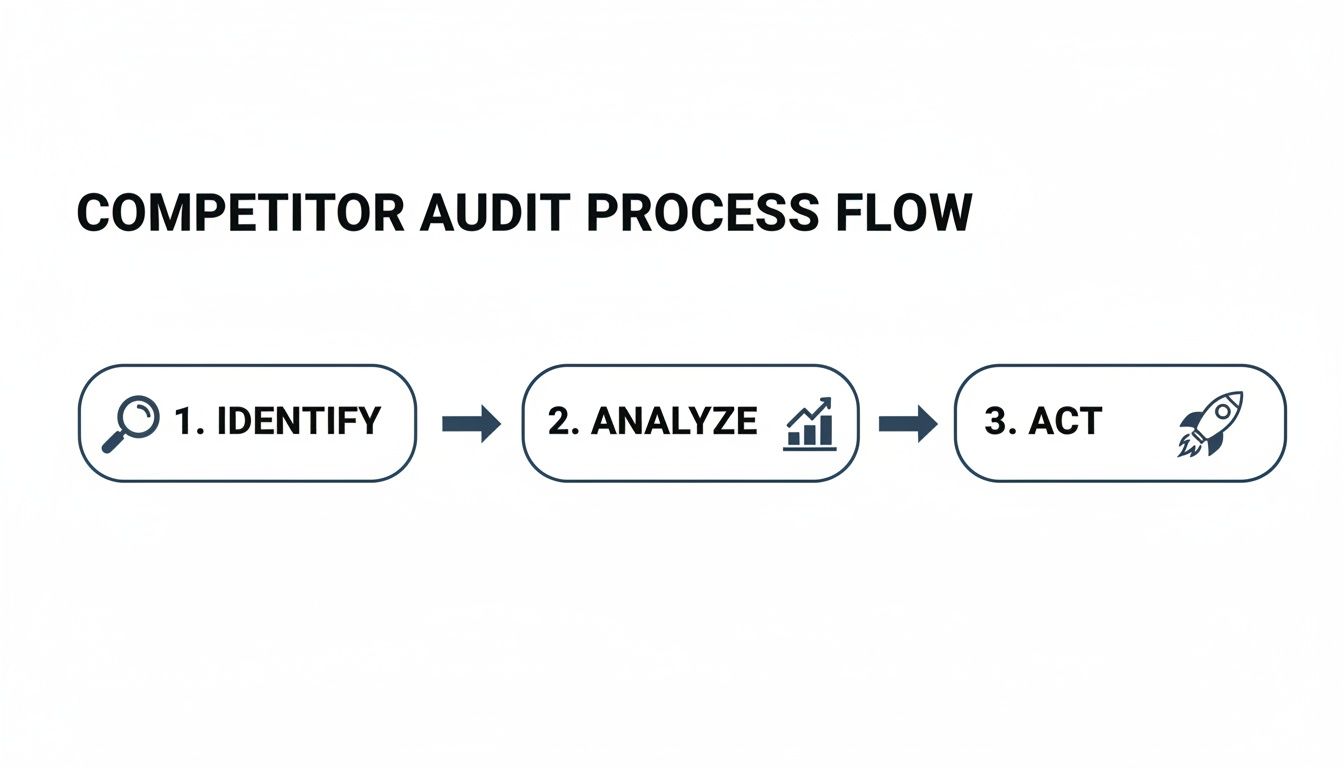
This process breaks down into three essential stages—Identify, Analyze, and Act—which is the core loop for continuous improvement in your strategy.
Creating a Clear Roadmap
Your final action plan should be a clear roadmap for the next 3-6 months. It’s what connects your big-picture goals to the daily and weekly tasks needed to actually achieve them. This is how the audit truly becomes part of your day-to-day operations.
For instance, if one of your goals is to "Fix" an inconsistent brand voice on LinkedIn, your action plan might break down like this:
- Objective: Overhaul our LinkedIn profile and content to align with new brand guidelines.
- Key Actions:
- Rewrite the company bio by [Date].
- Create 5 new content templates specifically for LinkedIn by [Date].
- Schedule a team training session on brand voice by [Date].
- KPIs to Track: Profile views, post engagement rate, and website clicks from LinkedIn.
This level of detail ensures your audit doesn't just end up in a forgotten folder. It becomes a living document that guides your team's work. By linking every action back to a specific finding from your audit, you create a powerful cycle of analysis and improvement. Once you have this roadmap, you can plug these tasks right into your workflow. Check out our guide to building a social media content calendar to see how this plan translates into a tangible schedule.
For agencies, this action plan is your most valuable deliverable. It proves to clients that you don't just spot problems—you deliver clear, data-backed solutions that will generate measurable results.
Got Questions About Your Social Media Audit?
Even with a solid plan, stepping into a full-scale social media audit can feel a bit daunting. It’s totally normal to have questions pop up about timing, tools, or what to do when the numbers aren't what you hoped for. This section is here to tackle those common "what ifs" and turn them into confident, decisive actions.
I’ve pulled together some of the most frequent questions I hear from teams doing an audit. The answers are designed to give you clear, no-nonsense advice to keep you moving forward.
How Often Should I Actually Be Doing This?
The honest answer? It depends. But if you're looking for a solid starting point, a full, deep-dive audit every quarter is the sweet spot for most businesses. This rhythm is just right—it gives you enough time to put the changes from your last audit into practice and see real results, but it's not so long that you let your strategy wander off track.
Now, if you’re in a fast-paced industry like tech or fashion, or you're in the middle of a big campaign, a lighter monthly check-in on your main KPIs is a smart move. Think of it as a quick course correction. And of course, a comprehensive annual review is fantastic for spotting those big, year-over-year trends and setting your strategy for the next 12 months.
What Are the Best Tools for a Social Media Audit?
You can absolutely start with the native analytics inside platforms like Meta, TikTok, and LinkedIn. They're your ground truth. But relying on them alone means a lot of manual data pulling and spreadsheet juggling, which can eat up your time.
To do this right and save your sanity, you’ll want a mix of tools in your arsenal:
- Native Analytics: Non-negotiable. This is where you get the raw, platform-specific data on your audience and post performance.
- All-in-One Management Platforms: Tools like Sprout Social or Hootsuite are great for getting a bird's-eye view of your performance and keeping your content schedule organized.
- Influencer Marketing Platforms: If you're working with creators, you need a dedicated tool to see what's actually working. A platform like REACH Influencers is purpose-built to track campaign metrics, measure ROI, and even help you find new creators based on what you learn from your audit.
Honestly, using a centralized platform like REACH Influencers for your creator work makes the influencer portion of your audit so much simpler. All that data isn't scattered across DMs, emails, and random spreadsheets anymore.
Help! My Audit Shows My Engagement Is Terrible. What Now?
First, take a breath. Discovering low engagement might feel like a punch to the gut, but it's actually one of the most useful things an audit can tell you. It's a flashing neon sign pointing to a disconnect between what you're posting and what your audience actually cares about. This isn't a failure; it’s a course correction.
Low engagement isn't a dead end—it's a roadmap. It tells you exactly where your strategy needs a tune-up, giving you a data-backed reason to start experimenting.
Start by digging into your top-performing posts. What do they have in common? Was it a behind-the-scenes video? A really specific tutorial? A certain tone of voice? Whatever it is, that's your clue. Your immediate next step is to create more content that looks and feels like that.
Then, go back to your audience data. Are you really making content for them? Does it solve a problem they have or tap into a genuine interest? If not, it's time to pivot. A fantastic way to do this is through influencer partnerships. Using a platform like REACH Influencers, you can find creators who have already built the exact engaged community you're trying to reach. Collaborating with them is one of the fastest ways to bring new life and real engagement back to your channels.
Wait, Isn't This Just Social Listening?
Great question, and it's a common point of confusion. The difference is simple but crucial.
A social media audit is an internal check-up. You're looking at your own profiles, your own content, and your own performance metrics. You're asking, "How are we doing?"
On the other hand, social listening is an external activity. You're tuning into the broader conversation happening online about your brand, your competitors, and your industry as a whole. You're asking, "What are they saying?"
Think of it like this:
- An audit tells you: "Our Instagram engagement rate dropped by 5% last quarter."
- Social listening tells you: "People are complaining that our new product's packaging is hard to open."
They're two sides of the same coin. The insights you gather from social listening should absolutely feed into the action plan you build after your social media audit.
A thorough social media audit is the first step toward building a smarter, more effective strategy. It provides the essential data-driven insights needed to stop guessing and start growing. The next step is taking decisive action. REACH Influencers is the platform designed to help you turn those audit insights into high-performing influencer campaigns that deliver real results. Discover the perfect creators, manage campaigns effortlessly, and track your ROI all in one place. Book a demo today to see how you can supercharge your growth.