 Skip to content


In today's saturated digital landscape, treating all social media platforms as a monolith is a recipe for wasted ad spend and low engagement. The key to impactful marketing isn't just knowing what to say, but precisely where to say it and who you're talking to. Understanding nuanced social media platform demographics is the difference between shouting into the void and starting a meaningful conversation with your ideal customer. A generic strategy that ignores user age, location, income, and interests simply won't cut it anymore.
This guide moves beyond surface-level stats to reveal the top seven resources and tools that provide the granular data needed to craft targeted, high-ROI campaigns. For those looking to apply this data directly, exploring specific applications like social media marketing for e-commerce can provide a practical framework for turning insights into sales. We'll explore how to leverage the platforms listed below to not only find your audience but also to select the right influencers who genuinely connect with them.
Each item in this list includes direct links and detailed breakdowns to help you immediately access and apply this critical demographic information. Let's dive into the best places to find the data that will sharpen your social media strategy.
1. Pew Research Center – Social Media Fact Sheet
For marketers, researchers, and strategists seeking an authoritative, unbiased source for social media platform demographics in the United States, the Pew Research Center’s Social Media Fact Sheet is the gold standard. This resource provides a comprehensive, high-level overview of who uses major platforms like YouTube, Facebook, Instagram, and TikTok, breaking down user bases by key demographic variables. It serves as a foundational tool for understanding the digital landscape.
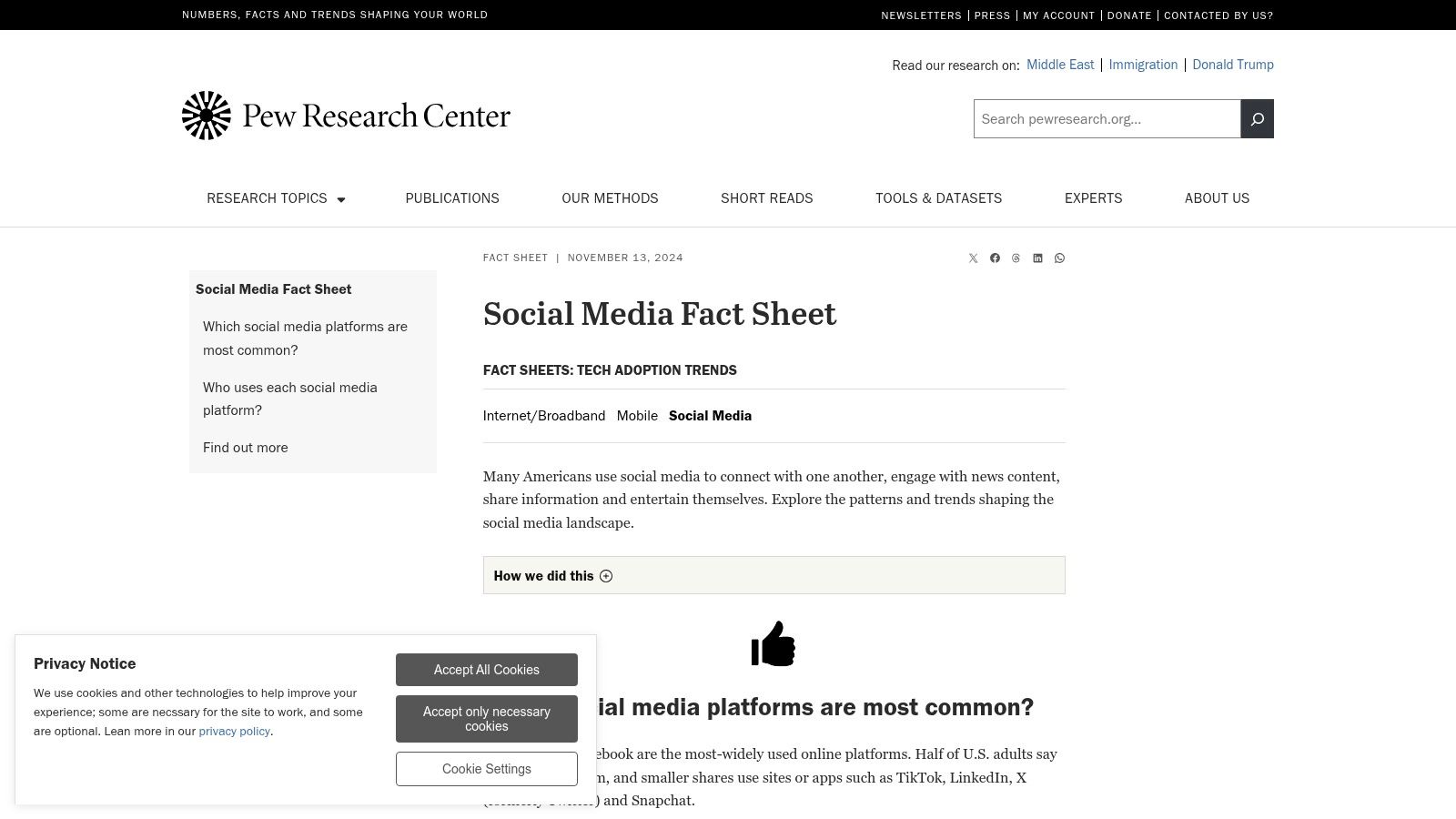
Unlike real-time analytics dashboards, Pew’s strength lies in its rigorous, transparent methodology. The data is gathered from nationally representative surveys, offering a credible snapshot that is ideal for strategic planning, academic research, and building market-level business cases.
Key Features and User Experience
The interface is clean, academic, and straightforward. Users can easily navigate to the latest findings, which are presented through clear charts and concise analysis. The site allows you to explore trend lines, showing how platform usage has evolved over the years.
- Core Demographics: Data is consistently broken down by age, gender, race/ethnicity, education level, and household income.
- Transparent Methodology: Pew provides detailed information on its survey methods, including question wording and sample sizes, which is crucial for building trust and citing the data.
- Downloadable Assets: All charts and data tables are easily downloadable, making it simple to incorporate them into presentations, reports, and strategic documents.
Expert Tip: Use the historical data charts to identify emerging trends. For example, tracking the rapid growth of TikTok among specific age groups can help you justify shifting ad spend or content creation resources toward that platform before competitors do.
Pricing and Access
The Pew Research Center is a nonpartisan, non-profit "fact tank," and all of its research, including the Social Media Fact Sheet, is available completely free of charge. There are no paywalls, subscriptions, or access limitations.
Pros & Cons
| Pros | Cons |
|---|---|
| Highly Credible: Considered a definitive source for U.S. demographic data. | Not Real-Time: Data is based on periodic surveys, not live analytics. |
| Completely Free: No cost or registration required to access all data and reports. | Limited Granularity: Lacks the deep, behavior-based targeting options of ad platforms. |
| U.S.-Centric Focus: Provides deep, contextual insights specifically for the American market. | Broad Scope: Doesn't delve into niche platforms or highly specific user interest segments. |
| Clear Trend Data: Excellent for tracking long-term shifts in platform popularity and usage. |
This resource is essential for anyone needing reliable, citable data to form the foundation of their social media strategy. For a more detailed look at how to apply these insights, you can review our extended analysis on social media demographics.
Website: https://www.pewresearch.org/internet/fact-sheet/social-media/
2. DataReportal – Global Digital Reports
For marketers and strategists needing a global perspective on social media platform demographics, DataReportal’s comprehensive Digital Reports are an indispensable resource. Published in partnership with Meltwater and We Are Social, these reports offer a massive, synthesized view of digital adoption worldwide, making them perfect for international benchmarking and understanding macro-level trends. The reports collate data from various sources, including ad tools and survey partners, to paint a broad picture of the digital state of the world.
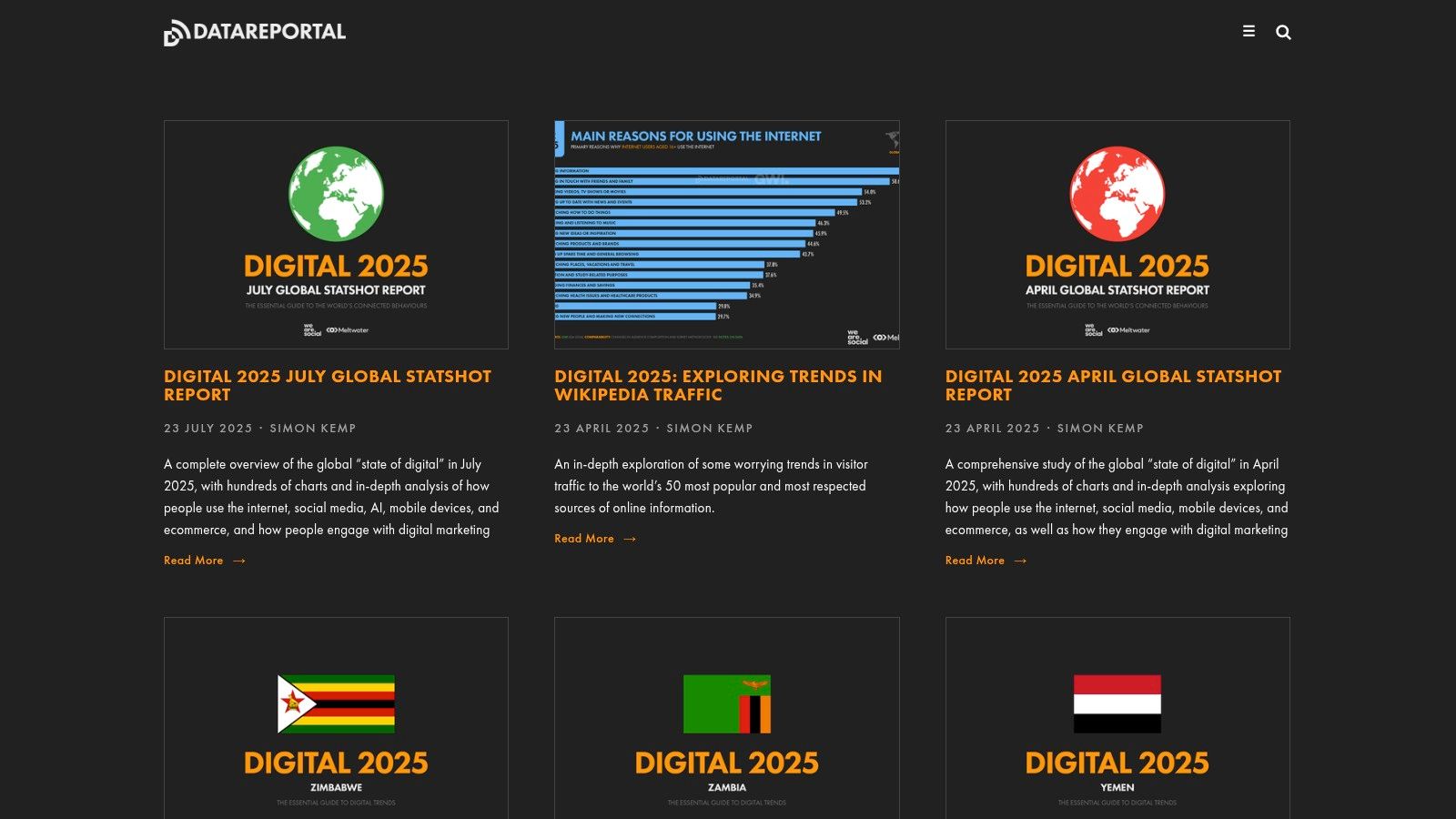
Unlike resources focused solely on survey data, DataReportal excels at aggregating platform-reported metrics, such as potential advertising reach. This makes it a crucial tool for strategists planning global campaigns or evaluating market penetration potential in different countries, moving beyond a U.S.-centric view.
Key Features and User Experience
The platform’s strength is its presentation. The reports are delivered as visually engaging, easily digestible slide decks that are ready for immediate use in presentations. The interface is simple: you browse the library of reports and download what you need.
- Global and Country-Specific Data: Offers an annual flagship global report, quarterly "Statshot" updates, and in-depth reports for nearly every country.
- Ad Audience Insights: Provides platform reach indicators sourced from ad planning tools, showing potential audience sizes by country and basic demographics.
- Clear Data Definitions: The methodology section carefully explains its data sources, distinguishing between metrics like "user identities" and "unique people" to prevent misinterpretation.
Expert Tip: When planning an international campaign, use the country-specific reports to compare the potential ad reach of platforms like Facebook versus Instagram. This data can directly inform budget allocation and platform prioritization for each target market.
Pricing and Access
All of DataReportal’s reports and data are available completely free of charge. The slide decks can be downloaded in their entirety without registration, paywalls, or any other access restrictions, embodying an open-access approach to global digital insights.
Pros & Cons
| Pros | Cons |
|---|---|
| Excellent for Global Context: Unmatched for cross-country comparisons and trend analysis. | Relies on Ad Reach Data: Metrics need careful interpretation as they reflect potential, not actual, reach. |
| Presentation-Ready Format: Reports are visual, well-designed slides perfect for presentations. | Limited Demographic Depth: U.S. demographic cross-tabs are less granular than sources like Pew or GWI. |
| Completely Free: No cost to access a vast library of global and local digital reports. | Aggregate, Not Individual Data: Synthesizes data from many sources rather than providing raw survey results. |
| Frequent Updates: Quarterly "Statshot" reports keep the data fresh throughout the year. |
This resource is essential for any professional whose work extends beyond a single market, providing the high-level data needed to make informed international strategic decisions.
Website: https://datareportal.com/reports
3. Statista – Social Media Statistics
For professionals needing quick, visually-compelling data on social media platform demographics for presentations and reports, Statista is a powerful aggregator. It compiles statistics, charts, and market reports from thousands of sources, offering a vast repository of information that extends far beyond social media into various industries. This makes it an ideal resource for triangulating data and understanding the broader market context of social media usage.
Unlike purely academic sources, Statista is built for business efficiency. Its key strength is the ability to quickly find and export professional-grade charts and data points, saving significant time on research and content creation for market analysis, strategic planning, and client-facing deliverables.
Key Features and User Experience
The platform is designed around a powerful search function that allows users to find specific data points with ease. The user experience is focused on quick retrieval and immediate usability of information, with clear sourcing provided for every statistic.
- Vast Chart Library: Access over 1 million statistics presented in clean, easy-to-read charts covering countless platforms, countries, and topics.
- Source Citations: Each data point includes a link to the original source, allowing for due diligence and verification, which is critical for credible reporting.
- Multiple Export Options: Charts and data can be instantly downloaded as PNG, PowerPoint (PPT), or Excel (XLS) files, making them ready for immediate use in executive presentations and reports.
Expert Tip: Use Statista to add context to your demographic findings. For example, after identifying your target age group for a platform, search Statista for "ad spend on [Platform Name]" or "e-commerce adoption by age" to build a more comprehensive business case for your strategy.
Pricing and Access
Statista operates on a freemium model. A significant number of charts and basic statistics are available for free, but accessing detailed reports, underlying data sets, and advanced export features requires a paid subscription. Pricing tiers are available for single users, multi-user teams, and entire corporations.
Pros & Cons
| Pros | Cons |
|---|---|
| Broad Global Coverage: Offers data from numerous countries, not just the U.S. | Subscription Required for Depth: The most valuable, detailed statistics are behind a paywall. |
| Presentation-Ready Visuals: Charts are designed for easy integration into reports and slides. | Secondary Data Source: Statista aggregates data, so it's always wise to check the original source. |
| Time-Efficient Research: Quickly find specific data points without extensive manual searching. | Potential for Outdated Stats: Always check the publication date of a statistic to ensure relevance. |
| Transparent Sourcing: Clear citations allow for easy verification and build trust in the data. |
This platform is invaluable for teams that need to produce data-backed reports quickly. To further enhance your reporting capabilities, you might explore our overview of the best marketing dashboard tools.
Website: https://www.statista.com/
4. GWI (GlobalWebIndex) – Consumer & Social Platform Audience Data
For organizations needing to go beyond basic demographics, GWI provides one of the most powerful datasets on social media platform demographics and consumer behavior available. Sourced from large-scale quarterly surveys across over 50 global markets, GWI offers an unparalleled depth of insight, connecting platform usage with psychographics, interests, purchase habits, and media consumption. It’s the tool of choice for agencies and brands building highly specific, international audience personas.
Unlike publicly available reports, GWI's strength is its self-serve platform that allows users to cross-analyze thousands of data points. This enables marketers to answer complex questions, such as "What social platforms do environmentally-conscious Gen Z consumers in Southeast Asia use to follow brands?" This level of granularity is crucial for precise strategic planning and global campaign execution.
Key Features and User Experience
GWI's interface is a robust data analysis tool designed for researchers and strategists. The platform allows users to build custom charts and audience profiles by layering demographic, psychographic, and behavioral attributes. AI-assisted tools like GWI Spark and Canvas help visualize data and create presentation-ready slides directly within the platform.
- Deep Profiling Points: The Pro tier offers access to over 250,000 data points, allowing for incredibly detailed audience segmentation.
- Global Coverage: Provides consistent data across more than 50 countries, essential for international market research and campaign planning.
- Trend Analysis: Historical data coverage spanning over 15 years allows for in-depth analysis of shifting consumer behaviors and platform adoption.
Expert Tip: Use the cross-filtering feature to identify "audience overlaps." For instance, you can analyze what percentage of Snapchat users in the U.S. also actively use Twitch. This insight is invaluable for planning integrated cross-channel campaigns and understanding your audience's complete digital footprint.
Pricing and Access
GWI operates on a subscription-based model. While some high-level reports are available for free, full access to the self-serve data platform requires a paid plan, with pricing tailored to organizational needs. Access to the core dataset typically requires contacting their sales team for a custom quote and demonstration.
Pros & Cons
| Pros | Cons |
|---|---|
| Exceptional Granularity: Deep cross-filtering capabilities far exceed public sources. | Significant Cost: Full access requires a higher-tier paid plan, making it a premium tool. |
| Trusted by Major Brands: Widely used by top agencies and brands for strategic segmentation. | Steep Learning Curve: Can be complex for users without a research or data analysis background. |
| Global Data Consistency: Offers reliable, comparable insights across dozens of international markets. | Sales-Gated Access: Requires direct contact with a sales team to purchase full platform access. |
| Connects Behavior to Usage: Links social media habits with wider consumer attitudes and interests. |
This platform is a must-have for large brands and agencies that need to build sophisticated, data-backed audience strategies for regional or global campaigns.
Website: https://www.gwi.com
5. SparkToro – Audience Research for Social/Web
While many tools provide broad demographic data for entire platforms, SparkToro excels at uncovering the social media platform demographics and online behavior of highly specific, niche audiences. Instead of starting with a platform, you start with your audience by defining them through keywords, websites they visit, or terms they use in their social profiles. This makes it an invaluable tool for marketers needing to understand where their ideal customers spend their time online.
SparkToro flips the traditional demographic research model on its head. It provides actionable intelligence by revealing the specific social accounts, websites, podcasts, and YouTube channels a defined audience follows. This allows for hyper-targeted media planning, influencer outreach, and content strategy based on actual audience affinities, not just broad platform statistics.
Key Features and User Experience
The platform is designed for quick, intuitive searches, presenting complex audience data in a visually digestible format. Within seconds of entering a query, you get a dashboard full of insights about who your audience is and what they pay attention to, making it easy to build targeted campaigns.
- Audience Discovery: Define your target audience by what they talk about, follow, or visit online to get a detailed profile of their digital habits.
- Demographic Indicators: Provides aggregated data on an audience's likely age, gender distribution, geographic location, and common job roles.
- Actionable Results: The platform generates exportable lists of the exact social accounts, websites, and media sources your audience engages with, perfect for outreach and ad targeting.
Expert Tip: Use SparkToro to validate your assumptions. If you believe your audience of "sustainable fashion enthusiasts" is primarily on Instagram, run a search to see which other platforms, like Pinterest or specific blogs, they frequent. This can reveal untapped channels for growth.
Pricing and Access
SparkToro offers a tiered subscription model, including a free plan that allows for a limited number of searches per month. Paid plans (Business and Agency) offer more searches, advanced features, and full data exports, with clear and transparent pricing available on their site.
Pros & Cons
| Pros | Cons |
|---|---|
| Excellent for Niche Audiences: Uncovers deep insights about specific customer segments. | Modeled Demographics: Data is aggregated and inferred, not official platform statistics. |
| Highly Actionable Data: Directly informs media buying, content strategy, and outreach. | Less Academic: Not suitable for rigorous, national-level demographic research like Pew. |
| Finds Hidden Gems: Identifies influential sources and platforms you might otherwise overlook. | Focus is on Affinities: Primarily shows what audiences follow, with demographics as a secondary layer. |
| Transparent Pricing: Offers a generous free tier and clear subscription options. |
For teams that need to move beyond broad platform data and understand the specific digital ecosystem of their target customer, SparkToro is an essential tool. To further enhance this understanding, exploring concepts like deep-dive social listening can provide invaluable qualitative insights to complement SparkToro's quantitative data.
Website: https://sparktoro.com
6. Meta Audience Insights (Facebook & Instagram) – within Meta Ads
For marketers looking to move from high-level research to direct campaign activation, Meta Audience Insights is the definitive first-party tool. Housed within Meta Ads Manager, this resource provides granular, real-time social media platform demographics and interest data directly from the source. It allows advertisers to explore, refine, and size potential audiences on Facebook and Instagram before spending a single dollar on ads.
Unlike third-party survey tools, Meta Audience Insights offers data based on actual user behavior and self-reported information within its ecosystem. This makes it an indispensable tool for pre-campaign planning, audience validation, and discovering new targeting opportunities based on the attributes of your existing followers or customers.
Key Features and User Experience
The interface is integrated directly into the campaign setup workflow within Meta Ads Manager, making the transition from insight to action seamless. Users define a potential audience using a vast array of targeting options, and Meta provides an aggregated profile of that group.
- Granular Demographics: Go beyond basics with breakdowns by age, gender, location (down to the city or zip code), relationship status, education level, and job title.
- Interest & Behavior Data: Explore audience affinities for specific pages, brands, hobbies, and online behaviors, providing a rich psychographic layer.
- Direct Campaign Integration: Build a promising audience in the insights tool and save it directly for use in your advertising campaigns, eliminating manual recreation.
Expert Tip: Upload a custom audience of your best customers (e.g., from an email list) and use Audience Insights to analyze their shared characteristics. This process reveals the core demographic and interest profile of your most valuable segment, which you can then use to build highly effective Lookalike Audiences for new customer acquisition.
Pricing and Access
Access to Meta Audience Insights is free, but it requires an active Meta Business account (which includes a Facebook Page) and access to Meta Ads Manager. The tool itself doesn't cost anything to use; costs are only incurred when you launch paid advertising campaigns.
Pros & Cons
| Pros | Cons |
|---|---|
| First-Party Data: Insights are based on actual user data from Facebook and Instagram. | Platform-Specific: Data is limited to Meta’s ecosystem and doesn't offer cross-platform insights. |
| Highly Actionable: Seamlessly transition from audience analysis to ad campaign activation. | Requires Meta Account: Users must have a business presence on Meta's platforms to access it. |
| Deep Granularity: Offers extremely detailed targeting options for precise audience definition. | Privacy-Focused Aggregation: Data is anonymized and aggregated, preventing individual user analysis. |
| No Direct Cost: The tool is free to use for audience planning and research. |
This tool is essential for any marketer actively advertising on Facebook or Instagram, providing the direct data needed to build and validate effective targeting strategies from the ground up.
Website: https://www.facebook.com/business/insights/tools/audience-insights
7. TikTok Ads Manager – Audience Insights + Research Hub
For brands and marketers all-in on TikTok, there is no better source for social media platform demographics than the platform itself. The TikTok Ads Manager provides a powerful one-two punch with its Audience Insights tool and a public-facing Research Hub. Together, they offer a direct line to first-party data on user behavior, interests, and demographic breakdowns, moving beyond broad survey data to actionable, campaign-level intelligence.
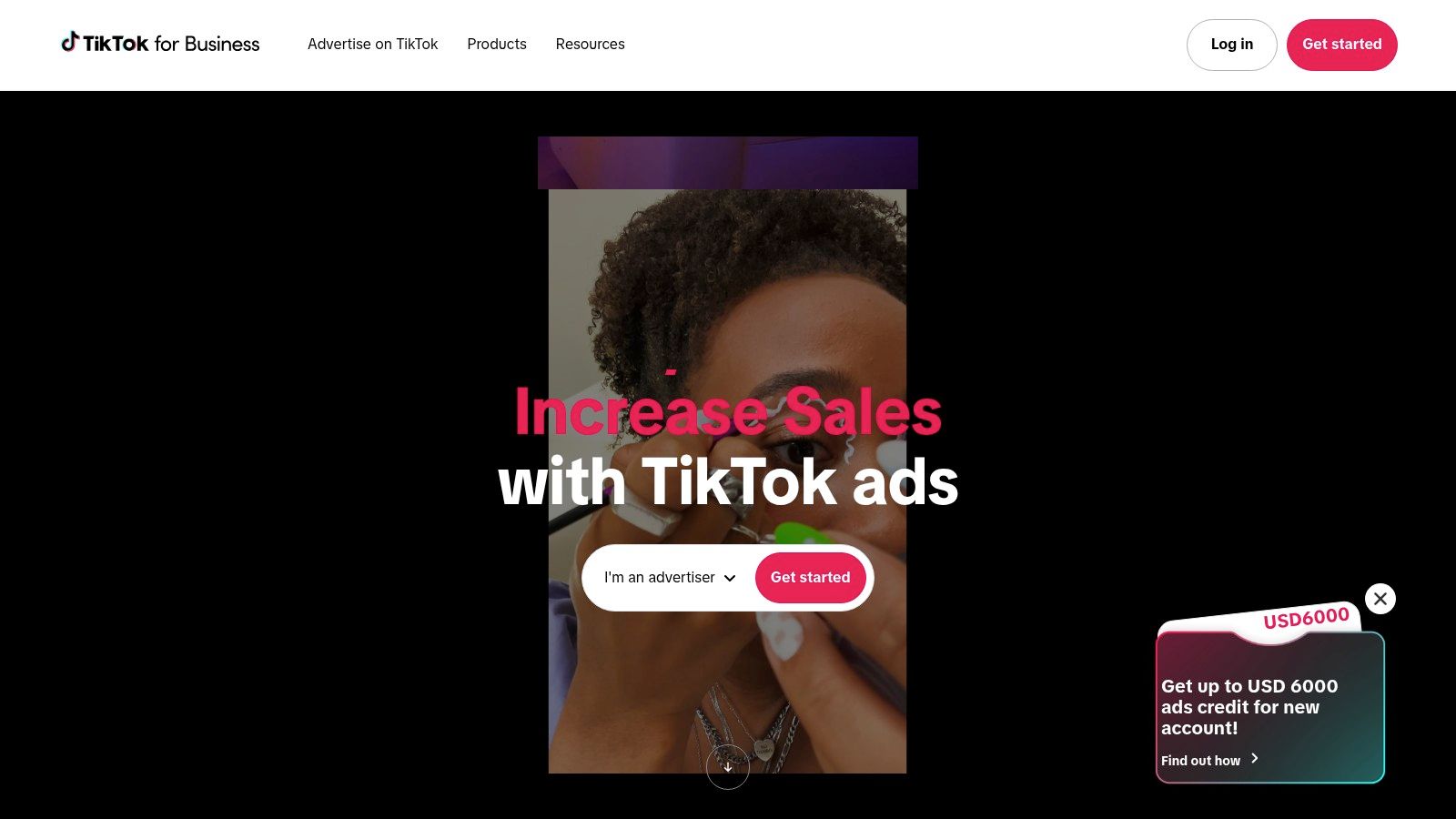
Unlike third-party research, TikTok's native tools provide granular data based on actual user activity on the platform. This allows marketers to understand not just who is on TikTok, but what they are actively engaging with, which is crucial for developing resonant creative and effective media plans. The data flows seamlessly from insight to campaign activation within the same ecosystem.
Key Features and User Experience
The interface is split between the in-platform Ads Manager and the public Insights site. The Ads Manager is business-focused, designed for campaign setup, while the Insights hub is more like a browsable library of trends and reports. Both are visually driven and tailored for modern marketers.
- Audience Overview: The Audience Insights tool provides a detailed breakdown of your custom audiences, including demographics, top interests, and audience overlap with other interest groups.
- Filterable Research Hub: The public Insights site features research cards and reports that can be filtered by country, industry, audience, and key moments (like holidays), providing ready-made strategic briefs.
- Creative Inspiration: Insights are often paired with examples of top-performing ads and creative strategies, directly linking demographic data to execution.
Expert Tip: Use the Audience Insights tool to discover "interest overlaps." If your core audience of beauty enthusiasts also shows a high affinity for gaming, it signals an opportunity for a creative crossover campaign that can tap into a new, highly engaged sub-community.
Pricing and Access
Access to the TikTok For Business platform, including the Ads Manager and its Audience Insights tool, is free, though it requires setting up an account. The public-facing Research & Insights hub is also available to everyone without a login. Running ad campaigns, of course, is a paid activity.
Pros & Cons
| Pros | Cons |
|---|---|
| First-Party Data: The most accurate and up-to-date source for TikTok audience signals. | TikTok-Specific: Data is exclusively for TikTok and cannot be used for cross-platform comparison. |
| Actionable Insights: Directly connects audience understanding to campaign targeting and creation. | Potential Availability Issues: The Audience Insights feature may still be rolling out and not available in all accounts. |
| Creative Guidance: Helps inform messaging and creative concepts based on user behavior. | Directional Research: The public hub provides valuable summaries but not raw, downloadable datasets. |
| Completely Free Access: No cost to access the data and reporting tools. |
This tool is indispensable for anyone actively advertising or creating content on TikTok. While these insights are platform-specific, understanding a user base with this level of detail is a model that can inform strategies on other platforms, similar to how one might analyze native data to see Twitter analytics.
Website: https://ads.tiktok.com/
Social Media Demographics: 7-Source Comparison
| Item Title | Implementation Complexity 🔄 | Resource Requirements ⚡ | Expected Outcomes 📊 | Ideal Use Cases 💡 | Key Advantages ⭐ |
|---|---|---|---|---|---|
| Pew Research Center – Social Media Fact Sheet | Low – Publicly accessible reports | Minimal – No setup, just download | Reliable U.S. demographic data, trend lines | Credible U.S. social platform usage stats, academic use | Trusted, methodology-transparent, noncommercial |
| DataReportal – Global Digital Reports | Low to Medium – Website access, downloads | Minimal – No account needed | Global and country-level social media adoption | International benchmarking, trend overview | Free, visually rich, cross-country comparisons |
| Statista – Social Media Statistics | Medium – Subscription needed for full access | Moderate – Paid plans for premium data | Broad social media stats, market reports | Quick data retrieval & triangulation, executive reports | Extensive coverage, export options, source-cited |
| GWI (GlobalWebIndex) – Consumer & Social Data | High – Subscription with learning curve | High – Paid Pro tiers with advanced tools | Deep audience profiling, trend analysis | Strategic segmentation, in-depth market research | Large dataset, customizable AI-assisted charts |
| SparkToro – Audience Research for Social/Web | Low to Medium – Self-serve SaaS platform | Moderate – Paid tiers with exports | Platform-specific audience insights, channel IDs | Niche audience discovery, outreach, media planning | Clear pricing, channel-level audience data |
| Meta Audience Insights (Facebook & Instagram) | Medium – Meta Ads Manager access required | Moderate – Meta account and Ads Manager access | Platform-native demographics and interest data | Campaign planning on Facebook/Instagram | First-party data, direct ad activation |
| TikTok Ads Manager – Audience Insights + Hub | Medium – Ads Manager and public hub | Moderate – Account with ad platform access | TikTok-specific audience and engagement insights | Campaign creative & messaging, TikTok market research | First-party TikTok data, insights-to-activation |
From Data Points to Campaign Wins
Navigating the landscape of social media platform demographics can feel like piecing together a complex puzzle. As we've explored, each tool, from the broad strokes of the Pew Research Center and DataReportal to the granular insights of Meta Audience Insights and SparkToro, offers a unique piece of that puzzle. The core takeaway is clear: a one-size-fits-all approach to social media is no longer viable. Success is found in the specifics.
Understanding that TikTok skews heavily toward Gen Z is surface-level knowledge. True strategic advantage comes from using tools like the TikTok Ads Manager to see exactly which interests, hashtags, and creator interactions define your specific Gen Z sub-segment. Similarly, knowing Facebook has a massive user base is only useful when you leverage its internal tools to pinpoint the precise age, location, and behavior patterns of your ideal customer within that audience.
Turning Insights into Actionable Strategy
The real value of understanding social media platform demographics lies in its application. Data is passive; strategy is active. Your next steps should focus on translating these numbers into a dynamic, multi-platform marketing plan that meets your audience exactly where they are.
Here is a practical framework to guide your implementation:
- Define Your Primary and Secondary Personas: Before you even select a platform, be crystal clear on who you are trying to reach. What is their age, location, income level, and what are their digital habits?
- Cross-Reference with Platform Data: Use the tools we've covered to map your personas to the platforms. Your primary persona for a B2B tech service might be highly active on LinkedIn, but a secondary persona of younger decision-makers could be more accessible through targeted content on Instagram or even a niche subreddit.
- Allocate Resources Intelligently: Don’t spread yourself too thin. Focus your budget and creative energy on the top one or two platforms where your target demographic is most engaged. A smaller, highly-targeted campaign on the right platform will always outperform a broad, underfunded campaign across five.
- Tailor Your Content: The demographic data should directly inform your creative. A campaign for a retirement planning service on Facebook will require a vastly different tone, visual style, and message than one for a new energy drink on TikTok.
Choosing the Right Tools for the Job
Your choice of demographic research tool should align with your specific goals. For high-level strategic planning and market overviews, resources like Statista and DataReportal provide an essential foundation. For deep dives into consumer behavior and psychographics, a subscription to GWI is invaluable.
However, when it comes to executing paid campaigns, nothing beats the native tools. Meta Audience Insights and the TikTok Ads Manager offer the most direct and actionable data for building and refining ad audiences. For organic strategy and understanding online conversations, SparkToro gives you a unique edge in discovering where your audience truly lives online.
Ultimately, the most powerful strategies are built on a foundation of accurate, up-to-date demographic data. By moving beyond simple user counts and digging into the rich tapestry of audience behaviors, interests, and affinities, you transform raw data into a powerful competitive advantage. You stop guessing and start connecting, ensuring every post, ad, and campaign dollar is invested in reaching the people who matter most to your brand.
Ready to find creators whose followers perfectly match your target audience? REACH helps you leverage detailed influencer audience data, including demographics and psychographics, to discover authentic partners who can amplify your message effectively. Move beyond guesswork and start building data-driven influencer campaigns by exploring REACH today.