

The single biggest mistake in social media marketing is guessing where your audience lives online. Without accurate social media platform demographics, brands throw marketing dollars at the wrong channels, creating campaigns that shout into a void. This guesswork leads to wasted budgets, low engagement, and missed opportunities. The core problem is simple: you can’t connect with your target customer if you don’t know which platforms they actually use.
Understanding the granular details is critical. Is your audience part of the Gen Z majority on TikTok or the Gen X and Boomer stronghold on Facebook? Are you targeting high-income professionals on LinkedIn or creative hobbyists on Pinterest? Answering these questions correctly is the difference between a thriving campaign and a failed one. Effective social media strategy for 2025 isn't about being everywhere; it's about being in the right places with a message that resonates.
This guide eliminates the guesswork. We’ve compiled the definitive roundup of the most reliable sources for detailed social media user data. Each entry provides a direct link and a clear overview to help you find the precise insights needed to build a data-driven strategy. This information is also the foundation for powerful influencer marketing, helping you identify creators whose followers perfectly match your ideal customer profile, a process that can be further streamlined with dedicated influencer platforms like REACH.
1. Pew Research Center
For any marketer, brand manager, or strategist building a campaign, establishing a credible, foundational understanding of social media platform demographics is the critical first step. The Pew Research Center serves as the gold standard for this foundational data, offering authoritative, nonpartisan, and methodologically transparent research on U.S. social media usage. It provides the citable baseline data that stakeholders and executives trust.
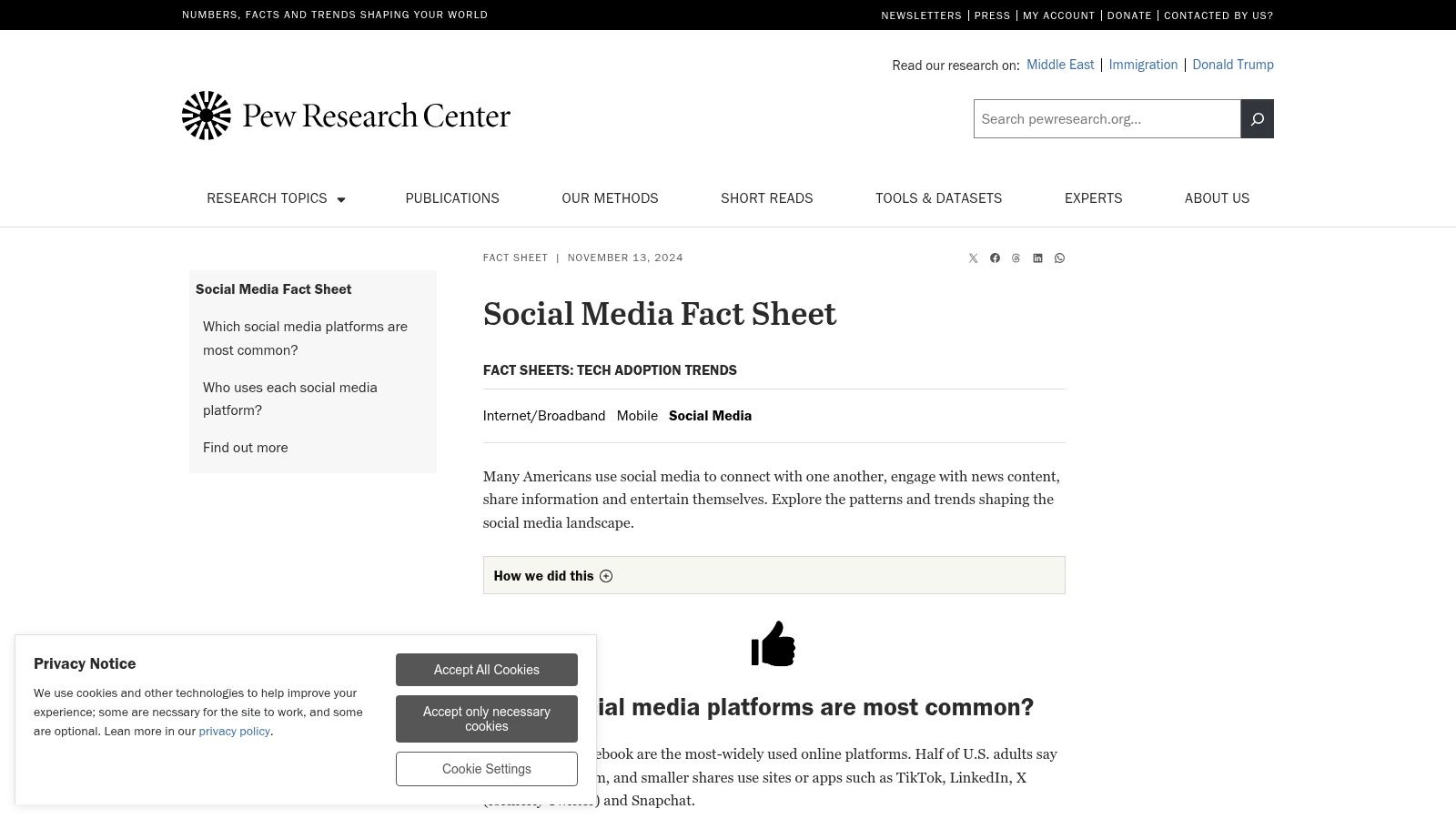
Unlike real-time analytics platforms, Pew’s strength lies in its rigorous, large-scale survey research. This approach provides a stable, macro-level view of who uses which platforms, broken down by key demographics like age, gender, race, income, and education level. It’s the ideal resource for annual strategy planning, new market entry analysis, or simply validating your team’s assumptions with unimpeachable data.
Key Features and How to Use Them
The website is organized for easy access to its rich data sets. The interface is clean and academic, prioritizing clarity and documentation over flashy visuals.
- Social Media Fact Sheet: This is your primary destination. It’s a regularly updated, comprehensive overview that presents a side-by-side comparison of usage statistics across major platforms. Use this to quickly grasp the demographic landscape and identify top-line trends.
- Platform-Specific Topic Hubs: Dive deeper into a single platform like TikTok, Instagram, or X (formerly Twitter). These hubs consolidate all of Pew’s research on that specific network, including trendlines showing how its user base has evolved. This is invaluable for understanding not just who is on a platform now, but its growth trajectory.
- Detailed Reports: For maximum detail, download the full PDF reports. They contain the complete methodology, survey questions, and more granular data breakouts, perfect for presentations or in-depth research documents. For instance, while you can learn more about how to see your own Twitter analytics, Pew provides the broader demographic context for the entire U.S. user base on the platform.
Pros & Cons
| Pros | Cons |
|---|---|
| Highly Trusted Source: Nonpartisan and respected globally. | Not Real-Time: Reports are published periodically (e.g., annually). |
| Free Access: All data and reports are free to access and use. | U.S. Centric: Focus is primarily on the American population. |
| Transparent Methodology: Rigorous methods are fully documented. | Limited Granularity: Lacks the deep cross-tab functionality of paid tools. |
Pew Research Center is the essential starting point for any serious analysis of social media platform demographics. It provides the "why" and "who" at a population level, giving your more granular, real-time analytics crucial context.
Website: https://www.pewresearch.org/internet/topics/social-media/
2. DataReportal
While Pew Research Center provides the foundational academic baseline, DataReportal delivers the global, presentation-ready overview essential for modern marketers. It's the go-to resource for quickly sizing up a country's entire digital landscape, consolidating data from various sources into comprehensive, visually engaging reports. For teams needing to understand social media platform demographics in a global context, DataReportal is an indispensable tool.
Its core value lies in synthesis. DataReportal aggregates and organizes metrics from platform-native advertising tools, GWI, Statista, and Similarweb into one coherent narrative. This makes it perfect for strategic planning sessions, executive briefings, and cross-country benchmarking where easily digestible, high-level statistics are paramount. The reports are designed to be immediately useful, saving you hours of data collection and slide creation.
Key Features and How to Use Them
The platform is built around its flagship "Digital" reports, which are incredibly easy to navigate and leverage for strategic insights. The user experience is straightforward, focusing on direct access to its massive slide decks.
- Comprehensive Country Reports: Search for any country (including the U.S.) to get a full "Digital [Year]" report. These PDFs and slide decks cover everything from internet penetration and device usage to detailed social media platform user counts and ad audience profiles. Use this for quick market sizing and understanding platform dominance in specific regions.
- Presentation-Ready Visuals: Every key statistic is presented as a clean, citable slide. You can directly copy these visuals into your own presentations for stakeholders, saving significant design time. They provide a clear, professional look that clients and executives appreciate.
- Sourced and Footnoted Data: While DataReportal synthesizes information, it clearly footnotes its sources. This allows you to trace data back to its origin (e.g., Meta's advertising tools, GWI surveys), adding a layer of transparency and allowing for deeper investigation if needed.
Pros & Cons
| Pros | Cons |
|---|---|
| Fast and Presentation-Ready: Data is visualized for immediate use. | Third-Party Estimates: Some data is based on models, not direct surveys. |
| Global Coverage: Extensive library of reports for most countries. | Lacks Deep Segmentation: Granular cross-tabs require paid source tools. |
| Free to Access: All major reports are free to view and download. | High-Level Focus: Not ideal for hyper-niche demographic analysis. |
DataReportal excels at providing the big-picture context. It’s the ideal resource for getting up to speed on a new market or for pulling key statistics that frame a strategic marketing plan, making complex demographic data accessible and actionable.
Website: https://datareportal.com/
3. Statista
While foundational research provides the broad context, marketers often need specific, presentation-ready statistics on demand. Statista excels as a massive, on-demand data aggregator, offering a vast catalog of social media platform demographics and market statistics. It's the go-to resource for quickly finding a specific data point, such as the age distribution of Instagram users in the U.S. or the global social network penetration rate.
Unlike a primary research institution, Statista consolidates data from over 22,500 sources, presenting it in clean, easy-to-digest charts and infographics. This makes it an incredibly efficient tool for populating presentations, reports, and marketing briefs with compelling data visuals. Its strength lies in its breadth and speed, allowing you to source a statistic for nearly any platform or region in seconds.
Key Features and How to Use Them
The user experience is built around a powerful search engine, allowing you to instantly locate relevant data. The interface is clean and professional, prioritizing fast data retrieval and export.
- Topic and Dossier Hubs: Statista curates statistics into comprehensive topic pages (e.g., "Social Media in the U.S.") and more in-depth "Dossiers." Use these to get a quick but thorough overview of a specific platform or market without having to search for individual data points.
- Specific Data Points: The platform's core function is its searchability for individual statistics. You can find highly specific information, from user numbers by platform to audience age splits and device usage, making it ideal for validating a hypothesis or answering a quick question.
- Downloadable Charts: Every chart can be downloaded directly as a PNG, PowerPoint slide, or Excel file. This feature is a massive time-saver for anyone building a presentation, allowing you to drop professional-looking data visualizations into your work with a single click. These stats provide excellent context when you are examining your own social media engagement metrics.
Pros & Cons
| Pros | Cons |
|---|---|
| Fast Access to Specific Stats: Quickly find data on a wide array of topics. | Subscription Required: Full data access and downloads are behind a paywall. |
| Easy Export for Reports: PNG, PPT, and XLS downloads save significant time. | Varying Methodologies: Sources are cited, but quality can vary. |
| Broad Platform Coverage: Includes data on major and niche social networks. | Lacks Primary Analysis: Presents data without the deep analysis of a research firm. |
Statista is the ideal tool for marketers who need to quickly source and visualize specific demographic data points. It serves as a powerful supplement to foundational research, perfect for adding quantitative weight to strategies and presentations.
Website: https://www.statista.com/
4. Insider Intelligence (eMarketer)
Where Pew Research Center provides a public-service view of social media usage, Insider Intelligence (formerly eMarketer) offers the business and financial perspective. This premium, subscription-based service is the go-to resource for industry forecasts and social media platform demographics tied directly to commercial outcomes. It’s the data source CMOs and finance teams rely on for budgeting, ad spend allocation, and market-sizing exercises.
Insider Intelligence stands apart by translating raw demographic data into actionable business intelligence. It provides not just the who but the how much, connecting user numbers to advertising revenue, market penetration, and future growth projections. This makes it an indispensable tool for annual planning, investment justification, and competitive analysis at the corporate level.
Key Features and How to Use Them
The platform is designed for quick access to mission-critical numbers and analyst insights, presented through a clean, corporate-friendly interface. While much of the best content is gated, its structure is straightforward.
- Analyst Briefings and Forecasts: These reports provide contextual analysis alongside hard numbers. Use them to understand the why behind demographic shifts and how they will impact future channel performance and advertising opportunities.
- Charts and Data Downloads: The platform is rich with downloadable charts and data sets (often in XLS format). These are perfect for dropping directly into internal presentations, pitch decks, or strategic plans to add a layer of third-party credibility to your recommendations.
- Gated Reports on Ad Spend and Reach: For deep dives, access reports that break down advertising investment, user reach, and buyer behavior by platform. This is crucial for determining channel mix and justifying budget increases or decreases for specific social networks based on their demographic alignment and monetization potential.
Pros & Cons
| Pros | Cons |
|---|---|
| Highly Credible for Business: Trusted by finance and executive teams. | Expensive Subscription: Primarily an enterprise-level tool. |
| Connects Data to Revenue: Links demographics to ad spend and forecasts. | Gated Content: Much content requires a subscription or lead form. |
| Consistent Definitions: Enables reliable year-over-year trend analysis. | Primarily U.S. Focused: While global, the deepest data is often U.S.-centric. |
Insider Intelligence is the essential resource when your demographic research needs to be backed by financial forecasts and business implications. It elevates the conversation from simply identifying user groups to strategically investing in the platforms where they are most active and receptive.
Website: https://www.insiderintelligence.com/
5. GWI (GlobalWebIndex)
For marketers needing to move beyond high-level trends and into the granular details of consumer behavior, GWI offers a powerful, subscription-based audience insights platform. Where tools like Pew provide a foundational snapshot, GWI delivers deep, queryable data connecting social media platform demographics with psychographics, purchase habits, and media consumption on a global scale. It's the go-to resource for building complex audience personas and justifying strategic decisions with rich, multidimensional data.
GWI’s strength lies in its extensive, harmonized survey data, collected quarterly from millions of internet users across 50+ countries. This allows brands to not only understand who is on TikTok in the U.S. but also how their attitudes toward sustainability or brand discovery differ from Instagram users in the UK. This level of detail is essential for global brands, agencies managing diverse client portfolios, and strategists looking to uncover nuanced market opportunities that broader reports might miss.
Key Features and How to Use Them
The platform is built around a user-friendly interface that allows for complex data analysis without needing a data science background. It’s designed to help you quickly build and understand niche audiences.
- Audience Builder & Profiling: This is the core of the platform. You can define a specific audience (e.g., U.S. Gen Z who use Pinterest and are interested in sustainable fashion) and instantly generate a detailed profile. Use this to validate target personas, discover unexpected interests, and tailor messaging with precision.
- Dashboards & Chart Builder: Create and share live dashboards that track key demographic and behavioral trends over time. This is perfect for quarterly business reviews, client reporting, and monitoring shifts in platform usage among your core consumer segments.
- Cross-Tab Analysis: The platform’s real power comes from its ability to cross-reference thousands of data points. You can analyze how daily Facebook usage correlates with podcast listening habits, household income, and specific brand affinities, providing a holistic view of your target consumer's life.
Pros & Cons
| Pros | Cons |
|---|---|
| Highly Granular Data: Cross-tab thousands of demographic, psychographic, and behavioral attributes. | Enterprise Pricing: Access is via a subscription model aimed at businesses. |
| Global Coverage: Provides consistent data across 50+ markets. | Requires Onboarding: Steeper learning curve to maximize its advanced features. |
| Regularly Updated: Quarterly data refreshes allow for tracking recent trends. | Sample-Based: Insights on hyper-niche audiences should be interpreted with care. |
GWI is an enterprise-grade solution for teams that require a deeper, more actionable understanding of their target audiences. It provides the "why" behind the "who," connecting demographic data with the motivations that drive consumer behavior online.
Website: https://www.gwi.com/
6. Comscore
While many tools focus solely on activity within a social media app, Comscore provides an enterprise-level view of how social media fits into the broader digital ecosystem. It is a critical resource for large brands and agencies that need to understand social media platform demographics not in isolation, but as part of a deduplicated, cross-platform audience. It answers the question: "Who are we reaching on social media that we aren't already reaching on our website or app?"
Comscore’s unique value lies in its ability to measure incremental reach. It shows the unique audience a brand’s social presence adds on top of its owned digital properties (like its website). This allows for a more accurate calculation of total digital reach and prevents overestimating audience size by counting the same user multiple times across different channels. For major advertisers, this is the currency for strategic media planning and investment.
Key Features and How to Use Them
The Comscore platform is designed for deep, integrated media planning rather than quick, self-serve queries. Its interface is robust and geared toward data professionals who need to justify significant advertising spend.
- Media Metrix Multi-Platform: This is the core product. Use its social incremental audience metrics to see the unduplicated reach of your website, app, and social channels combined. This is essential for understanding the true value and demographic makeup of your social media audience.
- Planning Datasets: Go beyond basic demographics by linking audience data with psychographics, lifestyle attributes, and purchase behaviors. This allows you to build sophisticated audience segments for highly targeted campaigns.
- Case Studies and Reports: Comscore regularly publishes reports that analyze demographic skews between a brand’s owned website audience and its social followers. Use these insights to understand how different platforms attract distinct user segments and how to tailor content accordingly. This data is also invaluable when analyzing influencer audience demographics to ensure alignment with your brand's cross-platform strategy.
Pros & Cons
| Pros | Cons |
|---|---|
| Deduplicated Cross-Platform View: Provides a true picture of total digital reach. | Enterprise-Focused: Requires a significant subscription/licensing fee. |
| Established Industry Currency: Widely accepted by major brands and agencies. | High Barrier to Entry: Not a self-serve tool for small teams or individuals. |
| Rich Psychographic Data: Links demographics to consumer behaviors. | Complex Interface: Steeper learning curve compared to simpler analytics tools. |
Comscore is the go-to solution for organizations that need to integrate social media audience measurement into a holistic digital strategy. It moves the conversation from platform-specific metrics to a unified understanding of a brand's total audience.
Website: https://www.comscore.com/
7. Meta Audience Insights
While third-party research provides a crucial macro view, accessing first-party social media platform demographics directly from the source is essential for campaign execution. Meta Audience Insights, available within the Meta Business Suite and Ads Manager, provides this ground-truth data for Facebook and Instagram users. It offers aggregated, privacy-safe insights into the people connected to your Page and the broader user base.
Unlike survey-based reports, Meta’s data is derived directly from user profiles and platform activity. This makes it an unparalleled tool for validating the composition of your current audience and discovering new, actionable targeting segments. It bridges the gap between high-level demographic research and the practical application of building ad sets, allowing you to move seamlessly from insight to implementation within the same ecosystem.
Key Features and How to Use Them
The tool is integrated directly into Meta's business products, making the interface familiar to anyone running ads or managing a Business Page. Its power lies in its direct connection to Meta's advertising infrastructure.
- Audience Demographics: This core feature provides an instant breakdown of your current audience (or a potential audience you build) by age, gender, top cities/countries, and language. Use this to confirm if your content is reaching your intended demographic or to identify surprising pockets of engagement.
- Potential Audience Builder: Explore the demographics of custom segments before spending a dollar. You can build an audience based on interests, behaviors, and location to see its estimated size and demographic makeup. This is perfect for testing hypotheses about new target markets.
- Page Insights: This section reveals audience performance at the content level. It shows you the demographic breakdown of users who engage with specific posts, helping you understand what type of content resonates with different segments of your followers. To effectively leverage this data, a strong understanding of the platform is key; following a Facebook Ads Manager tutorial is indispensable for applying these demographic insights to your campaigns.
Pros & Cons
| Pros | Cons |
|---|---|
| First-Party Platform Data: Highly accurate and reliable. | Ecosystem-Limited: Insights are only for Meta-owned properties. |
| Free Access: Available within any Business Suite account. | Interface Can Change: UI and feature location may be updated. |
| Directly Actionable: Build ad audiences from insights. | Requires Page Activity: Some insights need a minimum audience size. |
Meta Audience Insights is the definitive resource for understanding the specific demographics of your brand's community on Facebook and Instagram. It provides the granular, actionable data needed to refine targeting, inform content strategy, and maximize your advertising budget on the world's largest social network.
Website: https://www.facebook.com/business/
Demographic Data Comparison of Top 7 Sources
| Tool | Implementation Complexity 🔄 | Resource Requirements ⚡ | Expected Outcomes 📊 | Ideal Use Cases 💡 | Key Advantages ⭐ |
|---|---|---|---|---|---|
| Pew Research Center | Low – Public reports, easy access | Minimal – Free reports | Authoritative demographic baselines, transparent data | Trusted cited sources, U.S.-focused demographic trends | Highly trusted, nonpartisan, free to access |
| DataReportal | Low – Ready-made reports | Low – Free downloadable reports | Cross-country benchmarking, platform reach presentations | Quick market sizing, executive presentations | Presentation-ready, frequently updated, multi-source |
| Statista | Low to Medium – Search and download interface | Moderate – Subscription for full access | Fast access to platform stats and downloadable charts | Quick stat retrieval, report/chart exports | Wide coverage, easy exports |
| Insider Intelligence (eMarketer) | Medium – Subscription required, gated content | High – Enterprise subscription | Forecasts, ad spend insights, platform usage by age | Annual planning, budgeting, ad revenue decisions | Credible for CMOs, consistent yearly data |
| GWI (GlobalWebIndex) | Medium to High – Onboarding and interface learning | High – Enterprise pricing | Deep, granular segmentation and quarterly shifts | Custom research, detailed behavior analysis | Granular cross-tabs, analyst support, frequent updates |
| Comscore | High – Enterprise level, complex data sets | Very High – Subscription/licensing | Cross-platform audience measurement with deduplication | Large-scale digital campaign planning | Deduplicated cross-device measurement, enterprise standard |
| Meta Audience Insights | Low – Native to Meta Ads Manager | Minimal – Free with Meta access | In-platform audience composition and targeting data | Facebook/Instagram ad targeting and audience validation | First-party data, free, directly actionable |
From Data to Decisions: Activating Your Demographic Insights
Navigating the world of social media platform demographics can feel overwhelming, but the right tools transform raw data into a powerful strategic advantage. Throughout this guide, we've explored seven essential resources, each offering a unique lens through which to view your potential audience. From the high-level, authoritative reports of Pew Research Center and DataReportal to the deep, granular consumer data from GWI and Statista, you now have a toolkit to build a data-informed strategy.
Remember, collecting this information is only the first step. The true return on investment comes from translating these insights into action. The data from tools like Comscore, Insider Intelligence, and native platforms such as Meta Audience Insights doesn't just tell you who is on each platform; it reveals why they are there and how you should engage them.
A 3-Step Framework for Activating Demographic Data
To move from passive research to active strategy, follow this simple yet effective framework. This process ensures your marketing efforts are precise, efficient, and resonant.
- Validate Your Personas: Take your existing ideal customer profiles and cross-reference them with the data you've gathered. Do your assumptions about your target audience's age, location, and interests align with the reality presented by these reports? Use this step to refine your personas, ensuring they are grounded in empirical evidence, not just educated guesses.
- Prioritize Your Platforms: You cannot be everywhere at once, and you shouldn't try. Use the demographic data to identify where your validated customer personas are most concentrated and actively engaged. This allows you to strategically allocate your budget, time, and creative resources to the channels that promise the highest impact, rather than spreading your efforts too thin.
- Refine Your Messaging: A 25-year-old on TikTok consumes content differently than a 45-year-old on LinkedIn. Tailor your brand's voice, content format (video, static images, long-form text), and overall creative approach to match the specific demographic and psychographic makeup of each priority platform. This nuanced approach shows your audience that you understand them, fostering a stronger connection.
Bridging the Gap Between Research and Execution
Effectively applying this framework requires more than just access to reports; it demands a solid grasp of how to interpret and integrate this data into your broader marketing analytics. To effectively transition from data to decisions, it's crucial to enhance your understanding of social media analytics and how it incorporates demographic data. This knowledge is especially critical in high-stakes areas like influencer marketing, where audience alignment is the cornerstone of success.
Once you have a clear picture of the social media platform demographics that matter most to your brand, the next logical step is to find partners who can connect you with that exact audience. This is precisely where the gap between research and execution is often widest. You know who you want to reach, but how do you find the influencers who genuinely speak to them?
This is where a dedicated influencer discovery platform becomes indispensable. Instead of manually vetting creators and guessing at their audience makeup, you can use a tool that operationalizes your demographic research. For example, once you determine your target is 25-34 year old females in the United States interested in sustainable fashion, a platform like REACH allows you to filter for influencers whose audiences precisely match those specific criteria. This bridges the gap, turning your hard-earned demographic insights directly into an actionable, high-ROI influencer campaign.
The digital landscape is in constant flux, but one thing remains certain: understanding your audience is the key to winning their attention and trust. Bookmark this guide, revisit these tools often, and commit to making data the foundation of your social media strategy.
Ready to turn your demographic research into a powerful influencer marketing strategy? REACH helps you discover influencers whose audiences perfectly match your ideal customer profile, ensuring your message always hits the mark. Find your perfect partners and launch campaigns with confidence at REACH.