 Skip to content


A solid user-generated content strategy is your plan for getting customers and fans to create content for you, gathering it all up, and then putting it to good use. It’s a complete shift in thinking, turning your audience from people who just buy things into genuine advocates for your brand. This approach builds a level of trust and authenticity that you just can't buy with traditional advertising.
At its heart, UGC is about real people sharing real experiences. That makes it one of the most powerful tools in any modern marketing playbook.
Why UGC Is Your Most Powerful Marketing Asset
Let’s be real for a moment. People are tired of slick, over-produced ads. We've all developed a pretty good filter for corporate marketing speak and are naturally skeptical of what brands say about themselves. This is where a smart UGC strategy completely flips the script.
Instead of just shouting your message into the void, you start a conversation. You build a community where your customers feel heard and valued—so much so that they're excited to share their stories. This kicks off a powerful cycle of social proof that connects with people on a level a corporate slogan never could.
The Unmatched Power of Authenticity
Think about how you shop. Are you more influenced by a flashy billboard or a rave review from a friend? It's a no-brainer, and that same principle is what makes UGC work. When someone sees a real person—not a paid actor—using and genuinely enjoying your product, it creates an instant connection.
This content feels authentic because it is authentic. It’s raw, it's unpolished, and it cuts through all the marketing noise to prove that your product actually does what you say it does. This kind of peer-to-peer validation is basically word-of-mouth for the digital age, and it works wonders.
Building Trust That Translates Directly to Sales
The trust you build with UGC isn't just a fuzzy feeling; it has a real, measurable impact on your bottom line. When potential buyers see content from people just like them, it eases their doubts and makes them feel more confident about hitting that "buy" button. They can actually picture themselves using the product, which is a huge step toward making a purchase.
It's no surprise that this approach has gone mainstream. In fact, a staggering 86% of companies are now weaving UGC into their marketing. This isn't just a trend; it's a clear signal that brands understand their customers trust other customers far more than they trust them.
The real magic of a user-generated content strategy isn't just collecting photos and videos. It’s about systematically building a library of trust that you can deploy across every single touchpoint of the customer journey, from social media ads to product pages.
This is so much more than a one-off hashtag campaign. A truly great UGC program is an always-on system designed to deliver a steady stream of cost-effective, high-performing creative for all your marketing channels. Think of it as an engine that fuels your marketing with authentic, engaging, and conversion-focused content, day in and day out. To see how this works in a specific context, check out some of the Top User Generated Content Strategies for Events for practical examples.
To put it all together, a modern UGC strategy rests on a few core pillars. Understanding them is key to building a program that not only collects content but also drives tangible business results.
Key Pillars of a Modern UGC Strategy
| Pillar | Objective | Key Action |
|---|---|---|
| Authenticity | Build genuine trust and relatability with your audience. | Prioritize and showcase unpolished, real-life content from actual customers over staged shots. |
| Community | Foster a sense of belonging and brand loyalty. | Create dedicated spaces (like a hashtag or online group) for fans to connect and share their experiences. |
| Reciprocity | Encourage participation by giving back to your creators. | Offer incentives like features, discounts, or exclusive access to recognize and reward contributors. |
| Integration | Weave UGC across all marketing touchpoints. | Embed customer photos on product pages, use videos in ad campaigns, and share reviews in emails. |
These pillars aren't just buzzwords; they are the foundation of a strategy that turns passive followers into an active, content-generating community that helps your brand grow.
Building the Foundation for Your UGC Program

Jumping into a user-generated content strategy without a clear plan is like trying to build a house without a blueprint. You might get a few walls up, but the structure won't be sound. Before you even think about asking for a single photo or video, you have to lay the groundwork. This initial planning is what separates a successful, scalable UGC program from a chaotic, short-lived campaign.
And this strategic foundation has never been more critical. The UGC market is exploding, now valued at over $7.6 billion globally as brands are finally realizing how much more authentic and cost-effective it is. People trust people, not polished ads, making a well-planned UGC program a massive competitive advantage. You can see more on this growth with these UGC statistics on whop.com.
Define Your Core UGC Objectives
First things first, you need to answer a simple question: "What are we actually trying to achieve here?" Vague goals like "get more content" just won't cut it. Your objectives have to be specific, measurable, and tied directly to real business outcomes. This goal becomes your north star, guiding every single decision you make from here on out.
For example, are you trying to increase conversions on your product pages? A great objective would be to collect customer photos to feature alongside your professional shots, with a clear aim of boosting the add-to-cart rate by 15%.
Or maybe your focus is on social media. In that case, a much better goal would be to increase your Instagram Story interaction rate by 25% by consistently sharing content submitted by your customers.
Here are a few other targeted objectives you could set:
- Slash Content Creation Costs: Aim to source 30% of your monthly social media content from users, cutting down on expensive and time-consuming professional photoshoots.
- Amplify Social Proof: Collect and strategically display customer reviews and video testimonials on key landing pages to increase time-on-page and reduce bounce rates.
- Build a Real Community: Foster a sense of belonging by creating a branded hashtag and celebrating your top contributors. This turns customers into genuine brand advocates.
Key Takeaway: Your goals dictate everything—the type of content you need, the creators you'll work with, and the channels you'll focus on. Without specific objectives, you're just collecting content for the sake of it.
Identify Your Ideal Content Creators
Let’s be honest: not all UGC is created equal, and not every customer is going to be your ideal creator. You need to think carefully about the style, tone, and quality of content that truly represents your brand. Then, figure out who is already creating that kind of content. This goes way beyond basic demographics.
You’re searching for your brand advocates—the customers who are genuinely passionate about what you do. These are the people who leave detailed reviews without being asked, tag you in their posts, and actually participate in your online community. They are your absolute best source of authentic, high-quality content because their enthusiasm is 100% real.
If you want to turn those advocates into a thriving community, our guide on how to build an online community is a great place to start.
Once you know who you’re looking for, think about what drives them. It's almost never about the money. Most of the time, your best creators are motivated by:
- Recognition: The simple thrill of being featured on your brand’s official channels.
- Community: The desire to connect with other people who share their passions.
- Access: Exclusive perks, like getting early access to new products or special discounts.
Clarify Your Content Rights and Usage Policies
The legal side of UGC can feel intimidating, but it doesn’t have to be complicated. Putting a clear, simple process in place for getting usage rights is non-negotiable. This protects both your brand and your creators, building a relationship based on mutual respect and total transparency.
One of the most effective methods is the "reply-to-consent" model. When you find a piece of content you’d love to use, just leave a friendly, clear comment or send a direct message.
Here’s a great example of a rights request:
"Hi [Creator's Name]! We absolutely love this photo. We'd be honored to share it on our Instagram feed and website, with full credit to you, of course. If you're happy for us to do so, please reply with #Yes[YourBrand]."
This simple interaction creates a public record of their permission. For content you plan to use in more high-stakes situations, like in a paid ad campaign, it's a good idea to have them agree to a more detailed set of terms and conditions, which you can host on a dedicated landing page.
And always, always credit the creator by tagging them in the post and the caption. It’s the right thing to do, and it encourages even more people to share their own content.
How to Consistently Get High-Quality UGC

Here’s a hard truth: hoping for amazing user-generated content to magically appear on your feed isn't a strategy. It's wishful thinking. To move from occasionally stumbling upon a great post to building a reliable engine that churns out on-brand UGC, you need a proactive system.
You can't just sit back and wait for inspiration to strike your customers. You have to be the one to spark it, giving them a genuine reason to pull out their cameras and start creating.
Design Campaigns That Inspire Action
The best UGC campaigns don't feel like a marketing ask. They feel like a fun, community-wide activity. People are much more likely to jump in when there's a clear creative prompt and a compelling reason to participate.
Think about running contests, challenges, or themed campaigns. GoPro absolutely nailed this with their #GoProAwards. They didn't just ask people for photos; they created an entire event around it, giving creators a real incentive (prizes and, more importantly, recognition) to submit their absolute best footage. This simple shift in framing turns content creation from a chore into an exciting opportunity.
When you're building your own campaign, keep these things in mind:
- A Catchy, Memorable Hashtag: It needs to be unique to your brand but also easy to spell and remember. Think simple and direct.
- Clear Creative Prompts: Don't just say, "Share your photos!" Give them a starting point. A coffee brand might ask, "Show us your cozy morning coffee ritual." A fitness brand could say, "Share a clip of the workout that pushed you this week." Specificity breeds creativity.
- Incentives People Actually Want: A big prize is nice, but don't underestimate the power of recognition. Getting featured on your brand's official channels is a huge motivator for many creators. You can also offer gift cards, free products, or exclusive early access.
Actively Go Find Existing Content
While you're busy inspiring new content, don't forget about the goldmine that might already be out there. Your customers are probably already talking about your products. You just have to find them.
This process, often called social listening, is about more than just checking your tagged photos. You need to actively search for untagged mentions of your brand. It can be as simple as regularly searching Instagram or TikTok for your brand name, product names, and even common misspellings. You'd be surprised what you find.
Pro Tip: Set up saved searches on platforms like X (formerly Twitter) and Instagram for keywords tied to your brand. This automates a lot of the work, bringing potential UGC right to your doorstep without you having to constantly dig for it.
Think beyond just your brand name, too. If you sell hiking gear, search for popular trail hashtags or location tags where your customers are likely hanging out. You can uncover some absolutely stunning, authentic content from people who just forgot to tag you.
Make Submitting Content Ridiculously Easy
Friction is the ultimate killer of participation. If someone has to jump through a bunch of hoops to share their content with you, they just won't bother. Your strategy has to include dead-simple ways for them to submit.
Consider setting up a dedicated landing page on your website with a simple upload form. The sporting brand CMP does this really well for its community, creating a central hub for all submissions. You can then drop the link right in your social bios. Easy.
Another fantastic tactic is to put your post-purchase emails to work. A few days after a customer gets their order, send a follow-up asking them to share a photo or video of their new gear in action. Include your branded hashtag and maybe offer a small discount on their next purchase to sweeten the deal. You're catching them right at their peak excitement.
Ultimately, whether you're running a campaign or actively discovering posts, a steady stream of great UGC comes down to how well you connect with your community. While organic content is the goal, you can seriously amplify your results by working directly with creators. Digging into influencer campaign strategies driving brand-aligned UGC can give you a powerful framework for these collaborations, helping you source premium content that truly connects with your audience.
Weaving UGC Through Your Entire Marketing Funnel
So, you’ve got a steady stream of fantastic user-generated content coming in. That’s a massive win. But here’s the thing: collecting UGC is only the first step. The real growth happens when you strategically place that content across every single stage of your customer's journey, turning your library of authentic posts into a conversion-driving engine.
A top-tier UGC strategy isn't confined to a single social media feed. It should be an integral part of your entire marketing funnel. By putting the right kind of customer content at the right touchpoint, you can guide people from that first "hello" all the way to a confident purchase and even turn them into repeat buyers.
The process isn't random; it's a deliberate flow from platform selection to sourcing and scheduling content for maximum impact.
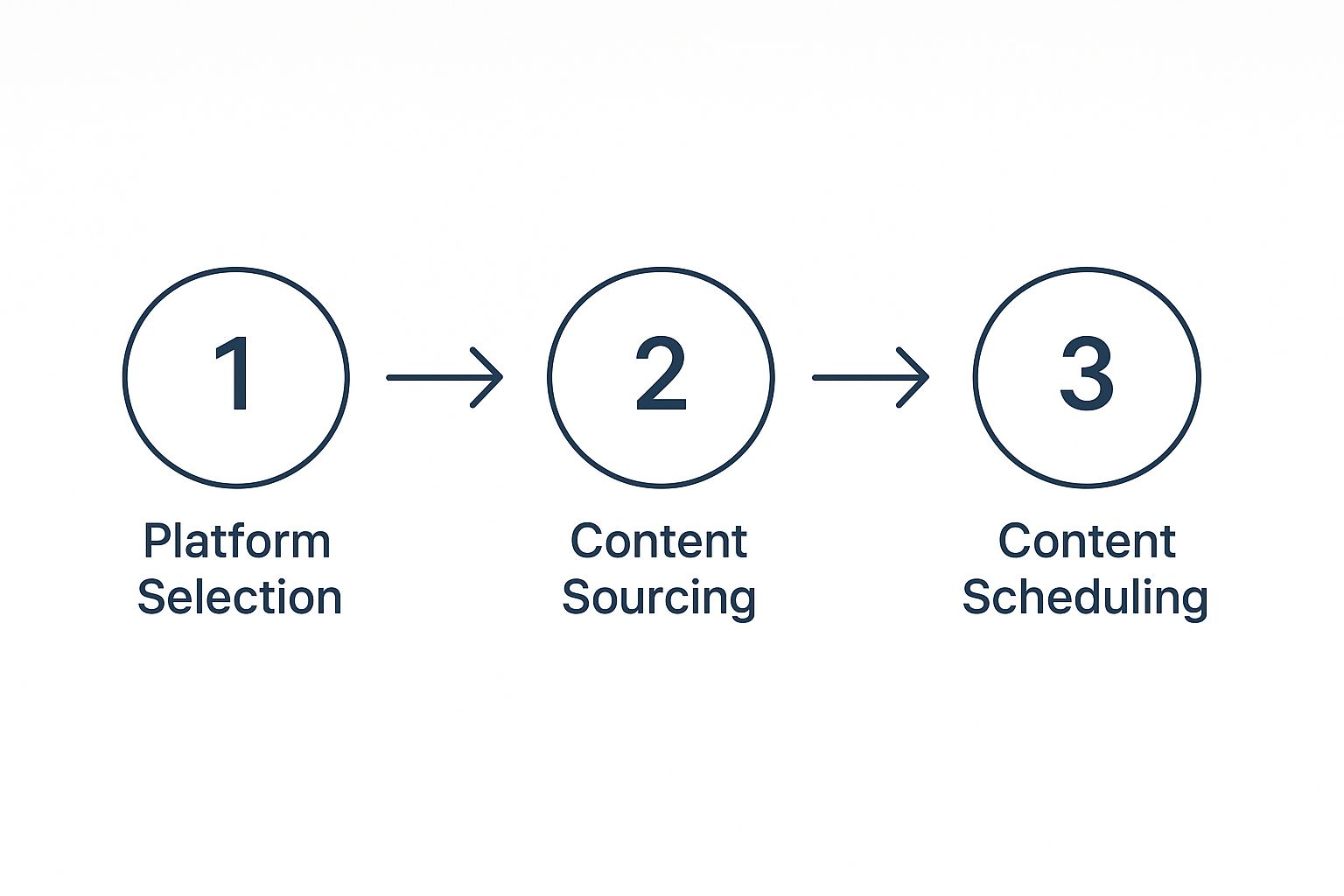
As you can see, this is about building a continuous, methodical system, not just running a one-off campaign.
To get the most out of your UGC, you need to map specific content types to each stage of the marketing funnel. This ensures you're delivering the most relevant and persuasive message when your audience needs it most.
UGC Application Across the Marketing Funnel
| Funnel Stage | UGC Type | Primary Goal | Platform Example |
|---|---|---|---|
| Top of Funnel (ToFu) | Viral-style videos, unboxings, aspirational photos | Build awareness, spark discovery, and create initial trust | TikTok and Instagram Reels ads featuring customer content |
| Middle of Funnel (MoFu) | In-depth reviews, customer photo galleries, how-to videos | Nurture interest, answer questions, build confidence, and overcome objections | Embedding a customer photo gallery on a product detail page |
| Bottom of Funnel (BoFu) | Detailed video testimonials, 5-star review screenshots | Drive conversion, reduce checkout abandonment, provide final reassurance | Adding compelling customer reviews to an abandoned cart email |
By thinking about the funnel this way, you move from just having UGC to using it with purpose. Each piece of content is given a job to do, whether it's stopping the scroll or sealing the deal.
Top of Funnel: Awareness and Discovery
At the top of the funnel (ToFu), your main job is to get noticed and build a foundation of trust. People at this stage don't know you yet, so they're naturally wary of glossy, traditional advertising. This is where UGC shines, cutting through the noise with raw authenticity.
Customer-created photos and videos are a game-changer for your social media ads. Instead of polished creative that feels like an interruption, UGC-powered ads look like something a friend would post. They stop the scroll. They provide instant social proof, showing new audiences that real people already use and love your products.
Here’s how to put ToFu UGC to work:
- Social Ads: Run campaigns on platforms like Instagram and Facebook using your best customer videos. You’ll often see higher click-through rates and lower acquisition costs compared to brand-made ads.
- Organic Social Posts: Make it a habit to feature customers on your main feed and in Stories. This gives you a constant supply of fresh content and also motivates more people to share their own posts, hoping for a feature.
- Blog Content: Weave customer photos and quotes into your blog posts. It’s an easy way to add visual proof and give your articles more credibility.
Middle of Funnel: Nurturing and Persuading
Once someone knows your brand, they enter the consideration phase. Now, they’re digging deeper, comparing you to competitors, and looking for reasons to choose you. Your mission here is to dissolve their doubts and build their confidence. UGC is your most persuasive asset for this.
Bring that social proof directly onto your own turf. For example, embedding a gallery of customer photos on your product pages lets shoppers see your items in the real world—on different body types, in different lighting, in different homes. It answers questions they didn't even know they had and makes the product feel real and relatable.
A single, well-placed customer photo or a detailed review can be the final nudge someone needs to go from "just looking" to "add to cart." It’s the digital version of a friend’s recommendation, served up right at the moment of decision.
Email is another fantastic channel for middle-funnel UGC. Don’t just send sales announcements. Feature a "customer of the week" or highlight top-rated products by showcasing their glowing reviews. This simple shift makes your emails feel less like a sales pitch and more like a valuable update from a community they want to be part of.
Bottom of Funnel: Converting and Retaining
At the bottom of the funnel (BoFu), your prospect is right on the edge. They just need one last bit of reassurance. This is where you bring out your most powerful UGC to close the deal.
Video testimonials and detailed customer reviews are pure gold at this stage. Placing them prominently on checkout pages or in abandoned cart emails can slash friction and dramatically increase conversion rates. Seeing another person's success story validates their choice and wipes away any last-second hesitation.
But UGC’s job isn’t done at the sale. It’s also a powerhouse for building loyalty and sparking repeat purchases. Sharing customer content creates a genuine sense of community, making customers feel seen and valued. This deepens their emotional connection to your brand, making them far more likely to buy again and become the advocates who create your next wave of UGC.
This cycle is especially potent on platforms like TikTok, where authenticity is everything. User content drives a staggering 60% of brand engagement on the platform, and 83% of users agree it makes brands seem more authentic. By weaving customer stories into every stage of your marketing, you build a powerful, self-sustaining loop of trust, conversion, and growth. You can discover more stats on UGC performance to see just how effective this approach can be.
Measuring the Real ROI of Your UGC Efforts
A strong user-generated content strategy feels good, but feelings don’t get your budget renewed. If you can't tie your UGC program to real business value, you’re leaving it vulnerable. The key is to look past vanity metrics like likes and shares and start tracking the numbers that actually move the needle.
Measuring the return on investment (ROI) for UGC isn't about finding a single magic number. It's about seeing its ripple effect across your entire marketing funnel. When you have hard data, you can fine-tune your approach, argue for more resources, and show stakeholders exactly how your customers’ content is fueling growth.
Key Metrics That Truly Matter
To prove your UGC strategy is working, you have to connect it to concrete business outcomes. A great way to start is by isolating its impact. For example, run a simple A/B test on your social media ads—pit your polished, brand-created creative against a top-performing photo from a real customer.
Here’s what you should be tracking:
- Conversion Rate Lift: What happens to your conversion rate when you add a gallery of customer photos to a product page? Many brands see a major jump here because authentic UGC serves as powerful social proof right at the moment someone is deciding to buy.
- Ad Performance: Look at the Click-Through Rate (CTR) and Cost Per Acquisition (CPA) for ads that feature UGC versus your standard brand ads. You'll often find that authentic content resonates more, leading to better engagement and a more efficient ad spend.
- Engagement Rate: Compare the likes, comments, shares, and saves on your UGC posts to your regular branded content. A higher engagement rate is a clear sign that customer content is grabbing more attention and building a stronger community.
The goal is to connect the dots between a customer's photo and a completed sale. When you can show that a product page featuring UGC converts 25% better than one without, you've moved from a "nice-to-have" marketing tactic to an essential revenue driver.
Tracking Content Volume and Value
Beyond direct sales, don't overlook the sheer efficiency of your UGC program. Creating content in-house or with an agency is expensive and slow. Your customers, on the other hand, provide a steady stream of authentic assets that scales beautifully.
Start by tracking the volume of usable content you source every month. If your community gives you 50 high-quality photos and videos, do a quick calculation. What would it have cost you to produce that same amount of content yourself? That "content savings" is a direct, hard-dollar return.
Another powerful, though more advanced, metric to consider is Earned Media Value (EMV). This puts a dollar value on the organic reach and engagement your UGC generates. Our guide explains in detail how to calculate EMV so you can start quantifying the impact of those organic mentions in a language your finance team will understand.
Tools and Methods for Effective Measurement
You can't track what you don't see. Putting the right tools and processes in place is the only way to gather accurate data.
- UGC Platforms: Tools like Flowbox or Yotpo are built for this. They help you collect, manage, and most importantly, track the performance of your UGC. Many have built-in analytics that show you exactly which pieces of content are driving clicks and sales.
- UTM Parameters: This is non-negotiable. When you share UGC anywhere—social media, emails, ads—tag the links with unique UTM codes. This lets you trace traffic and conversions from specific posts right inside Google Analytics, giving you a crystal-clear picture of what’s working.
- Website Analytics: Dive into your website's analytics. Compare the Add-to-Cart Rate and Time on Page for pages that have UGC galleries versus those that don't. A noticeable difference is powerful evidence of its influence on the buyer's journey.
By combining these different measures, you can paint a complete picture of your UGC program's value. For an even deeper dive, this ultimate guide to social media ROI measurement is a fantastic resource. Consistent, data-backed reporting doesn’t just justify your strategy—it gives you the insights you need to make it better and better over time.
Still Have Questions About UGC? We’ve Got Answers.

Even the best-laid plans run into questions. As you start putting your UGC strategy into motion, a few common hurdles and points of confusion are bound to pop up. Let's get ahead of them right now.
What’s the Difference Between UGC and Influencer Marketing?
This is a big one, and the line can feel blurry. While both involve content from people outside your company, the key difference is the relationship.
True user-generated content comes from genuine customers and fans who create content organically, usually without getting paid. It’s born from authentic excitement about your brand.
Influencer marketing, however, is a formal partnership. It's a business deal where you collaborate with creators who have a dedicated audience to promote your product. A really strong UGC strategy actually weaves these two together, mixing unpaid fan content with targeted influencer campaigns for a powerful one-two punch.
How Do I Get Legal Permission to Use Someone's Content?
Getting permission isn't just a good idea—it's non-negotiable. It protects you legally and, just as importantly, builds trust with your community.
The simplest way is to reach out directly. You can drop a public comment on their post or send a direct message. Just be crystal clear about how and where you want to use their content.
For instance, a quick message like, "This is amazing! We'd love to feature this on our Instagram feed and in our newsletter. If you're cool with that, just reply with #Yes[YourBrand]." This gives you a clear, written record of their consent. For bigger campaigns, like paid ads, it's wise to have them agree to more formal terms on a dedicated landing page. And please, always give credit by tagging their handle.
Responding to negative UGC with professionalism and empathy can build more brand trust than a positive review ever could. It shows everyone watching that you listen, you care, and you're committed to making things right.
What if My Brand Receives Negative UGC?
First, don't panic. Negative feedback, when handled correctly, can be an incredible opportunity to show your brand's character.
Your initial move should always be to address the comment publicly and professionally. Thank them for their feedback and offer to make things right. This simple act shows your entire audience that you're listening and you care.
Then, immediately shift the conversation to a private channel—DMs, email, a phone call—to dig in and solve their specific problem. This approach turns a potential PR fire into a public demonstration of fantastic customer service. The golden rule? Never delete negative comments unless they are clear spam or violate community guidelines with things like hate speech.
How Much Should I Budget for a UGC Strategy?
The beauty of a user-generated content strategy is that it can scale with you. You can absolutely get started with a shoestring budget, focusing your resources on the time it takes for community management and manually sourcing content.
Once you start seeing results, you can begin to allocate funds to level up your efforts. Here’s what that could look like:
- UGC Management Platforms: These tools are a lifesaver for automating content collection and rights management. They can run anywhere from $100 to over $1,000 per month.
- Contest Prizes: Offering incentives like gift cards, free products, or unique experiences can seriously boost participation in your UGC campaigns.
- Paid Amplification: Got a piece of UGC that’s performing exceptionally well? Put some ad spend behind it to expand its reach and get it in front of a whole new audience.
The key is to start small, prove the ROI with the metrics we covered earlier, and then scale your investment based on real, tangible results.
Ready to streamline your creator collaborations and build a powerful UGC engine? REACH provides the tools you need to discover influencers, manage campaigns, and measure your success all in one place. Find your perfect partners and prove your ROI by booking a demo.