 Skip to content

If you’ve ever stared at a campaign report, you know the confusion that can set in when you see views and impressions. They sound similar, but they tell two completely different stories about your content's performance. Getting them straight is the first step to understanding what's really working and proving your influencer marketing ROI.
Let's break down the views vs impressions debate simply. Impressions count how many times your content was displayed on someone's screen. That’s it. They could have scrolled right past it without a second glance. Views, on the other hand, are counted only when someone actively watches your content for a specific amount of time.
Think of it this way: an impression is potential visibility, while a view is confirmed attention. One person can rack up multiple impressions of the same post just by scrolling up and down their feed, but they'll likely only count as one view if they stop to watch the video. This distinction is critical for measuring success, and a platform like REACH Influencers is designed to give you clarity on both.
Table of Contents
- Views Vs Impressions: The Fundamental Difference
- What’s the Real Difference Between a View and an Impression?
- How Social Platforms Measure Views and Impressions
- Choosing Metrics for Your Campaign Strategy
- Why Views Often Tell a Better Story for Influencer ROI
- Optimizing Campaigns for Views and Impressions
- Frequently Asked Questions
Views Vs Impressions: The Fundamental Difference
Confusing these two metrics is a common pitfall in influencer marketing, one that can lead to flawed strategies and a skewed understanding of your campaign’s ROI. They aren't interchangeable, and knowing the difference in the views vs impressions discussion is critical for proving your campaign's value.
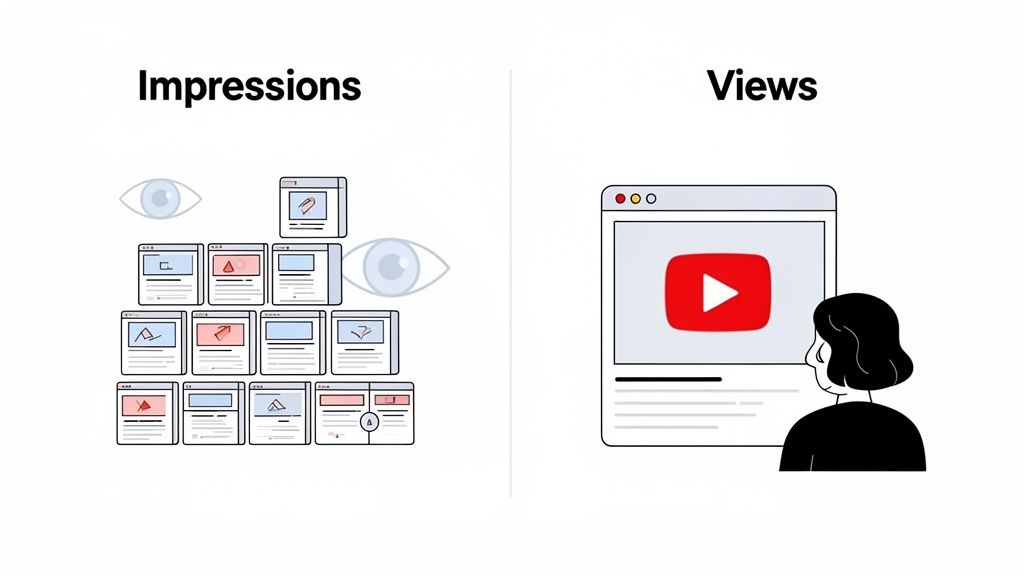
An impression is fundamentally a passive metric. It’s registered the moment your ad or post loads in a user's feed on Instagram or Twitter. No interaction is needed. This makes impressions a great yardstick for measuring brand awareness and sheer reach—a high number means the algorithm is pushing your content out there.
A view, however, is all about action. It signals that someone made a conscious choice to engage. This makes views a much stronger indicator of genuine interest and content quality. For brands, this is where the rubber meets the road. Chasing a high impression count is fine, but if those impressions don't translate into views, you have high visibility with very little impact.
Making Sense of the Data
So, how does this play out in a real campaign? An influencer's video might generate a massive 1,000,000 impressions but only get 50,000 views. That isn't necessarily a bad thing; it’s a data point that needs context.
The real insight comes from analyzing the ratio between views and impressions. A high ratio suggests your content is compelling enough to stop the scroll, while a low ratio might indicate a mismatch between your creative and your target audience.
This is exactly why we built the REACH Influencers platform—to cut through the noise. Our dashboards give you a clear, consolidated look at both metrics across all your campaigns. You can instantly see which influencers are truly capturing attention versus just appearing in feeds. By comparing these KPIs, you can make smarter decisions, refine your creative, and finally prove the tangible value of your partnerships.
To make it even clearer, here's a quick side-by-side breakdown.
Quick Comparison: Views Vs. Impressions
| Metric | What It Measures | User Action Required | Typical Volume |
|---|---|---|---|
| Impressions | How many times content was displayed on a screen | None; content just needs to load in a feed | Very High |
| Views | How many times content was actively watched for a minimum duration | A conscious choice to play or watch a video | Lower than Impressions |
Ultimately, both metrics have their place. Impressions tell you about your potential audience size, while views tell you how much of that audience you actually captivated. Knowing how to read them together is what separates a good campaign from a great one.
What’s the Real Difference Between a View and an Impression?
Let's get right to it. The whole views vs. impressions debate boils down to a simple mechanical trigger. An impression is counted the second your content loads on someone's screen. That's it. It doesn't matter if they actually saw it, scrolled past in a blur, or if it was hidden "below the fold." If the platform served it, it counts as an impression.
And that’s why you’ll almost always see impression numbers that are way higher than your view counts. A view is different because it demands a flicker of intent from the user. Most platforms, including Instagram and Facebook, only register a view after someone watches your video for a specific amount of time—often just three seconds. That tiny time-gate is everything; it’s the line between passive exposure and active attention.
A Practical Scenario
Imagine a creator on the REACH Influencers platform posts a new campaign video. Within a day, their dashboard is showing 100,000 impressions but only 20,000 views. So, what’s the story here?
This data tells you that the algorithm did its job and pushed the content out far and wide (hello, impressions). However, only 20% of the people who were served the post actually stopped their scroll to watch for at least three seconds. This isn't a bad thing; it’s a powerful diagnostic. You're seeing the difference between your potential audience and your captured audience. High impressions show the opportunity, but the view count reveals how much of that opportunity you actually seized.
The difference here is crucial. When your content gets 5,000 impressions, that means it was loaded onto a user's feed 5,000 times. It doesn't mean 5,000 unique people saw it. One person scrolling back and forth could generate several impressions. This is precisely why it's so important to understand what social media impressions really measure.
The gap between your impressions and your views is one of the most honest pieces of feedback you can get. It’s a direct measure of your content’s "scroll-stopping" power.
Why This Nuance Is a Game-Changer for Marketers
Understanding this distinction is everything when you're in the trenches analyzing campaign performance. If you only chase big impression numbers, you might be celebrating a win that isn't real. You could be reaching a huge number of screens, but if the view count is lagging, your message simply isn't connecting.
This directly shapes your strategy in a few key ways:
Smarter Budgeting: When you find an influencer who consistently delivers a high number of views relative to their impressions, you've found gold. Their content clearly resonates, making them a much better investment for campaigns that need to educate customers or drive conversions.
Creative Feedback: Seeing a ton of impressions but very few views is a clear sign that the creative itself missed the mark. Maybe the thumbnail wasn't intriguing, or the first few seconds failed to hook the viewer. It's not a failure; it's a signal to go back and tweak your approach.
Better Reporting: Being able to clearly explain the views vs. impressions difference to clients or stakeholders is a must. It moves the conversation beyond vanity metrics, sets realistic expectations, and shows you have a sophisticated grasp of what's really happening with the campaign.
How Social Platforms Measure Views and Impressions
If you think a "view" is just a view, think again. The whole views vs. impressions debate gets particularly messy when you realize every social platform plays by its own rules. What Instagram counts as a view is completely different from what YouTube does, which makes comparing campaign performance across channels a real headache without a unified tool.
You have to get into the weeds and understand how each network actually measures attention. It’s the only way to accurately read your campaign data and make smart decisions. Without that context, you're just comparing apples to oranges, and you risk completely misjudging how a campaign is actually performing.
This image tells the story perfectly. You'll almost always see a massive number of impressions that funnels down into a much smaller, more meaningful number of views.
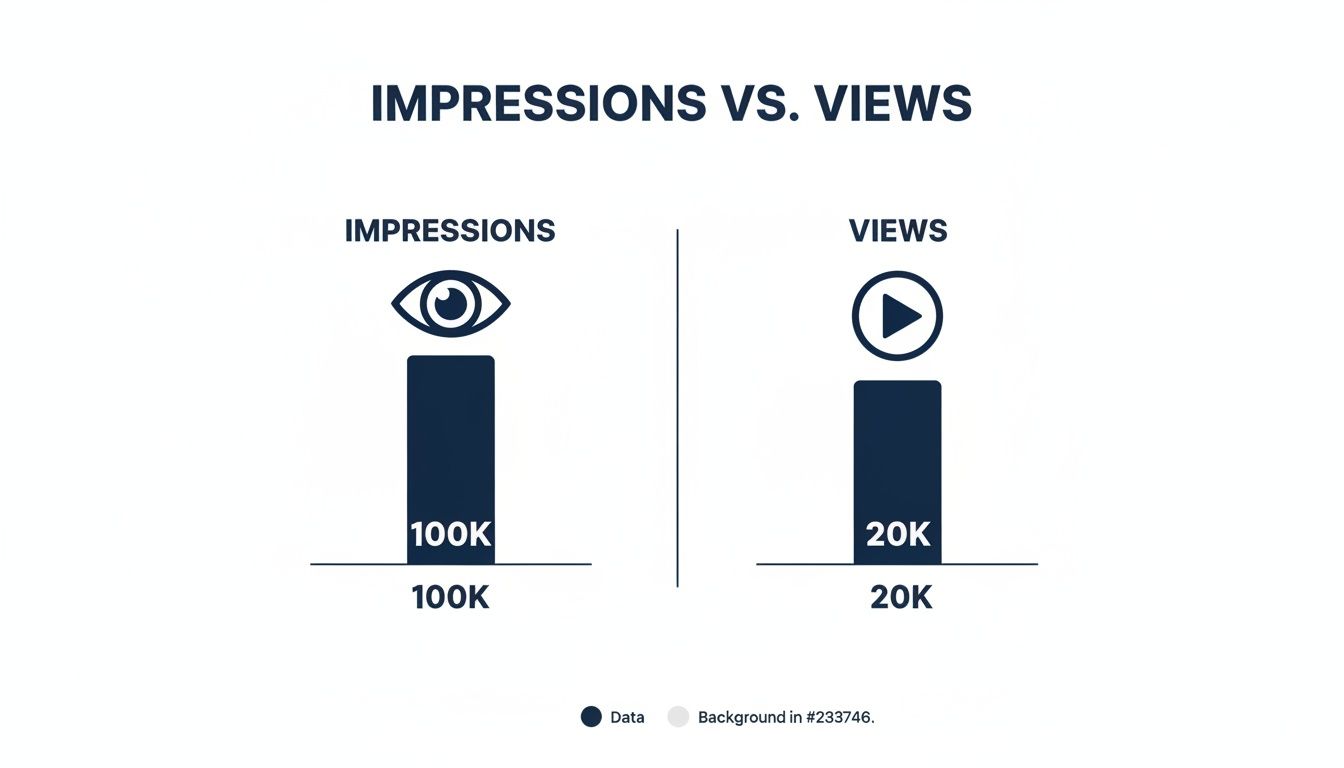
It’s a clear reminder that just because content lands on a screen (an impression) doesn't mean anyone actually stopped to watch it (a view).
Instagram and Facebook: The Three-Second Rule
On Meta’s turf, which includes Instagram and Facebook, the magic number is three. A video view is officially logged after someone watches for three continuous seconds. So, a quick thumb-flick past your content won’t count, but even a brief pause is enough to get tallied.
Impressions, on the other hand, are counted the moment your content appears on a user's screen. That’s why you'll see impression counts skyrocket compared to views on these platforms—the barrier to entry is just much lower.
YouTube: The Gold Standard for Views
YouTube really sets the bar high. To count as a view, someone has to watch your video for a full 30 seconds (or the entire video if it's shorter than that). This is precisely why a YouTube view is often seen as a much stronger signal of real interest.
This strict 30-second requirement does a great job of filtering out passive scrollers. It ensures that a "view" actually represents a conscious decision to engage, which is a big reason why brands and creators trust YouTube for building a genuinely invested audience.
TikTok: The Instant Play
TikTok is on the complete opposite end of the spectrum. A view gets counted the very instant a video starts playing on someone's "For You" page. There’s no minimum watch time at all.
This is the secret behind the astronomical view counts you see on TikTok. It’s a perfect reflection of the platform’s fast-paced, discovery-first nature, but it also means a single view doesn’t carry the same weight as it does elsewhere.
X (Formerly Twitter): A Softer Approach
X (formerly Twitter) splits the difference. For a view to count, a user needs to watch for at least two seconds, and 50% of the video player must be visible on their screen. It's a reasonable middle ground that makes sure the content was actually in a position to be seen.
A huge development has recently stirred the pot in the views vs. impressions world. Meta started prioritizing views over impressions in its reporting, and the impact has been significant. We’ve seen firsthand that view counts can be 25% or higher than the old impression numbers on Instagram and Facebook. This is because views now count every single playback, even repeats from the same person. For those of us using platforms like REACH Influencers, it means we have to readjust our benchmarks and explain to clients why view metrics suddenly look so much bigger than they used to.
Understanding the nuts and bolts of creating content, like in this guide on how to start streaming on Twitch, adds another layer of context to these metrics. The rules of each platform directly influence how creators make their content and how brands should interpret the results. And if you want to go even deeper, check out our guide on whether Instagram shows who viewed your video.
Choosing Metrics for Your Campaign Strategy
The whole views vs. impressions debate really gets interesting when you move past definitions and start planning your campaign goals. Deciding which metric to focus on isn't about picking a "winner." It's about aligning your measurement with your actual objective for a specific campaign. This is how you turn numbers into a smart, actionable plan.
Your choice should connect directly to where your audience is in the marketing funnel. Are you trying to cast the widest net possible? Or are you aiming to capture genuine interest from people who are already paying attention? Each metric tells a different story, and a great strategy uses both intentionally.
When to Prioritize Impressions for Maximum Visibility
Impressions are your go-to metric for any top-of-funnel activity where mass visibility is the goal. Think of impressions as the engine that drives brand awareness. Right now, you aren't trying to get deep engagement—you just need to get your brand, product, or message in front of as many eyeballs as possible, as often as possible.
Make impressions your main KPI in these situations:
- New Product Launches: When you’re rolling out something new, your first job is to let the world know it exists. A high impression count is your best bet for making sure that announcement is seen far and wide.
- Brand Awareness Campaigns: If you want to build brand recognition so people remember you later, repetition is key. Impressions directly measure how often your content is being shown, which is crucial for staying top-of-mind.
- Event Promotions: Trying to fill seats for a webinar, conference, or drive traffic to a big sale? You need to reach a huge audience fast. Impressions give you a clear read on how far your promotion is spreading.
In these cases, a lower view count doesn't mean you've failed. It's just the natural outcome of a strategy built for broad, passive exposure instead of active, focused watching.
When to Prioritize Views for Deeper Engagement
On the other hand, views become the star of the show once your goal shifts from just being seen to sparking genuine interest. A view is solid proof that you’ve not only reached someone but also held their attention, even if just for a few seconds. This makes views the perfect metric for campaigns meant to educate, build trust, or guide someone toward making a decision.
You'll want to focus your strategy on maximizing views when your goals are more about:
- Product Tutorials or Demos: If you need to show how your product works, you need people to actually watch. A view tells you a user is actively learning about what you offer, which is a huge step toward a potential purchase.
- Influencer Testimonials: The real magic of a testimonial is in the story and the delivery. High view counts on these videos show that the influencer's message is connecting and building real credibility for your brand.
- Building Brand Affinity: Content that tells a story, shares your company’s values, or just entertains your audience creates a much deeper connection. Views are how you measure how many people are willing to invest their time in your brand.
Choosing the right metric sets the entire tone for your strategy. Focusing on impressions pushes you toward broad, awareness-focused campaigns. Prioritizing views, however, forces you to create truly valuable content that holds attention.
The REACH Influencers platform is designed to support this kind of strategic thinking. Our dashboard lets you set specific goals for every campaign—whether that's hitting an impression target of 1 million for a launch or getting 100,000 quality views on a tutorial series. This helps you track performance against the KPIs that really matter for each objective, giving you the clarity you need to prove your ROI. You can learn more about this in our detailed guide on effective social media measurement.
Of course, to run a campaign that tracks these metrics well, you need the right setup. Checking out the best tools for marketers is a great next step. The right software doesn't just measure these things; it helps you optimize for the outcomes that actually grow your business. Ultimately, knowing when to focus on views vs. impressions is what lets you build campaigns with clear intent and truly measurable results.
Why Views Often Tell a Better Story for Influencer ROI
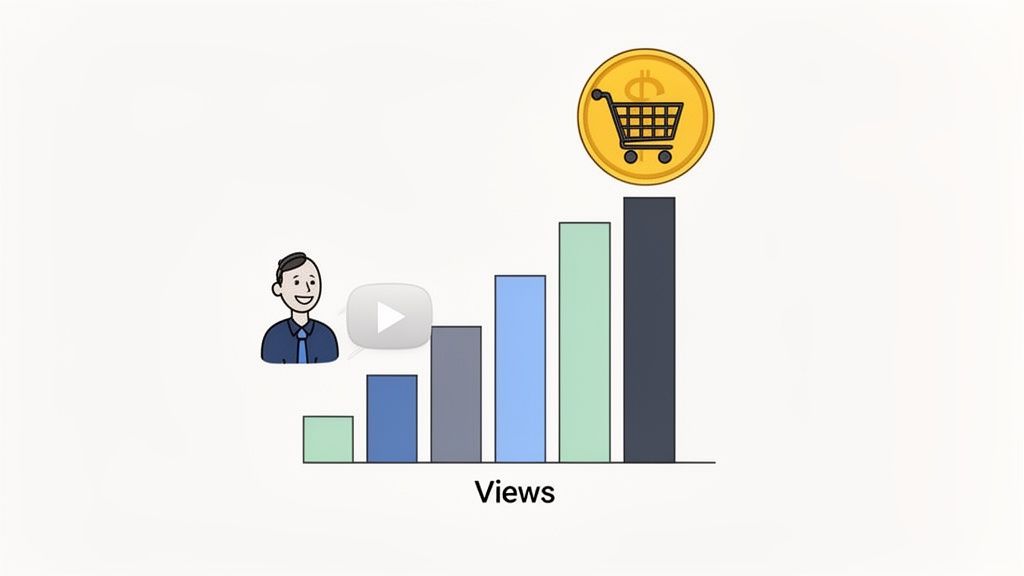
While impressions are a great starting point for measuring brand awareness, the views vs impressions debate usually ends with one winner when you’re talking about real ROI: views. An impression can be completely passive. It's a fleeting moment as someone scrolls through their feed, and it requires zero interaction.
A view, on the other hand, is an active choice. It’s a signal that your content was interesting enough to make someone pause, watch, and actually pay attention.
That small act of intentional engagement is far more powerful than a simple scroll-by. It shows genuine interest, which is the first step toward building brand recall, influencing a purchase decision, and ultimately, driving sales. When someone invests their time in your video, they're much more likely to absorb the message and form a real connection with your brand.
The Power of Confirmed Attention
When you have to prove your campaign's worth, views are a much more defensible metric to bring to your leadership team. It’s simply easier to draw a straight line from someone watching a product tutorial to them clicking "buy" than it is from a passive impression. A high view count doesn't just mean you reached people; it means your influencer’s content truly resonated.
The video marketing world figured this out a while ago. In fact, industry research shows that 67% of video marketers now prioritize view count as their single most important performance metric. It’s a clear consensus that active attention is the gold standard for knowing if your content is actually working. You can find a great breakdown of why views are so critical on MagicLogix.com.
When a creator on REACH Influencers reports 150,000 impressions but only 12,000 views, the 8% view-to-impression ratio tells a more honest story about audience engagement than the impression number alone.
This distinction is what separates good campaigns from great ones. You could have two influencers with the same follower count, but if one has a dramatically higher view rate, you know who is better at capturing and holding their audience's attention. Focusing on views helps you find the partners who create content people actually want to watch.
From Views to Business Outcomes
To truly connect influencer marketing to ROI, you have to look past the basic view count. This is where a platform like REACH Influencers becomes your command center. Our analytics dashboards let you move beyond surface-level numbers and track the KPIs that tell the full story.
Here are a few key metrics you can track in REACH to get a clearer picture:
- View-Through Rate (VTR): This shows you the percentage of impressions that actually turned into views. It’s a direct measure of your content’s “scroll-stopping” power.
- Cost Per View (CPV): By calculating exactly what you paid for each confirmed view, you can see how efficiently your budget is working and compare performance between influencers.
- Audience Retention: This metric shows you exactly how long people are watching. High retention on a product demo, for instance, is a massive indicator of purchase intent.
Let me give you a real-world example. A skincare brand we work with used REACH to partner with an influencer for a new serum tutorial. The campaign delivered 50,000 high-quality views with an impressive average audience retention of 65%. Because the brand was tracking everything in REACH, they could directly link that deep engagement to a 15% lift in online sales the week after the campaign. That’s the kind of clear, defensible proof of ROI you get when you prioritize views.
Optimizing Campaigns for Views and Impressions
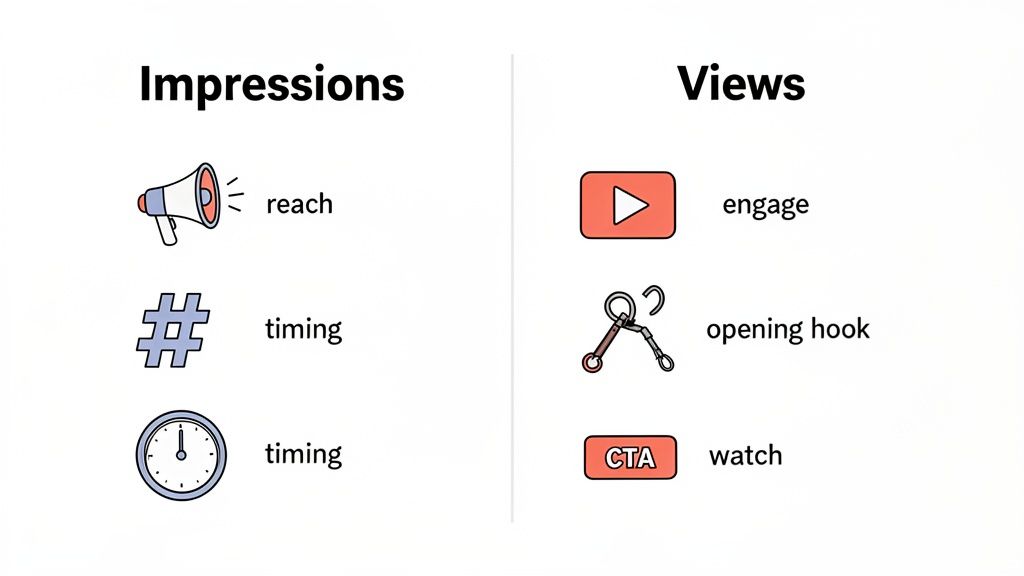
Knowing the difference between views vs impressions is a great start, but the real magic happens when you know how to pull the right levers to improve both. To get results, you need a separate playbook for each. Think of it this way: optimizing for impressions is about maximizing visibility, while optimizing for views is all about capturing and holding someone’s attention.
These two goals demand different approaches. You can't just throw content out there and cross your fingers. You have to be strategic, deciding whether you're playing the algorithm's game to get maximum reach or crafting an experience that truly earns a viewer's time.
Tactics to Boost Your Impressions
When your main objective is to get as many impressions as possible, your strategy is all about discoverability. You want your content to show up on as many screens as it can, and that means sending the right signals to each platform’s algorithm.
Here are a few battle-tested tactics to get your impression count climbing:
- Master Your Hashtags: Don't just slap on a few popular tags. Use a smart mix of broad, niche, and trending hashtags to get your content in front of people who don't follow you yet. This is your direct line into relevant, ongoing conversations.
- Post at Peak Times: Dive into your analytics and find out exactly when your audience is most active. Posting during these golden hours means your content gets seen right away, which often creates a snowball effect with the algorithm.
- Collaborate for Broader Reach: Team up with influencers who have a massive following and a reputation for high reach. They have the power to push your content to a huge audience, giving your campaign a quick and powerful impression boost.
Tactics to Drive More Views
Once you've earned that impression, the clock starts ticking. You have a split second to turn a passing glance into a committed view. This means your content has to be compelling enough to stop the scroll and keep someone watching.
To turn those impressions into meaningful views, focus on these strategies:
- Nail the Opening Hook: The first three seconds are do-or-die. Kick off your video with a provocative question, a surprising stat, or some eye-catching movement. Do whatever it takes to spark curiosity and stop them from swiping away.
- Optimize Your Video Length: There's no one-size-fits-all duration. A short, snappy video might crush it on TikTok, but a detailed tutorial could be perfect for YouTube. Match the length to the platform and what you're trying to achieve.
- Add a Clear Call-to-Action (CTA): Don't leave your audience hanging. At the end of the video, tell them exactly what to do next. A simple "Let me know what you think below" or "Share this with a friend" encourages engagement and increases the time spent on your post, signaling its value to the algorithm.
A winning influencer marketing strategy isn't an accident—it's built. It all starts with finding partners whose natural strengths align with your campaign goals, whether that’s incredible reach for impressions or deep engagement for views.
This is exactly where a platform like REACH Influencers gives you a serious edge. Our discovery engine lets you filter influencers based on their actual performance history. You can find partners with a proven knack for hitting massive reach numbers for your awareness campaigns, or you can zero in on creators who are masters at driving high engagement and view-through rates for your conversion-focused content.
By using REACH, you can build an optimized campaign from the ground up, putting your budget behind influencers who are already equipped to get you the results you need. Stop hoping for good performance and start building your strategy on data.
Frequently Asked Questions
Alright, we've covered the theory behind views vs. impressions. But when you're in the middle of a campaign and staring at the numbers, things can get confusing. Let's tackle a few of the questions that pop up most often.
What Is the Relationship Between Views and Reach?
Here’s a simple way to picture it: reach is the number of unique people who saw your content. Views are the total number of times your content was actually played.
Think of it this way: if one person watches your video five times, your reach is 1, but your views are 5. Reach tells you how big your audience is, while views tell you how much they're paying attention. A high reach with low views often means your content showed up in a lot of feeds, but your creative didn't give people a reason to stop scrolling and watch.
Is a High Impression Count with Low Views a Bad Thing?
It really comes down to what you were trying to achieve. If your main goal was brand awareness—just getting your name out there—then high impressions are fantastic. You've successfully cast a wide net.
But if you wanted to educate your audience or get them to consider a purchase, then a high impression count with low views is a red flag. It’s a clear signal that your message isn't landing. People see it, but they aren't interested enough to engage. That's your cue to rethink the creative, especially the first three seconds.
How Should I Explain Views Vs Impressions to a Client?
I find analogies work best here. Explain that impressions are like seeing a billboard on the highway. Thousands of cars drive past it (impressions), but only a fraction of those people will actually turn their head and read the message (views).
Then, immediately connect it back to their goals. For awareness campaigns, you’ll focus on the massive impression numbers to show wide-scale visibility. For engagement campaigns, you’ll highlight the view count and view-through rate to prove people are genuinely connecting with the content. Pulling up the REACH Influencers dashboard is great for this, as you can show both metrics side-by-side to visually separate potential audience from captured attention.
When reporting to clients or stakeholders, always start with the goal. If they wanted awareness, lead with the impressive impression count. If they wanted engagement, start with the view-through rate as proof of quality content.
Why Is My View Count Sometimes Higher Than My Impression Count?
This is a classic platform quirk, especially on Meta's apps like Instagram and Facebook. It all comes down to how they count things. An impression might only be counted the first time a post appears on a user's screen in a single session.
A view, however, can be counted every time the video plays, autoplays, or is replayed. So if one dedicated fan watches your Reel three times in a row, you'll get three views but maybe only one impression. It’s another perfect example of why the views vs impressions conversation is more complex than it seems.
Tired of juggling spreadsheets to explain your campaign's performance? The REACH Influencers platform brings all your data into one place, giving you a crystal-clear picture of both views and impressions. See how REACH can transform your reporting and strategy today.