 Skip to content


Let's get one of the most common social media terms straight: impressions.
Put simply, an impression is counted every single time your content pops up on someone's screen. Think of it this way: if one person scrolls past your post three separate times in their feed, that counts as three impressions. It’s a measure of total views, not unique viewers.
What Social Media Impressions Really Mean for Your Brand
It’s easy to gloss over impressions as a simple vanity metric, but they're the foundational layer for everything else you measure. Before a single person can like, comment, or share your content, they first have to see it. Impressions tell you if that first, crucial step is even happening.
This raw count is your first clue that a platform’s algorithm is doing its job and pushing your content out into the world. A high impression count means your post is showing up—in user feeds, on explore pages, or in stories. This visibility is the very bedrock of your social media strategy.
The Foundation of Brand Awareness
When it comes to building brand awareness, impressions are your currency. The more times your content appears in front of your target audience, the more familiar your brand becomes. In a noisy, crowded online world, that repetition is what builds recognition and keeps you top-of-mind.
Consider the scale: with a projected 5.42 billion people using social media globally by 2025, the potential for visibility is staggering. It’s why businesses are on track to spend $276.7 billion on social advertising that year—they're all paying for guaranteed impressions. You can explore these and other trends on Sprout Social.
Impressions are the first handshake between your brand and a potential customer. They don't guarantee a conversation, but without them, a conversation can't even begin.
How Impressions Pave the Way for Deeper Metrics
At the end of the day, impressions are the first domino to fall in a successful campaign. They create a clear funnel that leads directly to the metrics that measure deeper connection and action.
It all flows in a logical sequence:
- Awareness (Impressions): How many times was your content displayed?
- Reach: How many unique people saw that content?
- Engagement: Of those people, how many actually interacted with it?
Getting a handle on this progression is key. High impressions are a great start, but their true value comes to light when you analyze them alongside other performance indicators. To get a better sense of the full picture, take a look at our guide on social media engagement metrics.
Impressions vs. Reach: What's the Real Difference?
It’s one of the most common points of confusion for marketers, but getting the hang of impressions versus reach is a game-changer for any social media strategy. The distinction is actually quite simple once you nail it down.
Reach is about how many unique people see your content. Impressions are about how many times your content is seen in total.
Think of it like putting up a billboard on a busy highway. The total number of individual drivers who see your billboard over a month is your reach. If one of those drivers, let's call her Jane, drives that route to work every day and sees your billboard 20 times, she only counts as one person reached. However, Jane alone generated 20 impressions.
This visual helps break down how impressions and reach work together to create engagement.
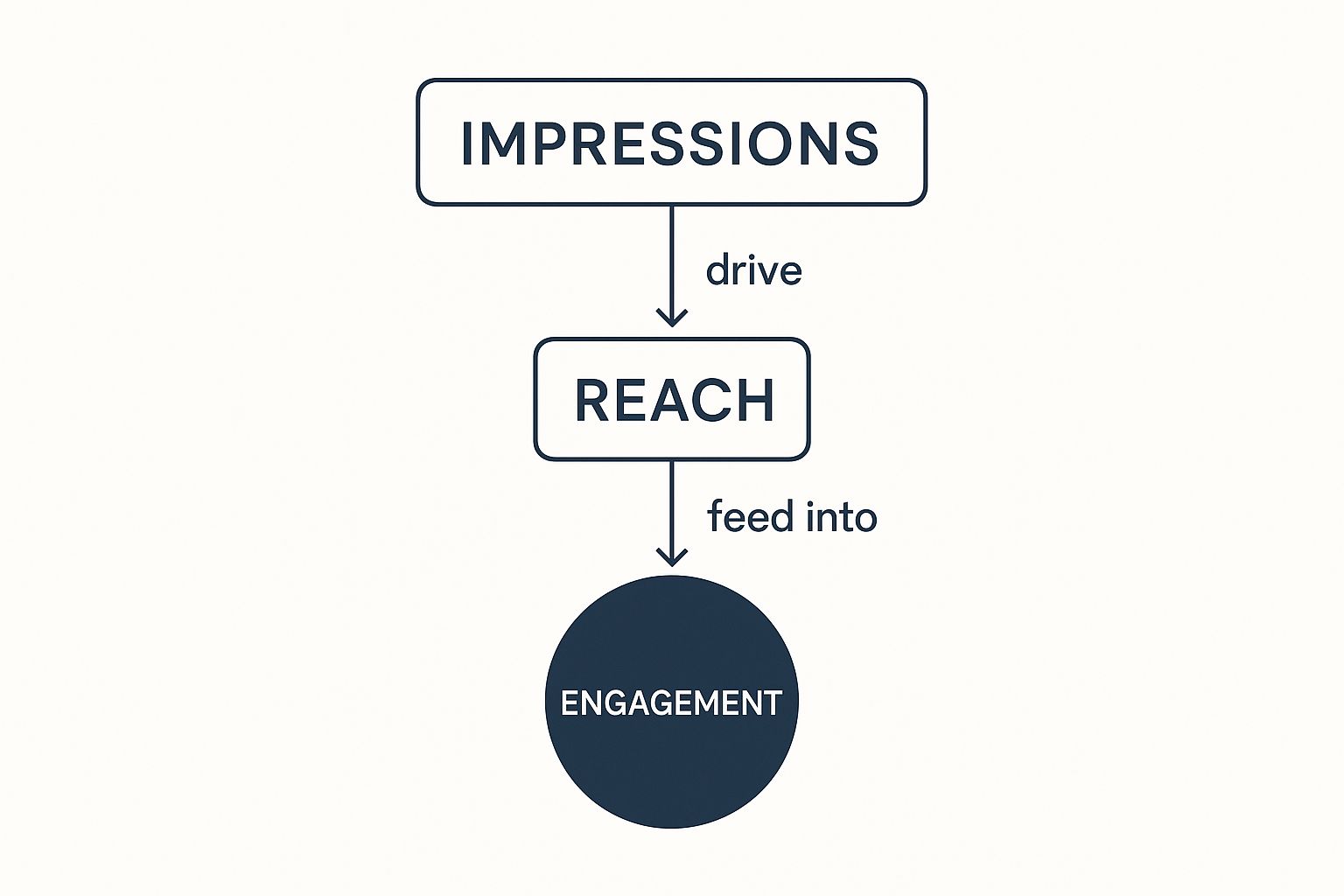
As you can see, impressions are the foundation. They create the visibility that leads to reach, and you need both to get people to actually interact with your content.
A Practical Example: How It Plays Out on Your Feed
Let’s translate this into a real social media scenario. You post a new video on your company's Facebook page.
One of your followers, David, scrolls through his feed and sees it. That’s one person reached and one impression. Simple enough.
A few hours later, David sees your post again because a friend commented on it, pushing it back into his feed. Your reach is still one (it's still just David), but your impressions have just ticked up to two. This is great news! It means your content is sticky and has enough relevance to be shown multiple times.
Reach tells you how wide your net was cast. Impressions tell you how many times people saw the net in the water. One measures audience size, the other measures message frequency.
This simple table breaks it down for quick reference.
Reach vs Impressions At a Glance
| Metric | What It Measures | Example | Primary Use Case |
|---|---|---|---|
| Reach | The total number of unique people who saw your content. | 1,000 unique accounts viewed your Reel. | Measuring the true size of your audience and the spread of brand awareness. |
| Impressions | The total number of times your content was displayed, regardless of clicks. | Your Reel was displayed 3,000 times to those 1,000 accounts. | Gauging content visibility, ad frequency, and how often your message is appearing. |
So, when you see a high number of impressions, it's a signal that the platform's algorithm likes your content and is showing it to people repeatedly.
When to Focus on Each Metric
Knowing which metric to prioritize really comes down to what you're trying to achieve with a specific campaign.
If your goal is pure brand awareness—getting your name in front of as many new faces as possible—then reach is your north star. You want to cast the widest net you can.
But if you're running a campaign to drive a specific action, like signing up for a webinar, you might care more about impressions. Seeing an ad multiple times can build the familiarity and trust needed for someone to finally click. A high impression-to-reach ratio means your core audience is seeing your message again and again, which is exactly what you want for building brand recall.
Why Impressions Are a Cornerstone of Your Strategy
It’s easy to get caught up chasing likes, shares, and comments. But if you ignore social media impressions, you're missing the first—and most fundamental—piece of the puzzle. Think of impressions as the foundation of a house. Without a solid base of visibility, everything else you try to build will eventually crumble.
High impressions are the first vital sign that your content is healthy. It's a clear signal that the platform's algorithm sees your post as relevant and is actively pushing it into people's feeds. This is what fuels brand awareness. The more times people see your content, the more your brand name, logo, and message start to stick. In a noisy, fast-scrolling world, that repetition is how you cut through the clutter.
Using Impressions as a Diagnostic Tool
Impressions are more than just a vanity metric; they're a powerful diagnostic tool. When you start looking at your impression data alongside other metrics, you can get a surprisingly clear picture of what’s working and what’s falling flat. This turns raw data into a genuine roadmap for what to do next.
For instance, looking at impressions and engagement together tells a story:
-
High Impressions, Low Engagement: This is a classic. It means your content is getting seen, but it isn't connecting. Maybe your headline or visual grabbed enough attention for the algorithm to show it around, but the substance of the post didn't inspire anyone to click, comment, or share. The visibility is there, but the value isn't.
-
Low Impressions, High Engagement Rate: This tells the opposite story. You have a small but mighty audience that absolutely loves what you're doing. The problem is, the algorithm isn't showing your content to anyone new. This could be anything from poor hashtag choices to posting at the wrong time or using a format the platform isn't favoring right now. The value is there, but the visibility isn't.
By learning to read these patterns, you can move from guesswork to making sharp, data-backed decisions. Impressions give you the context you need to understand why your other numbers are what they are.
This has never been more critical. As of July 2025, the global social media user base hit a staggering 5.41 billion people, with 241 million new users joining in the last year alone. That massive audience presents an incredible opportunity for visibility—and a tidal wave of potential impressions. You can dig into these numbers yourself in this comprehensive social media user report.
How to Find and Analyze Your Impression Data
So, you know impressions are a big deal. That's the easy part. The real question is: where do you find this data, and what on earth do you do with it once you have it? A pile of numbers is just that—a pile of numbers. The magic happens when you turn that raw data into genuine insights that actually make your content better.
Thankfully, you don't need a data science degree to get started. Every major social media platform has its own built-in analytics tools, and they're usually pretty straightforward. If you have a business or creator account, this goldmine of information is typically right on your profile page or tucked into your settings menu. On Instagram, for example, it's called the "Professional Dashboard."
This dashboard is your command center. It gives you a snapshot of all your key metrics, showing you exactly how many impressions your posts, Reels, and Stories racked up over any time frame you choose. This is where you start to see what the algorithm loves and what it ignores.
Locating Your Data on Major Platforms
While each platform has its own quirks and calls things by slightly different names, finding your impression data is a pretty similar process no matter where you look. Your goal is to get comfortable popping into these dashboards on a regular basis to keep a pulse on your performance.
Here’s a quick cheat sheet for where to find them:
- Instagram & Facebook: Head over to your Professional Dashboard or the Meta Business Suite. From there, look for a tab labeled "Insights" or "Analytics." You’ll find a detailed breakdown of impressions for every piece of content you post.
- X (formerly Twitter): From your profile menu, just click on "Analytics." It gives you a rolling 28-day summary and lets you drill down to see the impression count for every single tweet.
- LinkedIn: If you're managing a Company Page, you'll find an "Analytics" tab right at the top. Click into the "Updates" section to see how many impressions your posts are getting in front of your professional network.
The secret to good analysis is asking better questions. Instead of just asking, "How many impressions did this get?" try asking, "Why did this post get twice as many impressions as that one?" That's where the real learning begins.
Turning Impression Data into Actionable Insights
Alright, you've found the numbers. Now for the fun part: making them work for you. You're essentially playing detective, looking for clues and patterns that tell you what drives visibility on your accounts. Impressions are one of the top social media metrics to track precisely because they are the first signal of a trend.
Start by digging into these three areas:
- Which content formats are winning? Take a hard look at the impression numbers for different types of posts. Are your Reels blowing your static images out of the water? Do carousels get more eyeballs than single-photo posts? The answer tells you exactly what kind of content the algorithm is prioritizing right now.
- What topics are people actually interested in? Scan for spikes in your impression data. Did a post about a new product feature or a hot industry trend suddenly take off? That’s a massive clue telling you what your audience—and their networks—want to see more of. Double down on it.
- How do organic and paid impressions compare? Always separate your paid and organic numbers. If a post is getting a ton of organic impressions, it means the content is genuinely good and resonating on its own. That's your green light—posts like these are the perfect candidates to put a little ad spend behind to amplify what's already working.
When you get into the habit of this kind of analysis, you stop just reporting on what happened and start actively shaping what happens next. For those managing multiple accounts, a dedicated social media analytics dashboard can pull all this information into one place, making it even easier to spot those game-changing trends.
Actionable Strategies to Boost Your Impressions

Knowing your numbers is one thing, but making them grow is what really matters. Getting more social media impressions isn’t just a game of chance. It’s about using smart, repeatable strategies that tell the platform's algorithm your content is valuable and deserves a bigger audience.
Think of these tactics as ways to improve your content’s discoverability. The goal is to kickstart a positive feedback loop: more engagement leads to more visibility, which in turn leads to even more engagement.
Master Your Hashtag Strategy
Hashtags are basically the search engine of social media, guiding both users and algorithms to your posts. A classic rookie mistake is to pile on generic tags like #marketing. You’re just tossing your content into an ocean with millions of other posts.
A much smarter approach is to use a mix of different hashtag types. Picture it like a pyramid:
- Broad/Popular Hashtags (1-2): These are the huge, high-traffic tags that can give you a quick flash of visibility. Don't overdo it.
- Niche-Specific Hashtags (3-5): These get more specific to your industry or topic, like
#SocialMediaAnalyticsor#ContentMarketingTips. They draw in a much more relevant crowd. - Community/Branded Hashtags (2-3): These are tags unique to your brand or a campaign you're running. They’re fantastic for building community and collecting user-generated content in one place.
This blended strategy helps you cast a wide net while still zeroing in on the people most likely to actually care about what you have to say.
Leverage Trending Formats and Audio
Social media platforms always give a little extra love to their newest features. When Instagram launches a new sticker for Stories or a format like Reels gains traction, the algorithm often rewards creators who jump on board with a nice visibility boost.
The same logic applies to trending audio on TikTok and Instagram. Tying your video to a popular sound can expose it to a massive audience that extends far beyond your own followers, as the platform pushes content related to that trend.
Create Content That Begs for Engagement
At the end of the day, the surest way to earn more impressions is to create content that people can't resist interacting with. Simple things like asking questions, running polls in your Stories, or writing captions that prompt a response can make a huge difference.
One of the most powerful moves you can make is to get your community involved. Featuring content from your followers not only gives you authentic material but also makes your audience feel valued. Building a solid user-generated content strategy can transform your followers from passive viewers into active promoters of your brand.
To really squeeze every last drop of value out of your work, you can also explore various content repurposing strategies that turn one great idea into multiple pieces of content, each with a new chance to rack up impressions.
Common Questions About Social Media Impressions
Even after you get the hang of impressions, a few questions always seem to come up. Let's walk through the most common ones to clear up any confusion and make sure you're confident in how you interpret this metric.
Are More Impressions Always a Good Thing?
Not really. Seeing a massive impression count can feel great, but it's a vanity metric if those views aren't from the right people.
Think about it: A local coffee shop in Austin, Texas, gets a million impressions on a post… but they're all from users in Australia. That huge number does absolutely nothing to get more people through their door.
Success is about quality, not just quantity. A smaller number of impressions delivered right to your target audience is way more valuable than a giant number shown to people who will never become customers. Always look at your impressions next to metrics like engagement and clicks to see if that visibility is actually helping you hit your goals.
Can I Have More Impressions Than Followers?
Absolutely, and when this happens, it’s usually a great sign! When your impressions climb higher than your follower count, it means your content has officially broken out of your immediate circle.
It's reaching new people through shares, hashtags, or discovery features like the Instagram Explore page or TikTok's "For You" feed. This is the algorithm giving you a thumbs-up, seeing your content as valuable enough to push out to a wider audience. A high impression-to-follower ratio is a telltale sign of strong organic growth.
A post that travels far beyond your follower list is a post that's working hard for you. It's actively finding new potential customers without you spending a dime on ads.
How Do Paid Ads Affect My Total Impressions?
Paid ads are basically a fast-pass to more impressions. You're paying the platform to guarantee your content gets in front of a very specific, hand-picked audience.
When you run an ad campaign, your analytics will split your impressions into two buckets:
- Organic Impressions: The number of times your content was shown for free, just based on its own merit.
- Paid Impressions: The number of times your content was shown because you put ad dollars behind it.
This split is super important. It lets you see what kind of visibility you're earning naturally versus what you're buying. A smart move is to spot your best-performing organic posts—the ones people are already loving—and then put a little ad money behind them. You're essentially adding fuel to a fire that's already burning bright, ensuring your best stuff reaches an even bigger, more qualified audience.
Why Did My Impressions Suddenly Drop?
Seeing your impressions take a nosedive can be jarring, but it's rarely a sign that your content quality fell off a cliff overnight. It usually points to a handful of common issues.
The most frequent reason? A change in the platform's algorithm. Social networks are always tweaking their systems. An update might suddenly start prioritizing video over static images, and if you're still posting photos, you'll see a dip.
Other things that could cause a drop include:
- Posting at a different time when your audience isn't as active.
- More competition in your niche, making the feed a more crowded space.
- "Ad fatigue"—if you've been running the same ad creative for weeks, people might just be tuning it out.
To figure out what's going on, start by looking at your recent posts and checking for news about any algorithm updates. From there, it's time to experiment. Try new content formats, switch up your posting times, or refresh your ad creative and see what gets your numbers moving in the right direction again.
Ready to connect with the perfect influencers to boost your brand's impressions? REACH provides the advanced discovery tools and campaign management features you need to find partners who can get your message in front of the right audience. Streamline your entire influencer marketing workflow and prove your ROI with our all-in-one platform. Start your journey with REACH today!