 Skip to content


So, what is a good engagement rate? The quick answer is anything between 1% and 5%, but if you're hitting over 6%, you're doing exceptionally well.
However, the true measure of a "good" engagement rate is far more nuanced. It depends heavily on the social media platform, your specific industry, and the influencer's follower count. Understanding these benchmarks is critical for any successful influencer marketing campaign. To get started right, platforms like REACH Influencers provide verified data, helping you identify top-performing creators who genuinely connect with their audience.
This guide will break down exactly what a good engagement rate looks like across different platforms and influencer tiers, giving you the clarity needed to build high-impact partnerships.
Table of Contents
- What is a Good Engagement Rate and Why Should You Care?
- How to Accurately Calculate Engagement Rate
- What is a Good Engagement Rate on Instagram and TikTok?
- How Influencer Size Impacts Engagement Rates
- Key Factors That Influence Your Engagement Rate
- Actionable Strategies to Boost Engagement
- Common Questions About Engagement Rates
What is a Good Engagement Rate and Why Should You Care?
Think of your engagement rate as the heartbeat of your social media presence. It’s not just a number you track in a spreadsheet; it’s a direct reflection of how much your audience connects with what you're putting out there.
A high rate tells you people aren't just scrolling past your content—they're stopping, reacting, and getting involved. It’s the difference between speaking at an audience and having a real conversation with them. This single metric pulls together every like, comment, share, and save, and measures it against your follower count or reach. It’s the clearest way to know if your message is actually landing.
The Simple Math Behind Engagement
At its core, the calculation is straightforward.
Engagement Rate = (Total Engagements / Total Followers) x 100
Let’s put that into perspective. Say an influencer has 10,000 followers. They post a photo that gets 500 total interactions (likes, comments, the works). That gives them an engagement rate of 5% for that specific post. It's a quick and easy way to gauge how well a piece of content performed.
Why Context Is King
Here's the catch: a "good" number is completely relative. A mega-influencer with millions of followers might celebrate a 2% engagement rate, and that would be fantastic for their size. Meanwhile, a nano-influencer with a small, tight-knit community could easily pull in an 8% rate or higher.
This is exactly why context matters so much. Instead of getting bogged down in manual calculations and guesswork, a platform like REACH Influencers can do the heavy lifting. It lets you sift through thousands of creators using verified engagement metrics, so you can find partners who have a proven knack for connecting with their audience.
This chart gives you a general idea of where the benchmarks typically fall.
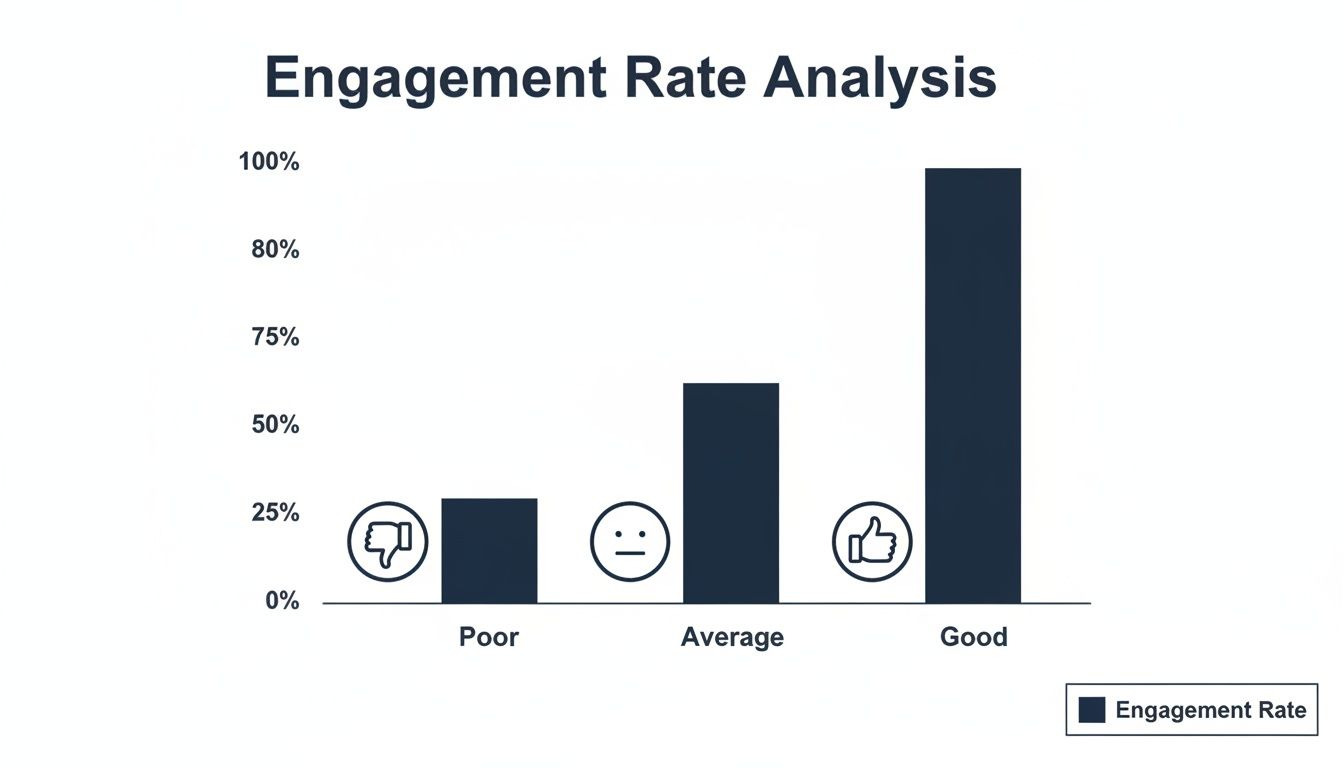
As you can see, anything under 1% is generally considered low. If you can push your average above 3%, you're in a really healthy spot.
Ultimately, understanding why engagement rate matters most for influencers is the first step. A strong rate isn't just about vanity; it signals trust, builds loyalty, and drives real results for any campaign.
How to Accurately Calculate Engagement Rate

Before we can even talk about what a "good" engagement rate is, we have to get on the same page about how to calculate it. The basic idea is simple—you're just comparing interactions to your audience size—but there are a couple of ways to do the math.
Each formula tells a slightly different story, and knowing which one to use is the key to getting a real sense of your content's performance. The two most important methods are Engagement Rate by Reach (ERR) and Engagement Rate by Posts (ERP), which is sometimes called Engagement Rate by Followers. Let's break them down.
Engagement Rate by Reach (ERR)
If you want the most honest picture of how your content lands with people, ERR is your go-to metric. Instead of measuring against your total follower count, this formula looks at the actual number of unique people who saw your post.
Here’s the simple formula:
ERR = (Total Engagements on a Post / Reach of that Post) x 100
So, why is this a better way to look at things? Because social media algorithms are picky. Not every single one of your followers will see your posts. ERR cuts through the noise and tells you how engaging your content was to the audience that actually laid eyes on it. A high ERR means you created something truly compelling, no matter how big or small your follower count is.
Engagement Rate by Posts (ERP)
The more traditional method is Engagement Rate by Posts (ERP). This one is straightforward: it measures how many of your total followers engaged with a specific post.
The formula looks like this:
ERP = (Total Engagements on a Post / Total Followers) x 100
This calculation is perfect for a quick check-up, especially if you're trying to compare a bunch of influencers at a glance. The big catch, though, is that it doesn't factor in the algorithm. An influencer could have a low ERP simply because the platform hid their post from most of their audience, even if the people who saw it loved it.
Seeing the Formulas in Action
Let’s run through a quick example to make this crystal clear. Picture an Instagram influencer with 50,000 followers.
They share a post, and here are the stats:
- Likes: 2,000
- Comments: 250
- Saves: 250
- Total Engagements: 2,500
- Post Reach: 15,000 unique accounts
Now, let's plug those numbers into our formulas:
-
Engagement Rate by Posts (ERP):
(2,500 Engagements / 50,000 Followers) x 100 = 5% -
Engagement Rate by Reach (ERR):
(2,500 Engagements / 15,000 Reach) x 100 = 16.7%
Big difference, right? The 5% ERP is pretty solid by most standards. But that 16.7% ERR tells a much more exciting story—it means that of the people who actually saw the post, almost 17% felt moved enough to engage. That's a sign of incredibly powerful content.
To get a full picture, you need to understand all the key social media engagement metrics that feed into these numbers. But crunching them manually for every single influencer is a recipe for headaches and mistakes.
That's where a platform like REACH Influencers comes in. Forget the spreadsheets. We give you instantly verified engagement rates for thousands of creators, showing you both ERR and ERP so you can make smarter, faster decisions. Want to see for yourself? Try our free influencer engagement rate calculator and start playing with the numbers.
What is a Good Engagement Rate on Instagram and TikTok?
Every social platform is its own little world, and you can't judge them by the same rules. When you’re trying to pin down what is a good engagement rate, comparing Instagram to TikTok is like comparing apples to oranges. They're both giants in the influencer space, but they play by completely different rules.
Understanding how each platform works is the key to setting smart goals and picking the right creators to partner with. What’s considered amazing on Instagram might just be "meh" on TikTok, and the other way around.
Let's break down the actual numbers so you know what to look for on each platform.
Instagram Engagement Averages
Instagram has been the go-to for influencer marketing for years, but things are always shifting. Here, engagement is a blend of stunning visuals, great captions, and a mix of content like Reels, Stories, and Carousels.
One of the biggest factors influencing an Instagrammer's engagement rate is their follower count. It’s a bit of a paradox: the smaller the audience, the more connected they tend to be. This tight-knit community feel almost always leads to higher interaction.
Here’s a rough guide to what a good engagement rate looks like on Instagram, broken down by influencer size:
- Nano-influencers (1k-10k followers): These creators are the engagement kings and queens, often hitting 4% to 8%. Their followers feel like they know them personally.
- Micro-influencers (10k-100k followers): They strike a great balance between reach and community, typically seeing engagement between 2.5% and 5%.
- Macro-influencers (100k-1M followers): As audiences grow, engagement naturally cools off. A rate between 1.5% and 2.5% is pretty standard.
- Mega-influencers (1M+ followers): With such a massive audience, even 1% is considered a solid engagement rate.
Keep in mind, these are just benchmarks. A Reel that catches fire can easily blow a static post out of the water and throw the averages for a loop.
TikTok: The Engagement Powerhouse
TikTok is a different beast entirely. Its algorithm is all about content discovery, not who you follow. The "For You" page can turn a video from a brand-new creator into a viral sensation overnight, leading to engagement rates that are almost unheard of anywhere else.
The whole vibe of the platform—the trends, the sounds, the quick-hit videos—encourages people to interact more casually and more often.
TikTok's algorithm is built for discovery. It's constantly pushing content to new audiences, which means even tiny accounts can get massive engagement if they strike the right chord.
Because of this, the baseline for a "good" engagement rate on TikTok is way higher than on Instagram.
- Nano-influencers: Can post jaw-dropping numbers, often in the 15% to 25% range.
- Micro-influencers: Still pull in incredible engagement, typically between 10% and 15%.
- Macro and Mega-influencers: Their rates come back down to earth a bit, but they still frequently outperform their Instagram peers, averaging 4% to 8%.
When we look at 2025 projections, the platform you choose makes all the difference. While Instagram holds a respectable 5.0% average engagement rate for influencer posts, TikTok blows it away with an 8-18% average. Nanos on TikTok can hit 18%, while bigger creators hover around 4.95%—still comfortably beating Instagram’s typical 2.4-2.8% average. You can dig into more of these influencer marketing statistics to see how the platforms stack up.
Finding Top Performers with REACH Influencers
Trying to manually check every influencer's stats and compare their engagement rates is a recipe for a headache. It’s slow, tedious, and easy to get wrong. You need a tool that does the heavy lifting for you.
This is where the REACH Influencers discovery engine comes in. It helps you stop guessing and start making data-driven decisions. You can set specific, non-negotiable filters to find creators who are already killing it.
For example, say you're planning a campaign and need Instagrammers with at least a 4% engagement rate. With REACH, you can pop that filter in and instantly see a list of creators who fit the bill. Need a TikToker hitting that 10% benchmark? Our platform will find them for you in seconds. It’s all about pinpointing the true top performers who have a proven connection with their audience, so you can build partnerships that actually work.
How Influencer Size Impacts Engagement Rates
When it comes to influencer marketing, it's easy to get caught up in follower counts. A million followers has to be better than ten thousand, right? Not so fast. One of the most consistent patterns we see in social media is a fascinating inverse relationship: as an influencer’s audience grows, their engagement rate often shrinks.
Bigger isn't always better. In fact, it’s often the smaller creators—your nano and micro-influencers—who pack the biggest punch. They build highly interactive, authentic communities that drive real results.
This happens because the personal touch gets lost at scale. A nano-influencer with a few thousand followers can actually reply to most of their comments and DMs, creating a real conversation. That kind of one-on-one interaction is just impossible for a mega-influencer juggling millions of followers, which naturally leads to a more passive audience.
The Power of Niche Communities
Nano and micro-influencers build their followings around specific, shared interests. Their audiences aren't just scrolling by; they're passionate members of a community built around a common hobby, lifestyle, or belief. That shared interest creates a powerful foundation of trust that you just can't replicate with a massive, generalized audience.
Think of it this way: a mega-influencer is like a keynote speaker on a huge stage, broadcasting a message to a faceless crowd. A micro-influencer, on the other hand, is in the middle of a lively small-group discussion where everyone feels included and heard. The engagement in that smaller circle is bound to be deeper and more authentic.
This dynamic has a huge impact on campaign performance. The latest data shows that nano-influencers (under 10,000 followers) hit an average Instagram engagement rate of 6.23%. That’s more than double the 2.8% you’d see from influencers with over 1.5 million followers.
Engagement Rate by Influencer Tier (Instagram)
To see this trend in action, here’s a look at how average engagement rates change as follower counts increase. The data consistently shows that smaller, more dedicated communities drive higher interaction.
| Influencer Tier | Follower Count | Average Engagement Rate |
|---|---|---|
| Nano-Influencers | 1k–10k | 5% – 8% |
| Micro-Influencers | 10k–100k | 2.5% – 5% |
| Macro-Influencers | 100k–1M | 1.5% – 2.5% |
| Mega-Influencers | 1M+ | 1% – 1.5% |
As you can see, there’s a clear trade-off between reach and engagement. The key is to find the right balance for your specific campaign goals.
Why Smaller Audiences Can Drive a Higher ROI
For brands, this inverse relationship is a golden opportunity. Partnering with a handful of high-performing micro-influencers can deliver a much stronger return on investment than putting all your budget into one celebrity-level campaign. Why? Because their followers genuinely trust their recommendations, which translates into stronger brand loyalty and, ultimately, more sales.
When you stop treating follower count as the only metric that matters, you can find the hidden gems—creators with real influence who can become powerful, long-term advocates for your brand.
Focusing only on the biggest accounts means you’re probably overlooking the creators who have the most authentic and persuasive voice with your ideal customers. The choice between macro-influencers or micro-influencers really depends on what you want to achieve.
Looking beyond follower count is exactly what REACH Influencers was built for. Our platform helps you filter influencers based on verified engagement metrics, not just vanity numbers. This gives you the power to find those high-impact nano and micro-influencers who can deliver the authentic results your brand is looking for.
Key Factors That Influence Your Engagement Rate
An engagement rate isn't just a number floating in space. You could have two accounts with the exact same follower count but completely different engagement levels, all because a handful of key variables are always at play. Getting a grip on these factors is the only way to accurately figure out what is a good engagement rate for your brand.
It’s not just about how many followers you have or which platform you’re on. Everything from the type of content you post to the industry you’re in can completely change how your audience interacts. A high-energy video, for instance, is naturally going to pull in more comments than a simple static image. By the same token, a B2B tech company will see very different engagement patterns than a trendy fashion brand.
Content Format and Quality
The single biggest lever you can pull is the content itself. It's no secret that dynamic, interactive formats almost always outperform static posts.
- Video Content: Think about short-form video on platforms like TikTok and Instagram Reels. They're literally built for high interaction and tend to rack up way more shares and comments than a standard photo.
- Carousels: On Instagram, carousels get people swiping. That simple action increases the time they spend on your post, which often translates into more saves and shares.
- Interactive Stories: Features like polls, quizzes, and Q&A stickers are super easy ways for your followers to engage, giving your interaction metrics a direct boost.
Of course, all of this assumes you have the basics down. High-quality, visually compelling content is table stakes. If your posts are blurry, poorly lit, or just plain boring, no amount of clever formatting is going to rescue them.
Niche and Audience Demographics
Your industry and the people you're trying to reach play a massive role in what you should expect. A brand in a passionate hobby niche—like gaming or crafting—is almost always going to have higher natural engagement than a brand in a more buttoned-up industry, like finance or law.
The context of your industry is everything. A 2% engagement rate might be stellar for a B2B software company on LinkedIn, while a beauty influencer on Instagram might look at that same number and think it's just average.
On top of that, who you're talking to matters. Younger audiences on TikTok are often quick to like, comment, and share. Older demographics on Facebook, on the other hand, might engage more deliberately but less often.
Posting Consistency and Timing
Let's be real: social media algorithms love consistency. Keeping a regular posting schedule does more than just keep your brand top-of-mind; it tells the platform you’re an active account worth showing to more people.
Timing is the other side of that coin. It’s simple, really. You have to post when your audience is actually online and scrolling. Pushing out great content at 3 AM when your followers are most active during their lunch break is a huge missed opportunity. That initial burst of interaction is what gives a post legs, and if you miss it, you're limiting its reach from the start.
Trying to make sense of all these moving parts requires some serious tools. The REACH Influencers campaign management dashboard gives you the real-time analytics to see what’s actually connecting. You can track performance across different content types, influencers, and campaigns all in one place. This lets you move past generic benchmarks and see which specific factors are driving real results for your brand, so you can stop guessing and start doubling down on what works.
Actionable Strategies to Boost Engagement
Alright, so you know what a "good" engagement rate looks like. Now, how do you actually get there? Just throwing more content out there isn't the answer. The real secret is being deliberate about every single thing you post.
These aren't just theories; they're practical, road-tested tactics for turning passive scrollers into an active community. Let's dive into how you can start building that genuine connection.
Ask Questions and Spark a Conversation
The easiest way to get people talking? Ask them something. Stop writing captions that are just simple descriptions. Instead, end your post with a direct question that pulls your audience into the conversation. It completely changes the vibe from a megaphone announcement to a real back-and-forth chat.
Think about it. A travel creator could post a stunning beach photo and ask, "What's the best beach you've ever been to and why?" That kind of open-ended question gets people sharing stories, not just double-tapping. It's so much more powerful than a generic "Like if you love the beach."
Use the Fun Stuff: Interactive Content
Every social media platform gives you a toolbox full of features designed to get people to interact. You just have to use them!
- Polls & Quizzes: These are pure gold. It takes a follower a split second to tap an answer on an Instagram Story or an X poll, making them a super easy way to get that engagement number up.
- Q&A Sessions: Whether you do a live "Ask Me Anything" (AMA) on TikTok or use Instagram's Q&A sticker, you're opening a direct line to your audience. People love feeling like they're being heard.
- Carousels: On Instagram, carousels are fantastic because they get people to swipe. That simple action keeps them on your post longer. Use them to tell a story, offer a step-by-step tutorial, or break down a big idea into bite-sized pieces.
Nail Your Timing
Even the most amazing content will flop if you post it when everyone's asleep. You've got to share your stuff when your followers are actually online and scrolling. Dive into your platform's built-in analytics and find out when your specific audience is most active.
Posting at the right time gives your content that initial burst of likes and comments. That early action tells the algorithm, "Hey, people like this!" which can massively boost your post's reach in those first critical hours.
Measure What Matters with Real-Time Analytics
So, are these strategies actually moving the needle? You can't just guess. This is where a tool like REACH Influencers becomes your best friend. Its real-time performance analytics show you the direct impact of every tactic you try.
You can instantly see which types of posts get the most comments or which posting times cause engagement to spike. That data lets you stop guessing, double down on what’s working, and prove the value of your efforts. For an even deeper dive, check out these top tips to increase social media engagement and apply them across all your platforms.
Common Questions About Engagement Rates

Even after you've got the basics down, a few tricky questions always pop up when you start applying this stuff in the real world. Let's tackle some of the most common ones I hear.
Think of this as your quick-reference guide for those "what if" moments. Answering these will help you move forward and evaluate influencers or campaigns with real confidence.
Are Likes More Important Than Comments?
This is a classic, and the answer is a hard no. Likes are easy. They're a passive nod of approval. Comments and shares? That's where the real connection happens.
A comment means someone stopped scrolling, thought about what you said, and took the time to write a reply. That's a genuine interaction. A share is even better—it's a personal endorsement to their own network.
Key Takeaway: Always look for creators who generate conversations and get their content shared. These actions signal a deeply connected audience, which is far more powerful than an account with tons of passive likes.
How Often Should I Measure Engagement?
You need to be consistent, but don't get lost in the daily noise. One viral post can throw your averages way off, so it’s much smarter to look at the bigger picture.
- For active campaigns: Check in weekly. This lets you see what's working and make adjustments on the fly.
- For your overall account: A monthly or quarterly review is perfect. It helps you spot long-term trends and really understand how your audience behaves over time.
This rhythm keeps you from panicking over a small dip while still catching any major performance shifts before they become a problem.
What If an Influencer’s Engagement Suddenly Drops?
A sudden drop can set off alarm bells, but don't jump to conclusions. First, look outside the influencer's profile. Did the platform just tweak its algorithm again? Is it a holiday week where everyone is offline?
Then, dig into their recent content. Have they tried a new format or topic that just didn't land with their followers? Sometimes, one or two duds can pull the whole average down.
Learning what is a good engagement rate means understanding these ups and downs. The best results often come from creators who know their audience inside and out, like micro-influencers who pull in an impressive 3.86% on Instagram. That's way ahead of the big-name accounts. For a deeper dive, you can explore detailed influencer marketing statistics that show how performance changes with audience size.
Ultimately, understanding what is a good engagement rate is about moving beyond vanity metrics and focusing on genuine audience connection. By analyzing the right data and partnering with creators who have proven influence, you can build campaigns that deliver measurable ROI.
Ready to skip the guesswork and find influencers with proven engagement? REACH Influencers gives you verified, real-time data on thousands of creators. You can filter for top performers who are a perfect match for your campaign goals. Discover your next high-impact partnership today.
{
  "@context": "https://schema.org",
  "@type": "BlogPosting",
  "mainEntityOfPage": {
    "@type": "WebPage",
    "@id": "https://reach-influencers.com/what-is-a-good-engagement-rate/"
  },
  "headline": "What Is a Good Engagement Rate? A 2024 Guide for Marketers",
  "description": "Discover what a good engagement rate is for influencer marketing in 2024. Our guide breaks down benchmarks for Instagram and TikTok by follower size.",
  "image": "https://cdn.outrank.so/64cdc0e0-2a54-4cd9-a45d-c4196c5e1d4e/3554aca4-7cdd-41bc-bb7c-a80529d95533/what-is-a-good-engagement-rate-engagement-rate.jpg",
  "author": {
    "@type": "Organization",
    "name": "REACH Influencers",
    "url": "https://reach-influencers.com/"
  },
  "publisher": {
    "@type": "Organization",
    "name": "REACH Influencers",
    "logo": {
      "@type": "ImageObject",
      "url": "https://reach-influencers.com/logo.png"
    }
  },
  "datePublished": "2024-05-15",
  "dateModified": "2024-05-15",
  "faqPage": {
    "@type": "FAQPage",
    "mainEntity": [{
      "@type": "Question",
      "name": "What is a good engagement rate in 2024?",
      "acceptedAnswer": {
        "@type": "Answer",
        "text": "A good engagement rate is generally considered to be between 1% and 5%. However, this varies significantly by platform, industry, and influencer size. For example, a good rate on Instagram for a micro-influencer could be 4-5%, while on TikTok, a good rate for a similar creator could be 15% or higher."
      }
    },{
      "@type": "Question",
      "name": "Are likes or comments more important for engagement?",
      "acceptedAnswer": {
        "@type": "Answer",
        "text": "Comments, shares, and saves are more valuable than likes. Likes are a passive form of engagement, while comments and shares indicate a deeper level of connection and audience investment in the content."
      }
    },{
      "@type": "Question",
      "name": "How does follower count affect engagement rate?",
      "acceptedAnswer": {
        "@type": "Answer",
        "text": "Typically, there is an inverse relationship between follower count and engagement rate. Nano-influencers (1k-10k followers) often have the highest engagement rates (5-8% on Instagram), while mega-influencers (1M+ followers) may see rates closer to 1-1.5% due to a less personal connection with their larger audience."
      }
    }]
  }
}