 Skip to content


Let's get right to it. A social media campaign isn't just a bunch of posts. It’s a concentrated marketing effort with a specific goal, a clear start and end date, and a focused message built to drive a particular outcome. Think of it as a strategic sprint, not an everyday marathon.
What Is a Social Media Campaign, Really?
Imagine your daily social media activity is like the regular, friendly conversation you have with the barista at your local coffee shop. It’s consistent, it builds a relationship, and it keeps you top of mind.
A campaign, on the other hand, is the big, planned event you host at that coffee shop—like a product launch party or a charity fundraiser. It has a singular, well-defined purpose and is designed to make a splash.
This focused approach is what turns your social media from a simple broadcast channel into a powerful engine for achieving real, measurable business results. You stop just "posting" and start executing a strategic plan with a clear objective.
Core Goals of a Campaign
Every single campaign needs a "why." It's built to achieve something specific, and most objectives fall into one of three buckets:
- Boosting Brand Awareness: Getting your brand in front of new eyeballs—people who may have never heard of you before.
- Generating Leads: Capturing contact info from potential customers to fill your sales pipeline.
- Driving Direct Sales: Pushing for immediate purchases of a product or service.
This chart gives you a great visual of how a well-run campaign can impact these key areas.
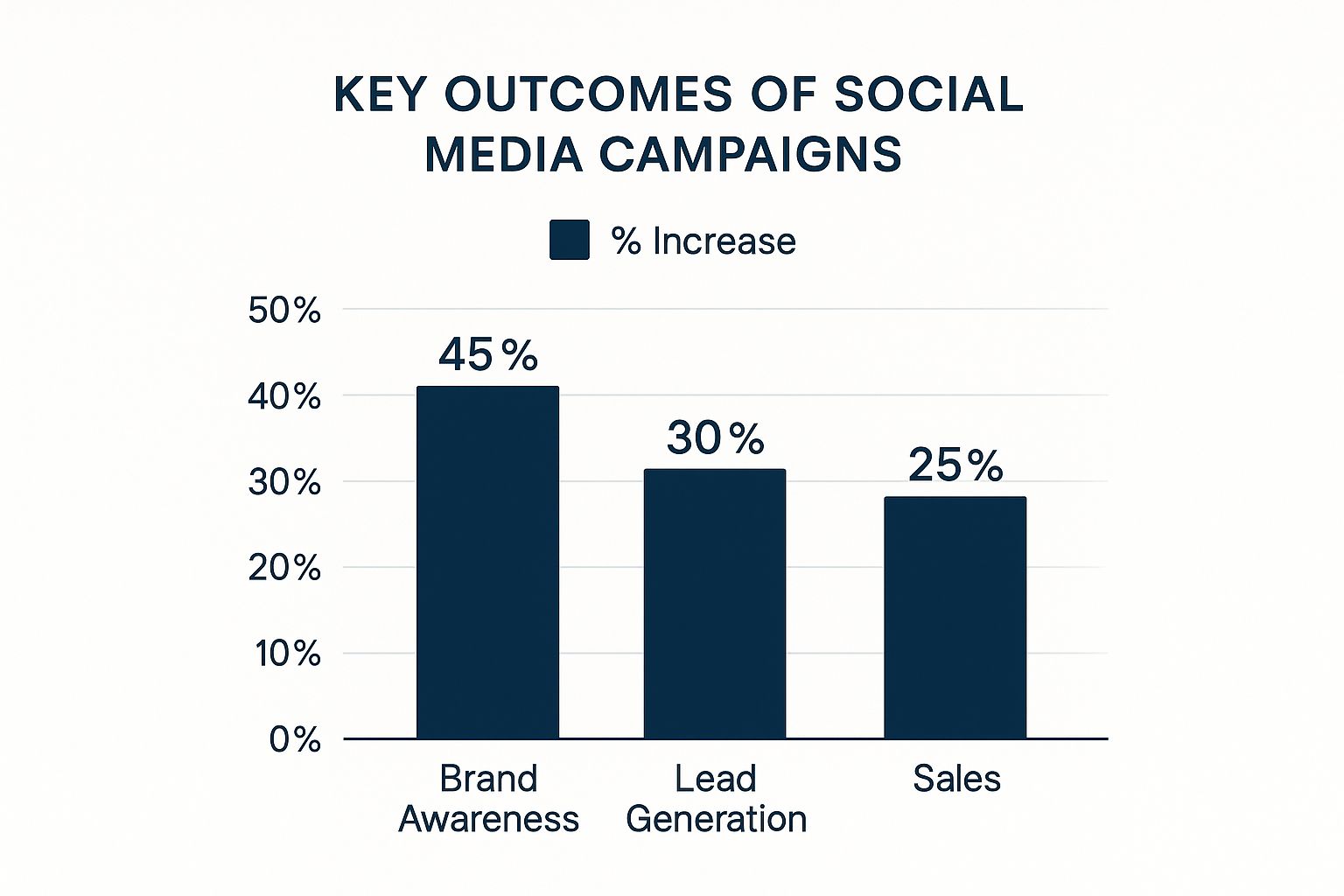
As you can see, brand awareness is often the first domino to fall, which in turn fuels lead generation and, ultimately, sales. Every piece of the campaign, from the visuals to the ad copy, is meticulously designed to push one of these goals forward. Of course, knowing how to build a marketing campaign from the ground up is where the magic really happens.
The key difference is intent. Always-on social media maintains your presence and keeps the lights on. A campaign actively changes things by pushing for a specific, time-bound goal, like increasing your follower count by 20% or generating 500 webinar sign-ups.
Quick Answer: Campaign vs. Always-On Social Media
It's easy to confuse a dedicated campaign with your day-to-day social media management. This table breaks down the fundamental differences.
| Characteristic | Social Media Campaign | Always-On Social Media |
|---|---|---|
| Timeline | Has a defined start and end date (e.g., 4 weeks) | Ongoing, with no specific end date |
| Goal | Focused on a single, specific outcome (e.g., 500 sales) | Broad objectives like community engagement and brand presence |
| Content | Highly targeted and themed around the campaign's message | Varied content mix (updates, news, engagement posts) |
| Measurement | Success is tied to specific campaign KPIs (leads, ROI) | Measured by general health metrics (reach, likes, comments) |
Ultimately, you need both. Your always-on activity builds the foundation and the audience, while campaigns provide the focused pushes that drive major growth and tangible business results.
The Building Blocks of Every Great Campaign
Every powerful social media campaign, whether it's a local coffee shop giveaway or a global product launch, shares the same fundamental DNA. Think of these core components as ingredients in a recipe—if you leave one out, the whole thing can fall flat.
It all starts with a clear purpose. Without a solid objective, your campaign is just shouting into the void. This is where S.M.A.R.T. goals become your North Star, guiding every decision and ensuring every action is both intentional and measurable.
Define Your Goals and Audience
Before a single piece of content is made, you have to answer two critical questions: what do you want to achieve, and who are you trying to reach? A fuzzy goal like "get more followers" won't cut it.
A S.M.A.R.T. goal, on the other hand, sounds like this: "Increase our Instagram followers by 15% among women aged 25-34 in the next 30 days." See the difference? That level of clarity immediately points you in the right direction.
That brings us to your audience. You need to dig deeper than just basic demographics. What keeps them up at night? What content do they genuinely value? What kind of humor resonates with them? Getting these answers right is how you craft a message that actually connects. For a detailed walkthrough, check out our guide on how to create buyer personas.
With around 5.42 billion people on social media globally and the average user juggling nearly seven platforms a month, you can't be everywhere. You have to be where your people are. To see more data on this, SproutSocial.com has some great statistics.
Craft Your Core Message and Metrics
Once your goal and audience are locked in, it’s time to shape your core message. This is the big idea, the central theme that holds everything together. It needs to be simple, memorable, and consistent no matter which platform you’re on.
Your message is the "what," while your visuals and copy are the "how." Compelling imagery, engaging videos, and sharp writing are what stop the scroll and bring that core message to life in a crowded feed.
Finally, you have to decide how you'll keep score. Key Performance Indicators (KPIs) are the specific, tangible metrics that prove whether your campaign is working. These should tie directly back to that S.M.A.R.T. goal you set earlier.
- For Brand Awareness: Keep an eye on reach, impressions, and follower growth.
- For Lead Generation: Track link clicks, form submissions, and overall conversion rates.
- For Sales: Focus on the bottom line with metrics like sales revenue, return on ad spend (ROAS), and cost per acquisition.
Putting these building blocks together gives you a complete blueprint, transforming a simple idea into a strategic social media campaign that actually delivers results.
Why Your Business Needs Social Media Campaigns
Going beyond just your everyday posting schedule is where the magic really happens. A well-designed social media campaign is a serious business driver, shifting your focus from simply maintaining a presence to actively creating growth around one specific, important goal. This kind of strategic push can deliver results that your "always-on" social content just can't achieve by itself.
Think of it like this: if your regular posts are the steady, daily rhythm of your brand, a campaign is the unforgettable guitar solo that makes the crowd go wild. It’s a calculated, high-energy burst designed to grab attention and achieve a very specific outcome in a set amount of time.
Drive Measurable Business Growth
The biggest win from a dedicated campaign is its ability to produce real, tangible results you can actually track. It's not just about getting likes; it's about moving the needle. In fact, 73% of marketers say their number one reason for using social media is to drive more traffic, with lead generation right behind it.
A targeted campaign gives you the focus to:
- Boost Brand Awareness: Get in front of people who have never heard of you before, quickly expanding your audience and making a bigger dent in your market.
- Generate High-Quality Leads: Pull interested prospects right into your sales funnel with a compelling offer, a fun contest, or a piece of must-have content.
- Increase Direct Sales: Run promotions and product launches that build excitement and urgency, encouraging people to buy now.
A campaign transforms social media from a passive branding tool into an active engine for revenue. It gives you a clear return on investment that you can take straight to the bank.
Beyond the immediate results, campaigns are also fantastic for gathering intel. The data you collect reveals so much about what your audience responds to, their behaviors, and what’s trending. You can then use these insights to sharpen your entire marketing strategy, making every future effort even more effective. And by creating genuine engagement, you’re not just getting followers—you’re building a loyal community of brand advocates.
Exploring Different Types of Social Campaigns
Not all social media campaigns are created equal. Think of it like a carpenter's toolbox—you wouldn't use a sledgehammer to hang a picture frame. The same principle applies here. Marketers have a whole range of campaign types to choose from, and picking the right one is all about knowing exactly what you want to achieve.
Some campaigns are designed for explosive, short-term growth, while others are a slow burn, built to cultivate lasting brand loyalty. The right choice hinges entirely on your main objective.
Campaigns for Growth and Engagement
When you need to expand your audience fast or inject a serious dose of energy into your social channels, a few tried-and-true tactics work wonders. These are high-impact efforts designed to get people talking—and clicking—right now.
-
Contests and Giveaways: These are popular for a simple reason: they work. By offering a compelling prize in exchange for a follow, share, or comment, you can spark a flurry of activity and see your follower count climb in a very short time. It's a direct and effective way to get on people's radar.
-
User-Generated Content (UGC) Campaigns: Why create all the content yourself when your biggest fans can do it for you? Brands like GoPro have built an empire on this idea. They encourage customers to submit their most epic action shots, effectively turning their entire user base into a creative, authentic marketing team.
This shot from GoPro’s Instagram is a perfect example of how they feature stunning photos and videos straight from their users.
This strategy does more than just fill your content calendar; it builds a vibrant community centered around shared passions and experiences.
Campaigns for Launches and Brand Building
Beyond immediate growth, some campaigns play the long game. They're designed to support bigger business goals, like rolling out a new product or shaping how the public sees your brand.
A product launch campaign isn't just an announcement; it's a carefully orchestrated narrative. It builds anticipation, educates the audience, and creates a sense of eventfulness that drives initial sales and buzz.
Similarly, awareness campaigns aim to connect your brand with certain values or important social causes. A classic example is Patagonia's deep-rooted commitment to environmentalism, which has forged an incredibly strong bond with customers who share those principles.
And then there are influencer marketing campaigns. These use the trust and credibility that creators have built with their followers to introduce a product or message. It's a powerful way to get an authentic endorsement and reach highly specific, engaged communities.
How Modern Tools Are Shaping Campaign Strategy
In today's world, a great idea isn't enough to guarantee a campaign's success. You need the right technology to turn that idea into something you can actually measure and improve. Modern tools are the secret weapon, the competitive edge that takes you from guessing what might work to knowing what does work.
Think of Artificial Intelligence (AI) as a co-pilot for your campaign. It's not some far-off concept; it’s a practical assistant that can sift through mountains of data to identify your perfect audience, brainstorm creative angles, or even predict the optimal time to post for the most engagement.
Making Smarter Decisions with Technology
The right tech stack is all about making informed choices. Instead of just assuming your audience hangs out on Instagram, data tools can prove it, showing you exactly who is active and when. This data-first approach bleeds into everything, especially how you manage your budget and resources.
This is why it's so important to explore the best social media marketing tools on the market. These platforms are central to planning ad spend, managing influencer collaborations, and tracking results as they happen. They give you a crystal-clear picture of your ROI, helping you double down on what’s working and cut what isn’t.
For an even closer look, we've also put together a guide on some fantastic social media campaign management tools.
The goal is to build a campaign that learns and adapts. Modern tools provide the feedback loop necessary to optimize performance on the fly, ensuring your strategy becomes more effective over time.
This isn't just a "nice-to-have" anymore; it's essential. The success of a modern social media campaign hinges on understanding demographic trends and user behavior. In fact, three-quarters of social strategists now use AI tools to fine-tune their campaigns—a massive shift in how we plan and execute.
To create authentic connections that truly resonate, campaigns have to be built on these kinds of data-driven insights. It’s the only way to keep up as social platforms continue to change.
Common Questions About Social Media Campaigns
Even with the best-laid plans, a few questions always seem to come up when you're getting ready to launch a new campaign. That’s perfectly normal. Getting a handle on these common sticking points can clear up confusion and help you make smarter decisions for your brand.
Let’s walk through some of the questions I hear most often from marketers, so you can move forward with total confidence.
How Long Should a Social Media Campaign Run?
This is probably the most common question, and the honest answer is: it depends entirely on what you're trying to accomplish. There’s no one-size-fits-all timeline.
A campaign built around a flash sale might only run for 48 hours to drive urgency. In contrast, a major product launch could be a multi-week affair, designed to build buzz before the release and sustain it afterward. A broad brand awareness push might even run for a full quarter.
The real trick is to give your campaign enough time to hit its goal and gather useful data, without letting it drag on so long that your audience loses interest.
What Is the Difference Between Social Media Marketing and a Campaign?
It helps to think about this in terms of scope. Your day-to-day social media marketing is your long game—it's the marathon. It includes all the ongoing activities you do to build and nurture your community, like posting regular content, replying to comments, and just generally being present.
A social media campaign, however, is a sprint. It’s a concentrated effort within your broader marketing strategy that has a very specific, measurable goal—like generating 500 signups for an upcoming webinar. It has a clear start date, an end date, and its own unique messaging.
How Much Should I Budget for a Campaign?
The cost of a campaign can swing wildly, from practically zero to tens of thousands of dollars. It all comes back to your goals and the tactics you choose. You could run a purely organic campaign that relies on clever, shareable content, where your only real cost is the time you put into it.
But for most campaigns, you'll want to set aside a budget for a few key things:
- Paid ads: This is how you guarantee your message gets in front of a larger, highly-targeted audience.
- Influencer collaborations: Partnering with creators gives you instant credibility and access to their dedicated followers.
- Asset creation: You might need a budget for professional video production, graphic design, or photography to make your content pop.
A local coffee shop might spend a few hundred dollars on boosted posts to promote a new seasonal drink, while a national retailer could invest thousands in a full-scale influencer program. The right budget is the one that directly supports your objective and the audience you need to reach.
Ready to take the guesswork out of your next influencer campaign? REACH provides the tools you need to discover the perfect creators, manage collaborations, and track your ROI in real-time. Find out more at https://reach-influencers.com.