 Skip to content


Table of Contents
- The Shifting Landscape of Marketing Teams in 2026
- Why Teams Go In-House for Brand Control and Integration
- When to Hire an Agency for Expertise and Scalability
- Head-to-Head Comparison: In-House Marketing vs Agency
- Building a Hybrid Model for Maximum Impact
- In-House vs. Agency: Making the Right Call for Your Business
- Frequently Asked Questions
Choosing between building an in-house marketing team or hiring an agency is one of the most critical business decisions you'll face. The in-house marketing vs agency debate has no single right answer; the best path depends on your company's size, budget, and growth objectives. For instance, a complex channel like influencer marketing can be a resource drain without the right systems. This is where a top influencer marketing platform like REACH Influencers can empower either model, providing in-house teams with scalability and agencies with white-label efficiency.
This decision sets the course for your brand's future, impacting everything from your day-to-day workflow to your market position for years to come.
The Shifting Landscape of Marketing Teams in 2026
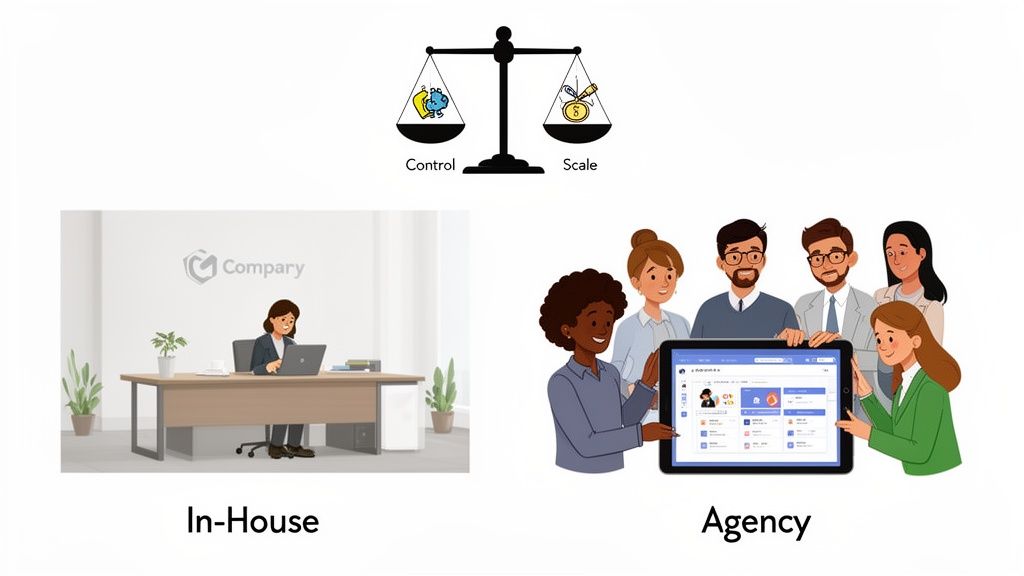
The in-house marketing vs agency conversation isn't new, but it has intensified as companies hunt for better ROI and agility. We're seeing a clear trend of more businesses bringing marketing talent inside. This isn't just about saving money; it's about embedding marketing deep into the company culture for faster decisions and a team that truly gets the brand.
Gartner has pointed out that this shift helps marketing teams move from just doing tasks to actually driving business growth. The choice boils down to how you want to manage four key areas:
- Cost: Do you prefer the fixed expense of salaries or the variable cost of retainers?
- Control: How much direct oversight and brand immersion do you need?
- Scalability: How fast do you need to ramp your marketing efforts up or down?
- Skills: Is it better to access specialized experts immediately or build that talent over time?
A Quick Comparison
To get a feel for the fundamental differences, here’s a high-level look. We’ll get into the weeds on each of these points later, but this table lays out the core trade-offs.
| Feature | In-House Marketing Team | Marketing Agency |
|---|---|---|
| Primary Advantage | Unmatched brand knowledge and control | Instant access to a wide range of experts |
| Cost Structure | Fixed overhead (salaries, benefits, tools) | Variable costs based on retainers or projects |
| Team Focus | 100% dedicated to your brand's success | Juggles multiple clients and industries |
| Brand Knowledge | Lives and breathes the brand every day | Needs time and effort to get up to speed |
| Scalability | Slower; involves a full hiring process | Quick; can add specialists or resources easily |
| Best For | Established brands that need deep integration | Businesses needing fast growth or specialized skills |
No matter which path you take, the right technology can smooth out the rough edges of either model. An influencer marketing platform like REACH Influencers is designed to support both approaches. An in-house team can use it to manage campaigns at scale without hiring more staff, while an agency can use its white-label features to run campaigns for multiple clients from a single dashboard.
It shows that smart technology gives you the control and efficiency to make either the in-house or agency model work better. For a deeper dive, check out this definitive guide on In House vs Agency Marketing for UK Businesses in 2026.
Why Teams Go In-House for Brand Control and Integration
When you ask founders why they chose to build their own marketing team instead of hiring an agency, the answer is almost always the same: total brand control. It’s a powerful argument. An in-house team lives and breathes your company culture every single day. They’re in the meetings, they hear the customer feedback firsthand, and they get the little nuances of your products in a way an outside partner just can't.
That deep connection is what leads to more authentic and consistent marketing. Your internal team acts as the guardian of your brand’s voice, making sure every social post, email, and ad feels like it came from you. There’s no long, drawn-out onboarding process or need to re-explain your brand history—they’re a part of that history.
This also makes your marketing incredibly agile. When a new opportunity pops up or the market takes a sharp turn, an in-house team can pivot in a matter of hours, not days. They can walk down the hall (or jump on a quick Slack call) to get data, talk to product managers, and sync with sales, letting them make smart decisions on the fly.
Unmatched Brand Immersion and Knowledge
An in-house team's greatest asset is its singular focus. Unlike an agency that’s splitting its attention across multiple clients, your team is 100% dedicated to your brand's growth. That undivided attention helps them develop a profound understanding of what you’re trying to achieve and who you’re trying to reach.
This is especially important if you sell complex products or operate in a tricky, regulated industry. Your internal marketers can speak with authority and confidence, cutting down the risk of miscommunication that often happens when you translate technical details for an outside group. They become your in-house experts.
By embedding marketing within the organization, you create a powerful feedback loop. Marketers gain direct insights from sales and support, enabling them to produce content that directly addresses customer pain points and accelerates the buying cycle.
The Financial and Resource Realities
Of course, that level of control doesn't come for free. Building an in-house team is a major financial commitment. You have fixed costs like salaries, benefits, and overhead. You’re not just hiring a marketer; you’re investing in their entire career, from training to the tools they need to do their job well.
But the cost breakdown isn't always as simple as it seems. An agency might charge upwards of $2,500 per month, which adds up to $30,000 a year. That can look pretty good next to a single specialist’s salary of $40,000+ per year, and that’s before you add benefits and software licenses. You can explore the cost-benefit analysis in more detail to see how the numbers stack up in the long run.
This is where technology can help your in-house team punch above its weight. For instance, a platform like REACH Influencers can give your team the power to manage something as complex as influencer marketing without hiring more people. A small team can use its dashboard to find creators, run campaigns, and handle payments, giving them the ability to launch large-scale programs that used to require an agency—all while keeping full control over the brand message.
Ultimately, choosing to build an in-house marketing team is a long-term play. It’s an investment in your brand’s value and the knowledge that stays within your company walls. It’s the right move for businesses that see marketing not as a service, but as a core part of who they are.
When to Hire an Agency for Expertise and Scalability

While having an in-house team gives you unmatched brand knowledge, the conversation around in-house marketing vs agency quickly turns to what an agency can bring to the table right away. For a lot of businesses, especially those trying to grow fast or needing very specific skills, bringing on an agency isn't just an option—it’s a smart, strategic move. The biggest draw is getting a whole team of seasoned pros without the time and expense of hiring them one by one.
An agency gives you a full bench of specialists. One day you might need a deep technical SEO audit, and the next you're launching a high-stakes PPC campaign. Finding, hiring, and paying for an in-house team with that kind of senior-level, diverse talent would take years and a huge budget that most companies just don't have.
With an agency, you get that brainpower from day one, all for a predictable monthly fee. This gives you amazing flexibility, letting you dial your marketing efforts up or down based on what the market is doing, seasonal rushes, or new product launches.
Access to Specialized Skills and Tools
Agencies live and breathe marketing. Their teams are always trying out new platforms, tweaking strategies across dozens of different industries, and getting good at the latest software. This wide-angle view gives them a perspective that an in-house team, focused on just one brand, can sometimes miss. They see what’s working for other companies and bring those real-world lessons straight to you.
This also applies to the technology they use. Agencies spend a lot on premium analytics, research, and marketing software that would be far too expensive for a single company to buy on its own. For example, an agency partner might use a platform like REACH Influencers to manage influencer campaigns for several clients. They can use its powerful search tools to find niche creators and its white-labeled reports to show you results in real time, offering a level of sophistication that’s tough to build internally.
An agency’s value isn’t just in the work they do, but in the fresh perspective they bring. Their external viewpoint can challenge internal assumptions and uncover growth opportunities that are often invisible from inside the organization.
For businesses that really want to zero in on improving their conversion rates, checking out the top Shopify CRO agencies is a great way to bring in that specialized, outside expertise.
Cost-Effectiveness and Scalability
When you look at the numbers, the case for an agency gets even stronger. An in-house team comes with fixed costs like salaries, benefits, training, and office space. An agency, on the other hand, is a variable cost. You pay for the services you need, making your marketing budget much more flexible and predictable.
This is especially true for one-off projects. If you need a new website or a three-month ad campaign, hiring an agency is way more efficient than hiring full-time employees you might not need in the long run.
On top of that, the agency model is built to scale. Need to double your ad spend and launch on a new social media channel next month? A good agency can make that happen almost instantly. That's a huge difference from the slow process of hiring and training new people in-house. In today's fast-moving markets, being able to scale quickly is a massive advantage.
The marketing world is also changing. Forrester predicts that by 2026, automation and AI will cause a 15% reduction in agency jobs, pushing agencies to become even more specialized and efficient. This means they are doubling down on high-value, expert services that are hard to replicate with an in-house team, making them more important partners than ever. You can learn more about the future of marketing agencies from Forrester's predictions.
Head-to-Head Comparison: In-House Marketing vs Agency
When the in-house marketing vs agency debate gets serious, the decision usually boils down to three things: cost, skills, and return on investment (ROI). This isn't about finding a one-size-fits-all "cheaper" or "better" choice. It's about understanding what you're truly paying for and which model aligns with your company's goals, both right now and down the road.
An in-house team is a fixed investment. You have predictable costs like salaries, benefits, and software. An agency, on the other hand, is a variable cost—you pay a retainer or project fee for their services. The right path for you really depends on your budget and where your business is in its growth journey.
This table breaks down the key differences between building an in-house team and hiring an agency across several critical business dimensions, helping you identify the best fit for your company's unique needs.
| Factor | In-House Team | Marketing Agency | Best For |
|---|---|---|---|
| Cost Structure | Fixed (salaries, benefits, overhead). High upfront investment. | Variable (retainers, project fees). Predictable monthly spend. | In-House: Stable, well-funded companies. Agency: Businesses needing budget flexibility or scaling up. |
| Talent & Skills | Deep, but narrow expertise on your specific brand and industry. | Broad, specialized expertise across multiple channels and industries. | In-House: Nurturing brand evangelists. Agency: Accessing diverse, immediate skill sets. |
| Speed & Agility | Fast for internal approvals and day-to-day pivots. Slower to launch new, specialized initiatives. | Fast to launch complex campaigns from a standing start. Slower on internal approvals. | In-House: Quick daily execution. Agency: Rapid campaign deployment and market entry. |
| ROI Measurement | Focus on long-term brand equity, customer loyalty, and internal knowledge value. | Focus on direct, campaign-specific KPIs (CAC, ROAS, leads). Easier to attribute spend to results. | In-House: Building long-term, sustainable growth. Agency: Proving immediate, measurable campaign value. |
| Tools & Tech | Company must purchase, manage, and train for all marketing software. | Costs for premium tools are often bundled into the retainer fee. | In-House: Companies with an existing tech stack. Agency: Businesses wanting to avoid high software costs. |
Ultimately, the choice isn't permanent. Many companies start with an agency, then build an in-house team as they grow, or even run a hybrid model to get the best of both worlds.
Evaluating The True Cost Of Marketing
A common mistake I see is putting an agency's monthly retainer up against a single employee's salary. That's an apples-to-oranges comparison. The true cost of an in-house hire is much higher than their paycheck.
That $90,000 base salary easily balloons to $121,500 per year once you factor in benefits, payroll taxes, recruiting costs, and essential software. This is what we call the loaded salary, and it’s the real number you should be looking at.
An agency retainer, while it might seem like a big number, already covers the salaries of multiple specialists, access to expensive tools, and all their operational overhead. You get a full team's brainpower without having to pay for each person's employment costs. For businesses in the $5M to $50M revenue range, going with an agency or a hybrid model is often 5-20% more cost-effective over three years than trying to build a comparable team from scratch. To get a better handle on these numbers, it’s worth taking a closer look at how to calculate your customer acquisition cost.
As you can see from the data, agencies provide a bundled solution with immediate access to talent and the flexibility to scale your efforts up or down without the long-term commitment of new hires.
Assessing Skills And Speed To Market
Beyond just the cost, think about the specific skills you need and how quickly you need them. An in-house team will, over time, develop an incredibly deep understanding of your product, your company culture, and your customers. That kind of institutional knowledge is gold for brand consistency.
The downside? Building a well-rounded team with experts in SEO, paid ads, content, and analytics is a slow, expensive grind.
On the flip side, an agency gives you a whole team of specialists from day one.
- In-House Team: Develops deep, focused expertise on your brand alone.
- Marketing Agency: Brings broad, specialized expertise from working with dozens of clients across different industries.
This difference directly impacts how fast you can get things done. An agency can launch a complex, multi-channel campaign almost immediately because their people and processes are already in place. They can start a technical SEO audit or a major influencer campaign tomorrow, while an in-house team might need months to hire or train someone for that job.
The core trade-off is this: An in-house team is faster for internal approvals and day-to-day pivots. An agency is faster for launching new, specialized initiatives from a standing start.
Measuring And Maximizing ROI
At the end of the day, it's all about getting the best possible return on your investment. Both models can get you there, but they take different routes.
An in-house team's ROI is often tied to long-term gains like brand equity, customer loyalty, and the value of having that deep knowledge base inside your company. Because they’re so integrated with other departments like sales and product, they can create a powerful feedback loop that lifts the entire business.
An agency's ROI is usually more direct and easier to measure. They live and die by campaign-specific KPIs like customer acquisition cost (CAC), return on ad spend (ROAS), and lead volume. They are built to prove their value with data, making it simple to connect your marketing spend to tangible outcomes.
For example, when using an influencer platform like REACH, an agency can provide a white-labeled dashboard showing real-time campaign ROI. An in-house team using that same platform might focus more on how the analytics inform their long-term brand strategy. The best choice in the in-house marketing vs agency debate really comes down to which type of ROI matters most to your business right now.
Building a Hybrid Model for Maximum Impact

The whole in-house marketing vs agency debate doesn't have to be so black and white. For a lot of businesses, the smartest move isn't picking a side but blending the two. This is what we call a hybrid model, and it's all about getting the best of both worlds.
This isn’t just a halfway compromise; it’s a strategic decision to get more from your marketing budget. You get to keep your brand’s soul and deep product knowledge in-house while tapping into specialized outside talent right when you need it. It’s about pairing your internal strategy with an agency’s execution power.
How a Hybrid Structure Actually Works
Think of it this way: your in-house team is the brain of the operation. They live and breathe your brand, so they’re in charge of the big-picture strategy, core messaging, and daily marketing tasks that demand that inside knowledge. They own the "why."
An agency partner then steps in to handle specialized work. This could mean tackling technical SEO, running complex paid ad campaigns, or managing a huge influencer marketing push. The agency becomes an extension of your team, focused on the "how."
This model just plain works. Here’s why:
- Fills Skill Gaps: Your internal team can't be masters of everything. An agency brings in specialists without you having to hire them full-time.
- Maintains Brand Control: With an in-house lead at the helm, you can be sure every single thing an agency does feels true to your brand.
- Scales Efficiently: Need to go big on a specific channel? Your agency can ramp up effort almost instantly, saving you from a long and painful hiring process.
A Practical Example of Hybrid Synergy
Let’s say you’re a direct-to-consumer brand with a scrappy two-person marketing team. Your in-house Marketing Manager is the keeper of the strategy, brand voice, and customer relationships. They know your customer inside and out.
They want to launch a major influencer marketing campaign. Instead of trying to do it all themselves, they go hybrid:
- Internal Strategy: The manager uses a platform like REACH Influencers to set the campaign goals, lock in the budget, and define the perfect creator profile.
- Agency Execution: They bring in an influencer marketing agency that lives for this stuff. The agency uses the powerful discovery tools in REACH to find and vet hundreds of perfect-fit creators.
- Collaborative Workflow: The best part? Both the in-house manager and the agency work from the same REACH dashboard. They approve content, track results, and handle payments all in one place. No messy email chains, no confusion.
This hybrid approach delivers a fantastic ROI. You’re combining the deep brand understanding from your internal team with the execution power and scale of a specialized agency. And the technology is the bridge that keeps everyone on the same page.
This setup helps you dodge the common headaches of going pure in-house or pure agency. The brand keeps its hands on the strategic wheel, while the agency does the heavy operational lifting it’s designed for.
For agencies, platforms like REACH offer incredible management tools. Many use white label software solutions to streamline how they serve clients. At the end of the day, the hybrid model is a modern, flexible answer to the age-old in-house marketing vs agency question.
In-House vs. Agency: Making the Right Call for Your Business
Alright, let's get down to it. You've seen the pros and cons, and now it’s time to decide. Moving from the theoretical in-house marketing vs agency debate to a real-world choice is about taking a hard, honest look at where your business is today and where you want it to be.
This isn’t about finding a one-size-fits-all answer. It’s about matching your unique goals, budget, and culture to the right operating model. To help you get there, let’s walk through the key questions you and your leadership team should be asking.
A Quick Checklist to Guide Your Decision
Grab your team and get real with these questions. Your answers will almost always point you in the right direction.
What are your goals for the next 1-2 years?
- If you’re aiming for lightning-fast market entry or need to scale up paid ads right now, an agency is built for that kind of immediate firepower. They can launch aggressive campaigns quickly.
- But if your focus is on the long game—building a lasting brand and deep customer relationships—an in-house team is usually better equipped to nurture that authentic connection over time.
What’s your realistic, all-in marketing budget?
- For budgets under $15,000/month, an agency is often the most practical choice. It gives you access to an entire team for less than the fully-loaded cost of a single senior hire.
- Once your budget is stable and can support several salaries (think $25,000/month and up), building an in-house team or a powerful hybrid model becomes a much more viable—and potent—investment.
Do you need deep brand immersion or niche skills?
- If your product is complex or your company culture is a huge part of your brand, you’ll want marketers who live and breathe it every day. Prioritize the deep knowledge of an in-house team.
- On the other hand, if you have obvious skill gaps in areas like technical SEO, programmatic ads, or influencer marketing, an agency or hybrid model can plug those holes immediately, saving you a long and painful hiring process.
How fast do you need to scale your efforts?
- Does your business have busy seasons? If you need to ramp marketing up or down quickly based on performance or seasonality, an agency provides that on-demand flexibility.
- If your growth is more steady and predictable, you can afford the slower, more methodical pace of building out an in-house team one great hire at a time.
At the end of the day, your choice comes down to what you value most right now. An agency prioritizes speed and specialized talent. An in-house team prioritizes brand control and deep integration. The hybrid model is an admission that most companies, at some point, need a bit of both.
No matter which path you take, the right technology is the glue that holds it all together. A platform like REACH Influencers can be a game-changer, giving in-house teams the control and detailed oversight they crave while offering agencies the efficiency and scale they need to manage multiple clients. In fact, agencies can find a whole suite of powerful tools in our guide to the best digital marketing agency tools to help them deliver even better results.
Frequently Asked Questions
When you're weighing the in-house vs. agency decision, a few key questions always come up. Here are some straight answers based on what we’ve seen work for countless brands.
Is It Cheaper to Hire a Marketing Agency or Build an In-House Team?
Out of the gate, an agency is almost always lighter on the wallet. You get to skip the hefty upfront costs tied to salaries, benefits, recruiting, and new software subscriptions. An agency retainer is a predictable monthly expense, which can feel a lot safer than the fixed overhead that comes with a full-time hire.
But that financial picture can change. For bigger companies with a constant stream of marketing work, building an in-house team eventually becomes the more economical choice. The cost per project simply goes down as you scale. Your best bet financially really depends on your company's size and long-term goals.
When Should a Startup Choose an Agency Over an In-House Team?
For a startup, going with an agency or a small hybrid team is almost always the right move. It comes down to two things: speed and skills. Most startups just don't have the 6-12 months it takes to recruit, hire, and train a full marketing department from the ground up.
An agency lets you hit the ground running, which is everything when you're launching a product, fighting for market share, or trying to show investors you have traction. It’s the fastest way to get high-level work done without draining your precious time and capital on hiring.
Time is a startup's most valuable asset. An agency lets you buy that time back. You get a team that delivers from day one, skipping the long and expensive ramp-up of building your own.
Can an Agency Truly Understand My Brand’s Unique Voice?
A good agency will put in the work, diving deep into your brand with immersion sessions and constant check-ins. But will they ever have that gut-level, instinctual feel for your brand that someone living and breathing your company culture has? It's tough.
The secret is a genuine partnership. When you provide clear direction and honest feedback, and the agency is committed to listening, you can definitely close that gap. The best agency relationships don't feel like a vendor; they feel like an extension of your own team.
The in-house marketing vs agency decision is pivotal, but it doesn't have to be permanent. Whether you choose an in-house team, an agency, or a hybrid model, having the right tools is non-negotiable for managing campaigns and proving they’re working. REACH Influencers is a flexible influencer marketing platform designed to support any structure with powerful, unified features.
Explore how REACH can streamline your influencer marketing today.