 Skip to content


Think of white label marketing as a "behind-the-scenes" partnership. One company creates a fantastic product or service, and another company puts its own brand on it to sell to customers. It’s like buying a perfectly made, unbranded suit off the rack, adding your own designer label, and presenting it as your exclusive creation.
What Is White Label Marketing? A Simple Analogy

Let’s imagine a local baker who is a true artist, crafting the most delicious, unmarked artisan bread in town. A few nearby cafes, wanting to offer top-tier bread without building their own bakery, buy it from him. They then wrap it in their own branded packaging and sell it to their customers as their own special recipe.
That simple exchange is the heart of white label marketing. It’s a smart business model that hinges on a clear partnership between two key players.
Who Are the Key Players?
Every white label partnership involves two distinct roles. First, you have the provider (or manufacturer). In our story, this is the baker—the expert who has mastered the craft of creating a high-quality product. They handle all the heavy lifting of production and development, completely out of sight.
Then, there’s the reseller. This is the cafe, the business that buys the finished product. The reseller's job is to take that product, give it a brand identity, market it, and sell it directly to their clients. They own the customer relationship from start to finish.
The real beauty of this model is that the reseller can offer an expert-level service without the massive investment of time and money needed to develop it from scratch. For the provider, it opens up a new way to sell their product without having to build a new customer-facing brand. It's a win-win.
This strategy has become a cornerstone for digital agencies worldwide. For example, an agency that excels at SEO can instantly start offering influencer marketing services by partnering with a specialized provider. This lets them say "yes" to more client needs without skipping a beat.
Curious about how that works? You can learn more about what influencer marketing is in our detailed guide. It's often the "aha!" moment for agencies when they realize how simple and powerful this approach can be.
To make these roles even clearer, here's a quick breakdown of who does what in a typical white label partnership.
White Label Marketing Key Roles at a Glance
| Role | Description | Core Responsibility |
|---|---|---|
| Provider | The expert company that creates the product or service. | Product development, quality control, and backend support. |
| Reseller | The company that brands and sells the product to end-users. | Marketing, sales, customer relationships, and branding. |
This table shows how responsibilities are divided, allowing each partner to focus on what they do best and creating a powerful, symbiotic relationship.
Why Agencies Use White Label Partnerships to Scale
Let's get straight to it: agencies jump into white label partnerships for one huge reason—to grow faster and more efficiently. The alternative is hiring, which is slow, expensive, and a massive headache. White labeling is like flipping a switch and instantly adding a whole new department of experts to your team, without any of the overhead.
Think about it. Maybe you run a top-notch SEO agency, but your clients are constantly asking if you can handle their social media or build them a new website. Instead of turning away that business (and potentially the client), you can bring in a white label partner. You sell the service, you own the client relationship, and your partner does all the heavy lifting in the background, all under your brand.
It's a powerful growth hack. We've seen agencies that embrace white label marketing scale 30% to 50% faster than those who insist on doing everything in-house. They take on more clients without ever sacrificing the quality of their work. It's a true game-changer for agencies on propellant.media.
Broaden Your Service Offerings Instantly
The most obvious win here is how quickly you can expand your service menu. You stop having to say "no" to projects that are just outside your team's current skill set.
This immediately helps you achieve two critical goals:
- Increase Revenue Per Client: You start upselling and cross-selling services you couldn't offer before, which dramatically increases the lifetime value of every account.
- Strengthen Client Retention: When you become a one-stop shop for all their marketing needs, clients have no reason to look for another agency. You become their indispensable growth partner.
Accelerate Growth and Boost Profit Margins
Hiring is a bottleneck. Finding the right talent, training them, and paying their salaries and benefits is a huge drain on time and money. White label partnerships let you sidestep that entire painful process. It's a leaner, more agile way to grow.
The financial logic is simple: you avoid the fixed costs of salaries, benefits, and office space. Instead, you operate on a variable cost model, paying for services only when you sell them, which directly protects and enhances your profit margins.
This isn't just about cutting costs; it's about being smarter with your resources. All that time and capital you save can be poured back into what you do best—sales, marketing, and client strategy. You can even explore things like ad agency automation to make your client delivery even smoother. By outsourcing the fulfillment, you free up your core team to focus on the high-value work that really drives your agency forward.
How a White Label Partnership Works in Practice
Let's move past the theory and walk through a real-world scenario to see what white label marketing actually looks like.
Imagine a digital marketing agency called "Growth Co." They’re absolute wizards at SEO, but their clients keep asking for social media management. They could turn that work away, but that’s leaving money on the table and, worse, potentially sending clients to a competitor who does offer it.
This is the perfect opening for a white label partnership. The process itself isn't rocket science, but getting it right means careful planning to ensure the end client has a completely seamless experience. Think of it as building a silent, efficient engine that powers your agency's new service.
This infographic breaks down the fluid exchange that defines a successful white label relationship.
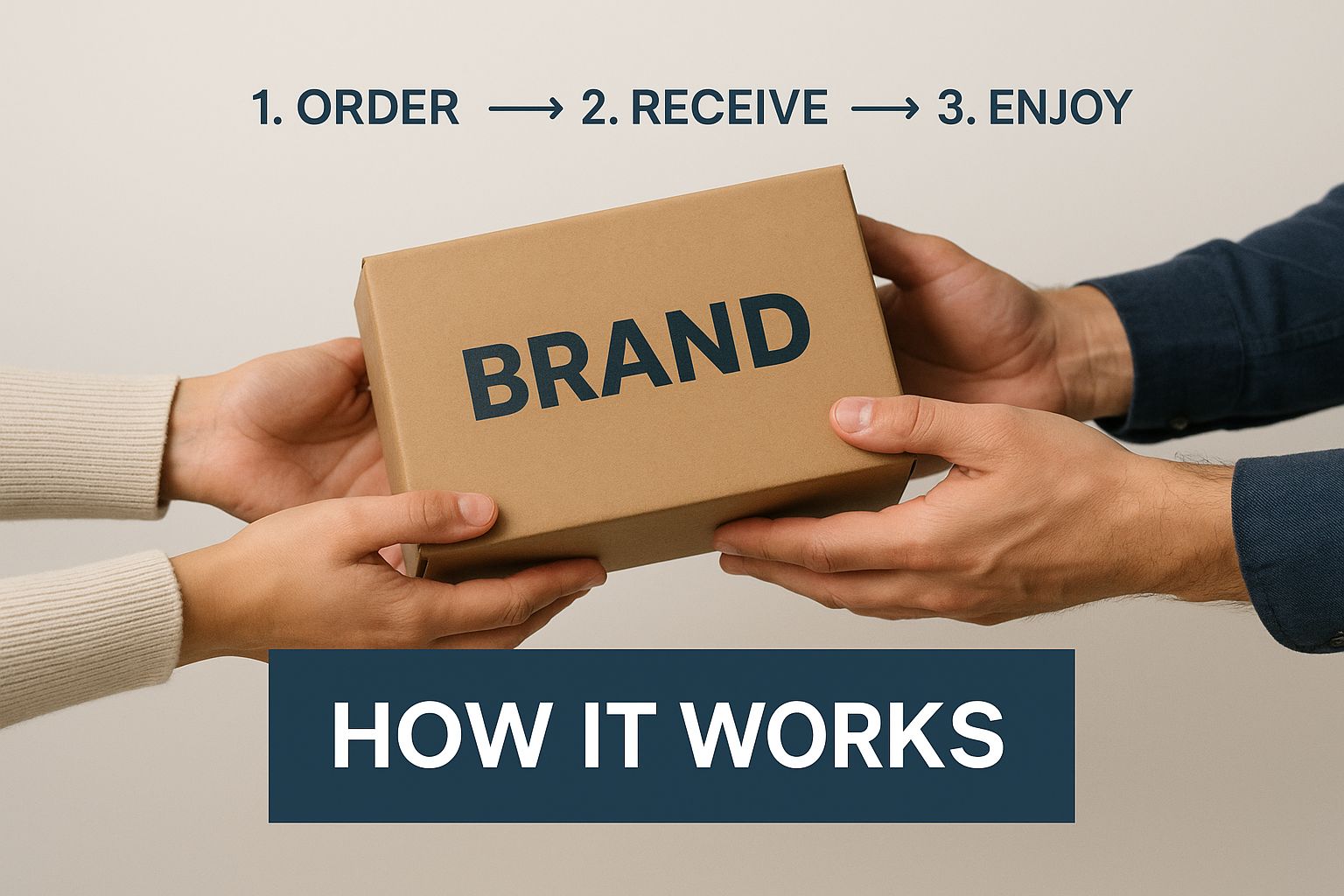
As you can see, the core idea is a simple handoff. One company’s product is passed to another to be branded and sold, making the whole process invisible to the final customer.
Identifying the Service Gap and Vetting Partners
For Growth Co., the journey starts by admitting they have a gap: no in-house social media team. Instead of going through the time and expense of hiring, they decide to find a white label provider. This kicks off a really important vetting stage.
They don't just go with the first name they find. They dig in and do their homework, looking for a few key things:
- Proven Expertise: They want to see case studies and read testimonials. Can this provider actually deliver results?
- Communication Style: Is the partner responsive, clear, and professional? A bad communicator can sink the whole ship.
- Technological Alignment: Do they use project management tools that play nicely with Growth Co.'s existing systems?
After a thorough search, Growth Co. partners with "Social Geniuses," a specialized white label social media agency with a great reputation. The goal is to find a partner that feels like an extension of your own team, not just a faceless vendor you farm work out to.
Establishing Clear Guidelines and Communication
With a partner chosen, the next step is setting the ground rules. This is where many partnerships either succeed or fall apart. Growth Co. and Social Geniuses need to establish crystal-clear rules of engagement from day one.
The success of a white label partnership hinges on flawless integration. The end client should never suspect that a third party is involved. This requires meticulous planning around branding, communication, and reporting to maintain a unified and professional front.
This means creating detailed branding guidelines. Growth Co. hands over its logos, color palettes, and tone of voice documents. Now, every report, email, and social media post from Social Geniuses will look and sound exactly like it came from Growth Co.
They also set up a shared project management board. This creates a central hub for communication and task tracking, making sure everyone is always on the same page.
Managing the Client Relationship Seamlessly
Now that the backend is sorted, Growth Co. can confidently start selling social media management services. When they sign a new client, the process is smooth and straightforward:
- Client Onboarding: Growth Co. handles all client-facing communication, from the initial strategy calls to gathering brand assets.
- Project Handoff: They package up the client brief and assets and pass them to Social Geniuses through their shared project tool.
- Silent Execution: Social Geniuses gets to work creating content, scheduling posts, and managing the client’s accounts—all completely behind the scenes.
- Branded Reporting: At the end of the month, Social Geniuses provides a full performance report. Growth Co. reviews it, adds their own strategic insights, and presents it to the client under their own brand.
From the client's perspective, Growth Co. is a full-service powerhouse. They get expert social media management from the agency they already know and trust, with no idea there's a silent partner working diligently in the background to deliver the results.
Finding and Managing the Right White Label Partner
Think of choosing a white label partner like hiring a key team member—one who will never actually meet your clients but whose work directly reflects on your reputation. A great partnership isn't just about finding someone who can do the job; it's about trust, crystal-clear communication, and knowing you’re both on the same page. The wrong partner can mean blown deadlines and angry clients, but the right one? That can be the key to unlocking some serious growth.
The goal here is to find a partner who can deliver the work your way, fitting so perfectly into your agency's workflow and standards that it's completely seamless. Don't rush this decision. It's a classic mistake that can really come back to bite your brand down the road.
Vetting Your Potential Partner
Before you even think about signing a contract, you need to do your homework. This is your chance to pop the hood and see if what they promise in their marketing materials is actually what you get. A great place to start is by asking for case studies and client testimonials to see real proof of their track record.
From there, dig into their actual process and how they communicate. A few direct questions can tell you everything you need to know:
- What does your onboarding process for new agency partners look like? This will show you just how organized and supportive they are from day one.
- How do you handle project management and communication? You're looking for established systems and a single, clear point of contact.
- Can you describe a time a project went wrong and how you fixed it? Their answer is a masterclass in their problem-solving skills and whether they take accountability.
A solid partner will be happy to answer these questions with transparent, confident responses. It’s how you’ll gauge if they can truly operate as a silent, effective extension of your own team. This initial legwork is what builds a profitable, long-term relationship.
Setting Crystal-Clear Expectations
Okay, you’ve picked your partner. Now for the most important step: get everything in writing. A detailed Service Level Agreement (SLA) is absolutely non-negotiable. This document is your rulebook, outlining every single aspect of the partnership so there’s zero room for guesswork.
A strong SLA is the cornerstone of a healthy white label relationship. It should clearly define project scope, turnaround times, quality standards, and communication protocols, ensuring both parties are perfectly aligned before any work begins.
Your SLA should also be upfront about what happens if standards aren't met. This gives you a clear path for resolving issues. It isn't about mistrust; it’s just smart business that creates a professional framework for success. It’s just like when you learn how to find brand ambassadors; you set clear campaign goals first. Here, you're defining the rules of engagement.
Finally, you need to get your sales team up to speed. They have to understand the new service—its capabilities and, just as importantly, its limitations—so they can sell it confidently without making promises you can't keep. As you start weaving these partnerships into your business, following smart vendor management best practices will make all the difference, ensuring your entire operation is ready to deliver.
The Future Of White Label Marketing Services

White label marketing isn’t taking a break—it’s speeding forward. Yesterday’s shortcuts quickly become today’s baseline; picking a partner who evolves with you is the difference between staying afloat and leading the charge. Smarter partnerships and results-driven collaborations will define tomorrow’s success.
AI And Automation Integration
What once felt futuristic now sits at the heart of every campaign. Brands and agencies are weaving AI and automation into their white label strategies to:
- Uncover Deeper Data Insights
- Boost Operational Efficiency
- Deliver Personalized Campaigns At Scale
Widespread tools such as advanced AI content creation tools for SEO showcase how these technologies are setting new benchmarks. For resellers, the payoff is clear: rapid-turnaround projects with laser-focused recommendations.
Specialization And Performance-Based Models
The era of generalist marketing vendors is fading fast. Companies are zeroing in on niche expertise—think SaaS, healthcare or eCommerce—and demanding proof of real-world results. Understanding the role of influencer marketing in eCommerce is a prime example of why vertical know-how matters.
Flat monthly retainers are going out of style. The next wave favors performance-based pricing, where partners earn by hitting targets like lead volume or sales growth. This setup turns a service provider into an invested collaborator.
By 2025, agencies will routinely combine services under one roof and pay according to performance. To discover more insights about these marketing trends, you’ll see that this shift towards measurable return is anything but optional.
Transparency And Real-Time Reporting
In this climate, nobody’s satisfied with vague status updates. Clients demand live data feeds—think dashboards that refresh as campaigns run. That transparency empowers agencies to pivot strategies on the fly and cements confidence in their white label partner.
Where Do You Go From Here?
So, what have we learned? At its core, white label marketing isn't just a fancy term—it's a smart way to grow your business. Think of it as a strategic shortcut to scaling up your services, building your brand's reputation, and improving your bottom line, all without the headache and expense of building out a new team from the ground up.
This is your chance to immediately expand what you can offer clients. You get to say "yes" more often, all while your team sticks to what they do best.
It's so much more than just outsourcing. This is about finding the right partner to deliver top-tier results that you can proudly put your name on. Your clients will never know the difference; they’ll just see your agency delivering incredible value and becoming the one partner they can't live without.
Time to Make a Move
The path forward is actually pretty straightforward. First, take a hard look at what you’re currently offering. Where are the gaps? What are clients always asking for that you have to turn down? Figuring that out is the first real step to finding a partner who can fill those needs.
Moving to a white label partnership means you stop trying to do everything yourself and start working within a smarter, more scalable model. It frees you up to focus on what really matters: building client relationships and thinking about the big picture.
Once you know what you need, start looking for partners who are experts in those areas. You'll want to find companies with a solid track record and a dedication to quality that mirrors your own. This isn't just about offloading work; it's about unlocking a more profitable, competitive, and scalable future for your agency.
Answering Your Top Questions About White Label Marketing
Even after you've got a good handle on white label marketing, a few questions always seem to pop up. Let's clear the air and tackle some of the most common ones so you can move forward with confidence.
Is White Label Marketing Actually Legal and Ethical?
Yes, absolutely. White label marketing is a completely legitimate and common business practice. Think of it as a standard B2B outsourcing arrangement. One company is great at building a service, and another is great at selling and managing it. It’s no different than a big-box store putting its own brand name on products made by another manufacturer.
The ethical side of things comes down to quality and accountability. As long as your agency stands behind the service and ensures your client gets fantastic results, it's a perfectly sound business agreement. The client is paying you for a solution, and you're delivering it.
What's the Real Difference Between White Label and Private Label?
This is a classic point of confusion, but the difference is actually pretty straightforward once you break it down.
-
White Label is a "one-to-many" deal. A provider creates a standardized service or product (like a marketing report template or a piece of software) and sells it to any number of other businesses to rebrand. It’s ready to go, right off the shelf.
-
Private Label is a "one-to-one" relationship. Here, a manufacturer creates an exclusive product for just one reseller. A great example is a grocery store chain hiring a supplier to create a specific soup recipe that will only ever be sold under that store's brand.
Basically, white label is about using a proven, scalable solution, while private label is about commissioning a completely custom one from scratch.
The bottom line? White label services let you tap into a proven, ready-to-deploy solution. Private label, on the other hand, means you’re building something from the ground up, which almost always costs a lot more time and money.
How Do I Figure Out Pricing for My Clients?
Nailing your pricing is key to making this model work. First, you need to know exactly what you're paying your white label partner—that's your baseline cost. Then, do a little market research. What are other agencies charging for similar services? You need to be competitive.
Your price should comfortably cover what you pay your partner and leave a healthy margin for your agency. A markup of 50% to 100% is pretty standard, and sometimes it can be even higher. Remember, that margin isn’t just pure profit. It covers your own team's time for project management, client communication, and making sure the service fits perfectly into the client's overall strategy.
Ready to scale your agency's influencer marketing services without the overhead? With REACH, you can manage unlimited client campaigns, generate fully white-labeled reports, and connect with a world of verified creators, all under your own brand. Discover how REACH can power your growth today.