 Skip to content

If you want to improve conversion rates, you need to do more than just tweak a button color. Real growth comes from a holistic strategy that blends data-driven optimization with the persuasive power of social proof. From finding and fixing leaks in your sales funnel to leveraging authentic influencer content, every step must be intentional. This guide will walk you through proven tactics to turn more browsers into buyers, reinforced by real-world examples from our work with top brands on the REACH Influencers platform.
A high conversion rate is the ultimate sign of a healthy business. It means your messaging resonates, your user experience is seamless, and you’ve built genuine trust with your audience. Let's dive into how you can make that happen.
Table of Contents
- Finding and Fixing Your Conversion Funnel Leaks
- How to Improve Conversion Rates with Landing Page Optimization
- Using Influencer Marketing to Drive Direct Sales
- From Social Views to Sales: Your Playbook for Video Content
- Proving Your Worth: How to Track Performance and Show Real ROI
- Common Questions About Improving Conversion Rates
Finding and Fixing Your Conversion Funnel Leaks
Before you can make any meaningful improvements, you have to put on your detective hat. Think of your website’s sales path as a pipeline. Every potential customer enters at one end, and a sale or signup is the destination. A "funnel leak" is any spot in that pipeline where people are dropping out.
Your job is to find exactly where those leaks are happening. Are visitors bouncing the second they hit a product page? Or are they loading up a shopping cart only to disappear when they see the shipping costs? Without diagnosing the problem, any "fix" is just a shot in the dark.
Start with a Data-Driven Diagnosis
Your most reliable tool for this investigation is your analytics platform. Something like Google Analytics is essential for getting a bird's-eye view of your funnel. By setting up goals and funnel visualizations, you can see the exact drop-off rates between each step a user takes.
For example, your analytics might show that 1,000 people visited a product page, 300 added the item to their cart, but only 100 actually started the checkout process. That massive drop-off between cart and checkout is your first major clue.
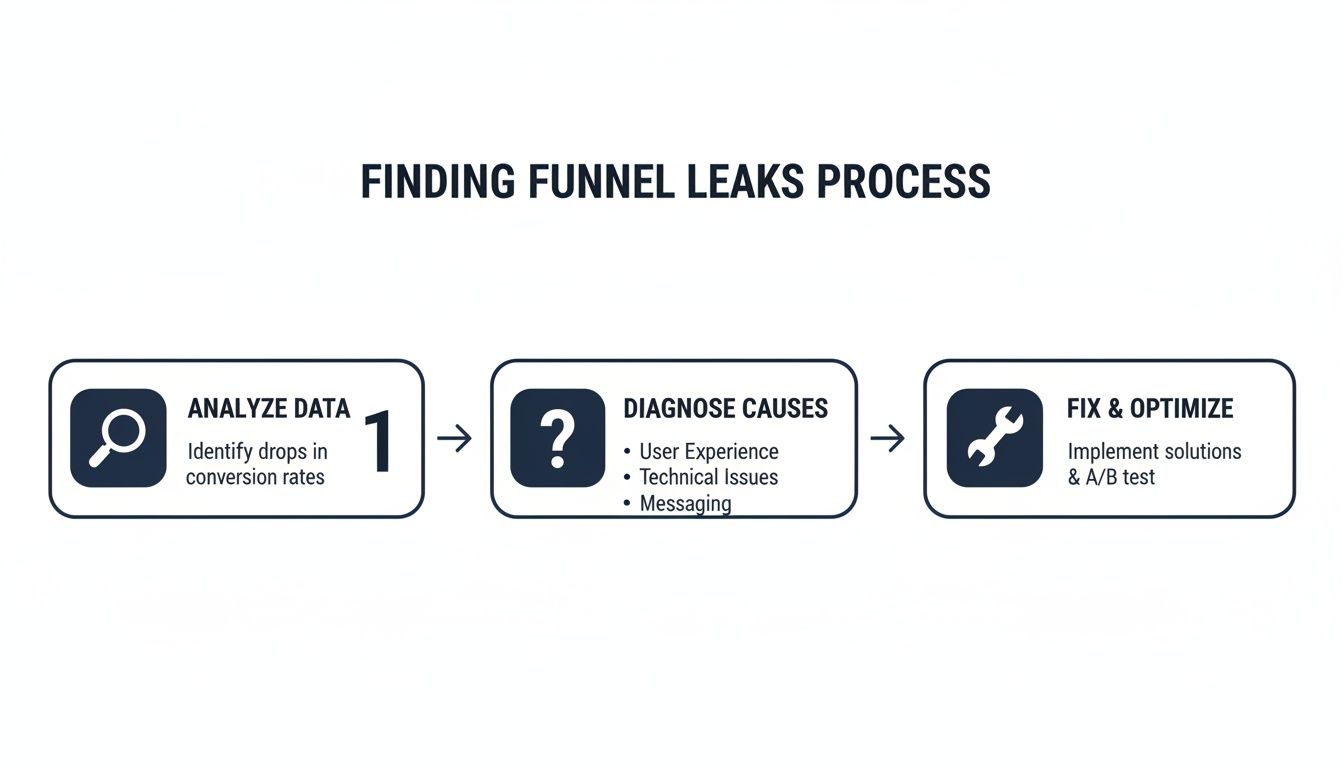
But analytics only tell you what is happening. They don't explain why. To get the full story, you need to layer in qualitative data. This is where you get inside your users’ heads.
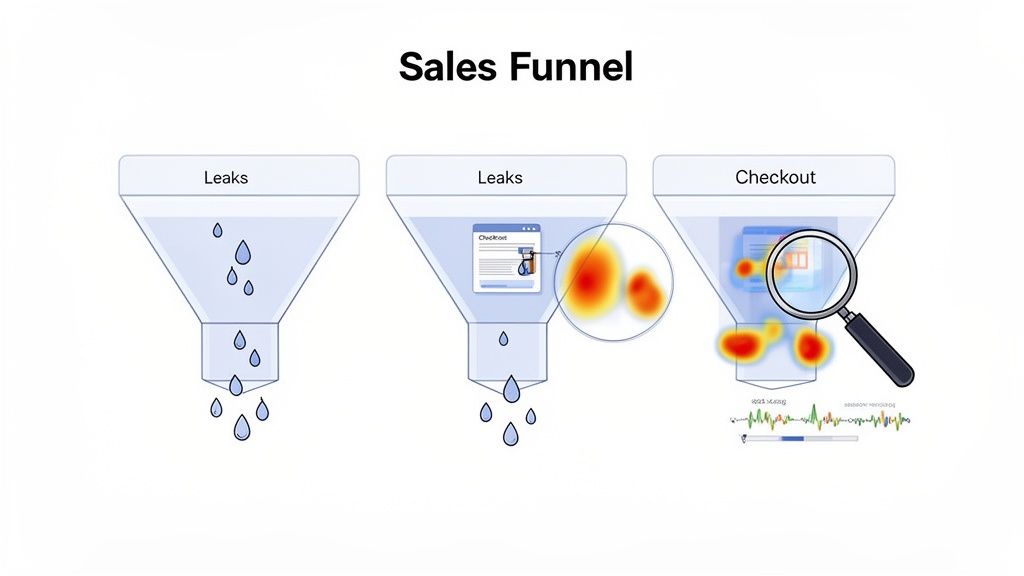
- Heatmaps are fantastic for this. They create a visual map of where people are clicking, scrolling, and moving their mouse. You can quickly see which elements get attention and which are completely ignored.
- Session Recordings are even more powerful. These are like watching a replay of someone’s visit to your site. You can see their exact mouse movements, where they hesitate, and what makes them give up and leave.
I remember working with an e-commerce client who was seeing a 65% cart abandonment rate. Analytics confirmed the drop-off was happening on the checkout page, but we couldn't figure out why. After watching just a handful of session recordings, the problem became painfully obvious: a "Company Name" field in the shipping form was mandatory. Individual buyers got confused and simply left. Removing that one field boosted checkout completions by 15% almost overnight.
This approach—analyzing the data, diagnosing the real problem, and then implementing a specific fix—is the core of smart conversion optimization. You stop guessing and start making changes that actually move the needle.
Prioritizing Your Fixes for Maximum Impact
Once you start looking, you'll probably find more than one leak. It's easy to get overwhelmed. The secret is to prioritize. Don't try to fix everything at once.
A simple framework I use is the PIE model:
- Potential: How big of an improvement could this fix create? A leak with a high drop-off rate has more potential than a small one.
- Importance: How valuable is the traffic on this page? A problem on your main checkout page is far more important than one on an old blog post.
- Ease: How difficult will this be to implement? Changing some text is easy. A complete redesign of your checkout flow is hard.
Score each potential fix against these three factors. This helps you identify the "quick wins"—the fixes that are high-potential, high-importance, and easy to implement. Tackling these first not only delivers immediate results but also builds momentum and proves the value of your work right from the start.
How to Improve Conversion Rates with Landing Page Optimization
Alright, you've pinpointed where your funnel is leaking. Now it's time to get your hands dirty and fix the pages where the magic is supposed to happen. Your landing pages and calls-to-action (CTAs) are the moments of truth—this is where a casual browser either becomes a customer or clicks away forever.
Think of your landing page as your best salesperson, but one who can only say one thing. Its entire existence is dedicated to a single goal: getting that visitor to act. If the page is cluttered, confusing, or just plain boring, you're losing money. It's as simple as that.
Crafting Headlines and Copy That Resonate
When someone lands on your page, their eyes immediately jump to the headline. You have about three seconds to convince them they’re in the right place. A great headline instantly solves this by speaking directly to their needs and matching the promise of the ad they just clicked. This concept is called message match, and it's non-negotiable for keeping people from bouncing.
Once the headline has them hooked, the rest of your copy needs to reel them in. This is where so many brands go wrong. They list features instead of explaining benefits. No one cares about your "AI features"; they care that your software will save them 10 hours a week.
- Focus on the "So What?": Always answer the question "So what?" for the user. How does this make their life better?
- Anticipate their Doubts: Are they worried about cost? Complexity? Address these concerns head-on with a guarantee or a quick FAQ section.
- Show, Don't Just Tell: Weave in testimonials, case studies, or logos of clients they recognize. Displaying reviews can boost conversions by a staggering 270%.
The Science of an Irresistible Call-to-Action
Your CTA is the final nudge. It’s the big red button you want them to press. Yet, so many pages end with a whimper: "Submit." It’s uninspiring and weak. A powerful CTA is specific, action-oriented, and reminds the user of the value they're about to receive.
I once worked with a client whose landing page CTA was a simple "Sign Up." We changed it to "Get My Free Guide," and conversions shot up by over 30% almost overnight. The change was tiny, but it reframed the entire exchange from the user giving their email to getting something valuable.
Here are a few rules I live by for creating CTAs that work:
- Be Hyper-Specific: "Start Your 14-Day Free Trial" crushes "Get Started" every time because it sets a clear expectation.
- Create Real Urgency: If you use scarcity, make it genuine. "Offer Ends Friday" works if it actually does. Fake urgency just erodes trust.
- Make It Pop: Your CTA button should be impossible to miss. Use a contrasting color that draws the eye and screams "click me!"
A/B Testing Your Way to Higher Conversions
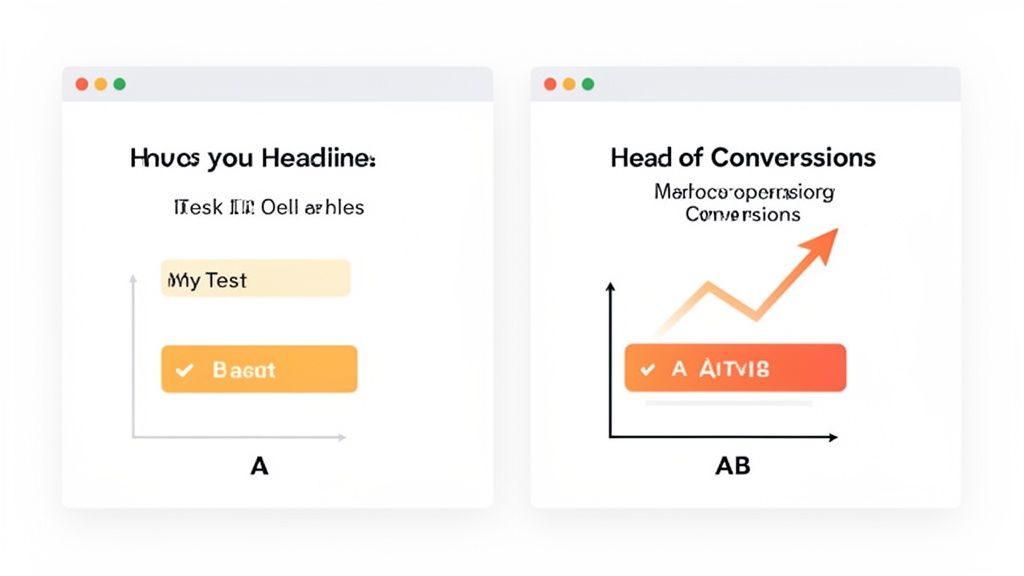
Here's the best part: you don't have to guess what works. A/B testing is your secret weapon for systematically improving your pages. You simply create two versions of a page (an "A" version and a "B" version), change one single thing, and show them to different people to see which one wins.
Not sure where to start? Test the big stuff first for the biggest impact.
- Your Headline: Try a statement vs. a question.
- Your Hero Image: Pit a product shot against a lifestyle photo of someone using it.
- Your CTA Text: Test different action words or benefit statements.
The golden rule is to only change one element at a time. If you change the headline and the button color, you'll never know which one was responsible for the lift. These small, incremental wins stack up over time, turning your static pages into conversion powerhouses.
Of course, it helps to know what you're aiming for. Take a look at what a good conversion rate is for your industry to set some realistic goals. From there, it's all about testing, learning, and refining your way to the top.
Using Influencer Marketing to Drive Direct Sales
If you think influencer marketing is just for racking up likes, you're leaving a ton of money on the table. It’s time to stop treating it as a fuzzy brand awareness play and start seeing it for what it is: a direct line to more sales. The whole game changes when you shift from chasing vanity metrics to building partnerships that actually move the needle.
Forget the massive celebrities for a moment. The real magic happens when you partner with creators whose audiences genuinely trust them. Think about it—you’re far more likely to buy something recommended by a friend than you are from a random billboard. That’s the exact dynamic you want to tap into.
Finding Influencers Who Actually Convert
So many brands get fixated on follower count, and it’s one of the biggest and most expensive mistakes I see. The real gold isn't in audience size; it's in engagement and trust. That's why one of the quickest ways to see a real lift in conversions is to partner with micro-influencers—creators with somewhere between 10,000 and 100,000 followers. They tend to have much tighter-knit communities.
The data backs this up. Nano-influencers on TikTok, for example, can hit engagement rates as high as 15.2%. Compare that to the 2.8% average for a massive Instagram influencer with over 1.5 million followers. That intimacy is what turns a sponsored post into a trusted recommendation from a friend, and that’s what gets people to pull out their wallets.
So, where do you find these high-impact partners?
- The Manual Grind: You can always scroll through hashtags and check out your competitors' mentions. It’s free, but it's a huge time-sink and nearly impossible to do at scale.
- The Smart Route: This is where an influencer marketing platform like REACH Influencers becomes your best friend. Its discovery engine lets you slice through the noise, filtering creators by niche, engagement metrics, audience demographics, and more. You can pinpoint people whose followers are your ideal customers.
I once worked with a DTC skincare brand that was burning cash on macro-influencers and seeing almost no sales from it. We switched gears and used REACH to find 20 micro-influencers deep in the "clean beauty for sensitive skin" niche. The result? A 25% jump in attributable sales in the first month, all from a smaller, smarter investment.
Structuring Campaigns for Trackable Sales
Once you’ve found the right people, you absolutely need a system to track their impact on your bottom line. This is what separates a hopeful expense from a measurable revenue driver. If you aren't tracking, you're just guessing.
The best way to do this is by giving each influencer their own unique assets. This creates a clear trail from their content straight to your checkout. Two tools are essential here:
- Unique Discount Codes: Giving each creator a specific code (like "SARA15") is simple and powerful. It gives their audience a reason to buy now and tells you exactly who sent the sale.
- Affiliate Links: These are trackable URLs that credit the influencer for every click and any resulting purchases. This is perfect for seeing not just who drives sales, but also who drives quality traffic to your site.
Platforms like REACH Influencers are designed to handle all of this for you. You can generate and send out unique codes and links right from the dashboard and then watch the clicks, conversions, and revenue roll in. It gets you out of spreadsheet hell and gives you a clear view of which partners are your true top performers. This is crucial for knowing how to improve conversion rates in future campaigns.
Turning Creator Content Into a Conversion Asset
The partnership doesn’t end when the influencer hits "post." The real long-term value comes from the content they create—what we call user-generated content (UGC). This stuff is a goldmine you can repurpose across your own marketing channels to boost conversions everywhere.
An authentic photo or video of a real customer loving your product is infinitely more convincing than a polished corporate ad. It’s pure social proof.
Here’s how to put that content to work:
- On Product Pages: Add a "Spotted on Social" or "See It In Real Life" section featuring tagged influencer photos.
- During Checkout: A powerful quote from an influencer can be just the nudge a hesitant buyer needs to complete their purchase.
- In Your Paid Ads: Test influencer UGC against your professionally shot creative in Facebook and Instagram ads. You’ll often find the UGC performs better because it feels more native and trustworthy to people scrolling their feeds.
By repurposing this content, you create a powerful, self-sustaining loop of social proof. The initial influencer post drives sales, and then their content enhances your own site and ads to convert even more customers down the line. It turns a one-off campaign into a lasting asset that keeps working for you.
From Social Views to Sales: Your Playbook for Video Content
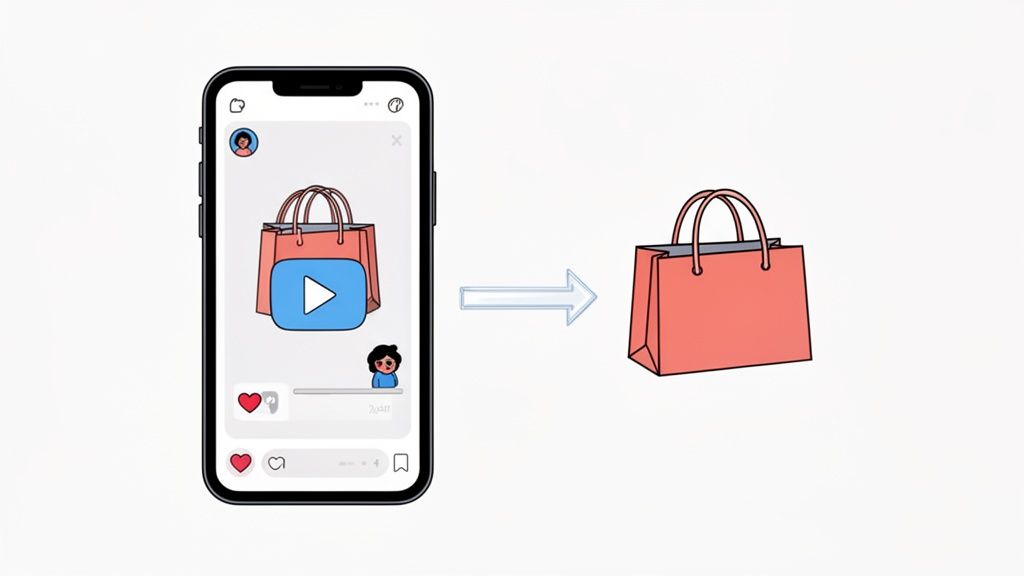
Let's be honest, the old marketing funnel is broken. People aren't just dutifully starting on Google and ending on your website anymore. They discover, research, and hit "buy" all within the same 10-minute scroll session on TikTok or Instagram. Short-form video is the new storefront, and if you're not there, you're leaving money on the table.
This isn't about chasing viral trends. It's about using video strategically to close the distance between a passive viewer and an active customer.
Social commerce is on fire for one simple reason: it meets people exactly where they are. You're making it incredibly easy for someone to go from "Oh, that's cool" to "It's on its way." The trick is to create content that feels real, offers genuine value, and subtly nudges them toward the checkout.
Make Videos People Actually Want to Watch
The best-performing videos on social media rarely feel like slick advertisements. They feel like a tip from a friend, a quick how-to, or a story you can relate to. Your first job is to stop the scroll. You do that by being either useful or entertaining—and if you can be both, you've hit gold.
I've seen these formats work wonders time and time again:
- Quick Product Demos: Show, don't just tell. A 15-second clip of your stain remover making a coffee spill vanish is infinitely more convincing than a block of text about its formula.
- Real User Testimonials: This is where nano- and micro-influencers are your secret weapon. Get them to create simple, unfiltered videos sharing their honest take. A real person's genuine excitement during an unboxing is the most powerful social proof you can get.
- Problem/Solution Stories: Hook them with a common frustration. Maybe it's frizzy hair on a humid day or a phone battery that always dies by 3 PM. Then, position your product as the simple, elegant solution. It's a classic storytelling arc that just works.
The key is making your product part of the story, not the entire story. A fashion creator's video on "3 Ways to Style a White Tee" that happens to feature your brand's shirt feels like great content, not a sales pitch. That’s how you build trust and drive real desire.
Find the Right Creators to Spark Action
Creating this kind of authentic content consistently is tough. The answer isn't a bigger ad budget; it's partnering with the right creators. Forget the celebrities for a moment. Your conversion goldmine lies with nano- and micro-influencers.
Why? Because their followers actually trust them. Their recommendations feel personal, not transactional.
The data backs this up completely. When you're trying to improve conversion rates, engagement is what matters most. Nano-influencers (those with under 10,000 followers) hit an incredible 6.23% engagement rate on Instagram. Over on TikTok, creators are seeing a solid 4.95%. It's no surprise that 80.8% of US marketers point to Instagram as a top channel for its effectiveness. You can dig into these performance marketing trends to see just how much the industry is shifting this way.
Of course, finding these high-impact creators can feel like searching for a needle in a haystack. Manually sifting through profiles is a huge time sink. This is where a specialized platform like REACH becomes an absolute game-changer. Its discovery tools let you filter creators by their niche, audience demographics, and—most importantly—their actual engagement stats. You can quickly pinpoint creators whose followers are your ideal customers, taking all the guesswork out of the process.
Make It Easy for People to Buy Now
You've got amazing video content from creators people trust. Don't fumble the ball at the one-yard line! Every extra click or page you make someone load is an opportunity for them to get distracted and walk away.
Make your videos instantly shoppable with these tactics:
- Use In-App Shopping: Tag your products directly in Instagram Reels and TikTok videos. This lets people tap a product and buy it right then and there, without ever leaving the app.
- Optimize Your "Link in Bio": Use a tool that turns your Instagram feed into a clickable, shoppable gallery. Your single bio link becomes a portal where followers can buy anything they just saw in your content.
- Insist on a Clear CTA: Coach your creators to end their videos with a simple, verbal call to action. Something as natural as, "You can grab one for yourself using the link in my bio!" can dramatically boost follow-through.
When you bring together authentic video, trusted creators, and a frictionless buying process, your social media accounts stop being just a branding exercise. They become a powerful sales channel that generates real, measurable revenue.
Proving Your Worth: How to Track Performance and Show Real ROI
Let's be honest: all the A/B tests and funnel optimizations in the world won't matter if you can't prove they're actually making money. If you want to secure more budget and earn trust from leadership, you need to show them the numbers. It’s about shifting the conversation from "look how many likes we got" to "look how much revenue we generated."
This means you have to stop reporting on vanity metrics. Impressions and follower counts might feel good, but they don't directly translate to a healthy bottom line.
From Vanity Metrics to Business Impact
To demonstrate real value, your focus needs to be on the metrics that truly count—the ones tied directly to sales and customer growth.
Below is a quick comparison to help you distinguish between the numbers that impress and the numbers that drive business decisions.
Key Conversion Metrics vs Vanity Metrics
| Metric Type | Examples | Why It Matters |
|---|---|---|
| Conversion Metrics | Cost Per Acquisition (CPA), Customer Lifetime Value (LTV), Return on Ad Spend (ROAS) | These metrics directly measure financial outcomes, profitability, and the long-term value of your marketing efforts. |
| Vanity Metrics | Likes, Impressions, Follower Count, Page Views | While they can indicate brand awareness, these numbers don't show a direct link to revenue or customer acquisition. |
Focusing on conversion metrics changes the entire conversation. Instead of just showing activity, you're demonstrating clear, financial results.
Here are the heavy hitters you should be tracking:
- Cost Per Acquisition (CPA): This is your bread and butter. It tells you exactly what you paid to land a new customer. A low CPA means your marketing is efficient and profitable.
- Customer Lifetime Value (LTV): This metric looks beyond the first purchase, calculating the total revenue a customer brings in over their entire relationship with you. A high LTV proves you’re building a loyal following, not just chasing one-off sales.
- Return on Ad Spend (ROAS): For any paid campaign, this is non-negotiable. It shows the gross revenue you earned for every dollar you spent on ads. A high ROAS is the clearest sign that your advertising is working.
When you lead with these KPIs, you can confidently walk into any meeting and say, "For every $1 we invested, we brought in $5 in return." That’s how you get a bigger budget.
Getting Real-Time Data from Your Influencer Campaigns
Measuring the ROI of influencer marketing used to be a messy affair, full of spreadsheets and best guesses. Thankfully, those days are over.
Modern platforms like REACH Influencers give you a central command center for all your influencer campaigns. Everything is consolidated into one dashboard, so you can see exactly what’s happening in real time.
When you can see clicks, conversions, and revenue data updating live, you can make smarter decisions on the fly. You're no longer waiting weeks for a campaign to end to see what worked. You can double down on high-performing creators and adjust strategies for those who are lagging, all while the campaign is still active.
This kind of agility is a game-changer. As more brands demand clear ROI, being able to track metrics like click-through rates (CTR) and CPA is essential. The data backs this up: influencer marketing can deliver an average ROI of $6.50 for every $1 spent. What's more, 82% of marketers find that leads from influencer campaigns are higher quality than those from other channels.
Building Reports That Actually Get Read
The final piece of the puzzle is presenting your data in a way that tells a clear story. Don't just dump a spreadsheet on your boss's desk. Your goal is to create a narrative that connects your work directly to financial wins.
A powerful performance report should always include:
- A quick summary of the big wins and key takeaways right at the top.
- A clear breakdown of your core metrics (CPA, LTV, ROAS).
- A comparison of your results against the goals you set at the start.
- A spotlight on your best-performing channels or creators.
This is especially effective for showing the power of long-term creator partnerships. The data consistently shows that the more you work with a creator, the better your results get. For instance, CTRs can jump by 10% with each new collaboration. By the sixth campaign with the same creator, brands often see a 1.9x lift in conversion rates compared to the first one.
For an even more comprehensive picture, consider integrating powerful Business Intelligence solutions. These tools can pull data from all your marketing channels, giving you a holistic view of the customer journey.
A well-crafted report makes it easy for anyone to see the incredible value you’re delivering, paving the way for continued investment in your work. To sharpen your reporting skills even further, check out our guide on effective social media measurement.
Common Questions About Improving Conversion Rates
When you start digging into conversion optimization, a few questions always seem to pop up. Let's clear the air and tackle some of the most common ones I hear from brands trying to turn more clicks into customers.
What Is a Good Conversion Rate to Aim For?
Everyone wants to know the magic number, but the honest answer is: it really depends. What’s considered "good" changes dramatically based on your industry, where your traffic is coming from, and what you’re selling. For an e-commerce store, a conversion rate between 1-3% is pretty standard. For B2B lead generation, that number could be significantly higher.
Instead of getting hung up on an industry average, your time is much better spent trying to beat your own numbers. Figure out what your baseline is right now, and then set a goal to improve it, even by a small margin, month after month. A 10% lift on your own rate is a way more powerful win than trying to hit some arbitrary benchmark.
How Long Should I Run an A/B Test?
This all comes down to two things: how much traffic your site gets and when you reach statistical significance. It's so tempting to call a winner the second one version starts to pull ahead, but that's a classic mistake that will lead you astray with false positives.
You should always run a test for at least one full business cycle—usually one to two weeks is enough. This helps smooth out any weird fluctuations in how people behave on a Monday versus a Saturday. Your testing tool should tell you when you've hit statistical significance (look for a 95% confidence level). That's your green light to declare a winner and roll out the change.
Can I Improve Conversion Rates Without a Big Budget?
Absolutely. You don't need a massive budget to see real results. In fact, some of the most powerful conversion-boosting tactics are low-cost or completely free.
Start by digging into your analytics with a free tool like Google Analytics or using low-cost heatmap software to see exactly where users are getting stuck. Simple tweaks can make a huge difference.
- Sharpen your CTA copy: Make it more specific and tell people exactly what they'll get.
- Boost your page speed: Compressing your images is a quick win.
- Add social proof: Customer testimonials and reviews build instant trust.
A great budget-friendly strategy is partnering with nano-influencers by gifting them products. A platform like REACH Influencers helps you manage these relationships, so you can generate a steady stream of authentic social proof and traffic without a huge cash investment.
If you're looking for more ideas, this list of actionable conversion rate optimization tips is packed with practical strategies that won't break the bank. The trick is to start small, be strategic, and let your data show you the way.
Knowing how to improve conversion rates is the key to unlocking sustainable, profitable growth. By combining technical optimization with the authentic voice of influencer marketing, you create a powerful engine for turning prospects into loyal customers.
Ready to unlock the power of influencer marketing to drive sales and build unshakable social proof? REACH Influencers makes it easy to find the perfect creators, manage campaigns, and track your ROI in real time. Book a demo today and see how our platform can supercharge your growth.