 Skip to content


Meta description: Learn how often to post on TikTok with a stage-based, evidence-backed roadmap for brands, agencies, and creators. Find the right cadence, test it over time, and optimize for sustainable growth.
URL slug: /how-often-to-post-on-tiktok
If you only remember one number, make it this one: moving from one TikTok post per week to 2 to 5 posts per week can produce up to 17% more views per post, based on analysis of more than 11 million posts by Buffer (https://buffer.com/resources/how-often-should-you-post-on-tiktok/).
That changes the usual conversation around how often to post on TikTok. The question isn’t whether more posting can help. It can. The better question is where the payoff starts to flatten, and how that answer changes as an account matures.
Most advice treats posting cadence as a universal rule. It isn’t. A new account trying to earn its first reliable distribution window needs a different rhythm than a mature brand with an established audience, a staffed content team, and tighter brand controls. That’s where most posting guides fall short.
This article takes a data analyst’s view. It separates posting frequency into stages, ties cadence to business goals, and turns frequency into something you can test rather than guess. If you manage a brand account, run campaigns for clients, or build your own creator business, that’s the practical lens that matters.
Why Posting Frequency Matters on TikTok Right Now
A creator posts once a week and waits for a result. Another posts several times across the week, learns which hooks hold attention, and gives the platform more chances to distribute a breakout video. Those are not equal strategies, even if the content quality is similar.
Buffer’s analysis of more than 11 million posts found that the biggest efficiency gain happens early. Increasing from one post per week to 2 to 5 weekly posts led to up to 17% more views per post (https://buffer.com/resources/how-often-should-you-post-on-tiktok/). That matters because it reframes frequency as a lever with a clear threshold, not an endless race.
Consistency beats bursts
Many teams still post in bursts. They go quiet, then flood the feed during launches, promotions, or campaign weeks. That feels productive internally, but it creates a weak signal externally. TikTok rewards regular participation more reliably than sporadic intensity.
Accio reports that brands posting daily or near-daily can see up to twice the follower growth of sporadic posters, and it also notes that sustaining a schedule for 90 days is important for long-term engagement (https://www.accio.com/blog/how-often-to-post-on-tiktok-guide-for-businesses-and-brands).
Practical rule: A schedule you can sustain usually outperforms an ambitious schedule you abandon after two weeks.
Frequency is really an operating decision
For marketers, posting frequency isn’t just a content question. It’s an operating model.
It affects:
- Creative planning: More posts require more concepts, formats, and editing capacity.
- Team workflow: Someone has to script, film, edit, approve, publish, and respond.
- Learning speed: More posts create more feedback loops on hooks, retention, and shareability.
- Brand risk: Higher cadence can increase inconsistency if approvals and content standards are weak.
That’s why “how often to post on TikTok” doesn’t have one answer. It has a best answer for your account stage, your goals, and your ability to keep the cadence running long enough to learn from it.
Understanding TikTok Algorithm Signals
TikTok doesn’t behave like a feed built mainly around follower relationships. It behaves more like a testing environment where each post gets an opportunity to prove itself.

That distinction matters when deciding how often to post on TikTok. Buffer’s research found that the algorithm does not primarily reward follower count, and that each post is an independent chance to break out (https://buffer.com/resources/how-often-should-you-post-on-tiktok/). In plain language, posting frequency expands your number of attempts.
More posts create more trials
Think of every post as a separate test of three things:
- Hook strength: Did viewers stop scrolling?
- Content fit: Did the topic, format, and delivery match audience interest?
- Distribution potential: Did enough early viewers engage in ways that justified wider reach?
When teams increase posting cadence, they don’t automatically make every post better. They create more shots at discovering a post that travels further than the rest. That’s why frequency and virality are related without being identical.
TikTok posting frequency raises the number of opportunities in the system. It doesn’t guarantee that any single video will perform.
What the algorithm likely reads from cadence
Posting frequency feeds into TikTok performance in indirect ways.
A consistent cadence can help you:
- Generate faster pattern recognition: You see sooner which formats repeat success.
- Reduce learning lag: Fewer gaps between posts mean fewer dead periods in your feedback cycle.
- Support audience memory: Regular appearance helps viewers recognize your style and niche.
- Build editorial discipline: Teams that post consistently usually refine hooks, pacing, and packaging faster.
This is also why generic advice like “just post more” often disappoints. Volume without a system creates noise. Volume with a repeatable creative process creates useful signal.
A useful companion read is this guide on making videos spread further: https://reach-influencers.com/how-to-make-a-video-go-viral/
Why TikTok itself recommends high output
Accio notes that TikTok recommends posting 1 to 4 times daily for some accounts, while also stressing that implementation depends on account maturity and available resources (https://www.accio.com/blog/how-often-to-post-on-tiktok-guide-for-businesses-and-brands). That recommendation makes sense if you view the platform as a probability engine. More quality attempts increase your odds of surfacing a winner.
This video gives a practical sense of how that publishing logic plays out in real content workflows.
The mistake is copying a high-volume recommendation without matching it to account stage. A creator with no repeatable production process can burn out quickly. A staffed brand team may be leaving reach on the table by posting too conservatively.
Optimal Posting Frequency by Account Stage
The strongest answer to how often to post on TikTok is stage-based. Posting cadence should change as your account changes.
JoinBrands identifies a useful progression: new accounts should aim for 7 to 14 posts per week, growth accounts 3 to 7, and mature brands 1 to 3 (https://joinbrands.com/blog/how-often-to-post-on-tiktok/). That isn’t just a content planning tip. It’s a maturity model.
Why newer accounts need more volume
New accounts have weak historical signals. They haven’t built enough data for clear audience-pattern matching, and they usually need more repetition to discover what works.
For that stage, higher posting frequency helps because it can:
- Create more initial impressions
- Expose more content angles quickly
- Reveal format-market fit faster
- Shorten the path to the first breakout post
A low-volume strategy can work for a mature brand. It’s much harder for an account that still needs to teach the platform what it is.
Why growth accounts should narrow focus
A growth-stage account already has some traction. The challenge shifts from pure discovery to repeatability.
At this point, posting too much can create drag if quality drops. Teams usually benefit from a more selective rhythm that leaves room for stronger concepts, tighter editing, and better comment interaction.
When an account enters the growth phase, the job changes from proving you can post to proving you can repeat what works.
Why mature brands can post less
Established brands often have stronger audience recognition, more comments to manage, and more internal review layers. Their problem is rarely “we need any post at all.” It’s “we need posts that protect the brand while still feeling native.”
That’s why maintenance mode can work with lower frequency. The account already has memory in the market. It needs relevance and consistency more than raw volume.
Posting Frequency by Account Stage
| Account Stage | Follower Range | Recommended Posts per Week |
|---|---|---|
| New account | 0 to 10K | 7 to 14 |
| Growth account | 10K to 100K | 3 to 7 |
| Mature brand | 100K+ | 1 to 3 |
Use the table as a directional model, not a rigid law. If a new account can’t produce quality at the top end of that range, it should favor consistency over strain. If a mature account is launching a campaign, short-term increases may still make sense.
The strategic move is knowing when to transition down from aggressive posting into a sustainable operating rhythm. Many teams either stay too aggressive and burn out, or slow down too early and lose momentum.
Aligning Goals with Posting Cadence
The right TikTok cadence depends on what success means for the account. A brand chasing broad awareness should not use the same posting logic as a company using TikTok to support product consideration. The volume may differ, but of greater significance is the reason for the volume.
If the goal is awareness
Awareness campaigns benefit most from repetition and range. You’re trying to appear in more recommendation cycles, test more creative angles, and learn which stories pull the strongest top-of-funnel response.
A higher cadence often makes sense when the goal is visibility because it gives you:
- More topic coverage: Product, culture, behind-the-scenes, creator-style formats
- More hook variation: Faster testing of openings and first-frame concepts
- More discovery chances: More opportunities to reach non-followers
Awareness teams should ask one core question: are we maximizing learnings per week?
If the goal is engagement quality
Some brands don’t need the broadest possible reach. They need a stronger response from the audience they already attract.
In that case, a moderate cadence often works better than constant output. It creates room for stronger responses in comments, sharper editing, and content that feels more intentional. A smaller number of strong posts can outperform a stream of forgettable ones if your objective is community depth.
If the goal is conversion support
Conversion-led accounts usually need more structure in each post. The message has to be clearer, the offer more deliberate, and the user journey tighter.
That usually points toward fewer but better-built posts, especially for brands with approvals, legal checks, or product education needs. The cadence should support clarity, not crowd it out.
A simple decision filter
Use this when choosing how often to post on TikTok:
- Choose the primary outcome. Awareness, engagement depth, or conversion support.
- Audit production capacity. Can your team sustain filming, editing, approvals, and community management?
- Check format complexity. Quick reactive videos are easier to scale than polished product explainers.
- Assess account stage. Newer accounts need more experimentation. Mature accounts need stronger selectivity.
- Commit to consistency. Pick the schedule your team can defend every week.
Many internal debates become easier. Frequency stops being an opinion and becomes a choice tied to goal fit, production reality, and account maturity.
Evidence-Backed Frequency Ranges and Testing Framework
When teams ask how often to post on TikTok, they usually want a single number. The data gives a better answer than that. It gives tiers.
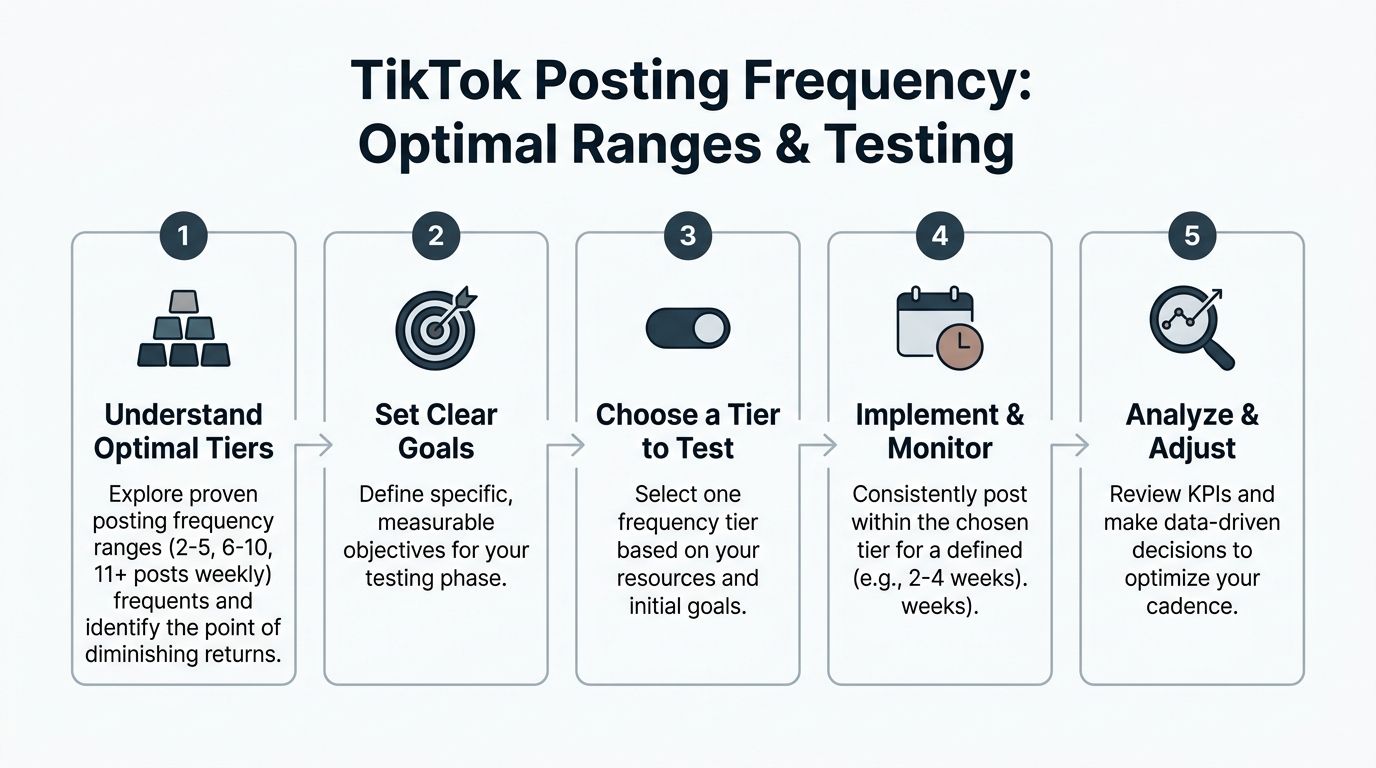
Buffer’s analysis of more than 11 million TikTok posts found three meaningful ranges. Moving from 1 to 2 to 5 posts per week produced up to 17% more views per post. Increasing to 6 to 10 posts per week raised the lift to 29%. Posting 11 or more times weekly reached 34%, which shows diminishing returns as frequency rises (https://buffer.com/resources/how-often-should-you-post-on-tiktok/).
What the tiers actually mean
Those ranges don’t mean every account should rush to the highest level.
They suggest three different operating choices:
- 2 to 5 posts per week is the efficiency tier. It gives the strongest early payoff relative to effort.
- 6 to 10 posts per week is the acceleration tier. It can increase opportunities, but it requires a real system.
- 11 or more posts per week is the saturation tier. It may lift overall opportunity further, but the marginal gain from each additional post gets smaller.
That’s the part many teams miss. More posting still helps, but it helps less efficiently after a certain point. If content quality or team stamina declines, return can fall faster than the headline numbers imply.
A better way to test cadence
Most brands change posting frequency casually. They post more during busy weeks and less during slow weeks, then try to interpret mixed results. That approach makes it hard to know what changed performance.
A cleaner method is to test cadence deliberately.
Step 1
Pick one core objective. Don’t test frequency against five KPIs at once. Use one primary success measure and a small set of supporting indicators.
Step 2
Choose one posting tier that matches your capacity. If your team can only produce four solid videos weekly, don’t pretend you can sustain ten.
Step 3
Hold other variables as steady as possible. Keep your content pillars, production quality, and publishing discipline relatively stable while frequency changes.
Step 4
Run the test long enough to matter. Accio advises maintaining a schedule for 90 days before making major evaluation calls (https://www.accio.com/blog/how-often-to-post-on-tiktok-guide-for-businesses-and-brands).
Step 5
Review patterns, not single-post anomalies. A breakout video can distort judgment if you look only at top performers.
Decision rule: Treat posting frequency as a testable variable, not a creative superstition.
A practical testing matrix
You can structure a cadence test like this:
| Test Period | Posting Tier | What to Watch |
|---|---|---|
| Phase one | 2 to 5 per week | Can the team sustain consistency and improve creative quality? |
| Phase two | 6 to 10 per week | Does extra output create enough learning and reach to justify the workload? |
| Phase three | Stage-dependent adjustment | Should the account maintain, increase, or reduce cadence based on results? |
What most teams learn too late
The most common mistake isn’t underposting. It’s changing too many variables at once.
A team raises frequency, changes content style, starts chasing trends, and shifts posting times in the same month. If results move, nobody knows why. Good testing isolates cadence enough to make a decision you can defend.
That’s the difference between “we posted more and things seemed better” and “this range fits our team, our account stage, and our business objective.”
Sample Schedules and Caption Templates
Theory helps, but frequency only matters if it survives the week. The schedule must align with the demands of scripting, filming, approvals, and publishing.
If your team struggles to keep output moving, it can help to delegate content writing or offload planning tasks so internal creators can focus on recording and response. Frequency often breaks because the workflow breaks first.
A separate tactical guide on scheduling posts is useful once the calendar is set: https://reach-influencers.com/how-to-schedule-a-tiktok-post/
Schedule for daily or near-daily mode
This works best for new accounts, campaign bursts, and aggressive awareness pushes.
| Day | Content Focus | Notes |
|---|---|---|
| Monday | Trend response | Fast turnaround, native feel |
| Tuesday | Educational tip | Solve one specific problem |
| Wednesday | Product or service angle | Keep it contextual, not ad-heavy |
| Thursday | Behind the scenes | Show process, people, or workflow |
| Friday | Opinion or reaction | Encourage comments |
| Saturday | Community-led post | Reply to a question or comment |
| Sunday | Repurpose top theme | Recut what already resonated |
Caption starters for this mode:
- Trend-led: “Everyone’s talking about this, but here’s what brands usually miss…”
- Educational: “If you’re still doing it this way, try this instead.”
- Community prompt: “Would you pick option A or option B?”
Schedule for 3 to 5 posts per week
This is often the most manageable mode for growth-stage accounts and lean teams.
Use a rhythm like this:
- Monday: Educational or problem-solution post
- Wednesday: Story-led or founder-led post
- Friday: Community or social proof angle
- Optional Tuesday or Thursday: Trend adaptation or quick reaction
- Optional weekend slot: Repurpose the best-performing concept
This schedule works because it balances planned content with room for reactive posting. You’re not trying to fill every day. You’re trying to maintain quality while keeping enough frequency to learn.
Schedule for maintenance mode
Mature brands and established creators often need a simpler calendar.
A three-post week can look like this:
| Slot | Purpose | Example Prompt |
|---|---|---|
| Post one | Stay visible | “What we’re seeing in our market right now” |
| Post two | Reinforce authority | “One mistake we keep noticing” |
| Post three | Maintain community connection | “Answering a question we get all the time” |
This cadence is strong when the account already has recognition and doesn’t need constant experimentation.
Caption templates that travel well
Good captions usually do one of three jobs. They frame the value, create tension, or invite a response.
Try these templates:
The correction
A common misconception is that TikTok growth comes from posting nonstop. It usually comes from a cadence you can sustain.”The observation
“We tested a simpler posting rhythm, and the biggest difference wasn’t reach. It was consistency.”The audience mirror
“If your team keeps missing posting targets, the issue probably isn’t motivation. It’s workflow.”The response driver
“What’s harder for your team right now: coming up with ideas or publishing consistently?”
The best schedule is the one your team can repeat without scrambling. That’s what turns a posting plan into a real operating system.
Measurement KPIs and REACH Optimization Tips
A posting schedule without measurement is just a habit. It may be a good habit, but it’s still guesswork.
The right way to evaluate how often to post on TikTok is to track whether the cadence improves the account’s underlying performance pattern. Accio reports that brands posting daily or near-daily gain up to twice the follower growth of sporadic posters, that TikTok recommends 1 to 4 daily posts, and that sustaining the schedule for 90 days supports stronger long-term engagement (https://www.accio.com/blog/how-often-to-post-on-tiktok-guide-for-businesses-and-brands).
Which KPIs matter most
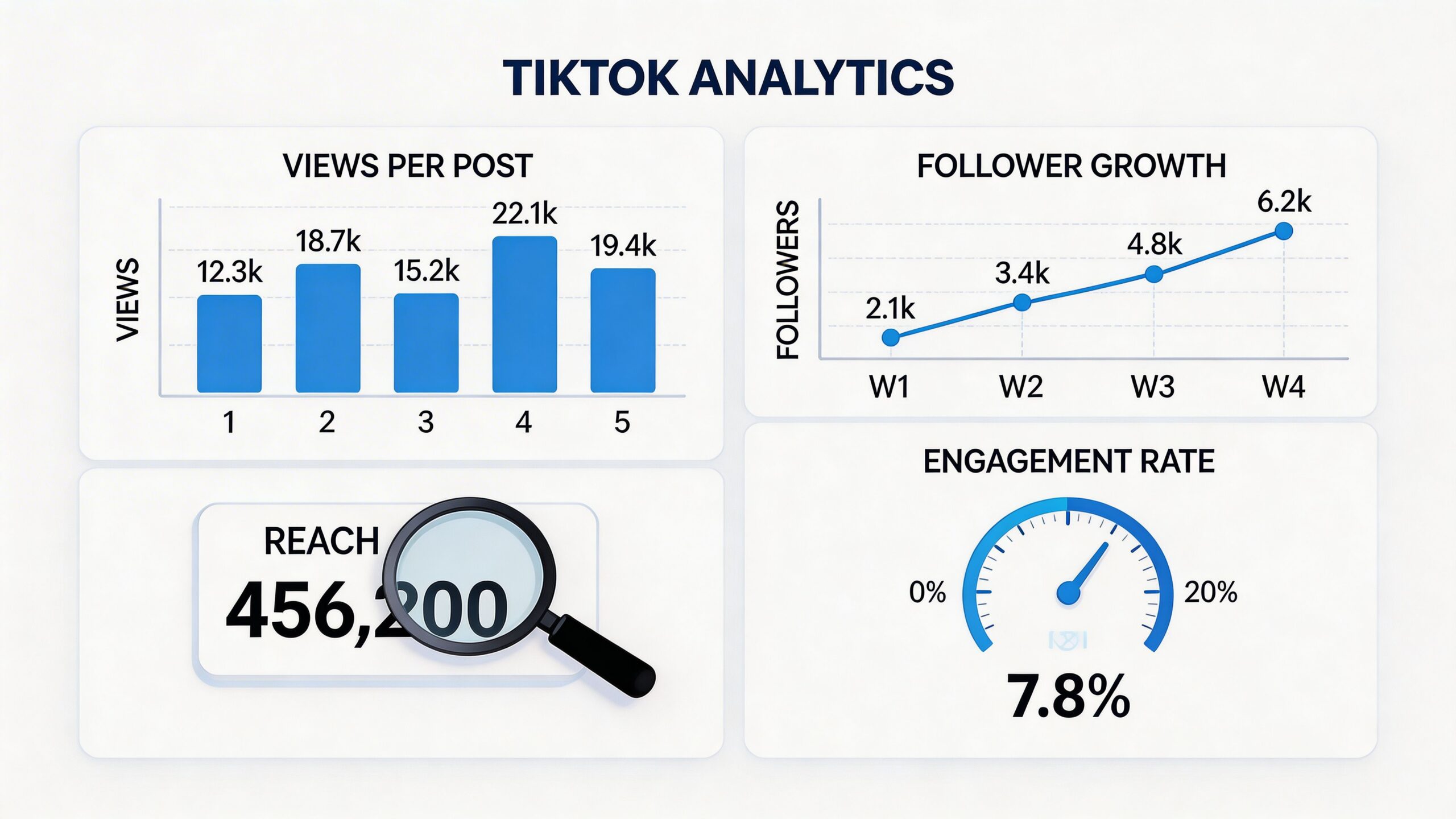
Don’t overload the dashboard. Start with a compact set of measures that reflect cadence impact.
Watch these closely:
- Views per post: Useful for comparing output quality across different posting tiers.
- Follower growth rate: Strong for judging whether increased visibility is compounding.
- Engagement quality: Comments, shares, saves, and other response signals indicate resonance.
- Click behavior: Important if TikTok supports a broader funnel, not just awareness.
If you need a practical primer on evaluating response quality, this roundup of essential social media engagement metrics is a good companion.
What to look for after a cadence change
A higher posting volume can create more total output without improving actual efficiency. That’s why analysts should compare both totals and averages.
Look for patterns like these:
| Signal | Good sign | Warning sign |
|---|---|---|
| Views per post | Stable or improving | Falling sharply as frequency rises |
| Follower growth | More consistent upward trend | No meaningful change despite more output |
| Engagement | Comments and shares stay healthy | Response gets thinner across newer posts |
| Workflow health | Team keeps pace | Delays, rushed edits, and approval bottlenecks increase |
More content is only better if performance and production quality can hold together at the same time.
Interpreting the data like an operator
Cadence decisions should answer three questions.
First, is the account learning faster? You should see clearer winners and stronger pattern recognition when frequency is right.
Second, is the audience response holding up? If volume increases but interactions weaken, the team may be flooding the feed without improving relevance.
Third, can the team sustain the motion? A schedule that works for ten days and collapses in week three isn’t a winning cadence.
For teams benchmarking interaction quality specifically, this engagement rate guide can help with interpretation: https://reach-influencers.com/tiktok-engagement-rate/
The strongest TikTok operators don’t chase the highest posting target. They identify the highest sustainable cadence that still preserves content quality, team execution, and measurable account progress.
Conclusion and Next Steps
The smartest answer to how often to post on TikTok isn’t “as much as possible.” It’s “often enough to create momentum, but not so often that quality and consistency break.”
The data supports that idea. There’s a clear payoff in moving beyond very low activity. There’s also a clear point where extra effort becomes less efficient. That’s why a stage-based approach works better than blanket advice.
New accounts usually need more volume because they’re still earning initial visibility. Growth-stage accounts need a balance of consistency and stronger creative discipline. Mature brands can often maintain results with a lower cadence, provided they keep relevance high.
What separates strong teams from frustrated ones is testing. They don’t guess. They choose a posting tier, commit to it long enough to collect useful evidence, and review the results against actual goals. They also treat workflow as part of strategy. If the production system can’t support the cadence, the cadence won’t last.
If you’re deciding how often to post on TikTok for your brand, agency, or creator business, start with account stage, tie cadence to your goal, and run a disciplined test that your team can sustain.
If you want to turn this into a repeatable growth system, explore REACH. It helps brands, agencies, and creators manage influencer discovery, campaign execution, reporting, and performance tracking in one place, so you can test content strategy with more structure and less manual work.