
Let's be real: relying on one-off sponsorships is an unpredictable way to build a career. One month you're flying high, the next you're scrambling. For a long time, affiliate marketing was just an afterthought—a little extra cash. But for the smartest influencers today, it’s become the core of their business, offering a reliable path to sustainable, scalable income. This guide to affiliate marketing for influencers will show you how to build a real business from your content.
For creators looking to professionalize their income streams, platforms like REACH Influencers are essential. REACH provides a centralized hub to find top-tier brand partnerships, manage campaigns, and track performance, transforming sporadic deals into a predictable revenue engine. We'll explore how to leverage such tools throughout this guide.
Table of Contents
- Affiliate Marketing Is the New Business Model for Influencers
- Laying the Groundwork for Your Affiliate Marketing Success
- How to Find and Secure High-Converting Partnerships
- Creating Affiliate Content That Actually Converts
- Tracking and Scaling Your Affiliate Marketing Success as an Influencer
- The Future of Influencer Affiliate Marketing
- Frequently Asked Questions About Affiliate Marketing for Influencers
Affiliate Marketing Is the New Business Model for Influencers
The days of just chasing the next sponsored post are numbered. While those deals offer a nice, quick payout, they don't provide the long-term stability you need to build a real business. This is where a smart affiliate marketing strategy changes everything. It’s the key to shifting from a "gig worker" mindset to becoming a true business owner.
Instead of getting paid once for a single post, affiliate marketing allows you to build ongoing revenue streams. You earn a commission every time someone in your audience buys a product through your unique link. That means a single video or blog post can keep earning you money for months, or even years, after you publish it. It's a model that rewards you directly for the trust and influence you've built.
Shifting from Gigs to a Business
This isn't just about making more money—it's about building a real asset. Your content library transforms from a collection of past jobs into a portfolio of revenue-generating tools that work for you 24/7. This approach also fosters a more genuine connection with your audience. After all, you’re now motivated to recommend products you truly believe in, not just ones that paid for a one-time shout-out.
And the opportunity is huge. The affiliate marketing industry has exploded, hitting an estimated value of $18.5 billion and projected to rocket to $31.7 billion by 2031. With over 81% of brands now using affiliate programs, there are more potential partners than ever before.
Making this transition work requires a new way of thinking. To truly succeed, you have to understand how to make money as a content creator by diversifying your income, and affiliate marketing is a massive piece of that puzzle.
To really see the difference, it helps to compare the two models side-by-side. Traditional sponsorships pay you for your reach, while affiliate marketing pays you for your influence and ability to drive action.
Affiliate Marketing vs Traditional Sponsorships
| Feature | Traditional Sponsorships | Affiliate Marketing |
|---|---|---|
| Payment Model | Flat fee per post/campaign | Commission on sales (CPA), clicks (CPC), or leads (CPL) |
| Income Potential | Capped by the agreed-upon fee | Uncapped; scales with performance and audience growth |
| Longevity | Short-term; income stops when the campaign ends | Long-term; evergreen content can generate passive income for years |
| Authenticity | Can sometimes feel like a forced ad | High; incentivizes genuine recommendations of valued products |
| Relationship | Transactional; paid for a single action | Partnership-based; focused on mutual long-term growth |
Ultimately, affiliate marketing lets you build a business on your own terms, based on trust and performance, not just one-off transactions.
Why Affiliate Marketing Works for Influencers
There’s a reason this model has become so powerful: it creates a win-win-win situation for you, your audience, and the brand. It’s all built on credibility.
Here’s exactly why it’s so effective:
- You build real authenticity. You finally get to partner with the brands you already use and genuinely love. Your recommendations feel natural because they are natural, not like a script you were paid to read.
- You create sustainable income. That flat-fee post is old news. With affiliate links in your evergreen content, a popular YouTube video or blog post can become a reliable source of passive income long after you hit publish.
- You can scale your growth. Your earnings aren't limited by how many sponsorships you can land. As your audience—and their trust in you—grows, so does your affiliate income. The sky's the limit.
Of course, with great opportunity comes new challenges. Juggling dozens of different links, commission rates, and payout schedules across multiple brand partners can quickly become a nightmare. This is exactly why we built REACH Influencers—to give you a single, centralized dashboard to manage campaigns, track every click and sale, and get all your payments in one place.
While affiliate marketing is a powerful new model, it’s crucial to understand how it differs from traditional influencer marketing. We dive deeper into the key distinctions in our guide comparing affiliate marketing vs. influencer marketing. Making this shift is what allows you to finally turn your influence into a durable, thriving business.
Laying the Groundwork for Your Affiliate Marketing Success
If you want to turn affiliate marketing into a real, reliable income stream, you have to get the foundation right from the very beginning. This isn't about guesswork or just grabbing any link you can find. It’s about being deliberate. A solid start means every product you share feels like an authentic recommendation your audience can trust, not just a random ad.
It all starts with taking an honest look at your audience. I mean really looking. Go past the basic demographics in your analytics dashboard. The real gold is in your DMs, your comment sections, and the questions you get asked over and over again. What are their biggest struggles? What are their goals? What brands are they already talking about and tagging in their own posts? Answering these questions is how you find products they’ll be genuinely happy you introduced them to.
This initial work is what separates creators who make a bit of cash here and there from those who build scalable businesses. It’s the difference between unpredictable income and a sustainable career.
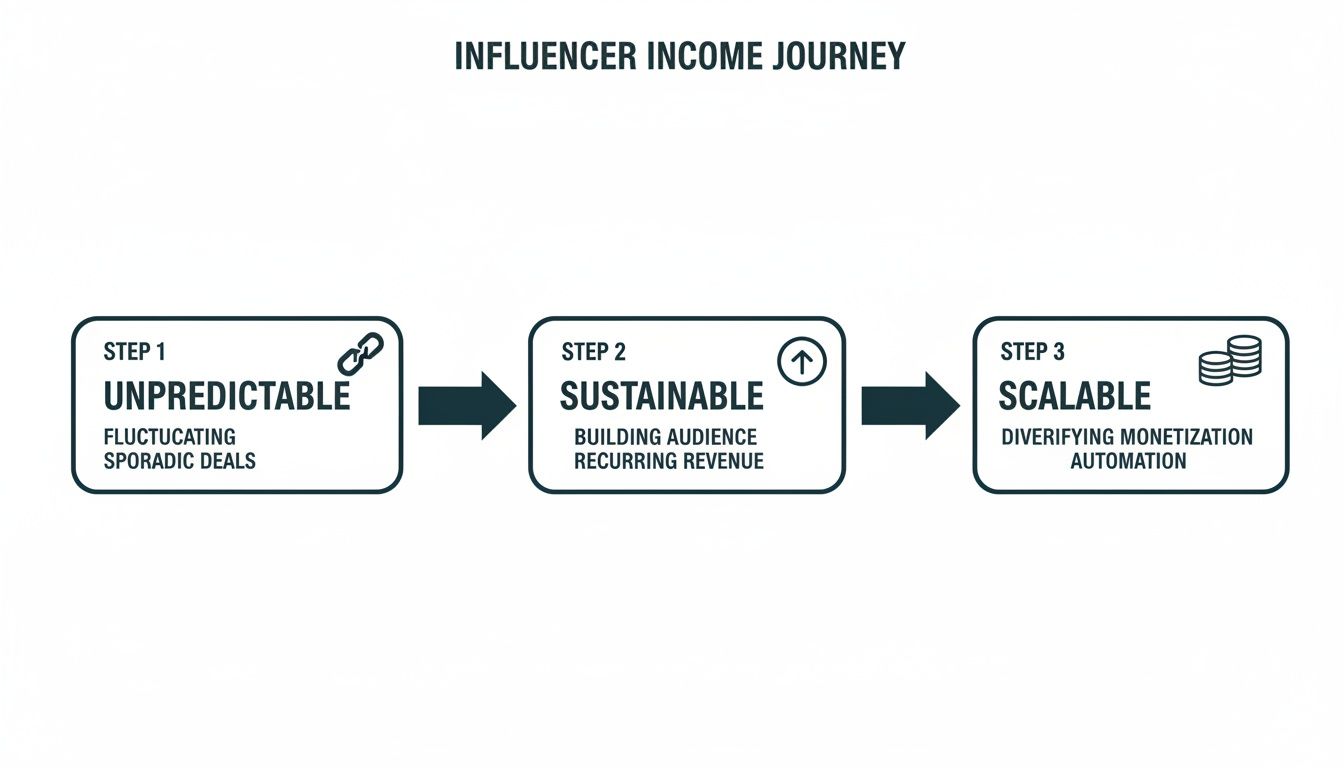
Think of it this way: setting up a proper foundation is how you move from one-off, sporadic deals to a consistent and scalable business. This is the strategic move that turns a hobby into a profession.
Figure Out Your Content Pillars
Once you have a solid grasp on who your audience is, you can define your content pillars. These are simply the 3-5 core topics you’re known for—the things your followers expect from you.
For a travel creator, this might be "budget backpacking," "solo female travel," and "sustainable tourism." A home decor influencer might focus on "DIY projects," "small-space solutions," and "thrifting vintage furniture."
Having clear pillars is powerful. It tells your audience exactly what they can count on you for, which keeps them coming back. At the same time, it signals your specific niche to brands. A company that makes eco-friendly travel gear will immediately see the value in partnering with a creator who has a "sustainable tourism" pillar. You become a magnet for the right kind of brands.
The biggest mistake I see creators make is trying to be everything to everyone. The truth is, the more you niche down with your content pillars, the more authority you build. You become the go-to expert, which makes you incredibly valuable to both your audience and the brands that want to reach them.
Choose Where to Find Your Affiliate Partners
Okay, you know your audience and you've defined your content pillars. Now, where do you actually find the products and programs? You've got a few solid options, and each comes with its own set of trade-offs.
Large Affiliate Networks
These are massive marketplaces like Amazon Associates, Rakuten, and CJ Affiliate (formerly Commission Junction). They act as a middleman, giving you access to thousands of brands all in one place.
- The upside: An unbelievable selection of products. They are easy to join and already have a ton of consumer trust.
- The downside: Commission rates can be pretty low, especially for physical goods. You’re also competing with a sea of other affiliates, and it's tough to build a real relationship with the brands themselves.
Direct-to-Brand Programs
Many brands, from small DTC startups to established names, run their own in-house affiliate programs. They might manage it themselves or use software like ShareASale to handle the logistics.
- The upside: You can often negotiate much higher commission rates. This route also opens the door to a closer relationship with the brand, which can lead to exclusive coupon codes for your audience or even custom collaborations.
- The downside: It’s a lot of manual work. You have to find and apply to each program one by one, and tracking your earnings across different dashboards can become a headache.
Influencer Marketing Platforms
This is where a dedicated platform like REACH Influencers can completely change the game for you. We built REACH to be the bridge between creators and brands that are specifically looking for performance-based partnerships.
Instead of endlessly searching different networks or individual brand sites, you get access to a curated list of campaigns from brands that are actively looking for creators in your niche.
A platform like REACH cuts through the noise. It simplifies how you find partners, manage your agreements, and track your performance, all from one central hub. This frees up your time from administrative busywork so you can focus on what you actually love to do: creating great content.
How to Find and Secure High-Converting Partnerships
Hoping for brands to just slide into your DMs isn't a real business strategy. The most successful creators I know are proactive—they don't just sit back and wait for opportunities. They're out there actively hunting for partnerships that are a perfect match for their brand and their audience. This is the moment you stop being a passive creator and start acting like a business owner.
The first move? Pinpoint brands that are a natural fit. Seriously, just look around your own house. What products are you already using and genuinely love? Those are your low-hanging fruit, your most authentic potential partners. Your audience follows you for your taste, so these endorsements will feel real because they are real.
Beyond your own medicine cabinet and pantry, you can use platforms like REACH Influencers to find brands that have already been vetted and are actively looking for creators like you. Our discovery tools let you filter by your niche, what kind of commission you're looking for, and campaign type. It saves you from the endless grind of cold emailing and connects you straight with companies ready to talk performance.
Crafting a Pitch That Gets a Yes
Once you’ve got a solid list of brands you want to work with, it's time to write a pitch that actually gets read. A generic "Hey, I love your stuff!" email is a one-way ticket to the trash folder. You have to show up as a valuable business partner, not just another fan.
Your pitch needs to be a short, sharp, data-backed case for why working together makes sense for them. Think of it as a mini-proposal that proves your value right from the get-go.
Here’s what you absolutely need to include:
- Audience Demographics: Who are you really talking to? Give them the key stats: age, gender, location, and what your followers are into. Brands need to see that your audience is their target customer.
- Engagement Metrics: Your follower count is just one piece of the puzzle. What really matters are your engagement rate, average views on your posts, and especially your link clicks. A highly engaged smaller community is often way more valuable than a huge, passive one.
- Past Performance: If you have a track record, now’s the time to show it off. Share your wins. Did you drive a ton of sales for another brand? Mention your conversion rates or the revenue you generated.
Remember, the goal is to make saying "yes" a no-brainer for the brand manager. Show them you've done your homework, you get what they're trying to achieve, and you have a clear idea of how you'll get them results. A professional pitch tells them you’re for real.
Understanding Commission Structures and Negotiation
Not all affiliate deals are built the same, and you need to know the lingo before you start talking numbers. Most partnerships fall into one of a few common models:
- Pay-Per-Sale (PPS/CPA): This is the classic affiliate model. You get a percentage of every sale made through your unique link.
- Pay-Per-Click (PPC): You earn a small amount for every single click on your affiliate link, whether it leads to a sale or not.
- Pay-Per-Lead (PPL): You get paid when someone does something specific, like signing up for a free trial or joining an email list through your link.
When it’s time to negotiate, don’t get tunnel vision on just the commission percentage. Think bigger. Ask for a vanity coupon code (like "YOURNAME15"). It’s a great way to give your audience an exclusive perk and makes tracking your sales super clean. You can also negotiate for free products or even a flat fee upfront to cover your time and effort creating the content.
Never underestimate your influence. Data shows that a staggering 88% of customers have purchased something after seeing an influencer recommend it. And for brands, affiliate marketing can drive anywhere from 5% to 25% of their total sales. That’s why they’re willing to invest in the right creators.
I know that navigating contracts and negotiations can feel like a minefield. That’s where a platform like REACH really simplifies things. All the contracts are handled right on the platform, the terms are laid out clearly, and payments are automated. It cuts out the awkward back-and-forth and legal guesswork, so you can just focus on making great content. If you're looking to explore more options, check out our guide on the best affiliate marketing platforms.
For creators with a solid following, there are some massive opportunities out there. A great example is the Amazon Influencer Program, which lets you set up your own storefront and earn from the millions of products sold on their site.
Creating Affiliate Content That Actually Converts

Even the most amazing affiliate partnerships will fall flat if your content doesn't actually get your audience to click. This is where the magic happens—where your creativity turns into real income. The secret? Stop "selling" and start "serving." Your affiliate links should feel like a natural, helpful part of the value you're already providing.
Great affiliate content isn't about spamming links. It's about strategically weaving them into the content your followers already expect and enjoy. You’re not a salesperson; you’re the trusted friend who gives the best recommendations.
Weave Links into Content They Already Love
Forget about awkward, shoehorned promotions. The most effective way to share affiliate products is to integrate them directly into your core content. A recommendation feels so much more authentic when it solves a problem or enhances an experience you're already talking about.
Some of the most tried-and-true formats are probably ones you're already creating:
- In-Depth Reviews: Don't just talk about the features. Unbox it. Use it in a real-world setting. Show the good, the bad, and the unexpected. A truly honest and thorough review gives your followers the confidence they need to buy.
- Tutorials and How-To Guides: Show them, don't just tell them. If you’re a home chef, film yourself making a recipe and link to the exact air fryer or stand mixer you’re using. For a beauty creator, that means a makeup tutorial featuring the products you’re recommending. These practical guides are conversion gold.
- "Top 5" or "Favorites" Lists: People love curated lists. Think "My Top 5 Holy Grail Skincare Products" or "The Only Gear You Need for a Weekend Camping Trip." These roundups are easy to digest, highly shareable, and instantly position you as an expert.
The most powerful affiliate content answers a question or solves a problem for your audience. One of our top creators on REACH shared this case study: a single, in-depth blog post solving a niche problem for their audience has now generated over $30,000 in commissions because it’s deeply useful.
Tailor Your Content for Each Platform
Let's be real: what crushes it on TikTok will probably bomb on your blog, and vice-versa. Every platform has its own unwritten rules and audience expectations. The smartest influencers know this and tweak their affiliate strategy for each channel to get the most engagement.
Choosing the right platform is everything. While over 75% of affiliate marketers use Facebook, the ROI tells a more interesting story. Facebook may lead with a 22% return, but YouTube, Instagram, and TikTok are right on its heels, each pulling in a respectable 16%. This proves you need to be where your audience truly is. You can dig into more affiliate marketing trends at Entrepreneurshq.com.
To get the ideas flowing, here’s how you can adapt your content across different platforms.
Affiliate Content Ideas By Platform
This table breaks down some high-converting ideas you can put into action right away, complete with a pro tip for each platform.
| Platform | High-Converting Content Idea | Pro Tip |
|---|---|---|
| Create an Instagram Reel showing a "Get Ready With Me" (GRWM) using affiliated beauty products. Use on-screen text to name each product. | Direct followers to a curated list on your LTK or a 'link-in-bio' page that features all the products from the video for easy shopping. | |
| YouTube | Film a detailed "What's In My Bag" video tailored to your niche (e.g., "What's in My Camera Bag" for photographers). Discuss why you chose each item. | Place affiliate links for every single product directly in the video description, clearly labeled. Pin a comment with your top 3 recommended items. |
| TikTok | Create a fast-paced "Amazon Finds" video showcasing 3-5 unique and useful products. Use trending audio to boost visibility. | Use a clear call-to-action like, "Find all these in my Amazon Storefront!" and make sure the link is prominently featured in your bio. |
| Blog | Write an SEO-optimized gift guide, like "The 20 Best Gifts for Coffee Lovers Under $50." Make it a resource people will search for. | Focus on long-tail keywords. This evergreen content can drive traffic and affiliate sales for years after it's published. |
Of course, mastering content is just one piece of the puzzle. For a bigger-picture view of turning your creativity into a career, check out our guide on how to monetize your content.
Maintain Trust Through Transparency
Don't forget the single most important rule: always disclose your affiliate links. It’s not just an FTC requirement; it's the foundation of the trust you have with your audience.
Your honesty is your biggest asset. A simple "(affiliate link)," #ad, or a quick verbal callout in a video is all it takes. People will respect your transparency, making them even more likely to trust your recommendations. Remember, effective affiliate marketing for influencers isn't a get-rich-quick scheme—it's a long-term strategy built entirely on trust.
Tracking and Scaling Your Affiliate Marketing Success as an Influencer
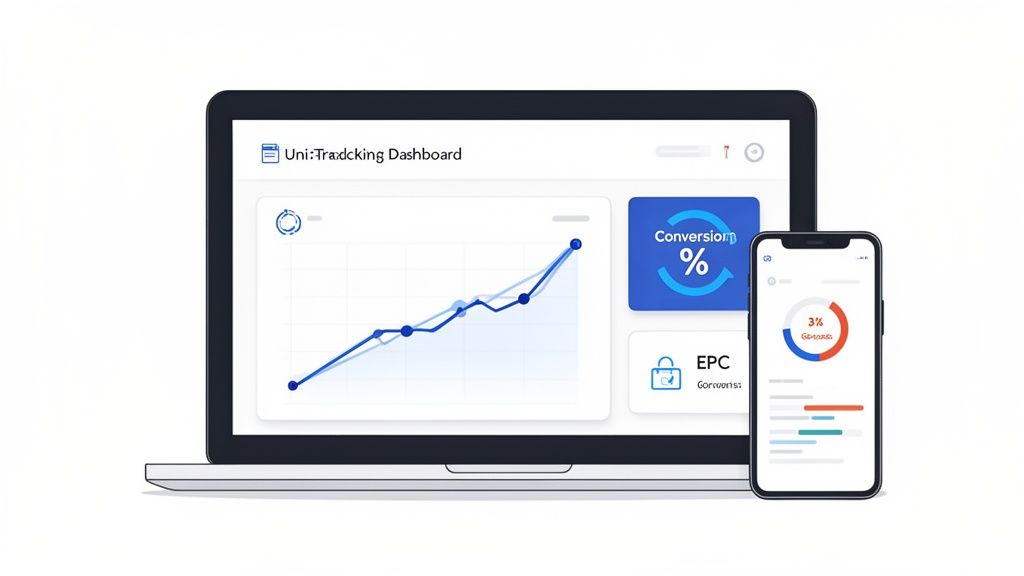
So, you've got your affiliate links out there. Now what? This is the part where you graduate from just posting content to running a real business. If you're not tracking your performance, you're essentially just guessing.
It’s time to stop throwing content at the wall to see what sticks. By digging into the data, you can make smarter decisions, fine-tune your strategy, and seriously scale your income. Don't worry, you don't need a math degree for this. The key is to focus on a few metrics that actually matter.
Mastering Your Key Performance Metrics
Forget about getting buried in a mountain of analytics. To really understand what's going on, you just need to keep an eye on a few core numbers. These are the vital signs of your affiliate marketing efforts.
Here are the essentials you should be watching like a hawk:
- Click-Through Rate (CTR): This is simple: what percentage of people who saw your link actually clicked it? If your CTR is low, your call-to-action might be weak, or maybe the link is buried. Try making it more prominent.
- Conversion Rate (CR): This is the money metric. Of the people who clicked, how many actually bought something? A high CTR but a low CR is a classic red flag. It often means there’s a disconnect between what you promised in your content and what the product page delivers.
- Earnings Per Click (EPC): Think of this as your performance at a glance. It calculates the average you earn every single time someone clicks your link. EPC is your best friend for quickly comparing which products and campaigns are actually making you the most money.
By looking at just these three metrics, you can diagnose problems and spot opportunities in minutes. For example, if you notice a tutorial video has a killer conversion rate, that's your audience telling you exactly what they want. The REACH Influencers dashboard makes this easy, showing you which content formats drive the most revenue so you can double down on what works.
Using Data to Optimize and Grow
Once you're comfortable with your metrics, the real fun begins. You can start using this data to make strategic moves that directly impact your bottom line. This is how you shift from earning commissions to actively building a performance-based business.
Start by looking at your analytics dashboard and asking some tough questions:
- Which content formats are driving sales? Are your long-form blog posts outperforming your quick-hit Instagram Reels? Double down on the format that works.
- What products are my audience actually buying? Your data will tell you exactly what resonates. Put your energy into promoting those winners and similar items.
- Where is my most profitable audience? Maybe your YouTube subscribers convert like crazy, but your TikTok followers don't. That tells you exactly where to invest more of your time and effort.
This is what separates the top 1% of earners from everyone else. They aren't just creating content; they are constantly analyzing and refining their strategy based on hard data. The numbers don't lie—studies show influencer marketing can return $5.78 for every $1 spent. You can learn more about these powerful influencer marketing statistics and see just how critical data is.
Scaling with the Right Tools
As you add more brand partners, trying to track everything by logging into a dozen different affiliate dashboards becomes a nightmare. It’s messy, time-consuming, and simply doesn't work once you start to scale.
This is where a centralized platform becomes a game-changer. Tools like REACH Influencers were built to solve this exact problem. Instead of wrestling with spreadsheets and a sea of open tabs, you get one clean dashboard. From here, you can see all your clicks, conversions, and earnings across every single partnership in one place.
This unified view does more than just save you a headache. It gives you incredible leverage. When you can clearly show a brand that your content drove thousands of dollars in sales last quarter, you change the entire dynamic. You're no longer asking for a better deal; you're proving you've earned it. Armed with that data, you can confidently negotiate higher commission rates, exclusive codes for your audience, or even a long-term ambassadorship.
The Future of Influencer Affiliate Marketing
If you're a creator, you already know affiliate marketing isn't just a side hustle anymore. It's a core part of building a real, sustainable business. The days of just dropping a few links here and there are fading fast. The future of affiliate marketing for influencers is about building smarter, more integrated, and long-term strategies that establish you as a genuine business owner.
This isn't just talk; it's happening right now. New technology, especially AI, is completely changing how creators and brands find each other. Forget endless scrolling and cold emails. Smart discovery tools are now matching creators with companies whose products and values are a perfect fit for their audience. It makes the partnership feel authentic from the very first post because it is.
The Rise of Brand Ambassadorships
This shift toward better matching leads to something much bigger: the move from one-off campaigns to long-term brand ambassadorships that run on an affiliate model. Brands are finally realizing how much more powerful it is to build deep relationships with creators who actually use and love their products.
This isn’t just another partnership; it’s a strategic alliance. You become a trusted extension of the brand, sharing your authentic experiences over time. This model builds deeper audience trust and creates more predictable, recurring revenue for you.
To really thrive in this new environment, you need the right support system. That’s where platforms like REACH Influencers come in. Think of us as the infrastructure for your growing business—we give you the tools to find these forward-thinking brands, manage long-term deals, and get the analytics you need to prove your impact.
Ready to turn your influence into a business that lasts? Your next big step starts with having the right partner in your corner.
Explore how REACH can help you build a profitable creator business. Get started with REACH today and take control of your career.
Frequently Asked Questions About Affiliate Marketing for Influencers
Jumping into affiliate marketing always brings up a ton of questions. I get it. Let's cut through the noise and get you some clear, straightforward answers to the things creators ask me most.
How Many Followers Do I Need for Affiliate Marketing?
This is probably the number one question I get, and it's built on a huge myth. You do not need a massive audience to make real money with affiliate marketing.
Brands are finally getting smart. They're realizing that an engaged, trusting audience is worth far more than a giant, passive follower count. In fact, some of the most successful affiliates are nano-influencers with just 1,000 to 10,000 followers.
Think about it: a recommendation from a smaller creator feels like a tip from a friend, not a sponsored post. That authenticity is powerful and leads to incredible conversion rates. Focus on that connection first, and the affiliate deals will come. Platforms like REACH Influencers are actually designed to connect these creators with brands who value that genuine trust.
Can I Use Affiliate Links On All Social Media Platforms?
Yes, but you have to play by each platform's rules. You can't just spam links everywhere and expect it to work. You need a strategy.
- Your Blog, YouTube & Pinterest: These are the easiest wins. You can place direct affiliate links right in your content, like in a YouTube video description or a blog post. Simple.
- Instagram & TikTok Feeds: The "link-in-bio" is your go-to tool here. Create a dedicated landing page where your followers can find all your favorite products in one spot.
- Instagram Stories: That little "link sticker" is pure gold. It's the most direct way to send someone straight from your Story to a product page.
No matter where you post, transparency is everything. Always, always disclose your affiliate links with something like #ad or #affiliatelink. It's an FTC requirement, sure, but more importantly, it's about being honest with the audience you worked so hard to build.
What Is a Good Starting Commission Rate?
There's no magic number here—commission rates are all over the map. For digital products like software or online courses, you might see commissions of 50% or more. For physical products, the range is usually somewhere between 5% to 20%.
Honestly, a 10-15% commission is a great starting point for most physical goods.
But don't get hung up on just the percentage. A 5% commission on a $1,000 mattress that your audience actually needs is way better than a 50% commission on a $10 keychain they'll never buy. Start with a rate that feels fair, prove you can drive sales, and then use that data to negotiate better terms down the road.
Ready to stop guessing and start earning? REACH Influencers gives you the toolkit to find great brand partners, manage your campaigns, and see exactly what’s working, all in one place. Get started with REACH today and build a real business as a creator.