 Skip to content

Meta description: A practical success metrics definition for influencer marketing. Learn how to choose the right KPIs, track leading and lagging indicators, avoid vanity metrics, and report on real business impact.
A campaign can look healthy on the surface and still fail where it counts.
You see strong likes, busy comment threads, and creators who say the post “performed well.” Then you check the sales dashboard. Nothing moved. Or worse, you can't tell what moved because the campaign was tracked across screenshots, spreadsheets, DMs, and platform-native reports that don't line up.
That's the problem a real success metrics definition solves. It gives you a way to measure what matters before the campaign goes live, not after the budget is already spent. It also forces a harder question that many teams skip: are you measuring only what already happened, or are you tracking signals that tell you what's about to go wrong?
Beyond Likes A Better Success Metrics Definition
The most common reporting mistake in influencer marketing is simple. Teams confuse visible activity with meaningful performance. A post gets attention, so everyone assumes it worked. But attention without a campaign goal is just noise.
A better success metrics definition starts with business intent. If the goal is awareness, you need visibility metrics. If the goal is sales, you need attribution. If the goal is community response, you need quality signals that go beyond raw counts. That sounds obvious, but plenty of campaigns still get judged by likes alone.

Vanity signals versus business signals
Likes, views, and follower counts can help with context. They should not carry the whole evaluation.
What matters is whether the metric matches the job:
- For awareness campaigns: reach and impressions matter most when the goal is exposure, as noted in this influencer marketing measurement guide.
- For engagement campaigns: comments and shares tell you more than passive views because they show active response.
- For performance campaigns: click-through rate, promo code usage, and conversion-related tracking are what let you tie activity to actual outcomes.
Practical rule: If a metric can't help you make a budget decision, it probably shouldn't be a primary KPI.
Why lagging indicators aren't enough
Revenue and conversions matter. They're also late. By the time they tell you something is broken, the campaign may already be over.
That's why teams need leading indicators too. Existing definitions of success metrics often overemphasize lagging indicators such as revenue and conversion while neglecting leading indicators that show campaign health earlier. A 2025 report cited by Indeed's overview of success metrics highlights that teams miss early warning signs when they don't track those signals. In influencer work, those signals can include creator response time, comment sentiment trend, or early engagement patterns that suggest the content isn't landing.
A strong measurement framework doesn't just tell you what happened. It helps you intervene while there's still time to improve the outcome.
What Are Success Metrics and Why They Matter
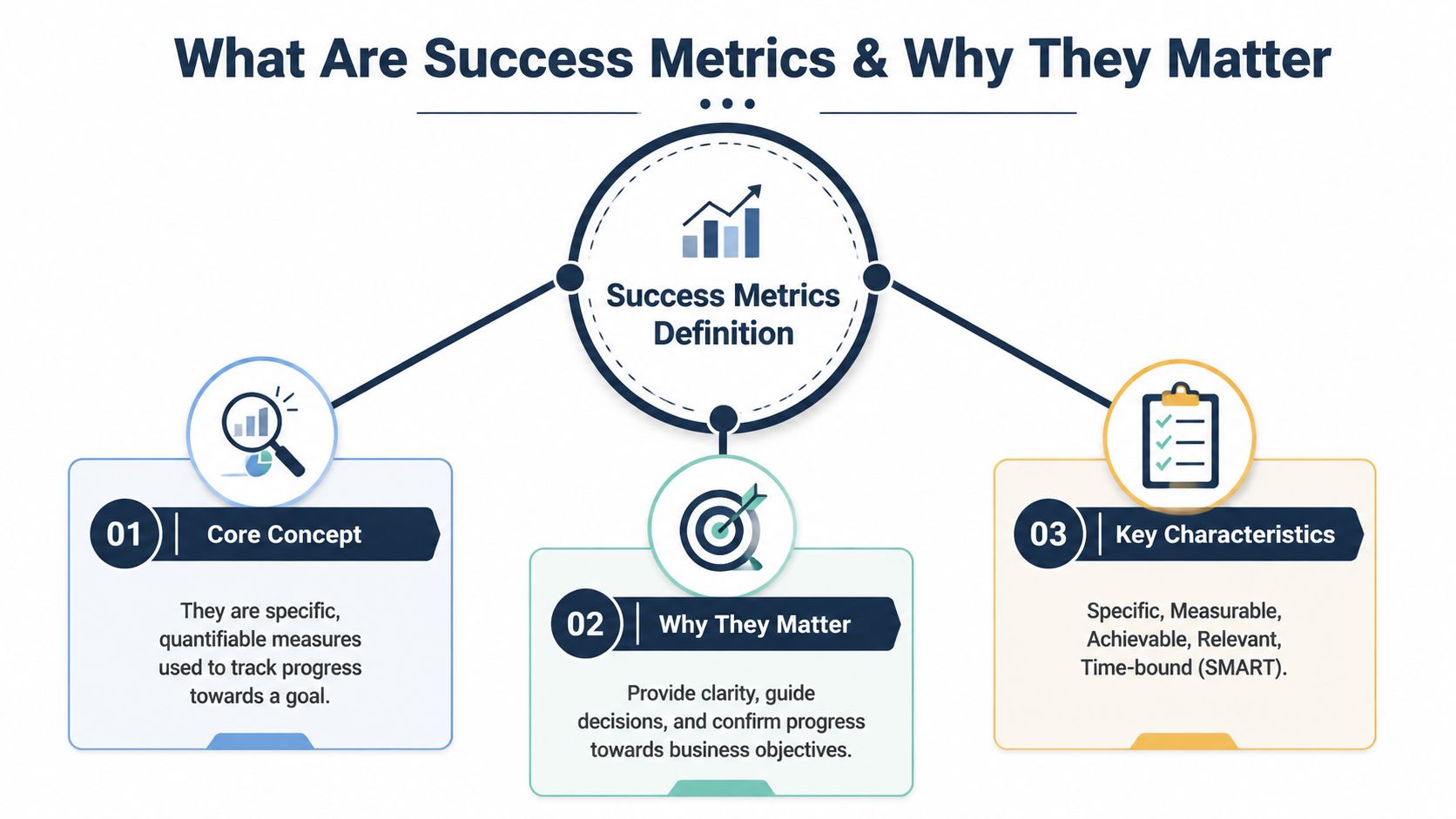
The clearest success metrics definition is this: they are the specific, measurable indicators you use to judge whether a campaign achieved its intended result.
Think of them like a pilot's instrument panel. Looking out the window tells you something, but not enough to fly safely. Marketing works the same way. A campaign can feel active and still miss the target if you aren't watching the right instruments.
What turns a metric into a useful one
A useful metric is tied to a goal before the campaign begins. In influencer marketing, that alignment is foundational. Awareness campaigns track reach and impressions, while performance campaigns need metrics such as click-through rate and promo code usage so success is measured against real business outcomes, not surface activity, according to Factory PR's explanation of influencer marketing success.
Good metrics also need structure. Goals should include a specific number and a deadline so the team knows what success looks like in measurable terms, as discussed in this guide to influencer marketing measurement.
Why marketers need them
Without success metrics, every campaign review turns into opinion. With them, teams can:
- Prove value: You can show what the campaign delivered instead of relying on subjective feedback.
- Allocate budget better: You can compare creator performance and decide where to invest more.
- Align teams: Creative, social, paid, and leadership all work from the same scoreboard.
- Defend the channel: Influencer marketing earns trust internally when performance is measured consistently.
If you want a broader framework for evaluating channel health, this breakdown of essential social media metrics is useful context alongside influencer-specific KPIs. For a deeper look at building a measurement process, REACH's own guide to social media measurement is worth bookmarking.
The wrong metric creates false confidence. The right metric creates a decision.
Key Categories of Influencer Marketing Metrics
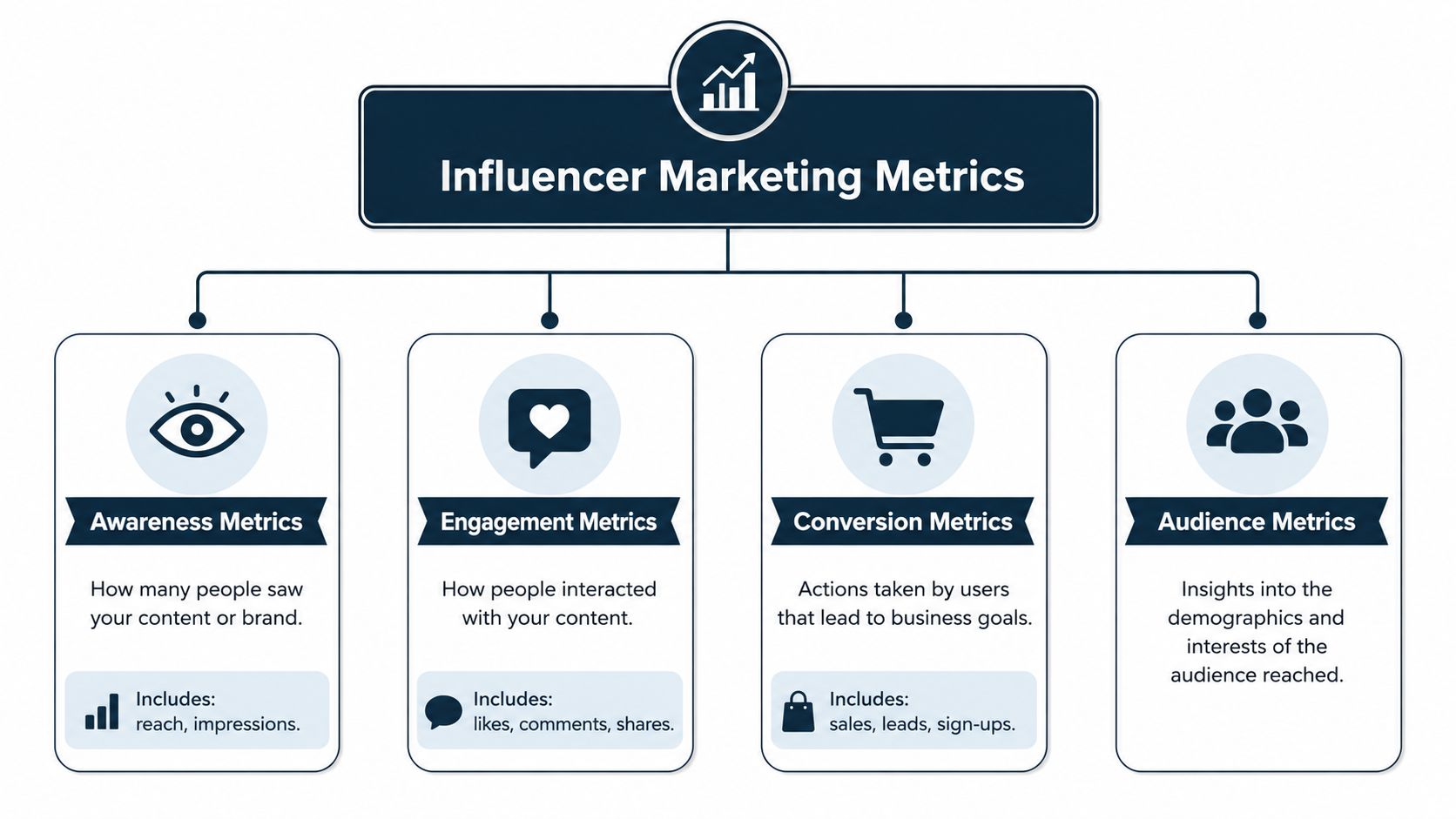
Once your goal is clear, the next step is sorting metrics into categories. This keeps reporting focused and stops teams from mixing awareness signals with conversion signals and treating them as if they mean the same thing.
Awareness metrics
Awareness metrics answer one question. How many people had the chance to see the campaign?
These are the right fit when the brand wants visibility, launch attention, or message distribution. The core measures are:
- Reach
- Impressions
For awareness-driven campaigns, reach is the primary KPI, while sales-driven campaigns should be judged by conversions and leads instead, according to this overview of campaign KPI alignment.
Awareness metrics are useful, but they're often overtrusted. A campaign can produce broad exposure and still fail to create interest or action.
Engagement metrics
Engagement metrics show whether the audience cared enough to react. They're more informative than raw audience size because they reflect active involvement.
The most important one is Engagement Rate (ER), calculated as (Likes + Comments + Shares) ÷ Followers × 100, based on Trend's guide to measuring influencer success. The same source notes that campaigns with ER above 3.5% typically yield 20–30% higher conversion volumes than those below 1.5%.
That makes ER more valuable than follower count alone. A smaller creator with stronger audience response can outperform a larger creator with weak resonance.
Engagement also needs context. Larger Instagram accounts typically see a solid 1% to 3% engagement rate, while micro-influencers often reach 3% to 8%, according to Superfiliate's field guide on tracking campaign success. Comparing creators only against similar account sizes gives you a far more honest read.
A high follower count tells you how many people could have seen the content. Engagement rate tells you how many cared enough to do something.
Conversion metrics
Conversion metrics tell you whether the campaign created business movement. With them, marketers stop talking about buzz and start talking about results.
Common conversion metrics include:
- Clicks
- Leads
- Sales
- Promo code usage
- Cost Per Acquisition
Cost Per Acquisition (CPA) is especially practical because it connects spend to outcomes. It's calculated by dividing total campaign spend by the number of conversions. If influencer CPA is lower than another channel such as paid social, the campaign is efficient. If it's higher, you need to reassess targeting, creator fit, or creative approach, based on the same Factory PR measurement framework.
Audience metrics
Audience metrics help you judge fit rather than output. Demographics, interests, and audience authenticity matter because inflated or misaligned audiences can distort the rest of your reporting.
This category doesn't replace awareness, engagement, or conversion metrics. It sharpens them. If the audience is wrong, good-looking performance can still be the wrong kind of performance.
How to Select and Calculate Your Success Metrics
Most measurement problems don't start in reporting. They start in planning.
Teams launch with vague goals, pick too many KPIs, and then try to patch attribution after the fact. A better process is simpler. Start with the business goal, choose the few metrics that reflect it, and set up tracking before the first post goes live.
Start with the goal, not the dashboard
If the campaign goal is unclear, the metric list will be messy. The strongest setups use one primary KPI and a small set of supporting indicators.
A practical way to choose them is:
- State the business outcome: awareness, traffic, leads, or sales.
- Make it measurable: include a specific target and a deadline.
- Pick the primary KPI: one metric that best reflects that goal.
- Add supporting signals: a few secondary metrics that explain performance.
Here's a simple planning table you can use.
| Campaign Goal | Primary Metric | Secondary Metrics |
|---|---|---|
| Brand awareness | Reach | Impressions, comments |
| Community engagement | Engagement rate | Shares, saves, comment quality |
| Traffic generation | Click-through rate | Landing page visits, conversion rate |
| Sales attribution | Promo code usage or affiliate-linked conversions | CPA, customer lifetime value |
Build attribution before launch
A campaign isn't measurable just because you posted content. It becomes measurable when you can isolate where results came from.
The operational side of a sound success metrics definition relies on UTM parameters for source tracking and unique promo codes or affiliate links for direct attribution, according to Streak's guide to influencer marketing ROI. That same framework supports a composite scorecard that tracks output, engagement, traffic, and revenue together rather than relying on one data point.
That matters because last-click data misses too much. People often see a creator's post, search later, and convert through another path. Post-purchase surveys can help catch that dark social influence when analytics alone can't.
A walkthrough can help make this operational:
Calculate with discipline
Some teams track everything and understand nothing. The better approach is to calculate a few core metrics consistently and review trends over time.
Focus on:
- Engagement Rate: Use the formula already defined above for creator-level resonance.
- Conversion Rate: Measure the percentage of users who take the desired action after clicking.
- CPA: Divide total spend by total conversions.
- Trend lines: Watch campaign patterns across creators and time periods, not just a single post result.
If you want your tracking system to stay usable, document naming conventions for UTMs, creator codes, and reporting periods before launch. That one operational habit saves hours of cleanup later.
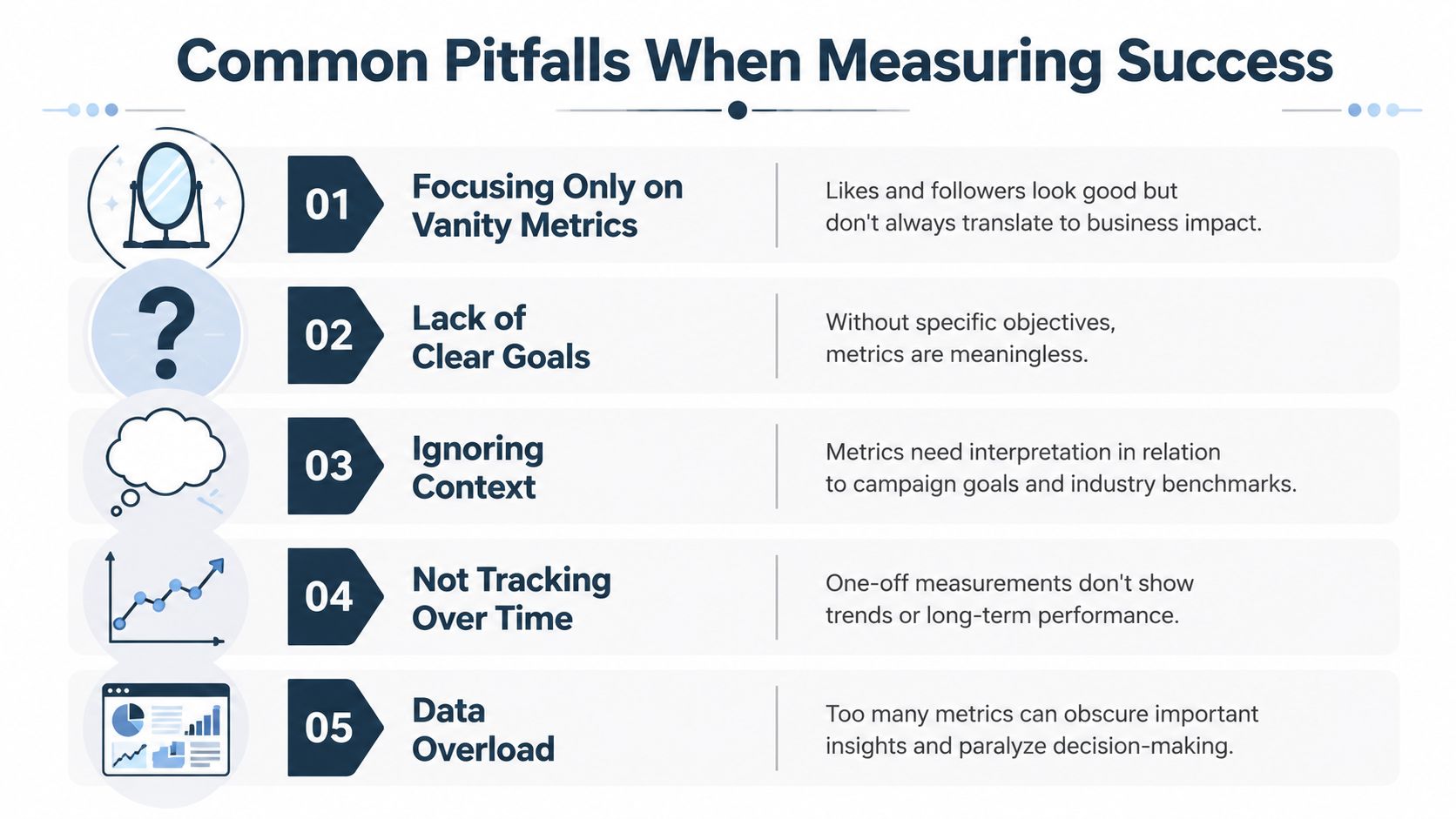
Common Pitfalls When Measuring Success
Many realize that vanity metrics can mislead them. Fewer teams deal with the deeper issue. Sometimes the metric itself changes the behavior in the wrong direction.
The obvious mistakes
Some reporting problems are basic, but they still show up constantly:
- Vanity-first reporting: Likes and followers look impressive but don't necessarily connect to business outcomes.
- No clear goal: If the team never agreed on the campaign objective, no metric will settle the debate later.
- Ignoring context: A creator's performance has to be judged against platform norms, audience size, and campaign type.
- One-time snapshots: A single post can spike or flop for reasons that have little to do with long-term creator fit.
- Data overload: Too many KPIs bury the signal you need.
If you need a clean explanation of one commonly confused pair, REACH's article on views versus impressions helps teams separate exposure metrics that often get mixed together.
The advanced problem called metric gaming
Measurement reveals a more complex reality. When creators know they're being judged on a narrow, visible KPI, some will optimize for that KPI instead of authentic impact.
A critical pitfall is metric gaming. Research discussed in this community success analysis shows that when people understand the exact metric being used, they may optimize for quantity over quality, which causes teams to miss deeper signals of value. In influencer marketing, that can show up as inflated engagement tactics, low-quality interactions, or content built to trigger reaction rather than drive trust.
Watch for this signal: If engagement rises while audience quality, sentiment, or downstream action weakens, the team may be rewarding the wrong behavior.
What works better
The fix isn't secrecy for the sake of secrecy. It's balance.
Use transparent operational KPIs so creators know what matters. Then pair them with harder-to-game evaluation criteria such as comment quality, audience fit, response reliability, sentiment patterns, and performance trends across multiple deliverables. That keeps the campaign honest and gives your team a fuller picture than a single public-facing metric ever could.
Putting Your Metrics Into Action
Measurement only matters if it changes what you do next.
A practical campaign report should include four parts: the goal, the primary KPI, the supporting metrics, and the decision. That last part is where many reports fail. They show numbers but don't say whether to scale the creator, revise the brief, change the offer, or stop the partnership.
A simple reporting rhythm works well:
- Goal and timeframe: What the campaign was meant to achieve, and by when.
- Primary outcome: The main KPI that determines success.
- Leading indicators: Early signs such as sentiment direction, audience response quality, or creator responsiveness.
- Next action: Scale, optimize, retest, or replace.
That's the practical value of a strong success metrics definition. It moves measurement out of the vanity zone and into decision-making. It also keeps teams from waiting until the end of a campaign to learn what they could have spotted earlier.
For marketers building a cleaner reporting stack, REACH's campaign analytics dashboard shows how centralized reporting can reduce manual work and keep campaign performance easier to interpret.
For broader reading, the American Marketing Association offers credible marketing resources, and HubSpot's marketing analytics library is a solid reference for teams refining how they report and act on performance.
If you're tired of stitching together creator reports by hand, REACH gives you a cleaner way to run campaigns after discovery. You can build campaigns faster, manage deliverables in one place, track performance across channels, and replace spreadsheet chaos with a structured workflow. For marketers who want clearer attribution and simpler reporting, it's a practical next step.