 Skip to content

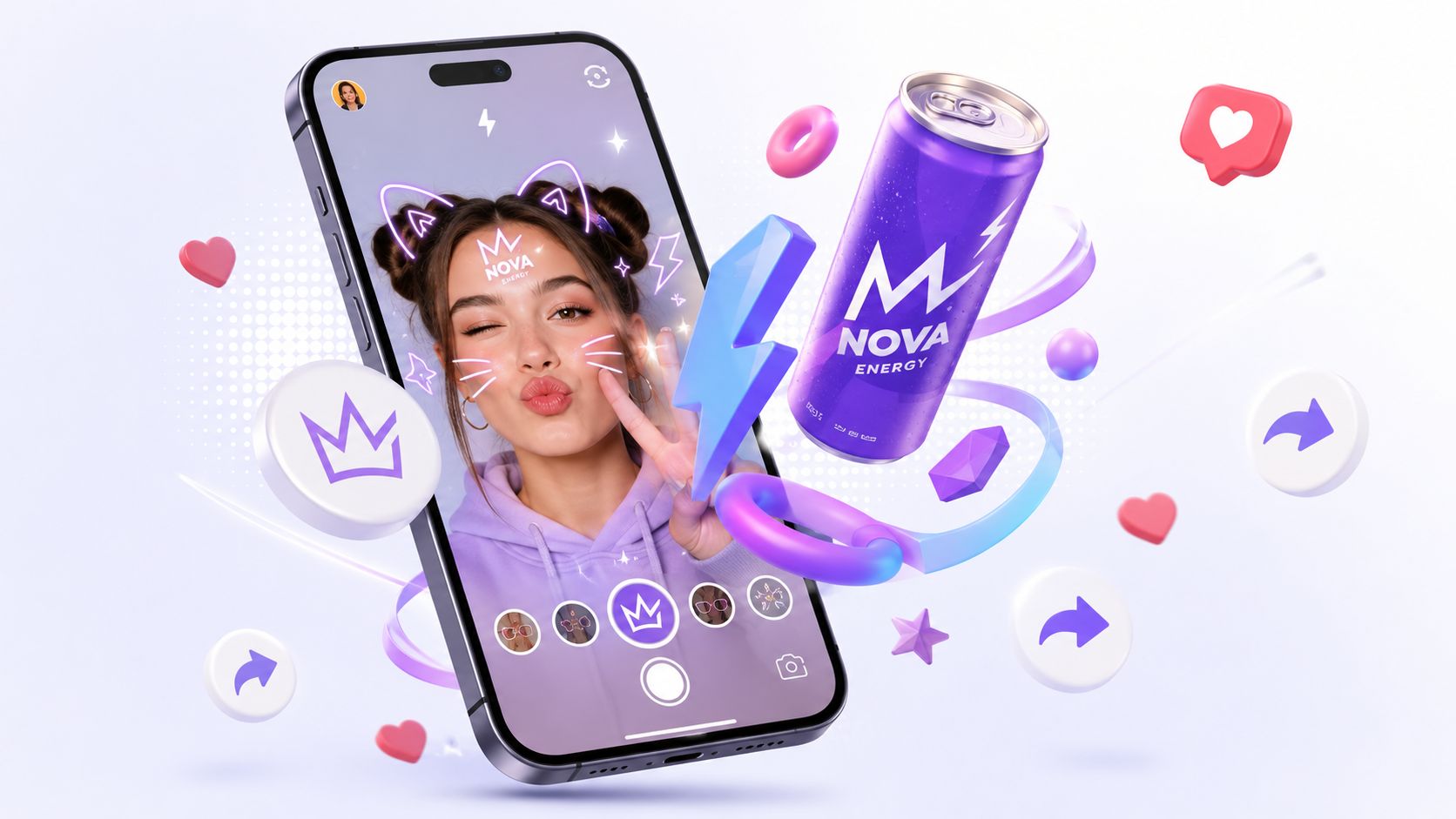
A beauty creator opens Instagram, taps a branded lens, and records a quick before-and-after clip. Within hours, that single filter has turned into dozens of posts, each one carrying the brand into new feeds without looking like a standard ad.
That's why augmented reality filters matter now. They don't just decorate content. They give creators and customers a tool they can use, remix, and redistribute at scale.
What Are Augmented Reality Filters
Augmented reality filters are camera-based digital overlays that add graphics, animation, or effects to a live image or video. The simplest way to explain them is this: they're digital stickers for the physical world, but smarter. Instead of sitting flat on a screen, they track a face, a room, or a product and move with it.
Many recognize them from face effects, beauty overlays, quiz lenses, or virtual accessories on Instagram, Snapchat, and TikTok. What changed is where they live. AR filters moved into mainstream social media marketing after Snapchat popularized them in 2015, which shifted face-targeted effects from a niche experiment into a widely used consumer format and helped create the native distribution model later used across creator platforms, as outlined in Coursera's overview of AR filters.
Why they spread so fast
A normal social asset has one publishing point. A filter works differently. The brand creates the asset once, then creators and users generate many posts from it.
That changes the economics of creative distribution.
- One effect, many outputs. A single lens can show up in Stories, short-form video, selfies, event clips, and challenge posts.
- Participation beats passive viewing. People don't just watch the idea. They perform it.
- UGC is built into the format. Every use of the filter can become a fresh piece of content.
Practical rule: If a campaign idea only works when the brand publishes it, it's content. If it gets stronger when other people use it, it may be an AR filter opportunity.
Why marketers should think beyond the visual
The primary value of augmented reality filters isn't the floating object or face effect. It's the behavior they trigger. A good filter gives people a reason to record, react, and share. That's why the format sits so close to influencer marketing. Creators already know how to package moments for social platforms. Filters give them a branded tool they can make feel native.
This is also where the operational challenge starts. Once creators and followers begin using a filter, content volume can spread across multiple posts and formats quickly. Teams that already follow shifts in interactive experiences and the future of user interface design will recognize the pattern. The interface becomes the campaign.
If you want a broader view of where creator campaigns are heading, this look at AI, VR, and the future of influencer marketing is a useful companion read.
Why Your Brand Needs an AR Filter Strategy
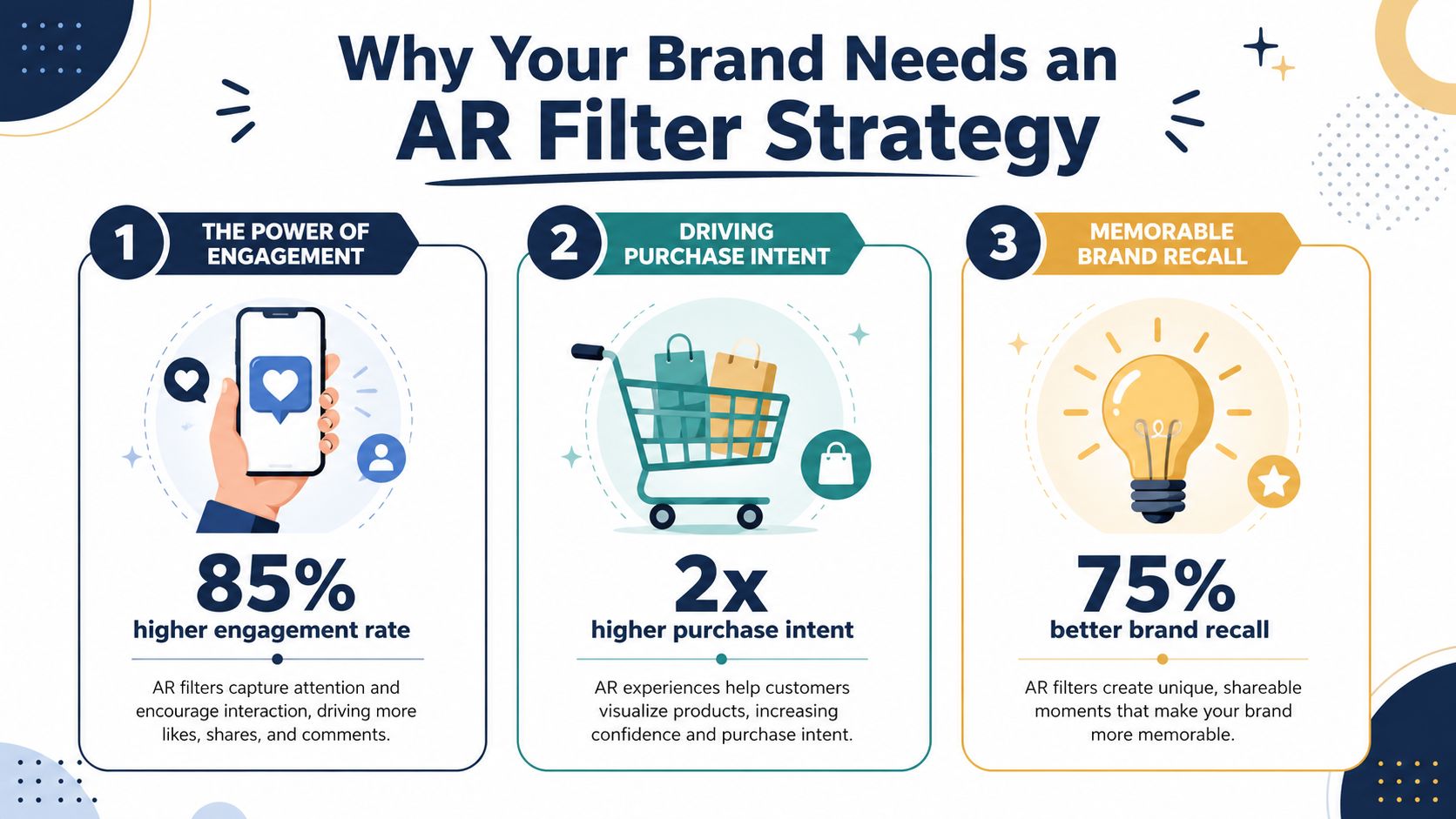
A beauty brand launches a creator campaign with ten sponsored posts. The content performs well for 48 hours, then the spend stops and the momentum fades. Run the same campaign with a filter that creators and followers can keep using, and the asset keeps producing content after the original posts go live. That is the shift. The filter is not just creative. It is campaign infrastructure.
Brands that get strong results from AR usually treat the filter as a reusable distribution asset with a clear job inside the influencer program. It gives creators a branded format they can adapt to their own style, and it gives the audience a low-friction way to participate instead of only watching.
One reason marketers keep investing here is performance. Snapchat reports that AR can lift ad awareness, brand awareness, and favorability across campaign studies in its AR advertising results and case study research. The exact lift varies by execution, platform, and audience fit, but the pattern is consistent. Interactive creative can outperform passive placements when the experience is simple enough to use and strong enough to share.
AR filters create repeatable creator mechanics
The strategic value is not the effect itself. It is the repeatable behavior the effect creates.
In influencer campaigns, that matters because one sponsored post rarely carries the full program. Teams need formats that can travel across creator content, audience remakes, event moments, and product drops without rebuilding the concept every time. A strong filter does that. It turns one creative idea into a system other people can publish with.
That usually shows up in three ways:
- More creator outputs from one concept. A single filter can appear in tutorials, reactions, challenge posts, launch-day content, and follower remixes.
- Lower creative friction. Creators do not need a full production setup to participate. The branded layer is already built into the asset.
- Better tracking discipline. When the filter is tied to a campaign brief, creator roster, and content collection workflow, teams can map usage back to specific partners and objectives.
This is why AR belongs in the influencer marketing stack, not off to the side with experimental brand activations. It gives the campaign a usable object that can be distributed, briefed, monitored, and measured.
The ROI case is stronger than the novelty case
Novelty gets a first use. Utility gets repeated use.
A filter strategy earns its budget when it supports a campaign goal you can manage. For a product launch, that might mean creators using the same branded try-on effect across timed posts so the visual identity stays consistent while each video still feels native. For an event, it might mean giving attendees and invited creators a location-specific effect that turns every on-site post into tagged UGC the team can collect and review. For a retail push, it might mean a virtual try-on or shade-match effect that shortens the gap between discovery and consideration.
The market is also large enough to justify serious planning. Deloitte notes that mobile AR adoption has continued to expand across consumer use cases, especially in commerce and entertainment, in its analysis of the growing market for mobile augmented reality. That does not mean every brand needs a complex build. It means the audience is already trained to engage with interactive camera experiences when the value is obvious.
The trade-off is operational. Once a filter starts spreading through creator content and follower posts, the campaign can get messy fast if the team has no system for approvals, creator coordination, usage monitoring, and UGC collection. That is where platforms matter. A tool like REACH helps connect the creative asset to the campaign layer, so the filter is not floating outside your reporting, creator management, and ROI analysis.
For teams planning next year's creator mix, these influencer marketing trends for 2026 give useful context for where interactive formats fit. The practical question is simpler. Does your campaign end when the sponsored post goes live, or does it give creators and audiences a branded tool they can keep using?
Creative Campaign Ideas Using AR Filters
The most effective augmented reality filters start with a campaign objective, not a visual gimmick. On social platforms, perceived entertainment is the strongest driver of satisfaction and recommendation behavior for AR filters, with interactivity also playing a role, according to this Wiley study on AR filters in social media. That's the right creative standard. If the filter isn't fun to use, it usually won't spread.
Brand awareness ideas
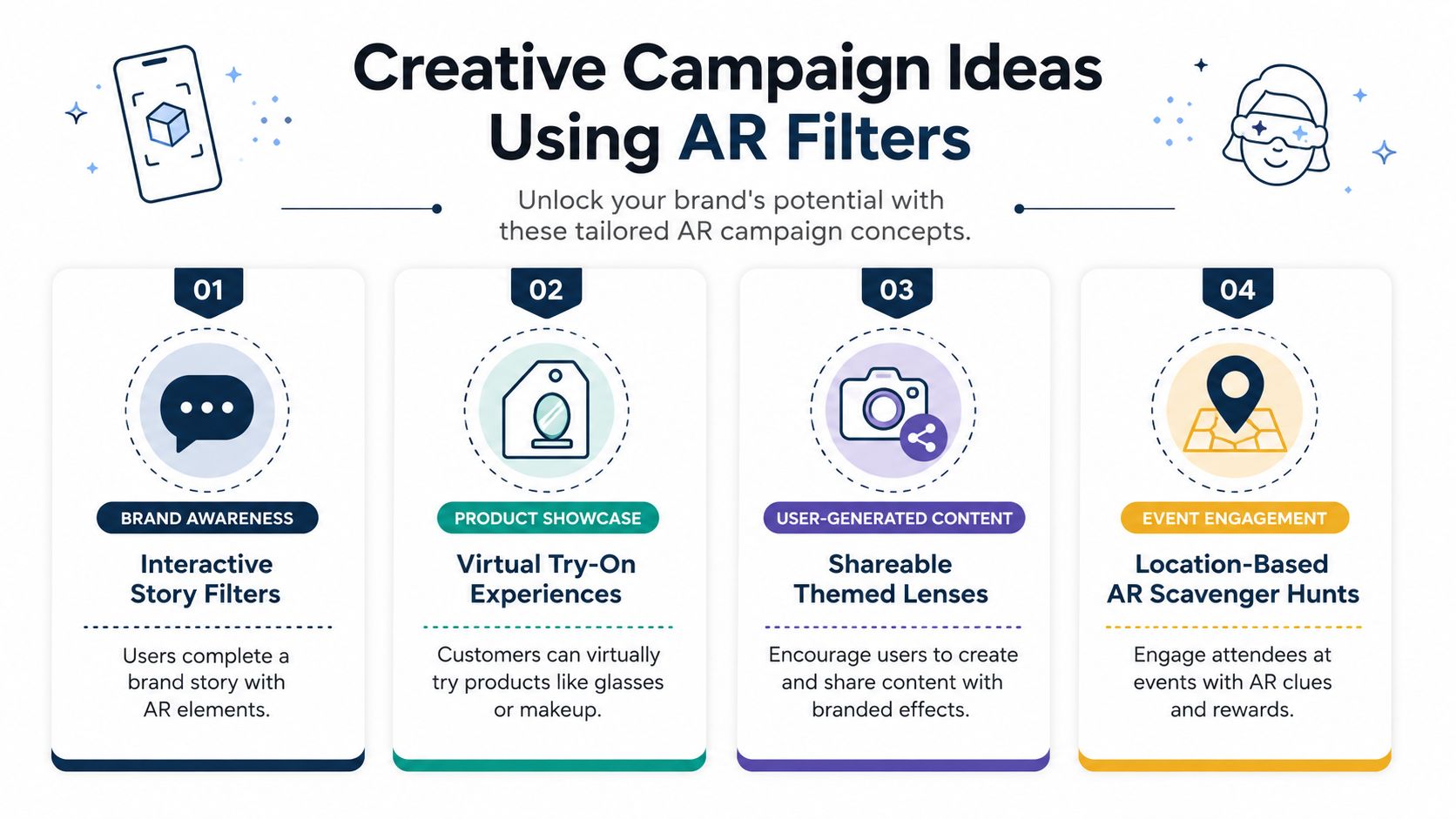
A snack brand can launch a face filter that drops animated flavors around the user's head and reveals a random “mood.” A creator uses it in a quick reaction video. Followers try it because the result changes each time, not because they were looking for an ad.
A mascot filter works similarly. Sports teams, beverage brands, and entertainment launches can place a recognizable character into selfies or short clips. The user becomes part of the visual identity without needing to explain the campaign.
- Game-style prompts work when the result is quick and surprising.
- Character overlays work when the brand already has strong visual assets.
- Story-completion effects work when creators can add their own punchline.
Community and event ideas
Filters are especially useful when a campaign needs a shared ritual. A festival, product drop, or pop-up event can use a location-themed effect that gives attendees a recognizable way to post from the moment.
One of the easiest wins is a challenge format. A creator says, “Use this lens and show your result.” The mechanics are simple. The social proof does the rest.
Here's a visual breakdown of concept types marketers can borrow:
A filter doesn't need to be complex to be effective. It needs a clear payoff in the first few seconds.
Conversion-focused ideas
For product-driven campaigns, the best concept is often the most concrete one. A beauty brand can build a shade try-on effect. An eyewear company can let users preview frame styles. A home brand can create a room-placement concept that helps people visualize an item in their space.
These concepts work when the creator's content answers a real buyer question:
- Will this look right on me
- Which version should I choose
- Can I see this in context
That's where filter campaigns stop being novelty and start supporting purchase decisions. If you want inspiration from live activations and participatory campaigns, these brand activation examples are useful reference points.
How to Create and Launch Your Filter Campaign
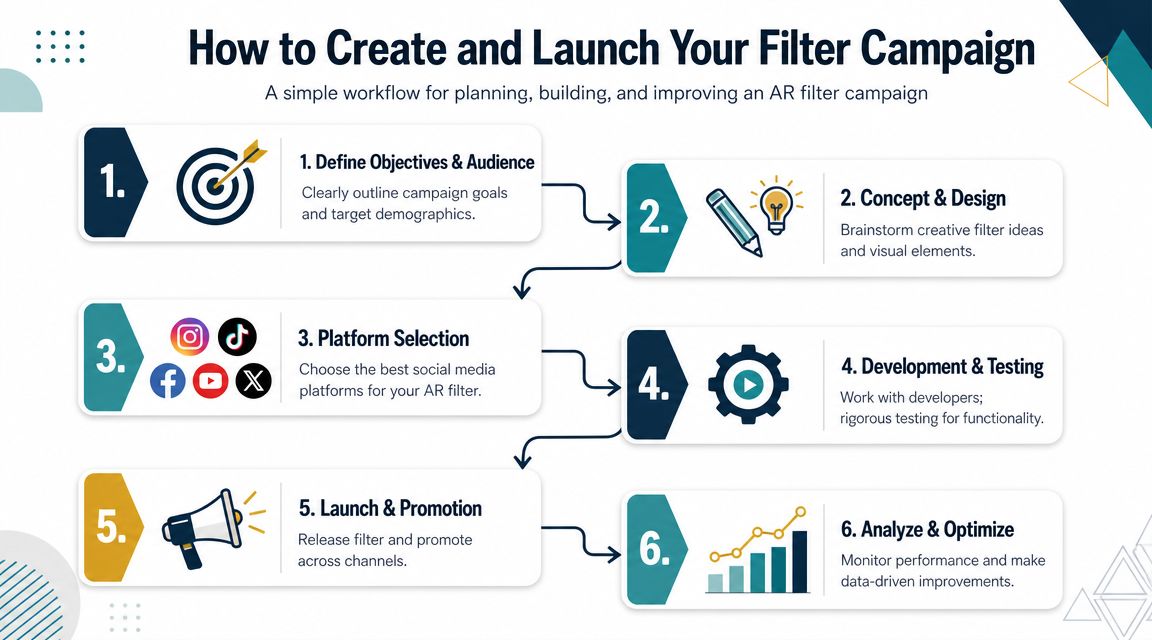
The tendency is to overcomplicate the build and under-plan the launch. The better workflow is straightforward: define the goal, design for behavior, test in real conditions, then seed the campaign with the right creators.
Start with one campaign job
Don't ask one filter to do everything. Pick the primary job first.
A filter usually performs best when it is built for one of these outcomes:
- Awareness. The user should recognize the brand quickly and want to share the effect.
- Participation. The mechanic should invite replies, duets, challenge entries, or event posting.
- Consideration. The filter should help someone preview or understand the product.
If the brief includes all three, prioritize. A try-on effect and a meme effect can both be useful, but they shouldn't fight each other inside one experience.
Design for use, not approval
Internal teams often approve filters from polished mockups. That's a mistake. Real users don't experience filters as still images. They encounter them on front-facing cameras, in bad lighting, at awkward angles, and on different faces.
Research also shows that object and filter fidelity affect user judgment and detection behavior, which means the same AR effect can land differently depending on the realism of the overlay and the surface it appears on, as discussed in this Frontiers study on AR filter fidelity.
Field note: Test on multiple faces, multiple devices, and multiple lighting setups. A filter that looks polished in one demo can fall apart in everyday use.
For teams working in niche product categories, especially movement or wellness experiences, technical founders may also find useful implementation context in this AR fitness app founder's guide.
Build the launch around creator seeding
Once the effect is approved on-platform, promotion matters more than polish. Many branded filters fail because the brand publishes them once and expects organic discovery to do the work.
A better launch plan looks like this:
- Seed with a small creator group who can demonstrate different use cases.
- Give creators a loose content angle rather than a rigid script.
- Stagger posting windows so the effect has more than one burst of visibility.
- Track response patterns early and learn which hooks people repeat on their own.
The filter is the asset. Creator content is the ignition.
Keep operations tidy from day one
The campaign gets messy fast when teams manage creator outreach, approvals, posting windows, and deliverables in separate docs and message threads. That's why launch planning should include a clean operational workflow before the first creator posts.
A practical place to start is a centralized campaign build process such as the REACH campaign builder, especially when multiple creators need the same filter links, content guidance, deadlines, and reporting expectations. The more filter-driven UGC you generate, the more valuable campaign coordination becomes.
How to Measure AR Filter Success
A filter campaign only earns a bigger budget if the team can explain what happened and why. That means measuring more than “it looked cool” or “people seemed to like it.”
The most useful framework combines platform metrics with creator output and downstream content value. If you need a wider measurement mindset beyond AR, this guide to calculating social media returns is a practical reference.
The KPI framework that matters
| KPI | What It Measures | Why It Matters |
|---|---|---|
| Impressions | How often the filter or related posts were seen | Shows whether the campaign reached enough people to matter |
| Captures | How many users recorded content with the filter | Indicates active participation, not passive exposure |
| Shares | How often captured content was sent or posted onward | Reveals whether the effect had viral or recommendation value |
| Creator posts | How many sponsored or seeded creators actually published with the filter | Confirms campaign execution and content volume |
| UGC volume | How many additional posts appeared from non-contracted users | Shows whether the campaign moved beyond paid distribution |
| Engagement quality | Comments, saves, and audience response on creator content | Helps distinguish curiosity from genuine interest |
| Content reusability | Which posts can be repurposed for ads, landing pages, or recaps | Extends value beyond the campaign window |
What each metric tells you
Impressions answer a reach question. Captures answer a behavior question. Shares answer the hardest question, which is whether users thought the experience was worth passing on.
That's why a campaign with moderate reach and strong share behavior can be more useful than a campaign with broad reach and weak participation. Filters are interactive assets. Their performance should reflect interaction.
- High impressions, low captures usually point to weak creative payoff.
- Strong captures, low shares often mean the experience was usable but not socially compelling.
- High creator output, weak UGC suggests the concept depended too much on paid seeding.
If you can't connect filter usage to creator content and resulting UGC, you're only measuring the top layer of the campaign.
Reporting without losing the story
The hardest part isn't collecting numbers. It's connecting them across creators, posts, and platforms in a way a brand team can use.
That's where a centralized reporting view helps. A dashboard such as REACH reporting and campaign management tools makes it easier to track creator deliverables, monitor cross-platform content, and see how the filter performed as a campaign asset rather than as a standalone effect. That's how AR filter ROI becomes something the team can defend in a recap deck.
Best Practices for Effective and Inclusive Filters
The strongest augmented reality filters do three things well. They make the brand visible without making the content feel like an ad, they respect basic legal and privacy boundaries, and they work for more than one type of user.
Brand presence without friction
Over-branding kills shareability. If the logo dominates the screen or the effect feels like a sales unit, creators will often skip it. Brand cues should support the experience, not overwhelm it.
Use signals people can carry naturally:
- Color systems that match the campaign look
- Character elements or product shapes that are instantly recognizable
- Subtle branding moments at the open or close rather than constant visual takeover
Inclusive performance is a product requirement
A 2024 study highlighted the need to design AR filters that perform consistently across a broad spectrum of skin tones because visual detection and representation quality can vary materially by complexion, as shown in this Frontiers research on skin-tone robustness in AR filters. That matters for campaign quality, not just ethics.
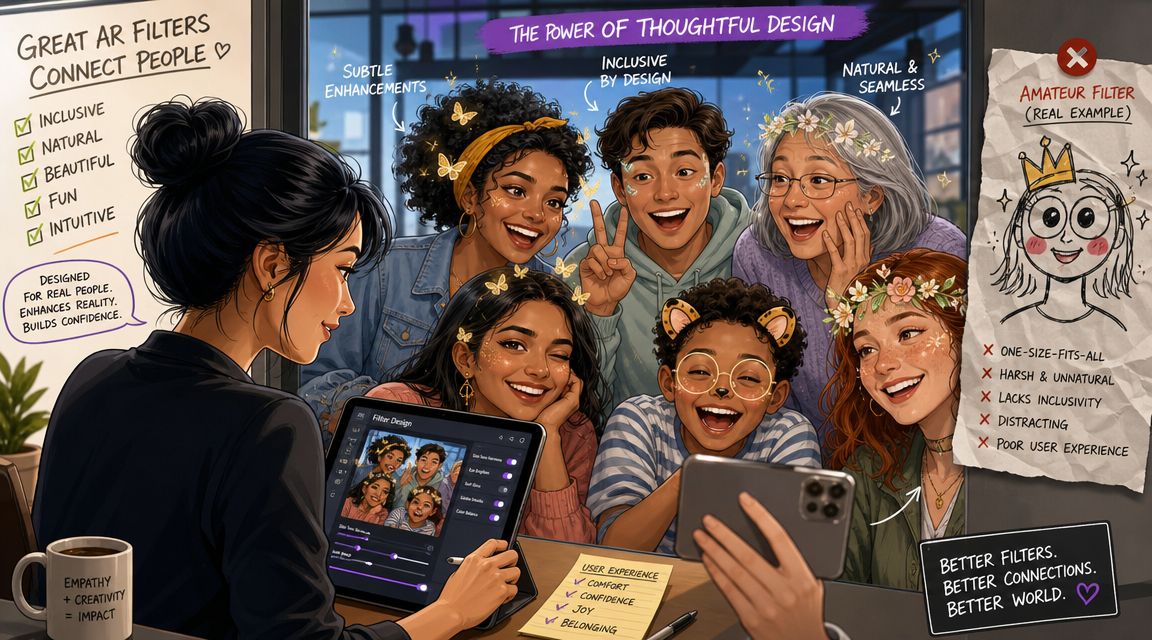
If a beauty filter reads well on one complexion and poorly on another, the campaign data becomes less trustworthy. You're no longer comparing performance fairly because the experience itself isn't consistent.
Legal and operational discipline
Teams also need clear usage rights around creator content and a basic understanding of how platform rules and privacy expectations apply. If the filter touches identity, appearance, wellness, or user capture in a sensitive way, get legal review early. Fixing a rights issue after creators have posted is expensive and messy.
The practical takeaway is simple. Good filters look polished. Great filters are usable, inclusive, and campaign-ready.
If you're planning an influencer campaign that uses augmented reality filters, REACH helps you run the part that usually becomes chaotic: creator coordination, content tracking, deliverables, payments, and reporting in one place. It's a practical way to turn a filter from a clever effect into an organized campaign asset.