 Skip to content

Landing your first brand deal is a huge milestone. But turning that one-off post into a steady, reliable income? That’s a whole different game. It’s about more than just having great content; it’s about building a business that brands are excited to partner with long-term. This guide will walk you through everything you need to know about securing profitable brand deals for influencers, from building your foundation to negotiating like a pro.
To start landing these deals, it's essential to have your strategy in place. Platforms like REACH Influencers are designed to connect creators directly with brands, but a strong personal brand is what makes you stand out. This article provides a comprehensive framework to help you position yourself as a top-tier partner that brands are eager to work with.
Table of Contents
- Laying the Groundwork for Big Deals
- How to Find and Vet Brand Deals for Influencers
- How to Craft a Pitch and Media Kit That Actually Gets a "Yes"
- Pricing Your Services and Negotiating Your Worth
- Managing Contracts, Payments, and Brand Relationships
- Your Top Brand Deal Questions, Answered
Laying the Groundwork for Big Deals
Before you even think about sending that first pitch email, you need to get your house in order. Think of it this way: you wouldn't open a shop without knowing what you're selling or who you're selling to. The same goes for your personal brand.
Brands aren't just looking for a walking billboard. They want strategic partners who understand their own audience and can deliver real results. Getting this foundation right is what separates hobbyists from professional creators.
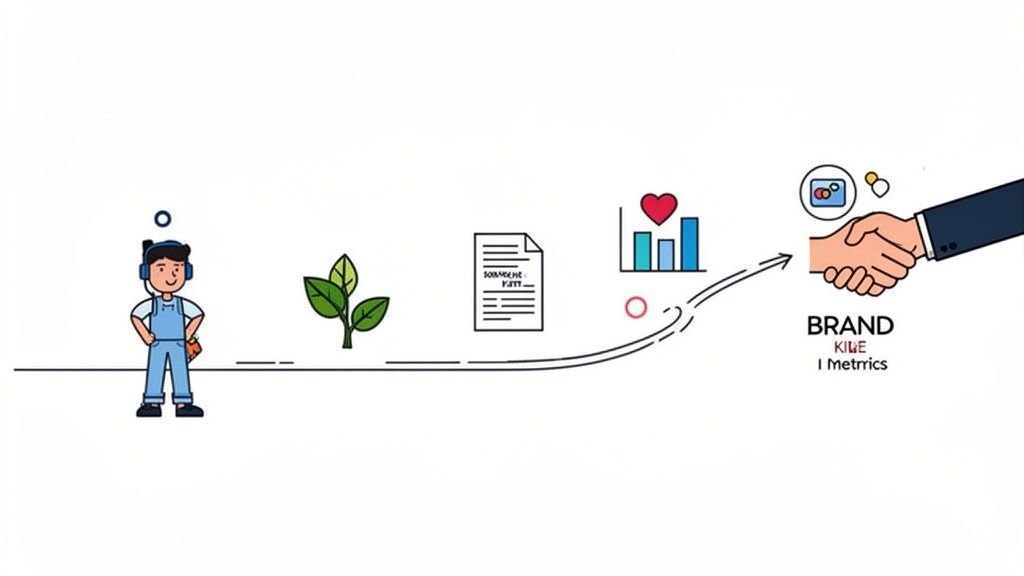
To give you a clearer picture, here’s a breakdown of the entire process from start to finish.
Key Stages of Securing a Brand Deal
This table shows the journey from preparing your brand to executing a successful partnership. Each phase builds on the last, so getting the early steps right is crucial.
| Phase | Key Objective | Essential Tools & Actions |
|---|---|---|
| Foundation Building | Define your niche, audience, and value. | Analytics tools, media kit, content calendar. |
| Opportunity Sourcing | Find brands that align with your values. | Influencer platforms (like REACH), industry research, networking. |
| Outreach & Pitching | Craft a compelling pitch that grabs attention. | Personalized email templates, media kit, clear call-to-action. |
| Negotiation & Pricing | Agree on fair compensation and deliverables. | Rate card, industry pricing guides, negotiation skills. |
| Contract & Execution | Formalize the agreement and create the content. | Legal contract review, project management tools, creative briefs. |
| Reporting & Scaling | Deliver results and build a long-term relationship. | Performance reports, follow-up communication, case studies. |
With these stages in mind, you can see why the initial foundation work is non-negotiable for building a sustainable creator business.
Find Your Niche and Own It
The biggest mistake I see new creators make is trying to be everything to everyone. It’s a fast track to getting lost in the noise. Brands are looking for experts—the go-to person for sustainable fashion, weeknight vegan meals, or retro gaming.
A tight, well-defined niche makes it a no-brainer for a brand to see if your audience is a match for their customers.
Get really clear on this by asking yourself:
- What topics do I genuinely love and know a ton about?
- Who is my ideal follower, and what are their pain points?
- What makes my style or perspective unique in this space?
Your answers to these questions become your value proposition. It’s the simple, powerful reason a brand should choose you.
Get Comfortable with Your Metrics
Ready for some real talk? Data is the language brands speak. To get paid what you're worth, you need to be fluent in it. Your follower count is just one small piece of the puzzle; brands need to see that your audience is real, engaged, and ready to act.
According to Statista, the influencer marketing industry is on track to hit a staggering $46 billion by 2027. What does that mean for you? It means brands are pouring serious money into creators who can prove their ROI. Data is your best friend here.
Make sure you know these key metrics like the back of your hand:
- Engagement Rate: The percentage of your audience that likes, comments, and shares. This is often way more important than how many followers you have.
- Reach and Impressions: How many unique people see your content and the total number of times it’s seen.
- Audience Demographics: The age, location, gender, and interests of your followers. A brand needs to know you’re reaching their ideal customer.
- Click-Through Rate (CTR): How many people click on your links. This is gold for brands wanting to drive traffic or sales.
Don't let the numbers intimidate you. Platforms like REACH Influencers pull all this data into one clean dashboard, so you can easily track your performance and show it to brands professionally. It takes the guesswork out and lets you build a powerful case for what you bring to the table. And if you’re looking for a complete walkthrough, our guide on how to get a brand deal covers every single step.
How to Find and Vet Brand Deals for Influencers

There’s a massive difference between a recommendation that feels authentic and an ad that makes your audience cringe. That difference usually comes down to one simple thing: genuine alignment. The best brand deals for influencers feel like they belong in your feed because, well, they do.
Your followers count on you to be their trusted filter. If you start promoting something that just feels off or low-quality, you're putting that trust on the line. The real goal is to find partnerships that are a win for you, a win for the brand, and most importantly, a win for the community you’ve worked so hard to build.
Where to Find Amazing Brand Deals
Opportunities are floating around everywhere, but you have to know where to actually look. Sure, some brands might slide into your DMs, but if you're proactive about your search, you'll land much higher-quality deals.
Start with Your Favorites: What do you already use and genuinely love? Make a "dream list" of brands you would rave about even if you weren't getting paid. This is always the best place to start because the authenticity is already there.
Analyze Your Peers: Check out which brands are working with other creators in your niche. This is your cheat sheet for companies that already get the value of influencer marketing and have a budget for it. Notice the type of deals they're doing—is it just a one-off post, or are they signing creators as long-term ambassadors?
Become a Social Media Detective: Use the search bar to look for hashtags like
#ad,#sponsored, or#brandpartner. This gives you a live look at who is spending money right now. If a sustainable fashion brand is sponsoring five other style bloggers you follow, they're a very warm lead.
Key Insight: Finding the right brand is a lot like dating. You wouldn't commit after one quick chat. Take your time to really get to know a brand’s products, their voice, and what they stand for before you even think about reaching out.
Use Platforms to Your Advantage
Let's be real—manually digging for deals can be a huge time sink. This is where influencer marketing platforms become an absolute necessity for any creator who's serious about making this a career. They act as a bridge, connecting you straight to brands that are actively looking for influencers for their campaigns.
Platforms like REACH Influencers are designed to help you cut through all that noise. You can create a professional profile that shows off your stats and then get matched with brands searching for creators with your exact niche, engagement rate, and audience demographics. For example, a travel creator could filter for eco-friendly resorts in Southeast Asia, or a fitness influencer could find supplement brands specifically targeting women aged 25-34.
This kind of direct access is a total game-changer. It means you spend way less time sending cold emails into the void and more time talking to brands that are already looking for someone just like you. And brands are more committed than ever—data from Influencer Marketing Hub shows that 70% of companies now have dedicated budgets for influencer partnerships. This shift is opening up paid opportunities for creators of all sizes. You can explore more of these trends and influencer marketing insights for 2026 to stay ahead of the curve.
Vet Partners Like a Pro
Okay, so you've got a list of potential brands. Now it's time to do your homework. A bad partnership can do more harm than good for your personal brand, so this vetting stage is something you can't afford to skip.
Your Vetting Checklist:
- Values and Mission Alignment: Does the brand's mission actually line up with yours? If you're all about conscious consumerism, partnering with a fast-fashion giant is going to look and feel wrong to your audience.
- Product Quality and Reputation: Is this something you'd actually spend your own money on? Dig into customer reviews and see what real people are saying about the products and their customer service.
- Past Influencer Collaborations: Go to their profile and look at their tagged photos and past campaigns. Do the other creators they've partnered with have a similar vibe and audience to you? If their feed is full of influencers who don't match your brand at all, that’s a red flag.
- Brand Messaging: Read their social media bios, captions, and website copy. Does their tone feel authentic and professional, or is it spammy and generic? You want to make sure their communication style won't clash with yours.
When you're selective and strategic, you'll find that every brand deal you sign actually strengthens your credibility and brings real value to your audience.
How to Craft a Pitch and Media Kit That Actually Gets a "Yes"
Let's be real: a brand manager's inbox is a battlefield. Your pitch email is your one shot to stand out from the hundreds of other creators asking for a collaboration. It's your handshake, your resume, and your first impression, all happening in a few short paragraphs.
This is where most creators go wrong. They fire off a generic, copy-pasted template and wonder why they never hear back. Brands can spot that from a mile away. Your real goal isn't just getting a reply; it's about starting a genuine conversation that leads to a partnership. To do that, you have to show you've done your homework and understand their world.
What a Great Pitch Email Actually Looks Like
A winning pitch isn't a long-winded essay about yourself. It's a short, sharp, and compelling story about how you can create value for the brand. Each piece builds on the last, taking the reader from "Who is this?" to "We need to talk to them."
Here’s the breakdown of what works:
An Irresistible Subject Line: Ditch the boring "Collaboration Inquiry." Get specific and spark some curiosity. Try something like, "Partnership Idea: Your awesome product + My engaged travel audience." It immediately tells them what's inside and why it's relevant.
A Personalized Hook: Prove you're not a robot spamming them. In the first line, mention something specific you admire about their brand. Maybe it’s a recent campaign you loved, a product you personally use, or how their mission resonates with you.
The "Why You" Statement: This is the heart of your email. In just a couple of sentences, introduce yourself and connect the dots between your audience and their customers. Get specific with your data. For example: "My audience of millennial foodies has an engagement rate of 5.8%, and they're constantly asking for healthy snack recommendations just like yours."
A Spark of a Creative Idea: Don't just ask for free stuff. Propose a simple, concrete idea to show you've given this some thought. Something like, "I'm picturing a Reel where I show how I use your protein powder in my three favorite post-workout smoothies." This makes the partnership feel real and tangible.
A Clear Call to Action: Tell them exactly what to do next. End with a simple, confident ask. "I've attached my media kit with more details on my audience and past work. Would you be open to a quick chat next week to explore this?"
The big secret? A great pitch is never about you. It's about them. Frame every single sentence around how you can help the brand hit their goals. The moment you shift the focus from what you want to what you can offer, everything changes.
Your Media Kit: The Professional Handshake
If your pitch email gets your foot in the door, your media kit is what gets you a seat at the table. This is the professional document that gives marketing managers the hard data they need to justify investing in you. A polished, well-designed media kit signals you’re a serious partner, while a sloppy one screams amateur.
Think of it as your creator resume—it needs to be sharp, up-to-date, and easy to skim. It should tell a powerful story about who you are, the community you've built, and the results you can deliver. For a complete walkthrough, check out our guide on creating a content creator media kit that will impress any brand.
What to Include in Your Media Kit
Your media kit should be a clean, 1-to-3-page PDF that hits all the key points.
Bio & Mission: Start with a short paragraph introducing yourself and what you're all about. What's your content focus, and why are you so passionate about it?
The Important Numbers: Don't just flash your follower count. Brands care more about engagement and reach. Make sure to include:
- Monthly Reach & Impressions
- Engagement Rate (both overall and per post)
- Link Clicks or Swipe-Up stats from past campaigns
Audience Demographics: This is non-negotiable. Brands have to know if your audience is their target customer. Grab screenshots directly from your platform's analytics to show:
- Age & Gender split
- Top Locations (cities and countries)
Proof of Your Work (Past Partnerships): Show off your experience! Include logos of brands you've worked with. Even better, add a mini case study: "Partnered with Brand X on a 3-post campaign that generated over 250,000 impressions and helped them gain 1,200 new followers."
Your Services & Rates: Be clear about what you offer (e.g., sponsored posts, Reels, story packages, longer-term ambassadorships). You have two options here: list your starting rates to pre-qualify leads, or simply state that a full rate card is available upon request.
By pairing a thoughtful, personalized pitch with a data-driven media kit, you instantly position yourself as a valuable marketing partner—not just another creator with their hand out. This professional approach is the absolute key to landing better, higher-paying brand deals.
Pricing Your Services and Negotiating Your Worth
Let's talk about the part that makes most creators sweat: the money conversation. It can feel intimidating to put a price on your work, but this is the moment you go from being a hobbyist to a business owner. Getting your pricing right is a balancing act. If you price too low, you're not just losing money; you're signaling that you don't fully value your own work. Go too high without the data to back it up, and you risk scaring off great partners before the conversation even starts.
The key is to walk into any negotiation with confidence, armed with a clear understanding of your value and the different ways you can get paid.
What Are Your Pricing Options?
Before you can set a price, you need to decide on a pricing structure. You'll run into a few common models, and knowing the ins and outs of each will help you propose the best fit for a brand’s specific campaign.
I always recommend new influencers get familiar with these three pricing models:
Flat Fee: This is as simple as it gets. You agree on a fixed price for a specific list of deliverables—say, one in-feed post and a set of three stories. It’s perfect when you want predictable income and the brand has a firm budget.
Cost-Per-Engagement (CPE): Here, you get paid based on how your content performs. Every like, comment, and share translates directly into earnings. If you have a super-active audience that loves to interact, this model can be incredibly lucrative because it rewards you directly for that engagement.
Affiliate Commission: This is a pure performance play. You earn a cut of every sale made through your unique affiliate link or discount code. This works wonders when your audience genuinely trusts your recommendations and is ready to act on them.
My Favorite Pro-Tip: Don't be afraid to mix and match. Propose a hybrid model that combines the security of a flat fee with the upside of performance. You could ask for a smaller base fee plus an affiliate commission. This lowers the brand's upfront risk and gives you a shot at a massive payday if the campaign really takes off.
And don't forget other formats you might work with. If you're a podcaster, for instance, understanding the different ways for how to monetize a podcast can open up entirely new revenue streams and give you more leverage in brand negotiations.
Influencer Pricing Models Compared
Choosing the right pricing structure is a strategic decision. This table breaks down the most common models to help you see which one aligns best with a particular brand deal or your personal business goals.
| Pricing Model | How It Works | Best For | Potential Pitfall |
|---|---|---|---|
| Flat Fee | A fixed price is set for specific deliverables (e.g., 1 post, 3 stories). | Predictable income, clear budget for brands, content-focused campaigns. | You might leave money on the table if the content goes viral. |
| Cost-Per-Engagement (CPE) | Payment is based on the number of likes, comments, shares, or clicks. | Creators with highly engaged audiences, brand awareness campaigns. | Unpredictable income; low engagement means low pay. |
| Affiliate Commission | You earn a percentage of sales generated through a unique link/code. | Creators with a loyal, high-intent audience, sales-driven campaigns. | Zero pay if no sales are made, regardless of content quality. |
| Hybrid Model | A combination of two models, like a lower flat fee plus commission. | Balancing security with high earning potential, building long-term partnerships. | Can be more complex to track and report on. |
Ultimately, the best model depends on the campaign's goals. A flat fee makes sense for brand awareness, while an affiliate model is built for driving sales. Don't hesitate to explain why you're recommending a certain model—it shows you're thinking strategically about the brand's success.
How to Actually Calculate Your Rates
So, how do you land on a number? Your follower count is just one small piece of the puzzle. Your real value is a combination of hard data and the unique qualities you bring to the table.
Here's what should go into your calculation:
- Engagement Rate: This is your secret weapon. A high engagement rate is proof that your audience isn't just following—they're listening, trusting, and taking action. It's often more valuable to a brand than a massive but passive follower count.
- Your Niche and Expertise: If you're an expert in a specialized field like sustainable tech or personal finance, you can command a premium. Scarcity and expertise are worth paying for.
- Production Costs: Don't forget to factor in your time, effort, and any hard costs. This includes everything from editing software and camera gear to props and location fees. Your rate should cover your expenses and your creative labor.
- Usage Rights: This is a big one that creators often overlook. If a brand wants to use your content on their website, social media channels, or in paid ads, that’s extra. You are essentially licensing your work, and that has a separate value.
This is all about building a compelling case for your worth. You're not just pulling a number from thin air; you're presenting a business case.

As this flowchart shows, a winning pitch is born from knowing your value, packaging it professionally in a media kit, and reaching out with confidence.
The Art of the Negotiation
Here’s a simple rule I live by: never accept the first offer. Negotiation is a normal and expected part of this business. Think of a brand’s initial offer as the starting point of a conversation, not the final word.
When a low offer comes in, don't get offended or discouraged. See it as an opportunity to demonstrate your professionalism. Respond politely, thank them for the offer, and gently steer the conversation back to the value you provide.
You could say something like:
"Thanks so much for the offer! Based on my average engagement rate of 4.5% and the deliverables outlined, my rate for this partnership is [Your Rate]. I'm happy to explore what we could achieve within your budget, perhaps by adjusting the scope of the deliverables."
This is especially crucial for smaller creators. Nano and micro-influencers are the backbone of the creator economy, with data showing that micro-influencers often achieve up to 60% higher engagement rates than larger accounts. Brands are recognizing this, and with 85.1% of marketers planning to use Instagram to drive sales in 2025, a small but mighty audience on that platform is an incredibly valuable asset.
Managing Contracts, Payments, and Brand Relationships
You’ve agreed on a rate and you’re buzzing with creative ideas. Awesome. But landing brand deals for influencers is only half the battle. What you do after the initial "yes" is what really separates the pros from the one-hit wonders.
This is where you lock down the details, make sure you get paid without any drama, and build a relationship that turns a single project into a long-term partnership. It might not feel as exciting as creating the content itself, but this is the stuff a sustainable creator business is built on.
Nailing Down the Contract Details
Let's be clear: a contract isn't just a stuffy legal document. It's your project's rulebook. It protects you from headaches like scope creep—where a simple project suddenly spirals into a monster—and ensures everyone is on the same page. My rule? Never, ever start creating without a signed agreement in your hands.
Your contract needs to be airtight on a few key things. Make sure these points are spelled out with zero ambiguity:
- What You’re Actually Making: Get super specific. Is it one Reel and three Stories? A static post? The exact number and format of every single deliverable should be listed.
- Key Dates and Deadlines: Lock in the dates for everything—when drafts are due, how long the brand has for approval, and the final publish dates.
- Exclusivity Clauses: Does this deal mean you can't work with a competitor? If so, for how long? Always remember that exclusivity costs them extra, so make sure your rate reflects that.
- Usage Rights (This is a big one!): This defines how the brand can use your content after it's posted. Can they put it on their website? Run it as a paid ad? Use it for a year? Each level of usage should add to your price tag.
- Payment Terms: The total fee, how you'll be paid, and when that payment is due (e.g., Net 30, Net 60) must be crystal clear.
This is where platforms like REACH Influencers can be a lifesaver. They often provide solid contract templates and a secure system that covers all these crucial terms right from the start. This cuts down on the tedious back-and-forth and lets you focus on your creative work. If you're managing this on your own, starting with a professional content creator contract template is a smart move.
Getting Paid on Time, Every Time
There's nothing more draining for a creator than having to chase down late payments. Your contract is your first line of defense, but a good system for invoicing and tracking is just as crucial. For those just starting out, learning how to properly check invoices on PayPal or other payment processors is a non-negotiable business skill.
Again, this is a problem that dedicated platforms are built to solve. REACH, for instance, manages the entire payment flow. The brand's funds are secured in an escrow account before you even start working and are released to you automatically once you deliver. This completely removes the risk of not getting paid and means you never have to send an awkward "just following up on that invoice" email again.
Pro Tip: I never agree to payment terms longer than Net 60 without a serious bump in my rate. If a brand is pushing for Net 90, it's completely reasonable to ask for an extra 5-10% to cover your own cash flow delay. Your work provides immediate value; your payment terms should honor that.
Building Relationships That Last
The real win isn't a single successful campaign—it's becoming a brand's trusted, go-to creator. How you act after the deal is signed is what builds that trust and opens the door for repeat business.
Always look for ways to go beyond just hitting the deliverables. Here are a few things I do to nurture the partnership:
- Over-deliver (but strategically). This doesn't have to be huge. Throw in an extra un-edited photo from the shoot or an additional Story. It's a small gesture that shows you're committed to their success.
- Be a proactive communicator. Don't wait for them to ask. Send updates on your progress. Let them know when the content is shot and when they can expect to see drafts. Good communication prevents anxiety and builds confidence.
- Send a wrap-up report. A few days after the campaign ends, send a simple report with screenshots of the content and key metrics: reach, engagement rate, clicks, and a few positive audience comments. This proves your value and makes it incredibly easy for them to justify hiring you again.
When you operate like a reliable, professional partner, you stop being a line-item expense and become a valuable asset they can't afford to lose. That’s how you secure a steady stream of brand deals.
Your Top Brand Deal Questions, Answered
Once you start thinking about brand partnerships, a million questions pop up. It can feel like a whole new world to navigate. Let's walk through some of the most common questions I hear from creators, with real-world answers you can start using today.
"How Many Followers Do I Actually Need?"
This is the big one, isn't it? The question every creator asks. And the answer might surprise you: there’s no magic number.
Brands have shifted their focus. Many are now actively searching for nano-influencers (1,000–10,000 followers) and micro-influencers (10,000–100,000 followers). The reason is simple: smaller, focused communities often have incredible engagement and a level of trust that’s hard to find with massive accounts.
So, instead of obsessing over your follower count, focus on building a genuine, engaged community. That’s what brands are really buying—your influence, not just your numbers.
The old myth of needing 100k followers is officially dead. It’s all about engagement. A creator with 5,000 highly engaged followers in a specific niche is often more valuable to a brand than a creator with 100,000 passive ones. This shift has opened up paid opportunities for creators at every level.
It’s become such a big deal that platforms like REACH Influencers even have features letting brands filter specifically for up-and-coming creators with great engagement, no matter the follower count.
What Are the Biggest Pitching Mistakes I Should Avoid?
Getting a brand's attention is half the battle, and you don't want a simple mistake to get your pitch deleted. I've seen it happen time and again. The good news is that the most common errors are easy to fix.
Watch out for these classic blunders:
- Sending Generic Pitches: We can all spot a copy-pasted email from a mile away. Show you've done your homework. Mention a recent campaign you loved or why their specific product resonates with you.
- Not Having a Media Kit: When a brand is interested, they move fast. If they ask for your info and you have to scramble, you look unprofessional. Have a sharp, updated media kit ready to go at all times.
- Failing to Explain "Why You": Don't just say you're a fan. You need to connect the dots for them. Explain exactly why your audience is the perfect fit for their brand. Use your demographic data to back it up.
- Pitching Misaligned Brands: Partnering with a brand that doesn't fit your values is the fastest way to lose the trust you've worked so hard to build. Do your research. Make sure it feels right.
Honestly, it all comes down to being professional. Treat every pitch like a serious business proposal, because it is.
How Should I Respond When a Brand Offers Free Product Instead of Pay?
Ah, the "gifted" collaboration offer. You're going to get these, especially early on. How you handle this moment is a huge step in defining yourself as a professional creator.
First, pause and evaluate the offer. Is this a product you’d genuinely buy and use? Is it a high-value item that could be considered a fair trade for your work, like a new camera or expensive software? Sometimes, it can be a good way to build your portfolio.
But your time, your creativity, and the audience you’ve built are valuable. If the product’s value doesn’t come close to matching the effort you'd put in, it's time to negotiate.
You can reply politely and confidently with something like this:
"Thank you so much for the offer and for thinking of me! While I love your products, my standard collaborations are paid partnerships to cover content production costs and creative services. My rate for [mention the deliverable, e.g., one Instagram Reel] starts at [Your Rate]. Is a paid collaboration something that might align with your budget for this campaign?"
This script is powerful. It shows you're grateful, sets a clear professional boundary, and immediately opens the door for a real negotiation. You’d be surprised how many brands are willing to find a budget once they see you mean business.
What Absolutely Has to Be in My Influencer Contract?
Never, ever work without a contract. A clear, solid contract is your safety net. It protects you and the brand by making sure everyone is on the same page and avoids future headaches.
Your contract needs to nail down these key points:
- Scope of Work: Get specific. List every single deliverable (e.g., one 60-second Reel, three Instagram Stories with a link sticker).
- Content Specifics: Note any required talking points, hashtags, tags, or links the brand wants you to include.
- Approval Process: Define the timeline for submitting drafts and how long the brand has to give feedback.
- Usage Rights: This is huge. Clarify how the brand can use your content (on their social media, website, in paid ads) and for how long.
- Exclusivity Clause: Make sure you understand if you're blocked from working with competitors for a certain period.
- Compensation Terms: The total payment, how you'll be paid, and when (e.g., 50% upfront, 50% on completion; Net 30).
This can feel overwhelming, but using a platform like REACH simplifies things tremendously. It offers standardized, legit contracts and handles secure payments, so you can focus on creating.
Ready to stop chasing deals and start connecting with brands that are actively looking for you? Mastering the art of securing brand deals for influencers is your ticket to a sustainable career. With REACH Influencers, you can create a professional profile, get discovered by top agencies and global brands, and manage your partnerships with tools built for creators. Sign up on REACH today and take the next step in your creator career.