

Meta description: Brands influencer marketing works when strategy, execution, and measurement stay connected. Learn how to build a scalable influencer program, avoid spreadsheet chaos, and manage campaigns from brief to payment.
You’ve probably seen the same pattern already.
A campaign starts with excitement. The team finds creators who look right on Instagram or TikTok. Outreach goes out. A few creators reply. Then the work shifts from marketing to operations. Suddenly someone is updating a spreadsheet, someone else is chasing content approvals in email, finance is asking who has been paid, and nobody is fully sure which post is live, late, or missing.
That’s where most brands influencer marketing programs break down. Not at discovery. At execution.
The hard part isn’t finding creators anymore. Social platforms already make discovery possible. The hard part is running a repeatable system after the shortlist is built, especially when campaigns span multiple creators, multiple platforms, and multiple internal stakeholders.
The Growing Pains of Modern Influencer Marketing
Influencer marketing isn’t a side experiment anymore. In 2025, the global influencer marketing industry reached approximately $32.55 billion, with 80% of brands either maintaining or increasing their budgets, and the channel delivered an average ROI of $5.78 per $1 spent according to this 2025 industry update from PR Newswire.
That kind of growth changes the operating standard. Once a channel becomes budgeted, recurring, and tied to revenue expectations, brands can’t run it with loose processes.
The common failure point is operational drag. Teams approve one caption in a DM, another in email, store rates in a spreadsheet, and track posting dates in a project tool that finance never sees. It works for a tiny pilot. It falls apart when you scale.
A lot of brands still treat campaign management as admin work. It isn’t. It’s what protects margin, deadlines, and reporting quality. If your workflow is messy, your results become hard to trust.
Practical rule: If your team can’t answer “who owes what by when” in one place, the campaign isn’t under control.
That’s why brands need a command center after discovery, not just another search tool. A platform built for campaign execution gives marketers a single environment for briefs, approvals, deliverables, payment status, and reporting. That operating layer is what keeps creators moving and internal teams aligned.
REACH fits into that post-discovery gap. It’s built to manage campaigns after you’ve identified creators, so teams can organize communication, track deliverables, and handle payment workflows without juggling disconnected tools. If your current process already feels fragile, these influencer marketing mistakes to avoid are usually the first signs.
What chaos looks like in practice
The symptoms are easy to recognize:
- Missed deliverables: A creator thought the deadline changed because the latest note lived in email, not the brief.
- Approval bottlenecks: Legal reviewed one version. The creator posted another.
- Payment confusion: Finance asks for backup after the post is already live.
- Weak reporting: The team has screenshots, but not a clean record of outputs and outcomes.
None of this means your strategy is wrong. It means your operating system is weak.
What Brands Influencer Marketing Actually Means in 2026
Brands influencer marketing in 2026 isn’t just paying for posts. It’s the practice of building creator partnerships that move people from attention to action in a way that feels more credible than a standard ad.
That difference matters because consumers don’t respond to creator content the same way they respond to branded media. Globally, 86% of consumers make at least one influencer-inspired purchase annually, and 61% trust creator endorsements more than traditional ads. Over half of those purchases happen through direct links in creator content, according to PartnerCentric’s 2025 roundup on trust and commerce.

That’s why the strongest programs don’t start with “Who has the biggest following?” They start with “Who can credibly influence this audience in this buying context?”
Partnership beats placement
A one-off paid mention can still work, but it usually has limits. The content may look transactional. The creator may not know the product well. The brand may get exposure without a meaningful lift in trust.
Longer relationships solve some of that. The creator understands the offer, audience objections, and messaging boundaries. The brand gets more natural content and better feedback from someone who knows how their community responds.
The strongest creator campaigns feel like a recommendation with structure, not an ad with a face attached.
Choosing the right creator tier
Not every campaign needs a large creator. In many cases, smaller creators are the more practical choice because audience fit and engagement quality matter more than raw reach.
Here’s a simple way to think about creator tiers:
| Creator tier | Best use case | Main trade-off |
|---|---|---|
| Nano | Niche communities, local trust, early testing | Lower reach, more manual management |
| Micro | Product education, strong engagement, efficient spend | Requires a larger roster to scale volume |
| Mid-tier | Balanced reach and relevance | Cost rises, but still manageable |
| Macro | Broad awareness and social proof | Lower intimacy with audience |
| Mega | Mass visibility and launch moments | Expensive and harder to tailor |
The current market still favors smaller, more efficient partnerships. The same PR Newswire release noted that 73% of brands prefer micro and mid-tier creators, and that micro-influencers average a 3.86% Instagram engagement rate compared with 1.21% for macro-influencers in the cited dataset. That doesn’t mean bigger creators never work. It means bigger creators aren’t automatically the smartest buy.
If Facebook is part of your channel mix, creator content there needs its own playbook. AdStellar AI’s complete guide to Facebook success is useful if you’re adapting influencer content for a platform with different audience behavior and creative expectations.
What this means for brands
Modern brands influencer marketing isn’t celebrity procurement. It’s audience alignment, commercial intent, and repeatable collaboration. If your team is still over-weighting follower count, the market has already moved past you. These influencer marketing trends for 2026 make that shift clear.
Building Your Audience-First Influencer Strategy
Most weak campaigns fail before outreach starts. The brand hasn’t decided who it needs to influence, what action matters, or which creator characteristics fit that job.
An audience-first strategy fixes that. Start with the customer, not the creator list.

Start with the business outcome
Different goals require different creator choices and different creative briefs.
If the goal is awareness, you may want creators who can introduce the brand clearly and naturally. If the goal is conversion, you need creators who can explain product fit, handle objections, and move people through direct links, codes, or storefronts. If the goal is credibility, then expertise, tone, and audience trust matter more than volume.
A good internal planning document answers four questions:
- Who are we trying to reach
- What action do we want
- Why would this audience care
- What kind of creator can carry that message naturally
Teams that skip these questions usually default to surface-level matching. They choose creators whose content looks attractive but whose audiences aren’t commercially useful.
Match audience signals before creative style
A creator can produce polished content and still be wrong for the campaign. Audience fit comes first.
Look for alignment in areas like:
- Demographic relevance: The audience should resemble the customer you want, not just a broad consumer pool.
- Context: Does this creator talk about problems your product solves?
- Community behavior: Are comments thoughtful, question-driven, and purchase-oriented, or mostly passive?
- Brand fit: Can your product appear in their content without feeling inserted?
This is also where segmentation matters. If your brand serves more than one buyer type, don’t run one generic creator brief for everyone. Build distinct creator groups around distinct audience segments. A useful starting point is this guide to audience segmentation strategies.
The creator side of the process matters too. When evaluating partners, ask for the basics in a clean format. If you need a practical benchmark for what a professional submission should include, revid.ai’s media kit guide is a helpful reference.
A quick walkthrough can help sharpen the planning process before you brief creators:
Diversity is a strategy choice, not a side note
Brands that want stronger relevance with younger consumers should treat creator diversity as a performance lever, not a branding checkbox. MSL U.S. data shows Gen Z prefers diverse voices, which boosts brand trust by 2.1x, yet only 17% of campaigns feature underrepresented creators, as reported in Agility PR’s summary of the research.
That gap creates a real opening for brands willing to build a better roster.
A diverse creator mix doesn’t just expand representation. It helps a brand sound more believable across different communities.
This doesn’t mean forcing identity-first casting without audience logic. It means widening your sourcing lens, checking for genuine relevance, and avoiding the lazy habit of picking the same creator archetype every time.
The Modern Influencer Campaign Workflow
Most campaign problems don’t come from bad intentions. They come from handoffs.
Marketing sends a brief. Legal edits contract language. The creator replies in email. Someone uploads a draft in a shared folder. Another person logs due dates in a spreadsheet. Finance gets pulled in near the end. By then, the team is managing fragments, not a campaign.
That breakdown is common. A 2025 report found that 68% of brands abandon campaigns midway because of spreadsheet overload and fragmented tools, and small businesses lose an estimated 25% of potential ROI to manual campaign errors, according to BrandShark’s review of why influencer marketing fails.
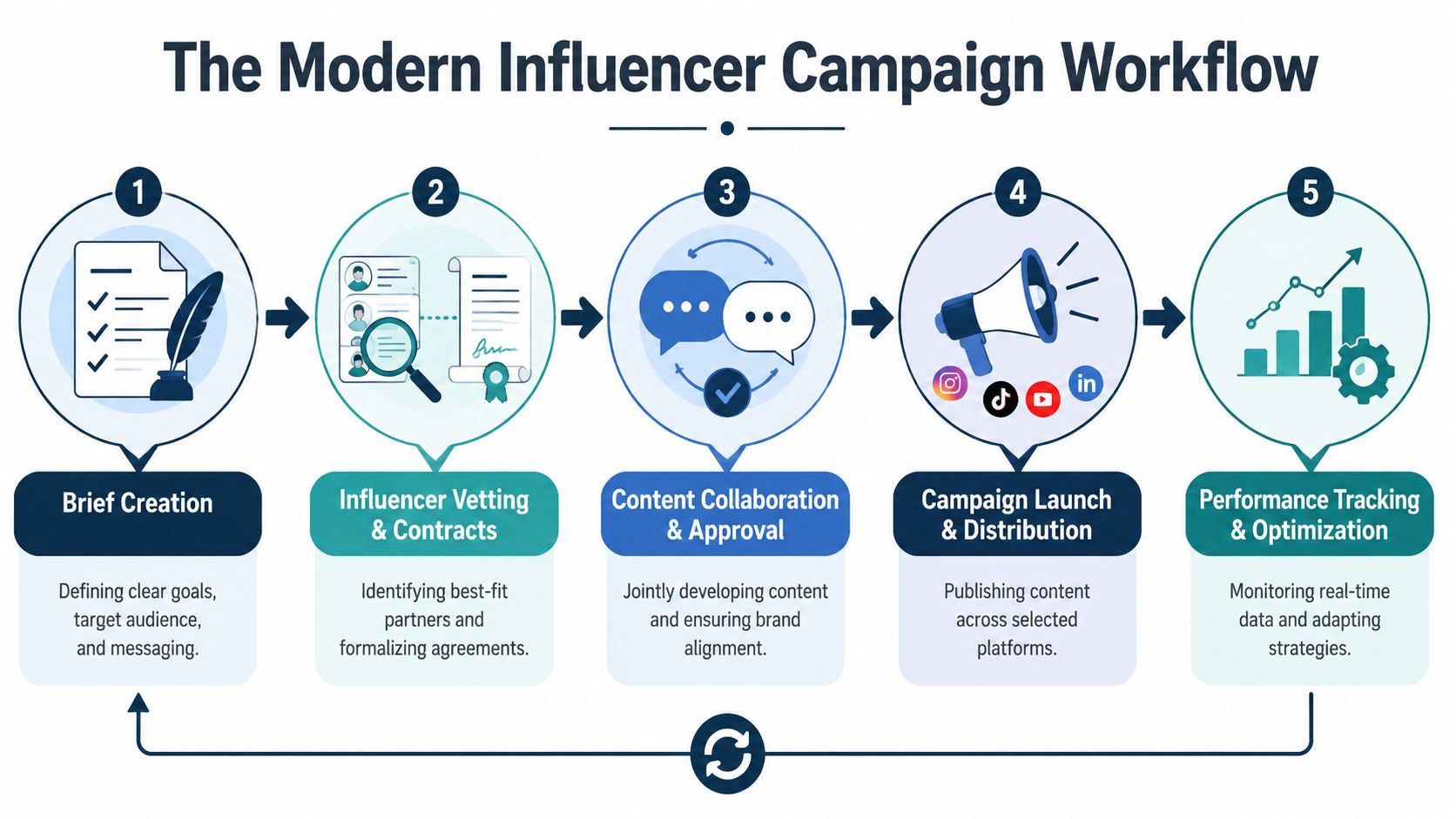
Step one through step three
The first half of the workflow determines whether execution stays controlled later.
Build a clear brief
The brief should define the campaign objective, target audience, core message, content requirements, review process, usage rights, and due dates. Vague briefs create revision loops. Clear briefs reduce friction before it starts.Vetting and contracts
After choosing creators, formalize terms early. Payment amount, posting expectations, revision limits, disclosure requirements, and content rights should all be documented before production begins. If this step is loose, disputes show up late.Content collaboration and approval
This stage is frequently underestimated. The issue usually isn’t creativity. It’s version control. If comments live across email, text, and DMs, nobody knows which asset is final.
Field note: The fastest way to lose momentum is to let approvals happen in multiple channels.
Step four through step five
The second half is where brands either stay organized or scramble.
| Workflow stage | Manual process | Controlled process |
|---|---|---|
| Launch and distribution | Team checks platforms manually and updates sheets | Deliverables tracked in one dashboard |
| Performance tracking | Screenshots, scattered links, delayed reports | Consistent reporting tied to campaign records |
| Payments and compliance | Finance chases missing details | Payment status and creator records stay centralized |
Campaign execution gets much easier when one system holds the source of truth. That’s the practical role of REACH. It gives brands and agencies an AI-powered campaign builder for setup, then a centralized dashboard to manage creator communication, content approvals, deliverables, payments, and 1099 compliance across campaigns. That doesn’t replace strategy. It removes the admin sprawl that prevents strategy from turning into consistent execution.
What a functional workflow looks like
A stable campaign operation usually follows this rhythm:
- One brief location: Creators and internal teams reference the same instructions.
- One approval path: Feedback is documented, visible, and attached to the right asset.
- One deliverables view: Everyone can see what’s pending, approved, posted, or late.
- One payment record: Finance isn’t hunting through old email threads.
- One reporting layer: Published content and performance data stay linked.
This matters even more when the campaign spans Instagram, TikTok, YouTube, affiliate links, and paid usage rights. Multi-platform campaigns create more creative variation, more deadlines, and more chances for a dropped detail.
What doesn’t work
Some habits keep showing up inside underperforming programs:
- Running contracts outside the campaign record
- Letting creators submit assets in whatever format they want
- Tracking due dates in a separate sheet from approvals
- Treating payment as a post-campaign clean-up task
- Reporting only after the campaign ends
None of these choices feel serious in the moment. Together, they make scaling painful.
Measuring Real Business Impact from Your Campaigns
If your report ends with likes, comments, and views, leadership still won’t know whether the campaign worked.
Vanity metrics can help diagnose creative performance, but they don’t answer the budget question. Real measurement ties creator activity to business movement. That means looking at engagement quality, traffic behavior, conversions, and the value of the attention a creator generated.
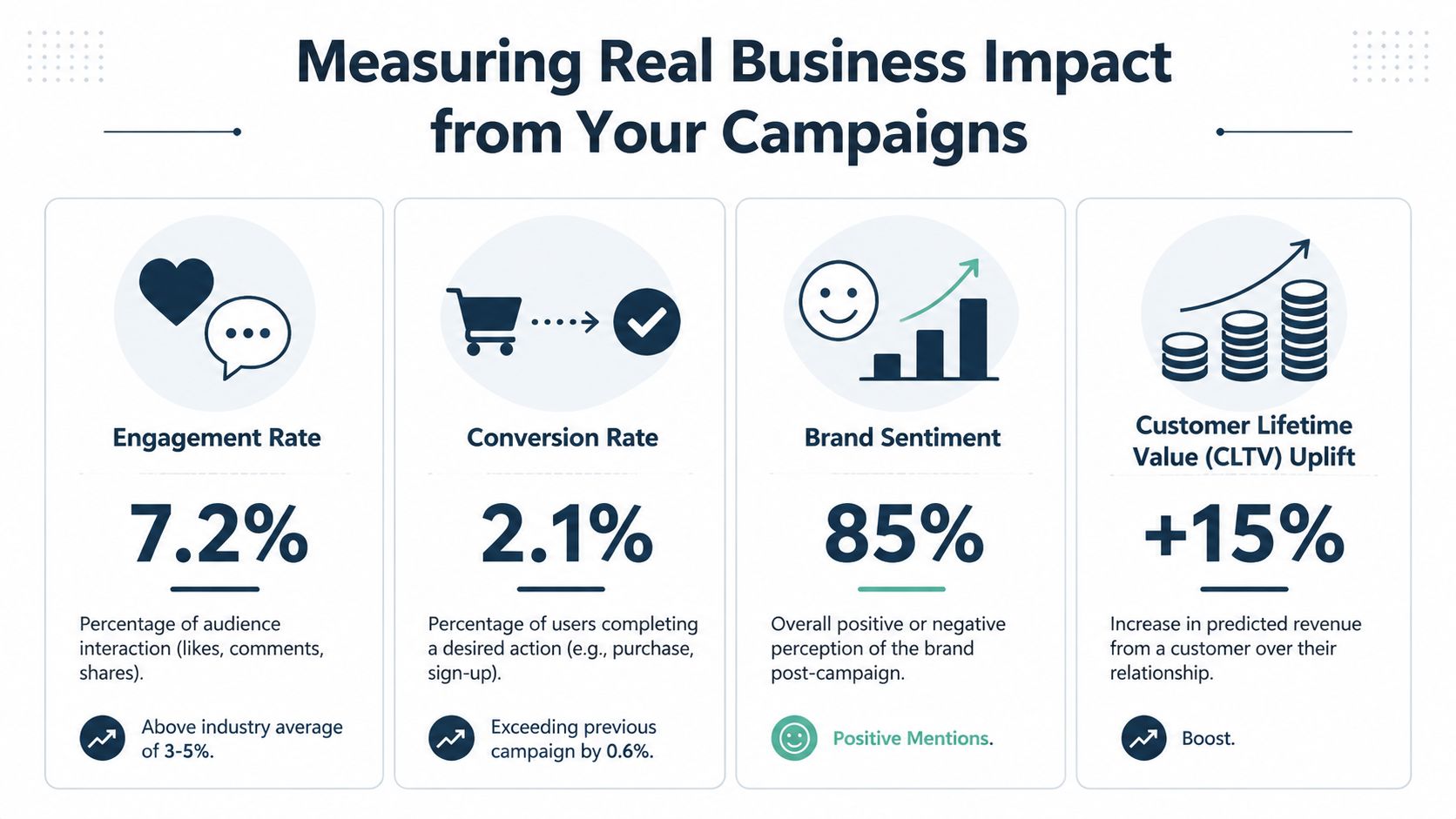
The metrics that matter most
A strong campaign scorecard usually includes a mix of outcome and diagnostic metrics.
- Engagement rate: Useful for understanding whether the content resonated.
- Click-through behavior: Shows whether the audience moved from content to consideration.
- Conversion signals: Purchases, leads, redemptions, or other defined actions.
- Cost efficiency: Spend compared with outcomes across creators or campaign groups.
- Content quality signals: Saves, shares, sentiment, and comments with buying intent.
The exact mix depends on your goal. A launch campaign and an always-on ambassador program shouldn’t be judged by the same lens.
Understanding EMV without overcomplicating it
Earned Media Value, or EMV, gives teams a way to assign dollar value to the impressions and engagements generated by influencer content. In simple terms, it asks: if we had to buy this attention through advertising, what would it be worth?
According to Modash’s guide to influencer KPIs and metrics, EMV is calculated by assigning a dollar value to impressions and engagements. The same source notes that high-EMV campaigns correlate with a 2x higher lift in brand favorability compared to paid ads, and that tracking engagement-tied EMV helps 68% of marketers prove performance.
That makes EMV useful for two reasons:
- It gives brand teams a shared language for comparing creator output with paid media value.
- It helps defend creator spend when direct conversion isn’t the only outcome.
EMV doesn’t replace revenue measurement. It adds context to top-of-funnel value that would otherwise be dismissed.
Reporting by creator, not just by campaign
One campaign can contain very different creator outcomes. One partner may drive strong click activity. Another may generate strong engagement but weak downstream behavior. Another may create the best reusable content for paid amplification.
That’s why reporting should compare creators side by side, not just roll everything into one blended total.
If you’re evaluating outside support, some teams use agency partners for strategy or sourcing while keeping campaign reporting in-house. This roundup of influencer agencies for eCommerce growth can help clarify where agency support makes sense versus where you need your own internal system.
Good measurement changes behavior. It tells you which creators to renew, which formats to brief again, and which offers need work.
Your Next Steps for Influencer Marketing Success
A familiar scenario plays out after the first few creator campaigns. The team has strong product fit, a decent shortlist of partners, and early wins. Then the operational cracks show up. Briefs live in one doc, approvals sit in email, content status lives in a spreadsheet, and finance is chasing payment details across threads.
That is the point where brands influencer marketing becomes an operating problem, not a sourcing problem.
Teams that scale this channel well run it like a system. They know who owns approvals, where deliverables are tracked, how usage rights are recorded, when invoices are cleared, and which results determine renewals. Without that structure, growth creates friction fast. Missed deadlines turn into rushed reviews. Rushed reviews turn into weak content or delayed posting. Payment mistakes strain creator relationships and make the next campaign harder to staff.
The practical next step is to build the workflow before volume forces it on you. Start with one standardized brief format. Set a fixed approval path. Keep creator communication, content status, contracts, payments, and reporting in one place wherever possible. The Meltwater guide to influencer marketing is a useful reference if you want outside reading on the broader discipline, but the day-to-day requirement is simpler: your program needs a central system of record.
This matters even more once multiple teams get involved.
Brand wants stronger creative control. Performance wants cleaner tracking. Finance wants accurate payment records. Legal wants usage rights documented. If each function works from a different tool, campaign management slows down and accountability gets blurry. A centralized platform fixes that by giving every stakeholder the same view of creator activity and campaign status.
If your team is already stuck in spreadsheet hell, treat that as a warning sign, not a temporary inconvenience. Spreadsheet-heavy programs usually hide the same issues: unclear ownership, inconsistent approvals, dropped deliverables, and reporting that takes too long to trust.
REACH helps teams run influencer marketing from one command center. Instead of stitching together separate tools for outreach, approvals, payments, and reporting, brands can manage the full campaign workflow in one platform. You can explore how the platform works, review pricing, see customer case studies, or request a demo to see whether it fits your campaign workflow.