 Skip to content


Paid social gets expensive fast. Creative fatigue shows up, acquisition costs rise, and your team starts asking the right question: why are we renting attention instead of building advocacy?
That’s where clothing brand ambassadors become more than a channel. They become a repeatable growth system. In fashion, brand ambassador marketing delivers an average ROI of $5.78 for every $1 invested according to this fashion ambassador ROI analysis. That result doesn’t come from random gifting or one-off influencer posts. It comes from structured programs with the right people, the right agreements, and clean performance tracking.
Most brands still get this wrong.
They recruit based on follower count, send vague briefs, skip contract details, and measure success with likes. Then they conclude ambassador programs are hard to scale. They’re not. Poorly built programs are hard to scale.
A strong ambassador program works because it matches brand identity with credible voices, gives those partners enough structure to perform well, and connects activity to sales and retention instead of surface metrics. The brands that win here treat ambassadorship like an operating model, not a seasonal experiment.
This is the practical playbook. It covers internal planning many teams skip, how to recruit people who fit, what to put in your contracts, how to choose compensation, how to track true return, and how to scale without creating legal or tax problems for your business.
If you run a DTC label, in-house fashion team, or agency account, this is the version that matters. Not theory. Not vague brand building advice. The framework that makes clothing brand ambassadors useful, measurable, and manageable.
Introduction
Clothing brands usually hit the same wall in roughly the same way.
Ads work for a while. Then your top creatives wear out, your customer acquisition model gets less predictable, and paid performance stops covering every growth target on its own. At that point, more spend isn't always the answer. Better trust is.
That’s why clothing brand ambassadors matter so much. They close the gap between brand messaging and buyer belief. A good ambassador doesn’t just display a product. They make the product feel lived in, socially relevant, and credible within a specific community.
The difference is long-term alignment. An ambassador program gives your brand a recurring presence in the feeds, conversations, and style references that shape purchase decisions. It also creates a steady flow of content, social proof, and first-hand product storytelling that a brand-owned ad account can’t manufacture on its own.
The strongest programs also move beyond celebrity logic. While celebrities offer instant reach, micro-influencers often convert better through personal connection, and 47% of ambassador conversations focus on emotional resonance according to this clothing ambassador analysis. That matters for apparel because clothing is identity-led. People don't just buy fabric. They buy taste, belonging, and self-expression.
The best ambassadors already talk like insiders before you ever contact them.
That’s the shift. Stop looking for rented exposure. Start building a network of people who can carry your brand story in a way audiences trust.
Laying the Foundation for Your Ambassador Program
Most ambassador programs fail before outreach starts.
The problem isn’t recruitment. It’s a weak brief disguised as a strategy. If you don’t know what the program is supposed to produce, you can’t choose the right people, structure the right deal, or measure whether the work is worth continuing.
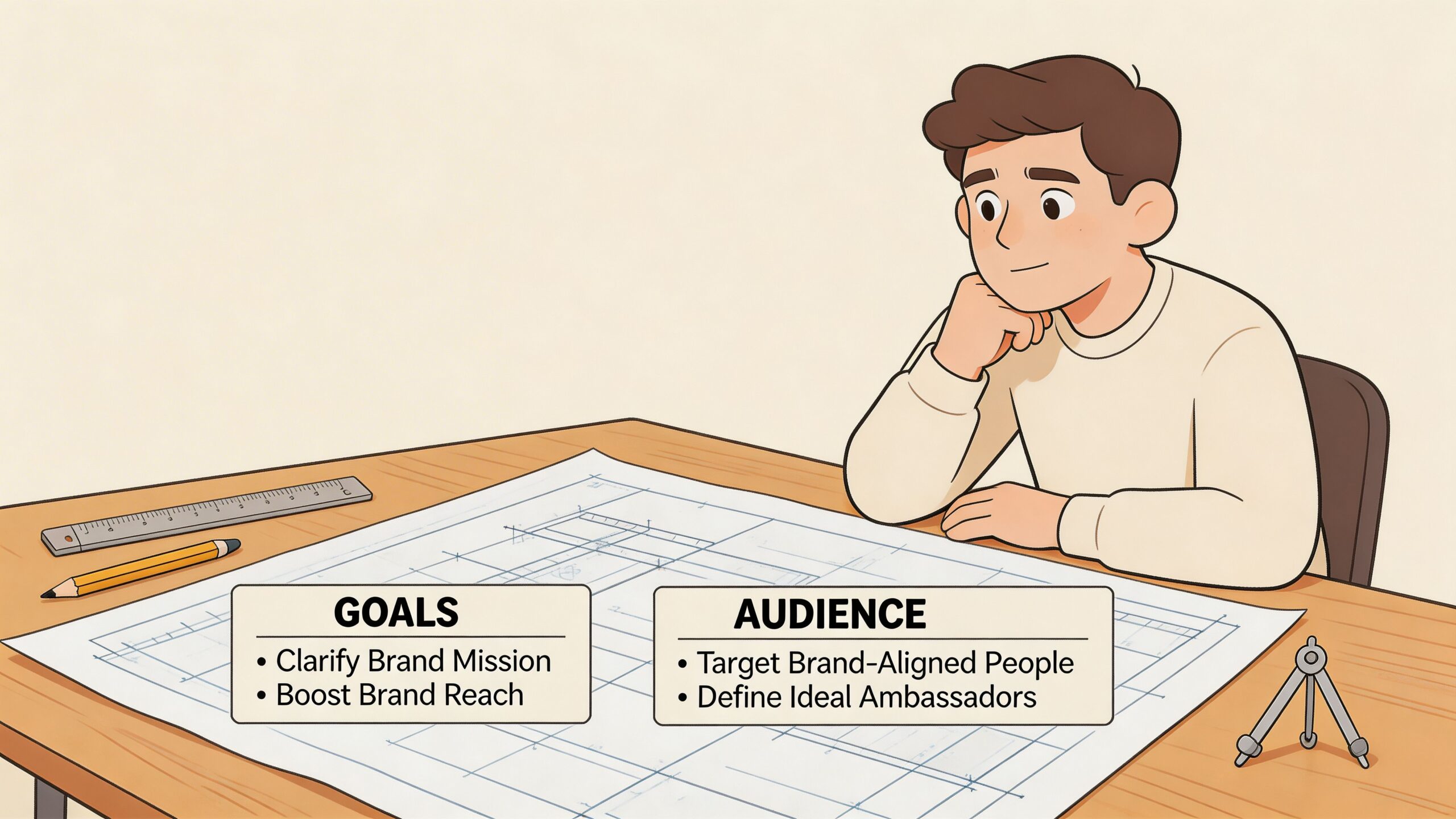
Start with business outcomes
“Increase awareness” is not a usable operating goal.
You need outcomes your team can manage week to week. The cleanest starting point is to define what role ambassadors will play inside your growth model.
Use questions like these:
- Sales role: Are ambassadors expected to drive direct purchases through codes, links, and launches?
- Content role: Do you need a dependable stream of UGC for paid, email, product pages, and organic social?
- Community role: Are you trying to build a visible circle of repeat advocates around a niche identity?
- Market role: Do you need local credibility in a new city, category, or demographic segment?
The answer changes everything. A conversion-focused program needs different partners than a content-focused one. Brands often blur the two and end up frustrated because they hired for aesthetics when they needed commerce.
A useful internal document should answer six things:
| Decision area | What to define |
|---|---|
| Program purpose | What the ambassador channel must contribute to the business |
| Audience | Who you want to influence and why they buy |
| Creator profile | What kind of person can credibly move that audience |
| Offer | What ambassadors receive and what you expect in return |
| Operating model | How often campaigns run and who manages approvals |
| Measurement | What signals determine whether the program keeps growing |
If your team needs a template for structuring the overall program model, the REACH guide to a brand ambassador program is a useful operational reference.
Build an ideal ambassador persona
Many fashion brands get lazy at this stage.
They describe a target creator with demographic labels and a follower range, then call it done. That gives you a shortlist, not a fit model. What you need is a working persona built around trust and cultural alignment.
Look at these dimensions:
- Style language: Minimalist, streetwear, modest fashion, performance, luxury, vintage, capsule wardrobe, nightlife, travel, or everyday basics.
- Content behavior: Outfit breakdowns, styling tutorials, lifestyle diaries, event coverage, reviews, community interaction, or polished editorial.
- Audience expectations: Does their audience come for inspiration, practical advice, social identity, or trend discovery?
- Brand adjacency: What other labels, aesthetics, and conversations already surround them?
- Credibility source: Do people trust them because they’re aspirational, relatable, highly knowledgeable, or embedded in a niche?
This matters more than raw size.
Launchmetrics noted that 47% of brand-ambassador conversations focus on lifestyle and audience connection in its Brand Ambassador Marketing 2025 analysis. That lines up with what strong fashion teams already know. The right ambassador doesn’t only expand reach. They shape how the brand is talked about.
Working rule: If you can swap your ambassador shortlist into a competitor’s campaign with no obvious mismatch, your persona is too generic.
Audit your brand before you recruit
Before inviting anyone in, fix the friction inside your own house.
Ambassadors need a clear brand environment. If your site, product pages, sizing guidance, shipping communication, or returns flow create disappointment, ambassadors won’t save you. They’ll amplify the cracks.
Run a simple pre-launch audit:
- Product readiness: Your hero SKUs should be available, consistent, and easy to explain.
- Brand message: Your positioning should be clear enough that ten ambassadors can interpret it without turning it into ten different brands.
- Content standards: You need examples of what good ambassador content looks like.
- Tracking setup: Codes, links, and campaign naming conventions should exist before outreach.
- Team ownership: One person must own the program day to day.
That final point matters more than many teams admit. Programs break when nobody is responsible for follow-up, approvals, or reporting.
Finding and Recruiting Your Ideal Clothing Brand Ambassadors
The strongest ambassador programs usually come from a small slice of the people a brand first considers. Discovery matters, but selection discipline matters more.
Manual research still plays a role. It helps you understand the style codes, language, and community signals around your category. It does not give you a dependable hiring system once you need to recruit at volume, track outreach, and compare candidates against the same standards.
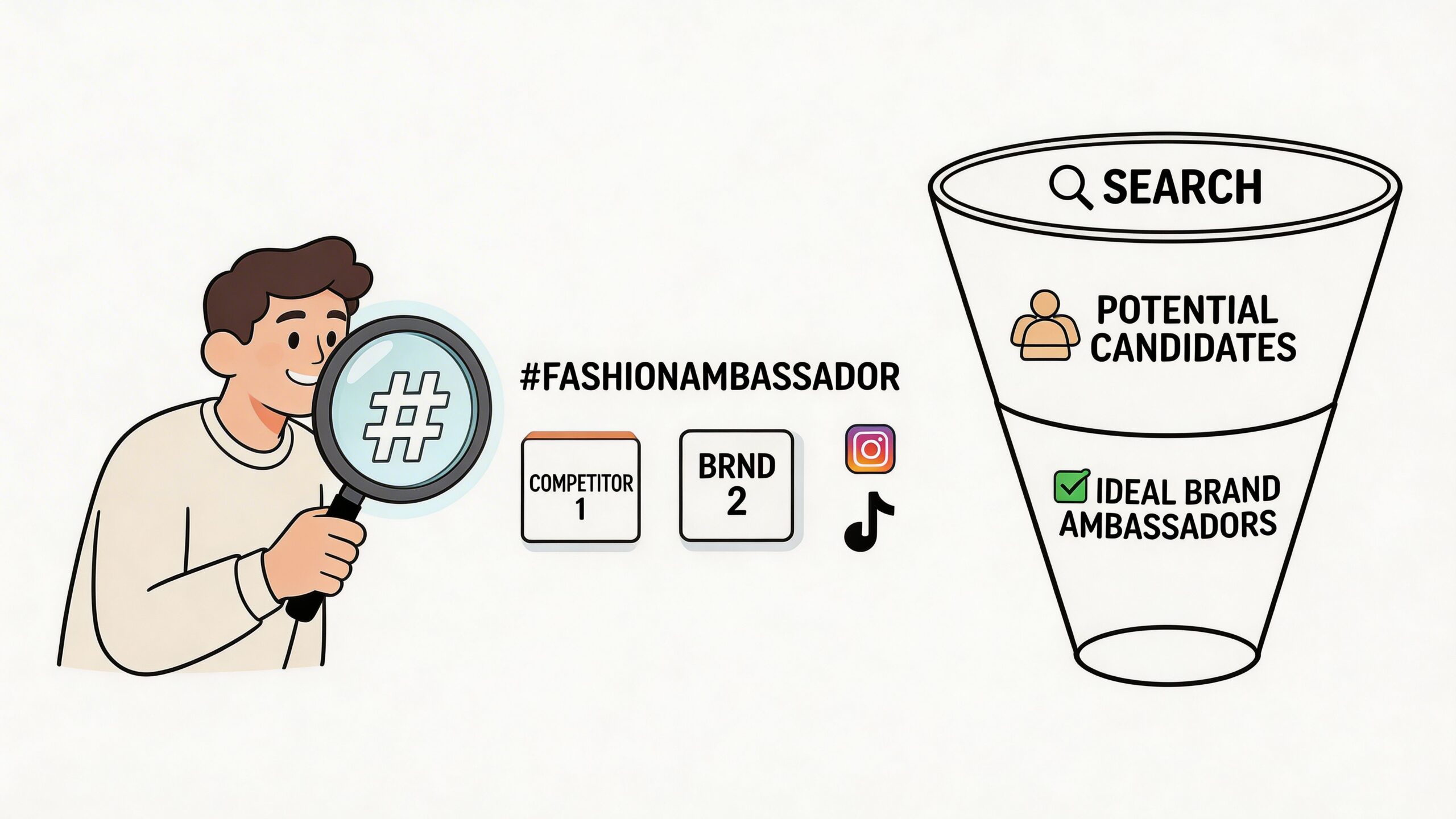
Manual search versus platform-led discovery
The trade-off is straightforward. Manual search gives you intuition. Platform discovery gives you control.
| Method | What works | What breaks |
|---|---|---|
| Manual search | Good for early research and niche immersion | Slow, inconsistent, hard to document |
| Spreadsheet prospecting | Easy to start with small budgets | Gets messy once outreach, notes, and follow-up stack up |
| Platform discovery | Better filtering, repeatability, and workflow control | Only works well if your criteria are clear |
Teams that rely only on manual search usually over-select the most visible creators. That creates a predictable problem. You end up with polished profiles that look impressive in a shortlist but produce average sales and weak retention.
A better approach is to use manual research to understand the category, then use a platform to screen at scale. REACH is useful here because it helps teams organize discovery around the signals that affect performance: audience fit, location, engagement quality, aesthetic alignment, prior brand work, and response history. This guide on how to find brand ambassadors shows the workflow in more detail.
What to evaluate before outreach
Effective recruitment prioritizes filtering before outreach.
The first pass should answer a practical question. Will this person make your product feel credible, desirable, and easy to picture in the life of your target customer?
Check five things before you send a message:
- Brand fit: Their personal style should already overlap with your product and price point.
- Audience quality: Comments should show real interest, not generic reactions or giveaway traffic.
- Content consistency: Their visual style, posting habits, and tone should be stable enough to support a long-term partnership.
- Commercial maturity: They should be able to feature a product naturally without making every post feel like an ad.
- Public behavior: Review how they handle conflict, sensitive topics, and criticism. One bad fit can create a legal, customer service, and reputation problem at the same time.
This filtering reflects a broader industry shift toward resonance over raw reach. In apparel, I would usually back a smaller creator with strong taste, clear audience trust, and consistent product integration over a larger account with vague lifestyle content and weak buyer intent.
If you want the program to scale, score candidates instead of relying on instinct alone. A simple 1 to 5 scorecard for fit, audience quality, content quality, professionalism, and risk is enough to improve hiring decisions. It also gives your team a record you can audit later when reviewing ROI.
Send outreach that sounds like a real offer
Outreach works best when it answers three questions fast. Why them. Why now. What kind of partnership.
Generic praise wastes the opening line. Specificity gets replies because it signals that your team did the work.
A simple framework works well:
We’ve been following your content around [style/niche]. The way you present [specific trait] lines up with how we want customers to experience our brand. We’re building a clothing ambassador program around long-term partnership, with clear deliverables, tracking, and room to grow if the fit is right. If that sounds aligned, we’d love to discuss what a collaboration could look like.
Keep it short. The goal is to start a serious conversation, not negotiate the full deal in the first message.
Speed matters here. Good candidates lose interest when brands take a week to reply, switch contacts mid-conversation, or ask for content before discussing terms. I have seen strong prospects go cold for that reason alone.
A short visual primer can help your team sharpen its recruiting instincts:
Vet with more discipline than you think you need
Recruiting errors are expensive because they create work in every later stage. Bad content approvals, missed deadlines, attribution disputes, and contract friction often start with weak vetting.
Run a structured review before every offer:
- Review recent posts for consistency, product integration quality, and any sudden changes in persona or audience.
- Read comments to gauge trust, purchase interest, and whether followers treat the creator like a style reference.
- Check prior brand work for professionalism, disclosure habits, and signs of over-promotion.
- Assess communication in email or DM. Slow, vague, or disorganized replies usually continue after signing.
- Test alignment with a sample brief or short call before offering a longer agreement.
Operational programs separate themselves from casual creator outreach at this point. The shortlist should not only look right on social media. It should hold up under contract, reporting, tax documentation, and ROI review later. If a creator is hard to evaluate at the recruitment stage, they usually become harder to manage once money and deadlines are involved.
The best clothing brand ambassadors are often the people whose audience already treats them like a trusted source of taste. Your job is to find them early, screen them carefully, and recruit them with a process your team can repeat.
Onboarding, Contracts, and Compensation Models
Strong ambassador programs are usually won or lost before the first post goes live.
Poor onboarding creates predictable problems: off-brand content, late submissions, weak disclosure, and disputes over usage rights. Those issues rarely come from a lack of talent. They come from a vague process.

Build a real onboarding flow
A clean onboarding flow gives ambassadors clear guidance without scripting their voice.
The goal is simple. Reduce avoidable mistakes while preserving the creator’s credibility with their audience. In fashion, that balance matters more than many teams expect. If the brand over-controls the message, content starts to look like an ad. If the brand under-explains the product, creators fill the gaps themselves and often get fit, fabric, or care details wrong.
A useful onboarding flow usually includes:
- Welcome materials: Brand story, target customer, hero products, and clear brand boundaries.
- Campaign expectations: Deliverables, deadlines, approval steps, posting windows, and reporting requirements.
- Product education: Fabric details, fit notes, sizing language, care instructions, and common objections shoppers raise.
- Communication norms: Primary contact, response times, escalation path, and where approvals happen.
- Tracking setup: Links, discount codes, campaign tags, and attribution rules.
Keep the pack short enough to use.
I’ve found that ambassadors absorb a five-page operational guide far better than a thirty-page brand document. The team should also confirm receipt of the brief, shipping details, payment details, and tax forms before any content deadline is set. REACH helps here because it centralizes those steps instead of splitting them across inboxes, spreadsheets, and DMs.
Clear beats exhaustive. An ambassador who understands the product, the audience, and the approval rules will usually produce better work than one buried under brand language.
Contract clauses you shouldn’t skip
Early-stage programs often rely on informal agreements, especially when the first few partnerships start through Instagram DMs or founder outreach. That works until an ambassador posts late, uses the wrong disclosure, signs with a competitor, or objects when the brand reuses their content in paid ads.
Put the operating terms in writing before product ships or content is created.
Every clothing ambassador contract should cover:
Must-have clauses
Scope of work
Deliverables and deadlines
Compensation terms
Content usage rights
Disclosure obligations
Exclusivity limits
Termination terms
Approval process
Payment timing
Dispute handling
Two clauses deserve more attention than they usually get.
First, usage rights. A brand may assume a repost on Instagram is covered, while the creator may treat paid ads, email placements, homepage banners, and product page use as separate licenses. Second, exclusivity. Broad category restrictions can make a reasonable fee look unreasonable fast, especially in apparel where creators often work across adjacent labels, accessories, and footwear.
If your team needs a starting point before legal review, this brand ambassador agreement template is a practical resource. It won’t replace counsel, but it does help teams start with the right structure.
For a platform-specific view of how agreements fit into approvals, deliverables, and campaign administration, REACH explains the process well on its influencer agreement contract guide.
The compensation model should match the job
Compensation problems usually start with a strategy problem. The brand wants awareness, conversion, UGC, affiliate sales, and long-term loyalty, then tries to pay for all of it with one offer.
That approach creates friction fast.
A creator producing one try-on reel for gifted product is doing a different job than an ambassador expected to post monthly, answer follower questions, drive tracked sales, and grant content usage rights. Pay structure should reflect the actual commercial value of the work and the level of control the brand needs.
Common models include:
| Model | Best use case | Main caution |
|—|—|
| Product gifting | Early testing, seeding, community activation | Weak for ongoing accountability |
| Commission only | Direct-response and affiliate-led programs | Can deter creators who influence consideration but do not close the sale |
| Flat fee | Campaign-specific content and predictable output | Requires clear terms for revisions and usage |
| Hybrid | Long-term partnerships with both content and sales goals | Needs stronger tracking, reporting, and admin discipline |
Hybrid deals often perform best for apparel brands because they align two realities. Clothing ambassadors create both brand value and measurable sales value. Product helps them wear the brand consistently and speak from experience. Cash reflects production time, audience access, and the commercial rights the brand may need later.
Practical compensation decisions
Use a simple decision rule.
- Use product only when the ambassador already buys the brand, the deliverable is light, and the relationship is still being tested.
- Add commission when sales attribution is clean and the creator is expected to drive purchasing behavior.
- Use flat fees when the content itself has value, even if immediate sales are hard to track.
- Move to hybrid when the partnership is recurring, strategically important, or includes both content production and revenue goals.
The strongest programs do not pay everyone the same way. They segment by role, expected output, rights granted, and business objective. That is also where REACH becomes more than a discovery tool. It gives teams a system to standardize offers, track contract status, store payment terms, and compare performance across compensation models without rebuilding the workflow every quarter.
Managing Campaigns and Measuring True ROI
Brands that track ambassador performance to the post level make faster budget decisions than brands that review results at the campaign-summary level. In practice, that gap shows up in one place. The stronger team can tell you which creator drove qualified traffic, which one produced reusable content, and which one looked good in a report but did little for the business.
That is the standard.
A clothing ambassador program breaks down once campaign execution lives in scattered inboxes, approvals happen in DMs, and reporting stops at likes, comments, and reach. A common reporting mistake is relying on engagement as the headline metric without tying ambassador activity to revenue, content output, customer quality, or repeat purchase behavior. REACH helps fix that by giving the team one operating system for briefs, deliverables, posting calendars, approvals, tracked links, and ambassador-level reporting.
Run campaigns on a fixed operating cadence
Good campaign management is boring in the best way. The team follows the same sequence every time, so variance comes from creator performance, not internal confusion.
Set a cadence your team can sustain:
- campaign brief sent
- products confirmed and shipped
- creator questions answered in one place
- draft or concept reviewed if needed
- post date locked
- live content checked for disclosure, links, and code accuracy
- performance reviewed on a defined window, not ad hoc
The brief matters, but clarity matters more than length. Ambassadors need to know what is being promoted, why it matters now, what audience the campaign is built for, which claims are approved, what brand risks to avoid, and how success will be judged. If those points are vague, creators fill the gap themselves. Sometimes that produces strong content. It also creates avoidable misses, especially in apparel where fit, styling, and product claims can easily drift off message.
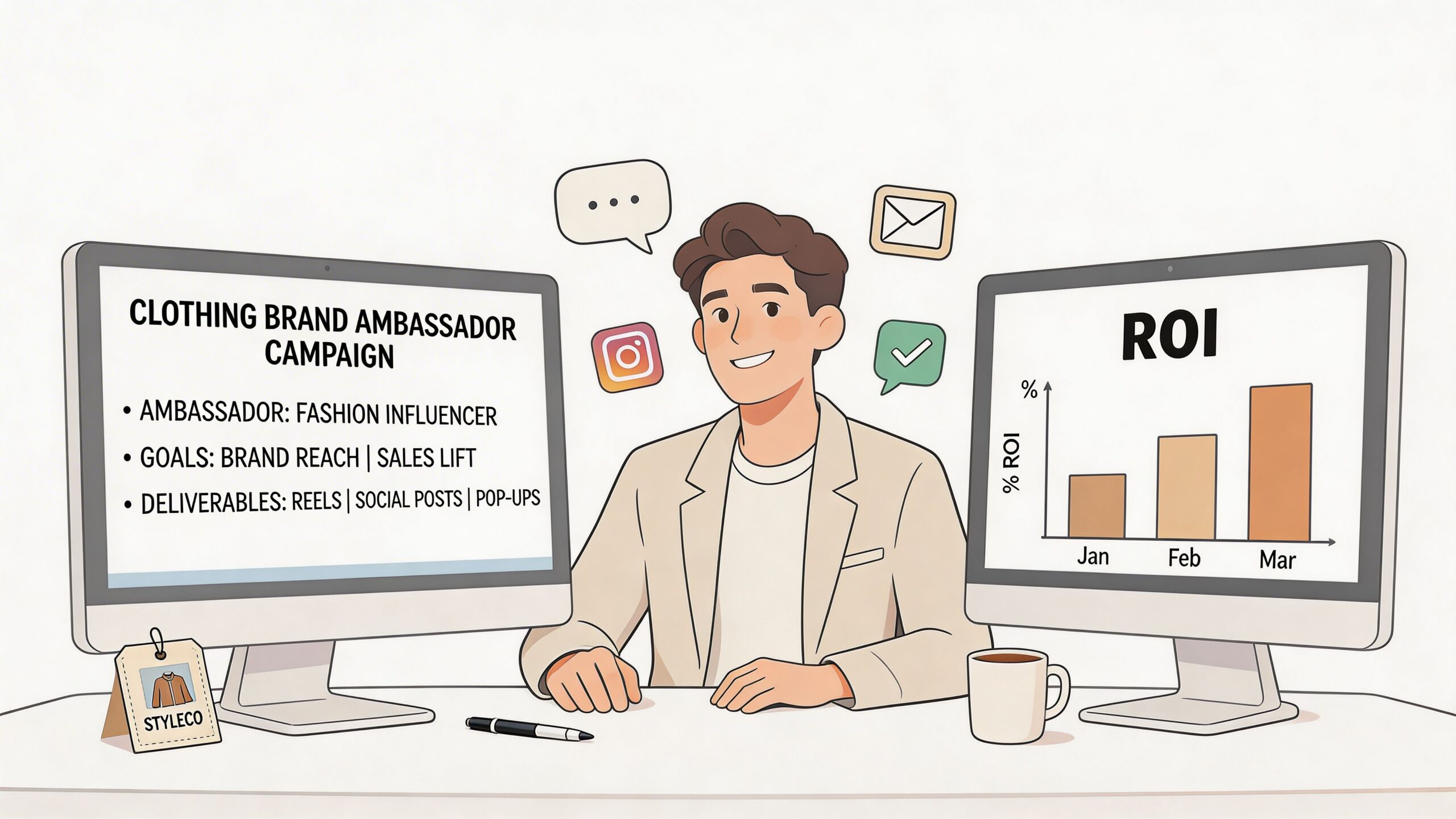
Use engagement as a signal, not the finish line
Likes and comments can help you spot creative traction, audience fit, and message resonance. They do not tell you enough on their own to decide whether a partner deserves more budget.
A better review asks five separate questions:
| Metric type | Better question |
|---|---|
| Engagement | Did the content generate relevant interaction from the audience the brand wants to reach? |
| Traffic | Did viewers click through and spend time on product pages or collection pages? |
| Conversion | Did this ambassador produce attributed purchases, email signups, or other target actions? |
| Content value | Did the creator deliver assets the brand can reuse in paid social, email, or product pages? |
| Brand impact | Did this partnership improve sentiment, creator fit, or visibility in a target community? |
That distinction matters because ambassadors do different jobs. One creator may be a reliable sales driver with modest content quality. Another may rarely convert on first click but consistently produces strong visual assets that improve paid performance later. If both get judged by one metric, the team cuts useful partners and keeps the wrong ones.
A practical rule helps here. If an ambassador creates strong conversation across several activations but produces little attributable action, classify that partner as a brand or content asset and budget them that way. Do not force them into a sales role they have not earned.
Build attribution before the first post goes live
Measurement gets messy when teams try to retrofit tracking after content is already live. Set the stack up first, then launch.
Use a simple attribution structure:
- unique discount codes for ambassador-level order tracking
- tracked links for click and session visibility
- UTM parameters so traffic is clean inside analytics
- naming conventions that match campaign, creator, channel, and date
- a post-campaign review window long enough to capture delayed purchases
- a clear rule for assisted conversions and content reuse value
Pricing discipline belongs in the same planning stage. If your team needs a benchmark for creator rate conversations, the TikTok Influencer Pricing Calculator is a useful reference point when comparing flat-fee proposals against expected content output and sales potential.
REACH is especially useful here because it centralizes the records teams usually lose track of. You can keep creator links, codes, deliverables, post dates, and results in one place, then compare performance across campaigns without rebuilding the report every month.
Define ROI in layers
ROI for ambassador programs is rarely one clean number. Treat it as a layered review, or you will either overpay for visibility or underinvest in partnerships that create value outside last-click sales.
A sound ROI model separates:
- direct revenue from codes, tracked links, and attributed orders
- content asset value from photos or videos the brand can reuse
- assisted impact from traffic, product discovery, and mid-funnel influence
- operational reliability, including on-time delivery, revision load, and compliance quality
- long-term relationship value, especially if the creator is becoming part of the brand’s identity
Experienced teams get sharper in this way. They stop asking whether an ambassador "worked" and start asking what kind of value that ambassador produced, at what cost, and under what conditions. That analysis leads to better decisions on renewals, fee increases, gifting strategy, and which creators should move into a longer-term tier.
The result is a program you can defend in a budget review. More important, it is a program you can improve because the reporting reflects how ambassador marketing creates value.
Scaling Your Program with Legal and Tax Confidence
Ambassador programs rarely break because of recruitment volume. They break when payment records live in one tool, contracts in another, and disclosure rules in someone's inbox.
At that point, growth creates friction faster than it creates revenue. The fix is operational discipline.
Standardize before you expand
A collection of custom processes is not a scalable program. As roster size grows, every exception adds approval time, increases compliance risk, and makes reporting harder to trust.
Set one default operating model for the parts that repeat every month:
- One onboarding sequence
- One contract review flow
- One approval process
- One payment schedule
- One reporting structure
- One disclosure standard
Good operators know where to standardize and where to stay flexible. Compensation can vary by creator tier. Usage rights can vary by campaign. Your intake process, legal review path, document storage, and payment controls should not vary every time.
Tracking needs the same discipline. If codes, links, content rights, and deliverables are tracked differently across creators, scale will expose the gaps quickly. Put your attribution setup in place before you expand the roster, not after.
Legal discipline protects the brand and the working relationship
Legal work gets framed as a blocker. In practice, it prevents expensive ambiguity.
The basics are straightforward:
- Use written agreements: Every relationship needs documented terms.
- Set disclosure expectations: Ambassadors need clear instructions for sponsored content disclosures.
- Define content rights clearly: Whitelisting, reposting, paid usage, and perpetual usage are different rights and should be priced and approved separately.
- Document approvals: Keep records of briefs, revisions, approvals, and final deliverables.
- Control exclusivity carefully: Restrictions should match the fee, duration, and business risk.
Loose terms create avoidable problems. Teams end up debating whether a gifted post counts as paid promotion, whether the brand can run an ambassador's video as an ad, or whether a creator can work with a competitor next month. Those are contract questions, not relationship questions.
Worker classification also needs attention. If your team controls schedules, scripts, required training, and day-to-day conduct too tightly, contractor status can become harder to defend. Legal counsel should review the structure before the program gets large, especially if you are operating across multiple states or countries.
Tax and payment processes need to mature with the program
Early programs often run payments through spreadsheets and email threads. That approach usually holds for a small test group. It becomes unreliable once finance, legal, and marketing all need the same records.
Your team needs a clear process for the basics:
| Compliance area | What the team needs |
|---|---|
| Payables | A consistent payment approval and processing workflow |
| Documentation | Contract records and tax forms stored in one place |
| Territory awareness | Different payment and compliance expectations across markets |
| Audit trail | Clear records of what was paid, when, and why |
In the US, independent contractor payments can create tax reporting obligations. The exact requirement depends on entity structure, payment method, jurisdiction, and current guidance from finance and counsel. Treat that as a formal workflow with owners, deadlines, and stored documentation.
Product seeding needs discipline too. If ambassadors receive free product, your team should know how that is recorded, valued, approved, and communicated internally. Gifting can affect budget controls and tax treatment, especially in cross-border programs.
Automation makes scale manageable
Manual administration is what usually caps growth. The strategic work in an ambassador program is partner selection, creative direction, retention, and performance review. The repetitive work should sit inside a system.
Without automation, teams lose hours to the same tasks every cycle:
- Chasing signatures
- Following up on briefs
- Checking post links
- Updating reports
- Confirming payment status
- Reconciling creator data across tools
Centralized operations solve that problem directly. REACH helps teams keep creator records, agreements, deliverables, campaign activity, and performance tracking in one place, which matters when your roster expands and auditability starts to matter as much as recruitment.
That is how mature programs scale. The brand team keeps control of legal and tax risk, finance gets cleaner records, and marketers spend more time improving ambassador performance instead of fixing process failures.
Conclusion
The success of a clothing brand ambassador program depends less on the concept and more on the operational discipline behind it.
Brands win when they set a clear job for ambassadors, recruit for fit, document expectations early, and measure revenue impact instead of relying on reach alone. That sounds simple. In practice, it is where weak programs break down. A polished recruitment push cannot fix loose contracts, unclear deliverables, bad attribution, or messy payment records.
Strong ambassador programs also change how growth feels inside the business. Marketing gets repeatable content and cleaner performance data. Finance gets clearer records. Legal gets fewer surprises. The brand gets trusted visibility from people who match the customer.
That is the difference between a short campaign and a system.
If you want better retention, stronger UGC, tighter audience alignment, and a clearer line from creator activity to sales, treat ambassador marketing like an operating function. Build it with workflows, ownership, documentation, and reporting from day one. Teams that do that usually scale faster because they spend less time fixing preventable process problems.
REACH helps teams run that system in one place, from discovery and outreach to contracts, tracking, payments, and ROI reporting. Book a demo if you want a cleaner way to recruit clothing brand ambassadors, manage campaigns without spreadsheet sprawl, and scale with more confidence in your legal, tax, and performance data.