 Skip to content

Finding the right YouTube influencer is about so much more than just a big subscriber number. It’s about discovering a true partner whose audience genuinely trusts them. The real magic happens when you match a creator’s audience and content style with your brand's goals—that's how a simple promotion becomes a powerful, authentic endorsement. This guide will provide a practical framework for finding YouTube influencers who can deliver measurable growth for your business.
Why Finding The Right YouTube Influencer Is A Game Changer
Let’s be real: searching for the perfect YouTube partner can feel like hunting for a needle in a digital haystack. But the payoff is huge. Getting it right is what separates a campaign that falls flat from one that drives incredible growth. Traditional ads just don't have the same pull they used to, as people now turn to creators they feel a real connection with for recommendations.
This guide isn't about theory. It’s the actual playbook I use for discovering and partnering with creators who can genuinely move the needle for a brand, enhanced by the power of platforms like REACH Influencers, which streamlines the entire process from discovery to ROI tracking.
The Shift To Creator-Led Marketing
The marketing power dynamic has completely flipped. Brands used to just broadcast their messages, but now, consumers look to individuals they trust. An honest endorsement from a YouTuber feels like getting a tip from a friend, and it carries a weight that no glossy ad can ever replicate.
The numbers back this up. The global influencer marketing industry is on a tear, projected to hit $32.55 billion in 2026—more than triple its size from 2019. YouTube is a massive player here, with 33% brand adoption for influencer campaigns, cementing its spot as a go-to platform. You can read the full research about influencer marketing's incredible growth to see just how big this opportunity is.
The real value isn't just in a creator's reach; it's in their credibility. When a creator your target audience loves and trusts recommends your product, that recommendation cuts through the noise and drives action.
Overcoming The Discovery Challenge When Finding YouTube Influencers
Even though the benefits are crystal clear, the actual process of finding YouTube influencers can be a grind. The sheer volume of content out there makes searching manually a slow, frustrating process. How do you know if their audience is real and engaged? How can you be sure their values align with your own?
This is exactly where influencer marketing platforms come in. Tools like REACH Influencers are built to slice through the noise with a powerful discovery engine. It lets you filter through millions of creators using the data points that actually matter, such as:
- Audience Demographics: Filter by age, gender, location, and even interests to find your perfect match.
- Engagement Metrics: Look past vanity metrics and see how audiences are really interacting with the content.
- Content Niche: Zero in on creators who live and breathe your specific industry.
Taking a data-driven approach removes the guesswork and helps you find partners who can deliver results you can actually measure. This guide will walk you through it all—from vetting creators to proving ROI and building profitable relationships that last.
Building Your Foundation For A Successful Search
Before you even think about typing a keyword into YouTube, you need to do some prep work. Honestly, this initial legwork is what separates a successful campaign from a flop. If you just jump in and start looking for popular creators, you're setting yourself up to waste time and money.
A smart search for the right YouTube partner always starts with two things: what you want to achieve, and who you want to reach. This isn't just about being organized; it’s about making sure every decision you make from here on out actually supports your end game. Without a clear target, you're just guessing.
What's The End Goal?
First things first, what does success look like for this partnership? The answer completely changes the kind of creator you should be looking for. Different goals demand different types of influencers and completely different strategies.
Here are the big three campaign goals I see most often:
- Brand Awareness: The main objective here is simple: get your brand in front of as many of the right eyeballs as possible. You'll be looking for creators with a significant, active viewership that matches your target demographic.
- Website Traffic: This is all about getting people to click. You need to find influencers who are pros at getting their audience to take action, whether it's hitting a link in their description or visiting a specific landing page.
- Direct Sales: This one is purely about moving the needle on revenue. You need creators who are more than just entertainers; they have to be genuinely persuasive. Their audience needs to trust their recommendations enough to pull out their wallets.
Your goal is your compass. A campaign built to generate sales leads will look totally different from one designed to just get your name out there. Nailing this down first makes the entire process of finding the right YouTube partner so much more efficient.
Who Is Your Ideal Creator?
Once you've got your "why," it's time to figure out your "who." This means sketching out a detailed profile of the perfect influencer for your brand. And I'm not just talking about their subscriber count—I mean their entire vibe and creative identity.
Think of it like casting a role in a movie. You wouldn't hire a slapstick comedian for a heavy drama, right? The same principle applies here. The creator's personal brand has to feel like a natural fit with your own.
Scenario: A Gaming Hardware Company
Let's walk through a real-world example. Imagine you're launching a new, high-performance gaming mouse. Your primary goal is direct sales, and you're targeting competitive esports players.
Here’s what your ideal creator persona might look like:
- Niche: They live and breathe first-person shooter (FPS) games like Valorant or Counter-Strike, where a mouse's precision can make or break a match. A general "let's play" channel just won't cut it.
- Audience Demographics: Their viewers are mostly 18-34 years old, know their tech, and actively follow the competitive gaming scene. A quick look inside a discovery tool like REACH can confirm if a creator's audience data lines up.
- Content Style: Their videos are sharp and analytical. They post in-depth gear reviews, tutorials on how to improve aim, and breakdowns of pro gameplay. Someone who focuses on "funny moments" compilations is the wrong fit.
- Engagement Signals: The comments are a goldmine. Are people asking about specific gear, mouse settings, or performance tips? That's a huge green flag. It shows an audience that genuinely trusts the creator's technical expertise.
See how this detailed profile instantly sharpens your focus? Instead of a vague search for "gaming influencers," you're now on the hunt for "competitive FPS YouTubers with an engaged, tech-focused audience." That level of clarity is what turns a long, frustrating search into a quick and successful one.
A Framework for Finding YouTube Influencers That Works
Alright, you’ve got your goals locked in and a clear picture of your ideal creator. Now for the fun part: the actual hunt. Finding the right YouTube influencers is part art, part science. You need the intuition to spot real talent and the right tools to do it without spending weeks glued to your screen.
Let's be real, YouTube is massive. With over 2.7 billion people logging in every month and 500 hours of video uploaded every single minute, just diving in and hoping to find someone is like searching for a needle in a continent-sized haystack. That’s why you need a game plan.
This is the simple framework I always come back to before starting any search. It keeps me focused and ensures I don't get lost down a rabbit hole of irrelevant channels.
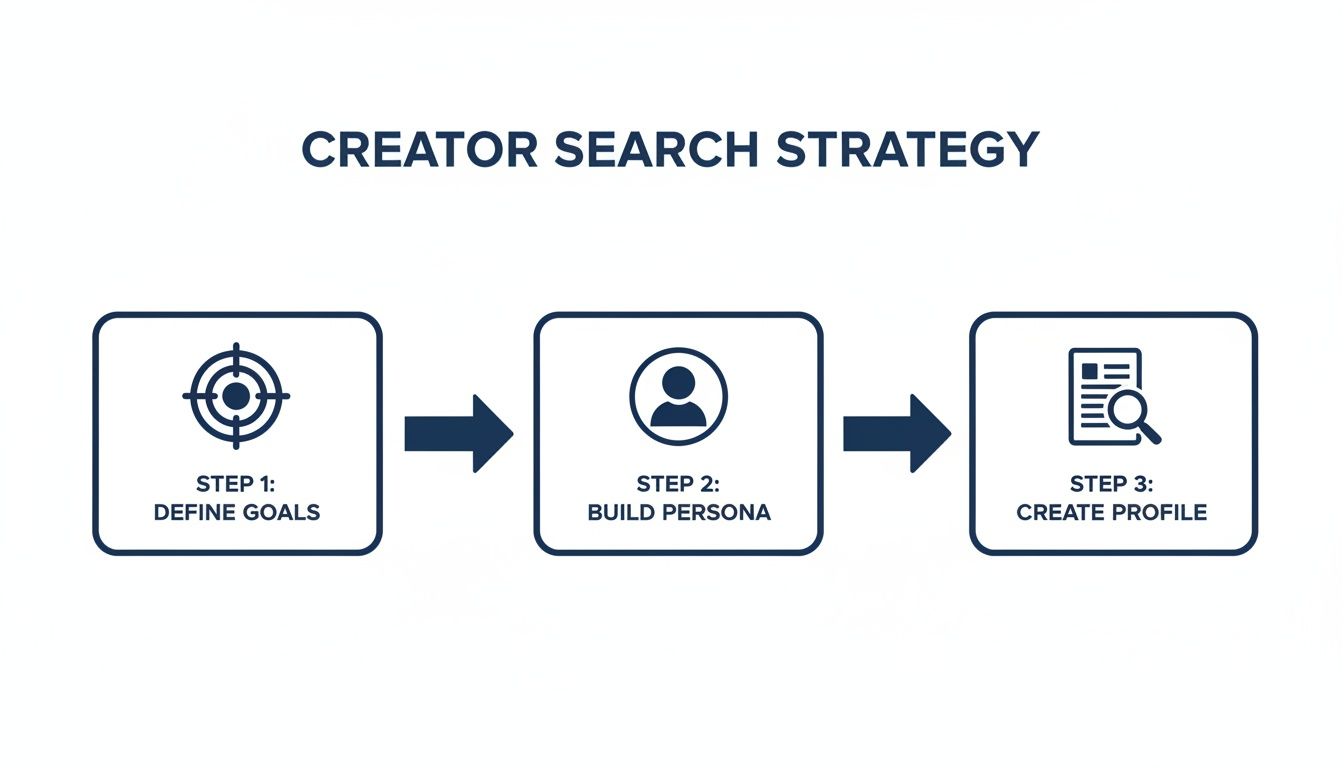
Think of these three steps—defining goals, building a persona, and creating a profile—as your North Star. Nail these, and the rest of the process becomes a whole lot easier.
Starting With Some Good Old-Fashioned Detective Work
Before I jump into any fancy tools, I always start with some manual digging. It’s the best way to get a genuine feel for the community and content landscape in your niche. It might be slower, but you often stumble upon hidden gems that automated searches can miss.
A great place to start? Your competitors. Who are they working with? Check out their sponsored videos, tagged posts, and any creators they feature. This gives you a ready-made list of potential partners who are already open to collaborations in your space.
Next, get creative with your search queries on YouTube and Google. Don't just type in broad keywords.
- Google Site Search: This is a classic for a reason. Try
site:youtube.com "your niche keyword"to zero in on relevant channels and videos. - Think Like a Customer: Search for the exact phrases your audience would use, like "best gaming mouse for Valorant" or "acne-safe skincare routine."
- Follow the Hashtags: On YouTube, searching for specific hashtags like #techtips or #travelvlog can instantly connect you with a ton of active creators.
Manual searching is your ground game. It's not about scale; it's about gaining those qualitative insights that a spreadsheet can't give you. What you learn here will make your entire strategy smarter.
Using The Right Tools to Accelerate Your Search
Manual searching is fantastic for getting started, but it won't get you very far if you need to build a real pipeline of creators. To do that efficiently, you need technology. This is where influencer discovery platforms completely change the game.
Tools like REACH Influencers are built specifically to cut through the noise. Instead of spending days scrolling, you can pull a hyper-targeted list of creators in minutes. The magic is in the filters—they let you slice and dice a massive database using the exact criteria that matter for your campaign.
Let's go back to that gaming hardware company example. Using an advanced influencer discovery tool, you could dial in your search with filters like these:
- Category: Gaming > First-Person Shooters
- Audience Location: United States, Canada, United Kingdom
- Audience Age: 18-34
- Engagement Rate: > 3%
- Keywords in Bio/Videos: "Valorant," "CSGO," "aim training," "gear review"
In seconds, you'll have a curated list of creators who are a perfect fit. This isn't just a time-saver; it’s about making smarter, data-backed decisions from day one.
YouTube Influencer Discovery Methods Compared
So, should you go manual or use a platform? The honest answer is: both. A truly effective strategy blends the personal touch of manual research with the speed and data of a dedicated tool.
Here's a quick look at how the two approaches stack up.
| Feature | Manual Search (YouTube & Google) | Influencer Platform (e.g., REACH Influencers) |
|---|---|---|
| Speed | Slow and incredibly time-consuming | Lightning-fast, building lists in minutes |
| Scalability | Almost none. It's tough to manage more than a handful of prospects | High. You can analyze thousands of creators at once |
| Data Quality | Limited to what you can see publicly, which is often incomplete | Deep analytics on audience demographics, true engagement, and growth |
| Efficiency | Very inefficient, with tons of manual vetting required | Super efficient, as creators are pre-vetted by your filters |
| Key Advantage | Gives you a true "feel" for the creator community and its culture | Provides hard data for precise, scalable, and defensible decisions |
Think of it this way: manual searching helps you understand the culture, while a platform like REACH Influencers gives you the power and data to execute at scale. The best marketers don't let technology replace their judgment—they use it to supercharge it. That combination of human insight and machine efficiency is how you master finding the perfect YouTube creators for your brand.
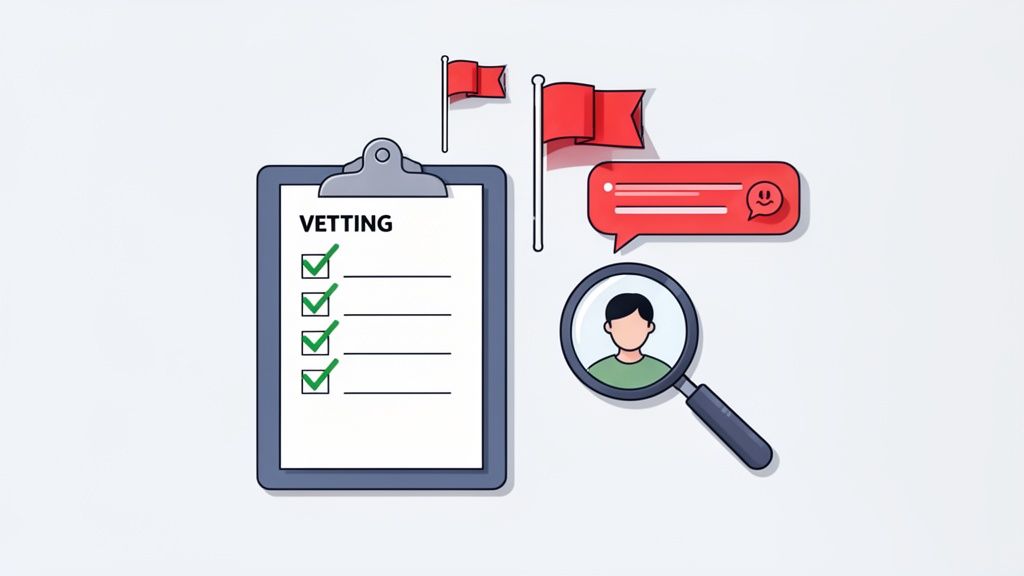
Vetting Influencers And Spotting Critical Red Flags
You've built a solid shortlist of potential partners. Now comes the make-or-break moment: the deep-dive vetting. This is where you separate the genuinely influential creators from the ones who could torch your budget or, worse, your brand's reputation.
Trust me, skipping this step is a classic rookie mistake. A creator might look perfect on paper with a massive subscriber count, but that number often hides what's really going on. Real influence isn’t a vanity metric; it’s about a creator’s authentic connection with an engaged community that actually cares what they have to say.
Looking Beyond The Subscriber Count
The first rule of vetting? Ignore the big, flashy subscriber number for a minute. While it gives you a sense of potential reach, it tells you nothing about the quality of that audience. Your focus should be on the metrics that pull back the curtain on the creator's real relationship with their followers.
This is where a dedicated platform like REACH Influencers becomes your best friend. Its analytics dashboard lets you see the data that actually matters, so you can stop guessing and start making informed decisions.
Here's what I always analyze first:
- Engagement Rate: This is your north star. A healthy engagement rate (likes + comments / subscribers) proves the audience is actively listening and participating, not just passively subscribed. If a channel has tons of subscribers but crickets in the comments, that’s a huge red flag.
- Comment Quality: Don't just count the comments—read them. Are they all generic one-liners like "Nice video!" or are they thoughtful, specific, and part of a real conversation? Genuine engagement sparks discussion and shows the content truly hits home.
- Audience Sentiment: Get a feel for the vibe in the comments section. Is it positive, supportive, and excited? A community that’s constantly negative or toxic is a community you don't want your brand anywhere near.
Identifying Dangerous Red Flags
A thorough vetting process is your brand’s best defense. You need to put on your detective hat and actively search for warning signs that signal a bad partnership is on the horizon. Ignoring these can lead to failed campaigns and a damaged reputation.
One of the newest challenges is the rise of AI-generated content, which can completely undermine authenticity. To stay ahead of this, check out this excellent guide to spotting synthetic media.
Beyond that, here are some other critical red flags to hunt for:
- Suspicious Growth Spikes: Did their channel suddenly gain 100,000 subscribers overnight? Unnatural jumps are a tell-tale sign of bought followers. A healthy channel grows steadily and organically over time.
- Generic Bot Comments: If you see a wall of identical, spammy comments, you're likely looking at an inauthentic audience. Look for real people having real conversations.
- Brand-Damaging Content: This one is non-negotiable. Dig through their past videos, social posts, and comments. Have they posted anything controversial, offensive, or just completely off-brand? A creator's history is the best predictor of their future behavior.
- Over-Saturated with Sponsorships: Is every other video a sponsored post? An audience bombarded with ads will eventually tune out. This "ad fatigue" means lower trust and worse performance for your campaign.
An influencer’s past content and audience interactions are the best predictors of your future partnership. Due diligence isn't optional—it's essential for protecting your brand and ensuring a positive ROI.
Confirming Audience Demographics
Finally, you have to confirm that the influencer’s audience is your audience. It doesn't matter if a creator has a million die-hard fans if those fans aren't the people who will ever buy your product. This is where data beats guesswork, every single time.
With a tool like REACH Influencers, you can get a precise demographic breakdown of an influencer’s audience. You’ll want to verify:
- Age and Gender: Do their primary audience segments match your target customer profile?
- Geographic Location: This is absolutely critical if you sell products or services in specific regions.
- Interests: See what other topics, creators, and brands the audience follows to make sure there's a natural alignment.
This level of detail ensures you're not just reaching people, but the right people. You can learn more about how to check for inauthentic followers and verify an audience with this free tool: https://reach-influencers.com/fake-follower-checker/.
Crafting Outreach That Actually Gets A Response
So you've found the perfect influencer. Now what? That list of names is worthless if your outreach email gets instantly deleted. The truth is, good creators are absolutely swamped with generic, copy-paste pitches every single day. If you want to even have a chance, your message needs to prove you’ve done your homework and that you see them as a creative partner, not just a walking billboard.
Forget the tired templates you find online. The real secret to getting a reply is genuine personalization. Your first message is your one shot to prove you're a real fan of their work, not just another marketer blasting out emails. A successful pitch isn't about you; it’s about them and what you can offer their audience.
The Anatomy Of A Winning Pitch
A great outreach email is short, personal, and gets right to the point. Creators are busy people. You need to grab their attention fast and state your purpose clearly without making them read a novel. After sending thousands of pitches, I've found every single successful one boils down to three key things.
First, start with a genuine connection. Don't just say "I love your channel." Mention a specific video. Reference a particular joke they made, an insightful point, or a project they recently completed. This is the fastest way to show you’re not just another bot.
Second, tell them what's in it for them (and their audience). Don’t lead with all the great things about your brand. Instead, explain why this partnership makes perfect sense for their viewers. How does your product solve a problem they talk about? Frame the whole thing as a collaboration that brings value to their community.
And finally, make it incredibly easy to say yes. End with a simple, low-effort call to action. Instead of a vague "let's connect," try asking for a quick 10-minute chat to share some ideas. Or even better, ask if they’d be open to receiving a product sample with zero strings attached.
Navigating Negotiations And Contracts
Once you get that "I'm interested" reply, the conversation shifts from creative to business. This is where you talk about the money, the deliverables, and all the nitty-gritty details. Being upfront and professional here is key to building a healthy, long-term relationship.
Compensation isn't one-size-fits-all. The right model really depends on what you're trying to achieve with the campaign:
- Flat Fee: A fixed payment for a specific deliverable, like one dedicated video. This is the most common and straightforward approach.
- Commission/Affiliate: The creator earns a percentage of sales from their unique link or discount code. This is perfect for campaigns where driving sales is the main goal.
- Hybrid Model: A combination of a smaller flat fee plus a commission. This gives the creator some guaranteed income while also incentivizing them to drive results.
The negotiation isn't just about the price tag; it's about the value. A creator with a hyper-engaged, niche audience can be way more valuable than one with millions of passive followers. Know your market rates, but be ready to explain the unique value you see in their partnership.
As soon as you’ve agreed on the compensation, get it all in writing. A clear, simple contract protects both you and the creator from any misunderstandings down the line. It doesn't have to be 50 pages of legalese, but it absolutely needs to cover:
- Scope of Work: What, exactly, are they creating? (e.g., one 60-second YouTube Short, one 10-minute dedicated review video).
- Content Usage Rights: How and where can you use the content they create? (e.g., on your website, in paid social ads). Be specific.
- Exclusivity: Is the influencer blocked from working with your direct competitors for a certain amount of time?
- Payment Schedule: How and when will they get paid?
Let's be honest—managing all these moving parts can be a nightmare, especially when you start working with multiple creators. Juggling outreach, contracts, payments, and tax forms is a full-time job in itself. This is where a platform like REACH can be a lifesaver. It puts the whole workflow in one place, handling contracts, securing payments, and ensuring you're compliant. It frees you from the administrative headaches so you can focus on what actually matters: building great relationships and running campaigns that work.
Measuring Your Success And Proving ROI
So, your campaign is officially live. The influencer's video is up, the views are rolling in, and your collaboration is out in the world. But your job isn't over just yet. This is where you figure out what actually worked and prove that your investment paid off.
Honestly, finding the right YouTube creator is only half the battle. The other, arguably more important half, is proving their work moved the needle for your business.
Linking KPIs To Your Campaign Goals
Your measurement strategy needs to circle right back to the goals you set in the very beginning. The metrics that matter for a brand awareness campaign are completely different from those for a campaign aiming to drive sales.
If you wanted awareness: Keep a close eye on Views, Impressions, and Reach. These tell you how many eyeballs landed on your brand.
If you were after engagement: You'll want to track Likes, Comments, Shares, and especially Audience Retention. Did people actually watch the video and interact with it?
If conversions were the goal: The big ones here are Click-Through Rate (CTR), Conversions (tracked with those unique UTM links you created), and Cost Per Acquisition (CPA).
This is where a dedicated platform like REACH Influencers makes life so much easier. Instead of trying to patch together data from a dozen different spreadsheets, its dashboard gives you a live look at your campaign's analytics. You can see clicks, conversions, and engagement metrics update in real-time, all in one place.
A great campaign isn't just about posting huge vanity numbers. It's about hitting the right numbers—the ones that show you achieved exactly what you set out to do.
To really get a handle on the financial impact and justify your budget, you need solid measurement tactics. This guide on how to measure marketing ROI is a fantastic resource for building a strong business case.
At the end of the day, you need to tell a clear, data-backed story that connects your spending to real business results. For a more detailed breakdown, our guide on the ROI of influencer marketing walks you through the entire process.
Got Questions? We've Got Answers
Even the most seasoned marketing pros have questions when it comes to finding the right YouTube creators. Let's tackle some of the most common ones that pop up.
Who's Better for My Campaign: Micro-Influencers or Macro-Influencers?
This is the classic "it depends" question, but the answer really hinges on what you’re trying to achieve.
Think of micro-influencers (those with 10k-100k subscribers) as trusted friends in a specific community. They tend to have sky-high engagement rates and an audience that genuinely listens to their recommendations. If your goal is to drive sales or build deep trust within a niche, they're often your best bet.
On the flip side, macro-influencers (with 100k-1M+ subscribers) are the superstars. They offer massive reach, which is perfect if you're looking to get your brand name in front of as many eyeballs as possible. A lot of successful strategies actually mix and match, using macros for broad awareness and micros to seal the deal with conversions.
What's the Real Cost of Hiring a YouTube Influencer?
The price tag can swing wildly. A small micro-influencer might just ask for a few hundred dollars for a quick mention in a video.
But if you're looking for a dedicated video from a major creator with a massive following, you could be looking at tens of thousands of dollars. It all comes down to their subscriber count, how engaged their audience is, your niche, and what you’re asking them to do.
Pro Tip: Never base your offer on subscriber count alone. A creator with 50,000 highly engaged, relevant subscribers can be far more valuable than one with 500,000 who get zero comments. Negotiate based on the value and potential ROI they bring to the table.
How Can I Actually Track Sales from a YouTube Campaign?
Guesswork won't cut it here. The easiest and most reliable way is to arm each influencer with two key tools:
- A unique, trackable link: Use a UTM link so you can see exactly how much traffic and how many sales came from their specific video in your analytics.
- A custom discount code: Something like "CREATORNAME15" gives their audience a compelling reason to buy and gives you another way to attribute sales directly to them.
Modern platforms like REACH often automate this, integrating click and conversion tracking right into your dashboard. This means you get clear, real-time data on your ROI without having to piece it all together yourself.
Ready to stop guessing and start building campaigns with the right YouTube partners? The REACH Influencers platform provides the tools you need for finding YouTube influencers, plus vetting and managing creators who deliver real results. Find your perfect influencer today.