 Skip to content


Deciding on the right influencer marketing software is a critical choice for any modern brand. When it comes to the Grin vs REACH platform comparison, the decision ultimately hinges on your core business model and operational needs. Grin has masterfully carved out a niche for large, in-house D2C brands that live and breathe e-commerce. In contrast, REACH Influencers is engineered for flexibility and scale, making it the preferred choice for marketing agencies and brands managing diverse, multi-faceted campaigns.
This guide will break down the essential differences between these two platforms. Your choice depends on a key question: do you need deep, singular integration for one brand, or a versatile, powerful platform to manage multiple clients and dynamic campaign styles? We will explore how REACH Influencers provides the comprehensive tools needed for today's complex marketing landscape.
Table of Contents
- Grin vs REACH: Which Platform is Right for You?
- Comparing Creator Discovery and Vetting
- How They Stack Up: Campaign Management and Automation
- Diving into Reporting and ROI Tracking
- Understanding Pricing Models and Total Value
- How to Choose the Right Platform for Your Brand
- Frequently Asked Questions
Grin vs REACH: Which Platform is Right for You?
Picking the right software isn't just a small decision; it directly shapes how efficiently you can run campaigns, your ROI, and how well you can scale your influencer program. Grin and REACH are two of the heavy hitters that always come up, but they're built for very different users. This guide breaks down the real-world differences in the Grin vs REACH platform comparison to help you decide, whether you're a high-growth e-commerce store, a busy marketing agency, or even a B2B company dipping your toes into creator marketing.
At their core, both platforms want to solve the same problems—finding creators, managing relationships, handling payments, and reporting on results. But how they get there is where they part ways, and those differences matter.
The Big Picture Difference
Grin has carved out a niche as the go-to creator management platform for large D2C brands. Its superpower is its deep integration with e-commerce giants like Shopify. If your world revolves around product seeding, affiliate tracking, and managing a high volume of product-centric campaigns, Grin is built from the ground up for you.
REACH Influencers, by contrast, was engineered with flexibility in mind, which is why it’s a favorite among marketing agencies and brands juggling multiple campaigns. REACH's strengths lie in its powerful, AI-driven discovery engine, its highly customizable workflows, and its white-labeling features. It’s built not just for the brand, but for the brand and its agency partners.
The real question isn't just about features. It’s about how you operate. Does your team thrive in a structured, e-commerce-first system, or do you need a more versatile platform that can bend to fit different clients and campaign goals?
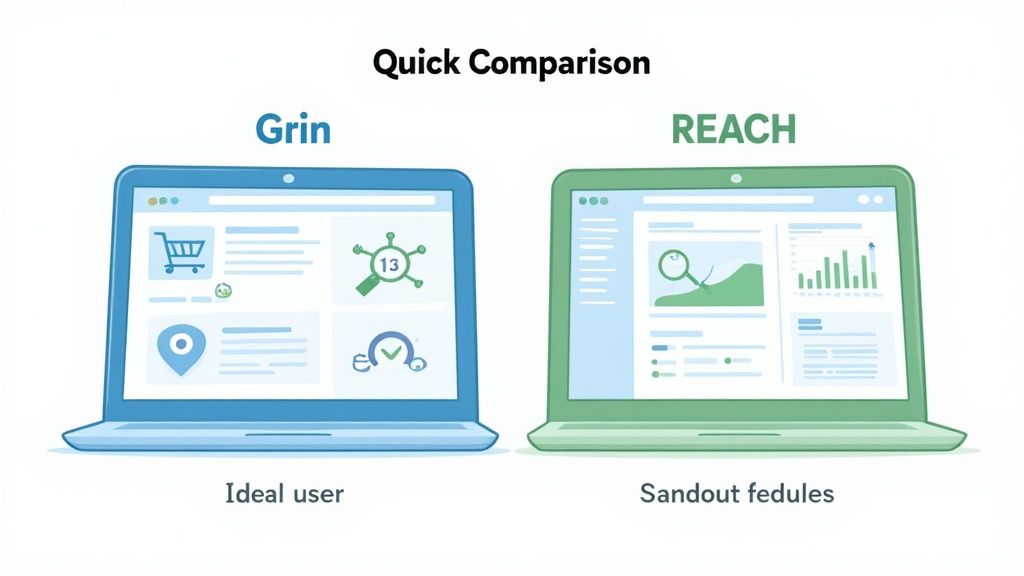
To help you see the differences at a glance, here’s a quick rundown of how they compare.
Grin vs REACH At a Glance
This table offers a high-level look at where each platform shines, giving you a quick gut check on which might be a better fit for your immediate needs.
| Attribute | Grin | REACH Influencers |
|---|---|---|
| Ideal User | Enterprise D2C brands, large in-house teams. | Marketing agencies, SMBs, multi-brand portfolios. |
| Core Strength | Deep e-commerce integration and product seeding. | Flexible campaign management and white-labeling. |
| Pricing Model | Annual contracts, typically a higher entry price. | Tiered, flexible subscriptions for scalability. |
| Discovery | Integrated social data and manual search filters. | AI-powered discovery across a massive database. |
| Standout Feature | Native Shopify and Magento integrations. | Fully customizable, white-labeled client portals. |
While this table gives you the 10,000-foot view, the devil is in the details. In the sections that follow, we’ll dive much deeper into the nuances of each platform—from creator discovery and vetting to ROI tracking—to give you the full picture you need to make the right call for your team.
A Deep Dive into the Grin vs REACH Platform Comparison: Creator Discovery
Finding the right creators is the absolute bedrock of a successful influencer campaign. The way a platform handles discovery and vetting isn't just a feature—it dictates your efficiency, the authenticity of your partnerships, and ultimately, your ROI. When you look at the Grin vs REACH platform comparison, this is where you see one of the biggest differences in their core philosophies. Grin is built to leverage the communities you already have, while REACH is all about giving you a powerful engine to explore new territory.
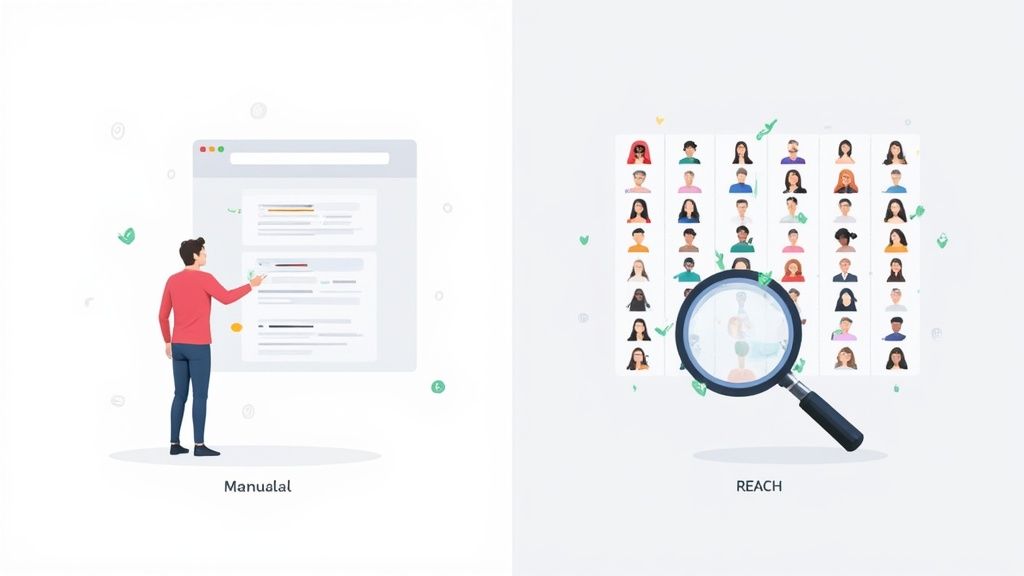
Grin’s approach feels more like a "creator management" system than a pure discovery tool. It’s fantastic for importing your existing creator lists, spotting influencers who are already talking about your brand, and searching across social platforms with some basic filters. This works wonders for big brands with established influencer relationships or companies that want to turn loyal customers into brand advocates.
REACH, on the other hand, is built around a powerful, AI-driven search engine. It’s designed from the ground up for proactive discovery, letting you search a massive, constantly updated database of creators with dozens of hyper-specific filters.
Proactive Discovery with REACH
The real power of REACH is its ability to uncover fresh talent well beyond your immediate circle. This is a game-changer for agencies and growing brands trying to crack new markets or launch campaigns that need new faces. The entire discovery process is designed for precision at scale.
Let's say a marketing agency is building a roster for a new sustainable fashion client. With REACH, they could drill down and find the perfect matches by filtering for:
- Audience Demographics: Targeting followers aged 25-40 in specific cities.
- Engagement Metrics: Looking for creators with an engagement rate over 3.5%.
- Content Keywords: Searching for niche terms like "ethical fashion" or "slow living."
- Past Collaborations: Screening out creators who have recently worked with direct competitors.
This kind of granular control cuts down on hours of manual vetting, freeing you up to focus on building relationships. You can see more of what's possible with the REACH influencer discovery tool.
Grin’s Integrated Search and Curation
Grin really shines when a brand’s strategy revolves around its e-commerce ecosystem. Its discovery tools are tightly woven into platforms like Shopify, which is brilliant for identifying influential customers who already buy and love your products. You can easily find creators who have tagged your brand or used your hashtags, effectively turning your social mentions into a recruitment pipeline.
This is a fantastic workflow for established D2C brands that get a lot of user-generated content and brand love. The catch is that for brands looking to expand beyond their existing audience, this approach can feel a bit reactive and limited compared to a dedicated discovery engine.
The core difference is one of scope. Grin helps you manage and activate the creator world you already know. REACH helps you explore the entire creator world to find the perfect partners you don't know yet.
While both platforms are heavy hitters, GRIN is well-known for its deep integrations and ability to scale, especially for large D2C and eCommerce brands. Since launching in 2014, GRIN has powered campaigns for over 800 enterprise brands, including big names like Tula Skincare and Sanrio. They've reported an average ROI of 11x, according to 2023 internal studies, which really speaks to how well it performs in its niche. REACH, in contrast, offers a much broader discovery toolkit.
So, which is better? It really depends on your starting line. If you're sitting on a huge, engaged customer base and want to turn them into ambassadors, Grin's integrated system is incredibly powerful. But if you’re an agency or a brand that constantly needs to find new, highly-vetted talent for a variety of campaigns, the proactive and data-rich discovery engine from REACH gives you a clear advantage.
How They Stack Up: Campaign Management and Automation
Once you've found your creators, the real work begins. The day-to-day grind of running a campaign is what makes or breaks a platform, and how it handles tasks, approvals, and communication will dictate your team's sanity and efficiency. When comparing Grin vs. REACH, this is where you see two very different philosophies at play: Grin’s structured, almost assembly-line approach versus REACH’s highly adaptable framework.
Grin is built around a very methodical, project-based system. It’s perfect for big brands that are running high-volume, repeatable campaigns—think massive product seeding initiatives or always-on affiliate programs. The workflows are clean and linear, walking you through predefined steps that guarantee nothing gets missed when you're working at scale.
REACH Influencers, on the other hand, was designed with flexibility at its core. Its campaign modules are highly customizable, which is a lifesaver for agencies juggling different clients or brands with a diverse campaign mix. You’re not forced into one way of working. Instead, you can build a completely bespoke process for a one-off product launch and a totally different one for a long-term ambassador program.
Grin’s Structured Campaign Execution
Grin truly shines in any environment where standardization is the name of the game. If you're an e-commerce brand shipping hundreds of products a month, its system is a godsend. It ensures every single influencer gets the right brief, ticks all the boxes, and submits content on time. Everything—from assets to messages—is neatly centralized in a project dashboard.
The flip side is that this structure can feel a bit restrictive if your campaigns need room to breathe. An agency trying to pivot a campaign mid-stream for a client or manage several unique projects with different approval stages might find themselves looking for workarounds. Grin is all about executing a proven formula efficiently, over and over again.
REACH’s Flexible and Automated Workflows
REACH was built from the ground up to handle variety and claw back time with smart automation. The campaign modules are anything but one-size-fits-all. An agency, for instance, can set up a complex campaign for a beauty client with multi-stage video approvals, while running a much simpler, image-based campaign for a food brand—all from the same dashboard without any friction.
This flexibility really comes to life in its communication tools. One of REACH's standout features is its automated follow-up sequences. Think about all the time spent chasing creators for drafts or revised posts. With REACH, you can set up automated email and in-app nudges that trigger based on deadlines, saving your team countless hours of tedious admin work every single week. You can see just how much time influencer marketing automation can give back to your team.
Here's the bottom line: Grin gives you a highly efficient assembly line for standardized campaigns. REACH gives you a versatile workshop where you can build any kind of campaign you can imagine with custom tools and powerful automation.
Drilling down into the Grin vs. REACH platform comparison, user satisfaction and feature depth tell a story. Grin often leads the pack for its target user base, holding an impressive 4.7/5 rating on GetApp from over 2,000 reviews. Much of this praise comes from its AI-driven outreach, which can automate up to 80% of email communications and reportedly boost response rates by 35%, according to their 2024 case studies.
While REACH gets a lot of love for its accessibility for smaller businesses, Grin’s enterprise-grade tools are hard to ignore. Features like custom tagging and hyper-efficient UGC approval workflows are built to help teams managing over 100 influencers slash approval times from days down to hours.
Ultimately, the right choice for campaign management comes down to how you operate. If your influencer program is built on scalable, repeatable processes, Grin’s structured system is a massive advantage. But if you need agility, deep customization, and smart automation to manage a variety of campaigns, REACH Influencers offers a more dynamic and efficient solution.
Reporting and ROI Tracking in the Grin vs REACH Platform Comparison
When it comes to measuring the success of an influencer campaign, you need more than just raw data. You need insights. In the Grin vs REACH platform comparison, how each platform handles reporting and ROI tracking really shows what they're built for. Grin is fantastic at connecting influencer content directly to sales, while REACH gives you a much broader, more complete picture of a campaign's total impact.
Grin's reporting tools are a dream for any direct-to-consumer brand. It's built around deep, native e-commerce integrations with platforms like Shopify. This makes it incredibly good at direct sales attribution through things like affiliate links and custom discount codes. If your number one goal is to know exactly how much revenue an influencer drove, Grin gives you a straight line to that answer.
REACH Influencers, on the other hand, is built on the idea that ROI is about more than just sales. It delivers comprehensive, multi-channel performance dashboards that track a much wider range of metrics. This holistic view is essential for brands and agencies who need to understand the full value of their campaigns, from awareness to conversion.
REACH’s Multi-Faceted Performance Analytics
REACH gives you the whole story by tracking key performance indicators that a sales-only model might miss. This is especially important for campaigns where the main goal is brand awareness, community growth, or breaking into a new market.
Some of the key metrics you'll find in REACH include:
- Earned Media Value (EMV): This calculates what it would have cost to get the same organic reach and engagement through paid ads.
- Engagement Rates: You get a deep dive into likes, comments, shares, and saves across every platform, showing you how well the content is connecting with the audience.
- Audience Sentiment: The platform monitors the tone of conversations around your brand, helping you understand how people feel about your campaign.
- Reach and Impressions: It tracks the total visibility of your content, so you know exactly how many eyeballs you're reaching.
This multi-metric approach gives you a much richer, more nuanced view of performance. Learning how to measure influencer marketing ROI with a mix of these data points is crucial for proving the value of your work and justifying the investment.
Customization and Agency-Focused Reporting
Another major difference is how much you can customize your reports. This is where REACH really stands out, especially for marketing agencies. The platform lets you generate completely custom, white-labeled reports that you can tailor for any client presentation. You could create a high-level executive summary for the CEO and a super-detailed, metric-by-metric breakdown for the marketing manager, all from the same campaign data.
Grin gives you a precise sales receipt for your influencer spend. REACH gives you a comprehensive performance review that covers sales, brand health, and audience engagement, all in one customizable dashboard.
Recent data really highlights these different philosophies. In 2025, Grin users saw 28% better performance tracking through Shopify and PayPal links, with brands attributing $5.2 million in sales just from product seeding in Q1. At the same time, REACH's strength is its tight alignment with key social metrics, like the 3.5% average Instagram reach rate. Grin, however, adds a layer of security by flagging 12% of suspicious creators with its fraud detection tools before a contract is even signed.
Ultimately, REACH’s real-time analytics let you be more agile. Imagine you notice mid-campaign that an influencer's content is getting tons of engagement but not many clicks. With REACH's dashboard, you can pivot immediately and ask the creator to tweak their call-to-action on the next post to drive more traffic. This ability to optimize on the fly—which is covered in more detail in our guide on how to measure influencer marketing ROI—is a powerful advantage that Grin’s more rigid, sales-focused reporting doesn’t quite offer.
Understanding Pricing Models and Total Value
When you're comparing platforms like in this Grin vs REACH platform comparison, it’s easy to get stuck on the price tag. But that's only part of the story. To really understand the financial commitment, you have to look at the pricing model, the contract terms, and what you’re actually getting for your money. Grin and REACH come at this from completely different places, which makes sense given who they're built for.
Grin is structured like a classic enterprise software. Think annual contracts and a significant investment upfront. This is built for big, established D2C brands that have a predictable, high-volume influencer program and the budget to support it. It gives them stability and deep integrations for a long-term, e-commerce-focused strategy.
REACH Influencers, on the other hand, is all about flexibility. It uses a tiered pricing model that’s designed to scale with you. This works for everyone from a small business just getting started to a large agency juggling multiple clients. You can begin with a plan that fits where you are now and upgrade as your program grows. For businesses with unpredictable campaign needs, this adaptability is a huge plus.
Analyzing the Total Cost of Ownership
It’s about more than just the subscription fee. You have to consider the total value—what you get back in efficiency and results. A lower monthly payment looks great on paper, but if your team ends up spending hours on manual tasks or running less effective campaigns, you're not actually saving money.
-
Grin's Value Proposition: That high price tag is all about its deep, native e-commerce integrations. The Shopify integration is a standout—praised by 92% of users in recent Capterra reviews—because it provides direct sales attribution. Brands have reported up to a 30% boost in conversions from this feature alone. If direct sales tracking is your north star metric, this specialized function can deliver a very clear return on investment. You can dig into more platform comparison insights on Influencer-Hero.com.
-
REACH's Value Proposition: The value here comes from its flexibility and the sheer amount of time it saves. An agency can run unlimited client campaigns from a single dashboard and spit out white-label reports without breaking a sweat. That kind of operational efficiency is money in the bank, boosting profit margins and freeing up your team to focus on strategy, not busywork.
The real financial question isn’t just about the upfront cost; it's about the return. Grin is a high-cost, high-return play laser-focused on e-commerce sales. REACH offers a flexible, scalable model that delivers value through efficiency and broad performance tracking.
Contract Terms and Scalability
Don't forget to look at the contract length. Grin's annual commitments mean you're locked in, which can be a real problem if your business strategy needs to change quickly.
REACH offers more flexible subscription terms, giving you an easier out and the freedom to change your plan as your needs evolve. For a growing brand or a fast-moving agency, that kind of agility is often worth more than the locked-in features of an enterprise contract. It ensures you’re only ever paying for what you actually use.
How to Choose the Right Platform for Your Brand
So, when it comes to the Grin vs REACH platform comparison, how do you make the final call? It really boils down to matching the platform's strengths to your unique business goals and workflow. Just like you'd spend time on an in-depth ecommerce platform comparison, figuring out how to choose the right platform for influencer marketing is a critical move. Get it right, and you supercharge your team's efficiency; get it wrong, and you'll struggle to scale or even prove ROI.
This simple decision tree can help you get started, focusing on your budget and need for flexibility.
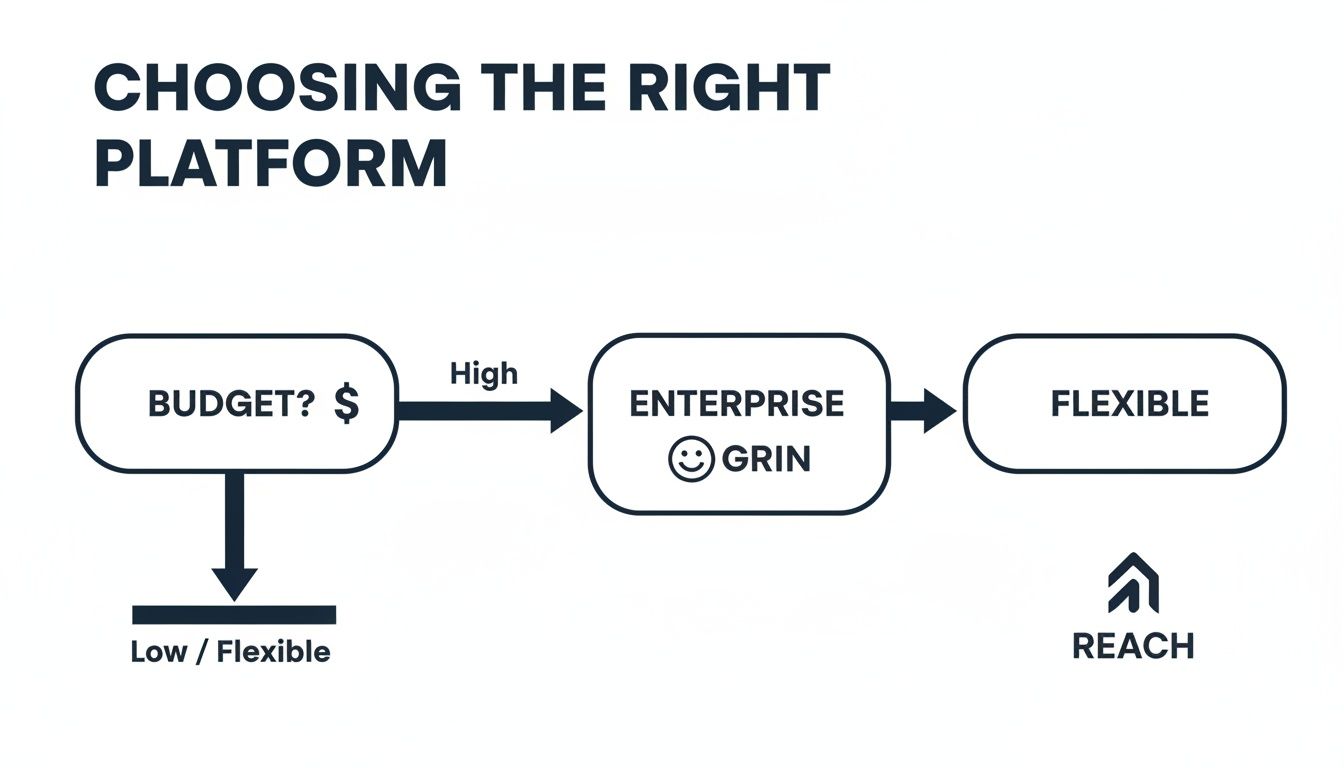
As you can see, enterprise-level budgets and a tight focus on e-commerce often point to Grin. On the other hand, if you need a tool that can bend and grow with you, REACH is probably where you'll land.
Recommendations for D2C Ecommerce Brands
If you're a large D2C brand living and breathing on platforms like Shopify, Grin was practically made for you. Its deep, native e-commerce integrations are its killer feature, giving you direct sales attribution that's hard to beat. If your number one KPI is tracking influencer-generated revenue, Grin is your workhorse. It’s built to manage high-volume product seeding and affiliate campaigns with maximum efficiency.
Here's a telling stat: In North America, brands using Grin execute 86% of their planned creator partnerships through the platform. This focus on long-term relationships helps them achieve a 4x higher lifetime value from their micro-influencers.
But what if your D2C brand needs more than just sales tracking? If you require more agile campaign management or want a broader look at ROI, including metrics like brand awareness and engagement, then REACH Influencers is a very strong alternative. It gives you a more complete picture of your brand's impact.
Recommendations for Marketing Agencies
For marketing agencies, the choice is much more straightforward. REACH Influencers is the clear winner here. The entire platform is built from the ground up to support the way agencies work.
Here’s why it’s the go-to choice for agencies:
- White-Label Capabilities: You can present fully branded client portals and reports. This reinforces your agency's value and looks incredibly professional.
- Multi-Client Management: Juggling multiple clients is a breeze. You can manage everything from a single dashboard without ever worrying about data getting mixed up.
- Flexible Campaign Modules: Whether you’re running a B2B thought leadership campaign or a consumer product launch, you can design totally custom campaigns for each client.
Grin’s model is just too rigid and brand-centric. It simply can’t offer the adaptability and client-facing tools that REACH provides, making it a frustrating and inefficient option for the fast-paced agency world.
Recommendations for B2B Companies
B2B influencer marketing is a completely different ballgame. It’s all about building long-term relationships, establishing thought leadership, and tracking qualitative metrics—not just making direct sales. This is where Grin’s e-commerce focus makes it a poor fit.
REACH Influencers, however, is perfectly suited for B2B. Its powerful discovery engine helps you find true industry experts, keynote speakers, and niche content creators. Even better, its relationship management tools help you nurture those crucial partnerships. The platform’s ability to track metrics like share of voice and audience sentiment gives B2B marketers the exact kind of qualitative data they need to prove a campaign was a success.
Recommendation Matrix: Grin vs REACH
To make things as simple as possible, this matrix breaks down which platform is likely the best fit for your business based on your main goal.
| Business Type | Primary Goal | Recommended Platform |
|---|---|---|
| D2C E-commerce Brand | Direct Sales Attribution & Product Seeding | Grin |
| Marketing Agency | Client Management & Campaign Flexibility | REACH |
| B2B Company | Thought Leadership & Expert Relations | REACH |
| SMB/Startup | Scalable Growth & Budget Flexibility | REACH |
While Grin is an absolute powerhouse in its e-commerce niche, REACH emerges as the more versatile and powerful solution for the majority of modern marketing needs. Its flexibility means a much wider range of businesses can build and measure truly impactful influencer campaigns.
Frequently Asked Questions
When you're comparing two heavy-hitters like Grin and REACH, a lot of specific questions tend to pop up. Let's tackle some of the most common ones we hear from marketing teams to help you get the clarity you need.
What’s the Biggest Difference Between Grin and REACH for an Agency?
For agencies, it really boils down to flexibility and how the platform is built to serve your clients. REACH Influencers was designed from the ground up for agencies, which you can feel in features like white-label reporting and multi-client dashboards. Being able to log in once and manage everything for different clients is a massive time-saver.
Grin is a fantastic tool, no doubt, but its DNA is rooted in serving in-house brand teams, especially those deep in the e-commerce world. That focus can make it a bit rigid when you're juggling a diverse client roster, each with its own goals and reporting needs.
How Difficult Is Migrating from Grin to REACH?
The thought of switching platforms can be daunting, but the move from Grin to REACH is surprisingly straightforward. The REACH Influencers team provides dedicated onboarding support, which means they're right there with you, helping to import your creator lists, campaign histories, and all that valuable content you've already collected.
Of course, any migration takes a bit of planning. But REACH's specialists work hand-in-hand with you to make the transition as seamless as possible. The aim is to get you back to running campaigns fast, without losing momentum or data in the process.
Does REACH Offer the Same E-commerce Integration as Grin?
This is a great question. Grin is famous for its deep, native integration with Shopify, and it does that very well. REACH takes a slightly different approach by offering versatile ROI tracking that works for a much wider range of business models, not just Shopify stores. The platform is excellent at tracking performance through affiliate links, custom coupon codes, and by plugging into major analytics tools.
REACH is more about giving you a complete picture of your campaign's impact. It tracks direct sales, sure, but it also measures crucial metrics like earned media value (EMV) and real-time engagement, which tells a much richer story about your influencer marketing success.
Can Small Businesses Afford a Platform Like REACH or Grin?
Yes, they can, and this is a huge point of difference between the two. REACH Influencers is built to be scalable. It has flexible pricing plans designed to be accessible for small businesses and startups just getting their footing. You can start with a plan that makes sense for your budget right now and grow into it as your program takes off.
Grin, on the other hand, is typically positioned for more established, enterprise-level brands that have larger, more predictable budgets and can commit to an annual contract. For a growing business, REACH is often a much more practical and financially friendly way to get professional-grade tools without a huge upfront investment.
This detailed Grin vs REACH platform comparison shows that while Grin excels in its e-commerce niche, REACH Influencers offers a more versatile, scalable, and agency-friendly solution for the diverse needs of modern marketing. Its powerful discovery, flexible campaign management, and comprehensive reporting make it the superior choice for businesses looking to grow and adapt.
Ready to see how a flexible, agency-first platform can transform your influencer marketing? REACH Influencers provides the tools you need to discover perfect creators, automate campaigns, and prove your ROI with stunning, white-labeled reports. Book a demo today and discover a smarter way to manage your campaigns.