 Skip to content


Tired of throwing money at influencer campaigns and just hoping for the best? Let's stop guessing and start measuring the real, tangible return on your investment.
Measuring influencer marketing ROI is all about connecting the dots between your spending and your business outcomes. It’s a straightforward process: set clear goals, track the right data—like actual sales or qualified leads—and then run the numbers to see what’s working and what isn't.
Stop Guessing Your Influencer Marketing ROI

Before we get into formulas, let's be clear on why this matters so much. This isn't just about making your marketing budget look good. It's about making every dollar work harder for you.
When you have solid data, you can finally see which influencers are genuinely moving the needle and which are just delivering vanity metrics. This knowledge is power. It lets you negotiate better deals, double down on what works, and prove to your boss that influencer marketing isn't just an expense—it's a serious revenue driver.
The Measurement Challenge is Real
The influencer marketing world is exploding. We're talking about an industry projected to hit $32.55 billion by 2025, and over 80% of marketers swear by its effectiveness. Yet, there’s a catch. A surprising 32% of marketers admit that measuring performance is their biggest obstacle. It's clear a lot of brands are still in the dark.
So, where's the disconnect? From what I've seen, it usually boils down to a few common missteps:
- Chasing vanity metrics: Getting distracted by likes and follower counts instead of focusing on what impacts the bottom line.
- Poor tracking: Not using the right tools for the job, like UTM parameters, affiliate links, or unique discount codes.
- Vague goals: Kicking off a campaign without first defining what success actually looks like.
The core of measuring influencer ROI isn't about complex algorithms. It's about a strategic mindset shift—viewing every campaign as a measurable investment with a clear, expected return.
For instance, one way people can use REACH Influencers to measure influencer marketing ROI is by using the link tracking feature to measure how many website clicks each of their influencers generate on their campaigns. This provides undeniable attribution data.
If you’re ready to move from guessing games to data-backed decisions, you’ll find further tips on measuring influencer marketing ROI a great next step. Adopting this strategic approach is what separates basic reporting from true performance optimization.
Defining What Success Actually Looks Like
Before you can even begin to talk about ROI, you have to get crystal clear on what the “R”—the return—actually means for your brand. A lot of marketers jump into campaigns with vague goals like "boost awareness" or "drive sales." That’s like starting a road trip without a destination. You'll definitely spend money on gas, but you'll have no idea if you're getting any closer to where you want to go.
To do this right, you have to translate those big-picture business objectives into sharp, specific campaign goals. Success isn't just about racking up likes and comments; it’s about hitting the targets that move the needle for your business.
From Vague Aims to Concrete Targets
Let's get practical. Instead of saying you want to "increase sales," a well-defined goal sounds more like this: "Achieve a 4:1 ROAS by generating 300 sales via influencer promo codes in Q3." See the difference? This target is specific, measurable, achievable, relevant, and time-bound (SMART), giving you a clear yardstick to measure performance.
It's the same story for "awareness" campaigns. Don't just hope for exposure. A much stronger goal is: "Increase our share of voice by 15% and generate 2 million impressions among our target demographic within the next 60 days." This approach turns a fuzzy concept into a tangible outcome you can actually track.
This step is everything. It dictates the influencers you choose, the content you create, and, most importantly, the metrics you'll obsess over. Without clear goals, you’re just collecting data for the sake of it. If you want to dig deeper, this guide on what success looks like in influencer marketing is a great place to start.
Don't fall into the trap of measuring everything and understanding nothing. Your campaign goals are your filter. They help you focus only on the data that tells you whether you're winning or losing.
Aligning Goals with the Marketing Funnel
Your objectives will naturally shift depending on which part of the customer journey you’re targeting. The real magic happens when you tie your goals to a specific stage of the marketing funnel—it ensures your entire measurement strategy lines up perfectly with what you’re trying to achieve.
Here’s a quick breakdown of how that looks in the real world:
-
Top of Funnel (Awareness): It’s all about getting your name out there. Your goal might be to reach 500,000 unique users in a new market or hit a specific video view count to introduce your brand to a cold audience.
-
Middle of Funnel (Consideration): At this point, you're trying to build interest and get people to engage. A solid goal could be driving 5,000 clicks to a key product page or capturing 1,000 new email subscribers with an influencer-promoted download.
-
Bottom of Funnel (Conversion): This is where the money is made. Your goals should be laser-focused on action, like generating $25,000 in revenue from affiliate links or hitting a 5% conversion rate on traffic from an influencer's posts.
When you define success with this kind of precision from day one, you build a clear roadmap for your campaign. Every dollar spent and every metric tracked has a purpose, which means your final ROI calculation won't be a vague guess—it will be a true measure of your campaign's impact.
Choosing Metrics That Truly Matter
Once your goals are locked in, you need to pick the right yardstick to measure them. It's so easy to get dazzled by a huge spike in "likes" or a ballooning follower count. But let's be honest—those are vanity metrics. They look great on a report, but they rarely tell the whole story or contribute to your bottom line.
The real secret is to shift your focus to action metrics. These are the data points that show genuine customer intent and track how people are moving through your marketing funnel. They connect the dots between your campaign objectives and real, measurable results.
Matching KPIs to Your Funnel
The metrics you watch like a hawk should change based on what you're trying to achieve. Are you building awareness? Driving consideration? Or going straight for the sale? Aligning your Key Performance Indicators (KPIs) with the marketing funnel is crucial for measuring what actually matters at each stage.
-
Top-of-Funnel (Awareness): If you just want to get your brand name out there, your KPIs need to reflect that exposure. Look at metrics like reach (how many unique people saw the content) and impressions (how many times the content was shown). Things like video views and brand mentions are also gold here.
-
Mid-Funnel (Consideration): This is where you start to see who’s genuinely interested. You're looking for signs of active engagement. Key metrics to track are click-through rate (CTR), landing page visits, and email sign-ups. This is the bridge between someone just seeing your brand and actually interacting with it.
-
Bottom-of-Funnel (Conversion): Now we're talking about money. This is where ROI gets crystal clear. You need to focus on the hard numbers: conversion rate, sales revenue tracked via promo codes, and your cost per acquisition (CPA). These KPIs tie an influencer's post directly to your revenue.
I see it all the time: a brand uses a top-of-funnel metric like impressions to judge a bottom-of-funnel sales campaign. That’s a classic mistake. Always make sure your KPIs are a direct reflection of your specific campaign goal.
Introducing Earned Media Value
Beyond the direct clicks and sales, there's another powerful way to quantify your campaign's impact: Earned Media Value (EMV).
Think of it this way: EMV puts a price tag on the organic buzz you got from an influencer. It answers the question, "If we had to pay for this same exposure through traditional ads, what would it have cost us?"
EMV is a fantastic way to standardize the value of your campaign's reach and engagement, especially for awareness-focused goals. While it isn't a direct sales figure, it’s a compelling way to show the ROI of getting people talking about your brand. Understanding your most important influencer marketing KPIs is fundamental to proving the value of your efforts.
When you have the right metrics, you have data-driven proof of success. And the data for influencer marketing is compelling; studies consistently show that businesses earn an average ROI of $6.50 for every $1 spent. This incredible potential is only realized when you track everything—engagement, conversions, sales—and have a clear line of sight into what's working.
Your Toolkit for Accurate Performance Tracking
You can't measure what you don't track. Before a single dollar is spent on your campaign, you need to have the right infrastructure in place to catch every click, code, and conversion. This isn't just about gathering numbers; it’s about building a clear, undeniable trail from an influencer’s content straight back to your business goals.
If you skip this step, you’re flying blind. Sure, you might see a bump in sales, but you'll have no concrete proof of where it came from. That makes it impossible to learn, optimize, or justify your budget for the next campaign. Getting your tracking right is the most critical part of the entire ROI equation.
Building Your Attribution Framework
The secret to solid attribution is giving each influencer a unique identifier. This is how you isolate their specific impact from all your other marketing channels—and even from the other influencers in the same campaign. Think of it as giving each creator their own digital fingerprint.
Here are the must-have tools for the job:
-
UTM Parameters: These are simple tags you tack onto the end of a URL. By creating a unique UTM link for each influencer, you can jump into Google Analytics and see exactly how much traffic they sent your way, which pages their audience visited, and how long they stuck around.
-
Unique Discount Codes: This is probably the most direct way to track sales. A code like "SARAH20" instantly tells your e-commerce system that any purchase using it came directly from Sarah’s promotion. It’s clean, simple, and incredibly effective.
-
Dedicated Landing Pages: For bigger campaigns or top-tier partners, sending an influencer's audience to a custom landing page is a fantastic strategy. This completely isolates their traffic, letting you analyze behavior and conversion rates without any noise from other sources.
Proper tracking setup is non-negotiable. It’s the difference between having a vague feeling that a campaign worked and knowing with certainty that an influencer generated a 5.5x return on your investment.
Of course, dedicated platforms can make this whole process a lot easier. For instance, brands using REACH Influencers often rely on its built-in link tracking feature to see exactly how many website clicks each creator generates for a campaign.
This dashboard from REACH Influencers gives you a clean, at-a-glance view of clicks and engagement for every creator.
Having this data all in one place makes it dead simple to compare performance and spot who your real rockstars are.
Integrating Your Tracking Tools
Your tracking tools shouldn't live on separate islands. The real magic happens when you integrate them into a cohesive system that paints a complete performance picture. Your influencer platform needs to talk to your analytics and e-commerce software.
For example, when a follower uses an influencer's unique discount code, your Shopify or Magento store should log that sale. That data should then flow back into your central dashboard, where you can see revenue sitting right next to the click and engagement metrics for that specific creator.
This kind of integration cuts out the soul-crushing manual data entry and gives you real-time insights. If you're aiming to build a system like this, it's worth exploring different marketing dashboard tools to find one that can centralize all your analytics. A unified view is absolutely essential for making smart, data-backed decisions about where your budget will make the biggest splash.
The Formulas for Calculating Your True ROI
Alright, you've set your goals and have your tracking systems fired up. Now comes the moment of truth: connecting the dots to figure out what you actually got back from your campaign. The good news is that the math isn't as scary as you might think.
The classic formula for ROI is refreshingly simple, but it tells you everything you need to know about a campaign's profitability.
The standard formula is: (Profit – Investment) / Investment * 100
This equation gives you a clean percentage. If it's a positive number, you're in the black. If it's negative, the campaign was a loss. Let's dig into what really goes into the "Profit" and "Investment" parts so you can calculate this with confidence.
Accurately Calculating Your Total Investment
First things first, let's talk about the "Investment" piece. This is where a lot of brands trip up. It's not just about the check you cut for the influencer. To get a real, honest look at your ROI, you have to account for every single cost associated with the campaign. Miss a few hidden expenses, and you'll end up with a wildly inflated ROI that doesn't reflect reality.
Your total investment should include a full picture of your spending:
- Influencer Fees: The most obvious one—the direct payment for their work.
- Product Seeding Costs: Don't forget the retail value of any freebies you sent over. It’s not a "free" cost to your business.
- Shipping and Handling: The money it took to get that product into the creator's hands.
- Team Management Time: This is crucial. Estimate the cost of your team's hours spent on outreach, negotiations, content approvals, and overall campaign wrangling.
- Software and Tool Costs: If you're using an influencer marketing platform, attribute a portion of that subscription fee to the campaign.
Getting this right hinges on having a solid system for capturing every dollar. It’s worth exploring strategies for tracking business expenses effectively to make sure your financial data is spot-on from the start.
This whole process relies on the tracking methods we discussed earlier—like UTM links, unique promo codes, and custom landing pages—to feed accurate data into your ROI calculation.
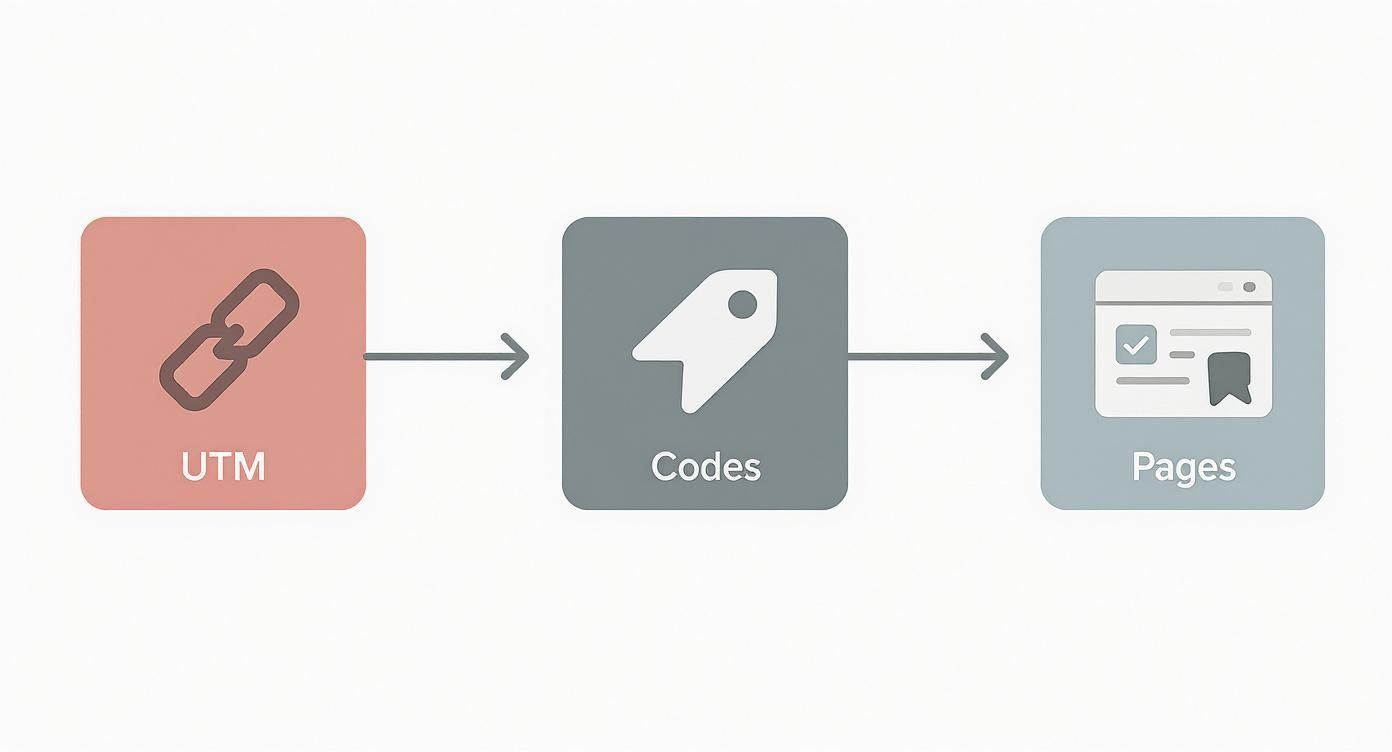
When you assign a distinct tracking method to each influencer, you can pinpoint exactly where every sale and every click came from. No more guesswork.
A Real-World ROI Calculation Example
Let's make this tangible with an example. Picture an e-commerce skincare brand running a campaign.
They paid an influencer a $1,000 fee. On top of that, they sent $150 worth of products and spent $20 on shipping. The marketing manager spent about five hours on the campaign, which the company values at $250 of their time.
So, the Total Investment = $1,000 (fee) + $150 (product) + $20 (shipping) + $250 (time) = $1,420.
Now for the return. The influencer’s unique discount code drove $7,500 in total sales. Let’s say the brand’s profit margin on its products is 60%. That means their actual profit from those sales is $4,500.
Time to plug it all into the formula:
- ROI = ($4,500 – $1,420) / $1,420 * 100
- ROI = $3,080 / $1,420 * 100
- ROI = 216.9%
What does this tell us? For every single dollar they invested in this campaign, they generated $2.17 in pure profit. Now that is a powerful, defensible number you can take to your next budget meeting.
Measuring the ROI of influencer marketing is crucial for understanding its effectiveness. The average ROI is $5.20 for every $1 spent, but this varies widely. E-commerce brands with strong tracking often see returns from 6 to 10 times their investment. Dive into more 2025 data on influencer marketing ROI trends.
Common Questions About Measuring ROI
Even with the best formulas at your fingertips, you're going to hit a few snags when you start digging into the data. It's just part of the process. Knowing how to measure influencer marketing ROI often means troubleshooting a few common hurdles.
Think of this as your quick-reference guide for those tricky questions that always seem to pop up. We'll tackle everything from tracking fuzzy awareness goals to figuring out what a "good" return actually looks like for your brand.
How Do I Measure ROI for an Awareness Campaign with No Direct Sales?
This is a big one. When your goal isn't ringing the cash register, your whole measurement approach has to change. For awareness campaigns, you need to pivot from sales data to metrics that signal brand growth and audience engagement.
Instead of hunting for conversions, keep a close eye on KPIs like:
- Impressions and Reach: How many eyeballs saw the content, and how many times did they see it? This is your baseline for exposure.
- Video Completion Rates: This is gold. A high completion rate tells you the audience was genuinely hooked by the content, not just scrolling past.
- Shifts in Brand Sentiment: Are people saying good things? Dig into the comments and mentions to gauge whether the conversation around your brand is getting more positive.
A great way to put a number on this is by calculating Earned Media Value (EMV). This metric assigns a dollar value to the organic exposure you gained, essentially asking, "What would this have cost us if we'd paid for it through traditional ads?" It's a fantastic way to translate brand lift into a figure your CFO will understand.
What Is a Good ROI for Influencer Marketing?
You'll see reports throwing around an industry average of $5 to $6 for every $1 spent, but honestly, a "good" ROI is completely relative. It depends entirely on your business goals, your industry, and especially your profit margins. A 10:1 return might be the benchmark for a company selling high-margin software, while a 3:1 return could be a massive win for a subscription box brand that knows the real profit comes from long-term customer value.
The most useful benchmark isn't some industry-wide average; it's your own performance. If your influencer marketing ROI is outperforming your paid social ads or other channels, you're heading in the right direction.
How Long Should I Wait Before Measuring the Final ROI?
I know you want to see the results now, but with ROI, patience is non-negotiable. The right time to measure is directly linked to your customer's typical buying cycle. If you jump the gun, you'll get a skewed, incomplete picture of your campaign's real impact.
Think about it: for a fast-moving consumer good like a snack food, a 7 to 14-day window probably captures most of the sales. But for a higher-ticket item like a mattress or a piece of software, you'll need to extend that to a 30 or even 60-day window to catch all the delayed purchases.
You can (and should) watch leading indicators like clicks and add-to-carts in real-time. But don't you dare calculate that final ROI number until your full attribution window has officially closed.
Ready to stop guessing and start getting clear, actionable data from your campaigns? REACH provides an all-in-one platform with advanced discovery tools and a centralized dashboard to track performance, prove ROI, and scale your influencer marketing with confidence. Find out how REACH can supercharge your influencer strategy.