 Skip to content


Finding the right influencer isn't about getting a quick shout-out. It's about finding a genuine partner for your brand. The real magic happens when you identify creators whose values and audience perfectly mirror your own, turning a simple promotion into a relationship that builds trust and lasts. This alignment is the key to unlocking authentic engagement and seeing real results.
Why the Right Influencer Changes Everything
We live in a world saturated with ads, and people have gotten incredibly good at ignoring them. They're looking for authenticity, which is exactly where a well-chosen influencer partnership comes in. The right creator is a trusted voice, bridging the gap between your brand and a loyal community that truly listens to what they have to say.
This is so much more than a transaction. It’s about building a real connection. When an influencer genuinely believes in your product, their endorsement feels less like a commercial and more like an enthusiastic recommendation from a good friend. You just can't buy that kind of authenticity, and it’s what converts passive scrollers into loyal customers.
The Power of Authentic Alignment
Think about it. What’s the difference between a generic, one-off post and a meaningful collaboration? A simple shout-out might give you a brief traffic spike, but it rarely builds any lasting loyalty. On the other hand, a partnership built on shared values connects with an audience on a much deeper level.
Imagine a sustainable fashion brand teaming up with an influencer known for their eco-conscious lifestyle. It just makes sense. The audience already trusts that influencer’s take on ethical products, so the endorsement feels natural and completely credible. That’s the "secret sauce" that drives not just initial sales, but long-term brand fans.
To really see how influencer marketing fits in, it helps to understand its place in the bigger picture of digital marketing for beginners.
The goal is to shift your mindset from simply 'finding influencers' to strategically building partnerships that become a cornerstone of your marketing efforts. An aligned partnership is an investment in your brand's reputation and future growth.
The Growing Importance of Influencer Partnerships
The explosive growth of this industry really hammers home the need for smart selection. The global influencer marketing market is on track to hit $32.55 billion by 2025—a massive sign of just how effective it is.
With over 80% of marketers saying it’s a successful strategy, the conversation has changed. It's no longer if you should work with influencers, but how you can find the right ones to make sure your investment truly delivers. For more stats on this, check out the insights on thunderbit.com.
Before you even think about typing a keyword into a search bar, you need to pause and ask a critical question: Who are we actually looking for?
Jumping straight into influencer discovery without a clear plan is a surefire way to get lost. It's like wandering through a massive city trying to find "someone" without a name, a photo, or even a description. You need a blueprint. That’s where building an ideal influencer persona comes in—it’s not just a vague idea, but a detailed profile that will guide every single decision you make from here on out.
The process mirrors how you’d define your ideal customer. In fact, knowing how to identify your target audience is the prerequisite here. The influencer you partner with is the bridge to your customers, so their audience should be a near-perfect reflection of your own.
Defining Key Characteristics
Let's get one thing straight: follower count is not the place to start. While reach matters, it’s a vanity metric if the audience isn't right. Instead, your focus should be on the qualitative traits that signal a genuine, authentic brand fit.
Imagine we're a clean skincare brand. We're not just looking for anyone with a good camera. We're looking for a specific type of creator.
Here's what our ideal influencer persona would include:
- Content Aesthetic: We need someone with a clean, bright, and natural visual style. Think minimalist, authentic, and real—no heavy filters or overly produced shots that feel disconnected from our brand’s down-to-earth ethos.
- Audience Psychographics: Their followers aren't just looking for another skincare product. They’re deeply invested in ingredient transparency, sustainability, and holistic wellness. These are people who read labels, follow eco-conscious creators, and value educational content over the latest flashy trend.
- Platform Expertise: Our ideal partner lives on Instagram and TikTok. These are visual-first platforms where product demos and storytelling thrive. They need to be a pro at creating compelling Reels and informative TikToks that can break down the science behind our ingredients in a way that’s easy to digest.
Defining these characteristics sharpens our focus immediately. We can instantly weed out creators whose style is too glam, whose audience is just chasing discounts, or who don't have a feel for educational content. This is how you find partners who drive real results, not just temporary buzz.
Your influencer persona is your North Star. It keeps you from getting distracted by popularity contests and ensures you're finding partners who truly embody your brand’s soul and can connect with the community you want to build.
To make this process more concrete, laying out the key elements in a structured way can be incredibly helpful. This ensures everyone on your team is on the same page.
Here is a table summarizing the essential criteria to define for your influencer profile:
| Criteria | Description | Example (Skincare Brand) |
|---|---|---|
| Content Aesthetic & Tone | The visual style, voice, and overall vibe of their content. | "Clean, minimalist, natural lighting. Tone is educational but approachable, like a knowledgeable friend." |
| Audience Demographics | Age, gender, location, and other quantifiable data of their followers. | "Primarily females aged 25-40 in the US, Canada, and Western Europe. Urban/suburban dwellers." |
| Audience Psychographics | The interests, values, beliefs, and lifestyles of their followers. | "Health-conscious, values sustainability and ingredient transparency, interested in wellness and self-care." |
| Key Platforms | Where they have the most engaged and relevant audience. | "Instagram (Reels, Stories) and TikTok (short-form educational videos). Minor presence on YouTube for deep dives." |
| Engagement Quality | The nature of the comments and conversations on their posts. | "Comments are thoughtful questions about ingredients or personal experiences, not just emojis or giveaway entries." |
| Brand Values Alignment | Do their personal and professional values match your brand’s mission? | "Must be a vocal advocate for cruelty-free products and sustainable living. No partnerships with fast-fashion." |
This table serves as a quick reference, a checklist that makes the vetting process much more efficient and objective.
Putting It All Together
Once you've fleshed out these details, put them into a simple, shareable document. This isn't just a mental exercise—it's a practical tool that keeps your whole team aligned.
This persona is closely related to the profiles you build for your customers. For a deeper dive into that, check out our guide on how to create buyer personas. A well-defined influencer profile saves an incredible amount of time and money by making sure everyone knows exactly who they’re looking for and, just as importantly, who to pass on.
Finding Influencers Who Actually Move the Needle
Alright, you’ve got a solid picture of your ideal influencer in your head. Now, let's get out of the theoretical and into the real world of finding them. Forget the endless, aimless scrolling—that's a surefire way to burn out. The real secret is using smart, targeted methods to uncover partners who can genuinely connect with your audience.
This isn't just about finding someone who looks the part. It's about finding alignment across their aesthetic, their audience, and the platform they've mastered. When those three things click, that's where the magic happens.
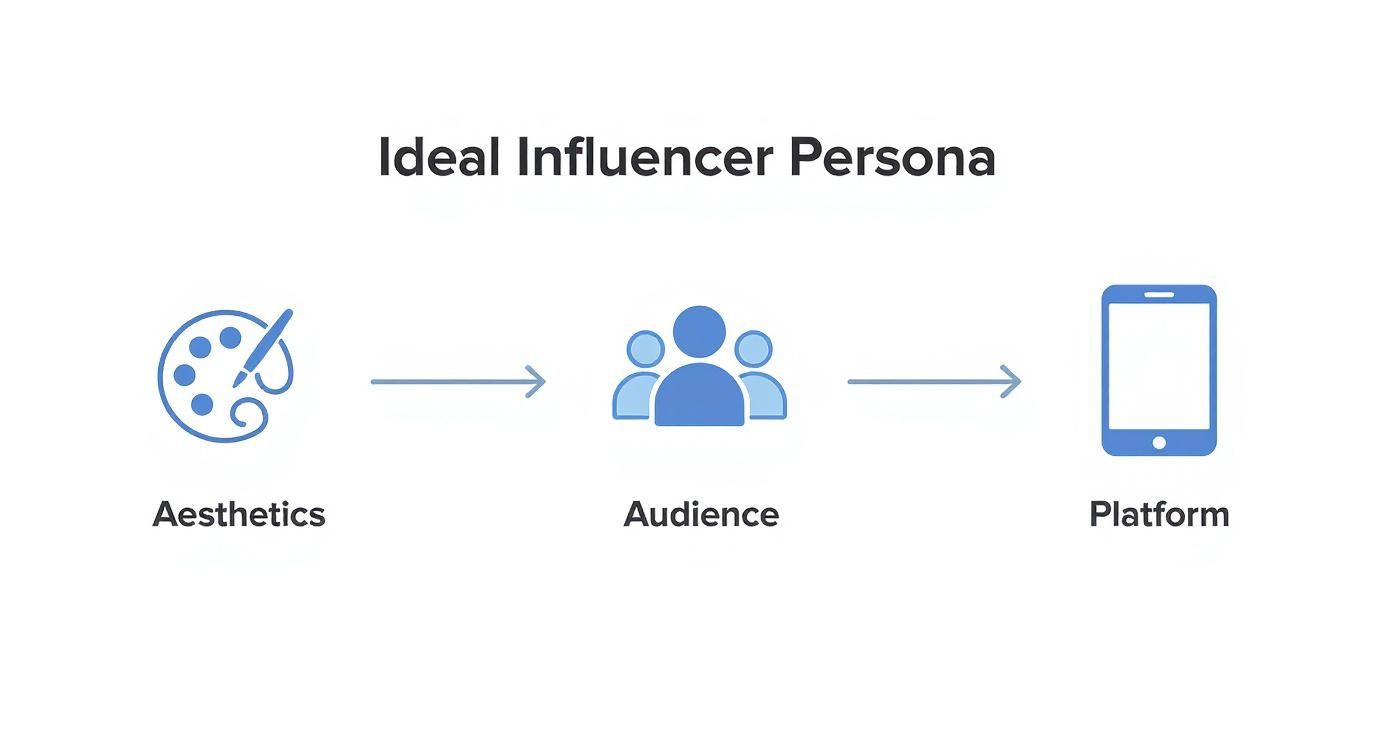
As you can see, a successful partnership depends on that perfect overlap of visual style, community relevance, and platform expertise. Let's dig into how you can find creators who check all those boxes.
Uncover Hidden Gems in Your Own Backyard
Honestly, one of the most powerful and overlooked places to find influencers is right under your nose. Your current customers, followers, and brand fans are a goldmine of potential advocates. These are people who already get it—they use your products, they love what you do, and their recommendations come from a truly authentic place.
Start by digging into your own brand mentions, tagged posts, and even the comment sections on your content. You’ll likely be surprised to find micro-influencers with super-engaged communities who are already singing your praises. A partnership that blossoms from an existing, organic relationship? That’s the good stuff.
If you want to take it a step further, consider using social listening for influencer discovery. This lets you monitor conversations happening across the web about your brand and industry, helping you pinpoint influential voices you would have otherwise completely missed.
Master the Art of Hashtag and Keyword Searching
This might sound a bit basic, but a strategic search on Instagram or TikTok can work wonders. The trick is to think way beyond the obvious, broad terms. Just searching for #fitness is going to get you nowhere fast. You need to get specific.
- Niche Hashtags: Try combinations that reflect a real community, like
#veganproteinrecipesor#homeworkoutsforbeginners. These narrower terms attract creators who have built specialized, dedicated audiences. - Location-Specific Tags: If you're a local business, this is a must. Searching for tags like
#dallasfoodbloggeror#nycfashioncreatorwill connect you with influential people right in your own community. - Action-Oriented Keywords: On TikTok, think about what people actually type into the search bar. Phrases like "how to style a trench coat" or "best clean beauty products" will bring up creators who make the practical, helpful content that motivates people to buy.
A rookie mistake is to stop after finding one good creator. Once you find someone promising, dive into their world. Look at who they collaborate with, who’s consistently commenting on their posts, and who Instagram or TikTok suggests as similar accounts. This "spiderweb" technique is my favorite way to quickly uncover an entire ecosystem of relevant creators.
Analyze Your Competitors' Collaborations
Why not let your competitors do some of the initial legwork for you? Seriously, analyzing who they’re partnering with can give you a ton of insight into what’s working in your niche. Check out their tagged photos and look for posts with #ad or #sponsored to see which creators they've paid to work with.
But don't just copy their roster. Use their activity as a launchpad for your own deep-dive.
- Evaluate Performance: How did the audience actually react to the collaboration? Was the engagement genuine, or did it feel flat and forced? The comments section never lies.
- Find "Lookalike" Influencers: If a competitor's partner seems like a perfect fit but is out of your budget (or already taken), use their profile to find similar creators. The platform's algorithm is surprisingly good at suggesting other creators with a comparable style and audience.
This isn’t just about finding potential partners; it’s about getting a real-time benchmark for the kind of content and creators that are truly resonating in your market right now.
Leverage Dedicated Discovery Platforms
Look, manual searching works, but it can be a massive time sink. This is where dedicated influencer discovery platforms like REACH completely change the game. They’re built to fast-track your search with powerful, data-driven tools that would be impossible to replicate by hand.
These platforms essentially give you a massive, searchable database of creators that you can slice and dice with filters that actually matter to your brand.
For example, you can instantly narrow your search using criteria like:
- Audience Demographics: Filter creators based on their audience's age, location, gender, and interests to make sure you’re hitting your target customer.
- Engagement Metrics: Go way beyond vanity metrics like follower count. Find creators with genuinely high engagement rates and audience authenticity scores.
- Content Keywords: Search for influencers who consistently post about specific topics, products, or phrases that are central to your industry.
Using a purpose-built platform turns your search from a frustrating guessing game into a precise, efficient strategy. It saves you countless hours and connects you directly with a pool of pre-vetted professionals who are ready to collaborate.
How to Vet Influencers and Spot Red Flags
Alright, you've used the discovery tools and have a solid list of potential influencers. This is where the real work begins. It’s tempting to get excited by a huge follower count, but trust me, those numbers can be incredibly deceiving. Skipping a thorough vetting process is the fastest way to a failed campaign.
Now you have to put on your detective hat. The goal is to move past the surface-level metrics and figure out if a creator's community is not just large, but real, active, and genuinely trusts what they have to say.
Analyzing Audience Authenticity
First things first: you need to sniff out fake followers and inflated engagement. It’s an unfortunate reality of the industry. Bot accounts can make a creator look way more popular than they are, but they bring absolutely zero value to your brand.
A massive, overnight spike in their follower growth is a huge red flag—it almost always means they bought them. Another dead giveaway is a lopsided follower-to-engagement ratio. An account with 100,000 followers that only gets a few dozen likes and a handful of generic, emoji-only comments? Something’s not right there.
Genuine engagement looks like a conversation. You'll see real questions, thoughtful replies, and back-and-forth between the creator and their audience. If you want a more data-driven look, you can always use a reliable fake follower checker to get a clearer picture of who you're dealing with.
Don't get distracted by vanity metrics. I'd take a micro-influencer with a super-loyal community of 10,000 over a macro-influencer with a million disinterested or fake followers any day of the week. Real influence is built on trust, not just numbers.
Scrutinizing Content and Past Partnerships
An influencer's feed is their resume. What you see is what you’ll get, so it pays to scroll deep into their history to get a feel for their work. Does their vibe and aesthetic actually match your brand? And just as importantly, how do they handle their sponsored posts?
Here’s a quick mental checklist I run through:
- How do their ads feel? Do sponsored posts stick out like a sore thumb, or do they weave them into their content naturally? The best creators make a partnership feel like a genuine recommendation from a friend.
- Who else have they worked with? Check if they’ve recently promoted a direct competitor. Partnering with someone who was shouting out your biggest rival last month will just confuse their audience and dilute your message.
- What does their audience say? The comments section on sponsored posts is a goldmine of information. Are people receptive and asking questions, or are they calling the influencer a "sellout"? The comments rarely lie.
Confirming Audience-Brand Fit
This last part is crucial. Even if an influencer is 100% authentic with an engaged audience, it means nothing if that audience isn't your target customer. A mismatch here is like buying a billboard in a town where none of your customers live—you're just wasting money.
Many influencers have media kits with audience data, but you can also find this with third-party tools. You need to make sure you have alignment on the essentials:
- Age and Gender
- Geographic Location (especially critical for local businesses)
- Interests and Behaviors
I know this level of digging can feel tedious, but it’s the single most important part of setting your campaign up for success. It's what separates a partnership that drives real results from one that just burns through your budget.
Crafting Outreach That Gets a Response
Alright, you’ve found the perfect creators. Now for the hard part: actually getting them to reply. Top-tier influencers are swimming in DMs and emails from brands, so your message needs to do more than just show up. It has to stand out.
If you’re just blasting out a generic, copy-pasted template, you might as well not send anything at all. Creators can spot that stuff from a mile away, and it’s an instant red flag that you don’t really care about what they do. You’ve got to show them you’re a fan first, a brand second.
Go Deeper Than Just Their Name
True personalization is way more than dropping {{first_name}} into a template. It's about proving you've actually watched their stuff and get what they're about.
Kick off your message with a specific reference to a piece of their content that genuinely resonated with you. It shows you’ve put in the time.
For example, skip the generic "I love your content!" and try something like, "I just watched your video on sustainable morning routines—that tip about reusing coffee grounds was genius. It’s obvious your audience trusts you for real, practical advice like that." See the difference? That small detail instantly builds rapport.
That initial connection changes the entire dynamic. It’s no longer a cold pitch; it’s a warm conversation starter.
A genuine, specific compliment is your foot in the door. It tells the creator you see them as an individual artist, not just a number on a spreadsheet.
Spell Out the Value Prop—No Vague Offers
Once you've broken the ice, get right to the point. Creators are running a business, and their time is valuable. Ambiguous lines like "we'd love to collab" just create extra work for them.
Be upfront and clear about what you're offering and—most importantly—what’s in it for them. Is it a paid post? Are you gifting a product? Is it an affiliate deal? Don't be shy about mentioning money. In fact, a recent report found that 59% of influencers prefer working with brands that are transparent about budgets from the very first message.
Let’s look at a quick before-and-after.
The Vague Pitch (Don't do this):
"Hey, we're a new skincare brand and we'd love to work with you!"
The Clear Pitch (Much better):
"We're launching a new Vitamin C serum and would love to offer you a paid partnership of $500 for one Instagram Reel and three Stories. Your audience's focus on science-backed skincare makes you a perfect fit."
This kind of clarity respects their time and lets them immediately see if the partnership makes sense. When you give them all the key details upfront, you make it so much easier for them to say yes.
Common Questions About Finding Influencers
Once you start digging into the world of influencer marketing, the practical questions start popping up pretty fast. Moving from a long list of potential names to actually reaching out and striking a deal brings its own set of challenges. Let's walk through some of the most common hurdles I see brands run into.
How Do You Figure Out Fair Pay?
Ah, the money question. There’s no simple, one-size-fits-all answer here, and honestly, that’s a good thing. Influencer rates are all over the map, and they depend on everything from their niche and follower count to engagement stats and the type of content you’re asking for.
While it’s smart to look up industry benchmarks to get a ballpark idea, think of them as just a starting point.
The best way to handle it? Just ask. Most experienced creators have a media kit ready to go, spelling out their standard rates for things like an Instagram Reel, a dedicated YouTube video, or a set of Stories. If they don’t, go into the conversation with a clear budget in mind. And remember, it's not always about cash. The total value can include the product you're sending, an affiliate commission setup, or the potential for a long-term brand ambassadorship.
What’s the Real Difference Between Influencer Tiers?
The main distinction between nano, micro, and macro-influencers is simply their audience size. But that one difference has a ripple effect on everything from their reach and engagement to the kind of relationship they have with their followers. Each tier is useful, but for very different reasons.
- Nano-Influencers (1K-10K followers): Think of these as the hyper-local experts. They have small but incredibly tight-knit communities and often have the highest engagement rates because they know their followers personally.
- Micro-Influencers (10K-100K followers): For many brands, this is the sweet spot. They have a sizable, dedicated audience within a specific niche and are known for being authentic and trustworthy.
- Macro-Influencers (100K-1M+ followers): These are the big names—established creators, public figures, or even celebrities. Their massive reach makes them a great choice if your goal is pure, widespread brand awareness.
Nano-influencers, in particular, have become a quiet powerhouse for brands that need to hit a very specific target audience. The data backs this up: in 2024, they accounted for a whopping 75.9% of the entire influencer pool on Instagram. You can dive deeper into these influencer marketing benchmarks to see just how much they’re shaping the industry.
My best advice? Don't just chase the biggest follower count. A well-vetted micro-influencer with a genuinely loyal following in your niche will almost always deliver better results than a macro-influencer with a broad, disengaged audience.
What if an Influencer Just Doesn’t Reply?
First off, don't take it personally. Silence is just part of the outreach game. The most sought-after creators get dozens, sometimes hundreds, of pitches a day. It’s totally fine to send a polite, professional follow-up about a week after your first message.
If you still get radio silence after that? It’s time to move on. Their lack of response could mean anything: your offer wasn’t the right fit, their plate is full, or your email just got buried. Respect their silence and turn your attention back to the other great candidates on your list.
Ready to stop searching and start connecting? REACH’s discovery engine and campaign management tools make finding the perfect influencers for your brand simple and effective. Find your ideal partners today.