 Skip to content


Getting people to click your link is all about making it the most compelling option they see. It really comes down to crafting headlines that are too good to ignore, writing meta descriptions that scream "this is the answer," and using structured data to make your search result pop.
When you nail this, your CTR goes up. That’s a direct signal to search engines that people find your stuff valuable, which can lead to better rankings and, you guessed it, more traffic.
Why a High Click-Through Rate Is So Important
Think of your CTR as more than just a number; it's a conversation starter. It's that first nod of approval from a potential customer, a clear sign that your message cut through all the digital noise and grabbed their attention.
This initial handshake has a major ripple effect. For search engines like Google, a high CTR is a huge vote of confidence. It tells them your page is a highly relevant answer to what someone is looking for. This can directly boost your search rankings, creating a fantastic feedback loop: better rankings mean more visibility, which naturally leads to an even higher CTR. It’s a cornerstone of any solid SEO strategy.
The Business Impact of CTR
Beyond just organic search, CTR is a powerhouse in your paid campaigns. On platforms like Google Ads, a higher CTR is a key ingredient for a better Quality Score.
A strong Quality Score is your ticket to a more efficient ad spend. Google rewards you with lower costs-per-click (CPC) and better ad placements. You get better results without having to throw more money at it.
Ultimately, CTR is one of the most vital digital marketing performance metrics because it directly connects your content to your bottom line. It shows you how well you really understand your audience.
A consistently low CTR is a red flag, signaling a clear disconnect between what you’re offering and what your audience actually wants. By focusing on improving your click-through rate, you're not just chasing a number—you're sharpening your message, building a stronger brand, and creating a much more efficient way to bring in new customers.
Before we dive into the nitty-gritty of how to do this, here’s a quick snapshot of the key areas we’ll be focusing on. Think of these as the main levers you can pull for the biggest impact.
Key Levers for Boosting CTR: A Quick Overview
| Focus Area | Primary Action | Expected Impact |
|---|---|---|
| Headlines & Titles | Craft emotionally resonant and curiosity-driven headlines. | Grabs immediate attention and increases initial click impulse. |
| Meta Descriptions | Write compelling, benefit-focused summaries of your page. | Provides context and a clear reason to choose your link over others. |
| Structured Data | Implement schema markup for rich snippets (reviews, FAQs, etc.). | Makes your search result visually stand out and provides more info. |
| URL Structure | Create clean, descriptive, and keyword-rich URLs. | Builds trust and gives users a clear idea of the page content. |
Each of these areas offers a powerful opportunity to convince a user that your link is the one worth clicking. Let's break down the specific strategies for each.
Make Your SERP Listing Impossible to Ignore

Long before anyone ever sees your beautifully designed website, they see your entry on a search engine results page (SERP). It’s a crowded battlefield, and you’re just one of a dozen blue links fighting for attention. This is your one shot to convince a searcher that your page has the answer they're looking for.
Think of your SERP listing as your digital storefront. A generic title and description is like a dusty, forgotten window display. But a well-crafted one? That’s the magnetic showcase that pulls people right in off the street.
Craft Titles That Beg to Be Clicked
Your title tag is the single most important piece of real estate you own on the SERP. It does all the heavy lifting in about 60 characters. Simply stuffing it with keywords isn't going to cut it anymore.
To really make your title stand out, you have to get inside the user's head and trigger a response—whether that's curiosity, urgency, or a sense of value. I've seen these techniques work time and time again:
- Lead with Numbers: Our brains love numbers. They promise a clear, structured, and easy-to-digest answer. "11 Actionable Ways to Improve CTR" just feels more tangible than "How to Improve CTR."
- Use Power Words: Words that pack an emotional punch—like "Ultimate," "Effortless," "Proven," or "Essential"—can seriously boost clicks. They promise a real result.
- Ask a Question: A title like, "Are You Making These Common SEO Mistakes?" is a direct challenge. It engages the reader and makes them want to click to find out the answer.
- Create a Curiosity Gap: Hint at a solution without giving it all away. "The One SERP Feature Most Marketers Ignore" creates an irresistible urge to discover the secret.
The goal is to make your title more than just a label. It needs to be a compelling promise of what the searcher gets when they click. A great title makes clicking feel like the obvious next move.
Write Meta Descriptions That Seal the Deal
Yes, Google rewrites meta descriptions a lot these days. But when yours does show up, it can be your secret weapon. You have about 160 characters to deliver a knockout elevator pitch that reinforces your killer title.
Your meta description should be a mini-advertisement for your page. Don't just summarize what's there; sell the benefit. Answer the user's unspoken question: "What's in it for me?"
Let’s look at an example for a post on email marketing:
- The Weak Version: "This article discusses email marketing. We cover topics like subject lines, open rates, and calls to action. Learn about email marketing here." (Boring, right?)
- The Strong Version: "Unlock proven strategies to double your open rates. Learn to write irresistible subject lines and CTAs that actually convert. Get our top tips for immediate results."
See the difference? The second one is active, it promises a tangible outcome ("double your open rates"), and it uses persuasive language. It does the selling for you.
Dominate with Rich Snippets and Structured Data
If you really want to stand out, you have to move beyond the standard blue link. That’s where structured data (or Schema markup) comes in. It’s a bit of code you add to your site that tells search engines exactly what your content is about.
When you do this, Google might reward you with "rich snippets"—those eye-catching, enhanced search results that are impossible to miss.
These can take many forms, including:
- Review Stars: An average star rating appears right under your title, giving you instant social proof and building trust before the click.
- FAQ Snippets: A dropdown of common questions and answers can appear under your listing, taking up more SERP real estate and addressing user pain points immediately.
- How-To Snippets: For the right kind of query, you can get step-by-step instructions displayed directly in the results, positioning you as the go-to expert.
Implementing structured data makes your listing bigger, more informative, and far more visually appealing. It’s not just about getting more clicks; it's about getting better-qualified clicks from people who know exactly what they’re about to find.
Of course, none of this matters if you're buried on page five. Getting a top rank is still fundamental. Recent data confirms that sites in the #1 spot on desktop saw a major CTR increase. In the Education sector, for example, the top position hit a massive 45.35% CTR. Real Estate saw a 2.73 percentage point jump for its top-ranking sites. These numbers prove that ranking high is still one of the most powerful levers for engagement. You can discover more insights from the latest CTR study to see how your industry stacks up.
Developing a Content Strategy That Drives Clicks

A killer SERP appearance gets you the first click, but it's your content that makes them stay. If a user lands on your page and it doesn't immediately solve the problem promised in your title, they're hitting the back button. That bounce sends a clear, negative signal to Google: your content missed the mark.
To truly master how to improve click through rates, your content strategy needs to be laser-focused on user expectations from the very start. The goal is to create something so relevant and valuable that clicking feels like the obvious next step.
Go Beyond Keywords to Uncover User Intent
Keyword research is still your foundation, but just targeting high-volume terms won't cut it anymore. You have to get into your user's head and understand the why behind their search. What problem are they trying to fix? What's the one answer they're desperate to find? That's user intent.
For instance, someone searching for "best running shoes" is in buying mode. They're looking for comparisons, reviews, and pricing. A technical spec sheet is going to fall flat. On the other hand, a search for "how to clean running shoes" is purely informational—that person just wants a fast, actionable guide.
When your headline and meta description perfectly reflect the value on the page, your CTR improves because you're not just making a promise; you're delivering on it instantly.
A great way to do this is to simply look at the top-ranking pages for your keywords. Are they listicles? In-depth guides? Videos? The SERP is literally showing you what kind of content Google already knows satisfies that specific query.
Structure Content for Instant Gratification
The second a user clicks your link, a timer starts. You have mere moments to convince them they made the right choice. Don't waste that time with a long, rambling intro that buries the answer they came for.
An effective content structure is all about clarity and making your page easy to scan. Here's how to deliver that immediate payoff:
- Use the Inverted Pyramid Method: Get straight to the point. Put the most important information—the direct answer to their question—right at the top. You can always add detail and context further down the page.
- Lean on Subheadings and Lists: Break up your text with clear, descriptive H3s and H4s. Bullets and numbered lists are perfect for making complex information digestible at a glance.
- Incorporate Visuals: Images, charts, and videos do more than just break up walls of text; they illustrate your points. For visual-heavy platforms, you can find inspiration from these proven strategies to boost your Pinterest appeal and apply similar concepts.
This approach shows you respect the user's time. In return, they're more likely to stick around, signaling positive engagement to search engines. For a complete rundown on building a solid foundation, take a look at our guide on content marketing best practices.
Integrate AI to Scale Smartly
Let's be real: creating high-quality, intent-driven content day in and day out is a huge lift. This is where AI becomes an incredible partner, not to replace your creativity, but to amplify it. Today, about 66% of businesses use AI for content ideation or drafting to get an edge in their SEO.
Here’s how AI can help you move faster:
- Brainstorm Topic Clusters: Quickly generate hundreds of related subtopics and long-tail keywords.
- Create Detailed Outlines: Structure articles with a logical flow and comprehensive subheadings in minutes.
- Analyze the Competition: Instantly see common themes and content gaps in the top-ranking articles.
- Refine Existing Content: Get suggestions to improve clarity, tone, and overall SEO.
Content is still king when it comes to improving click-through rates. Organic search drives around 53% of all website traffic, and the $90 billion market for SEO services proves it. Businesses that blog consistently see 55% more visitors and get 434% more pages indexed, creating massive opportunities for clicks. By weaving AI into a smart SEO framework, you can scale your content production without sacrificing the quality that builds trust and boosts CTR.
How to Squeeze More Clicks Out of Your Paid Ad Campaigns
While getting your organic results in order is crucial, your paid ads on platforms like Google Ads and social media are where you can really pull some levers to see an immediate impact on your click-through rate. Winning here isn't just about having the biggest budget. It’s about crafting a message that’s so relevant and hits so close to home that your ideal customer can't resist clicking.
This means you have to ditch the generic ad copy and start speaking directly to the problems and desires of your audience. A high CTR in paid search does more than just stroke your ego; it directly boosts your Quality Score. A better Quality Score can mean lower ad costs and more prominent ad placements. It’s a direct signal to Google that you’re giving searchers exactly what they want.
Writing Ad Copy That Actually Gets Clicked
Your headline is your first—and maybe only—chance to grab someone's attention. It has to be a perfect marriage of what they just typed into the search bar and a clear benefit. For instance, if someone is looking for "waterproof running jackets," a headline like "Stay Dry on Every Run" will always beat a generic "Shop Running Jackets."
The description is where you close the deal. This is your space to handle any objections, call out the best features, and maybe create a little urgency.
- Hit the Pain Point: Acknowledge the problem they’re facing right away. "Tired of getting soaked on your morning jog?"
- Present Your Solution: Clearly explain how you solve that problem. "Our StormGuard jackets offer 100% waterproof protection."
- Push for Action: Tell them what to do next with a strong call-to-action (CTA). "Shop Now & Get Free Shipping" is direct and adds a nice little incentive.
This approach creates a quick story that takes the user from their problem straight to your solution, making a click the most logical next step.
The Underused Power of Ad Extensions
Ad extensions are your secret weapon for taking up more space on the search results page and seriously boosting your CTR. Think of them as free, powerful upgrades for your ads. They add extra, helpful information that makes your ad bigger, more useful, and far more tempting to click.
I've seen firsthand how using a few relevant ad extensions can make a night-and-day difference in performance. By giving people more info and direct links to specific pages, you're removing friction and making your ad the obvious choice.
Imagine a local bakery running an ad. They could use:
- Sitelink Extensions: To add direct links for "Wedding Cakes," "Birthday Parties," and "Daily Menu."
- Location Extensions: To show their address and map, which is a lifesaver for people searching on their phones.
- Call Extensions: To add a clickable phone number so customers can call right from the ad.
- Price Extensions: To list specific prices like "Cupcakes: $3.50."
Each of these gives a searcher one more reason to pick your ad over a competitor’s, often leading to a double-digit jump in CTR.
Fine-Tuning Your Ads with Testing and Targeting
Never just assume you know what will work. The real key to unlocking a higher CTR is relentless A/B testing. Test everything—headlines, descriptions, CTAs, even the little display URL. A tiny change, like swapping "Buy Now" for "Get Yours Today," can have a surprisingly big impact.
Beyond just the words you use, sharp audience segmentation is a game-changer. Don't show the same ad to every single person. Split your audience up based on demographics, their past behavior (retargeting is huge here), or their interests. A user who left something in their shopping cart needs a very different message than a first-time visitor.
When you tailor your ads to specific segments, you guarantee they're as relevant as possible, and relevance is what drives high click-through rates. To really go deep on this, check out this excellent Google Ads campaign optimization playbook.
This targeted approach not only lifts your CTR but also improves your return on ad spend (ROAS). You’re putting your money to work more effectively by focusing only on the people most likely to become customers. It also helps to understand the calculation of CPM and other cost metrics, as a better CTR almost always leads to a healthier cost structure for your whole campaign.
Adapting to AI Search and Zero Click Results
The ground is shifting beneath our feet. For years, the goal was simple: get to the top of the search results page. But now, with AI-powered search and the rise of "zero-click" results, just being visible isn't enough. When users get their answers directly on the SERP from features like Google's AI Overviews, their motivation to click through to your website drops off a cliff.
This is the new reality. Visibility no longer guarantees a click, which means we have to give users a compelling reason to move beyond the AI summary and visit our page.
This infographic really drives the point home, showing the stark difference in CTR between a standard result and content that’s built to be "snippet-proof" in this new environment.
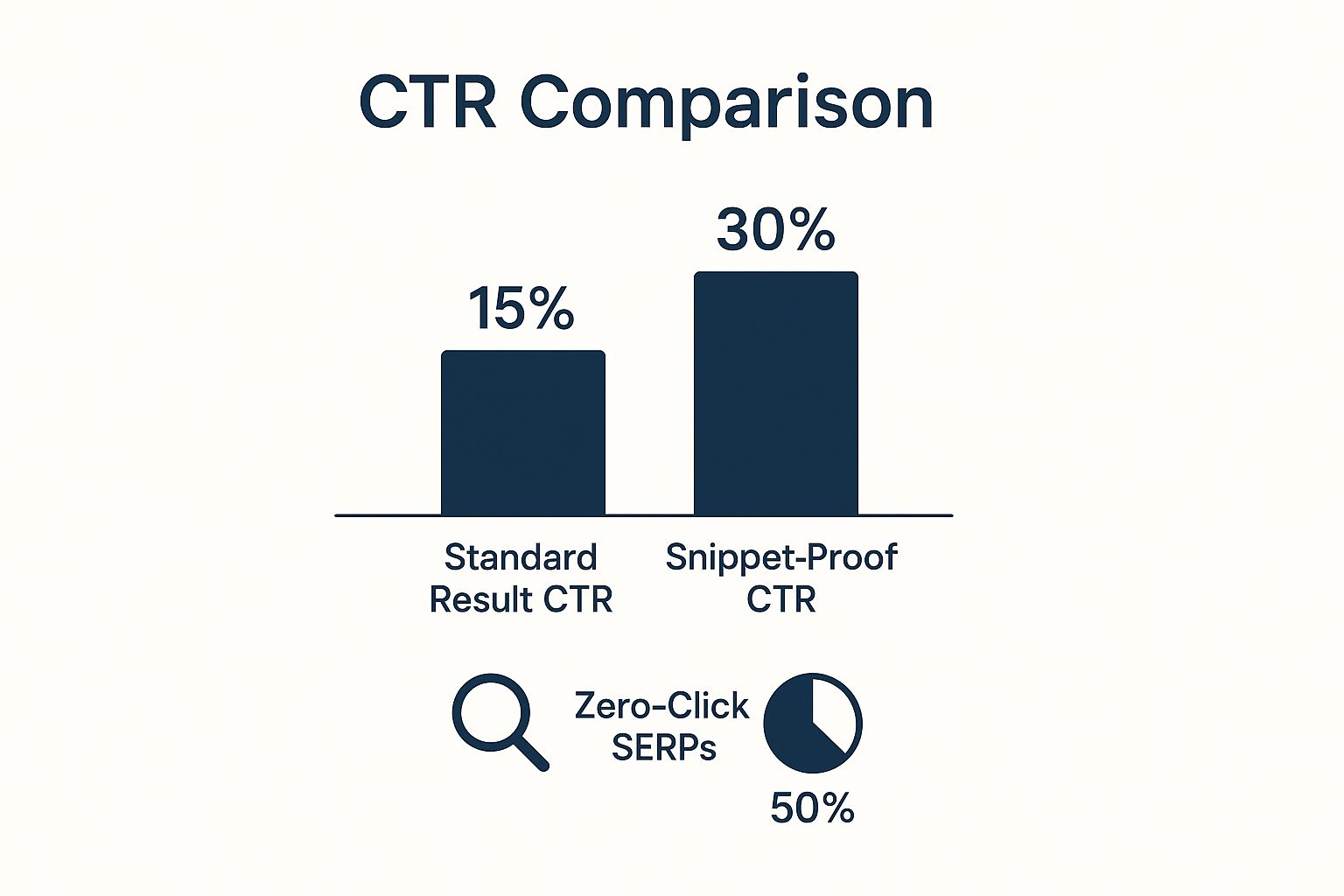
As you can see, proactively creating content that offers deeper value can literally double your odds of earning that click, even when you're up against an instant answer.
Creating Snippet Proof Content
The key to surviving—and thriving—is to create what I call "snippet-proof" content. This is all about offering something an AI summary simply can't replicate. The goal is to make clicking your link feel like an essential next step, not an optional one.
Your content has to go much deeper than just surface-level answers. Instead of just defining a term, publish a detailed case study with real numbers. Instead of another listicle, build an interactive calculator that gives a personalized result.
Think about what an AI still struggles with:
- Unique Data: Present original research, survey results, or proprietary data that can't be scraped from anywhere else.
- Interactive Elements: Tools, quizzes, and calculators demand user interaction that can only happen on your site, not on the SERP.
- Expert Opinions: Feature quotes, unique perspectives, and firsthand insights from industry leaders. An AI summarizes existing information; it doesn't have an original opinion.
- A Strong Brand Voice: Use humor, personal stories, and a distinct personality. This makes your content memorable and builds a real connection.
When you start offering this kind of value, users have a powerful reason to click. The AI summary just becomes a teaser, not the final destination.
The Real Impact of AI on CTR
The zero-click effect isn't just a theory; it's a measurable reality that’s changing how we all approach SEO. When AI Overviews show up, data shows organic CTRs can plummet by an average of 67.8%, with paid CTRs seeing a similar drop of around 58.0%. It happens because the AI snippet provides a "good enough" answer, killing the user's need to dig any deeper.
The volatility is real. In one recent six-month period, organic CTR without AI involvement fluctuated wildly from 2.03% all the way up to 4.71%, showing just how much algorithm changes can rock the boat. For a deeper look at these numbers, you can read the full analysis on AI's effect on CTR.
This shift forces us to evolve beyond just ranking. Visibility is now the starting point, not the finish line. Success in an AI-driven search world depends on our ability to create experiences that an AI cannot replicate.
To combat this, we need to shift our thinking from defensive tactics to adaptive strategies that anticipate and work around the zero-click effect. This table breaks down how traditional SEO thinking needs to evolve.
Adapting to AI Search How to Reclaim Your Clicks
| Challenge | Traditional Tactic | Modern Adaptive Strategy |
|---|---|---|
| AI provides the direct answer | Optimize for the #1 ranking. | Create content that can't be summarized, like unique data, case studies, or interactive tools. |
| User intent is satisfied on the SERP | Answer the question clearly and concisely for featured snippets. | Hint at a deeper, more valuable answer. Use headlines that promise unique insights or a solution the AI can't offer. |
| Reduced brand visibility | Focus on keyword volume. | Build a strong brand with a unique voice and perspective that people specifically search for. |
| CTR plummets across the board | A/B test titles and meta descriptions. | Optimize for other SERP features like "People Also Ask," image packs, and video carousels to create more entry points. |
Ultimately, the goal is to make your content the destination, not just another source for the AI to summarize. By focusing on creating irreplaceable value, you give users a reason to seek you out directly.
Optimizing for Other SERP Features
While AI Overviews are getting all the attention, they aren't the only game in town. Other SERP features still present massive opportunities to grab clicks and stay visible. In fact, focusing on them can be a powerful counter-strategy.
One of the most valuable features to target is the "People Also Ask" (PAA) box. These dropdowns show you exactly what other related questions users are searching for, giving you a direct line into their thought process.
Here’s how to nail your PAA optimization:
- Find the Questions: Use an SEO tool or just search your main keywords and see what questions pop up in the PAA box.
- Answer Them Directly: In your content, create dedicated sections that provide clear, concise answers to these specific questions. I highly recommend using the question itself as an H3 subheading.
- Write Like a Human: Frame your answers in a straightforward, conversational tone, almost as if you were explaining it to someone in person.
By answering these questions effectively, you can get your content featured directly in the PAA box. This not only positions you as an authority but also gives you another entry point to earn a click from a highly engaged user who is actively looking for more detail. It’s a smart way to boost your click-through rate by meeting searchers right where they are.
Even with the best strategies in place, questions always pop up. Improving your click-through rate is a constant game of testing and learning, so it's only natural to have questions about what to expect.
Let's dive into a few of the most common questions we hear from marketers trying to get more out of their campaigns.
What’s a Good Click-Through Rate, Anyway?
This is the golden question, and the honest answer is: it depends. There's no single magic number for a "good" CTR. What's considered great in one industry might be a total flop in another. It all comes down to your industry, the channel you’re using, and even how competitive a specific keyword is.
For example, across all industries, the average CTR for Google Ads on the search network is about 3.17%. But that’s just an average. If you're in a fun, visual industry like arts and entertainment, you might see numbers closer to 6%. On the flip side, a highly competitive field like legal services could be battling for a CTR around 2.5%.
Your most important benchmark isn't some generic industry average—it's your own past performance. A truly "good" CTR is one that's consistently getting better. Aim to beat your own numbers month after month.
When it comes to organic search, the difference is even more dramatic. Snagging the #1 spot on Google can get you an average CTR between 28-32%. But by the time you slide down to the bottom of the first page, that number plummets to the low single digits. The key is to set realistic goals based on where you are now and work toward steady, upward progress.
How Long Does It Take to See CTR Improvements?
Patience is a must in digital marketing, but how long you have to wait to see a better CTR really depends on what you're tweaking.
-
The Quick Wins (Days to Weeks): Making changes to on-page elements like your title tags and meta descriptions can produce results surprisingly fast. As soon as Google recrawls and re-indexes your page, you could see a jump in organic CTR in just a few days or weeks.
-
The Long Game (Months): For bigger, more foundational improvements—like a complete content quality overhaul or a major push to improve your overall rankings—you need to think in months, not days. It takes consistent effort to climb the search rankings, which in turn lifts your click-through rate.
Your best friend here is Google Search Console. Keep a close eye on it to track clicks, impressions, and average CTR for specific pages and search queries. It’s the clearest way to see if your changes are actually working.
Is a High CTR and a High Bounce Rate a Bad Thing?
Absolutely. This is a huge red flag.
This nasty combination is often called "pogo-sticking," and it sends a clear negative signal to search engines. It basically tells them, "Hey, my headline was great, but my content stinks!" You convinced someone to click, but you failed to deliver on the promise you made in the search results.
Put yourself in the user's shoes. They clicked your link expecting an answer, but the page was confusing, the information was buried, or it just wasn't what they were looking for. What do they do? They hit the back button and click on the next result.
This disconnect between user expectation and your page's reality can seriously damage your rankings over time. Search engines are obsessed with user experience, and a high bounce rate screams that you're not providing a good one. A winning strategy isn't just about earning the click—it’s about satisfying the user's intent once they arrive.
At REACH, we know that connecting with the right audience is everything. Our influencer marketing platform helps you find creators with genuinely engaged followers, so when they share your message, it leads to meaningful clicks and real results. Find out how our data-driven approach can help you not just boost your CTR but drive the conversions that matter by visiting REACH online.