 Skip to content

Let's be honest, influencer marketing in the health and wellness space isn't just another channel—it's become a cornerstone for building real trust in a market that's, frankly, full of skepticism. For health brands, success comes down to partnering with authentic voices—think board-certified doctors, dedicated patient advocates, and licensed professionals who know how to make complex health topics feel human and understandable. This comprehensive guide will walk you through creating a powerful and compliant influencer marketing for health brands strategy.
Platforms like REACH Influencers are designed to bridge this gap, offering a curated network of pre-vetted medical professionals and patient advocates. By connecting brands with credible experts from the start, REACH Influencers helps build campaigns on a solid foundation of trust, ensuring authenticity and compliance are at the core of your strategy.
Table of Contents
- Why Influencer Marketing for Health Brands Needs a Different Playbook
- Getting Compliance Right: Your Guide to the FDA, FTC, and HIPAA
- How to Find and Vet Credible Health Influencers
- Crafting Compliant and Compelling Campaign Briefs
- Measuring Success Beyond Likes and Follows
- Frequently Asked Questions About Influencer Marketing for Health Brands
Why Influencer Marketing for Health Brands Needs a Different Playbook
You can't market a new health supplement the same way you'd sell a pair of sneakers. The stakes are completely different. Your customers aren't just making a casual purchase; they're making a decision about their well-being, often when they're feeling vulnerable and searching for real answers.
This is exactly why that polished, corporate-speak of traditional advertising often falls flat. It can feel cold and distant, failing to create the genuine connection needed to earn someone's trust with their health. A specialized approach to influencer marketing for health brands isn't just a "nice-to-have," it's a necessity.
People are actively looking for health information online, but they're hunting for authenticity, not a sales pitch. They’re drawn to creators they can relate to and trust: the board-certified dermatologist breaking down skincare ingredients on TikTok, the registered dietitian showing off evidence-based meal prep on Instagram, or the patient advocate sharing their honest journey with a medical device on YouTube. These are the voices that matter because they bring legitimate expertise and real-life experience to the table.
It’s All About Credibility, Not Just Corporate Messaging
Today's consumers are smart. They can sniff out a disingenuous claim from a mile away and are incredibly wary of brands that seem to put profits before people. A sterile, clinical tone just doesn't build a community or inspire loyalty. This is where influencer marketing completely changes the dynamic by giving your brand a human face.
Here’s why this shift is so powerful:
- Trust is Everything: When an influencer talks about their positive experience with a telehealth service or a wellness app, it lands like a recommendation from a trusted friend, not a paid advertisement.
- Education Leads to Action: Health influencers are masters at simplifying complex subjects. They can explain the science behind a new supplement or demo how to use a fitness tracker in a way that empowers their audience to make an informed decision.
- Niche Communities Drive Deeper Connection: A micro-influencer who is a certified diabetes educator has an incredibly engaged audience that hangs on their every word. This allows you to connect with the exact people who need your solution, something broad advertising campaigns could only dream of.
This absolute need for credibility is why finding the right partners is so critical. It’s also why platforms like REACH Influencers have become so valuable. They are specifically built to connect health brands with pre-vetted medical professionals and credible creators, taking the guesswork and risk out of the equation so you can build campaigns on a solid foundation of trust right from the start.
The global influencer marketing industry is projected to hit an estimated $32.55 billion, and health brands are a huge part of that growth. The numbers speak for themselves: businesses are seeing an average return of $6.50 for every $1 spent, and a staggering 69% of consumers now trust influencers more than the brands themselves. You can discover more insights about influencer marketing statistics and see where the industry is headed.
Getting Compliance Right in Influencer Marketing for Health Brands
For most brands, marketing rules are just part of doing business. But in the health and wellness world, the stakes are so much higher. The rules have real teeth. A slip-up in influencer marketing for health brands isn’t just a bad look; it can land you in hot water with the Federal Trade Commission (FTC), the Food and Drug Administration (FDA), and even bring Health Insurance Portability and Accountability Act (HIPAA) violations into the picture.
Think of compliance as the bedrock of your brand. Getting it right from day one protects you from crippling fines, legal headaches, and the kind of bad press that's nearly impossible to shake. It’s all about building campaigns that are not only effective but also ethical and completely above board.
This decision tree helps map out the strategic thinking that goes into choosing the right influencer path for a health brand.
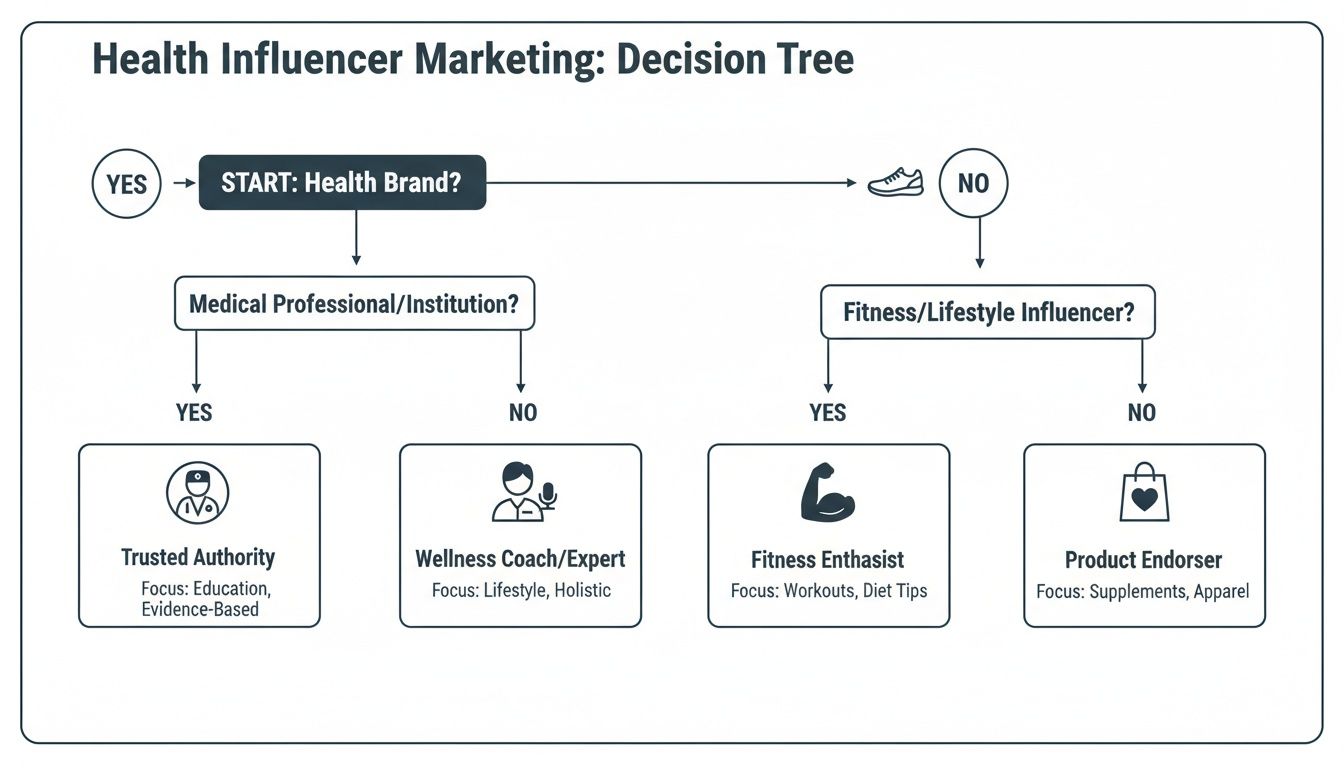
As you can see, a health brand’s journey is different from other industries. It puts a premium on specialized, credible partners—like healthcare professionals—over general lifestyle creators.
FTC Rules: Don't Hide the Ball
The FTC’s main job is to shield consumers from shady or deceptive business practices. When it comes to influencers, their number one concern is transparency. If an influencer has a "material connection" to your brand—meaning you paid them, sent them free stuff, or compensated them in any way—that relationship has to be disclosed.
And it can't just be any old disclosure. It has to be clear and conspicuous.
That means a tiny #ad buried among 20 other hashtags at the bottom of a super long Instagram caption just won't fly. The disclosure needs to be impossible to miss, placed right where people will see it without having to click "read more." For videos, this means saying it out loud and putting it in the description.
Key Takeaway: The FTC's rule of thumb is dead simple: could an average person quickly and easily tell this is an ad? If the answer is anything but a resounding "yes," you're at risk.
This is where a platform like REACH Influencers can be a lifesaver. It bakes disclosure rules right into campaign briefs and approval steps, making sure every post is compliant before it ever sees the light of day. For a deeper look, check out our complete guide to FTC compliance in influencer marketing.
Staying Off the FDA’s Radar
While the FTC is all about how you advertise, the FDA cares about what you say, especially when it comes to supplements, medical devices, and health apps. This is the biggest minefield for health brands: unapproved health claims.
An influencer can’t say your supplement "cures insomnia" or a wellness device "treats anxiety" if the FDA hasn't approved those specific claims. Making statements like that instantly reclassifies your product as an unapproved drug, and the penalties are severe.
To stay in the clear, you have to coach your influencers on the right language to use:
- Stick to Structure/Function Claims: It's okay to talk about how a product supports a normal body function. Think "supports a healthy immune system" instead of "prevents the flu."
- Avoid Disease Claims at All Costs: They absolutely cannot claim a product diagnoses, treats, cures, or prevents any disease. Period.
- Always Include the Disclaimer: Any structure/function claim must come with the standard FDA disclaimer: "This statement has not been evaluated by the Food and Drug Administration. This product is not intended to diagnose, treat, cure, or prevent any disease."
Understanding HIPAA's Guardrails
Finally, if your brand deals with patient care—say, you run a telehealth platform or a clinic—you've got to be mindful of HIPAA. This law is all about protecting sensitive patient health information. While a powerful patient testimonial sounds like a fantastic idea, you can't just run with it.
You need explicit, written consent from the patient to share their story. This isn't a casual agreement; it's a formal document that specifies what information will be shared, where it will appear (e.g., on a specific influencer's Instagram), and for how long. An influencer screenshotting a happy DM from a patient is a huge HIPAA red flag. A quick "yes" in a message won't protect you from a violation.
A much safer—and often more powerful—approach is to partner with patient advocates who are already public with their health journeys.
How to Find and Vet Credible Health Influencers
Follower count is just a number. Let’s be real—when you’re marketing a health brand, the only metric that truly matters is credibility. Your entire campaign, and your brand's reputation, hangs on finding partners who can build genuine, evidence-based trust with their audience.
This means you have to dig deeper than surface-level stats like likes and views. The most important question isn't "How many people follow them?" but rather, "What are their credentials?"
Prioritize Credentials Over Clout
In the health and wellness space, expertise is absolutely non-negotiable. An influencer without the right background is, at best, a waste of your budget. At worst, they're a serious liability. Your vetting process must start by verifying their professional qualifications.
Look for people who can speak with authority because they’ve earned it through years of training and certification. I'm talking about:
- Medical Doctors (MD, DO): Physicians and specialists who can tackle clinical topics.
- Registered Dietitians (RD): The real nutrition experts qualified to give dietary guidance.
- Licensed Therapists (LCSW, LPC): Professionals who can speak authentically about mental health.
- Certified Personal Trainers (CPT): Fitness pros with recognized, legitimate certifications.
- Registered Nurses (RN): Healthcare professionals with a wide range of clinical knowledge.
A general "wellness enthusiast" just doesn't carry the same weight as a board-certified professional. Focusing on credentialed experts from the start immediately elevates your campaign's integrity and shields your brand from the all-too-common risk of spreading misinformation.
Key Insight: Think of a creator's credentials as your first line of defense against compliance headaches. Partnering with a licensed professional shows you're committed to accuracy and safety, which is exactly what health-conscious consumers are looking for.
Analyze Their Content for Scientific Accuracy and Tone
Once you've confirmed an influencer's credentials, it's time for a deep dive into their content history. This is where you figure out if their communication style and values actually align with your brand. A degree on the wall isn't enough; they have to be responsible and effective communicators.
As you scroll through their feed, ask yourself these crucial questions:
- Is their information evidence-based? Do they cite credible sources, or are they just making anecdotal claims? Promoting fad diets, making wild promises, or leaning on pseudoscience are all massive red flags.
- What's their tone like? Are they educational and empowering, or do they use fear-mongering and sensationalism for clicks? You want a partner with a balanced, responsible tone who avoids making absolute medical claims.
- How do they engage with their community? The comments section is a goldmine of information. Do they foster a supportive environment and answer questions thoughtfully? Or do they ignore tough questions and delete any dissenting opinions?
This qualitative check is just as vital as looking at their engagement rate. It gives you a sense of their true character and tells you whether they’re a safe bet for your brand.
Health Influencer Vetting Checklist
Use this checklist to evaluate potential health influencers and ensure they meet the highest standards of credibility and brand safety.
| Vetting Criteria | What to Look For | Red Flags |
|---|---|---|
| Credentials & Licensing | Verifiable license/certification in their field (e.g., MD, RD, CPT). Clearly stated expertise in their bio. | No credentials listed, vague "health coach" titles, or expired licenses. |
| Content Accuracy | Evidence-based information, citations to scientific literature or established health organizations. | Promotion of pseudoscience, fad diets, "miracle" cures, or anti-science rhetoric. |
| Tone & Communication Style | Educational, empowering, and non-judgmental. Acknowledges nuances and avoids definitive medical advice. | Fear-mongering, sensationalism, shaming language, or making unsubstantiated claims. |
| Audience Engagement | Responds to questions responsibly, fosters a supportive community, and handles criticism professionally. | Deletes negative comments, ignores valid questions, or engages in hostile debates. |
| Brand Alignment | Past partnerships with reputable brands. A professional demeanor that matches your brand's values. | History of controversial statements, partnerships with scammy brands, or unprofessional behavior. |
| FTC/FDA Compliance | Consistent and clear use of disclosure hashtags like #ad or #sponsored. Avoids making disease claims for supplements. | Hidden or no disclosures, making explicit medical claims about products. |
This checklist isn't exhaustive, but it provides a solid framework. A creator who ticks all the right boxes is far more likely to be a valuable, brand-safe partner.
Use a Platform Built for Health Professionals
Let's be honest, manually searching for and vetting credentialed health influencers is a grind. It can take countless hours of scrolling through hashtags, cross-checking licenses on professional boards, and analyzing post after post for red flags. This is where a specialized platform can be a game-changer.
Tools like REACH Influencers were built specifically for this challenge. Instead of wading through a sea of general lifestyle creators, you can immediately filter for the exact expertise you need. Our platform lets you search for influencers based on specific credentials, like "Registered Dietitian" or "Licensed Therapist," so your search starts with a pre-vetted pool of qualified candidates. For a closer look at effective search strategies, our guide on how to find influencers has more actionable tips.
By using a platform that puts professional verification first, you can dramatically shorten your vetting timeline and connect with credible partners who are a perfect match for your brand’s commitment to integrity and trust.
Crafting Compliant and Compelling Campaign Briefs
Once you’ve found the right influencer for your health brand, the campaign brief is easily the most important document you'll create. Think of it less as a list of instructions and more as your first line of defense against compliance issues and your best shot at keeping the messaging on-brand.
A truly effective brief for a health campaign walks a fine line. It needs to provide rock-solid guardrails while still giving creators enough freedom to sound like themselves. After all, their authentic voice is why you hired them in the first place.
This brief is your collaborative blueprint. It has to give the influencer everything they need to knock it out of the park—your goals, key messages, audience details, and most critically, the absolute must-follow legal and regulatory rules. If you're not crystal clear here, you're leaving way too much up to interpretation, which can lead to off-brand content or, even worse, a post that makes an illegal health claim.
The idea isn't to give them a script. That's a surefire way to kill the genuine connection that makes this kind of marketing work. Instead, you're building a creative sandbox for them, complete with pre-approved talking points and clear boundaries.
The Essential Components of a Health Campaign Brief
A vague brief gets you vague, risky content. To protect your brand and set your creators up for success, every single brief needs a few core elements. These are the non-negotiables for any influencer marketing for health brands.
First, be painfully specific about what a "win" looks like for this campaign. Are you trying to get downloads for your new wellness app? Drive sign-ups for a telehealth service? Move a specific supplement off the shelves? Don't just say "awareness"; define the action you want people to take.
Next, nail down the key messages. If the audience only remembers one or two things, what should they be? Your job is to translate the complex science into simple, human-friendly benefits. Instead of listing out a string of scientific ingredients, give them a line like, "Helps support a calm and focused mind."
Key Takeaway: Your brief should be a guide, not a script. Provide clear "what to say" and "what not to say" lists, especially regarding health claims. This gives creators confidence and keeps your brand safe.
Translating Complex Information into Creator-Friendly Content
One of the biggest hurdles for health brands is taking dense, clinical data and making it feel natural on social media. The brief is where you do that heavy lifting for the influencer.
- Provide Simple Analogies: Help them make complex ideas relatable. For a probiotic, you might suggest an analogy like, "Think of it as a personal gardening team for your gut."
- Offer Pre-Approved Sound Bites: Arm them with a handful of simple, compliant phrases they can weave into their own content. This drastically lowers the risk of them accidentally stepping over the line.
- Create a Visual Style Guide: Show, don't just tell. Is your brand's aesthetic bright and optimistic or more calm and clinical? When crafting compelling visual content for your influencer campaigns, consider using innovative tools for creating impactful AI-generated social media images.
This kind of proactive guidance makes life easier for the creator and reinforces your brand's dedication to communicating responsibly. We're seeing this play out in the digital health app space, which is exploding with a projected growth rate of 28%. This reflects a huge shift in consumer behavior—with 69% of consumers now trusting influencers more than brands directly, a clear brief is essential. For health apps specifically, micro-influencers are pulling in engagement rates of 3.86%, turning authentic content into actual downloads. You can read the full research about health platform marketing to see just how powerful this is.
At the end of the day, a great brief is a direct investment in your campaign's success. It builds a real partnership, cuts down on risk, and lets creators do what they do best: connect with their audience in a way that feels genuine and trustworthy.
Measuring Success in Influencer Marketing for Health Brands
Let's be honest: vanity metrics like likes and follows look nice on a report, but they don't keep the lights on. When it comes to influencer marketing for health brands, stakeholders want to see tangible results that prove a real return on investment. Success isn't measured in applause; it's measured in actions that grow the business, whether that's new patient sign-ups or product sales.
This means we have to shift our focus from surface-level engagement to the key performance indicators (KPIs) that actually matter. It’s all about connecting the dots between an influencer’s post and a meaningful business result. To do that, you need a smart tracking strategy that follows the customer journey from their social feed all the way to a conversion.
Tracking Conversions That Matter
What does a "conversion" even mean for your health brand? It can be a lot of different things, and you absolutely have to define this before you launch a campaign. Getting that clarity from the start will shape your entire approach to measurement.
Here are some of the most common conversion goals I see with health brands:
- Product Sales: This is the most direct measure of ROI, especially if you're selling supplements, wellness products, or medical devices.
- Telehealth Bookings: For virtual care providers, the ultimate goal is getting new patients to schedule their first appointment.
- App Downloads: A critical metric for digital health apps focusing on meditation, fitness, or nutrition tracking.
- Lead Generation: This could be a sign-up for your newsletter, a download of an educational guide, or a request for a consultation.
The easiest way to track these actions is with the right tools. Simple, unique discount codes assigned to each influencer are a fantastic starting point. They create a clean, easy-to-follow link between a creator's content and a customer's purchase.
Setting Up Your Attribution Toolkit
To get a really accurate picture of performance, you’ll need more than just discount codes. A solid attribution strategy layers several methods to capture data from different touchpoints.
Start by creating custom landing pages for each influencer. Sending their audience to a dedicated page isn't just a great user experience; it also makes it incredibly easy to track traffic and conversions in Google Analytics. You can see exactly how many people came from a specific influencer's link and what they did once they got there.
On top of that, use UTM parameters on every single link you give to influencers. These are just simple tags added to a URL that tell your analytics tools where the traffic is coming from. A well-structured UTM can track the source (e.g., Instagram), medium (e.g., influencer), and the specific campaign, giving you granular data on which partners are driving the most value.
Key Insight: Attribution isn't about finding one perfect metric; it's about layering different tracking methods to build a complete picture. Combining unique codes, custom landing pages, and UTM links ensures you capture as much data as possible, proving the true value of your influencer partnerships.
For health brands running e-commerce platforms, understanding how to use tracking tools is essential. If you want to dive deeper, check out these resources on leveraging marketing pixels for tracking campaign performance.
Going Beyond the Numbers with Qualitative Feedback
While hard data on sales and sign-ups is king, don't sleep on the value of qualitative feedback. The comments section on an influencer's post is an absolute goldmine of insight into how your message is landing.
Reading through audience comments helps you gauge brand sentiment and trust. Are people asking smart questions about the product? Are they sharing their own positive experiences? This kind of engagement is a sign that the influencer's message is resonating on a deeper level, building the kind of credibility that is so vital for health brands.
This qualitative dive can also expose any points of confusion or concern, giving you incredibly valuable feedback to sharpen your messaging for the next campaign.
Of course, juggling all this can be a headache. Platforms like REACH Influencers are built to make this whole process simpler. The built-in analytics dashboard pulls all these critical metrics into one place, giving you real-time tracking of clicks, conversions, and engagement. This centralized view gives you a clear, immediate understanding of your campaign's true impact without having to jump between a dozen different tools. To get a better handle on this, you can learn more about how to measure influencer engagement and ROI with the right strategies.
Frequently Asked Questions About Influencer Marketing for Health Brands
Even with the best playbook, you're bound to have questions when you dive into the world of influencer marketing for health brands. It's a space with its own unique rules and complexities, from figuring out fair pay to staying on the right side of the law. Let's tackle some of the most common questions I hear from brands.
Think of this as your go-to FAQ for those moments that make you pause. Getting clear on these points upfront will help you avoid common mistakes and build stronger, more compliant partnerships with creators. Honestly, nailing these details is what separates a good campaign from a truly great one.
Ultimately, being prepared for these questions shows you're serious about running ethical, effective campaigns that respect creators, their audiences, and your brand's integrity.
How Much Should I Pay a Health Influencer?
This is the big one, isn't it? The simple, honest answer is: it depends entirely on the value they bring to the table. Rates for health influencers aren't just about follower counts. They're heavily weighted by credentials, audience engagement, and the scope of your campaign. A registered dietitian with 50,000 highly engaged followers who genuinely trust their advice will, and should, command a much higher fee than a general wellness blogger with the same audience size.
Here's how to break down your budget considerations:
- Credentials and Expertise: A licensed professional—like an MD, RD, or CPT—brings a level of credibility that justifies a premium. You're not just paying for reach; you're paying for their hard-earned expertise.
- Engagement Quality: You have to look past the vanity metrics. A creator with a smaller but fiercely loyal community that lights up the comment section is often far more valuable than one with a huge, passive audience.
- Scope of Work: The payment has to match the effort. A single Instagram story is a world away from a multi-platform campaign that includes a deep-dive YouTube video, several Reels, and supporting blog content.
Don't fall into the trap of paying for followers alone. In the health space, you're really paying for trust and expertise. Benchmark your rates against the value of their credentials and the depth of their audience connection, not just a number on their profile.
Can Influencers Give Medical Advice?
No. Full stop. This is a non-negotiable rule with serious legal consequences. Unless an influencer is a licensed medical professional in a formal doctor-patient relationship (which is never the case on social media), they are legally barred from giving medical advice. Your campaign brief needs to state this in bold, capital letters and provide crystal-clear examples of what they can and cannot say.
The key is to draw a bright line between education and prescription. An influencer can share general, evidence-based health information, but they can never tell an individual what to do for their specific health situation.
For instance, a registered dietitian can explain the benefits of fiber for overall gut health. But they can't tell a follower with IBS to "take this specific supplement to treat your symptoms." Even licensed professionals have to be incredibly careful to speak in general terms and avoid creating any impression of a therapeutic relationship online. This boundary is critical for protecting your brand and their license.
What Is the Most Important Metric for a Health Campaign?
While every campaign has different goals, the most critical metric is almost always the one tied directly to a business outcome. For most health brands, that means focusing on the conversion rate for a specific action. This is what connects an influencer's content to tangible results and proves ROI far more effectively than likes or views ever could.
What does that action look like in the real world?
- Telehealth: How many new patient appointments were booked?
- Wellness App: What was the total number of app downloads or free trial sign-ups?
- Supplement Brand: How many products were sold using an influencer's unique discount code?
Beyond hard conversions, you should also keep a close eye on audience sentiment in the comments. Are people asking thoughtful questions? Are they expressing trust in the creator and, by extension, your brand? This qualitative feedback is a powerful sign of whether you're building genuine credibility—the real currency in influencer marketing for health brands.
Ready to build trust and drive real results with credible health influencers? REACH Influencers is the only platform built to connect you with pre-vetted medical professionals and patient advocates. Find the perfect partners, manage campaigns with built-in compliance, and track ROI all in one place. Book a demo today and see how we can elevate your influencer marketing strategy.