 Skip to content


Picture your entire market as one big, noisy room. Everyone's talking—customers, competitors, industry voices. Your Share of Voice (SOV) is simply how much of that conversation is about your brand. It's your slice of the attention pie. Understanding and growing your share of voice marketing is not just an exercise; it's a direct line to boosting your visibility, claiming more market share, and ultimately, growing revenue.
Figuring out how to grow that slice isn't just a marketing exercise; it's a direct line to boosting your visibility, claiming more market share, and ultimately, growing revenue. A strong share of voice marketing strategy can be a game-changer, especially when you leverage the right tools and partnerships. For instance, platforms like REACH Influencers are designed to help brands amplify their message by connecting them with authentic creators, effectively boosting their SOV in targeted conversations.
Table of Contents
- Understanding Share of Voice in Modern Marketing
- How to Measure Your Share of Voice Across Key Channels
- Amplify Your Voice with Influencer Marketing
- Actionable Strategies to Increase Your Share of Voice
- Setting Benchmarks and Reporting Your SOV Success
- Common Questions About Share of Voice Marketing
Understanding Share of Voice in Modern Marketing
Let's be honest, digital noise is deafening and ad costs just keep climbing. In this environment, simply being seen isn't enough. You need to be heard. This is the whole idea behind share of voice. It pushes us past surface-level metrics like clicks and impressions to measure something much more valuable: your brand's actual presence and authority in your industry.
Think of it as a peek into the future. Time and again, we see that a higher share of voice today almost always leads to a bigger piece of the market tomorrow. This proven correlation between conversation dominance and market share is why so many leading brands make share of voice marketing a top priority.
And this isn't some vanity metric reserved for giant corporations with bottomless budgets. Whether you're a scrappy startup or a well-established company, tracking SOV gives you a clear competitive benchmark. It helps you answer the tough questions. Are our campaigns actually moving the needle? Is anyone even noticing our new product launch? Are our competitors quietly dominating conversations where we should be?
The Growing Importance of Online Visibility
So much of business has moved online. The conversations that used to happen in stores are now spread across social media feeds, search results, forums, and review sites. It's no surprise that global advertising revenues are expected to clear a staggering USD 1.04 trillion in 2024, with most of that cash flowing to digital platforms. This massive spend confirms a simple reality: online visibility is market power.
But here’s where a lot of brands miss the mark. Shockingly, only 37% of PR professionals say they use SOV as a key measure of success. That’s a far cry from the 56% who still prioritize audience reach. This gap points to a huge missed opportunity for brands that want to build real authority, not just collect eyeballs. You can dig deeper into these share of voice statistics and what they mean for marketers today.
Share of voice isn’t about being the loudest person in the room. It’s about becoming the most relevant and trusted voice in the conversations that truly matter to your customers.
Turning Conversations into Conversions
This is exactly where smart, strategic partnerships can completely change the game. Instead of just shouting into the void with expensive ads, you can work with platforms like REACH Influencers to find authentic creators who already have the trust of your target audience. It’s a way to strategically join and amplify your message within conversations that are already happening.
When you focus on growing your share of voice, the benefits have a direct impact on your bottom line:
- Enhanced Brand Awareness: When your brand consistently shows up in the right discussions, you stay top-of-mind for customers when they’re ready to buy.
- Competitive Intelligence: Monitoring SOV gives you a live look at what your competitors are doing. You can spot their strategies, react faster, and find opportunities they’ve overlooked.
- Improved Campaign Effectiveness: By seeing how your SOV shifts, you can finally measure the true impact of your content, PR efforts, and influencer campaigns.
- Predictive Growth Metric: A rising share of voice is one of the strongest signals of future growth, giving you a powerful, forward-looking KPI to share with your leadership team.
How to Measure Your Share of Voice Across Key Channels
Trying to measure your brand’s Share of Voice can feel a bit like trying to grab a cloud—it seems abstract and everywhere at once. But it’s actually far more straightforward than you might think. Calculating SOV boils down to one simple question: in the places that matter, how much of the conversation does our brand own compared to the competition?
The good news is, you don't need a data science degree to figure this out. With a few simple formulas and the right tools, you can get a clear picture of your brand's visibility across paid media, organic search, social media, and more. A comprehensive share of voice marketing plan starts with accurate measurement.
This isn't just a vanity metric; it's the first domino to fall. Gaining a larger share of the conversation is what leads to real-world results.

As you can see, commanding more of your industry's conversation directly boosts your visibility. That visibility, in turn, helps you capture more market share and ultimately drives revenue.
So, How Do You Actually Calculate It?
Here’s the catch: you can’t measure your SOV on Google the same way you do on Instagram. Each channel has its own "language" and its own core metrics. The trick is to pick the right metric for each channel and stay consistent with your tracking.
To make this easy, here’s a quick reference table breaking down the formulas for the most important channels.
Channel-Specific Share of Voice Formulas
This table shows you exactly which metric to focus on for each channel and how to calculate your SOV.
| Channel | Primary Metric to Track | SOV Calculation Formula |
|---|---|---|
| Paid Media | Impression Share | (Your Impressions / Total Eligible Impressions) x 100 |
| Organic Search | Keyword Visibility/Rankings | (Your Clicks for Target Keywords / Total Clicks for Target Keywords) x 100 |
| Earned Media | Brand Mentions | (Your Brand Mentions / Total Competitor + Brand Mentions) x 100 |
| Social Media | Mentions & Hashtags | (Your Brand Mentions / Total Industry Mentions) x 100 |
| Influencer Marketing | Campaign-Specific Mentions | (Your Campaign Mentions / Total Competitor Campaign Mentions) x 100 |
As you can see, the core idea is always the same: your activity versus the total market activity. Now let's see how this works in a real-world scenario.
Let's Put This Into Practice: Social SOV
Imagine you're running marketing for a new skincare brand. You want to figure out your share of voice marketing impact on Instagram, where all your competitors are active.
Let's say in one month, your brand was mentioned 500 times. You track your top four competitors and find the total mentions for all five brands (including yours) added up to 10,000.
Using the formula, you’d divide your 500 mentions by the 10,000 total mentions, then multiply by 100. Your social SOV is 5%.
Right away, you have a clear benchmark. A 5% SOV tells you there’s a huge opportunity to grow and steal some of that conversation from your rivals. This is where a smart influencer strategy can completely change the game. By identifying and partnering with the right creators, you can inject your brand directly into relevant conversations and watch your SOV climb.
And you wouldn't be alone. The social listening market hit USD 8.44 billion in 2024, highlighting just how critical it is for brands to tune into these conversations. With 93% of marketers already on social media, simply being present isn't enough—you have to measure your impact.
For a deeper dive into the KPIs that matter, The Ultimate Guide to Any Metric in Marketing offers a comprehensive look at how to track performance effectively.
A low share of voice isn’t a failure—it’s an opportunity. It shows you exactly where you can focus your efforts to gain ground on competitors and connect with new audiences.
Of course, tracking all this manually is a huge headache. That's where dedicated platforms come in. When you run influencer campaigns with REACH Influencers, for instance, our dashboard centralizes all your mentions and engagement data in one place. This lets you see in real time how your partnerships are directly boosting your social SOV, without ever touching a spreadsheet.
By understanding how to measure your presence on different channels, you're taking the first step toward a much more strategic marketing plan. For more on turning these numbers into action, check out our guide on effective social media measurement.
Amplify Your Voice with Influencer Marketing
Let's be honest, the days of winning your audience over with traditional ads alone are long gone. Today, the most powerful conversations are started by real people. This is where influencers come in, and why they’ve become such a crucial part of any serious share of voice marketing strategy.
Instead of just shouting your message from a digital rooftop, you can partner with trusted voices who already have the ear of your ideal customers. A single, authentic collaboration can spark more genuine buzz and boost your social SOV far more effectively than a massive ad spend ever could.
Why Micro-Creators Offer an Outsized Voice
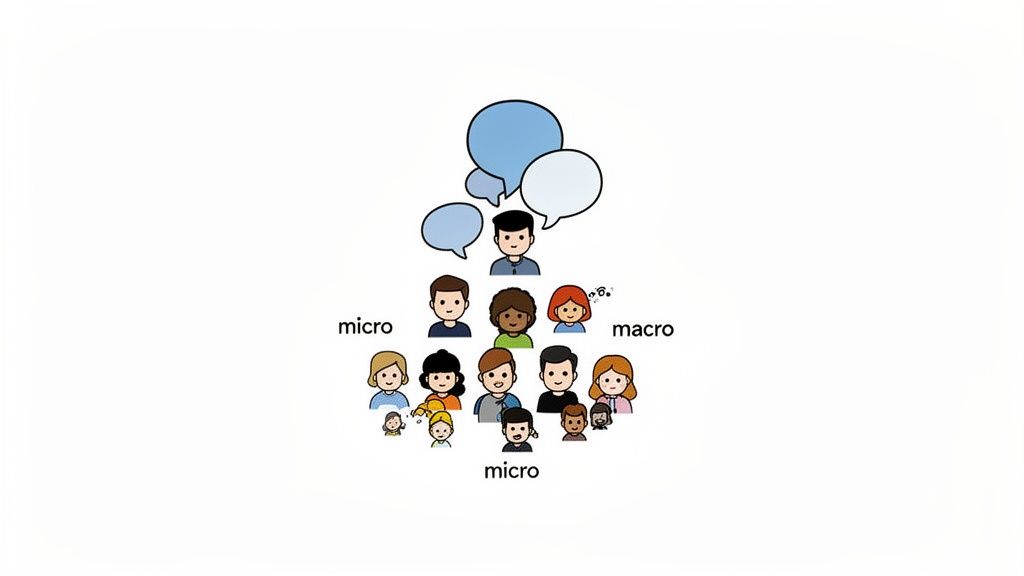
It's tempting to chase the huge reach of macro-influencers, but the real magic for dominating niche conversations often happens with micro-creators. We're talking about creators with smaller but incredibly dedicated communities built around passions like sustainable fashion, vegan cooking, or retro gaming.
Their followers hang on their every word. A recommendation from them doesn't feel like a paid ad; it feels like getting advice from a knowledgeable friend. That authenticity is gold—it drives deep engagement and creates a groundswell of conversation that directly grows your brand’s SOV within that community.
Partnering with ten micro-creators who have 10,000 dedicated followers each can be far more powerful for your share of voice than partnering with one celebrity who has 100,000 passive followers.
This approach lets you surround your target audience with positive feedback from multiple trusted sources. You effectively "own" the conversation in a way that feels completely natural and earned.
The Role of a Dedicated Influencer Platform
Trying to find and manage these valuable partnerships manually is a recipe for chaos. This is where a dedicated platform like REACH Influencers is a game-changer. REACH helps you look past simple follower counts and discover ideal partners using specific filters for engagement rates, audience demographics, and content niches.
Let's say you're launching a new line of eco-friendly cleaning products. With a tool like REACH, you can quickly find dozens of micro-creators who are genuinely passionate about sustainability and already talking to an audience that shares those values. One of our clients, a sustainable home goods brand, used this exact strategy to partner with 25 eco-focused micro-influencers, resulting in a 40% increase in their social share of voice within just one quarter.
From there, a good platform simplifies everything:
- Campaign Management: You can coordinate outreach, handle negotiations, and approve content all from one central hub.
- Performance Tracking: See exactly which influencers are driving mentions, clicks, and sales.
- SOV Measurement: The platform's analytics make it simple to track how your influencer campaigns are impacting your share of voice, giving you clear data to prove your success.
From Mentions to Market Dominance
As influencer marketing continues to explode, share of voice is quickly becoming the key metric for a brand's actual influence. The global influencer platform market hit $15.2 billion in 2022, and nine out of ten top marketers agree it's a powerful way to boost SOV. With TikTok's ad revenue expected to reach $44 billion by 2026, the power of creators to own the conversation on their platforms is undeniable.
To really make the most of it, you can fold in smart tactics like using an influencer press release writing guide to create stories that media outlets and audiences will love. When you make influencers a core part of your communications strategy, you create a ripple effect that amplifies your brand's voice everywhere. To get a better handle on the numbers, it helps to understand the ROI of influencer marketing and how to prove its value.
Actionable Strategies to Increase Your Share of Voice
Alright, you've measured your Share of Voice and you know where you stand. The next step is the fun part: actually growing it. This isn't about being the loudest brand in the room; it’s about being the smartest. You can strategically capture a much bigger piece of the pie, even on a tight budget.
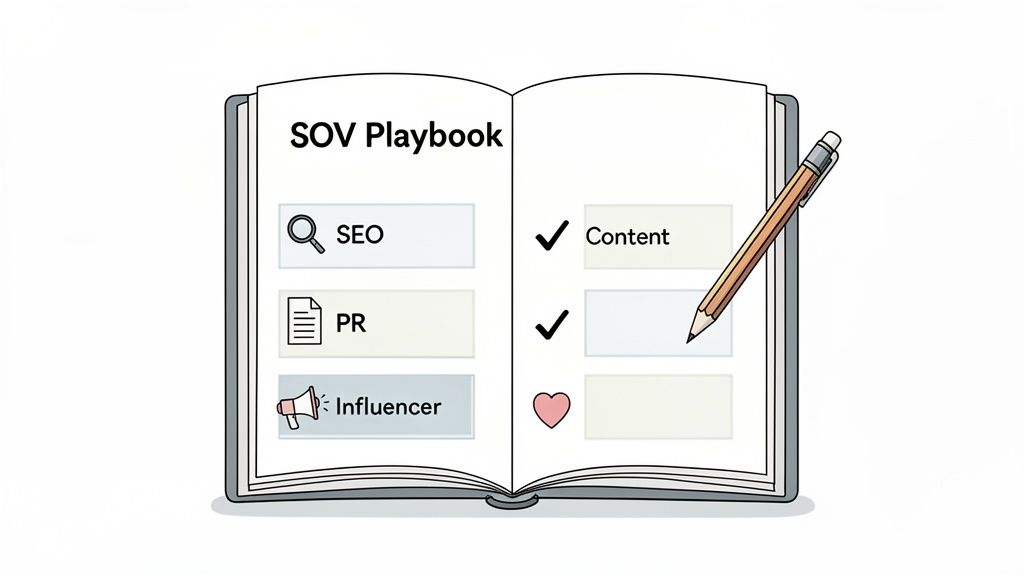
Think of these strategies as a playbook you can start running today. By putting these ideas into practice, you can turn your share of voice marketing into real, measurable gains in your brand's visibility and authority.
Build Thought Leadership in a Niche
Instead of going head-to-head with industry giants on huge, competitive topics, find a smaller sandbox to play in—and own it. Your goal is to become the absolute go-to expert for a specific area that your competitors are ignoring.
Start by digging for the questions your audience is asking but not getting answers to. Use social listening tools, chat with your sales team about their conversations, and look through customer support tickets. These are goldmines for finding knowledge gaps. Once you’ve found your niche, create the best piece of content on the planet for it—think original research, ultimate guides, or data-driven articles that solve a very specific problem.
A small cybersecurity startup, for instance, has no chance of outranking Microsoft for "cybersecurity solutions." But it can absolutely dominate the conversation around "cybersecurity compliance for dental offices" by creating the definitive guide on the topic. This is how you build a rock-solid foundation of authority before expanding your reach.
Target Your Competitors' Keywords
One of the most direct ways to grow your SOV is to find out what keywords are already working for your competitors and then do it better. I'm not talking about copying their content. I’m talking about creating something so much more valuable that search engines have no choice but to rank you higher.
Use an SEO tool to pull a list of your competitors' top-performing keywords. Then, look at the pages that are ranking for those terms and ask yourself a few simple questions:
- Is this information outdated? Can I make it current?
- Can I go deeper and create a more comprehensive guide?
- Could I add original data, visuals, or case studies to make this better?
By creating superior content for these proven keywords, you start to steal their traffic and, with it, their share of search. It’s a direct play to take over their digital shelf space.
An effective share of voice marketing plan doesn't just build your own castle—it strategically takes territory from your competitors' kingdoms.
This approach meets your customers right where they're at, positioning your brand as the more helpful and trustworthy choice.
Deploy an Army of Brand Advocates with Influencers
While great content and SEO are your foundation, nothing gets your message out there faster than genuine praise from people your audience already trusts. When done right, influencer marketing is a massive force multiplier for your social SOV.
The secret is to move beyond one-off sponsored posts and instead build a true community of advocates who are excited to talk about your brand. This is where you need to be smart about who you partner with. Using a platform like REACH Influencers takes the guesswork out of it, letting you find creators who are a perfect match for your brand and audience.
Here’s a simple way to build your advocate army:
- Find Your Core Creators: Use a platform like REACH to discover a mix of influencers. Start with nano-influencers (1k-10k followers) to build authentic, grassroots buzz. Their followers really trust them, which leads to high-quality conversations about your brand.
- Make Them Feel Like Insiders: Don’t just send free products and hope for the best. Give your creators early access to new features, share exclusive information, and maybe even give them a direct line to your product team. The more they feel like part of the team, the more passionately they’ll advocate for you.
- Go Big for Key Moments: When you have a major launch or announcement, bring in macro-influencers for a big splash. They can kickstart a huge wave of conversation, which your army of nano-influencers can then carry forward at the community level.
This tiered strategy creates a powerful echo chamber for your brand. A study from Comcast Advertising found that advertisers who kept their presence up while competitors went dark saw a +13% increase in their multiscreen share of voice. A consistent base of influencers creates that same "always-on" effect, making sure your brand is always part of the conversation.
Setting Benchmarks and Reporting Your SOV Success
So you've measured your share of voice. Now what? Getting a number is a good first step, but that number on its own doesn't really tell you much. To turn that data into a real strategic advantage, you need to give it context with smart benchmarking and track it with ongoing reporting. This is how you go from just measuring to actually managing your market presence.
It all starts by figuring out where you are on the map. Before you can plan your destination, you have to know your starting point. That means taking a good, hard look at your competitors to set a baseline. From there, you can set ambitious but achievable goals and build a system that tells you exactly how you're doing.
Establishing Your SOV Baseline
Before setting any goals, you need a reality check. The first step, and you can't skip it, is a deep dive into your competition. Pick your top three to five direct competitors—the brands that are genuinely fighting for the same customers you are.
Once you know who you're up against, use your favorite social listening and SEO tools to see what their share of voice looks like across your key channels. This gives you that all-important benchmark. You’ll immediately see who’s shouting the loudest, who’s barely whispering, and more importantly, where the conversation hasn’t even started.
A benchmark isn’t just a number; it’s a story about your market. It reveals who is winning the conversation and, more importantly, provides clues as to why.
For instance, maybe you find out a competitor has a pretty low SOV overall but absolutely owns the conversation on TikTok. That’s a huge insight. It tells you there's a clear opportunity to either go head-to-head with them on that platform or focus your efforts on a channel they're ignoring, like YouTube or organic search.
Creating a Dynamic Reporting Dashboard
Let’s be honest, static monthly reports are dead. To keep a real pulse on your share of voice marketing, you need a live dashboard that brings all your key metrics together in one place. Think of it as your brand's command center, pulling in data from social media, search results, PR hits, and influencer campaigns.
A well-built dashboard lets you do a few critical things with ease:
- Track SOV Over Time: See how your share of voice ebbs and flows from week to week, especially after you launch a new campaign.
- Monitor Competitor Activity: Get a heads-up when a rival launches a big campaign or suddenly gets a wave of mentions.
- Connect SOV to Business Goals: Lay your SOV data over other important numbers like website traffic, leads, or sales to finally see how brand awareness truly impacts the bottom line.
This is where a solid platform can make all the difference. When you run influencer campaigns on REACH Influencers, for example, the live campaign dashboard automatically tracks every mention, engagement, and point of reach. This shows you exactly how our influencer partners are boosting SOV in real-time, no manual spreadsheets required. You can also see how these activities translate into real value by learning more about calculating Earned Media Value.
For agencies, this kind of reporting is even more essential. The white-label feature in REACH lets you create sharp, professional reports with your own branding. It’s the perfect way to show clients clear, data-driven proof that your strategies are making them a bigger voice in their industry and delivering results they can see.
Your Path to Market Leadership Through Share of Voice
We've covered a lot of ground, and the main takeaway is simple: share of voice marketing is much more than just a metric you glance at on a dashboard. In a noisy market, it’s a direct indicator of your future growth. When your share of voice goes up, you're not just getting more attention—you're building the kind of brand awareness and authority that carves out a bigger piece of the market pie.
But turning this knowledge into results is where the real challenge begins. Winning isn't about having the biggest budget; it's about being the smartest brand in the room. This means creating content that actually connects, zeroing in on your competitors' blind spots, and building a community of real advocates who champion your brand. Research from Comcast Advertising even found that brands who stay visible when their competitors pull back see a +13% increase in their share of voice. Consistency pays off.
Take Control of the Conversation
This is where you stop struggling with clunky spreadsheets and scattered tools and start working smarter. A dedicated platform like REACH Influencers can feel like an unfair advantage because it puts everything in one place. You can discover the right micro-influencers, track how your campaigns are doing in real-time, and pull reports that show you exactly where you stand. It’s all about dominating the conversation in your niche.
Share of voice is the ultimate reflection of your brand’s relevance. Growing it means you’re not just being seen—you’re being remembered.
By making a deliberate effort to amplify your voice, you start turning people who just scroll past into loyal customers. It’s about showing up where it counts and making sure your brand is the first one that comes to mind. With a solid strategy and the right tools, any brand has the power to outmaneuver the competition and take its place as a leader.
Common Questions About Share of Voice Marketing
Even with a solid plan, a few questions about share of voice marketing always seem to pop up. Let's clear up some of the most common ones so you can move forward feeling confident.
Is Share of Voice the Same as Market Share?
Nope, but they're definitely related. In fact, one is often a crystal ball for the other.
Think of it like this: Share of Voice is how much of the conversation your brand owns, while market share is how much of the sales you own. A high SOV is a powerful leading indicator of market share growth. When people are talking about you, they're more likely to buy from you.
Industry research backs this up. Studies have shown that for every 10% of excess share of voice (ESOV) a brand gets—meaning its SOV is 10 points higher than its market share—it can expect to see its market share grow by about 0.5%. This makes SOV a crucial metric for any brand serious about growth.
What Is a Good Share of Voice Percentage to Aim For?
There’s no magic number here. A “good” SOV completely depends on your industry, budget, and where you currently stand in the market.
A ‘good’ share of voice isn't a universal percentage; it’s a number that puts you on a clear path to achieving your specific business objectives, whether that's market leadership or niche dominance.
Here’s a more practical way to look at it:
- For a new brand, just getting on the board and capturing 5-10% of the conversation is a huge win.
- For an established leader, the goal is usually to keep your SOV higher than your market share to defend your turf and keep growing.
Your first move should be to benchmark your SOV against your top three to five competitors. That will give you a realistic target to shoot for.
How Can a Small Business Compete on Share of Voice?
This is where strategy beats budget. Small businesses can absolutely punch above their weight by being smarter, not just louder. Forget trying to outspend the Goliaths on every channel. The secret is to pick your battles and dominate a specific niche.
Start by owning long-tail keywords with SEO that bigger competitors often overlook. Even better, use an influencer marketing platform like REACH Influencers to team up with micro-influencers. These creators have incredibly loyal, targeted audiences. A partnership can generate a massive SOV within that community, driving real results without needing a massive budget. It's all about owning the conversations that matter most to your business.
Ready to take control of your brand's conversation and see how you really stack up? Find out how REACH Influencers can connect you with the right partners to turn up the volume and grow your presence. Book a demo with REACH today.
{
  "@context": "https://schema.org",
  "@type": "BlogPosting",
  "mainEntityOfPage": {
    "@type": "WebPage",
    "@id": "https://reachinfluencers.com/blog/share-of-voice-marketing"
  },
  "headline": "Share of Voice Marketing: Your Complete Guide to Market Dominance",
  "description": "Learn what share of voice marketing is, how to measure it across channels, and actionable strategies to increase your SOV with SEO and influencer marketing.",
  "image": "https://reach-influencers.com/wp-content/uploads/2026/03/share-of-voice-marketing-marketing-playbook.jpg",
  "author": {
    "@type": "Organization",
    "name": "REACH Influencers",
    "url": "https://reachinfluencers.com"
  },
  "publisher": {
    "@type": "Organization",
    "name": "REACH Influencers",
    "logo": {
      "@type": "ImageObject",
      "url": "https://reachinfluencers.com/logo.png"
    }
  },
  "datePublished": "2024-05-21",
  "dateModified": "2024-05-21",
  "faqPage": {
    "@type": "FAQPage",
    "mainEntity": [{
      "@type": "Question",
      "name": "Is Share of Voice the same as Market Share?",
      "acceptedAnswer": {
        "@type": "Answer",
        "text": "No, but they are related. Share of Voice measures conversation share, while market share measures sales share. A higher SOV is a leading indicator of future market share growth. For every 10% of excess share of voice, a brand can expect its market share to grow by about 0.5%."
      }
    },{
      "@type": "Question",
      "name": "What is a good share of voice percentage to aim for?",
      "acceptedAnswer": {
        "@type": "Answer",
        "text": "A 'good' SOV depends on your industry and goals. For new brands, 5-10% is a great start. For market leaders, the goal is to maintain an SOV higher than your market share. Benchmarking against your top 3-5 competitors is the best way to set a realistic target."
      }
    },{
      "@type": "Question",
      "name": "How can a small business compete on Share of Voice?",
      "acceptedAnswer": {
        "@type": "Answer",
        "text": "Small businesses can compete by being strategic. Focus on owning niche topics and long-tail keywords with SEO. Leverage platforms like REACH Influencers to partner with micro-influencers who have highly engaged, targeted audiences, allowing you to dominate specific conversations without a large budget."
      }
    }]
  }
}