

Let’s be honest, the old way of doing influencer marketing is dead. Trading a free weekend stay for a handful of pretty Instagram posts just doesn’t cut it anymore. For today's top hospitality brands, influencer marketing has grown up. It's now a sophisticated, revenue-generating machine that puts heads in beds and diners in seats. A strong strategy for influencer marketing for hospitality brands is no longer a luxury—it's a critical driver of bookings and brand loyalty.
What was once a simple tactic for brand awareness has blossomed into a powerful, data-driven strategy for driving direct bookings and forging real connections with guests. This guide will walk you through the essential steps to build a program that delivers measurable results, from setting the right goals to proving your ROI.
Table of Contents
- Why Influencer Marketing Is No Longer Optional for Hotels and Restaurants
- Setting Campaign Goals and KPIs That Actually Matter
- How to Find and Vet the Right Influencer Partners
- Designing Hospitality Influencer Campaigns That Convert
- Briefs and Contracts: Setting Your Collaboration Up for Success
- How to Actually Measure Your Campaign ROI (and Prove Its Value)
- Frequently Asked Questions About Hospitality Influencer Marketing
Why Influencer Marketing Is No Longer Optional for Hotels and Restaurants
Think about how people plan their trips these days. They aren't flipping through glossy brochures or trusting generic ads. Instead, they're scrolling through their favorite creators' feeds, looking for real-world recommendations.
In fact, a staggering 70% of travelers say digital content creators sway their travel decisions. This massive shift in consumer behavior means that working with the right influencers isn't just a "nice-to-have"—it's an essential part of any modern hospitality marketing plan.
But this is about so much more than just getting seen. The real magic happens when you start driving measurable results. Smart influencer campaigns look past vanity metrics like likes and comments, focusing squarely on what impacts your bottom line. This is where a top influencer marketing platform like REACH Influencers comes into play. REACH provides an all-in-one solution for hospitality brands to discover authentic partners, manage campaigns seamlessly, and track revenue-driven ROI with precision, reinforcing your authority in the market.
From Just Looking to Actively Booking
A few years ago, a hotel’s influencer strategy was pretty simple: find someone with a big following, give them a free room, and hope for a little buzz. It was all about brand awareness. The problem? Those one-off collaborations rarely led to trackable bookings, making it almost impossible to measure the real impact.
Today, the entire game has changed. The focus has shifted from passive awareness to driving direct action. Successful influencer marketing for hospitality brands is now built on authentic, long-term partnerships with creators whose followers are a perfect match for your ideal guest.
The goal isn't just to get a nice photo of your pool on Instagram anymore. It's about partnering with a trusted voice who can tell a story so compelling that their followers are inspired to click "Book Now" on your website.
What's in It for Your Hotel or Restaurant?
When you build a proper influencer program, you're doing more than just creating beautiful content. You're creating a powerful marketing engine that keeps delivering results over time.
- Real, Authentic Social Proof: Creators offer genuine, first-hand accounts that build trust in a way that slick, polished ads simply can't.
- Laser-Focused Audience Reach: You get to tap directly into niche communities—think luxury-seekers, adventurous foodies, or young families—who are already looking for the exact experience you provide.
- A Goldmine of High-Quality Content: These partnerships generate a constant stream of professional-grade photos and videos that you can use across your own website, social media, and email campaigns, saving a fortune on production costs.
- A Direct Line to Bookings: Using unique discount codes and trackable links, you can see exactly which reservations came from which influencer, giving you undeniable proof of your ROI.
A Framework for Influencer Marketing for Hospitality Brands: Goals and KPIs
Before you even think about which influencer to invite, you need to answer a fundamental question: What does a win actually look like for us? If you don't have a clear objective, you're just throwing money at a wall and hoping something sticks. Trust me, that's a costly way to learn. Real influencer marketing for hospitality brands starts with sharp, measurable goals.
Are you trying to fill rooms during a notoriously slow shoulder season? Or maybe you’re launching a new rooftop bar and need to create a serious buzz in a city already packed with options. Sometimes, the goal is simply to get a steady stream of authentic, high-quality content to liven up your own social feeds. Each of these goals demands a completely different playbook.
The game has changed. We've moved far beyond just counting likes. Today, it’s all about data-driven strategies that hit real business targets.
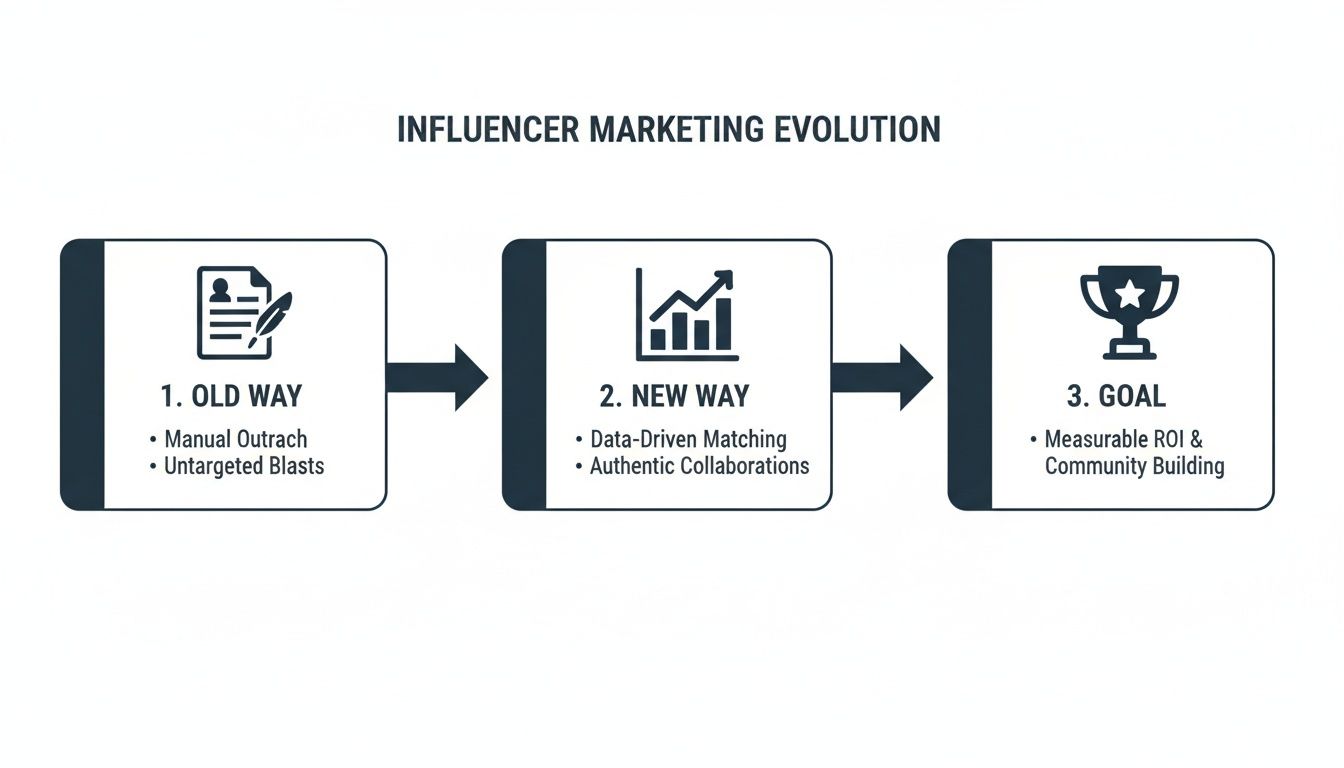
The image above really nails the shift from loose, handshake-style agreements to precise, data-backed campaigns that achieve tangible results. The main takeaway? Modern campaigns are built on a foundation of solid data, not just good vibes.
Moving Beyond Vanity Metrics
Likes and comments feel good, but they don't keep the lights on. We call these vanity metrics for a reason—they look impressive on the surface but don't tell you much about your actual business performance. Real success is measured by actions that directly contribute to your bottom line.
Forget about chasing huge follower counts. Instead, zero in on key performance indicators (KPIs) that signal genuine guest interest and a real intent to book or visit. This is where a dedicated platform like REACH Influencers becomes a game-changer, giving you a live dashboard to track the metrics that truly matter. For example, a REACH Influencers client, a boutique hotel in Miami, shifted focus from influencers with 1M+ followers to micro-influencers specializing in "luxury weekend getaways." Their engagement rate soared by 300%, and direct bookings from the campaign generated a 5:1 ROI in just three months.
A campaign that gets 1,000 likes is a fleeting moment. A campaign that gets 10 direct bookings is a proven revenue driver. Always build your strategy around the latter.
Tying Goals to Tangible KPIs
To run a campaign that works, every single goal needs to be paired with specific, measurable KPIs. This creates a clear framework for judging success and tells you exactly what’s working and what needs tweaking.
Here are some of the most common goals I see in hospitality and the KPIs we use to track them:
-
Goal: Increase Direct Bookings
- KPIs: The number of bookings made with an influencer-specific promo code is your gold standard. Beyond that, track the click-through rate (CTR) on unique tracking links (UTMs) in their bio or stories. Finally, calculate the overall booking conversion rate from all the traffic they send your way.
-
Goal: Boost Brand Awareness in a New Market
- KPIs: Measure the campaign's total reach and impressions, but filter it for your target geographic area. See how you stack up against local competitors by tracking your share of voice (brand mentions). And, of course, watch for a jump in follower growth from that specific city or region.
-
Goal: Generate High-Quality UGC
- KPIs: This one is straightforward: count the number of high-res photos and videos you receive that fit your brand aesthetic. Also, keep an eye on how many people are saving or sharing the influencer’s content—it’s a great sign of quality. When you repurpose their content, measure its engagement rate on your own channels.
-
Goal: Drive Restaurant Reservations
- KPIs: Track reservations made with a special code word the influencer shares. Monitor clicks on your "Reserve a Table" link. You can also count how many diners show up and redeem an influencer-specific offer, like a complimentary glass of prosecco.
By setting these clear benchmarks right from the start, you build accountability and real measurement into your campaign. You'll know exactly how your investment is performing, which helps you fine-tune your approach and prove the value of your work.
For a deeper look at this, check out our guide on the most important influencer marketing KPIs. This kind of precision is what separates a casual collaboration from a strategic, revenue-generating partnership.
How to Find and Vet the Right Influencer Partners
Your entire campaign hinges on this one thing: finding the right creator. A partnership with the wrong influencer isn't just a missed opportunity; it can actively water down your brand message and burn through your budget. The trick is to look past simple follower counts and find authentic storytellers whose audience is a mirror image of your ideal guest.
Think about it. The perfect partner for a sleek, luxury hotel in the heart of the city is worlds away from the ideal creator for a family-friendly beach resort. A winning influencer marketing for hospitality brands strategy is built on this simple truth of audience alignment. It’s never about finding the biggest voice, but the one that resonates the most.

Different Tiers of Influencers for Hospitality
The influencer world isn't a monolith. Creators are usually grouped by their audience size, and each tier brings something different to the table for a hospitality brand.
-
Nano-Influencers (1K-10K Followers): Don’t underestimate them. These creators often have sky-high engagement rates and a deep, trust-based connection with their hyper-local or niche communities. They are absolute gold for promoting a new restaurant opening to locals or highlighting a hotel's weekend spa package to residents in a neighboring city.
-
Micro-Influencers (10K-100K Followers): This is often the sweet spot for hospitality. You get a powerful mix of solid reach and authentic engagement. They tend to focus on specific interests—think sustainable travel, culinary tourism, or solo female travel—and their recommendations carry serious weight with their dedicated followers.
-
Macro-Influencers (100K-1M Followers): When you need to make a big splash, macro-influencers are your go-to. Their broad reach can put your property on the map for a national or even international audience, making them perfect for a grand opening or launching in a competitive new market.
Don't get distracted by follower counts. A nano-influencer with a highly engaged local following can drive more real-world restaurant bookings than a macro-influencer whose audience is spread thinly across the globe.
A Practical Guide to Vetting Your Potential Partners
Once you've got a shortlist of potential creators, the real work begins. Vetting isn't optional—it requires a deep dive into their analytics, content history, and audience vibe. Honestly, sifting through hundreds of profiles by hand is a massive time sink, which is where platforms like REACH Influencers become indispensable. The platform’s discovery tools let you instantly filter creators by the criteria that actually matter.
You can zero in on influencers based on their location, their audience's demographics (age, gender, location), and specific niches like 'luxury travel' or 'family-friendly resorts.' This helps you find the perfect match for your brand’s unique story in a fraction of the time.
Here’s my checklist for vetting every potential partner:
1. Dig into Audience Demographics
Does their audience actually live where your target guests live? Do their age and interests line up with your ideal customer? A creator’s media kit or analytics from a platform like REACH will give you this data. It’s completely pointless to partner with a US-based travel influencer if your goal is to attract European visitors.
2. Analyze the Engagement Rate (The Real Way)
Look beyond the likes. A healthy engagement rate (comments, shares, saves) of 2-3% or higher is a good sign, but the real story is in the comments. Are they generic ("Nice photo!") or are people asking specific questions about the experience? Genuine conversations are the hallmark of real influence.
3. Check for Content Quality and Brand Alignment
Scroll through their last 20-30 posts. Does their visual style match your brand’s aesthetic? Is their tone of voice authentic and trustworthy? You're looking for high-quality photography and videography that you would be proud to feature on your own channels.
4. Review Past Brand Collaborations
See who they've worked with before. Are they partnering with brands that align with yours? A big red flag is frequent collaborations with competing hotels in the same city, which can make their recommendation feel less genuine. If you're a boutique hotel, a partner who primarily promotes massive, all-inclusive chains probably isn't the right fit.
Finding creators in your own backyard can be especially powerful. For a closer look, learn more about our tools to find local influencers who can drive immediate foot traffic. This methodical approach ensures your partnerships are strategic, authentic, and set up for success from day one.
Designing Hospitality Influencer Campaigns That Convert
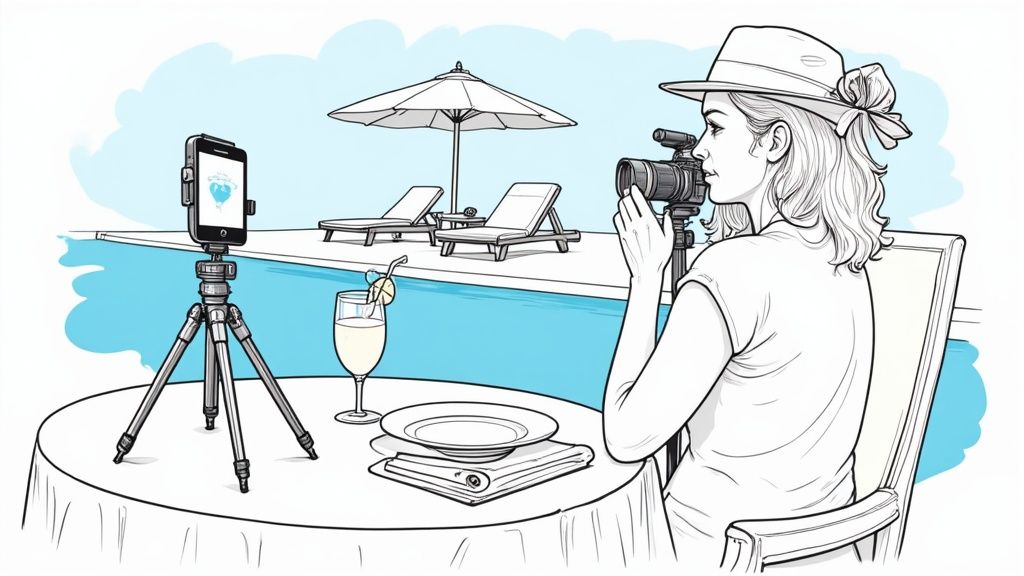
The classic "hosted stay" campaign is a fine starting point, but let's be honest, it’s just the tip of the iceberg. If you really want to cut through the noise, your influencer marketing for hospitality brands has to be more creative, more engaging, and frankly, more memorable. It's time to move past basic room tours and start building unique, experience-driven concepts that turn a creator's audience into your next guests.
The best campaigns I've ever seen come from true co-creation—that sweet spot where your brand goals meet a creator's authentic voice. Instead of just handing over a room key and a list of hashtags, think of it as a collaborative storytelling project. The real goal is to work together to craft a narrative that feels genuinely valuable to their followers, making your property the natural hero of their story.
A big piece of this puzzle is understanding how to create converting user-generated content (UGC). This knowledge is your secret weapon, helping you guide creators toward content that doesn't just look pretty but actually inspires people to book.
Beyond the Hosted Stay: Creative Campaign Concepts
A one-size-fits-all approach is a recipe for forgettable content. Your campaign concept should be built around what you're trying to achieve, whether that's filling your restaurant on a quiet Tuesday night or getting locals excited about your new spa packages.
Here are a few proven ideas that drive real engagement and bookings:
- The Food-Focused Activation: Don't just show them the restaurant; let them live the culinary experience. Bring in a food blogger for a behind-the-scenes kitchen tour with your chef, then treat them to a full tasting menu. Imagine the content: a "Day in the Life of a Chef" Reel or a detailed blog post that makes mouths water with every course.
- The Local's Guide to Your City: This one is brilliant for attracting travelers who want an authentic trip. Partner with local nano-influencers to create a guide to the best hidden gems around your hotel. This instantly positions your property as the ideal home base for exploring the city like a local, not a tourist.
- The On-Site Experience Deep Dive: Got a world-class spa, a killer mixology class, or sunrise yoga by the pool? Build a whole campaign around it. A wellness influencer could document their entire spa journey, from the signature massage to the blissed-out feeling in the relaxation lounge.
The best campaigns don’t just show what your property has; they show what a guest can feel and experience there. It's about selling the emotion, not just the room.
Harnessing the Power of Short-Form Video
A beautiful photo is great, but short-form video on platforms like TikTok and Instagram Reels is where the magic happens. Video captures the energy, the atmosphere, and the entire vibe of your property in a way a static image just can't. By 2025, short-form video has come to dominate how hospitality brands drive both engagement and direct bookings. Industry studies show it pulls in 2 to 4 times more engagement and converts far better than static posts.
The key is to guide, not dictate, in your creative brief. Instead of asking for a generic video tour, propose a specific, engaging story.
Try these concepts:
- "Get Ready With Me" for a Night Out: Have a lifestyle influencer show their process of getting ready in one of your beautiful suites before they head down to your hotel's bar or out to a local event.
- "A Perfect Day at [Your Hotel Name]": This uses quick, energetic cuts to showcase a full day's experience—waking up to a stunning view, enjoying room service, lounging by the pool, and ending with dinner at your signature restaurant.
- "Hidden Gems" Tour: Ask a creator to find and feature the unique, lesser-known spots around your property. Maybe it's a quiet garden nook, a fascinating piece of local art in the lobby, or the absolute best seat at the bar.
These ideas give creators a narrative to work with, which gives them the freedom to produce content that feels completely genuine to their style. Platforms like REACH Influencers can be a huge help here, allowing you to manage creative briefs and track content approvals to ensure the final product is perfectly on-brand without sacrificing that crucial authenticity.
Briefs and Contracts: Setting Your Collaboration Up for Success
You’ve found the perfect creator. Now what? It's tempting to jump right into the fun stuff, but a casual DM and a handshake just won't cut it for a professional partnership. This is where you lay the foundation for a smooth, successful campaign.
To protect your brand and make sure everyone is crystal clear on expectations, you need two key documents: a solid influencer agreement and a detailed creative brief. These aren't just corporate formalities; they're your playbook for a great collaboration. A strong contract prevents awkward conversations about payment or content rights down the line, while a great brief is what sparks amazing content that actually hits your goals. Honestly, skipping this step is one of the biggest—and most avoidable—mistakes I see hospitality brands make.
Building an Ironclad Influencer Agreement
Think of the influencer agreement as the legal backbone of your partnership. It's a binding contract that clearly outlines who is responsible for what, leaving no room for confusion. Let’s be real, juggling legal docs can get messy, which is why platforms like REACH Influencers are so helpful. They give you one central place to manage contracts so nothing gets buried in an endless email thread.
At a minimum, your agreement needs to cover these bases:
- Content Deliverables: Get super specific here. Don't just say "some posts." Spell it out: 2 Instagram Reels, 5 Instagram Stories with a link sticker, 1 blog post. The more detail, the better.
- Content Usage Rights: This is huge. How and where can you use the influencer’s content after they post it? Can you feature their gorgeous photos on your website or use them in paid social ads? Define everything, including how long you have those rights (e.g., for one year).
- Exclusivity Clause: This is your competitive edge. An exclusivity clause prevents the creator from working with your direct competitors—say, other boutique hotels in your city—for a set period of time around your campaign.
- FTC Disclosure Guidelines: It's the law. Your contract must require the creator to clearly label all sponsored content with hashtags like #ad or #sponsored to comply with Federal Trade Commission rules.
- Payment Terms: Talk about the money. Outline the total compensation, when they get paid (e.g., 50% upfront, 50% on completion), and how you'll be paying them.
Writing a Creative Brief That Inspires, Not Restricts
If the contract is the "what," the creative brief is the "why" and "how." This is where you bring the campaign's story to life. The trick is to provide clear direction without killing the creative spark that made you want to work with them in the first place. A great brief is a guide, not a script.
Your brief should feel like a collaborative starting point, not a strict set of rules. Give the creator the key story beats and brand messages, then trust them to tell that story in a way that will resonate with their audience.
Here’s what I always include in a brief that gets results:
- Campaign Overview: Start with the big picture. What are we trying to achieve? Is the goal to pack the house for your new brunch menu, drive bookings for a summer spa package, or just get your hotel on the radar of a younger crowd?
- Key Messages: What are the 2-3 absolute most important things you want people to remember? Maybe it's your hotel’s commitment to sustainability, the unique history of the property, or the farm-to-table ethos of your restaurant. Keep it simple and focused.
- Target Audience: Who are we talking to? A quick description of the ideal guest helps the influencer find the right tone and angle to make a genuine connection.
- Content Do's and Don'ts: Think of these as friendly guardrails. For example: Do capture the incredible morning light in the lobby. Don't use that oversaturated photo filter that clashes with our brand's vibe.
- Call to Action (CTA): Be direct. Tell the influencer exactly what you want their followers to do next. Should they swipe up to book, use a special promo code, or enter a giveaway? A clear CTA makes a world of difference.
How to Measure ROI for Influencer Marketing for Hospitality Brands
Alright, the content is live and looking great. But now comes the part that really matters: proving it was all worth it. How do you walk into a meeting and show that your influencer program is a powerful revenue generator, not just another line item on the marketing budget?
It all comes down to tracking the right things, measuring them clearly, and connecting the dots back to real business results. This is how you shift the conversation from "marketing expense" to "investment."

The goal here is simple: connect every dollar you spend to a tangible outcome. We have to move past vanity metrics like 'likes' and focus on the data that truly impacts the bottom line. It's not just a good idea; it's essential.
Tracking Direct Bookings and Revenue
The most powerful way to show ROI is by drawing a straight line from an influencer's post to your booking engine. You need to know, without a doubt, that their content drove actual revenue.
Here are my go-to methods for making that happen:
- Unique Promo Codes: This is the classic for a reason. Give each influencer their own discount code, like "CHLOE15" or "TRAVELTOM10". It’s simple, clean, and gives you undeniable proof of who drove which booking.
- UTM-Tagged URLs: Get friendly with UTM parameters. By creating a custom link for each influencer to use in their bio or Stories, you can see exactly how much traffic and how many direct conversions came from their specific post right inside your analytics.
- Affiliate Links: If you prefer a performance-based setup, affiliate links are perfect. Creators earn a commission on every booking they generate, which ties their compensation directly to the revenue they bring in.
Using these tactics gives you the hard data you need to calculate your return. If you want to get more granular on the financial side of things, it’s a good idea to learn how to calculate marketing ROI in detail.
Calculating Earned Media Value
Beyond direct bookings, influencer campaigns create a massive amount of brand awareness and credibility. How do you put a number on that? That’s where Earned Media Value (EMV) comes in.
EMV is a metric that estimates what it would have cost you to get the same amount of exposure through traditional paid ads. It helps quantify the "buzz" your campaign generated.
EMV helps tell the whole story. It bridges the gap between the hard booking numbers and the massive branding impact, giving stakeholders a complete picture of what you've achieved.
Many influencer platforms, like REACH Influencers, can calculate this for you automatically. They analyze the reach, engagement, and impressions of every post to assign a dollar value, which is incredibly useful for demonstrating the full scope of your ROI.
Presenting a Complete Performance Picture
When it's time to report back, a mix of hard and soft metrics is your best bet. Industry data from 2025 shows that influencer content can deliver up to 11x better ROI than many traditional digital marketing tactics.
In fact, it’s not uncommon for a well-run hospitality influencer program to generate around $6.50 for every $1 invested.
To help you get started, here's a look at the key metrics you should be tracking to build a compelling ROI report.
Key Metrics for Measuring Hospitality Influencer ROI
| Metric | What It Measures | Why It's Important |
|---|---|---|
| Direct Bookings/Revenue | The total revenue generated from unique promo codes, UTM links, or affiliate links. | This is the most direct proof of ROI, linking campaign spend directly to income. |
| Cost Per Acquisition (CPA) | The total campaign cost divided by the number of new bookings. | Shows how efficiently your influencer spend is acquiring new guests. |
| Earned Media Value (EMV) | The monetary value of the organic reach and engagement generated. | Quantifies the brand awareness and "buzz" value, beyond just direct sales. |
| Engagement Rate | The percentage of an influencer's audience that liked, commented, or shared the content. | Indicates how well the content resonated with the target audience. High engagement often precedes conversions. |
| Website Traffic/Clicks | The number of people who clicked through to your website from the influencer's content. | Measures the campaign's ability to drive interest and direct potential customers to your booking platform. |
By combining hard revenue data from your tracking methods with powerful metrics like EMV, you build an undeniable case for your program's success. It’s this comprehensive approach that secures future budgets and proves your impact.
For a deeper dive, our guide on how to measure influencer engagement and ROI covers even more advanced strategies.
Frequently Asked Questions About Hospitality Influencer Marketing
As you start piecing together your influencer strategy, you’re going to hit some practical questions. It happens every time. This section is all about giving you straight answers to the common hurdles and "what-if" scenarios that trip up hospitality managers and marketers.
Getting these details sorted out upfront is the secret to a campaign that runs smoothly instead of giving you headaches. We’ll cover everything from how to set a realistic budget to the finer points of negotiating with creators.
How Much Should We Actually Budget for Influencer Marketing?
I get this question all the time, and the honest answer is: it depends. There’s no magic number. A campaign to hype up a new menu with a few local nano-influencers might only cost a few hundred dollars on top of the comped meals. On the other hand, if you're bringing in a macro-travel influencer for a full resort takeover, you could easily be looking at tens of thousands.
A good way to frame it is to think in terms of value, not just cost. A creator with a smaller, but highly-engaged, niche audience that perfectly mirrors your ideal guest is often a much smarter investment than someone with a huge, generic following. As a general rule of thumb, many brands find a sweet spot by dedicating 10% to 20% of their total marketing budget to creator partnerships.
Do We Really Have to Pay Influencers for Collaborations?
The days of just "gifting" a free stay or meal in exchange for a post are mostly behind us. The creator world has professionalized, and for good reason. Top-tier creators run their channels like a business. If you’re asking for high-quality, dedicated content that takes real effort—like polished videos or a multi-day shoot—you should absolutely expect to pay a fee.
That said, a contra deal (swapping your services for their content) can still be a great option, especially with smaller or up-and-coming creators. This works best when the experience you're offering has a genuinely high value. The key is to be crystal clear about compensation right from the first email. No surprises.
Think of it this way: You're not just paying for a post. You're investing in a creator's professional skills, their carefully built audience, and the quality content they produce. Adopting this mindset is the foundation for building respectful, long-term partnerships that actually work.
How Can We See if an Influencer is Actually Driving Bookings?
This is the million-dollar question. Attribution is everything. The most reliable way to connect the dots is by giving each influencer a unique tool to share with their audience.
Here are the go-to methods:
- Unique Promo Codes: Give each creator a special discount code (like "SOPHIA15") that your booking system can track.
- UTM-Tagged Links: Create custom URLs for them to pop in their bio or link stickers. This lets you see the exact traffic and conversions they send your way in your analytics dashboard.
- Dedicated Landing Pages: For bigger partnerships, a simple, custom landing page for an influencer's specific offer creates a fantastic user experience and keeps your tracking squeaky clean.
And the data shows this isn't just wishful thinking. By 2025, analyses predict that nearly one-third of consumers will have booked a vacation after seeing influencer content. Right now, Instagram alone is responsible for driving bookings for about 61% of travelers who see a post and decide to act on it. You can dive into more hospitality marketing statistics here.
The landscape of influencer marketing for hospitality brands has evolved from simple exposure to a performance-driven channel essential for growth. By focusing on authentic partnerships, setting clear, data-backed goals, and meticulously tracking your ROI, you can transform creator collaborations from a marketing expense into your most powerful booking engine. The key is to treat it with the strategic rigor it deserves, leveraging platforms and frameworks that ensure every campaign contributes directly to your bottom line.
Ready to turn influencer partnerships into your most powerful booking channel? REACH Influencers is the top influencer marketing platform designed to give you the tools you need to discover the perfect creators, manage campaigns efficiently, and track your ROI with precision.