 Skip to content


Meta description: Influencer public relations blends creator partnerships with PR strategy to build trust, lift share of voice, and prove ROI through clicks, conversions, and earned media metrics.
Public relations changed when brands stopped relying on media coverage alone to shape reputation. In 2025, 63.8% of PR campaigns worldwide included influencer collaboration as a core strategy, according to PRLab’s public relations statistics roundup. That figure tells you something bigger than channel mix. It shows that influencer public relations has moved from experimental to operational.
Public relations teams already feel the shift. Journalists are harder to reach, audiences are split across platforms, and brand messages rarely travel far on a press release alone. But trusted creators can carry a narrative into communities that traditional PR often struggles to reach. That doesn’t mean media relations is obsolete. It means modern PR now works across both editorial trust and creator trust.
The operational problem is where many teams stall. Influencer public relations creates more moving parts than a standard media campaign. You need discovery, vetting, outreach, approvals, contracts, compliance, link tracking, and reporting that makes sense to leadership. If those pieces stay disconnected, the work becomes hard to scale and even harder to defend.
The New Reality of Public Relations
Influencer public relations is now part of how brands build reputation, not a side tactic reserved for product seeding or short-term buzz. The old model treated PR as coverage generation and influencer work as something separate, often owned by another team. That split no longer reflects how audiences consume information.
People don't move through a clean funnel anymore. They see a founder quoted in an article, then hear a creator explain the product, then click a link from social, then search for reviews. PR now has to manage that full chain of trust.
Traditional visibility is no longer enough
A press hit can still matter. So can a feature in trade media. But visibility without resonance doesn't do much. If the audience doesn't trust the messenger or see the message repeated in the places they already spend time, the story fades quickly.
Influencer public relations works because it gives PR a distribution layer built on familiarity. The strongest creator partnerships don't feel like borrowed reach. They feel like contextual endorsement inside a community that already shares interests, language, and expectations.
Public relations used to ask, “Can we get coverage?” Modern PR has to ask, “Who will carry this story in a way people believe?”
Why execution got more complex
This shift created a practical burden for in-house teams and agencies. A creator program touches brand, social, legal, PR, paid, and analytics. If each team tracks success differently, reporting breaks down. One team talks about mentions, another talks about engagement, another talks about clicks, and leadership still asks the obvious question: what did this do for the business?
That’s why influencer public relations needs a more unified operating model than traditional media outreach. It has to connect message delivery, creator fit, audience response, and commercial outcomes in one system. Without that, teams end up with activity reports instead of strategic proof.
What Is Influencer Public Relations
Influencer public relations sits between media relations and influencer marketing, but it isn't just a blend of the two. It’s a reputation-building discipline that uses creators as trusted third-party voices to shape awareness, narrative, and perception.
A useful way to think about it is this: traditional ads use a spokesperson, while influencer public relations works more like a diplomat. The creator isn't just repeating a script. They’re translating a brand story for a specific audience in a voice that audience already accepts.
Where it fits in the communications mix
The category matters because the market around it is now too large to dismiss as a niche tactic. The global influencer marketing market reached $32.55 to $33 billion in 2025, according to PR Newswire coverage of 2025 influencer marketing data. That scale reflects budget commitment, not just curiosity.
Influencer public relations takes that market energy and applies it to classic PR outcomes:
- Narrative shaping through trusted creator voices
- Reputation support in communities that care about peer recommendations
- Message reinforcement across social, search, and editorial channels
- Earned momentum when creator content triggers discussion, sharing, and follow-on coverage
If you want a broader primer on category basics, this overview of what influencer marketing is provides useful background.
Influencer PR compared with adjacent disciplines
| Aspect | Influencer Public Relations | Traditional Public Relations | Influencer Marketing |
|---|---|---|---|
| Primary goal | Build trust, shape perception, expand brand voice | Secure editorial credibility and manage reputation | Drive awareness or sales through creator promotion |
| Main partners | Creators with trusted niche audiences | Journalists, editors, producers, analysts | Creators, talent managers, paid social teams |
| Core value | Relational trust and message translation | Institutional trust and editorial validation | Attention and campaign performance |
| Relationship style | Ongoing partnerships and selective alignment | Media relationships and story pitching | Often campaign-based, sometimes transactional |
| Typical outputs | Reviews, commentary, event participation, social proof, creator-led storytelling | Articles, interviews, features, mentions | Sponsored posts, affiliate pushes, campaign content |
| Measurement focus | Share of voice, sentiment, earned media, clicks, conversions | Coverage quality, message pull-through, reputation indicators | Reach, engagement, traffic, conversions |
What it is not
Influencer public relations isn't just sending free product and hoping for posts. It also isn't the same as running paid creator ads at volume. The strongest programs are selective. They align creator voice, audience trust, brand narrative, and reporting discipline.
That’s the distinction many teams miss. If all you buy is attention, you’re doing sponsorship. If you build credible advocacy around a brand story, you’re doing influencer public relations.
Why Influencer PR Is Essential for Brand Trust
Trust is the reason influencer public relations moved into the center of modern communications. Media fragmentation changed how people discover brands, but trust determines whether discovery turns into action. A brand can appear everywhere and still fail if the message lands as self-promotion.
Creator partnerships help because they add a human layer to brand communication. The audience isn't just hearing what a company says about itself. They're seeing how a person they already follow interprets, tests, uses, or challenges that message in public.
Share of voice is now a practical KPI
One of the strongest reasons to treat influencer public relations as a PR function is its impact on share of voice. According to Prowly’s guide to influencer PR, well-executed campaigns often produce 15% to 25% increases in brand share of voice in competitive sectors, and a 10% share of voice uplift correlates with 5% to 7% sales growth.
Those figures matter because share of voice gives PR teams a language leadership already understands. It shifts the conversation from “How many posts did we get?” to “Did we own more of the category conversation after this campaign?”
For teams that want a clean definition of earned impact, this guide on earned media is useful context.
Practical rule: If a creator campaign doesn't change the quality or volume of brand conversation, it may have generated content, but it didn't do much PR work.
Why authenticity beats raw audience size
Influencer public relations rewards fit over scale. A creator with a highly aligned audience and a credible voice can improve trust more effectively than a much larger personality with weak category relevance. That's because PR outcomes depend on message credibility, not just impressions.
What tends to work:
- Niche alignment: The creator already speaks to the exact community the brand wants to influence.
- Audience authenticity: Real interaction matters more than a large but passive following.
- Contextual storytelling: The brand appears in a believable setting, not a forced insertion.
- Message discipline: The creator keeps their own voice while staying close to the campaign narrative.
What tends to fail:
- Celebrity-first selection with little topical relevance
- Over-scripted briefs that flatten the creator’s voice
- One-off posts with no relationship depth
- Reporting that stops at likes and ignores sentiment, traffic, or conversion behavior
Trust lives in the overlap
Traditional PR still brings editorial weight. Influencer public relations adds social proof and repeated exposure in places people spend time. The overlap is where brand trust compounds. A feature, an expert quote, and creator commentary around the same narrative give audiences multiple reasons to believe the message.
That’s why this work now belongs inside communications strategy, not at the edge of it. If PR owns reputation, it has to own the channels where reputation is actively formed.
Building Your Influencer Public Relations Framework
Most weak campaigns fail before outreach begins. The usual problem isn't a bad creator list. It's a vague strategy. Teams know they want “awareness” or “buzz,” but they haven't defined what the campaign is supposed to change, who needs to hear the message, or what story the creators should help carry.
A strong influencer public relations framework starts with planning decisions that make execution easier later.
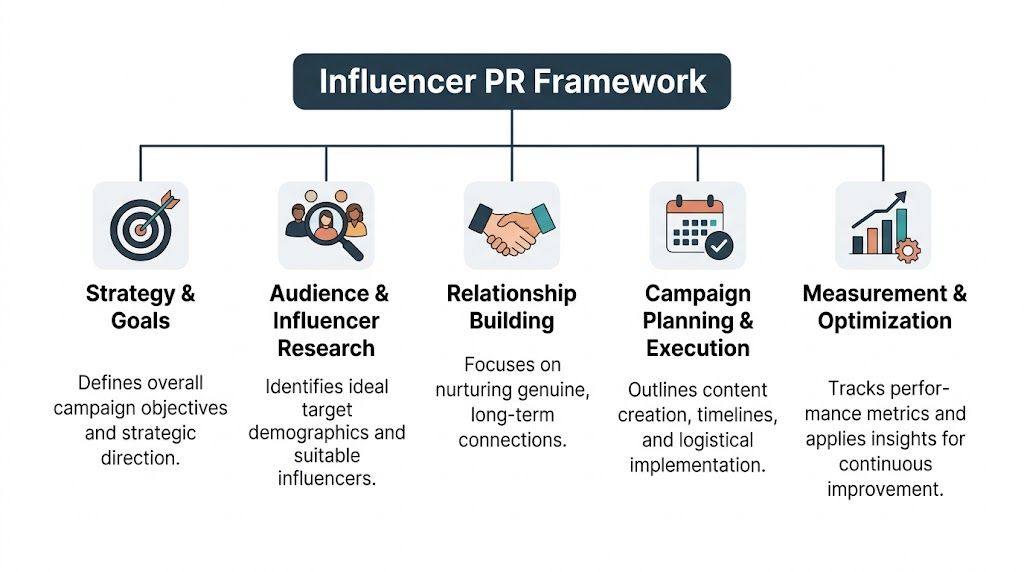
Start with the communication objective
The first question isn't “Which influencers should we use?” It's “What PR outcome are we trying to create?” A launch campaign needs one kind of creator mix. A reputation repair effort needs another. A founder visibility campaign may call for expert voices rather than lifestyle creators.
Useful PR-oriented goals include:
- Narrative adoption: You want a new brand message repeated consistently in-market.
- Audience trust building: You need validation from people the audience already listens to.
- Category visibility: You want the brand mentioned alongside competitors more often.
- Event amplification: You need creator content to extend the life of a press moment.
- Proof generation: You want clicks, sign-ups, or sales tied back to communications work.
Define audience and creator fit together
Many teams still brief audience and creator selection as separate tasks. That creates mismatches. If you define the audience precisely, your creator criteria become obvious. You can evaluate tone, platform fit, audience demographics, content style, and whether the creator can explain the brand in language the audience trusts.
The same logic applies to PR packages and product mailers. Sending product without a strategic fit usually produces clutter, not coverage. This explainer on what PR package means is helpful if your team is still treating gifting as a strategy instead of a tactic.
The best creator shortlist usually gets smaller as the brief gets sharper.
Build the narrative before the outreach
Creators need room to speak naturally, but they also need a story to carry. Give them a narrative frame, not a script. Explain the brand tension, the product relevance, and the audience takeaway. Then show where flexibility exists.
For teams writing formal launch materials alongside creator activations, this influencer press release writing guide is a useful resource. It helps align media-facing and creator-facing messaging so the campaign doesn't fragment across channels.
A practical framework usually includes these documents:
- Campaign objective brief with the PR outcome stated clearly
- Audience definition that goes beyond age and location
- Narrative guide with key messages, proof points, and red lines
- Creator criteria covering voice, audience quality, and content style
- Measurement plan that connects communications goals to business reporting
Framework first. Outreach second. That order saves time, lowers revisions, and produces better creator partnerships.
Your Influencer PR Workflow from Discovery to Reporting
Execution is where influencer public relations becomes either scalable or exhausting. Teams often don't struggle because they lack ideas. They struggle because the workflow lives across spreadsheets, inboxes, chat threads, payment tools, and disconnected analytics. That fragmentation slows campaigns and makes reporting messy.
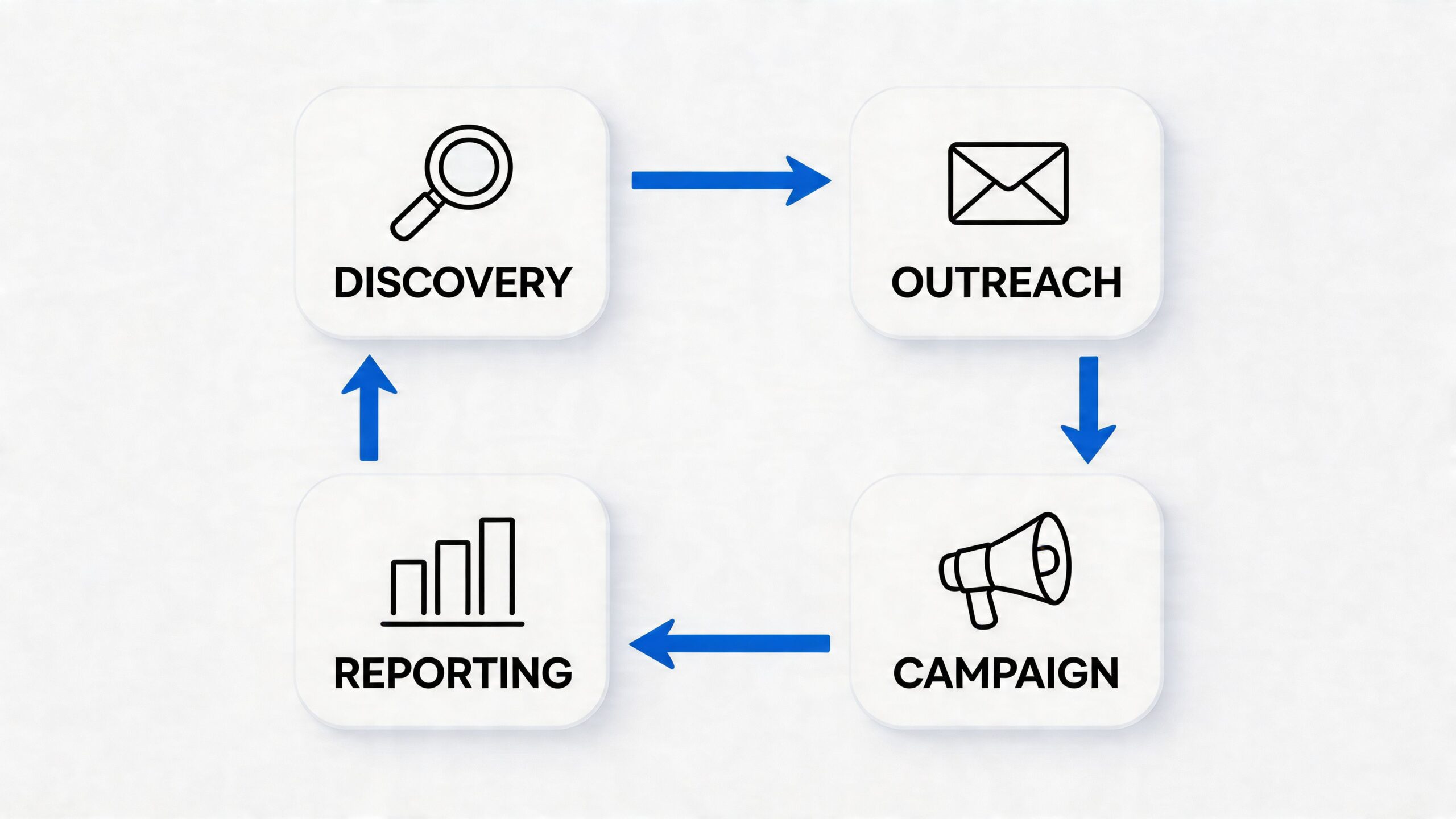
That operational drag hits agencies especially hard. Many agencies are underresourced, with pre-tax margins as low as 3.6%, as noted in Meegle’s write-up on public relations for influencers. Thin margins make manual campaign administration expensive, even before you consider reporting expectations from clients.
Discovery and vetting
Start with relevance, not popularity. The right shortlist reflects audience fit, content quality, brand safety, and whether the creator can credibly speak about the category. Look closely at comment quality, posting consistency, and how the audience responds when the creator recommends a product.
A disciplined vetting process should include:
- Audience match: Do followers resemble the people the campaign needs to influence?
- Content compatibility: Does the creator already produce the format your message needs?
- Reputation check: Does anything in the feed create unnecessary brand risk?
- Authenticity review: Are interactions believable and consistent with the creator’s niche?
One of the easiest mistakes here is overvaluing follower count. In PR work, a smaller creator with genuine authority often delivers stronger narrative adoption than a large account with weak relevance.
Outreach and relationship management
Bad outreach reads like procurement. Good outreach reads like partnership. The difference is whether the brand shows that it understands the creator’s audience and why the collaboration makes sense.
Personalized outreach usually includes:
- A short reason the creator was selected
- A clear explanation of the campaign story
- Enough detail to show seriousness, not so much that it feels like legal copy
- A practical next step with timeline expectations
Keep outreach human. Creators can spot mass sends immediately, and experienced ones ignore them.
Later in the process, teams also need a place to manage revisions, approvals, deliverables, usage rights, contracts, and payment status. At this stage, integrated systems become operationally useful, especially for agencies handling multiple accounts. Teams evaluating process setup often look for workflows built for agency influencer campaign management.
Campaign coordination and compliance
Once creators are signed, PR teams need structure without over-controlling the output. That means shared timelines, agreed talking points, disclosure expectations, and a review process that respects platform speed. Delayed approvals kill momentum. So do briefs that leave major questions unanswered.
A working campaign process needs:
- Clear deliverables with formats, deadlines, and review steps
- Usage rights terms documented before posting
- Disclosure guidance that matches local requirements
- Asset organization so nobody is chasing links in email threads
- Live monitoring to catch issues early
This walkthrough offers a useful visual reference for the operational side of campaign management:
The campaigns that feel effortless to outsiders usually run on strict internal process.
Reporting and stakeholder communication
Reporting is where influencer public relations often breaks down. Teams collect screenshots, summarize impressions, and call it done. That doesn't satisfy a client, a finance lead, or a brand director trying to justify budget.
A better workflow closes the loop with reporting that combines PR and performance signals. Show what creators posted, how audiences responded, what traffic arrived, which messages landed, and where the campaign influenced business outcomes. If you can't tell that story quickly, the issue usually isn't campaign value. It's workflow design.
How to Measure Influencer Public Relations ROI
ROI is the question that decides whether influencer public relations becomes a line item or a strategy. If the team can't prove value beyond engagement screenshots, budget conversations get defensive fast. The fix isn't to abandon PR metrics. It's to connect them with performance metrics in one reporting model.
That means tracking influence at multiple levels. Some outcomes show up as visibility and sentiment. Others appear as site activity, lead quality, or direct conversion behavior. Good measurement respects both.
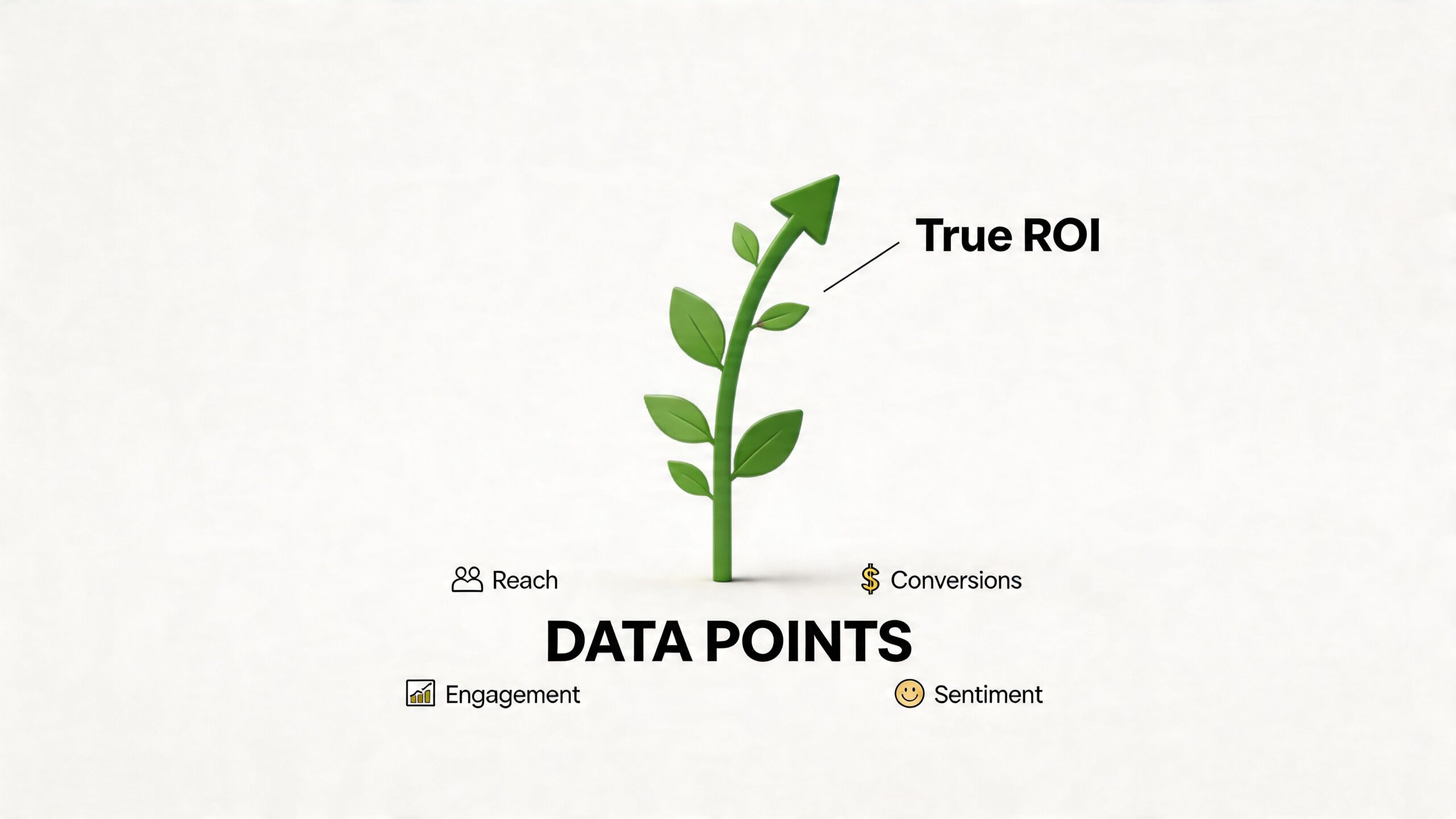
Start with benchmarks that mean something
One useful benchmark comes from campaign engagement quality. In influencer PR campaigns, an engagement rate of at least 3% serves as a critical benchmark for success, according to Finesse Group’s guide to PR agency influencer relations. That matters because engagement is one of the earliest signals that the message resonated rather than just being seen.
But benchmarking only one metric creates blind spots. A campaign can clear an engagement threshold and still underperform commercially if the audience wasn't the right fit or the message didn't drive action.
A balanced scorecard usually includes:
- Engagement quality: Comments, shares, saves, and discussion depth
- Earned media value: A proxy for the value of exposure generated
- Traffic behavior: Clicks, landing page visits, and on-site actions
- Conversion signals: Sign-ups, purchases, downloads, or booked demos
- Brand outcomes: Sentiment, share of voice, and message pull-through
Bridge PR metrics with performance analytics
PR teams have long used measures like earned media value, share of voice, and sentiment to judge campaign quality. Those still matter. The problem starts when those metrics live in one report while clicks and conversions live in another. Leadership then sees two incomplete stories instead of one complete one.
A stronger method is to map creator activity to outcomes across the funnel:
| Measurement layer | What to track | Why it matters |
|---|---|---|
| Visibility | Mentions, reach context, earned media value | Shows whether the campaign expanded awareness |
| Perception | Sentiment, message alignment, brand conversation quality | Shows whether visibility improved reputation |
| Action | Clicks, code usage, UTM traffic, form fills | Shows whether audiences responded |
| Outcome | Sales, qualified leads, repeat interest | Shows business impact |
If your team needs a practical framework for tying these pieces together, this guide on measuring influencer engagement and ROI covers the logic well.
What good reporting looks like
A strong ROI report doesn't bury stakeholders in dashboards. It answers a short set of business questions clearly.
Use this sequence:
- State the objective. Was the goal trust, launch visibility, category conversation, or conversion support?
- Show creator fit. Explain why these voices were chosen.
- Report audience response. Focus on quality, not vanity.
- Connect response to action. Show clicks, traffic, and conversion behavior where available.
- Interpret the result. Explain what worked, what didn't, and what should change next cycle.
If reporting can't explain why a campaign worked, the team won't know how to repeat it.
The biggest advance in influencer public relations isn't just creator access. It's measurement maturity. When teams combine earned metrics with click and conversion analytics, they stop arguing that influencer PR is hard to prove and start treating it like any other accountable growth function.
Influencer PR Examples in Action
The easiest way to understand influencer public relations is to look at how different teams use it for different communication goals. The mechanics change by industry, but the underlying logic stays consistent: credible voices carry the message farther than brand copy alone.
A D2C brand launch
A sustainable fashion brand launches a new capsule collection. Traditional PR secures a few style roundups, but the bigger goal is to make the launch feel culturally relevant inside communities that care about materials, fit, and repeat wear.
The team selects a small group of creators who already post thoughtful wardrobe content instead of chasing broad lifestyle reach. Each creator receives product, a concise narrative guide, and room to style the collection their own way. The brand tracks conversation quality, link clicks, and code use alongside earned discussion across social.
What works here is specificity. The campaign doesn't ask creators to announce a launch. It asks them to interpret why the product belongs in their audience’s routine.
A B2B SaaS thought leadership push
A software company wants more authority in a crowded category. It doesn't need glossy creator content. It needs respected operators, consultants, and niche industry voices who can discuss the problem space with credibility.
The PR team partners with expert creators on LinkedIn and podcast-adjacent channels. Instead of product demos alone, the campaign focuses on practical commentary, webinar participation, and opinion-led posts tied to a broader company narrative. The reporting mix includes registration sources, discussion quality, and whether the brand appears more often in relevant category conversations after the campaign.
This is influencer public relations at its most underused. In B2B, trusted voices often shape reputation long before a buyer speaks to sales.
An agency managing multiple clients
An agency running creator programs for several brands faces a different challenge: consistency. The client doesn't just want deliverables. They want organized workflows, clear approvals, and reports they can understand quickly.
The agency builds a repeatable process for creator vetting, outreach, contract handling, approvals, and live reporting. It presents clients with one clear view of performance rather than a pile of screenshots and exported spreadsheets. That improves trust in the agency itself, not just in the campaign.
The lesson across all three examples is simple. Influencer public relations works best when the team treats it as communications infrastructure, not content procurement.
Conclusion: Integrate Influencer PR Into Your Strategy
Influencer public relations is now part of the standard PR toolkit because it solves a real communications problem. Audiences trust people more than polished brand messaging, and brands need ways to measure that trust in terms leadership understands. The work only becomes defensible when strategy, workflow, and reporting stay connected.
That means setting sharper objectives, choosing creators for credibility rather than raw scale, and measuring both reputation impact and business response. Teams that do this well don't separate PR value from performance value. They report both together.
For broader industry perspective on how communications teams are adapting, PRWeek remains a useful publication to follow.
If you want to run influencer public relations with less manual work and clearer reporting, explore REACH. It gives brands, agencies, and creators one place to manage discovery, outreach, approvals, click tracking, analytics, payments, and white-labeled reporting so influencer PR is easier to scale and easier to prove.